Showing posts with label acts. Show all posts

Monday, April 20, 2026

The Restoration of the Jews according to Jeremiah 33, with Zechariah and Hebrews

"Behold, the days are coming, declares the Lord, when I will fulfill the promise I made to the house of Israel and the house of Judah. In those days and at that time I will cause a righteous branch to spring up for David, and He shall execute justice and righteousness in the land. In those days Judah will be saved and Jerusalem will dwell securely. And this is the name by which it will be called: 'The Lord is our righteousness.' for thus says the Lord: David shall never lack a man to sit on the throne of the house of Israel, and the Levitical priests shall never lack a man in My presence to offer burnt offerings, to burn grain offerings, and to make sacrifices forever." (Jeremiah 33:14-18) 

To my mind, this is an exhilarating passage, because it unites so many messianic themes. The Branch is an epithet used for the coming Messiah several times in Jeremiah, and points to the coming of Jesus, about 600 years after the historical events of the book. The prophet uses several confirmatory references that we know from the New Testament. First, the Branch will cause His people to bear the name "The Lord is our righteousness." This should cause any Christian to think immediately of the words of Paul in II Corinthians 5:21: "For our sake, He [the Father] made Him [Jesus] to be sin who knew no sin, so that, in Him, we might become the righteousness of God." Contrary to the claims of some dispensationalists, this proves that the future conversion of the Jews will occur on the same basis as the conversion of the Gentiles, by faith alone in Christ alone, so that His righteousness is imputed to the elect believer. There is no separate class of saved people among the Jews (Acts 15:11). They simply follow a different historical track to arrive at that same place. 

Furthermore, Jeremiah tells us that the Branch will fulfill a dual role, to fill the throne of David forever. "Once for all I have sworn by My holiness; I will not lie to David. His offspring shall endure forever, his throne as long as the sun before Me. Like the moon it shall be established forever, a faithful witness in the skies" (Psalm 89:35-37). The other is that He will sustain the work of the Levitical priests. We know that Jesus was of the tribe of Judah, not of Levi. However, the Epistle to the Hebrews addresses that question by telling us that Jesus's priesthood is not according to Levi, but according to the pattern of Melchizedek. "The one of whom these things are spoken belonged to another tribe, from which no one has ever served at the altar. For it is evident that out Lord was descended from Judah, and in connection with that tribe Moses said nothing about priests. This becomes even more evident when another priest arises in the likeness of Melchizedek, who has become a priest, not on the basis of a legal requirement concerning bodily descent, but by the power of an indestructible life. For it is witnessed of Him, 'You are a priest forever after the order of Melchizedek'" (Hebrews 7:13-17, quoting from Psalm 110:4; see also Hebrews 4:14-5:10). Together we have the Priest-King prophesied by Zechariah: "Behold the man whose name is the Branch, for he shall branch out from his place, and he shall build the temple of the Lord.It is he who shall build the temple of the Lord and shall bear royal honor, and shall sit and rule on his throne. An there shall be a priest on his throne, and the counsel of peace shall be between them both" (Zechariah 6:1-13, using Josiah the high priest as a type). 

There can be no doubt that that the restoration of Israel will come, not as the political event expected by dispensationalism, but as a Gospel event, founded upon Jesus Christ alone as savior. It won't be at the same time as Gentile believers, but it will be by exactly the same faith, atonement, and imputation of His righteousness alone.

Monday, April 13, 2026

The Restoration of the Jews in Jeremiah 30 and Romans 11

I have written before on the subject of the conversion of the Jews (here, here, and here), so this post will rehash some material from those earlier posts. However, it has been several years, so I feel a need to revisit the question, and from a different text. 

"Thus says the Lord: Behold, I will restore the fortunes of the tents of Jacob and have compassion on his dwellings; the city shall be rebuilt on its mound, and the palace shall stand where it used to be. Out of them shall come songs of thanksgiving, and the voices of those who celebrate. I will multiply them, and they shall not be few; I will make them honored, and they shall not be small. Their children shall be as they were of old, and their congregation shall be established before Me, and I will punish all who oppress them. Their prince shall be one of themselves; their ruler shall come out from their midst; I will make Him draw near, and He shall approach Me, for who would dare of himself to approach Me, declares the Lord?: And you shall be My people, and I will be your God" (Jeremiah 30:18-22). 

The first part of these verses could be taken to refer to the restoration of Judah after the exile in Babylon, the same events we see described in Ezra and Nehemiah. However, that is just a launching point, used typologically for events we have yet to see either in Israel or among the Jewish diaspora. 

While modern Jews are mostly secular, often even agnostic or atheist, the people described in this passage are expressing thanks and celebrating God, because they are a people who are established in faithfulness before their God. 

The description of their prince is especially amazing to me, because it is couched in the same language as the davidic, messianic prince. Compare the words of Deuteronomy 18:15: "The Lord your God will raise for you a prophet like me [I. e., Moses] from among you, from your brothers...," and its explicit fulfillment in Acts 7:37. This is none other than the Lord Jesus Christ, the Son of David: "He will be great and will be called the Son of the Most High. And the Lord God will give to Him the throne of His father David, and He will reign over the house of Jacob forever, and of His kingdom there will be no end" (Luke 1:32-33). 

Jeremiah is prophesying to Israel a hope, not merely of the restoration to the land after exile in Babylon, but restoration to the covenantal relationship with her God that she had eschewed in idolatry. He remained faithful, though she was faithless (II Timothy 2:13). As he says to Israel: "You shall be My people, and I will be your God" (Jeremiah 30:22), just as He first said to them in Exodus: "I am the Lord, and I will bring you out from under the burdens of the Egyptians, and I will deliver you from slavery to them, and I will redeem you with an outstretched arm and with great acts of judgment [against them]. I will take you to be My people, and I will be your God, who has brought you out from under the burdens of the Egyptians" (Exodus 6:6-7).

See some historical views on the matter here and here

Monday, March 23, 2026

"God Is No Respecter of Persons"

"The next day, as they were on their journey and approaching the city, Peter went up on the housetop about the sixth hour [i. e., noon] to pray. And he became hungry and wanted something to eat. But, while they were preparing it, he fell into a trance and saw the heavens opened and something like a great sheet descending, being let down by its four corners upon the earth. In it were all kinds of animals and reptiles and birds of the air. And there came a voice to him: 'Rise, Peter, kill and eat.' But Peter said, 'By no means, Lord, for I have never eaten anything that is common or unclean.' And the voice came to him again a second time, 'What God has made clean, do not call common.' This happened three times, and [then] the thing was taken up at once to Heaven... So Peter opened his mouth and said: 'Truly I understand that God shows no partiality, but in every nation anyone who fears Him and does what is right is acceptable to Him." 

-Acts 10:9-16, 34-35 

An argument I often get from anti-Calvinists against the doctrine of election is based on verse 34 above: "God shows no partiality." Or, in the words of the KJV, "God is no respecter of persons." The anti-Calvinist accuses the Calvinist of making out God to discriminate between individuals. 

I agree with the anti-Calvinist that election discriminates between individuals. I deny, however, that such discrimination violates the words of Peter in this passage.

Consider, for example, what Paul says in Romans 9:10-16: "When Rebekah had conceived children by one man, our forefather Isaac, though they were not yet born and had done nothing either good or bad - in order that God's purpose of election might continue, not because of works but because of Him who calls - she was told, 'The older will serve the younger.' As it is written, 'Jacob I loved but Esau I hated.' What shall we say then? Is there injustice on God's part? By no means! For He says to Moses, 'I will have mercy on whom I have mercy, and I will have compassion on whom I have compassion.' So then it depends not on human will or exertion, but on God, who has mercy." 

Paul's exact point here is that God discriminates, but not on the basis of human characteristics. Rather, the discrimination is a sovereign act of God's electing grace. As this applies to Peter's vision it precludes the discrimination that Peter expected, that of a national supremacy of Israel, and lays the men of all nations on equal grounds in terms of ethnicity. This was such a difficult concept that Peter later reneged on this commitment (Galatians 2:12). 

Sunday, April 6, 2025

The Oneness Sect and Baptismal Regeneration

Some Oneness (maybe all) claim that Acts 2:38 is "the Gospel," and the verse is always mentioned alone. The problem is that, if that were true, the Gospel would be a Gospel of works, contrary to the next verse, which calls the Gospel, not a work, but a promise. In other words, if Acts 2:38 is true according to the Oneness interpretation, then Acts 2:39 can only be false. 

On the other hand, we are explicitly told elsewhere that justification is by grace through faith, not by any human works (Ephesians 2:8-9). That is consistent with Acts 2:39, but not with the Oneness version of Acts 2:38. 

What is wrong with the Oneness interpretation? Well, the problem is that they insert a form of works righteousness, salvation by baptism, into a verse that says so such thing. 

If I say, "I took an aspirin for a headache," would any rational person understand me to mean that I took an aspirin to give me a headache? Of course not! Rather, "for" there means "because of," not "in order to." And the reference to baptism for the remission of sins in Acts 2:38 is grammatically identical. 

Therefore, Acts 2:38 proclaims baptism as a recognition of the justification that comes by faith alone, just as verse 39 tells us. It is only the bad Oneness distortion of the verse that could be seen to indicate otherwise.

Friday, June 7, 2024

The Universal Sovereignty of God

"God reigns over the nations; God sits on His holy throne. The princes of the people have gathered together; the people of the God of Abraham. For the shields of the earth belong to God; He is greatly to be exalted" (Psalm 47:8-9). 

There is a common belief among evangelicals that only the church is accountable to God. In fact, dispensationalists would go even further and claim that only Israel is accountable to God, as a nation. But those assumptions are based on human presuppositions, not on any assertion of Scripture. 

Notice the verses above, in which the Psalmist tells us that God reigns, not over Israel, but explicitly over the "nations," which can also be translated as "Gentiles." When God created Adam, He created the founder of the human race, not of the people of Israel in particular. That is the establishment of His universal rule over all of mankind, of whatever nation we may be. 

The mistake that the dispensationalists make is that they overlook the role that Israel fulfilled as the reestablishment of a people in faithful covenant with God. Adam and Eve and their immediate descendants in the line of Seth were in such a faithful covenant. Yet they died out, such that God called Abraham, a pagan, into His covenant of grace, to restore the line of faith among men. Abraham, too, was not a Jew; they were to be his descendants. 

That is why Paul could refer to the Gentiles called by God's name, because this was not a new concept, contrary to the assertions of dispensationalists, but a return to God's original purpose, as described, not just in the psalm above, but also in Amos 9:11-12: "After this, I [God] will return and will rebuild the tabernacle of David, which has fallen down; I will rebuild its ruins, and I will set it up; so that the rest of mankind may seek the Lord, even all the Gentiles who are called by My name, says the Lord who does all these things" (in the Septuagint version, as quoted in Acts 15:16-17). 

After the Fall, the focus of God's revelation narrowed step by step to just one man, Abraham. From him, that revelation began to widen again step by step to its original scope, until it once again includes all elect men, whether Jewish or Gentile. Dispensationalists err when they try to distinguish between the Jews as the people of God and the Gentiles as a mere parenthesis in His plans of redemption. 


Saturday, April 29, 2023

Pentecost and the Christian Sabbath

In Leviticus 23, God reveals to Moses the holy festivals that He has given to Israel for His worship. He introduces these festivals with a renewal of the Sabbath: "Six days shall work be done, but on the seventh day is a Sabbath of solemn rest, a holy convocation. You shall do not work. It is a Sabbath to the Lord in all your dwelling places" (Leviticus 23:3). That opening may strike us as odd, because we don't think of the Sabbath as feast day. However, it is significant, because it sets the context of what is to follow, a not accidental introduction. 

Moses then describes the Passover, perhaps the most important of the Jewish festivals. Then the Feast of Firstfruits, a holiday much like our American Thanksgiving. 

Then, in verse 15, God turns to the Feast of Weeks, better known to us by its Greek name, Pentecost. "You shall count seven weeks from the day after the Sabbath, from the day that you brought the sheaf of the wave offering. You shall count fifty days to the day after the seventh Sabbath. then you shall present a grain offering of new grain to the Lord" (Leviticus 23:15-16). So fifty days was to be counted from the Sabbath of Passover. That would be seven weeks, each ending on the seventh day. Then one more day, the first day of the eight week. "You shall make a proclamation on the same day. You shall not do any work. It is a statute forever in all your dwelling places throughout your generations" (Leviticus 23:21). 

So we have the account of instructions to Moses, in which he was to celebrate the day of Passover, the anniversary of the day that the angel of death passed over every Israelite household that was marked by the blood of a sacrificial lamb. To whom did that point? To Jesus, the Lamb of God who would mark the elect with blood so that God's judgment would pass over us. Then another holiday is commanded, following seven Jewish Sabbaths plus one day. What happened on the day to which the feast pointed? The coming of the Holy Spirit (Acts 2) as the gift to His people from the resurrected and ascended Christ. 

That next day was Sunday, just as Sunday was the day on which Jesus rose from the dead, and just as the Apostles made Sunday the day of Christian gathering and worship (Acts 20:7 and I Corinthians 16:2). After a transitional period in Acts, we never see again a Christian activity on a Saturday. 

Did the Apostles use the word "Sabbath" for that day? No. We can grant that without affecting the argument presented here. However, we have a saying in America: "If it walks like a duck and quacks like a duck, then it is a duck." In the same way, as Moses foretold the shift of the Sabbath from the last to the first day of the week and the Apostles treated the first day like the Sabbath, then it is the Sabbath, whether the word occurs there or not. 


Wednesday, September 28, 2022

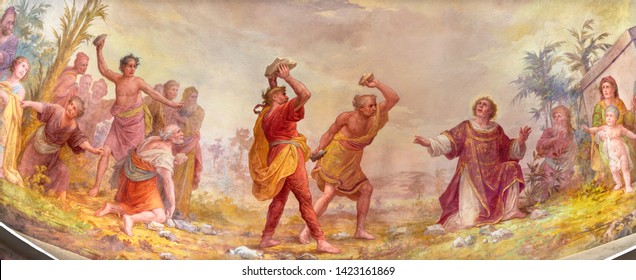
The Martyrdom of Stephen as a Refutation of "Soul Sleep"

Where was the spirit of Stephen after he was stoned to death? The Seventh-Day Adventists claim that it was asleep with his body in the grave. The Jehovah's Witnesses claim that it disintegrated, to be recreated at the final judgment. Those two doctrines are variants of what is commonly called "soul sleep." It is in sharp contrast to the traditional Christian belief that the spirits of the godly passed immediately upon death into the heavenly presence of Jesus (see II Corinthians 5:8). 

The story of Stephen is found in Acts, chapter 7. We are introduced to him in the previous chapter, where we are told that the church elected him to the diaconate, because he was "full of faith and of the Holy Spirit" (Acts 6:5). In chapter 7, he gives a long sermon about Jesus to a Jewish crowd, culminating in verses 51-53: "You stiff-necked people, uncircumcised in heart and ears, you always resist the Holy Spirit. As your fathers did, so do you. Which of the prophets did your fathers not persecute? And they killed those who announced beforehand the coming of the Righteous One, whom you have now betrayed and murdered, you who received the law as delivered by angels and did not keep it." As might be expected, his audience was not happy with his words: "Now when they heard these things they were enraged, and they ground their teeth at him... They cried out with a loud voice and stopped their ears and rushed together at him. Then they cast him out of the city and stoned him" (Acts 7:54, 57-58). 

How did Stephen respond to this persecution? "He, full of the Holy Spirit, gazed into Heaven and saw the glory of God, and Jesus standing at the right hand of God. And he said, 'Behold, I see the heavens opened, and the Son of Man standing at the right hand of God'... And, as they were stoning Stephen, he called out, 'Lord Jesus, receive my spirit.' And, falling to his knees, he cried out with a loud voice, 'Lord, do not hold this sin against them.' And when he had said this, he fell asleep [i. e., died]" (Acts 7:55, 59-60). 

This spiritual man knew that death was upon him, but his expectation was to enter thereupon into the presence of Jesus, as orthodox Christians have always said. He knows nothing of a two-thousand year (and counting) gap between his death and rising to see Jesus only then. Stephen the Deacon was surely no Adventist or Jehovah's Witness. 


Saturday, September 17, 2022

The Scriptural Origin of Paul's Faith


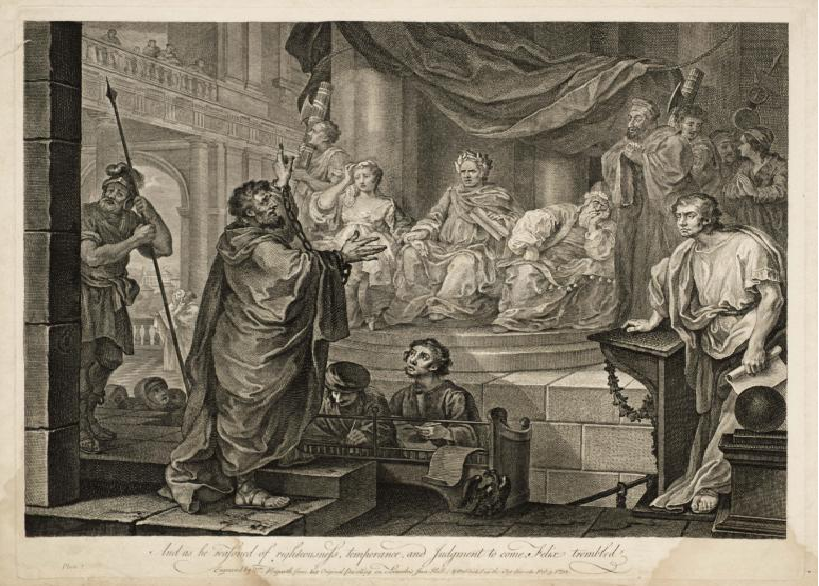
When he was called before Felix, the Roman procurator for the province of Judea, Paul gave an apologetic, that is, a defense, for the Christian faith for which the Jewish leaders had charged him of insurrection. Part of that defense, as recorded in Acts 24:14, is this statement: "This I [i. e., Paul] confess to you [Felix], that, according to the Way, which they [the Jewish leaders] call a sect, I worship the God of our fathers, believing everything laid down by the Law and written in the prophets." 

Paul's defense is not in any mystical revelation, whether by dreams or sensationalist evangelists, but strictly by the testimony that he found in the Bible, the Scriptures which we now know as the Old Testament (compare his later message to Timothy in II Timothy 3:14-15). 

If anyone could, Paul could have spoken of a mystical experience. In Acts 9:1-9, Luke the Physician gives us a record of Paul's, then still called Saul, persecution of the Christians, until he is literally thrown to the ground by Jesus, who challenges him, "Saul, Saul, why are you persecuting Me?" (verse 4). Yet, we are then told, verses 10-19, that this same Jesus then sent a disciple named Ananias to explain the faith to Saul/Paul. "The Lord said to him [i. e., Ananias], 'Go, for he is a chosen instrument of Mine, to carry My name before the Gentiles and kings and the children of Israel'" (verse 15). It is only after this meeting with Ananias that Paul is able to rise and be baptized, not after his vision. 

I think this record is one of the landmarks that distinguish between true Christian churches and the cults. Cults usually start with a leader who claims to have had a mystical experience, apart from Scripture, in which God supposedly taught him or her some new revelation. Nowhere does the New Testament describe conversions as occurring in this way. On the contrary, it is Paul himself who tells us that people are converted by the preaching of that same word of which he testified to Felix (Romans 10:14-17). 

We see this contrast most vividly in the Mormon religion, the founder of which, Joseph Smith, Jr., claimed revelatory visions, including new scriptures, to support his claims of a new religion, new though he claimed Christian terminology for it. The apologetic of Paul contrasts starkly with the claims of Smith, being one of the proofs that Mormonism has no legitimate claim to the name of Christ for its organization. 

Wednesday, March 16, 2022

The Perfect and Proper Sovereignty of God Over His Creatures

"The heavens and the earth and all the hosts of them, as yet having no being, it was [according to] His pleasure whether He would make them or not. And, if He would, what being He would give them, to what end, and how that end should be accomplished. And that all these were ascertained by the decree is evident, for 'known unto God were all His works (which He would do in [the process of] time from the beginning of the world' (Acts 15:18)." --Puritan Elisha Coles, "A Practical Discourse of God's Sovereignty" 

In the quote above, we see the historic protestant view of the sovereignty of God. He created all things according to His plan of what to create, what the purpose and place of each would be, and how that purpose would be achieved. This is especially contrasted with the modern theology of Open Theism, which asserts that God cannot determine or even predict the contingent actions of animate creatures. But it also conflicts with the Arminian view, which claims that God has the power of sovereignty, but has withheld His determination in favor of free agency. 

Coles gave an excellent citation for his view, and against the various forms of autonomy: "Known to God from eternity are all His works" (Acts 15:18 NKJV). God had planned all that He would do in and with His creation before He created any of it. "Remember this and stand firm, recall it to mind, you transgressors, remember the former things of old; for I am God, and there is no other; I am God and there is none like Me, declaring the end from the beginning and from ancient times things not yet done, saying, 'My counsel shall stand, and I will accomplish all My purpose'" (Isaiah 46:8-10). 

Both Coles and the Bible describe a God who is very different from the deity of the Arminians.


Wednesday, November 24, 2021

The Works of a Christian As a Defining Line Between True and False Christianity

One of the consistent errors that mark cults is their perversion of salvation to some form of works righteousness. This is true of the largest cult, the Roman Catholic Church, as well as other well-known cults such as the Mormons, the Jehovah's Witnesses, Church of Christ, or any one that we could name. 

That one error is a defining distinction between cults and orthodox Christianity, i. e., biblical Protestantism. 

The error of each of these cults is that they mix justification with sanctification. That is, they make the good works of the professing Christian to be part of his justification before God, whether it is faith plus sacraments, or faith plus love. Always the error involves faith plus something, instead of biblical justification, which is by faith alone

This is not to profess the strawman argument used by such groups against Protestants, by which they claim that the denial of a role in justification means that Protestants believe that works do not matter. That accusation is false. With the Bible, Protestants hold that works are the necessary result of saving faith. That is the opposite of what the cults teach. The Protestant talks about works as the necessary result, while the cults make works a necessary component of justification. 

This is what we find in the New Testament. 

Acts 15:9: "He [God] made no distinction between us [Jews] and them [Gentiles], having cleansed their hearts by faith." 

Romans 6:1-6: "What shall we say then? Are we to continue in sin that grace may abound? By no means! How can we who died to sin still live in it? Do you not know that all of us who have been baptized into Christ Jesus were baptized into His death? We were buried, therefore, with Him by baptism into death, in order that, just as Christ was raised from the dead by the glory of the Father, we, too, might walk in newness of life." 

Galatians 2:20: "I have been crucified with Christ. It is no longer I who live, but Christ who lives in me. And the life I now live in the flesh, I live by faith in the Son of God, who loved me and gave Himself for me." 

This is far from an exhaustive list.

Wednesday, October 13, 2021

The Anti-Sabbatarian Use of Colossians 2


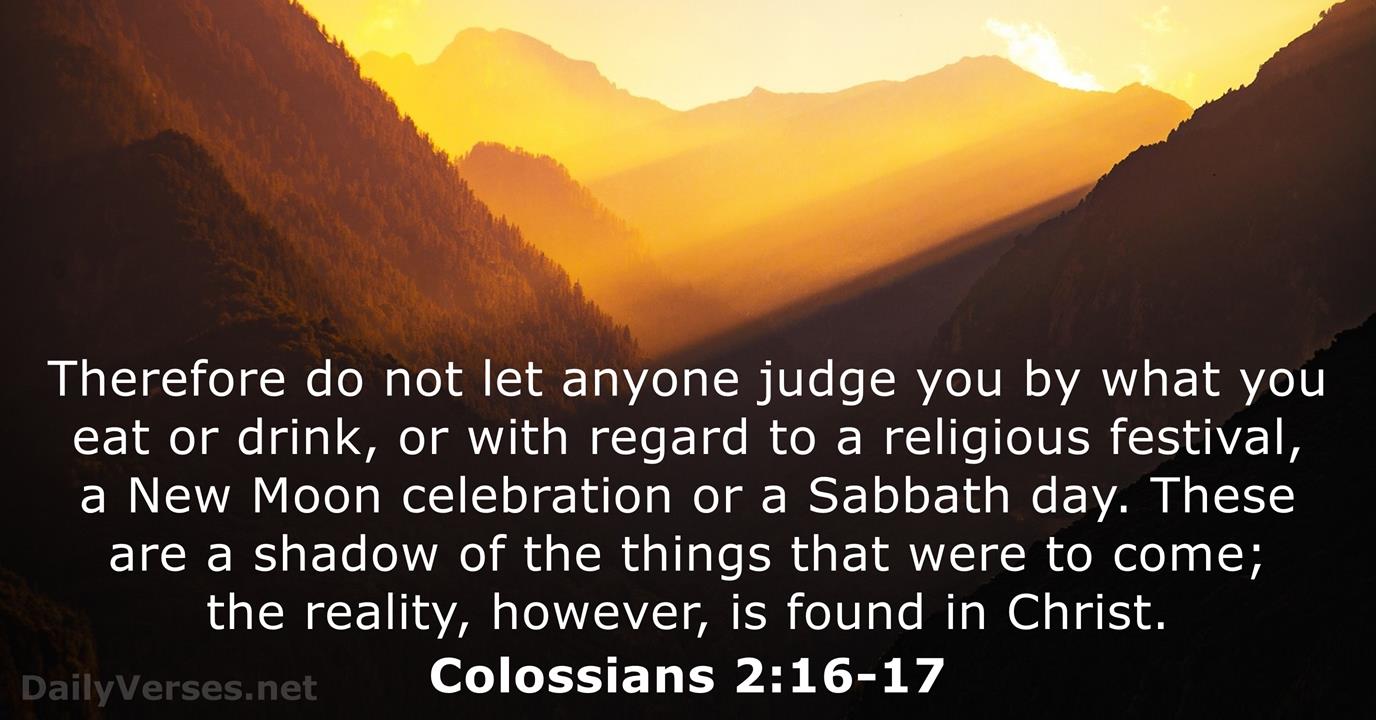
In almost every discussion of the abiding nature of the Christian Sabbath, my experience has been that the anti-Sabbatarian will refer to Colossians 2:16: "Therefore let no one pass judgment on you in questions of food and drink, or with regard to a festival or a new moon or a Sabbath." The argument is that Paul here is telling us that the Sabbath is adiaphora, a matter of preference only. 

What I have never had was an anti-Sabbatarian who mentioned the next verse, Colossians 2:17: "These are the shadow of things to come, but the substance belongs to Christ." 

This is one of those cases where the context is so obviously contrary to the argument being made that it is painful to hear yet again. In verse 16, the items mentioned are food rules, of which there are none ion Christianity, except to avoid meat sacrificed to idols, unlike the many rules in Judaism; to festivals, of which there are none prescribed in Christianity, but several in Judaism; new moons, which are celebrated in Judaism, but not in Christianity; and finally the Sabbath. According to the opponents, Paul rejected the Mosaic rules of Judaism for three things, but left the fourth to be taken generally. Context matters! 

This is confirmed in verse 17, where Paul refers to these ceremonies of Judaism as completed in Christ. As he said to the Galatians, why hold on to the shadows when we have now received the reality? And what is the reality of the Sabbath? 

"At that time Jesus went through the grainfields on the Sabbath. His disciples were hungry, and they began to pluck the heads of grain and to eat. But, when the Pharisees saw it, they said to Him, 'Look, Your disciples are doing what is not lawful to do on the Sabbath.' He said to them, 'Have you not read what David did when he was hungry, and those who were with him: how he entered the house of God and ate the bread of the Presence, which it was not lawful for him to eat nor for those who were with him, but only for the priests? Or have you not read in the Law how, on the Sabbath, the priests in the temple profane the Sabbath and are guiltless? I tell you something greater than the temple is here. And if you had known what this means, I desire mercy and not sacrifice, you would not have condemned the guiltless. For the Son of Man is Lord of the Sabbath'" (Matthew 12:1-8). 

If the Sabbath, as such, had been abrogated, this was the opportunity for Jesus to say so. Yet, He didn't. Why? Because, He says, He is the Lord of the Sabbath. Not was. That is why the writer of Hebrews can tell us that there remains a Sabbath rest for the people of God (Hebrews 4:9). It would have been silly for Jesus to claim to be the Lord of something which was passing away!

If a person were to argue that the code of Moses added ceremonial elements to the Sabbath, then he would be correct. However, if he were to assert that there is no Sabbath apart from those Mosaic elements, then he would be wrong. That is what Paul addresses in Colossians 2:16. If a Christian celebrates the Sabbath without the Jewish ceremonial elements, then he should be free from the judgment of others. Paul neither says nor implies that the person is thereby freed from the Fourth Commandment. That would be to be guilty exactly of that of which his critics accused him, of being an enemy of the Law (e. g., Acts 18:13). 

Saturday, August 28, 2021

Pentecost and the Deity of Jesus, Giver of the Holy Spirit


"And in the last days it shall be, God declares,
that I will pour out My Spirit on all flesh,

and your sons and your daughters shall prophesy,
and your young men shall see visions,
and your old men shall dream dreams;
even on My male servants and female servants
in those days I will pour out My Spirit, and they shall prophesy.
and signs on the earth below,
blood, and fire, and vapor of smoke;
the sun shall be turned to darkness
and the moon to blood,
before the day of the Lord comes, the great and magnificent day.

And it shall come to pass that everyone who calls upon the name of the Lord shall be saved."

- Acts 2:17-21 

In the above passage, the Apostle Peter quotes from Joel 2:28-32 as his explanation of what has just occurred in this chapter of Acts. The Holy Spirit has been poured out on the Apostles and other disciples waiting, as Jesus had commanded them in Acts 1:4-5, for the empowering of the Holy Spirit. That Spirit had indeed come upon them, enabling them to speak in languages that they did not know, but which were recognized by their audience, consisting of Jews of the Diaspora, visiting Jerusalem from all over the eastern Empire (Acts 2:5-11). To assuage their shock, Peter reminds them of this prophecy, and then continues:  

"'This Jesus God raised up, and of that we all are witnesses. Being therefore exalted at the right hand of God, and having received from the Father the promise of the Holy Spirit, He has poured out this that you yourselves are seeing and hearing. For David did not ascend into the heavens, but he himself says, The Lord said to my Lord, Sit at My right hand, until I make Your enemies Your footstool. Let all the house of Israel therefore know for certain that God has made Him both Lord and Christ, this Jesus whom you crucified.' Now when they heard this they were cut to the heart, and said to Peter and the rest of the apostles, 'Brothers, what shall we do?' And Peter said to them, 'Repent and be baptized every one of you in the name of Jesus Christ for the forgiveness of your sins, and you will receive the gift of the Holy Spirit'" (Acts 2:32-38).

Note that the parallels between Joel's prophecy and the Pentecostal fulfillment are not merely general. Where Joel says that God will send the Holy Spirit, Peter tells his audience that it is Jesus who has poured out the Spirit. And where Joel tells his audience that calling upon the name of the Lord (Yahweh in the Hebrew) they shall be saved, Peter tells his audience that it is the name of Jesus that brings forgiveness of sins. Is the logical conclusion, then, not necessarily that Peter believes and is teaching that Jesus is the same Yahweh who mediated for Israel as the covenant God in the Old testament? I say that that is the only possible conclusion.

Wednesday, July 21, 2021

Forgiving Sins and Priesthood Authority

I have been having discussions with Mormons recently on the place of "priests" in the Christian Church. They claim to have an exclusive "priesthood authority." According to the organization's website, that means "in mortality, priesthood is the authority that God gives to man to act in all things necessary for the salvation of God's children." What is that authority? From the organization's handbook: "The keys of the priesthood are the right to preside and direct the affairs of the Church within a jurisdiction. Jesus Christ holds all the keys of the priesthood pertaining to His Church. He has conferred upon each of His Apostles all the keys that pertain to the kingdom of God on earth. The senior living Apostle, the President of the Church, is the only person on earth authorized to exercise all priesthood keys." 

When I talk to Mormons, they claim that Jesus Himself created this authority in the church, when Peter first professed His Messianic office in  Matthew 16. Jesus said, "Blessed are you, Simon Bar-Jonah! For flesh and blood has not revealed this to you, but My Father who is in Heaven. And I tell you, you are Peter, and on this rock I will build My church, and the gates of Hell shall not prevail against it. I will give you the keys of the kingdom of Heaven, and whatever you bind on earth shall be bound in heaven, and whatever you loose on earth will be loosed in Heaven" (Matthew 16:17-19). Mormons (and Catholics) claim that Peter and his successors received here from Jesus his imprimatur allowing them to forgive sins, and, thus, mediating salvation to everyone else. 

To my mind, that claim is blasphemous, a denial of the sufficiency of Christ for the salvation of His people. As the Scriptures say, "There is one God, and there is one mediator between God and men, the man Christ Jesus, who gave Himself as a ransom for all" (I Timothy 2:5-6). That is what is said about Him. 

But is there anything which Jesus Himself said that directly refutes this claim of priesthood? 

Yes, there is. In the story of the paralytic, Jesus says to the frowning scribes, "Which is easier, to say, 'Your sins are forgiven,' or to say, 'Rise and walk'? But that you may know that the Son of Man has authority on earth to forgive sins - (He then turned to the paralytic) - Rise, pick up your bed and go home" (Matthew 19:5-6). In the parallel passage in Mark, we get an additional piece of information. That is that the scribes accused Him of blasphemy, because, "Who can forgive sins but God alone?" (Mark 2:7). And notice that Jesus does nothing to disabuse them of this opinion! They were correct that God alone can forgive sins. And in claiming that authority, Jesus blasphemed, in their view, because His claim was a claim to deity, equal to that of the Father! 

More to my point is that Jesus agreed that the authority belongs to God alone, and, therefore, cannot be held by any mere man, including Peter or anyone who claims to be his successor. Rather, as the representative of the only Head of the Church, Peter, the other apostles, and every true minister since their time has declared, not that they forgave sins, but rather that they brought the Gospel, the news that Jesus has purchased forgiveness of sins for everyone who believes (Acts 10:43). Jesus forgives, and the messenger announces

"With God are wisdom and might; He has counsel and understanding. If He tears down, none can rebuild; if He shuts a man in, none can open. If He withholds the waters, they dry up; if He sends them out, they overwhelm the land. With Him are strength and sound wisdom; the deceived and the deceiver are His. He leads counselors away stripped and overthrows the mighty. He deprives of speech those who are trusted and takes away the discernment of the elders" (Job 12:13-20). 


Wednesday, July 14, 2021

Everyone Whom God Calls Will Hear the Call


There is a common claim among some semi-Pelagian groups, namely Mormons, universalists, and professed unbelievers, that there is something unfair in God's judgment of all unbelievers to Hell, because such a large portion of the world's population has never had an opportunity to hear the Gospel. How can He justly condemn those who are ignorant of His existence and requirements? 

That the challenge comes from various varieties of Pelagians is a clue to the answer: They don't believe that men deserve to be judged for sin. Therefore, they object to the judgment of some, because they reject the biblical truth that all men deserve that judgment. "All have sinned and fall short of the glory of God" (Romans 3:23). With all of the talk of equality in our modern culture, this is an equality that they want to deny. 

However, we have the hope given to us in the Gospel: "God shows His love for us in that, while we were still sinners, Christ died for us" (Romans 5:8). For us, these people say, but what about those who don't know about that? 

Not understanding the sovereignty of God, the Pelagian cannot rationally connect two ideas: If God's love and wisdom could create a way to save His people, then that same love and wisdom can find a way to bring His people to a time and place in which they can hear of it. To the Calvinist, that logic is obvious; to the Pelagian, that logic is impossible. 

We see God's inspired description of that plan in the words of Paul at the Areopagus in Acts 17:26-27: "He made from one man every nation of mankind to live on all the face of the earth, having determined allotted periods and the boundaries of their dwelling place, that they should seek God, and, perhaps, feel their way toward Him and find Him." If we understand that God has planned all of history (Isaiah 46:10), then it is easy to conceive that He has organized that history, in part, to the end that all those for whom Jesus died would unfailingly come into contact with the gospel and to be converted (John 6:37-39; Acts 13:48). 

So the answer to the challenge of Mormons, universalists, and unbelievers, when they ask, "What about those who haven't had a chance to hear?", is that there are no such people. 

Saturday, October 17, 2020

Jesus Contra "Soul Sleep"

"Let not your hearts be troubled. Believe in God; believe also in Me. In My Father’s house are many rooms. If it were not so, would I have told you that I go to prepare a place for you? And if I go and prepare a place for you, I will come again and will take you to Myself, that where I am you may be also.

- John 14:1-3 

Jehovah's Witnesses and Seventh-Day Adventists share a doctrine called "soul sleep." For SDA's, that doctrine says that the spirits of the dead remain, unconscious, with their bodies until the resurrection. For Jehovah's Witnesses, the doctrine is that the spirit of the dead ceases to exist, and is then recreated at the resurrection. So, while there are significant differences between the two, they both deny that there is an intermediate state for the spirits of the dead, whether for the godly in Heaven or for the wicked in Hell. That is a denial of the traditional doctrine of Christians, and I address them together here. 

Look at what Jesus says in the quote above. He was to go away to prepare a place for us to be with Him. Do Witnesses or SDA's claim that Jesus is currently unconscious in a grave? I hope they don't say anything so awful. Rather, we know that He rose into Heaven after His resurrection (Acts 1:9-11). Therefore, logic only allows us to take His words in Matthew to mean that He has been preparing a place with Him in Heaven

Even without considering any other scriptures, these words of Jesus preclude any interpretation comparable to "soul sleep." 

Wednesday, June 10, 2020

If God Has Determined All Things, Then Is He Responsible for Sin?

Let us be unequivocal: Scripture says that God has determined all things, from the beginning of the universe to eternity future. He Himself says, "I declare the end from the beginning and from ancient times things not yet done, saying, ‘My counsel shall stand, and I will accomplish all My purpose'" (Isaiah 46:10). We also read this: "Many are the plans in the mind of a man, but it is the purpose of the LORD that will stand" (Proverbs 19:21). Short of being deliberately obtuse, we cannot miss the meaning here. God has determined all things according to His own plan, not according to ours. 

OK, so He has determined all things. Does He change course midway, whether because He has thought of a better way or because men have not approved of His plans? "Also the Glory of Israel will not lie or have regret, for He is not a man, that He should have regret" (I Samuel 15:29; see also Numbers 23:19). To claim that God would change His mind is to make Him like us, to bring Him down to man's level. And Scripture says that any such attempt is based on a false view of God. 

Then comes the question, what of the wicked acts of men? God could not have predetermined them, because that would make God responsible for sin, right? Well, no, not right. First, let us say that Scripture affirms that God has predetermined even the wicked acts of men: "Truly in this city [i. e., Jerusalem] there were gathered together against Your holy servant Jesus, whom You anointed, both Herod and Pontius Pilate, along with the Gentiles and the peoples of Israel, to do whatever Your hand and Your plan had predestined to take place" (Acts 4:27-28). So, in a prayer to God, Peter and John, while addressing God, confess that He had planned all of the events around the suffering and death of Jesus, even in planning the evil actions of Herod and Pilate. But what was the goal in those actions? The atonement of God's people. In other words, our salvation is dependent on God's predestining the evil actions of particular men! 


Look also at Paul's words in Romans 3:7: "If through my lie God’s truth abounds to his glory, why am I still being condemned as a sinner?" Using the words of a hypothetical unbeliever, Paul has that unbeliever confess that his lies, his sins, glorify God. "However," the unbeliever pleads, "then I shouldn't be punished for them." The first part is true. His wickedness glorifies God, both through His justice to the unrepentant unbeliever and by His mercy to the repentant elect sinner. However, that wasn't the purpose when the sinner committed his wicked acts, just as Herod and Pilate planned nothing good by their murder of Jesus. That is why God is still just in bringing them under judgment. His bringing about good from their evil is to His praise, not theirs.

And it is also why God cannot be said to be the author of sin.


Saturday, May 30, 2020

What Happens to Children When They Die?

This is a hard topic on which to write. I anticipate some negative reaction. However, it is a question I have been asked repeatedly by anti-Calvinists.

First, let us look at the confessional standard: "Elect infants, dying in infancy, are regenerated and saved by Christ through the Spirit, who worketh when, and where, and how He pleaseth. So also are all other elect persons who are incapable of being outwardly called by the ministry of the Word" (Westminster Confession of Faith X:3). The divines described what happens to elect infants who die. Of course, since they are elect, that would be God's plan for them. What about non-elect infants? On that the divines were silent. Charles Hodge and his son, A. A. Hodge, took that to mean that all infants who die are elect. I think that is presumptuous, taking an argument from silence where it does not lead.

For the Christian, there is extensive biblical justification to believe that his dead child is in Heaven. First, God claims the children of believers for Himself in Ezekiel 16:20-21: "You took your sons and daughters, whom you had borne to Me, and these you sacrificed to them [i. e., idols] to be devoured. Were your whorings so small a matter that you slaughtered My children and delivered them up as an offering by fire to them?" When the Israelites had become so given over to idolatry that they even practiced human sacrifice, God's anger was directed at the theft of what belonged to Him by covenant.

And second, what does God promise to these children who are His? "Your children shall be taught by the LORD, and great shall be the peace of your children" (Isaiah 54:13). Also in Acts 2:39: "The promise is for you and for your children and for all who are far off, everyone whom the Lord our God calls to Himself." So, in both Testaments, we have a promise from God to be covenantally faithful to the children of believers. Is this a promise that every child of believers will be saved? No, it isn't, as we know both from personal experience and from the biblical examples of Esau and Ishmael.

However, we also have a biblical example of the comfort that covenantal promise is to the believer. When David's first son with Bathsheba died (II Samuel 12:15-23), David took comfort in his assurance that his son would be waiting for him is Heaven: "I shall go to him, but he will not return to me" (verse 23).

I think that the most-important verse on this issue is I Corinthians 7:14: "The unbelieving husband is made holy because of his wife, and the unbelieving wife is made holy because of her husband. Otherwise your children would be unclean, but as it is, they are holy." Paul tells us that the children of at least one Christian parent are holy. He doesn't say saved. Rather, he speaks of the covenantal connection between the believing parent and the child, such that the child is federally holy on the basis of the parent's faith.

However, we should notice his exact words. Paul speaks negatively. He doesn't just say, "The child with a believing parent is holy." Instead, he adds, that the child would otherwise be "unclean." And this is logical because we know there is no neutral moral state. But what are the consequences to the unbelieving parents regarding their own children?

"Nothing unclean will ever enter it [i. e., the New Jerusalem, v. 10], nor anyone who does what is detestable or false, but only those who are written in the Lamb’s book of life" (Revelation 21:27). Here is where the unbeliever must consider his standing with God, because it affects not just himself but also his children. If he decides that the pleasures of this life outweigh the eternal consequences, can he also say that they outweigh the eternal consequences for his child? Of course, this doesn't mean that every child of an unbeliever will himself be an unbeliever. We know from experience that the Holy Spirit often breaks into the families of unbelievers to bring one to Himself. I myself was such a convert. But the generality can be predicted, just as above with the children of believers.

This is my personal interpretation. Though I consider it a rational conclusion from the relevant Scriptures, I am aware that it goes beyond the confession. Therefore, other Calvinists should not be blamed for my personal opinion. I am especially conscious that I am going against some theological giants when I disagree with the Hodges. All I can say is that the Scriptures compel me.

Saturday, May 16, 2020

False Teachers and Their Pompous Claims of Authority

In our day, there are many "Christian" groups that claim grandiose titles for their organizational leaders. Mormons have their "Apostles and Prophets," various Pentecostal churches claim that their pastors are "Apostles," and, of course, the Pope has long claimed to occupy the "apostolic throne of Peter." I deny all such titles, and insist that all such claims mark false teachers. 

First, let me concede that the Bible does talk about Apostles and Prophets in the organization of the church: "He gave the apostles, the prophets, the evangelists, the shepherds and teachers, to equip the saints for the work of ministry, for building up the body of Christ, until we all attain to the unity of the faith and of the knowledge of the Son of God, to mature manhood, to the measure of the stature of the fullness of Christ, so that we may no longer be children, tossed to and fro by the waves and carried about by every wind of doctrine, by human cunning, by craftiness in deceitful schemes. Rather, speaking the truth in love, we are to grow up in every way into Him who is the Head, into Christ, from whom the whole body, joined and held together by every joint with which it is equipped, when each part is working properly, makes the body grow so that it builds itself up in love" (Ephesians 4:11-16). The Church is the Body of "Christ." He alone is the Head of the body, and has established how the members shall be organized (see also 1:22, 5:23,and Colossians 1:18). Among other things, this means that men are not left to ourselves to design the government of Christ's Church. 

"Shepherds" here is the equivalent of "elders" in the rest of Scripture, and "teachers' are what we call pastors (see I Timothy 5:17). Paul describes the selection of elders, with deacons as their assistants (Acts 6:1-7), in several places, especially in I Timothy 3 and Titus 1. And where does that same Apostle describe selecting new apostles or prophets? Nowhere. In fact, except for the selection of Matthias to replace Judas (Acts 1:12-26), a special circumstance, there is never a mention of selecting any more such men.

Does that not require us to accept that those were temporary offices, while the others were to be continuing offices in the Church? I think that the rationale is unavoidable, and demonstrates
that presbyterianism is the only scriptural system of congregational government, precluding congregational democracy, episcopalianism, or any claims to the offices of the Apostles and Prophets.


Saturday, March 28, 2020

Esau and Jacob: The Holy Discrimination of God

 I have mentioned before that anti-Calvinists have certain verses which they consider "trump verses" against Calvinism. No matter how many verses a Calvinist cites in support of the doctrines of grace, his opponent will plunk out one of these trump verses and congratulate himself for, supposedly, ending all debate. Of course, the number one verse is John 3:16, which I have addresses here and here.

In this post, I want to address the phrase, "God is no respecter of persons" (Acts 10:34). Supposedly, this verse says that God does not discriminate between any two people. And in isolation, it might be taken that way, as is the wont of isolated prooftexts. However, doing so ignores the actions that God says that He has taken, making distinctions between people, both as individuals and as groups.

The obvious example, of course, is Romans 9:6-13 (referring back to Malachi 1:2-3): "Not all who are descended from Israel belong to Israel, and not all are children of Abraham because they are his offspring, but 'Through Isaac shall your offspring be named.' This means that it is not the children of the flesh who are the children of God, but the children of the promise are counted as offspring. For this is what the promise said: 'About this time next year I will return, and Sarah shall have a son.' And not only so, but also when Rebekah had conceived children by one man, our forefather Isaac, though they were not yet born and had done nothing either good or bad—in order that God’s purpose of election might continue, not because of works but because of Him who calls— she was told, 'The older will serve the younger.' As it is written, 'Jacob I loved, but Esau I hated.'" This is clearly a discrimination between two people, the twin brothers Esau and Jacob (see, in passing, Genesis, chapters 18-33). God claims the right to choose between Esau and Jacob, even before they were born, before they had done anything good and evil. On what basis? "I will have mercy on whom I have mercy, and I will have compassion " (Romans 9:15; see also verse 16). That is sovereign election, and God feels no compunction to explain beyond that.

When the anti-Calvinist cites Acts 10:34, he should also look at Acts 15:8-9: "God, who knows the heart, bore witness to them, by giving them the Holy Spirit just as He did to us, and He made no distinction between us and them, having cleansed their hearts by faith." Peter is expressing the surprise of the disciples upon learning that God has extended salvation even to the Gentiles, on the same basis as the Jews, i. e., by faith alone. The disciples were astonished at this, because the Jews had always though of God and the Messiah-to-come as their special reserve, not for the unclean Gentiles.

And this explains how God does and does not discriminate between men. He shows no concern for the characteristics which men value, such as wealth or physical beauty. His standard is His own will alone, the ultimate in justice. He tells us this explicitly in His choosing of David to replace the line of Saul on the throne of Israel: "Do not look on his appearance or on the height of his stature, because I have rejected him. For the LORD sees not as man sees: man looks on the outward appearance, but the LORD looks on the heart" (I Samuel 16:7).

Thus we see that God is certainly discriminatory, and the plunking down of Act 10:34 to claim otherwise is to ignore the message of Scripture for debate points.

Saturday, January 11, 2020

Sanctification: We Shall Be Like Him

"The justification of a sinner introduces him into a state in which he can no more be left to the dominion of sin and the possibility of the curse than Christ can lose His glory or God be unfaithful to His promises and oath" (James Henley Thornwell, "The Necessity and Nature of Christianity").

In its simplest, justification in Scripture refers to the declaration of "Not Guilty" on the sinner redeemed by the blood of Christ, applied through faith alone: "For by grace you have been saved through faith. And this is not your own doing; it is the gift of God, not a result of works, so that no one may boast" (Ephesians 2:8-9). Look also at verses 4-5: "God, being rich in mercy, because of the great love with which He loved us, even when we were dead in our trespasses, made us alive together with Christ—by grace you have been saved." See also Acts 15:11 and Romans 3:24. These references are far from exhaustive. However, Thornwell's point above is that our justification is the beginning of God's work in us, not the totality. And the Apostle Paul gave us the same assurance: "I am sure of this, that He who began a good work in you will bring it to completion at the day of Jesus Christ" (Philippians 1:6).

The problem with modern Christians is that we talk about being saved from the wrath of God. And that is, indeed, a wonderful thing which is taught in Scripture: "Since, therefore, we have now been justified by His blood, much more shall we be saved by Him from the wrath of God" (Romans 5:9). Jesus by His blood has brought us into peace with His Father, who had been offended by our sin (Romans 5:1). But that was never intended to be the end of His work.

What were we told when Jesus was born among us? "She will bear a son, and you shall call His name Jesus, for He will save His people from their sins" (Matthew 1:21). This was the promise given to Joseph about the unexpected pregnancy of his betrothed wife. Notice the promise. It is not just that Jesus would save His people from the curse for their sins, as glorious as that is, but from the sins themselves!

We know that this is a gradual process in this life. We grieve as we find in ourselves attitudes of wickedness that are inconsistent with our profession of Christ. Yet, we are also encouraged by the promises of Scripture that we are no longer possessed by sin, and someday, when we see Him face to face, we shall finally be as sinless as our Savior is: "Beloved, we are God’s children now, and what we will be has not yet appeared; but we know that when He appears we shall be like Him, because we shall see Him as He is" (I John 3:2).