Sunday, April 6, 2025
The Oneness Sect and Baptismal Regeneration
Saturday, June 18, 2022
The Intra-Trinitarian Covenant as the Starting Point for Paul
In two places, Paul initiates a theological point by placing the foundation of his doctrine before time. In Ephesians 1:4, he tells us of the choosing of the elect "in Him," that is, in Christ, "before the foundation of the world." And again in II Timothy 1:8-10, he tells us that the elect are the objects of His calling "before the ages began," but which has now been manifested. We see similar phrases used by John in John 17:24 and Revelation 13:8, and by Peter in I Peter 1:20.
In each case, we see the salvific purposes of God exercised in time, in history, but based on decisions made before time and history. If it was before creation, then in what context did God work out these plans? Within the fellowship of the three Persons of the Trinity, co-eternal and co-equal. Paul tells us of the plan among the Father (such as verses 3 and 5), the Son (verses 3,4, and 5), and the Holy Spirit (verse 13). Thus Paul displays to us that his soteriology is inherently trinitarian; God's purposes could be carried out only by the intimate involvement of all three of the divine Persons.
I have shown the scriptural glimpses of this intra-Trinitarian covenant, or convenant of redemption, from the Old Testament (such as here and here), but we must also see that it underpins the theology of the New Testament. Among other things, it necessarily precludes any christological heresy denying the Trinity or any of the Persons, or their deity and preexistence, especially the heresy of modalism. But it also shows the step by step purposes of God in the redemption of His people, not for our sake, but because of the Father's love of the Son. Thus, it cannot fail or be undone. The intra-Trinitarian covenant provides a sound basis for the assurance of salvation. that again precludes most of the aberrant sects, who all maintain a fragility of their version of salvation, such that it can be lost at any time.
Wednesday, September 15, 2021
The Deity of Jesus Proven from Hebrews
"Of old You laid the foundation of the earth,
And the heavens are the work of Your hands.
They will perish, but You will remain;
They will all wear out like a garment.
You will change them like a robe, and they will pass away,
But You are the same, and Your years have no end."
- Psalm 102:25-27
The verses above were penned by the Holy Spirit through an unnamed poet. We are told of him in the subtitle only that he was "one afflicted," but not by what. It continues, "when he was faint and pours out his complaint before the Lord." Indeed, the psalm is full of pathos, and we should be encouraged by that example. Jesus is ready to hear all of our human emotions, not just happy ones, as is sometimes suggested by popular TV preachers.
These verses are then quoted in Hebrews 1:10-12, and explicitly applied to the Son, that is, to Jesus in His divinity (verse 8), in His role as co-Creator with the Father.
In the original passage, we are given no specific information to which divine Person the passage is addressed. In isolation, it could be taken as addressed to the Father. However, we have a hint, made explicit by the author of Hebrews, that it is addressed to the preincarnate Son because the psalmist explicitly addresses his complaints to Jehovah (verse 1), the name by which He was known to His Old Covenant people. However, the sects can pretend not to see that, whether to support the Arianism of the Jehovah's Witnesses or the tritheism of the Mormons or the Sabellianism of the Oneness Pentecostals, or any other denial of the full deity of Christ.
Yet, when we look at the quote in Hebrews, all of those quibbling voices are quelled, as that author makes explicit what is implied in the original: the Lord of whom the Psalmist speaks is none other than the Son, our Lord Jesus Christ.
Saturday, June 12, 2021
The Angel of the Lord, the Preincarnate God the Son
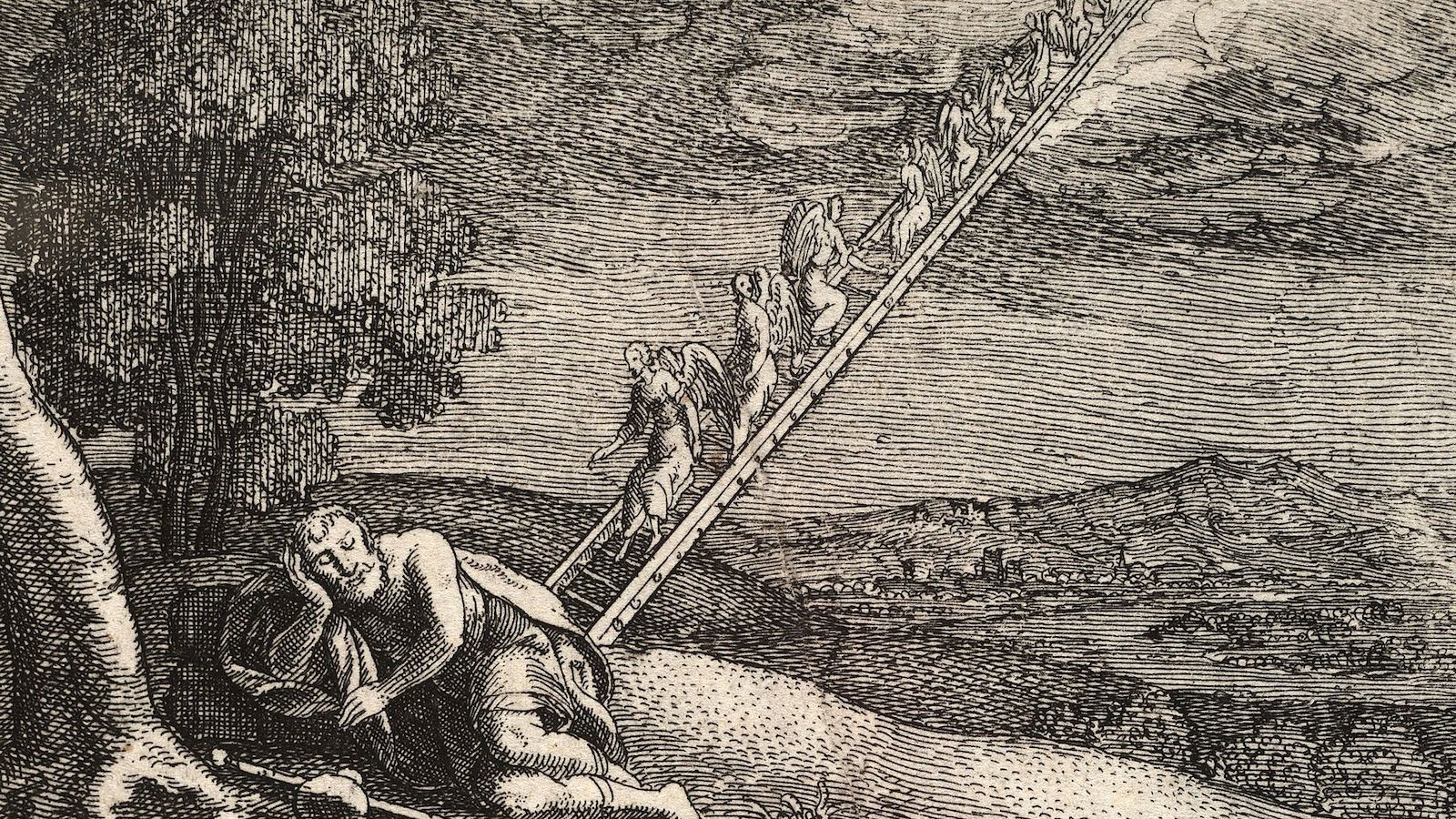
"Jacob left Beersheba and went toward Haran. And he came to a certain place and stayed there that night, because the sun had set. Taking one of the stones of the place, he put it under his head and lay down in that place to sleep. And he dreamed, and behold, there was a ladder set up on the earth, and the top of it reached to heaven. And behold, the angels of God were ascending and descending on it! And behold, the Lord stood above it and said, 'I am the Lord, the God of Abraham your father and the God of Isaac. The land on which you lie I will give to you and to your offspring. Your offspring shall be like the dust of the earth, and you shall spread abroad to the west and to the east and to the north and to the south, and in you and your offspring shall all the families of the earth be blessed. Behold, I am with you and will keep you wherever you go, and will bring you back to this land. For I will not leave you until I have done what I have promised you.' Then Jacob awoke from his sleep and said, 'Surely the Lord is in this place, and I did not know it.' And he was afraid and said, 'How awesome is this place! This is none other than the house of God, and this is the gate of heaven.'"
- Genesis 2810-17
This is a well-known and much-beloved passage. We even have a song based on it: "We are climbing Jacob's ladder." Notice that God is referred to both as "God" and as "Yahweh" ("Lord" in the quoted portion above). So Jacob professes, without correction, that Yahweh is his God.
Let us continue.
"Then the angel of God said to me in the dream, ‘Jacob,’ and I said, ‘Here I am!’ And He said, ‘Lift up your eyes and see, all the goats that mate with the flock are striped, spotted, and mottled, for I have seen all that Laban is doing to you. I am the God of Bethel, where you anointed a pillar and made a vow to Me.'" (Genesis 31:11-13).
In this later passage, Jacob is again visited. This visitor is identified as "the angel of God," but then He identifies Himself as "God," the same God and Yahweh who had visited Jacob in chapter 28. Therefore, the angel of God, called elsewhere the angel of the Lord or the angel of the covenant, is Yahweh, the God of Israel.
The comparison of these two passages proves three things, contrary to the claims of the anti-Trinitarians: first, it proves that Yahweh and the Angel of Yahweh are the same Person; second, it proves the preexistence of the Son; and third, it shows that Yahweh was the preexistent Son, in His mediatorial role. And if Yahweh is God, then the logical necessity is that the Son is God! Thus the claims of the Jehovah's Witnesses on one side and the Oneness sects on the other are shown to be false.
Saturday, April 3, 2021
When Men Turn the Name of God into Vanity
Do you know the third Commandment? It is the one that says, "You shall not take the name of the Lord your God in vain, for the Lord will not hold him guiltless who takes His name in vain" (Exodus 20:7). In our modern understanding, this commandment means not to use "God" flippantly, such as, "Oh God, I love pizza!" And it certainly includes that. But isn't it in itself flippant to believe that one of the Big Ten would be about that?
Our ancestors certainly gave it more weight: "What are the sins forbidden in the third commandment? Answer : The sins forbidden in the third commandment are, the not using of God’s name as is required; and the abuse of it in an ignorant, vain, irreverent, profane, superstitious, or wicked mentioning, or otherwise using his titles, attributes, ordinances, or works, by blasphemy, perjury; all sinful cursings, oaths, vows, and lots; violating of our oaths and vows, if lawful; and fulfilling them, if of things unlawful; murmuring and quarreling at, curious prying into, and misapplying of God’s decrees and providences; misinterpreting, misapplying, or any way perverting the Word, or any part of it, to profane jests, curious or unprofitable questions, vain janglings, or the maintaining of false doctrines; abusing it, the creatures, or anything contained under the name of God, to charms, or sinful lusts and practices; the maligning, scorning, reviling, or anywise opposing of God’s truth, grace, and ways; making profession of religion in hypocrisy, or for sinister ends; being ashamed of it, or a shame to it, by unconformable, unwise, unfruitful, and offensive walking, or backsliding from it" (Question 113, Westminster Larger Catechism). There is little in our mental or social lives that the divines did not put under the Third Commandment.
I want to especially consider one aspect of the abuse of God's name, and that is the claiming of it by members of pseudo-Christian cults. The worst ones are the ones that simply create a false Jesus, by depriving Him of His full and eternal deity. This would include Mormons, Jehovah's Witnesses, and Oneness Pentecostals. They abuse God's name by applying it to idolatrous inventions of their cult founders. In this sense, the commandment is equivalent to the warning given by Jesus Himself: "See that no one leads you astray. For many will come in my name, saying, ‘I am the Christ,’ and they will lead many astray. For false christs and false prophets will arise and
perform great signs and wonders, so as to lead astray, if possible, even
the elect" (Matthew 24:4-5, 24)
The followers of these manmade pseudo-Christs claim the name of Christ, and will even expect others to acknowledge them as Christians. However, they have claimed the name, not of the Jesus of the Bible, but of an idol, and are, therefore, using His name in vain. And, as Moses wrote, God will not hold them guiltless. They remain in their sins (John 8:24).
Saturday, March 6, 2021
A Simple Refutation of All Forms of Unitarianism
In their opposition to the doctrine of the Trinity, Arians and Modalists unite in denying the deity of the Son. Arians, represented primarily by the Jehovah's Witnesses, claim that Jesus was a fully-created being, whether a mere human or an angel, but definitely not God. Modalists, represented primarily by Oneness Pentecostals, on the other hand, say that Jesus was God, but His deity was that of the Father, not the inherent deity of the Son.
Both are unbiblical.
In I John 5:20, that Apostle tells us, "We know that the Son of God has come and has given us understanding, so that we may know Him who is true; and we are in Him who is true, in his Son Jesus Christ. He is the true God and eternal life." Contrary to the claims of both Arians and Modalists, John tells us that the Son, named as such twice in that verse, is God. His statement precludes any claim that Jesus was merely a creature, or that the Son was merely a body inhabited by the deity of the Father.
Wednesday, August 19, 2020
Following Paul to Righteousness by Faith
"Look out for the dogs, look out for the evildoers, look out for those who mutilate the flesh. For we are the circumcision, who worship by the Spirit of God and glory in Christ Jesus and put no confidence in the flesh— though I myself have reason for confidence in the flesh also. If anyone else thinks he has reason for confidence in the flesh, I have more: circumcised on the eighth day, of the people of Israel, of the tribe of Benjamin, a Hebrew of Hebrews; as to the law, a Pharisee; as to zeal, a persecutor of the church; as to righteousness under the law, blameless. But whatever gain I had, I counted as loss for the sake of Christ. Indeed, I count everything as loss because of the surpassing worth of knowing Christ Jesus my Lord. For His sake I have suffered the loss of all things and count them as rubbish, in order that I may gain Christ and be found in Him, not having a righteousness of my own that comes from the law, but that which comes through faith in Christ, the righteousness from God that depends on faith."
- Philippians 3:2-9
The Apostle Paul gives us a list of things here which might have been considered grounds for a righteousness before God based on his own qualities. As righteousness was understood by his judaizing opponents, Paul had all of the qualifications of birth, of training, and of works. If anyone could be justified by his own qualifications, then that person could be none other than Paul.
Yet, what does that same Paul say about his qualifications: "I count them as rubbish" (verse 8). What men would count as shining qualities, Paul calls garbage. And I don't think that Paul is referring here to God's point of view (Isaiah 64:6). Rather, he is telling us what was his own attitude to those things that he, too, in a previous life, counted as glorious. They were garbage, not because they were rejected by God, though that is true, but rather because they had blinded him to true righteousness, that which comes by faith alone in Christ alone. It is as if some prospector had been so in love with his lump of coal that he had ignored a streambed next to him littered with gold nuggets.
This is why Christians should feel such sorrow for those trapped in pseudo-Christian sects. I have spoken to Mormons, Jehovah's Witnesses, and Oneness Pentecostals who were so proud of their chunks of coal - such as baptism or organizational position - while they are blind to the gold of true righteousness, such as Paul had found, by faith in Christ alone.
Saturday, July 25, 2020
Oneness of the Godhead, Oneness of the Church, and the Irrationality of Oneness Religion
It does not.
Consider these other words of Jesus from the same book: "I do not ask for these only, but also for those who will believe in Me through their word, that they may all be one, just as You, Father, are in Me, and I in You, that they also may be in Us, so that the world may believe that You have sent Me. The glory that You have given Me I have given to them, that they may be one even as We are one, I in them and You in Me, that they may become perfectly one, so that the world may know that you sent Me and loved them even as You loved Me" (John 17:20-23).
This is from Jesus's High-Priestly Prayer. In it, He asks the Father to make His people one, just as He and the Father are one. Now, if we follow the logic of Oneness theology, this means that He is praying that all Christians will be merged into one gigantic mass, a literal oneness of person - no more single bodies or personalities. Yet no rational person would imagine that was His intent.
However, the fact remains that Jesus describes a parallel of the unity of the church with the unity of the Godhead. It is not a unity of person, with no distinctions of identity or personality. Rather, it is a unity of purpose and love. The people of God should be united in the sight of an unbelieving world, united in a work that He gave us to do (Matthew 28:19-20) and love for each other (which is not to say that we have attained such oneness yet). This is exactly how the Persons of the Godhead are one, in perfect unity and love. They have had that unity from eternity, even if their people have yet to attain it. Each member has his own job to do, just as each Person of the Trinity has His own office. If all are made the same, then the body and the Godhead fail (see I Corinthians 12).
Simply stated, Oneness arguments cannot stand even minuscule attention because they are irrational, and produce even more irrationality if applied consistently. Any worldview that fails by its own consistent application is necessarily a false worldview.
Wednesday, July 15, 2020
The Logic of Jesus versus the Irrationality of Oneness Theology
Thus, Oneness claims are refuted by the simple question, If the Son is just flesh, and not God in Himself, then how can He be equal to the Father?
Saturday, June 20, 2020
The Trinity and the Divine Son from Heaven
One thing that I have seen them assert is that the deity of Jesus is the Father in Heaven, while the Son was His humanity on earth. Therefore, the Son began with His conception in the womb of Mary. That means, depending on how you look at that assertion, that they either deny the deity of the Father, making Him Jesus instead, or they deny the deity of Jesus, making Him nothing more than a vessel for the Father. I should say that Oneness deny both of those implications. However, they also deny the applicability of logic to their doctrine. It is just "human reasoning," they claim. The principles of logic violated by their doctrines are the Law of Non-Contradiction, which states that a thing and its contrary cannot both be true at the same time and in the same way, and the Law of Identity, which states that a thing must be itself, not something else, again at the same time and in the same way.
In John 6:62, that apostle quotes these words of Jesus: "Then what if you were to see the Son of Man ascending to where He was before?" They apply very specifically to the matter at hand. Jesus says that He was in heaven before His incarnation. Oneness claim that this is a reference to His deity as the Father. However, He explicitly refers to Himself as the Son in this verse, not the Father. Here is where the laws of logic apply: Oneness deny the Law of Identity by making Him something other than what He is -and says that He is - to avoid the implications of this verse. And they violate the Law of Non-Contradiction by making Him the Son and the Father at the same time, in violation of their own doctrine. I should repeat, however, that these logical problems don't bother Oneness, because they consider logic to be "human reasoning."
In contrast, the Trinitarian violates neither rule. Since orthodox Christians hold that the Son has always been the Son, never the Father, both divine Persons keep their respective identities without contradiction. The Son was in Heaven from eternity as the Son. With Him was the Father, as the Father from eternity, just as we are told in John 1:1. Thus we maintain the full deity of both Father and Son, sacrificing neither in order to maintain a manmade doctrine.
Wednesday, November 6, 2019
Contending for the Faith Against False Teachers
Yet, their repeated "why's" have an answer: the commandment of Scripture.
First, we have the warning against false teachers: "Do not listen to the words of the prophets who prophesy to you, filling you with vain hopes. They speak visions of their own minds, not from the mouth of the Lord. They say continually to those who despise the word of the Lord, ‘It shall be well with you’; and to everyone who stubbornly follows his own heart, they say, ‘No disaster shall come upon you'" (Jeremiah 23:16-17). The danger of false teachers is that they leave their followers under the wrath of God, while blithely imagining their safety. That is why false teachers are so popular. "While people are saying, 'There is peace and security,' then sudden destruction will come upon them as labor pains come upon a pregnant woman, and they will not escape" (I Thessalonians 5:3). And it isn't just the cults which are the danger here. The popular TV preachers, such as Joel Osteen, are equally dangerous. They promise peace and prosperity, but never mention sin or the wrath of God. So their followers march, grinning and satisfied, into the waiting maw of Hell.
In the face of such deceivers, the Scriptures give me a stark warning: "If I say to the wicked, ‘You shall surely die,’ and you give him no warning, nor speak to warn the wicked from his wicked way, in order to save his life, that wicked person shall die for his iniquity, but his blood I will require at your hand" (Ezekiel 3:18). If I see the false teacher and those deceived by him, and I make no effort to warn them of God's judgment, then God holds me guilty of their death!
That's why the New Testament also gives every true Christian this commandment: "I found it necessary to write appealing to you to contend for the faith that was once for all delivered to the saints" (Jude 1:3). I do not face accounting to cultists or other false teachers for challenging their errors; I face the wrath of God if I fail to do so.
Wednesday, August 7, 2019
Justifying Faith Is a Working Faith
These organizations point to the commands in Scripture to live holy lives. And those commands are truly there, and should be in the mind of every Christian. That isn't the problem. The problem is that they claim that those works commanded by Scripture are commanded in order to gain the favor of God, though they may phrase it in different ways. That is, they claim that justification is, in part, the result of these works. And that destroys the true doctrine of justification by grace alone through faith alone, apart from works (e. g., Romans 3:28). That is, they put the result for the cause, and, thus, destroy assurance of salvation.
In every discussion on this issue, we can expect these works-mongerers to refer to James 2:24: "You see that a person is justified by works and not by faith alone." They consistently block out the context of the paragraph that includes that verse, which is about the demonstration of justification before men, not justification before God.
Then they will bring up the accusation against the biblical Christian that "faith alone" means that works are irrelevant, allowing the Christian to live wickedly, and yet go to heaven. That is a caricature, which has been answered repeatedly down through history. Yet the works-mongerers consider themselves very clever to repeat it, regardless of the answer. What is that answer? "Faith, thus receiving and resting on Christ and his righteousness, is the alone instrument of justification; yet is it not alone in the person justified, but is ever accompanied with all other saving graces, and is no dead faith, but worketh by love" (Westminster Confession of Faith XI:2). True faith will necessarily result in good works.
Wednesday, January 23, 2019
The Deity of the Son Asserted Against Oneness Doctrine
Consider the words of Jesus in John 6:62: "Then what if you were to see the Son of Man ascending to where He was before?" He doesn't say "where I was," which would allow for the Oneness doctrine. Rather, He explicitly states where the Son was before, which excludes the Oneness doctrine. When was this fulfilled? "When He had said these things, as they were looking on, He was lifted up, and a cloud took Him out of their sight. And while they were gazing into heaven as He went, behold, two men stood by them in white robes, and said, 'Men of Galilee, why do you stand looking into heaven? This Jesus, who was taken up from you into heaven, will come in the same way as you saw Him go into heaven'" (Acts 1:9-11). Here, in the literal, physical fulfillment of Jesus's earlier words, the angels identify Him as Jesus. Therefore, simple logic requires us to equate Jesus with the Son, and, if one is God, then both names must refer to deity.
Saturday, January 5, 2019
God the Son, Our Savior Upon His Throne
However, such a doctrine ignores too much of the Old Testament, in which we see the interaction between the Father and Son in preparation for the incarnation and redemptive work of the Son. The most explicit is Psalm 45:6: "Your throne, O God, is forever and ever. The scepter of your kingdom is a scepter of uprightness." The value of this verse is that it is quoted in Hebrews 1:8 with this introduction: "But about the Son He says..." Thus we have inspired commentary telling us that Psalm 45:6 is the Father's comment to the Son, whom He addresses as "God." Oneness claim that it is a prophecy, not an actual address, but they provide no exegetical grounds for that assertion. The assertion is mere circular reasoning, required by their presupposed doctrine. It is not the result of any consideration within the text.
The problem with the Oneness doctrine is that it makes the Son of God just an idea in the Father's mind in eternity. He wasn't a real person, until He was created in the womb of Mary. Thus, their doctrine boils down to the same doctrine as that of the Arians, that the Christ who walked among men was really just a created creature, not fully God in Himself, as orthodox Christians have always claimed. And that equivalency is actually entertaining, considering the contempt that Oneness express for Arians, such as the Jehovah's Witnesses.
However, they are both wrong. "Christ is a real savior, and not an instrument by which the sinner is enabled to gratify his pride. The Holy Ghost is a real sanctifier, and not an influence by which the energies of men are stimulated, and their better impulses roused into action. The Persons of the glorious Trinity have entered into a real covenant to redeem a Church from the lost multitude of the race, and are not the authors of paltry expedients or abortive efforts to coax men into what they find it impossible directly to effect" (James Henley Thornwell, "Theology as a Life in Individuals and the Church").
Wednesday, December 12, 2018
Can Baptism Save When There Is No Water?
Notice what Peter says: "which corresponds to this." Ah, now the obvious question should be, corresponds to what? Yet no one ever asks that question.
In the immediately preceding verse, Peter says, "when God’s patience waited in the days of Noah, while the ark was being prepared, in which a few, that is, eight persons, were brought safely through water."
Ah, so the comparison that Peter is making is to Noah, his wife, three sons, and three daughters-in-law, who were preserved during the Flood. Where were Noah and his family during the Flood? "Noah and his sons and his wife and his sons’ wives with him went into the ark to escape the waters of the flood" (Genesis 7:7). Noah and his family weren't in the water. In fact, everyone in the water died. Noah and his family remained dry.
So, Peter is comparing a situation in which people remained dry to water baptism! If his point were that baptism is salvific, then Noah and his family would have been the only people not saved during the Flood! And such an absurdity proves that baptismal regeneration is not what is taught in I Peter 3:21.
Rather, continuing in that verse, "not as a removal of dirt from the body but as an appeal to God for a good conscience." So, not the baptism per se, but rather what it represents, "a good conscience," a synonym for "faith." Peter is actually teaching the opposite of what the sacerdotalists claim for him, justification by faith alone, not by the addition of any ritual.
Wednesday, November 28, 2018
The One and the Many: Trinity in Unity in the Bible
- Mark 5:1-9
When I interact with anti-Trinitarians, whether of the Arian or Sabellian varieties, one strategy they all seem to try is to describe the Trinity in this way: "One plus one plus one equals three, so you believe in three gods." For some inconceivable reason, they think this is a very clever argument, even though math has nothing to do with it. Or, if you want to do math, why can't it be one times one times one equals one? Or one cubed is one? If you see what I mean, the argument is nowhere nearly as clever as they think it is. We talk about things as unities in one sense but manifold in a different sense all of the time. Have you heard of the three branches of the one federal government?
Yet, the anti-Trinitarian desperately holds on to this argument. Their answer is, "Well, we do that, but the Bible doesn't."
Really? I guess anti-Trinitarians don't read Mark 5. Notice the interaction between Jesus and the demoniac. Actually the demon in the demoniac. Notice that Mark refers to the demon consistently as "he," not "they." And notice that the demons say "me," not "we," except one time in verse 9. Even in verse 9, the demon says "my name is," not "our names are."
My point is that the Bible certainly does refer to things as one in one sense and manifold in another. In this case, we see one demon also described as a legion, a unit of Roman military consisting of about 6,000 soldiers. If the demon of Mark 5 can be 6,000 demons described as a unity, then why can't the three Persons of the Trinity be one God?
Wednesday, November 21, 2018
Oneness Refuted by the Words of Jesus
That assertion is contrary to more biblical texts than I can address in just one blog post. I have cited some of the Old Testament examples of the presence of the Son before (click the "intra-Trinitarian" tag at the bottom).
Here I want to mention a New Testament example: "Now, Father, glorify Me in Your own presence with the glory that I had with You before the world existed" (John 17:5). This verse is spoken by Jesus as part of His high-priestly prayer (John 17:1-26).
There are several elements in this verse relevant to the topic of the preexistence of the Son. First, it is Jesus who is speaking, explicitly addressing the Father. That prevents some of the customary Oneness dodges when confronted with Scriptural evidence against their doctrines, such as that it was a vision, or it was spoken erroneously by someone else. Second, He says that He was with the Father, not that He was the Father. That refutes the Oneness claim that Jesus was the Father before the incarnation. Third, it is addressed to the Father at the time it was spoken, refuting the Oneness claim that Jesus is the Father, or that Father and Son are successive manifestations of the Godhead. Jesus is distinct from the Father, and co-existent with Him, at the present time when the verse was spoken. And fourth, He explicitly states that He was with the Father before the Creation, not just before the incarnation. That again refutes the successive nature of manifestations claimed by Oneness. But, more importantly, it demonstrates the preexistence of the Son as a Person, not as a mere idea or prophecy of the Father. Ideas don't have glory, especially not a glory comparable to that of the Father!
This one verse precludes many of the assertions of Oneness Pentecostalism regarding the Son.
Tuesday, October 23, 2018
Oneness Claims Refuted, and Trinity Sustained
The problem with that analogy is that those roles are defined in terms of what a man is to other people, not to himself. That is completely unlike the respective Persons of the Godhead. The Father is a father, and the Son is a son, and the Spirit proceeds, all in internal relationship to each other. They would be the Persons they are even if the world had never been created or any other sentient creature were ever born.
The Oneness analogy fails because the man is not father to his own role as son. Yet that is exactly what the Oneness believe about the Godhead, which helps to explain why Oneness arguments are convincing only to
themselves.
The analogy also ignores what Jesus Himself says. For example, in John 8:18, He tells us, "I am the one who bears witness about Myself, and the Father who sent Me bears witness about Me."
Jesus is referring to the two-witness rule: "A single witness shall not suffice against a person for any crime or for any wrong in connection with any offense that he has committed. Only on the evidence of two witnesses or of three witnesses shall a charge be established" (Deuteronomy 19:15). His own testimony of Himself, corroborated by the testimony of the Father, proves His messianic ministry.
No individual man can fulfill this requirement, no matter how many roles he fills, because he is counted as only one witness, not one witness per role. Therefore, the Oneness analogy is false, and their doctrine is refuted.
Wednesday, September 12, 2018
Contra Modalism: Jesus Cannot Be the Father
The answer has long since been given: Jesus was speaking in His humanity, not in His deity. People often forget that Jesus was, is, and ever shall be, truly human. That is not to say that He is not God. Rather, He unites in one person two separate natures, the divine and the human, each with its proper attributes remaining intact. This is correctly summarized in the Definition of Chalcedon: "One and the same Christ, Son, Lord, Only-begotten, recognized in two natures, without confusion, without change, without division, without separation; the distinction of natures being in no way annulled by the union, but rather the characteristics of each nature being preserved and coming together to form one person and subsistence, not as parted or separated into two persons, but one and the same Son and Only-begotten God the Word, Lord Jesus Christ." And, as a human with the same limitations as any other human, He would not have had the Father's knowledge of the future. As God, He certainly did, but decided not to reveal that knowledge.
I bring up this verse now because of its impact on the modalist doctrine of Oneness Pentecostalism. That sect claims that Jesus is the Father incarnated. Yet, He explicitly distinguishes between Himself and the Father in this verse, showing that the modalist doctrine is false. The Law of Non-Contradiction tells us necessarily that A cannot be both B and not-B at the same time. Yet, that is what the Oneness theologians would have us believe.
Saturday, June 30, 2018
Oneness Misuse of Scripture: John 14:9
Jesus spoke, yet no one has heard the Father's voice. Jesus had a visible physical form, yet no one has seen the Father's form. Therefore, Jesus cannot be the Father. and the literalist Oneness use of John 14:9 is the insertion of a presupposed manmade doctrine.