Showing posts with label 2 timothy. Show all posts

Monday, April 13, 2026

The Restoration of the Jews in Jeremiah 30 and Romans 11

I have written before on the subject of the conversion of the Jews (here, here, and here), so this post will rehash some material from those earlier posts. However, it has been several years, so I feel a need to revisit the question, and from a different text. 

"Thus says the Lord: Behold, I will restore the fortunes of the tents of Jacob and have compassion on his dwellings; the city shall be rebuilt on its mound, and the palace shall stand where it used to be. Out of them shall come songs of thanksgiving, and the voices of those who celebrate. I will multiply them, and they shall not be few; I will make them honored, and they shall not be small. Their children shall be as they were of old, and their congregation shall be established before Me, and I will punish all who oppress them. Their prince shall be one of themselves; their ruler shall come out from their midst; I will make Him draw near, and He shall approach Me, for who would dare of himself to approach Me, declares the Lord?: And you shall be My people, and I will be your God" (Jeremiah 30:18-22). 

The first part of these verses could be taken to refer to the restoration of Judah after the exile in Babylon, the same events we see described in Ezra and Nehemiah. However, that is just a launching point, used typologically for events we have yet to see either in Israel or among the Jewish diaspora. 

While modern Jews are mostly secular, often even agnostic or atheist, the people described in this passage are expressing thanks and celebrating God, because they are a people who are established in faithfulness before their God. 

The description of their prince is especially amazing to me, because it is couched in the same language as the davidic, messianic prince. Compare the words of Deuteronomy 18:15: "The Lord your God will raise for you a prophet like me [I. e., Moses] from among you, from your brothers...," and its explicit fulfillment in Acts 7:37. This is none other than the Lord Jesus Christ, the Son of David: "He will be great and will be called the Son of the Most High. And the Lord God will give to Him the throne of His father David, and He will reign over the house of Jacob forever, and of His kingdom there will be no end" (Luke 1:32-33). 

Jeremiah is prophesying to Israel a hope, not merely of the restoration to the land after exile in Babylon, but restoration to the covenantal relationship with her God that she had eschewed in idolatry. He remained faithful, though she was faithless (II Timothy 2:13). As he says to Israel: "You shall be My people, and I will be your God" (Jeremiah 30:22), just as He first said to them in Exodus: "I am the Lord, and I will bring you out from under the burdens of the Egyptians, and I will deliver you from slavery to them, and I will redeem you with an outstretched arm and with great acts of judgment [against them]. I will take you to be My people, and I will be your God, who has brought you out from under the burdens of the Egyptians" (Exodus 6:6-7).

See some historical views on the matter here and here. 

Saturday, September 17, 2022

The Scriptural Origin of Paul's Faith


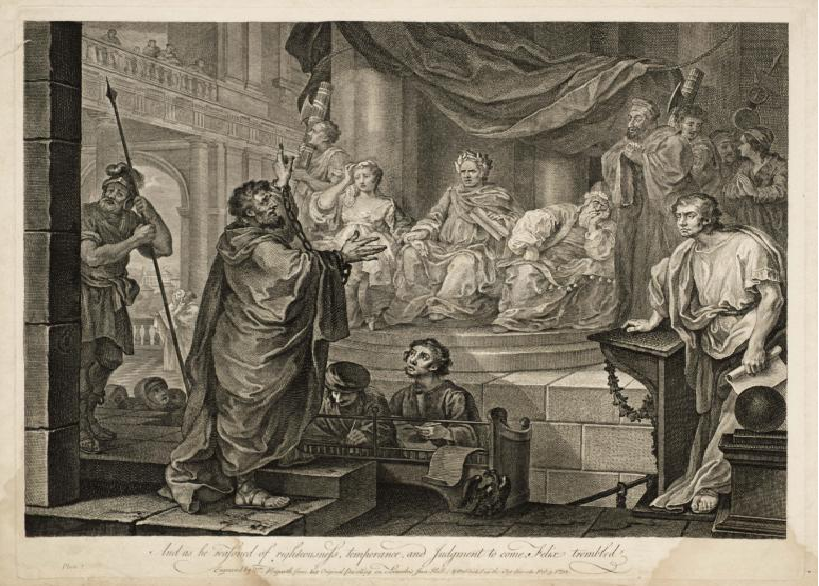
When he was called before Felix, the Roman procurator for the province of Judea, Paul gave an apologetic, that is, a defense, for the Christian faith for which the Jewish leaders had charged him of insurrection. Part of that defense, as recorded in Acts 24:14, is this statement: "This I [i. e., Paul] confess to you [Felix], that, according to the Way, which they [the Jewish leaders] call a sect, I worship the God of our fathers, believing everything laid down by the Law and written in the prophets." 

Paul's defense is not in any mystical revelation, whether by dreams or sensationalist evangelists, but strictly by the testimony that he found in the Bible, the Scriptures which we now know as the Old Testament (compare his later message to Timothy in II Timothy 3:14-15). 

If anyone could, Paul could have spoken of a mystical experience. In Acts 9:1-9, Luke the Physician gives us a record of Paul's, then still called Saul, persecution of the Christians, until he is literally thrown to the ground by Jesus, who challenges him, "Saul, Saul, why are you persecuting Me?" (verse 4). Yet, we are then told, verses 10-19, that this same Jesus then sent a disciple named Ananias to explain the faith to Saul/Paul. "The Lord said to him [i. e., Ananias], 'Go, for he is a chosen instrument of Mine, to carry My name before the Gentiles and kings and the children of Israel'" (verse 15). It is only after this meeting with Ananias that Paul is able to rise and be baptized, not after his vision. 

I think this record is one of the landmarks that distinguish between true Christian churches and the cults. Cults usually start with a leader who claims to have had a mystical experience, apart from Scripture, in which God supposedly taught him or her some new revelation. Nowhere does the New Testament describe conversions as occurring in this way. On the contrary, it is Paul himself who tells us that people are converted by the preaching of that same word of which he testified to Felix (Romans 10:14-17). 

We see this contrast most vividly in the Mormon religion, the founder of which, Joseph Smith, Jr., claimed revelatory visions, including new scriptures, to support his claims of a new religion, new though he claimed Christian terminology for it. The apologetic of Paul contrasts starkly with the claims of Smith, being one of the proofs that Mormonism has no legitimate claim to the name of Christ for its organization. 

Saturday, June 18, 2022

The Intra-Trinitarian Covenant as the Starting Point for Paul


In two places, Paul initiates a theological point  by placing the foundation of his doctrine before time. In Ephesians 1:4, he tells us of the choosing of the elect "in Him," that is, in Christ, "before the foundation of the world." And again in II Timothy 1:8-10, he tells us that the elect are the objects of His calling "before the ages began," but which has now been manifested. We see similar phrases used by John in John 17:24 and Revelation 13:8, and by Peter in I Peter 1:20. 

In each case, we see the salvific purposes of God exercised in time, in history, but based on decisions made before time and history. If it was before creation, then in what context did God work out these plans? Within the fellowship of the three Persons of the Trinity, co-eternal and co-equal. Paul tells us of the plan among the Father (such as verses 3 and 5), the Son (verses 3,4, and 5), and the Holy Spirit (verse 13). Thus Paul displays to us that his soteriology is inherently trinitarian; God's purposes could be carried out only by the intimate involvement of all three of the divine Persons. 

I have shown the scriptural glimpses of this intra-Trinitarian covenant, or convenant of redemption, from the Old Testament (such as here and here), but we must also see that it underpins the theology of the New Testament. Among other things, it necessarily precludes any christological heresy denying the Trinity or any of the Persons, or their deity and preexistence, especially the heresy of modalism. But it also shows the step by step purposes of God in the redemption of His people, not for our sake, but because of the Father's love of the Son. Thus, it cannot fail or be undone. The intra-Trinitarian covenant provides a sound basis for the assurance of salvation. that again precludes most of the aberrant sects, who all maintain a fragility of their version of salvation, such that it can be lost at any time. 

Wednesday, May 11, 2022

David's Sense of God's Inspiration

In giving his final charge to Solomon regarding the building of the Temple, King David included this statement: "All this He made clear to me in writing from the hand of the Lord, all the work to be done according to the plan" (I Chronicles 28:19). 

There is a lot of substance in this one sentence. 

First, David is explicit about the source of his plans for the Temple, i. e., God. He says, "He made clear to me." The writer of the Epistle to the Hebrews develops this statement in Hebrews 8:5: "They [the levitical priests] serve a copy and shadow of the heavenly things. For, when Moses was about to raise the tent, he was instructed by God, saying, 'See that you make everything according to the pattern that was shown you on the mountain.'" That writer was referring to statements that are found in Exodus 25:9, 25:40, 26:30, and 27:8. What Moses was shown regarding the construction of the tabernacle, David also received when the tabernacle was replaced by the Temple. 

Second, David tells us that he received God's words  by the mediatorial hand of the Lord, i. e., Yahweh, the preincarnate Son. This, too, is a pattern we see elsewhere: "The revelation of Jesus Christ, which God gave Him to show to His servants" (Revelation 1:1). What God would inspire to be recorded in the Scriptures had its origin in the triune God, and was then mediated through the Son to the human writer. This is probably what Peter meant when he mentioned that the prophets were taught by the Spirit of Christ when they predicted His "sufferings and subsequent glories" (I Peter 1:11). 

This refutes some neo-orthodox teachers who claim that the writers of the Bible had no concept of divine inspiration when they wrote (compare II Timothy 3:16). While some may not have had such a concept, some did, as we see in the words of David recorded here. 


Wednesday, April 6, 2022

The Conversion of Israel As Proof of the Saint's Perseverance

"I will establish his [i. e., David's] offspring forever, and his throne as the days of the heavens. If his children forsake My law, and do not walk according to My rules, if they violate My statutes, and do not keep  My commandments, then I will punish their transgressions with the rod and their iniquity with stripes, but I will not remove from him My steadfast love or be false to My faithfulness. I will not violate My covenant or alter the word that went forth from My lips" (Psalm 89:29-34). 

These are the words of God in His covenantal promises to King David. Paul echoes them in II Timothy 2:13: "If we are faithless, He remains faithful - because He cannot deny Himself." In both passages, God's faithfulness to His people is never founded on our faithfulness to Him. Rather, even when we are unfaithful, He remains faithful, because to do otherwise would be to deny Himself. To violate His covenant promises would be a betrayal of His own nature, and is, therefore, unthinkable. 

We know the history of Israel, though it was still future to the time of the writing of the Psalm. She was, indeed, unfaithful, and God did, indeed, bring down on her fearsome judgments, especially the destruction of Jerusalem and the temple by the Babylonians, and the carrying away by them of the bulk of the population into captivity. This was a judgment only succeeded by the later judgment under the Romans in 70 AD, when Jerusalem was again looted and the temple destroyed, and an estimated 1.1 million Jews were massacred. From that judgment, the Jews have not yet recovered. Rather, Israel lies under a judicial hardening for her rejection and murder of her Messiah. 

Yet even that judgment points to Psalm 89. 

"It is true [that] the body of that nation, for their unbelief, is now broken off; there is a suspension of the outward part of the covenant. Not that God intends an utter rejection of them. For such as have part in the special election are always saved, Romans 11:7, and the time will come when all Israel shall be saved. For, as touching the election, they are beloved still, though yet unborn. For their sakes it was that 'those days of tribulation were shortened,' Matthew 24:22, which answers to Isaiah 65:8, 'Destroy it not, there is a blessing in it.' The Lord will not so much regard what they have done or deserved as what His covenant is concerning Abraham's seed, which, minding of His covenant, is from the unchangeableness of His purpose. And, therefore, though broken off at present, 'they shall be grafted in again,' verse 24, though driven into all lands, scattered into corners, mingled with the heathen, and become so like them as not to be known asunder. Yet, being His chosen, and within His covenant, He will bring them out of their holes and gather them one by one, Isaiah 27:12. He will do it so accurately, exactly, punctually, that none shall be wanting, 'though sifted among all nations, not one grain shall fall to the earth,' Amos 9:9. The reservation mentioned in Romans 11 was God's omnipotent safeguarding of His elect, when the rest of the nation fell to idolatry. They had gone all, as well as some, had not election held them back. It is, therefore, said to be according to the election of grace. Election was the pattern, and reservation the copy of it" ( Puritan Elisha Coles, "A Practical Discourse of God's Sovereignty"). 

Coles cites the faithfulness of God to His promises to Abraham as the grounds for the sustaining of a faithful remnant among the Jews, and for their eventual national repentance and salvation. And that same faithfulness is why the Christian can be assured that God will enable him to persevere in this life unto eternal life in the age to come. 


Wednesday, December 8, 2021

The Unpopular Biblical Doctrine of Reprobation

"The Lord has made everything for its purpose, even the wicked for the day of trouble." 

-Proverbs 16:4 

I think that the least-popular doctrine of Calvinism is that of reprobation, the biblical teaching that God has not only elected some to salvation, but has also chosen the rest for damnation. In biblical language, it is said that God has made the reprobate from the same lump of clay, but as "vessels for dishonorable use" (Romans 9:21; see same phrase in II Timothy 2:20). Both Peter (I Peter 2:8) and Jude, the brother of Jesus (Jude 1:4), tell us that false teachers were anciently purposed for condemnation. 

Yet, though Scripture is explicit on the matter, Christians hate it, deny it, and turn a blind eye to such verses. Even Reformed Christians soften the teaching by saying that it is merely God's passive passing by those whom He has not decided to elect unto salvation. In other words, God, they say, did not decree that the reprobate would die in unbelief; rather, He simply decided not to ordain their salvation. Yet Scripture tells us, "He hardens whomever He wills" (Romans 9:18). Paul certainly showed no hesitancy in declaring that unbelief is as much the decree of God as is belief. 

So, why are Christians of today hesitant, where our forefathers showed no hesitation to speak plainly? 

I think that it is because of the infiltration of the worldview of autonomy into the Christian mentality that has created this backpedaling. American evangelicals have adopted the American cultural view of autonomy, of personal sovereignty, against which the sovereignty of God is a distasteful atavism. Yes, the Puritans held to God's absolute kingship over the creature, but we have outgrown that. 

We have? 

Not really. Rather, that absolute personal autonomy falls back to a time far earlier than that of Paul, Peter, or Jude. It hearkens back to the words of Satan in Genesis 3:5, when he deceitfully tempted Adam and Eve with the myth of independence of the creature from the Creator. 


Wednesday, September 22, 2021

The Potter, the Clay, and the Doctrine of Reprobation


"Who are you, O man, to answer back to God? Will what is molded say to its molder, 'Why have you made me like this?' Has the potter no right over the clay to make of the same lump one vessel for honorable use and another for dishonorable use?" (Romans 9:20-21).

"Now in a great house, there are not only vessels of gold and silver but also of wood and clay, some for honorable use, some for dishonorable. Therefore, if anyone cleanses himself from what is dishonorable, he will be a vessel for honorable use, set apart as holy, useful to the master of the house, ready for every good work" (II Timothy 2:20-21). 

The first text above, Romans 9:20-21, is one of the classic prooftexts for the biblical doctrine of reprobation, the understanding that God has chosen the nonelect to remain in unbelief, and receive the judgment of damnation in Hell. The Apostle did not create this analogy, but rather borrows it from Isaiah 29:16: "You turn things upside down! Shall the potter be regarded as the clay, that the thing made should say of its maker, 'He did not make me': or the thing formed say of Him who formed it, 'He has no understanding.'" And Jeremiah 18:6: "'O house of Israel, can I not do with you as this potter has done?' declares the Lord. 'Behold, like the clay in the potter's hand, so are you in My hand, O house of Israel.'"

People who hold to any level of Pelagianism avoid Romans 9:21, as they do, in fact, the entire chapter. To say that God claims the right of creator to use His creations as His glory requires is to deny any amount of sovereignty in humans. Yet, just as Satan offered Adam and Eve in Genesis 3:5, the semi-Pelagian advocates an autonomy in men, as if we were self-created and self-redeemed. 

God knows nothing of such autonomy, but, instead, claims the same sovereignty over His human creations as the potter claims over the clay, to make some into vessels of honor, that is, of holiness and blessedness, and others into vessels of dishonor, that is, into holders of wastes to be shattered and discarded (See Leviticus 6:28, 11:33, etc.). 

Saturday, July 10, 2021

The Marital Faithfulness of Jesus to His Church


"I will betroth you to Me forever. I will betroth you to Me in righteousness and in justice, in steadfast love and in mercy. I will betroth you to Me in faithfulness. And you shall know the Lord." 
- Hosea 2:19-20 

This is a sweet promise. If you have read the rest of Hosea, then you know that much of it is about the unfaithfulness of Israel, the covenant community. Yet God takes it upon Himself to describe a time in which He will abolish the unfaithfulness of that community. 

First, I want to point to the last word in that passage: Lord. That English word is used as a gloss for the tetragrammaton, Yahweh, or Jehovah, the name used by by the preincarnate Christ whenever He acted in His mediatorial role. It is Jesus, His cross work, and His resurrection that have purchased the Church, faithful Israel in the Old Testament and the united Jews and Gentiles in the New Testament. His purchase, being effectual in all for whom it was intended (John 6:37-39), cannot fail to make every true believer, not just a believer, but a faithful servant. 

He uses marital imagery, a common theme in both testaments (such as Isaiah 54:5-6, Jeremiah 3:14, and Revelation 19:6-9). This is why our own marriage ceremony includes the vow to be faithful "until death do us part." Granted, that vow has become a mere anachronism among us, but it is not an anachronism to God. His vows are eternal and unfailing, even though we, who call ourselves by His name, are certainly not. "If we are faithless, He remains faithful - for He cannot deny Himself" (II Timothy 2:13).  

This is why I believe so passionately in the perseverance of the saints. I don't use the phrase "once saved always saved," because of its antinomian implications. Rather, God's faithfulness works in His blood-bought people by keeping them faithful, both in the sense of having faith and in the sense of faithful obedience to His word. 

Saturday, January 16, 2021

Never Known versus Fallen from Faith

As I have said before, the doctrine of the Perseverance of the Saints is very precious to me. I am very conscious of my weakness, so I am glad that my unfaithfulness never cancels the faithfulness of God (II Timothy 2:13). That is an important distinction: my perseverance is because Of God's faithfulness, not mine. So the common caricature of the doctrine as an expression of pride is no more than a pejorative, void of any true basis. 

We find this short statement from Jesus in Matthew 7:21-23: "Not everyone who says to Me, ‘Lord, Lord,’ will enter the kingdom of heaven, but the one who does the will of My Father who is in heaven. On that day many will say to Me, ‘Lord, Lord, did we not prophesy in Your name, and cast out demons in Your name, and do many mighty works in Your name?’ And then will I declare to them, ‘I never knew you; depart from Me, you workers of lawlessness.'" Notice that He is talking about men who claim to be His people. Yet He rejects them, because He had never known them! That is an important statement. They are professing believers, members of the visible church. Yet He doesn't say to them, "I now kick you out." Rather, He tells them, "I never knew you." So, while they had claimed to be believers, members of the visible covenant community, the profession of Jesus was that their profession had been false. They had never been members of His invisible church, regenerate and redeemed. The Apostle John put this in more-explicit form in I John 2:19: "They went out from us, but they were not of us; for if they had been of us, they would have continued with us. But they went out, that it might become plain that they all are not of us." 

Are there men who go to church and claim to be Christians, who, later, fall into grievous sin or even deny the faith that they had once professed? Of course. Does that mean that true Christians can become unbelievers? Absolutely not. Rather, they have demonstrated that their profession was a lie, and that Jesus had never known them.

Wednesday, September 16, 2020

Jesus on the Cross Knew His Sheep


"God’s firm foundation stands, bearing this seal: 'The Lord knows those who are His,' and, 'Let everyone who names the name of the Lord depart from iniquity'" (II Timothy 2:19).

The Apostle Paul makes the statement above to his pastoral apprentice Timothy. He seems to be quoting something, but we don't know the origin of the quote. However, we can certainly find equivalent statements of Paul's statement, "The Lord knows those who are His." In fact, Jesus Himself made the same point: "I am the good shepherd. I know My own and My own know Me" (John 10:14). Jesus also declared that He knew who is not His sheep: "You [Jewish leaders] do not believe because you are not among My sheep" (John 10:26). 

Jesus also understood the significance of being one of His sheep:"My sheep hear My voice, and I know them, and they follow Me. I give them eternal life, and they will never perish, and no one will snatch them out of My hand. My Father, who has given them to Me, is greater than all, and no one is able to snatch them out of the Father’s hand" (John 10:27-29). The sheep of Jesus are those that He would later redeem on the cross, a redemption which would be effectual and irreversible (compare John 6:37-39). 

The image I like is another one used in Scripture, Jesus as the bridegroom, and the church, i. e., all of His sheep together, as the bride. In that patriarchal society, fathers chose the spouses for their children. Arranged marriages were the norm. As His Father, God the Father had chosen a bride for His Son, and Jesus, as the dutiful Son, could neither reject that bride for another nor fail to bring His marriage to fulfillment. Yet, the Arminian wants us to believe that Jesus did not know His bride. In fact, the Arminian would have us believe that there was no guarantee that there would be a bride. Rather, the Groom was to be blindfolded, to share His favors with any stranger. He was to give His divine love to even the prostitute (Proverbs 5:1-20). 

But no, Paul tells us. the Lord knows those who are His. he knows His bride, and that she is no seductress.

Wednesday, January 1, 2020

Particular Atonement Required by Reason

I think that the only doctrine in Scripture hated more than eternal conscience torment in Hell is particular atonement (also called definite atonement, or limited atonement), the belief that Jesus died for a particular group of people, for whom He fully achieved salvation. While this doctrine is often described as Pauline, it is also found in the direct teachings of Jesus. I don't see any way to avoid it in Scripture.

Moreover, reason requires a particular atonement. Here is why. First, if Jesus died for all of the sins of all men, then all men are saved. Yet we know from both Scripture and experience that this is not the case. Second, if Jesus died for only some of the sins, whether of only some men or of all men, then all men still have sins for which there has been no atonement, and, therefore, they are condemned to Hell. Or lastly, if Jesus died for all of the sins of some men, as I urge is the case, then those men have no sins for which to be judged, and they shall effectually receive eternal life. I have borrowed these arguments from the great Puritan theologian John Owen.

Almost every Arminian will, at this point, interject that salvation requires a person to respond with faith and repentance, before the atonement can be applied to him. There are two logical problems with that assertion, a lesser and a greater. The lesser problem is that unbelief is a sin. Did Jesus atone for it? If yes, then unbelief is no barrier to salvation. If no, then even the believer must be judged for his prior unbelief. He can never be saved, whether he believes or not. The greater problem is what such a doctrine teaches about the blood of Jesus. It is insufficient, says the Arminian, and must be augmented by something added by the believer. What a sleight against our Lord, whom we were falsely assured would save His people from our sins (Matthew 1:21), and who was falsely promised by His Father that He would see the successful travail of His soul (Isaiah 53:11), and who, in turn, promised us that He could not fail to save anyone whom the Father had given Him (John 6:39). The assertion of the Arminian also ignores the Scriptures that tell us that faith (Ephesians 2:8, Romans 12:3) and repentance (Acts 5:31, II Timothy 2:25) are given to the believer by God, not something that the unbeliever gives God.

"Christ by His sufferings and death completely satisfied the justice of God in regard to the sins of His people. They, through Him, either cease to be guilty or they must die; their consciences are either purged by His blood or they have no peace. They are still under the law and its curse, or they are delivered from its condemnation" (James Henley Thornwell, "The Necessity and Nature of Christianity").

Wednesday, August 14, 2019

The Dual Judgment as a Refutation of Annihilationism

In interactions with annihilationists, I always insist that the Christian at death is immediately ushered into the presence of Jesus in Heaven (see II Corinthians 5:8 and Philippians 1:21-23), and the wicked are immediately delivered to Hell (II Peter 2:9). Their usual response is, "Then what is the Judgment for?" And I can see why they ask.

In John 3:18-21, we have these words from Jesus: "Whoever believes in Him is not condemned, but whoever does not believe is condemned already, because he has not believed in the name of the only Son of God. And this is the judgment: the light has come into the world, and people loved the darkness rather than the light because their works were evil. For everyone who does wicked things hates the light and does not come to the light, lest his works should be exposed. But whoever does what is true comes to the light, so that it may be clearly seen that his works have been carried out in God." Notice His words: "Whoever does not believe is condemned already." In other words, the judgment for sin occurs in life, unless atoned by the blood of Christ through faith. Judgment is not waiting for the end of history when Jesus returns. 

Does that mean that there won't be a great Judgment at the end of history? Not at all. As Paul tells us in II Corinthians 5:10: "For we must all appear before the judgment seat of Christ, so that each one may receive what is due for what he has done in the body, whether good or evil." See also II Timothy 4:1 and Revelation 20:12.

Is there a contradiction here? Of course not. Rather, the two passages are talking about two separate things. We are truly judged at death: "It is appointed for man to die once, and after that comes judgment" (Hebrews 9:27). Then what happens at the final judgment is told to us in John 3:21, quoted above: "Whoever practices the truth comes into the Light, so that it may be seen clearly that what he has done has been accomplished in God." The final Judgment is public, unlike the judgment that occurs at each person's death. In it, the works of each person are revealed, so that the justice of God is revealed to all, whether men, angels, or demons. The wicked are revealed in their wickedness, so that the glory of God's justice is displayed. At the same time, the wicked acts of the godly are also revealed, so that the glory of His grace is also displayed. 

Saturday, February 16, 2019

Antinomian "Love" versus the Word of God

I run into a lot of Christians who proclaim, "Love does no wrong to a neighbor; therefore love is the fulfilling of the law" (Romans 13:10). They claim that having Christian love abrogates the biblical Law, because we now have an ability to love, which is higher than the requirements of the Law.

However, as such prooftexting often does, this claim ignores the context of that verse. Notice the immediately-preceding verse: "For the commandments, 'You shall not commit adultery, You shall not murder, You shall not steal, You shall not covet,' and any other commandment, are summed up in this word: 'You shall love your neighbor as yourself'" (Romans 13:9). Paul actually cites four of the Commandments, then refers to the others, and tells us that they are summarized in the commandment to love. Summarized, not abrogated. Loving others means obeying the Law in regard to our relations to them. It is not a get-out-of-jail-free card that leaves us free to disregard the Law. 

It is this same author, the Apostle Paul, who leaves this instruction: "Let everyone who names the name of the Lord depart from iniquity" (II Timothy 2:19; see John 10:14). In order to depart from iniquity, the Christian must be able to identify it. But how? The antinomian simply claims that it is whatever is contrary to love. But love according to whom? The child molester has a very different understanding of love from that of his victims. How do we determine which one is right? That question takes us right back to Romans 13:9. We determine true love by comparing it to the standards of God, which are found in the biblical Law.


Wednesday, July 25, 2018

Only the Regenerate Have Free Will

Arminians have enshrined their doctrine of free will, making it the concept that trumps all others. Yet, it has no biblical basis. Ask them! They will hem and haw about why it should be true, but they will offer zero biblical justification.

I suggest, instead, that Scripture is against their doctrine of free will (not that I deny the reality of free will, as I have said before). Rather, I deny their use of it, to mean that men have a will that can choose to seek and obey God. "Free" merely means without coercion. No one, including God, coerces the unregenerate to hate God and to rebel against Him. That is their nature, and they freely, even gladly, choose to act according to it, just as a bird freely wills to fly or a fish to breathe water. But the Arminian would never claim that a man is free to will either of those, since both are contrary to the nature of a man. However, the Arminian blanks out the logical parallel between that and a choice by the unregenerate to act regenerate.

Paul says, "God may perhaps grant them repentance leading to a knowledge of the truth, and they may come to their senses and escape from the snare of the devil, after being captured by him to do his will" (II Timothy 2:25-26). Whose will does the sinner freely follow? Not his own. Rather, he wills the will of Satan. The coercion isn't by God, or predestination, but rather by Satan. Yet the Arminian never criticizes Satan for ignoring man's free will! That misdirection is very telling!

What breaks that bondage? It is only by the prevenient act of the Holy Spirit in regenerating the elect sinner. It is by this intervention that Jesus, in His kingly office, overthrows the power of Satan and brings that man to repentance and faith: "When a strong man, fully armed, guards his own palace, his goods are safe; but when one stronger than he attacks him and overcomes him, He takes away his armor in which he trusted and divides his spoil" (Luke 11:21-22).

Turning to Paul again, he summarizes this in Romans 9:16: "So then it depends not on human will or exertion, but on God, who has mercy."

Saturday, May 5, 2018

The Bible, Truth, and the Myth of Autonomy

In dealing with agnostics or atheists, I, of course, use the Bible as my source of truth. That is what distinguishes me as a Christian. To act otherwise is to be a non-Christian. However, the other person will often respond with a challenge to the effect of, "Prove that the Bible is authoritative." Yet, the atheist, even as he is demanding rational evidence, doesn't recognize the irrational presupposition of his question.

As a Christian, I accept what the Bible says about itself: "All Scripture is breathed out by God and profitable for teaching, for reproof, for correction, and for training in righteousness, that the man of God may be complete, equipped for every good work" (II Timothy 3:16-17). Since the Bible is the word of God, then it carries His truth and His authority. But that isn't the information that the atheist is demanding. He wants evidence that convinces him, from his worldview of autonomy. Therefore, if I answer his question according to his standards, then I am necessarily abandoning my worldview and adopting his. Therefore, as a Christian, I cannot argue that way. Nor do you ever see Jesus or any of the apostles arguing in such a way. They always presuppose the reality of God and the truth and authority of the Bible.

Rather, from the Scriptures, I can demonstrate that the godless worldview of human autonomy is exactly what Satan offered to Adam and Eve in the garden: "The serpent said to the woman, 'You will not surely die. For God knows that when you eat of it your eyes will be opened, and you will be like God, knowing good and evil" (Genesis 3:4-5, "knowing" meaning "deciding" here). Accepting that premise, Adam rejected the world created for him by God, a world without disease, suffering, or death, and chose instead the world we have. That was an irrational choice.

The atheist repeats, and wants me to repeat, that same irrational choice. That is the implication of his demand that I satisfy his supposed autonomous human will. And, since I reject the choice that Adam made, I cannot answer him the way the atheist demands.

First, we must understand that the atheist's demand is a dishonest one. He knows the truth of God, because it is revealed to him in the creation (Psalm 19:1-4) and in his conscience (Romans 2:15). So, why isn't he a Christian? Because part of that knowledge is that the existence of God and our accountability to Him necessarily mean that men are not autonomous, in spite of Satan's promise in Genesis. Therefore, to maintain the illusion of autonomy, the atheist suppresses his knowledge of God (Romans 1:18-22). That means that, when I explain to him the truth from God's word, I am not addressing someone who does not understand. He simply hates the truth, and is trying to avoid it.

Second, this is not a matter of human persuasion. God promises to prosper His word: "So shall my word be that goes out from My mouth; it shall not return to Me empty, but it shall accomplish that which I purpose, and shall succeed in the thing for which I sent it" (Isaiah 55:11). If this atheist is one bought by the blood of Jesus, then God will make His word effectual in breaking through his suppression of knowledge, thus bringing him to saving faith. The battle is the Lord's! As Luke says of a particular evangelistic occasion: "When the Gentiles heard this, they began rejoicing and glorifying the word of the Lord, and as many as were appointed to eternal life believed" (Acts 13:48).

Saturday, December 16, 2017

Judging the Truth of the Bible

In our political system, courts have the power to judge the validity of laws passed by Congress. What is the basis on which they  - at least, hypothetically - base their judgments? On the basis of the Constitution. That is, the Constitution has a higher, a priori, status than do Congressional acts. That makes sense, doesn't it? We expect to judge a thing by a standard which is higher than the thing judged.

That creates a problem when you seek to judge the highest thing. Against what would you judge the validity of the Constitution? In the field of law, there is no such higher standard.

That brings me to the discussion of the truth of the Bible. The challenge from the atheist is to prove the Bible. Yet, no one seems to notice the supposition hidden in the words of that question. That is, no one admits that it is a loaded question.

When the atheist (or whomever) demands proof for the Bible, he is demanding that the Bible be judged by a higher standard, one that he accepts. Not only must that standard, whether reason or experience, etc., be higher than the Bible, but it must be something that satisfies his intellectual nature. Thus, there are really two higher standards, with his mind as the highest of all.

Ah, here is that dastardly hidden supposition: that atheist is presupposing his own sovereignty, autonomy, his right to judge God.

This is as if some Congressman claimed that, before his law could be subjected to the Consitution, the Constitution must first be subjected to his personal satisfaction. Would he not be considered presumptuous? Perhaps even irrational?

Yet, no one makes any such judgment of the atheist who expects to judge God and His word before it can be accepted! Here is his argument, though it is never made explicit: "The Bible is not God's word; therefore, I am not responsible to its authority."

The only legitimate approach is to consider the Bible on its own authority. That is, for example, "All Scripture is breathed out by God and profitable for teaching, for reproof, for correction, and for training in righteousness" (II Timothy 3:16). Is that circular reasoning? After a fashion. However, as I have sought to demonstrate, a certain circularity is unavoidable when dealing with ultimate standards. If the Bible is God's word, then I must accept it as true. Any other approach assumes that it is not God's word, and is, thus, also circular: "It is not God's word; therefore, it is not God's word."

That's why no one in Scripture ever attempts to prove the truth of Scripture. The Prophets, Jesus, the Apostles, all assumed that it is absolute truth, and proceeded, not to prove it, but to apply it.

Wednesday, August 9, 2017

There Is No Merit in Repentance


When he preached at the Areopagus in Athens (Acts 17:16-34), one of the things the Apostle Paul told his hearers was, "[God] commands everyone everywhere to repent of their sins and turn to Him" (verse 30). Pelagians will often claim that a command to repent must imply that the ability to do so is natural to every man. Of course, that claim is consistent with the a priori belief of the Pelagian that men are capable of all forms of spiritual good, not just repentance. And it is just as false.

That is certainly not how repentance is described in Scripture.

Consider, first, Psalm 80:3: "Restore us, O God; let Your face shine, that we may be saved." The word "repentance" does not appear here. However, in order to be "restored," do we not have to repent? Yet, restoration in this verse is something that God does, not us.

Second, look at Jeremiah 31:18: "Bring me back that I may be restored, for You are the Lord my God." This sentence contains two verbs, "bring" and "restore," that make the same point, that it is God's initiative to bring us to repentance, not something that a sinner creates in himself.

And third, turn to Lamentations 5:21: "Restore us to Yourself, O Lord, that we may be restored!" Again, the same Prophet uses that word, "restore."

In the New Testament, we find the same concept, but using the word "repent," in Acts 5:31: "God exalted Him at his right hand as Leader and Savior, to give repentance to Israel and forgiveness of sins." Just as fallen Israel cannot forgive her own sins, neither can she create her own repentance. Rather, God must give both. This verse is especially important, because, by pairing those two things, no one can claim that one is by free will, without the implication that the other is, as well.

Also, look at the words of Paul in II Timothy 2:24-25: "And the Lord’s servant must not be quarrelsome but kind to everyone, able to teach, patiently enduring evil, correcting his opponents with gentleness. God may perhaps grant them repentance leading to a knowledge of the truth." Not only does he describe repentance as having its origin in God, not in us, but he also tells us that God is under no obligation to give it. When He does, it is an act of grace and mercy, not of imperative.

Unlike its common perversion even among Evangelicals, repentance is not an act of human merit. It is not a thing that fallen man can produce and offer to God. Rather, it is something that God, out of His goodness, mercy, and sovereign will, gives to the elect alone. Pelagianism is the natural religion of the sinful human heart, but the Scriptures refute it.

Saturday, July 8, 2017

The Bible as the Only Means of Sanctification

"How can a young man keep his way pure?
     By guarding it according to Your word.

I have stored up Your word in my heart,
     that I might not sin against You.

Your word is a lamp to my feet
     and a light to my path.

Keep steady my steps according to Your promise, 
     and let no iniquity get dominion over me."
- Palm 119:9, 11, 105, 133

Muslims and cultists around the world speak of the morality of professing American Christians and claim that it is a reflection of the nature of Christianity. And, in a sense, they are right to look at us. After all, if we profess that faith, then we should live accordingly. What is sad, however, is that they understand that, but all of those professing Christians don't. As I have pointed out here, the religion of America ceased long ago to be Christianity, and is, instead, deism, though baptized with Christian terminology.  

However, for the true Christian, what brings moral failure? How should he judge whether his life reflects the Lord that he professes? In the four verses above, the Psalmist gives us clear and explicit counsel.

In each of these four verses, there is a reference to the Scriptures. In the first three, it is called the "word." That emphasizes that the Bible is no mere word of men, but is really the word of God (I Thessalonians 2:13), God-breathed (II Timothy 3:16). And the last verse calls it  the "promise," because it is God's word to us, His message of salvation, of sanctification, and of glorification (Romans 8:30).

Then, also in all four verses, the Psalmist describes a role for the Scriptures in our sanctification, that is, the process of repudiating sin and striving more and more to be like Jesus. He desires to be "pure" (verse 9), "not to sin" (verse 11), to be enlightened (verse 105), and that "iniquity will not have dominion" (verse 133). Each of those phrases describes his desire to repudiate his old life of sin and to live as the new creation he is in Christ (II Corinthians 5:17). He refuses the deistic, humanistic mindset, which says that doing right is what he feels is right. Rather, doing right is doing what God says is right. And that we can find only in Scripture.

Saturday, May 27, 2017

Regeneration and Repentance

Peter on Solomon's Portico
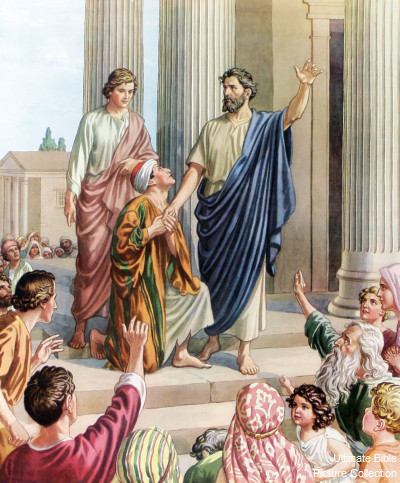
In Acts 3:15-21, Luke gives us an account of a sermon to the Jews in front of the Temple. "You killed the Author of life, whom God raised from the dead. To this we are witnesses. And His name—by faith in His name—has made this man strong whom you see and know, and the faith that is through Jesus has given the man this perfect health in the presence of you all. And now, brothers, I know that you acted in ignorance, as did also your rulers. But what God foretold by the mouth of all the prophets, that His Christ would suffer, He thus fulfilled. Repent therefore, and turn back, that your sins may be blotted out, that times of refreshing may come from the presence of the Lord, and that He may send the Christ appointed for you, Jesus, whom heaven must receive until the time for restoring all the things about which God spoke by the mouth of His holy prophets long ago."

As God had planned (see Acts 4:27-28),  the Jews had rejected their Messiah and killed Him on the cross. This was God's purpose, to bring to pass the redemption of His church (Ephesians 5:25). But the perpetrators of that crime, the unbelieving Jews, had declared a curse upon themselves: "His blood be on us and on our children!" (Matthew 27:25). Yet, notwithstanding their self-cursing, Peter tells them how to escape the wrath of God: "Repent and turn back, that your sins may be blotted out" (Acts 3:19). And this was no new doctrine, for it was exactly what had been proclaimed in their Hebrew Scriptures: "Come now, let us reason together, says the LORD: though your sins are like scarlet, they shall be as white as snow; though they are red like crimson, they shall become like wool" (Isaiah 1:18).

Many people put an incorrect order to this. They suppose that an unregenerate man first repudiates his sin, and then believes in God, and then, finally, is justified. That, in fact, is impossible. The unregenerate man has no interest in forsaking sin or turning to God: "None is righteous, no, not one; no one understands; no one seeks for God" (Romans 3:10-11). First, God must work regeneration in the heart of that man (Ezekiel 36:26). Then, God gives Him faith to recognize a reconciled God in the redeeming blood of Jesus (Ephesians 2:8-9), by which means God then inspires him to repent of his sins (Acts 5:31 and II Timothy 2:25). Note that each step is by the initiation of God, never by man: "For those whom He foreknew He also predestined to be conformed to the image of His Son, in order that he might be the firstborn among many brothers. And those whom He predestined He also called, and those whom He called He also justified, and those whom He justified He also glorified" (Romans 8:29-30).

Peter's answer to the Jews was that they needed to repent. And being knowledgeable of their Old Testament Scriptures. they know what he meant. However, even Christians today are ignorant of the Scriptures, especially the Old testament, so we don't have a proper understanding of how it occurs. It is not something which one can do by working at it. Rather, it can only be something that God works in him: "I have heard Ephraim grieving, 'You have disciplined me, and I was disciplined, like an untrained calf; bring me back that I may be restored, for you are the Lord my God" (Jeremiah 31:18). See also Acts 5:31 and II Timothy 2:25. And it is something that He promises to do in His elect: "I, I am He who blots out your transgressions for my own sake, and I will not remember your sins" (Isaiah 43:25).

Saturday, November 5, 2016

Evangelical Assurance: The True Believer Can Have It!

One of the most horrible teachings, to my mind, of the cults is that a person cannot know for sure that he has eternal life. The Roman Catholic Church says that it is presumptuous to be assured of heaven. The Church of Christ says that a person can be a believer today, and then be an unbeliever tomorrow. For them, one can be confident if one dies right now, but there can be no assurance for tomorrow. Most Arminians aren't that extreme. They claim that one can have assurance right now, but the future holds no certainty.

Those views turn the Christian walk into a terror! The person has come to understand the eternal consequences of sin, but is not set free of that fear of death.

The Westminster Confession of Faith (XVIII:1) says something wonderful on this topic: "Although hypocrites, and other unregenerate men, may vainly deceive themselves with false hopes and carnal presumptions: of being in the favor of God and estate of salvation; which hope of theirs shall perish: yet such as truly believe in the Lord Jesus, and love Him in sincerity, endeavoring to walk in all good conscience before Him, may in this life be certainly assured that they are in a state of grace, and may rejoice in the hope of the glory of God: which hope shall never make them ashamed."

On what basis did the divines assert this wonderful truth? It is all over Scripture, the word of God! Here are just a few examples.

In Job 19:25-27, we read, "For I know that my Redeemer lives, and at the last He will stand upon the earth. And after my skin has been thus destroyed, yet in my flesh I shall see God, whom I shall see for myself, and my eyes shall behold, and not another." That patriarch, even after all of the horrible things that have happened to him, looks with confidence to the day when he will stand before his redeemer in the resurrection.


In a better-known passage, Psalm 23:4-6, King David wrote, "Even though I walk through the valley of the shadow of death, I will fear no evil, for You are with me; Your rod and Your staff, they comfort me. You prepare a table before me in the presence of my enemies; You anoint my head with oil; my cup overflows. Surely goodness and mercy shall follow me all the days of my life, and I shall dwell in the house of the Lord forever." Like Job, David was in a dark period in his life, but his confidence is in the knowledge that he would "dwell in the house of the Lord forever." Not "I might"; not "I hope so." But "I shall."

In Isaiah 26:1, that Prophet proclaims, "You keep him in perfect peace whose mind is stayed on you, because he trusts in you." And in Isaiah 32:17, he adds, "The effect of righteousness will be peace, and the result of righteousness, quietness and trust forever." Notice the use of "peace" in both verses. The believer has no reason to fear for his eternal security, but rather can have have peace.

In the New Testament, the Apostle Paul adds his testimony in Romans 8:38-39: "For I am sure that neither death nor life, nor angels nor rulers, nor things present nor things to come, nor powers, nor height nor depth, nor anything else in all creation, will be able to separate us from the love of God in Christ Jesus our Lord." Isn't that wonderful? Isn't it liberating? There is nothing in creation, even our own weakness, that can cause us to lose God's love.

The same Apostle also said, in II Timothy 4:6-8, "The time of my departure has come. I have fought the good fight, I have finished the race, I have kept the faith. Henceforth there is laid up for me the crown of righteousness, which the Lord, the righteous judge, will award to me on that day." He is contemplating the approach of the end of his life. Is he shivering in fear? Is there trepidation in his words to his apprentice? No! Rather, he expresses absolute confidence in his eternal reward.

The next time some priest or preacher claims that the believer cannot be certain of heaven until he gets there, remember these verses. And this is not an exhaustive list. That man is a false teacher. He wants you to depend on him for your confidence, rather than on Jesus. Flee that place!That is the surest mark of a cult.