Showing posts with label isaiah. Show all posts

Wednesday, July 9, 2025

Anthropomorphisms for God Against Mormon Theology

One of the the doctrines that distinguish Mormons from biblical Christians is their belief that God the Father has a physical body like that of a human being. That is, they take references in the Bible literally, such as to His eyes, or arms, ears, feet. 

In contrast, biblical Christians take such references to be anthropomorphisms. That is, figures of speech in which is God is described as if He has human features, not because He does, but in order to make Him more relatable to mortal men. That is because He tells us explicitly that He is not a man: "God is not a man" (Numbers 23:29, I Samuel 15:29). Furthermore, we are told that His divine nature is invisible (Colossians 1:15, I Timothy 1:17). 

When I have denied their literal use of such anthropomorphisms in reference to God, I have had Mormons tell me that I demonstrate that I do not believe what the Bible says. 

However, anthropomorphisms in the Bible are not limited to references to God. 

"For you shall go out in joy and be led forth in peace; the mountains and the hills before you shall break forth into singing and all the trees of the field shall clap their hands" (Isaiah 55:12). Here there are anthropomorphisms of land features and trees expressing emotions like human beings. I posted the verse in a discussion group with Mormons and asked if they believe that mountains can sing or that trees have hands. Of course, they denied that they do. So then I asked, don't you believe the Bible? Then some fell silent while others turned to ridicule. None even attempted a rational distinction between this verse and the ones that they claim refer to literal body parts of God. 

Mormon exegesis falls apart under a little examination. 


Friday, May 23, 2025

Human Moral Inability and the Gospel

 "I know, O Lord, that the way of man is not in himself, that it is not in man who walks to direct his steps" (Jeremiah 10:23). 

I have written many times about the doctrine of total depravity. This is the doctrine of total inability, which is closely related, but distinct. Total depravity is the condition, while total inability is the result. That is, sin has affected every faculty of our humanity, the result of which is that there REMAINS no native ability in us to perform any moral good. The two things are often equated, but I am treating them separately, because I think that Scripture addresses them separately. 

It is a common error of supporters of free will that the doctrine of total inability is an invention of John Calvin, based on a misreading of the writings of Paul. I deliberately chose the verse above from Jeremiah to show that both aspects of that accusation are wrong. Total inability is an invention of neither Paul nor John Calvin. 

Rather, we see in the prophet his concern that men are unable to obey God from any ability in ourselves. As he faced the coming prospect of the exile of Judah in Babylon, he lamented that Judah could not reform himself. So, he pleaded, "correct me" (verse 24), because I cannot correct myself. That is, speaking on behalf of his people. 

As theologian John Frame has said, "Although fallen persons are capable of externally-good acts (acts that are good for society), they cannot do anything really good, I. e., pleasing to God (Romans 8:8). God, however, looks on the heart. And from His ultimate standpoint, fallen man has no goodness, in thought, word, or deed. He is, therefore, incapable of contributing anything to his salvation."

That is the connection of this doctrine to the gospel. The inability of men to display the righteous nature that God requires would naturally doom all men to eternal judgment (Hebrews 12:14), would display, not injustice on God's part, but rather hopelessness on the part of men. Instead, God established a righteousness which is by faith alone, the imputation of the perfect righteousness of a surety, an alien righteousness, granted to every sinner for whom He died on the cross, Jesus of Nazareth (Isaiah 26:12, John 6:37-39, II Corinthians 5:21). 

Thursday, March 14, 2024

The Puritans on the Sabbath

I think that it can be argued that the Fourth Commandment is the most-ignored among the ten, even among Christians. Or should I say especially among Christians? After all, it is we who should best understand the significance of the Sabbath. 

Here is what the commandment says: "Remember the Sabbath day, to keep it holy. Six days you shall labor and do all your work, but the seventh day is a Sabbath to the Lord your God. On it you shall not do any work, you, or your son, or your daughter, your male servant, or your female servant, or your livestock, or the sojourner who is within your gates. For in six days the Lord made heaven and earth, the sea, and all that is in them, and rested on the seventh day. Therefore the Lord blessed the Sabbath day and made it holy" (Exodus 20:8-11). 

So we notice several things here. First, the origin of the Sabbath is not in the commandment. That is a common error regarding this commandment, that it began with Moses. No, God Himself relates it back to his own actions in the creation: "On the seventh day, God finished His work that He had done, and He rested on the seventh day from all His work that He had done. So God blessed the seventh day and made it holy, because, on it, God rested from all His work that He had done in creation" (Genesis 2:2-3). Surely we understand that this is not a description of the weariness of God. Such an idea doesn't even make sense. Rather, it is a description of His enjoyment of the completion of His work, like the artist who steps back to enjoy the painting that he has just finished. 

Second, Christians strangle every discussion of the Sabbath by wrangling over what we are and are not allowed to do on that day. That discussion misses the point. It also ignores what the description that God Himself gives us in His word: "If you turn back your foot from the Sabbath, from doing your pleasure on My holy day, and call the Sabbath a delight and the holy day of the Lord honorable; if you honor it, not going your own ways, or seeking your own pleasure, or talking idly; then you shall take delight in the Lord, and I will make you ride on the heights of the earth; and I will feed you with the heritage of Jacob your father, for the mouth of the Lord has spoken" (Isaiah 58:13-14). The Sabbath has never been about rules. That was the error of the Pharisees, which turned the Sabbath into a burden

The Sabbath was God's plan for His people to have joy, both in the work that we have done establishing His dominion in a fallen world, but especially in the work that He has done in redeeming us from the curse that sin has placed on us and our work! 

The Puritan Stephen Charnock, in his book The Existence and Attributes of God, chastised the Christians of his day, in words that apply even more to today's Christian, "A sleight and weariness of the Sabbath was a sleight of the Lord of the Sabbath and of that freedom from the yoke and rule of sin that was signified by it."

Joy! Not drudgery! 


Wednesday, October 4, 2023

The Commandments of God in Stone and the Hearts of Men


Most people are not aware that God gave Moses the Ten Commandment not once but twice. The first time is described in Exodus 24:12: "The Lord said to Moses, 'Come up to Me on the mountain and wait there, that I may give you the tablets of stone, with the law and the commandment, which I have written for their instruction.'" And again in 31:18: "And He gave to Moses, when He had finished speaking with him on Mount Sinai, the two tablets of the testimony, tablets of stone, written with the finger of God." These tablets were the ones shattered by Moses in anger at the idolatry of the Israelites in their worship of the golden calf (chapter 32).

After shattering the original tablets, Moses was then tasked with replacing them with a new pair of tablets, which he himself fashioned. "The Lord said to Moses, 'Cut for yourself two tablets of stone like the first, and I will write on the tablets the words that were on the first tablets, which you broke'" (Exodus 34:1). As when Adam fell into sin, when Moses broke the commandments, literally, he was cursed with an increase in labor, having to carve and carry the stone tablets himself. 

This historical event came to my mind during a recent Sunday school lesson at my church. Part of that lesson dealt with the law of God written on human hearts. We see this in two places in the New Testament. First, Paul mentions it in Romans 2:15: "[Gentiles] show that the work of the law is written on their hearts, while their conscience also bears witness, and their conflicting thoughts accuse or even excuse them." Then the writer of Hebrews mentions it again as part of the new covenant, which he, in turn, borrowed from the Prophet Jeremiah: "This is the covenant that I will make with them after those days, declares the Lord: I will put My laws on their hearts, and write them on their minds" (Hebrews 10:16, from Jeremiah 31:33). 

Notice the parallels between these two pairs of events. In each, God gave His holy commandments, but they were broken by men. And then God gave them again

By this pairing of breaking and restoration, we see two magnificent things. First is that God does not lower His standards merely because men cannot meet them. To do so would be to betray His own holiness. And second is His mercy. While the breaking of the law naturally incurs the death penalty (Romans 6:23), God's work is restorative, not punitive, for His elect. He restores His law (Isaiah 42:21). And He restores His elect through the imputation by faith of the perfect obedience of His only-begotten Son, Jesus Christ (John 1:17, II Corinthians 5:21, Romans 3:21-22). 

Saturday, May 27, 2023

The Scriptures as the Basis of Our Apologetic

 Psalm 119 is the longest chapter in the Bible, with 176 verses. Of those verses, only three don't contain a word referring to the scriptures, such as law, commandments, or testimonies. The Psalm is 176 references to the benefits of God's Word in the life of the believer. I will focus on the section labeled "Waw," verses 41-48. 

"Let Your steadfast love come to me, O Lord, Your salvation according to Your promise; then shall I have an answer for him who taunts me, for I trust in your Word. And take not the word of truth utterly out of my mouth, for my hope is in Your rules. I will keep Your law continually, forever and ever, and I shall walk in a wide place, for I have sought your precepts. I will also speak of Your testimonies before kings and shall not be put to shame, for I find my delight in Your commandments, which I love. I will lift up my hands toward Your commandments, which I love, and I will mediate on Your statutes" (Psalm 119:41-48).  

The Psalmist here uses the same encouragement that Jesus gave to His disciples: "Behold, I am sending you out as sheep in the midst of wolves, so be wise as serpents and innocent as doves. Beware of men, for they will deliver you over to courts and flog you in the synagogues, and you will be dragged before governors and kings for My sake, to bear witness before them and the Gentiles. When they deliver you over, do not be anxious how you are to speak or what you are to say, for what you are to say will be given to you in that hour. For it not you who speak, but the Spirit of your Father speaking through you" (Matthew 10:16-20). 

In both passages, it is the source of our answers that should give us confidence, because it is the very Word of God, inspired  by the Holy Spirit. The rest of Psalm 119 relays the means to this end, the constant study of, and obedience to, the Word of God. 

What is often forgotten in our apologetical confrontations is that there is no promise in Scripture that God will give success to our clever response. Rather, He promises His power to attend His word: "So shall My word be, that goes out from My mouth; it shall not return to Me empty, but it shall accomplish that which I purpose, and shall succeed in the thing for which I sent it" (Isaiah 55:11). 


Wednesday, May 3, 2023

Book of Numbers and Sprinkling as the Mode of Baptism

Most Christians would say that Numbers is a book that they avoid reading. And I admit that the censuses of Israel, from which the book gets its name in English, are tedious, and I usually skip over them. However, to skip the entire book is to miss some hidden gems within it. 

What struck me recently is the rite of purification, described in chapter 19: "Now the Lord spoke to Moses and to Aaron, saying, 'This is the statute of the law that the Lord has commanded: Tell the people of Israel to being you a red heifer without defect, in which there is no blemish, and on which a yoke has never come. And you shall give it to Eleazar the priest, and it shall be taken outside the camp and slaughtered before him. And Eleazar the priest shall take some of its blood with his finger and sprinkle some of its blood toward the front of the tent of meeting seven times. And the heifer shall be burned in his sight. Its skin, its flesh, and its blood, with its dung, shall be burned. And the priest shall take cedarwood and hyssop and scarlet yarn and throw them into the fire burning the heifer... And a man who is clean shall gather up the ashes of the heifer and deposit them outside the camp in a clean place. And they shall be kept for the water for impurity for the congregation of the people of Israel; it is a sin offering'" (Numbers 19:1-6, 9, emphasis added). 

So we have a ceremony described by God, in which a heifer, that is, a cow that has not yet been bred or worked, is to be sacrificed. Its blood is to be sprinkled before the tabernacle, the symbol of God's presence among His people. It was then to be burned and its ashes gathered and saved for "the water of impurity." 

"'This is the law when someone dies in a tent: everyone who comes into the tent and everyone who is in the tent shall be unclean seven days... For the unclean they shall take some ashes of the burnt sin offering, and fresh water shall be added in a vessel. Then a clean person shall take hyssop and dip it in the water and sprinkle it on the tent and on all the furnishings and on whoever touched the bone or the slain or the dead or the grave. And the clean person shall sprinkle it on the unclean on the third day and on the seventh day. Thus, on the seventh day he shall cleanse him, and he shall wash his clothes and bathe himself in water, and at evening he shall be clean'" (Numbers 19:14, 17-19). Reference to sprinkling can also be found in verse 21. Thus, the rest of the ceremony is that the ashes from the heifer would be mixed with water and sprinkled on the unclean person, and he would be cleansed. 

Finally, in Isaiah 52:15, part of the Suffering Servant passage, we read the words of the prophet to Israel of the coming Messiah who would cleanse His people from their sins. How? "He shall sprinkle many nations." The blood of Jesus is to sprinkled by faith on unclean sinners just as the ashes of the heifer were sprinkled on the unclean under the law of Moses. That is no coincidence! The one is a type of the other. 

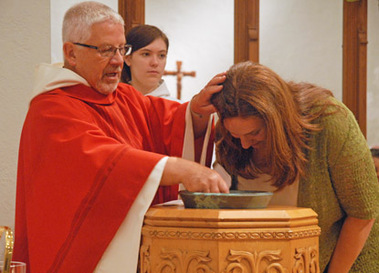
To my Baptist brethren, I would also point out that the recipient of cleansing wasn't dipped in the water of impurity. On the contrary, it was the finger of the priest, who would then sprinkle both the blood of the sacrifice and the water of cleansing. This strongly refutes the claim of Baptists that baptism is properly done only by immersion. Rather, the type in Numbers indicates that the proper mode of baptism is by sprinkling (by which I do not mean that baptisms by other modes are, therefore, invalid). 

This Scripture points to what the Westminster Assembly would say on the subject of baptism some three millennia later: "Dipping of the person into the water is not necessary; but baptism is rightly administered by pouring or sprinkling water upon the person" (Westminster Confession of Faith XXVIII:3).


Saturday, December 31, 2022

Parallels Between Isaiah and Paul on the Conversion of the Jews


"On this mountain the Lord of hosts will make for all people a feast of rich food, a feast of well-aged wine, of rich food full of marrow, of aged wine well refined. And He will swallow up on this mountain the covering that is cast over all peoples, the veil that is spread over all nations. he will swallow up death forever; and the Lord God will wipe away tears from all faces, and the reproach of His people He will take away from all the earth, for the Lord has spoken. It will be said on that day, 'Behold, this is our God; we have waited for Him, that He might save us. This is the Lord; we have waited for Him; let us be glad and rejoice in His salvation.' For the hand of the Lord will rest on this mountain..." (Isaiah 25:6-10). 

"The mountain of the Lord" and its variants appear frequently in the prophets, especially in Isaiah. See, for example, chapter 2, and the fourth chapter of Micah. It is an image derived from the temple mount, the place where God met in fellowship with His people. That image, in turn, may have come from the mountain on which Adam was placed in the garden. Thus, it is an image of fellowship, between the elect and our Redeemer. Use of "the Lord," used in English Bibles when the Hebrew refers to Jehovah, shows that the relationship is not with the Trinity undifferentiated, but rather with the Second Person of the Trinity, the preincarnate Christ, acting in His mediatorial role. 

In addition to those Old Testament parallels, we also see elements in the passage above that would appear in the New Testament, specifically in the writings of Paul. 

Where the prophet describes the spiritual veil over the hearts of men, Paul uses the same image for the yet-unbelieving Jews in II Corinthians 3:12-18: "Since we have such a hope [of life in the Spirit, v. 6], we are very bold, not like Moses, who would put a veil over his face so that the Israelites might not gaze at the outcome of what was being brought to an end. But their minds were hardened. For to this day, when they read the old covenant, that same veil remains unlifted, because only through Christ is it taken away. Yes, to this day, whenever Moses is read, a veil lies over their hearts. But when one turns to the Lord, the veil is removed. Now the Lord is the Spirit, and where the Spirit of the Lord is, there is freedom. And we all, with unveiled face, beholding the glory of the Lord, are being transformed into the same image from degree of glory to another..."

Notice also that Paul tells us another relevant fact: It is in turning to Christ that the veil of unbelief is removed, verifying that it is in Christ that the events described by Isaiah will occur. Some will agree, but place the events after His second coming. Yet the passage precludes that possibility by describing it in feast terms. yet, there will be no hunger in the resurrection, and, therefore, no use for food. 

Does Paul restrict our case to the Jews? In II Corinthians, that might be possible, but it is eliminated if we include another Paulian passage, Romans 11:11-15: "So I ask, did they [i. e., the Jews] stumble in order that they might fall [forever]? By no means! Rather, through their trespass salvation has come to the Gentiles, so as to make Israel jealous. Now, if their trespass means riches for the world, and if their failure means riches for the Gentiles, how much will their full inclusion mean? Now I am speaking to you Gentiles. Inasmuch then as I am an apostle to the Gentiles, I magnify my ministry in order, somehow, to make my fellow Jews jealous, and thus save some of them. For if their rejection means the reconciliation of the world, what will their acceptance mean but life from the dead?" And further, Romans 11:25-26: "Lest you be wise in your own sight, I do not want you to be unaware of this mystery, brothers: a partial hardening has come upon Israel, until the fullness of the Gentiles has come in. And in this way, all Israel will be saved..." 

Thus, Paul predicts in narrative what Isaiah prophesied in the poetic language of Hebrew prophecy, that a time will come, in which the greater part of both Gentiles and of Jews will be converted to saving faith in Jesus Christ. The Puritans called this the postmillennial hope. 

Wednesday, December 14, 2022

The Irreducible Sovereignty of God

"This is the purpose that is purposed concerning the whole earth, and this is the hand that is stretched out over all the nations. For the Lord of hosts has purposed, and who will annul it? His hand is stretched out, and who will turn it back?
-Isaiah 14: 26-27

The absolute sovereignty is a truth which men find hard to swallow. Certainly any unbeliever will reject it. Yet, even the majority of believers is compelled by the Adamic nature to hold fast to some element of human autonomy, that very temptation that Satan offered to Adam and Eve. The believer professes to be a sinner, but claims a right of free will over the eternal purposes of God. 

However, consider the verses quoted above. Who is sovereign? God or man? Who is subject to a veto? God or man? Unquestionable, the prophet tells us that the decree of God is founded on certainly, and cannot be overturned, even by the rebellion of men. 


Saturday, August 20, 2022

Abortion: "Christian" America's Covenant with Death

In his book Abortion Violation, author Rev. Rusty Lee Thomas cites Proverbs 8:36, in which the personification of Wisdom says, "All who hate me love death." In application, Thomas tells us, "[T]he rejection of God's wisdom leads selfish, autonomous men to love and embrace death. In the case of abortion, it is the death of innocent children made in the image of God" (p. 22). 

In the Bible, god calls this mentality a covenant with death. This phrase is found twice in Isaiah 28, in which God is castigating Israel for her adultery with pagan deities, for which she is to be judged. God quotes a personification of the whole people: "We have made a covenant with death, and with Sheol we have an agreement, when the overwhelming whip passes through, it will not come to us, for we have made lies our refuge, and in falsehood we have taken shelter" (Isaiah 28:15). The people of Israel had convinced themselves that their game of balancing a profession of faith to Jehovah with their secret whoring with demons would protect them from the judgment of Jehovah, the only true God, who had made them a people. 

However, the prophet tells them God's response to their confidence: "Then your covenant with death will be annulled, and your agreement with Sheol will not stand; when the overwhelming scourge passes through, you will be beaten down by it. As often as it passes through, it will take you; for morning by morning, it will pass through, by day and by night; and it will be sheer terror to understand the message... Now, therefore, do not scoff, lest your bonds be made strong; for I have heard a decree of destruction from the Lord God of hosts against the whole land" (Isaiah 28:18-19, 22). 

America is playing this game. She is playing the whore, both literally and in the sense that Israel did. Sexual immorality is rampant, even among professing Christians. Yet abortion enables the immoral to practice their sensuality without consequences... or so they believe. I think we see the signs already of God's judgment on this imagined sleight of hand. The sacrifice of the innocent will never save the guilty, no matter what "freedom of choice" men may imagine that they have. 

Wednesday, August 17, 2022

Abortion as a Cover for Sexual Promiscuity

"Draw near, sons of the sorceress, offspring of the adulterer and the loose woman. Whom are you mocking? Against whom do you open your mouth wide and stick out your tongue? Are you not children of transgression, the offspring of deceit, you who burn with lust among the oaks, under every green tree, who slaughter your children in the valleys, under the clefts of the rocks?" -Isaiah 57:3-5. 

Sometimes the Scriptures are quite colorful in their descriptions of human beings. This is one of those times. The prophet rebukes men and women involved in sexual promiscuity. But I want to point especially to the way such men and women try to avoid the consequences of their behavior: by the slaughter of their own children. 

Are we not seeing this in our culture? It has actually been said that the recent Supreme Court decision overturning the abomination of Roe v. Wade that it spells the doom of "hook-up culture." Oh, the horror! But is that not an admission of the reason for so many abortions? The people involved want to satisfy their lusts without consequences, even to the point of murdering their own children! Not because of poverty or abusive partners, but just to avoid the consequences of their own decisions. 


Saturday, August 13, 2022

Isaiah: The Prophet of Monotheism

"Thus says the Lord, the King of Israel and his redeemer, the Lord of hosts: 'I am the first and I am the last; besides Me, there is no god. Who is like Me? Let him proclaim it. Let him declare and set it before Me, since I appointed an ancient people. Let them declare what is to come, and what will happen. Fear not, nor be afraid; have I not told you from old and declared it? And you are My witnesses! Is there a god besides Me? There is no rock; I know not any'" (Isaiah 44:6-8). 

The Bible strongly contrasts the triune God who truly lives with all of the false deities that men have created. This passage goes on to ridicule the pagan, who uses half of a piece of wood to bake his bread, and the other half to carve into an idol. Then this creation of his own the pagan then asks for help in his life. And I think any rational man must agree with that assessment of paganism. As the Bible describes it, worshiping the creature in place of the Creator (Romans 1:25). 

And this is no accident, but is, rather, a part of God's plan: "They know not, nor do they discern, for He has shut their eyes, so that they cannot understand" (Isaiah 44:18; compare 45:15 and Matthew 13:11). For men to be blinded in unbelief is part of God's determination in prehistory. It is the reprobate side of God's sovereign grace. 

The prophet continues: "I am the Lord, and there is no other; besides Me, there is no god" (Isaiah 45:5), and "There is no other god besides Me, a righteous God and a Savior; there is none besides Me" (verses 21-22). 


Saturday, August 6, 2022

God's Judgment on Unjust Rulers

"Woe to those who decree iniquitous decrees, 

And the writers who keep writing oppression."

-Isaiah 10:1 

As a lover of God's Law, I often hear remarks saying that, since we are "under grace, not under law" (a misreading of Romans 6:14), the civil magistrate is under no obligation to the word of God in the execution of his office. In fact, any source of law except for the Bible is preferred, including the humanistic law under which we Americans are forced to live. 

Sometimes the problem is a belief that the Law ended with the crucifixion of Jesus. That is just bad hermeneutics. Other times, the person - and remember that I am speaking of professing Christians - will point to something in that Law and claim that it would be horrible to live by such a standard today. And they say that, completely oblivious to the implied blasphemy, as if God were unjust in His moral standards!  

Yet we have the verse above, Isaiah 10:1, in which God calls the actions of some magistrates "iniquitous." By what standard is an action iniquitous? Is the law of the state to be judged by its own standards? Surely such circularity would always confirm the morality of that law. Of course not! It must be judged by the objective standards of God. And where do we find those standards? In His law, recorded for us in the Bible. 


Saturday, July 30, 2022

"Gods" in the Bible and Mormon Tritheism

"In the Church of Jesus Christ of Latter-day Saints, prophets since Joseph Smith have taught clearly that there are three separate members of the Godhead, each of which is God. As Joseph Smith stated, 'These personages... are called God the first; the Creator, God the second, the Redeemer; and God the third, the Witness or Testator' (Teachings of the Prophet Joseph Smith, p. 190). He further taught: 'I have always declared God to be a distinct personage, Jesus Christ a distinct personage from God the Father, and that the Holy Ghost was a distinct personage and a Spirit: and these three constitute three distinct personages and three Gods (Teachings, p. 370; see also History of the Church 6:474)." I quote this from this Mormon website. That is, it is their words, not my representation. 

Up until the last words, "and three Gods," a biblical Christian could be nodding his head, because the Bible does, indeed, indicate that the Father, Son, and Holy Spirit are three distinct persons, but, we insist, they are one God. We know this because each person, as Mormons will concede, is called in turn, God. Yet, the Bible also tells us, "Thus says the Lord, the King of Israel and his Redeemer, the Lord of hosts: I am the first and I am the last; besides Me there is no god. Who is like Me? Let him proclaim it. Let him declare and set it before Me, since I appointed an ancient people. Let them declare what is to come, and what will happen. fear not, nor be afraid; have I not told you from of old and declared it? And you are My witnesses! Is there a God besides Me? There is no Rock; I know not any" (Isaiah44:6-8, emphasis added). And elsewhere, "To you it was shown, that you might know that the Lord is God; there is no other besides Him" Deuteronomy 4:35). Three persons called God, and only one God; that is the simple description of the triune God of the Bible, the creeds, and biblical Christianity. It makes no allowance for multiple deities, whether the three of Mormonism or the millions of Hinduism, or any number held forth in pagan religions. 

In response to the plain words of the Bible, Mormons claim that their belief is consistent with the Bible's references to "gods." Yet even that claim is refuted by the Bible itself. It must be granted, of course, that the Bible does refer to "gods." But the usage clearly forbids any conclusion that the reference is to real gods, as is the living God of the Bible. 

Consider another reference from the Old Testament: "There [i. e., in Babylon] you will serve gods of woods and stone, the work of human hands, that neither see, nor hear, nor eat, nor smell" (Deuteronomy 4:28). That is, when the Bible refers to "gods," it means idols, as the deceived pagans see them, not in their real nature. 

In the New Testament, we see these words from the Apostle Paul: "What pagans sacrifice they offer to demons and not to God" (I Corinthians 10:20). He goes beyond Moses and says that pagan deities are not merely idols, but are actually demonic spirits. And that brings us back to the three gods of Mormonism. Not only are they not, any of the three, the God of the Bible, but they are, in reality, demonic spirits leading Mormons on a merry path to Hell. 


Saturday, July 2, 2022

The Covenant Faithfulness of God: Covenant Succession


"The children of Your servants shall dwell secure; their offspring shall be established before You" (Psalm 102:28). 

Psalm 102 is described in its subtitle as "a prayer of one afflicted, when he is faint and pours out his complaint before the Lord." Who that person is, we do not know. Yet we read his complaint of some affliction which leaves him sleepless and without appetite. His foes taunt him. Whether that is because of what is happening to him, or if that is itself the affliction, again we do not know. But his heart is revived as he recalls the sovereignty of God (verse 12), especially in His faithfulness to His church (verse 16). 

In the final verse, which I have quoted above, the author reminds us that God is faithful not just to us in the moment, but to our children and their posterity. This covenant succession is mentioned frequently in Scripture. For example, we see a parallel verse in Isaiah 54:13: "All your children shall be taught by the Lord, and great shall be the peace of your children." 

Wednesday, May 25, 2022

Free Grace and the Creator-Creature Distinction

"Esteem not yourself the better for what you may carry with you. Think not to be accepted because of your present. It is not your money, Isaiah 55:1, John 7:37, nor your double money in your hand that will fetch you corn from above, though it may come from Egypt. Silver and gold, your own works and worthiness, are of no value at the mint of free grace. But there it is, and thence you must have whatever may hinder you welcome at the court of Heaven." -Puritan Elisha Coles, "A Practical Discourse of God's Sovereignty" 

People like to bargain. "If you do X, then I will do Y for you." That is part of our existence as creatures of a similar class. However, seeing our autonomy from our fellow creatures, we imagine that we have a comparable stand with our Creator, offering Him some good works, according to our own standards, in exchange for His forgiveness. 

However, our relationship with God is not of the same sort as that with our fellow creatures. We may be equal to them, and with the autonomous right to offer voluntary exchanges, but neither applies to our relationship as creature to our Creator. 

As our Maker, God retains an absolute right over His creatures. The Bible compares that relationship to that between the potter and his clay: "O House of Israel, can I not do with you as this potter has done? declares the Lord. Behold, like the clay in the potter's hand, so are you in My hand, O House of Israel" (Jeremiah 18:6; see also Romans 9:21). And what does the lump of clay have that it can exchange with the potter to change its form? Nothing. 

That is why the justification of God's people can be only by His voluntary condescension. "What shall we say then? Is there injustice on God's part? By no means! For He says to Moses, 'I will have mercy on whom I have mercy, and I will have compassion on whom I have compassion.' So then, it depends not on human will or exertion, but on God, who has mercy... So then, He has mercy on whomever He wills, and He hardens whomever He wills" (Romans 9:14-18). 


Saturday, May 14, 2022

The Character of God as Guarantee of the Saint's Perseverance

"It is impossible [that] we should lose the thing we were wrought for, because it is God that wrought it for us. It is not the designment of an idol; that is, of some ignorant, rash, fallible, or mutable agent, such a one as may possibly be surprised by unlooked-for accidents, circumvented by a sublimer understanding, overborne by a power above him, or recede from his purpose through levity and fickleness of his nature, etc. But it is God who is 'wise in heart and mighty in strength,' Job 9:4. It is He from whom all things that are have their being and are perfectly under His rule and obeisance. He had eternity before Him, to lay His design surely; and, accordingly, 'He declared the end from the beginning.' It is, therefore, as impossible for Him either to do or to neglect to do, or to suffer to be done, anything whereby His purpose might suffer disappointment, as it is impossible that God should lie. He would never have set up those ends as the sum and substance of His design, if He had not determined to see them made good." -Puritan Elisha Coles, "A Practical Discourse of God's Sovereignty 

Part of the Creator/creature distinction is that the Creator is omniscient, omnipotent, and eternal, while the creature has all but three of those attributes. A creaturely awareness is conscious of our inability to plan for all contingencies, at all times, as may disrupt our best-laid plans. For example, the farmer cannot know of the coming hurricane that wipes out his crop. In contrast, the triune God of the Bible has infinite awareness across all time, all space, and under all contingencies, such that His plans are infallibly achieved. As in the verse that Coles quotes, "I am God, and there is none like Me, declaring the end from the beginning and from ancient times things not yet done, saying, 'My counsel shall stand, and I will accomplish My purpose'" (Isaiah 46:10). It would be comical hubris for any human to make such an assertion. 

However, it is also unforgiveable hubris to assert such infallibility for any man's ability to keep himself in a state of grace. Yet that is what the Arminian does, when he claims that no man can keep himself saved, and, therefore, he should never be assured of his hold on eternal life. If the fundamental assumption of the Arminian, that it is the will of the man that should thus preserve him, then it would be true that no man could ever know an assurance of salvation in this life. 

But this is exactly what perseverance is not. It does not, has never, and never shall, depend on the will and power of the creature to maintain his state of grace. It is the work of God alone, He whose irrepeatable attributes of deity guarantee that any man, truly saved, can never fully and finally lose his salvation. Thus, his assurance is sound, not because of any ability of his own, but because of the infallible character of the God who saved him to begin with. 


Saturday, April 9, 2022

How Can I Know that the Bible Is the Inerrant Word of God?

The Christian philosopher and apologist Gordon Clark once wrote, "Because God is sovereign, God's authority can be taken only on God's authority. As the scripture says, 'Because He could swear by no one greater, He swore by Himself' (Hebrews 6:13)" (from God's Hammer, p. 39). His point was that confirmation of authority comes from higher authority. However, there can be no authority higher than God by which to confirm what He says. By His own authority, therefore, He declares His own truth and authority. 

The thoughtful person sees this and asks, "But isn't this circular reasoning?" And it is. Yet, we can see the impossibility of an alternative if we ask a parallel question: "How can you prove logic without presupposing logic as the basis for its proof?" 

The thoughtful Christian might ask whether the unbeliever would be convinced by that argument. And the obvious answer is that an unbeliever would not be convinced. Yet we must deny that his disbelief is based on a reasonable doubt. On the contrary, his rejection would arise from his own presuppositions against God's authority. Those presuppositions are the inherent nature of unbelief (Romans 1:18). 

On the other hand, we know that there are many Christians who receive the Bible as God's word, and that it is necessarily, therefore, inerrant. I am one of those Christians. Yet that belief did not arise from a consideration of a chain of logical arguments or archeological verifications. 

So, from where did my belief come? 

Clark quotes from the Institutes of John Calvin: "It is, therefore, such a persuasion as requires no reason; such a knowledge as is supported by the highest reason and in which the mind rests with greater security and constancy than in any reasons; in fine, such a sense as cannot be produced but by a revelation from Heaven" (I. vii.5). By "revelation," Calvin meant no such thing as a voice whispering in the believer's ear. Rather, in the process of effectual calling, the Holy Spirit causes the man's spirit to recognize the truth of the Scriptures as he reads them or hears them preached. 

This concept was picked up later (1646) in the writing of the Westminster Confession of Faith (I:5), the doctrinal statement of the world's Presbyterians: "We may be moved and induced by the testimony of the Church to an high and reverent esteem of the holy Scripture; and the heavenliness of the matter, the efficacy of the doctrine, the majesty of the style, the consent of all the parts, the scope of the whole (which is to give all glory to God), the full discovery it makes of the only way of man's salvation, the many other incomparable excellencies, and the entire perfection thereof, are arguments whereby it doth abundantly evidence itself to be the Word of God; yet, notwithstanding, our full persuasion and assurance of the infallible truth and divine authority thereof, is from the inward work of the Holy Spirit, bearing witness by and with the Word in our hearts." The Westminster divines added to Calvin's argument that Scripture provides good reasons for recognizing it as the Word of God. Yet the unbeliever suppresses his awareness of those qualities (Romans 1:18). He cannot recognize them exactly because of his unbelief (I Corinthians 2:14). He cannot be argued out of his unbelief, because his unbelief is a matter of sin, not ignorance. 

The case here demonstrates why we never see an apologetical situation in the New Testament in which Jesus or the Apostles ever argued for acceptance of Scriptural proofs. Even when Jesus faced Satan and when Paul preached to the pagan philosophers of Athens, each argued from Scripture as his starting point, not as a subsidiary point requiring proof. 

We must remember the promise of God: "So shall My Word be, that goes out of My mouth; it shall not return to Me empty, but it shall accomplish that which I purpose, and shall succeed in the thing for which I sent it" (Isaiah 55:11). God promises success to His word, not to our attempts to appeal to the fallen intellect of the unbeliever. "Of His own will He brought us forth by the word of truth, that we should be a kind of firstfruits of His creatures" (James 1:18). There has never been any other way by which God has converted His elect (Romans 10:8-15).


Wednesday, April 6, 2022

The Conversion of Israel As Proof of the Saint's Perseverance

"I will establish his [i. e., David's] offspring forever, and his throne as the days of the heavens. If his children forsake My law, and do not walk according to My rules, if they violate My statutes, and do not keep  My commandments, then I will punish their transgressions with the rod and their iniquity with stripes, but I will not remove from him My steadfast love or be false to My faithfulness. I will not violate My covenant or alter the word that went forth from My lips" (Psalm 89:29-34). 

These are the words of God in His covenantal promises to King David. Paul echoes them in II Timothy 2:13: "If we are faithless, He remains faithful - because He cannot deny Himself." In both passages, God's faithfulness to His people is never founded on our faithfulness to Him. Rather, even when we are unfaithful, He remains faithful, because to do otherwise would be to deny Himself. To violate His covenant promises would be a betrayal of His own nature, and is, therefore, unthinkable

We know the history of Israel, though it was still future to the time of the writing of the Psalm. She was, indeed, unfaithful, and God did, indeed, bring down on her fearsome judgments, especially the destruction of Jerusalem and the temple by the Babylonians, and the carrying away by them of the bulk of the population into captivity. This was a judgment only succeeded by the later judgment under the Romans in 70 AD, when Jerusalem was again looted and the temple destroyed, and an estimated 1.1 million Jews were massacred. From that judgment, the Jews have not yet recovered. Rather, Israel lies under a judicial hardening for her rejection and murder of her Messiah. 

Yet even that judgment points to Psalm 89. 

"It is true [that] the body of that nation, for their unbelief, is now broken off; there is a suspension of the outward part of the covenant. Not that God intends an utter rejection of them. For such as have part in the special election are always saved, Romans 11:7, and the time will come when all Israel shall be saved. For, as touching the election, they are beloved still, though yet unborn. For their sakes it was that 'those days of tribulation were shortened,' Matthew 24:22, which answers to Isaiah 65:8, 'Destroy it not, there is a blessing in it.' The Lord will not so much regard what they have done or deserved as what His covenant is concerning Abraham's seed, which, minding of His covenant, is from the unchangeableness of His purpose. And, therefore, though broken off at present, 'they shall be grafted in again,' verse 24, though driven into all lands, scattered into corners, mingled with the heathen, and become so like them as not to be known asunder. Yet, being His chosen, and within His covenant, He will bring them out of their holes and gather them one by one, Isaiah 27:12. He will do it so accurately, exactly, punctually, that none shall be wanting, 'though sifted among all nations, not one grain shall fall to the earth,' Amos 9:9. The reservation mentioned in Romans 11 was God's omnipotent safeguarding of His elect, when the rest of the nation fell to idolatry. They had gone all, as well as some, had not election held them back. It is, therefore, said to be according to the election of grace. Election was the pattern, and reservation the copy of it" ( Puritan Elisha Coles, "A Practical Discourse of God's Sovereignty"). 

Coles cites the faithfulness of God to His promises to Abraham as the grounds for the sustaining of a faithful remnant among the Jews, and for their eventual national repentance and salvation. And that same faithfulness is why the Christian can be assured that God will enable him to persevere in this life unto eternal life in the age to come. 


Saturday, April 2, 2022

Kings Your Foster Fathers and Queens Your Nursing Mothers: Biblical Religion the Duty of the Christian Magistrate

"Kings shall be your foster fathers and their queens your nursing mothers" (Isaiah 49:23). 

In today's America, a supposed religious neutrality is enforced by law, especially by a zealously secular judicial system. I question whether that was ever the intention of the Founders when they adopted the First Amendment to the US Constitution. Below is an extended quote from John Bannerman, in his book, The Church of Christ, in which he argues for the doctrine of the established church, as he knew in Scotland. 

"I take it for granted, as a fact not to be disputed, that the state, in all its acts, is to be accounted a moral and responsible agent, as much as any individual that is a subject of it; and that, although not under law to man, the supreme power, or organ of the state, is under law to God. I take it for granted, further, that, in consequence of this responsibility to God, the state is bound, as the first and chief of its duties, to own His will, as embodied in the form of a supernatural revelation from Him, and, in its national capacity, to recognize the authority and the Word of God as its law. And now, with an inspired revelation from God in its hands, what is it that the state learns as to its own interests and duties? It learns, in the first place, the intimate and indissoluble connection between the interests of civil society and the interests of true religion; and that, to promote the wellbeing, or, rather, to insure the existence of the state, it is necessary to call in the aid of powers and influences which the state has not in itself. It finds that what is awanting [sic] in civil society for accomplishing the very end of its own existence, the Gospel alone can supply; and that, for the state to dismiss, as a matter foreign to it, the religious instruction and spiritual wellbeing of the people at large, is to forego the main instrumentality which God has put into its hands for securing the authority of law, for promoting the ends of civil government, [and] for protecting the rights and furthering the peace of society. All this is too plain to need illustration. Without some religion, no society on earth, it is admitted by all parties, could exist at all; and without the true religion, no society can exist happily. Law would cease to be enforced if it had to trust to punishment alone for its authority, without any higher motive to secure obedience to it; and justice between man and man could not be carried into effect if it had no hold upon the conscience and the moral sense of a nation. And can it be alleged that religion is a matter with which states, as such, have no right to intermeddle, when it, in reality, forms the main and only secure foundation on which the authority of state rests - the only sanction sufficient to enforce right and to deter from wrong in a community - the only force strong enough to ensure obedience and respect for law - the only bond that can bind together the discordant elements of human society, and give peace between man and man? To assert that it is no duty of the civil magistrate to care for the religion of the people is nothing less than to assert that he is at liberty to forego the chief or only certain stay of his own authority, and to disregard what is essential to his own existence or wellbeing. If religion be the great and indissoluble cement of human society, then the magistrate is bound, by a regard to his own interests, and for the sake of the grand objects for which a state exists at all, to make the care of religion one of the first duties he has to discharge towards his people." [emphasis in the original]


Wednesday, March 16, 2022

The Perfect and Proper Sovereignty of God Over His Creatures

"The heavens and the earth and all the hosts of them, as yet having no being, it was [according to] His pleasure whether He would make them or not. And, if He would, what being He would give them, to what end, and how that end should be accomplished. And that all these were ascertained by the decree is evident, for 'known unto God were all His works (which He would do in [the process of] time from the beginning of the world' (Acts 15:18)." --Puritan Elisha Coles, "A Practical Discourse of God's Sovereignty" 

In the quote above, we see the historic protestant view of the sovereignty of God. He created all things according to His plan of what to create, what the purpose and place of each would be, and how that purpose would be achieved. This is especially contrasted with the modern theology of Open Theism, which asserts that God cannot determine or even predict the contingent actions of animate creatures. But it also conflicts with the Arminian view, which claims that God has the power of sovereignty, but has withheld His determination in favor of free agency. 

Coles gave an excellent citation for his view, and against the various forms of autonomy: "Known to God from eternity are all His works" (Acts 15:18 NKJV). God had planned all that He would do in and with His creation before He created any of it. "Remember this and stand firm, recall it to mind, you transgressors, remember the former things of old; for I am God, and there is no other; I am God and there is none like Me, declaring the end from the beginning and from ancient times things not yet done, saying, 'My counsel shall stand, and I will accomplish all My purpose'" (Isaiah 46:8-10). 

Both Coles and the Bible describe a God who is very different from the deity of the Arminians.