Showing posts with label idolatry. Show all posts

Saturday, August 13, 2022

Isaiah: The Prophet of Monotheism

"Thus says the Lord, the King of Israel and his redeemer, the Lord of hosts: 'I am the first and I am the last; besides Me, there is no god. Who is like Me? Let him proclaim it. Let him declare and set it before Me, since I appointed an ancient people. Let them declare what is to come, and what will happen. Fear not, nor be afraid; have I not told you from old and declared it? And you are My witnesses! Is there a god besides Me? There is no rock; I know not any'" (Isaiah 44:6-8). 

The Bible strongly contrasts the triune God who truly lives with all of the false deities that men have created. This passage goes on to ridicule the pagan, who uses half of a piece of wood to bake his bread, and the other half to carve into an idol. Then this creation of his own the pagan then asks for help in his life. And I think any rational man must agree with that assessment of paganism. As the Bible describes it, worshiping the creature in place of the Creator (Romans 1:25). 

And this is no accident, but is, rather, a part of God's plan: "They know not, nor do they discern, for He has shut their eyes, so that they cannot understand" (Isaiah 44:18; compare 45:15 and Matthew 13:11). For men to be blinded in unbelief is part of God's determination in prehistory. It is the reprobate side of God's sovereign grace. 

The prophet continues: "I am the Lord, and there is no other; besides Me, there is no god" (Isaiah 45:5), and "There is no other god besides Me, a righteous God and a Savior; there is none besides Me" (verses 21-22). 


Saturday, July 30, 2022

"Gods" in the Bible and Mormon Tritheism

"In the Church of Jesus Christ of Latter-day Saints, prophets since Joseph Smith have taught clearly that there are three separate members of the Godhead, each of which is God. As Joseph Smith stated, 'These personages... are called God the first; the Creator, God the second, the Redeemer; and God the third, the Witness or Testator' (Teachings of the Prophet Joseph Smith, p. 190). He further taught: 'I have always declared God to be a distinct personage, Jesus Christ a distinct personage from God the Father, and that the Holy Ghost was a distinct personage and a Spirit: and these three constitute three distinct personages and three Gods (Teachings, p. 370; see also History of the Church 6:474)." I quote this from this Mormon website. That is, it is their words, not my representation. 

Up until the last words, "and three Gods," a biblical Christian could be nodding his head, because the Bible does, indeed, indicate that the Father, Son, and Holy Spirit are three distinct persons, but, we insist, they are one God. We know this because each person, as Mormons will concede, is called in turn, God. Yet, the Bible also tells us, "Thus says the Lord, the King of Israel and his Redeemer, the Lord of hosts: I am the first and I am the last; besides Me there is no god. Who is like Me? Let him proclaim it. Let him declare and set it before Me, since I appointed an ancient people. Let them declare what is to come, and what will happen. fear not, nor be afraid; have I not told you from of old and declared it? And you are My witnesses! Is there a God besides Me? There is no Rock; I know not any" (Isaiah44:6-8, emphasis added). And elsewhere, "To you it was shown, that you might know that the Lord is God; there is no other besides Him" Deuteronomy 4:35). Three persons called God, and only one God; that is the simple description of the triune God of the Bible, the creeds, and biblical Christianity. It makes no allowance for multiple deities, whether the three of Mormonism or the millions of Hinduism, or any number held forth in pagan religions. 

In response to the plain words of the Bible, Mormons claim that their belief is consistent with the Bible's references to "gods." Yet even that claim is refuted by the Bible itself. It must be granted, of course, that the Bible does refer to "gods." But the usage clearly forbids any conclusion that the reference is to real gods, as is the living God of the Bible. 

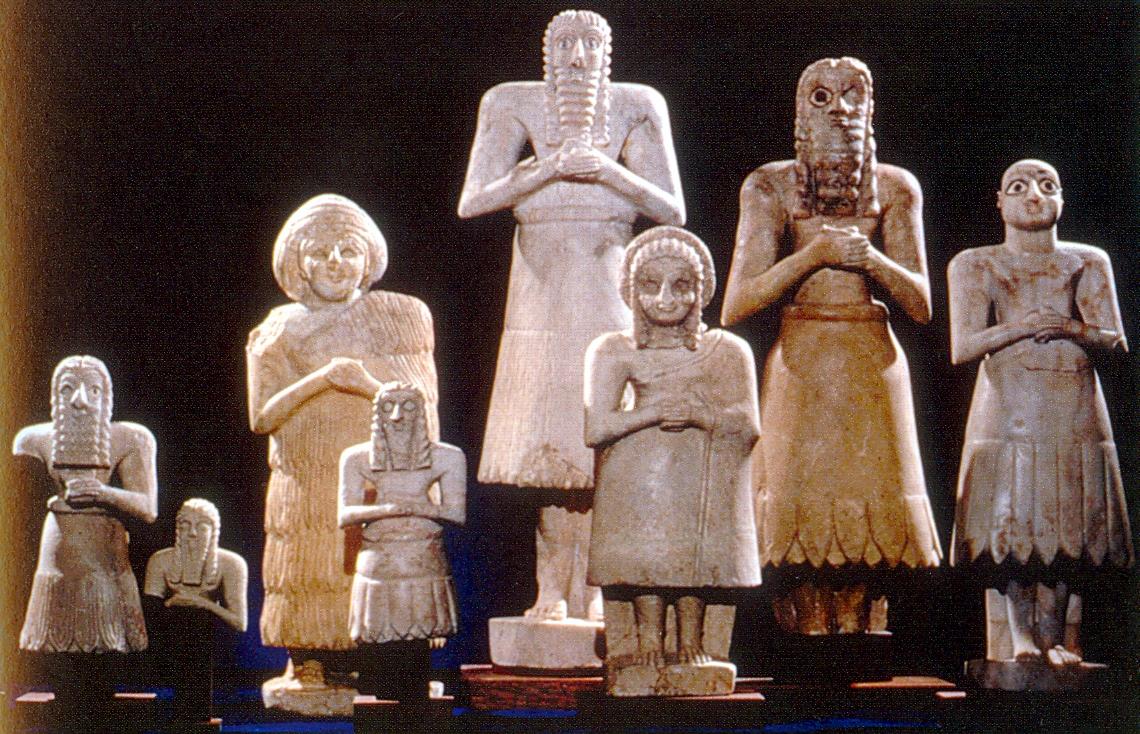
Consider another reference from the Old Testament: "There [i. e., in Babylon] you will serve gods of woods and stone, the work of human hands, that neither see, nor hear, nor eat, nor smell" (Deuteronomy 4:28). That is, when the Bible refers to "gods," it means idols, as the deceived pagans see them, not in their real nature. 

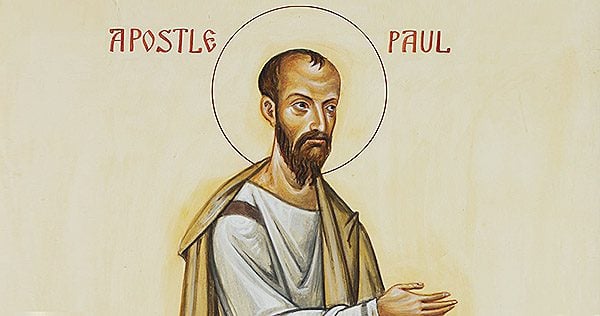
In the New Testament, we see these words from the Apostle Paul: "What pagans sacrifice they offer to demons and not to God" (I Corinthians 10:20). He goes beyond Moses and says that pagan deities are not merely idols, but are actually demonic spirits. And that brings us back to the three gods of Mormonism. Not only are they not, any of the three, the God of the Bible, but they are, in reality, demonic spirits leading Mormons on a merry path to Hell. 


Saturday, August 15, 2020

How the Church Paved the Way for Humanism

There has long been a tradition of dividing the Ten Commandments into two tables, commandments one through four and then five through ten. I am OK with that division. The first four deal primarily with man's relationship with God, and the other six primarily with his relationship with his fellow man. They are often portrayed this way in images of the commandments. That might be a bit fanciful. We have no record of how they were divided between the two tablets. Or even if they were divided. Some people believe that each tablet displayed all ten.

That's fine so far. 

There is also a common view that the civil government is supposed to enforce the second table, the laws against thievery and murder, etc., but has no authority over the first four. 

My question is this: Why? 

Sometimes the answer is that the First Amendment to the Constitution forbids it. We have freedom of religion in this land, so we can't have laws against idolatry. Yet our country has a heritage of so-called "blue laws," laws that required businesses to be closed on Sunday in honor of the Sabbath. "Blue," in this case, derives from a historical usage, in which "blue" was used for something which was overly strict. It was a pejorative term, but passed into general usage. The courts have upheld Sunday-closing laws on secular grounds, such as the practicality of providing a day off for workers. 

However, the question must be, Why does the First Amendment - in reality, the Supreme Court's interpretation of the First Amendment - outweigh God's commandments? Should a cultural preference become the standard by which even Christians are to live, over the Word of God? 

When God tells us, "You shall have no other gods before Me" (Exodus 20:3), His desire is clear. So also when He says, "You shall not make for yourself a carved image, or any likeness of anything that is in heaven above, or that is in the earth beneath, or that is in the water under the earth. You shall not bow down to them or serve them, for I the Lord your God am a jealous God" (verses 4-5). So, on what grounds do we decide that His will in these two commandments is less important that it is when He says, "You shall not murder" (verse 13)? There is certainly no biblical justification for that judgment. 

When the Westminster Standards were originally written, the Larger Catechism, question and answer 109, included among the sins forbidden by the Second Commandment, "tolerating a false religion."  However, in 1788, when the first Presbytery of the Presbyterian Church met in the newly-independent United States, they removed that clause as offensive to religious liberty. Not as offensive to the Word of God. 

What this should tell us is that the secular humanism which has come to dominate these United States is not a new phenomenon, and did not suddenly puff into existence because prayer was removed from government schools in the 1960's. Rather, it was the culmination of that decision in 1788 to place political and cultural considerations above the enscripturated Word of God. The door was opened to the supposed independence of "secular life" from God. Now we have parts of our lives which are designated "religious," and parts which are designated "secular." And the humanists are perfectly happy with allowing Christians to enjoy that distinction, because it turns all of life outside the church doors over to them. And the church doors are only a temporary barrier, until the humanists have secured their territory against that day.

Wednesday, August 12, 2020

Does God Have a Body Like Men Have?

One of the distinctions between Mormonism and biblical Christianity is the insistence by Mormons that God the Father has a body such as humans have. They also believe this of the preincarnate God the Son. They justify this belief by the statement in Genesis 1:26-27 that God made Adam in His own image. Mormons say that this must be in His physical image. 

There are three arguments against this Mormon claim.

The first I have discussed before, that the image consists of spiritual attributes, not physical. Since I have already dealt with argument, I will not repeat it here. 

The second argument regards the birth of Seth (Genesis 5:3): "When Adam had lived 130 years, he fathered a son in his own likeness, after his image, and named him Seth." There is a marked change here! Where Adam had been created in the image of God, Seth is conceived in the now-fallen image of Adam. Mormons do not claim that the physical image of men changed from Adam to Seth. That leaves only a spiritual change from Adam's original status to his spiritual status in chapter 5. Therefore, there can be no physical image involved in the creation of Adam. 

And thirdly we have the statements of Moses to Deuteronomy 4. He is reminding did to the idolaters at Baal Peor (described in Numbers 25), and at the giving of the Ten Commandments (Exodus 20): "You came near and stood at the foot of the mountain, while the mountain burned with fire to the heart of heaven, wrapped in darkness, cloud, and gloom. Then the Lord spoke to you out of the midst of the fire. You heard the sound of words, but saw no form; there was only a voice" (Deuteronomy 4:11-12). This is Jehovah, who is identified as the preincarnate Christ by Mormons. I agree with that identification. In His mediatorial role, the preincarnate Son mediated the giving of the Ten Commandments to the covenant people. 

Moses continues (Deuteronomy 4:15-18): "Therefore watch yourselves very carefully. Since you saw no form on the day that the Lord spoke to you at Horeb out of the midst of the fire, beware lest you act corruptly by making a carved image for yourselves, in the form of any figure, the likeness of male or female, the likeness of any animal that is on the earth, the likeness of any winged bird that flies in the air, the likeness of anything that creeps on the ground, the likeness of any fish that is in the water under the earth." 

In both sections of the chapter, Moses emphasizes the lack of physical form of Jehovah. And to bring the point home even more strongly, he warns the people not to make anything as a physical representation of that divine presence. Notice that he also doesn't make what would be a rational suggestion if the Mormon doctrine were true, to look at themselves as the representations of a supposed divine image. That would have been the rational argument, rather than to warn them against the images of animals, if the divine nature had had a physical image

Together, these three arguments from Scripture show that the doctrine of the Mormons has its origin in the same pagan mindset described by Paul in Romans 1:20-23: "His invisible attributes, namely, His eternal power and divine nature, have been clearly perceived, ever since the creation of the world, in the things that have been made. So they are without excuse. For although they knew God, they did not honor Him as God or give thanks to Him, but they became futile in their thinking, and their foolish hearts were darkened. Claiming to be wise, they became fools, and exchanged the glory of the immortal God for images resembling mortal man and birds and animals and creeping things." There is nothing of a biblical basis in it.

Wednesday, January 8, 2020

Paganism and the True and Innate Knowledge of the Triune God

The Apostle Paul records something interesting in Romans 1:18-23: "The wrath of God is revealed from heaven against all ungodliness and unrighteousness of men, who by their unrighteousness suppress the truth. For what can be known about God is plain to them, because God has shown it to them. For His invisible attributes, namely, His eternal power and divine nature, have been clearly perceived, ever since the creation of the world, in the things that have been made. So they are without excuse. For although they knew God, they did not honor Him as God or give thanks to Him, but they became futile in their thinking, and their foolish hearts were darkened. Claiming to be wise, they became fools, and exchanged the glory of the immortal God for images resembling mortal man and birds and animals and creeping things."

In this passage, Paul is referring to the knowledge of God which all men have, through the Law of God recorded in each man's conscience (Romans 2:15), reinforced by god's revelation of Himself in His works of creation (Psalm 19:1-4): "The heavens declare the glory of God, and the sky above proclaims His handiwork. Day to day pours out speech, and night to night reveals knowledge. There is no speech, nor are there words, whose voice is not heard. Their voice goes out through all the earth, and their words to the end of the world." 

As Paul tells us in the Romans passage above, the inherent knowledge of God is received with hatred. The unregenerate man seeks to escape his awareness of God and our accountability to Him. One way in which he does so is to replace the true, triune God with mute idols in the forms of men and animals (see also Isaiah 44:9-20). Therefore, the existence of paganism is not a neutral historical event; it happened exactly because men are sinners under the wrath of God, that we know our condition, and we crave some solution that will quiet our consciences. In the case of paganism, the effort is to quiet our consciences while being able to continue in our deception of autonomy from the true God, who yet rails against the unregenerate man in his conscience. 

And Paul was not speaking from mere theory, but from his experience in the pagan world of Greco-Roman culture (Acts 17:16-34). "The religion he [Paul] proclaimed was preeminently that of a sinner - adapted in all its provisions to the spiritual necessities of a fallen being under the righteous government of God. The altars around him were dumb, yet pregnant, witnesses that the wants which the Gospel undertook to relieve were not the fictions of fancy, nor the creatures of superstition, but the urgent demands of the soul" (James Henley Thornwell, "The Necessity and Nature of Christianity").

Saturday, December 14, 2019

Unbelief Is Ingratitude

In Romans 1:18-25, the Apostle Paul gave this description of the unbeliever: "The wrath of God is revealed from heaven against all ungodliness and unrighteousness of men, who by their unrighteousness suppress the truth. For what can be known about God is plain to them, because God has shown it to them. For His invisible attributes, namely, his eternal power and divine nature, have been clearly perceived, ever since the creation of the world, in the things that have been made. So they are without excuse. For although they knew God, they did not honor Him as God or give thanks to Him, but they became futile in their thinking, and their foolish hearts were darkened. Claiming to be wise, they became fools, and exchanged the glory of the immortal God for images resembling mortal man and birds and animals and creeping things. Therefore God gave them up in the lusts of their hearts to impurity, to the dishonoring of their bodies among themselves, because they exchanged the truth about God for a lie and worshiped and served the creature rather than the Creator, who is blessed forever! Amen." 

He tells us several surprising things. First of all, unbelief is not ignorance. God has so revealed Himself that no man can claim that he does not know about God (see, for example, Psalm 19:1-4). There is no such thing as an atheist. Every single human being who lives now, has ever lived, or will ever live, knows that God exists and that he is accountable to Him. 

Which leads us to the second surprise, that men hate that knowledge, and try to suppress it. That is the origin of both pagan religions and atheism, the heart of the unbeliever's effort to bury the knowledge of God, in order to remain free to imagine that he is sovereign over his life and can decide right and wrong for himself. 

This hatred of God, commonly called unbelief, expresses itself in the use of God's gifts, such as the air we breathe, the food we eat, and the water we drink, while crediting it to ourselves or to some other source apart from God. Unbelief is founded on ingratitude! 

"Such a conduct as the generality of men are guilty of towards God, continually and through all ages, in innumerable respects, would be accounted the most vile contemptuous treatment of a fellow creature, of distinguished dignity. Particularly men's treatment of the offers God makes of Himself to them as their friend, their Father, their God, and everlasting portion; their treatment of the exhibitions He has made of His immeasurable love, and the boundless riches of His grace in Christ, attended with earnest repeated calls, counsels, expostulations, and entreaties; as also of the most dreadful threatenings of His eternal displeasure and vengeance" (Jonathan Edwards, "Original Sin," Book 1, section 5).


Wednesday, August 21, 2019

The Polytheism and Self-Deception of Mormons

I interact often with Mormons on the question of whether they are polytheists. They deny it, though they willingly say that they believe that there is an unknown number of gods in addition to their god. However, they say that doesn't make them polytheists because they only worship one god. In support of their profession, they refer to the frequent biblical references to the gods of the nations, and even of pagan gods worshiped by Israel.

Of course, they ignore such sceptical references to gods as Deuteronomy 32:21: "They have made me jealous with what is no god; they have provoked me to anger with their idols." And I Corinthians 8:5: "Although there may be so-called gods in heaven or on earth..." In other words, biblical references to "gods" don't refer to actual deities, but rather to the idols of the pagans. It is a form of sarcasm.

And what does the Bible say about those idols? "[They] have cast their gods into the fire, for they were no gods, but the work of men’s hands, wood and stone" (Isaiah 37:19). The idols of the pagans have no divine power, but are only the artifacts of men's hands, empty wood and stone. The one real God ridicules such foolishness: "They know not, nor do they discern, for He has shut their eyes, so that they cannot see, and their hearts, so that they cannot understand. No one considers, nor is there knowledge or discernment to say, 'Half of it I burned in the fire; I also baked bread on its coals; I roasted meat and have eaten. And shall I make the rest of it an abomination? Shall I fall down before a block of wood?' He feeds on ashes; a deluded heart has led him astray, and he cannot deliver himself or say, 'Is there not a lie in my right hand?'" (Isaiah 44:18-20).

The point of the biblical references to "gods" is not because there are actually other gods, but because there aren't. The belief in other gods is presented as foolishness and self-deception. Yet these are the very references that the Mormons use to maintain their claims. 


Saturday, July 13, 2019

The Mormon Deity Contrasted with the Eternal God of the Bible

 First thing, a little announcement. This is my 700th blog post. Who could have imagined that I would have that much to say!

When Mormon missionaries ride around on their bicycles, there are certain Mormon doctrines that they don't discuss with new contacts. One of those doctrines is their belief that their god was once a man on another planet, with its own god, which man succeeded in fulfilling that god's plan of salvation, such that he was rewarded with godhood and a planet of his own. Mormons call this "exaltation," and claim that some of them will receive the same reward in their afterlife. (Side note: these doctrines are part of popular Mormonism, not official doctrines of the LDS organization.)

This doctrine is stated in what is known as Snow's Couplet:
"As man now is, God once was;
As God now is, man may be."

It was also stated more prosaically by LDS Founder Joseph Smith in his King Follett Discourse: "God himself was once as we are now, and is an exalted man, and sits enthroned in yonder heavens!"

I can imagine no clearer proof that can be offered that Mormons are not Christians, and have, not just a different god, but a different kind of god from that of the Bible. Their theism is more comparable to that of the ancient Greeks, ancient Romans, or modern Hindus, than to Christianity.

In contrast, the God of the Bible, Father, Son, and Holy Spirit, is eternal. That is, He is as He has been for all eternity past and as He will be for all eternity future. This precludes not only the evolutionary deity of Mormonism but also the creaturely Son of Arianism and the multiple-personality deity of the Modalist. The biblical God is utterly unlike any creature, including humans.

In Psalm 9:7, David tells us, "The LORD sits enthroned forever." "LORD" indicates Jehovah, the preincarnate Christ, proving the eternality of the Son.

In Psalm 90:2, Moses is even more explicit: "Before the mountains were brought forth, or ever You had formed the earth and the world, from everlasting to everlasting You are God." He precludes the possibility that God could ever have been any less than God!

The anonymous writer of Psalm 102:25-28 tells us even more: "Of old You laid the foundation of the earth, and the heavens are the work of Your hands. They will perish, but You will remain; they will all wear out like a garment. You will change them like a robe, and they will pass away, but You are the same, and Your years have no end. The children of Your servants shall dwell secure; their offspring shall be established before You." He builds a contrast between changeable and perishable matter and the true God who can do neither, and then provides that as the foundation for assurance for the biblical believer. How can anyone have assurance of salvation, the future, or eternity, when he thinks that his god is an evolutionary creature?

When I read the Greek or Roman myths, and they describe a man exalted to godhood, I take no umbrage at that assertion, because a Pagan doesn't claim to be representing Christianity. And if Mormons stopped claiming to be Christians, I would stop being offended by their religion. However, as long as they continue to claim Christian terminology for Pagan content, I will continue to be offended, and to believe that I have a responsibility to expose and refute their doctrines.

Wednesday, April 10, 2019

The Apostle Paul versus Catholic Saints

"For to me to live is Christ, and to die is gain. If I am to live in the flesh, that means fruitful labor for me. Yet which I shall choose I cannot tell. I am hard pressed between the two. My desire is to depart and be with Christ, for that is far better. But to remain in the flesh is more necessary on your account. Convinced of this, I know that I will remain and continue with you all, for your progress and joy in the faith" (Philippians 1:21-25).

The verses above are an expression of the ambivalence that Paul felt about the approach of death. The epistle was probably written a few years before his martyrdom in 68AD. Did he know that it was approaching? We don't know. If he did, he doesn't explicitly say so, either here or in any of the other extant Pauline letters. But, at least hypothetically, he was considering a coming time when he would be spiritually absent. That knowledge produced a conflict within him. He gloried in the thought of being with Jesus in Heaven. However, he was also aware of the frailty of the churches that would be left behind, such as this one in Philippi.

The thing I want to focus on is something that Paul does not say. Even though he is concerned about the aid that will be needed by these Philippian Christians, he does not say, "Oh, well, the problem is solved, because you will be able to pray to me in heaven, and I will be able to intercede with Jesus for you, just as I do in this earthly life." Yet, that is what the Roman Catholic and Eastern Orthodox churches teach about the dead saints in Heaven, especially Mary.

If their doctrine of saints were true, then Paul's dilemma would not exist. Therefore, we can know that Paul did not believe anything comparable to the Catholic/Orthodox doctrine of saints. It is just simple but necessary logic.

Wednesday, March 6, 2019

The Sense of God in the Minds of Men

In the defense of their program of baptism for the dead, Mormons claim that God gives a second chance for conversion to those who never had a chance to learn about Jesus in this life. In fact, they object to the phrase "second chance," because, they claim, such people had never had a first chance. It would be unjust, they claim, for God to punish for unbelief those who had never had a chance to learn about Christ.

Of course, they completely blank out the biblical teaching that unbelief is an act of will, not of ignorance. No unbeliever is merely ignorant of God; rather, he actively hates God.

"For the wrath of God is revealed from heaven against all ungodliness and unrighteousness of men, who by their unrighteousness suppress the truth. For what can be known about God is plain to them, because God has shown it to them. For His invisible attributes, namely, His eternal power and divine nature, have been clearly perceived, ever since the creation of the world, in the things that have been made. So they are without excuse. For although they knew God, they did not honor Him as God or give thanks to Him, but they became futile in their thinking, and their foolish hearts were darkened. Claiming to be wise, they became fools, and exchanged the glory of the immortal God for images resembling mortal man and birds and animals and creeping things" (Romans 1:18-23).

In this passage, the Apostle Paul explains that God has so revealed Himself in the creation that no one can claim to be ignorant of His existence or sovereignty. That assertion comes straight from Paul's Bible, what we know as the Old Testament: "The heavens declare the glory of God, and the sky above proclaims His handiwork. Day to day pours out speech, and night to night reveals knowledge. There is no speech, nor are there words, whose voice is not heard. Their voice goes out through all the earth, and their words to the end of the world" (Psalm 19:1-4). This is a description of God's self-revelation through His works of creation. In theology, it is called natural or general revelation, because it is available to every human being who has ever existed. This revelation is general, but is suppressed in his awareness by the unbeliever. Again, his unbelief isn't an accident of ignorance, but, rather, a deliberate suppression of what they know to be true.

When Paul spoke to the pagans at the Areopagus in Athens (Acts 17), this was the basis of his argument to them. The Athenians had an altar to "The Unknown God" (Acts 17:23). This God could not be literally "unknown," or they would not know that He was unknown to them. Therefore, this altar was a tacit admission that there was a God whom the Athenians left unnamed, the very God, the triune God of the Bible, whom Paul then proceeded to explain to them.

In the Old Testament, King Solomon tells us (Ecclesiastes 3:11), "He has put eternity into man's heart." God has made man with an irrepressible spiritual nature, an awareness of God and a need to be in fellowship with Him. Thus, while Paul in Romans and King David in Psalm 19 make their cases from the revelation of God in His works, Solomon proves Him from the nature of man, His created image-bearer.

As Presbyterian Theologian James Henley Thornwell paraphrased the biblical writers, "The interests of religion, in some form or other, must and will exact attention. Man is essentially a religious animal. His nature calls for religious worship. He must have God to pray to, as well as a God to swear by, and, while the true God is unknown [relationally], the heart will be filled with idols in His place. All idolatry consists essentially in the false worship of the true, or a superstitious worship of the unknown, God" ("The necessity and nature of Christianity.

All of these shows that the Mormon practice is unbiblical, not because it is different from the biblical baptism of the dead, but rather because it is based on an unbiblical assertion of an innocent ignorance on the part of the unrepentant unbeliever. Thus, if he leaves this life continuing in unbelief, the unbeliever is justly condemned (John 3:18, Hebrews 9:27).

Wednesday, June 13, 2018

Roman Worship of Saints, a Remnant of Roman Paganism

The worship of saints is a well-known characteristic of Roman Catholicism. Yeah, they quibble about calling it "worship," but their argument is unconvincing. However, when they say that it is an ancient practice, they are completely correct.

Most Americans are exposed to Roman mythology at some point during our educations. We know about Jupiter and Juno, Neptune, Pluto, etc. What most Americans don't know, however, is that the big-name gods were not the focus of the devotion of the common people. They were reserved for important people, such as emperors and senators. In their homes, Romans worshiped minor deities called Lares. "Lares were the spirits of one's dead ancestors and there was a cupboard in the home which housed their statuettes and from which they worked to make sure the family prospered. Daily prayers and offerings were made to the Lares throughout the year but elaborate rituals were enacted on special days such as a birthday, wedding, anniversary or departure or return from a journey. When a family moved permanently from one house to another, the Lares and the Panes would move with them." These family spirits had the time and devotion to give to each household when the gods were too busy with things like wars and coronations.

Does this sound familiar?

The Church of Rome promotes praying to saints, often in home shrines, not as mediators to God, she says, but as mediators to the Mediator, Jesus Christ. Why not pray directly to Him? *Shrug* Is He too busy? We need to speak to His secretary? Is it really not matter of trust? I feel no need to pray to saints, because I am confident that Jesus is glad to receive my prayers: "This is the confidence that we have toward Him, that if we ask anything according to His will He hears us" (I John 5:14).

But I digress.

My point here is simply this: As much as Rome talks about the Bible in the explanation linked above, the real basis of saint worship is the hold-over of a custom from pagan Rome.


Saturday, December 30, 2017

Catholic Images and the Second Commandment

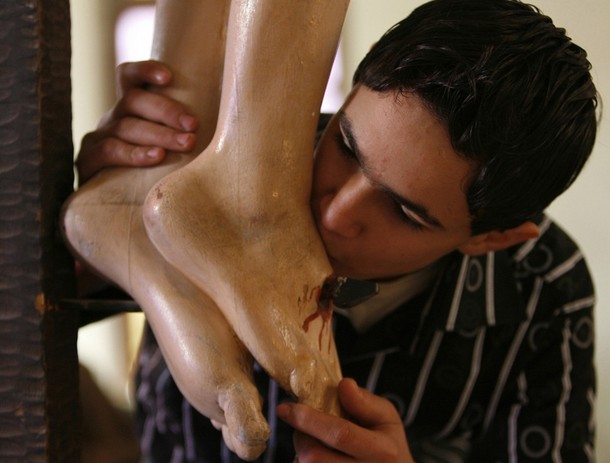
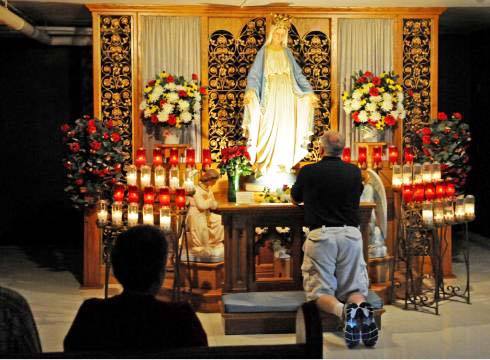
Most Americans are familiar with the Ten Commandments from our Sunday School days as kids. Some of us can even recite them from memory. For those who can't, the Commandments are found in Exodus 20:2-17 (and repeated in Deuteronomy 5:6-21). The Second reads, "You shall not make for yourself a carved image or any likeness of anything that is in heaven above or on the earth beneath or that is in the water under the earth. You shall not bow down to them or serve them, for I the Lord your God am a jealous God..." In spite of such a plain ban, buildings of the Roman Catholic Church are notorious for the presence of images and statues, especially of the Virgin Mary. Shrines are even built to them in Catholic homes.

The first problem is that Catholic portrayals of the Commandments hide the Second, a problem which I address here.

However, when confronted, Catholics will dodge the implications of the commandment by claiming that their use of images of saints is a matter of devotion, not worship, and, therefore, not a violation of the commandment. For statues of Jesus, they claim to be worshiping Christ Himself, not the statue; the statue is merely an aid.

I have dealt with the issue of saint worship elsewhere (such as here). I want now to address the worship of Jesus by use of images of Him.

In Deuteronomy 12:29-30, Moses gives the Israelites a grave warning: "When the Lord your God cuts off before you the nations whom you go in to dispossess, and you dispossess them and dwell in their land, take care that you be not ensnared to follow them, after they have been destroyed before you, and that you do not inquire about their gods, saying, 'How did these nations serve their gods?—that I also may do the same.'" This was written during the Conquest, as the Israelites were driving out the pagans in the Promised Land, as God had commanded them. We see immediately that He is warning them not to get sucked into the worship of the deities of the pagans, the very perversions for which God had judged the Canaanites. However, that wasn't the end of the warning: "You shall not worship the Lord your God in that way, for every abominable thing that the Lord hates they have done for their gods, for they even burn their sons and their daughters in the fire to their gods" (Deuteronomy 12:31). Not only did Jehovah forbid the Israelites to worship the Canaanite deities, He also forbade them to use pagan forms of worship to worship Him!

This was an error that Israel had already made in their travels in the Wilderness. When Aaron, Moses's brother, had made for them the Golden Calf (Exodus 32:1-6), in imitation of the pagan rituals that they had known in Egypt, they did not call it a new god, as is often mistakenly thought. Rather, they called the image "Jehovah" (verse 5)!

This is the death blow to all of the pretenses of Rome. She claims that there is no harm in using an image of Jesus, an image just like those used by the pagan Romans in earlier Christian history (just as Israel had learned from the Egyptians), because it is an image of Jesus, not of Jupiter. Yet, that is exactly the pretense of the Israelites as they called the Golden Calf "Jehovah"! And it is equally judged by God's words through Moses: "You shall not worship the Lord your God in that way, for every abominable thing that the Lord hates they have done for their gods" (Deuteronomy 12:31).

Saturday, September 16, 2017

God's War on Idolatry


"On the day after the Passover, the people of Israel went out triumphantly in the sight of all the Egyptians, while the Egyptians were burying all their firstborn, whom the Lord had struck down among them. On their gods also the Lord executed judgments. [And God said to Moses] 'Speak to the people of Israel and say to them, When you pass over the Jordan into the land of Canaan, then you shall drive out all the inhabitants of the land from before you and destroy all their figured stones and destroy all their metal images and demolish all their high places. If you do not drive out the inhabitants of the land from before you, then those of them whom you let remain shall be as barbs in your eyes and thorns in your sides, and they shall trouble you in the land where you dwell. And I will do to you as I thought to do to them.'"
- Numbers 33:3-4, 51-52, 55-56

The main focus in the story of the Exodus is God's redemption of His people out of slavery in Egypt. It is a glorious story to every Christian, because it serves as a type of our rescue from slavery to sin by the atoning cross work of Jesus Christ.

However, that is not the whole of the story.

I want to point especially at the words of Numbers 33:4, included above: "On their [i. e., the Egyptians'] gods also the Lord executed judgments." The ten plagues are seen to be on the Egyptian people, yet, somehow, they were also judgments on the deceiving spirits that they considered to be gods.

Jehovah continues in His exhortation to Israel: "Just as you saw Me destroy the gods of Egypt, so shall you do the religion of the Canaanites" (paraphrased from Num. 33:52). This demonstrates that the conquest of the Promised Land by the Israelites was not the capricious, vindictive act portrayed by liberal theologians. Rather, it was an act of judgment, one that was deserved by the Canaanites. Why? Because God is jealous of His divine prerogatives: "You shall worship no other god, for the LORD, whose name is Jealous, is a jealous God" (Exodus 34:14). Worshiping any god but Jehovah is to steal from Him what is properly His alone, an act of severe treason. That's why the abolition of it is the first of the Ten Commandments. Is the violation of the Prime Directive (to borrow a Star Trek term) not sufficient reason for capital punishment? I don't believe that any person can say that it is not, except as a self-serving effort to protect his own idolatry (Romans 1:18).

Saturday, September 2, 2017

Is Trump Your Savior?

In every presidential election season since I have been old enough to follow (which would be since Reagan's initial election), I remember so many voices proclaiming that we must "save America" by voting for one candidate, or by voting against another. This was especially apparent in the 2016 election. "The only hope for America is to elect Trump!"

In conscience, I must deny that such a concept is any way biblical.

An anonymous Hebrew poet recorded God's words on this subject in Psalm 146:3-4:
"Put not your trust in princes,
     in a son of man, in whom there is no salvation.
When his breath departs, he returns to the earth;
 

     on that very day his plans perish."

There is no salvation in a king or a president? Why? Because he dies and turns to dust just like any other man. On that day, his political plans, as wonderful as they might have been, are buried in the grave with him.

However, that Hebrew poet didn't stop there, as if he saw no hope in the world of men. Rather, he continued, in Ps. 146:5-7,
"Blessed is he whose help is the God of Jacob,
     whose hope is in the Lord his God,
who made heaven and earth,
     the sea, and all that is in them,
who keeps faith forever;
     who executes justice for the oppressed,
 

     who gives food to the hungry."

First, notice what he does not say. It is common to say about any problem, "You just have to have faith." Not faith in, but just faith. Faith in faith. No, the Psalmist says. Rather, we must have faith in God, the triune God of the Bible. It isn't faith as such that saves, but rather faith in the proper object, the one true God.

Why is God the only proper hope? Because, unlike human kings - or presidents - He is eternal. Men die, and they and their plans rot into dust. Not so with God. He is eternal, as are His purposes, as is His sovereignty. 

And this isn't simply a practical issue, one of depending on a resource that can sustain that dependency. Rather, for the Christian, this is a matter of faithfulness. How easily we forget the First Commandment: "You shall have no other gods before me" (Exodus 20:3). "I don't think Trump is God," you are no doubt saying. However, whatever you depend on for salvation is your god, whether you use that word or not. As Jesus Himself said (Matthew 6:24), "No one can serve two masters, for either he will hate the one and love the other, or he will be devoted to the one and despise the other. You cannot serve God and money." He speaks of God or money, but it is just as true of God or government. "I, I am the LORD, and besides Me there is no savior" (Isaiah 43:11).


Wednesday, August 30, 2017

Jesus Does Not Allow Devotion to His Mother!


In Luke 11:27, the Blessed Physician gives the record of an anonymous woman, who said to Jesus, "Blessed is the womb that bore You, and the breasts at which You nursed!" This is one of the texts that Roman Catholics cite to justify their adoration of Mary.

The problem with that use is that it is possible only if one stops at verse 27. The next verse, Luke 11:28, records the reaction of Jesus to the woman's statement: "But He said, 'Blessed rather are those who hear the word of God and keep it!'" 

Jesus denies that Mary has a special status on the basis of her having given birth to Him. Rather, He said, spiritual status comes from being a disciple! I will certainly grant that Mary was almost-certainly a disciple of Jesus. However, that makes her equal to every other disciple, not superior. Much less does it earn her special status, with the divine attributes of omnipresence and omniscience, as is implied by Catholic reverence for her.

Saturday, July 15, 2017

Yes, It Is Black or White: Belief and Unbelief

 In today's society, it has become unpopular to state things in absolutes: truth or falsehood, right or wrong. It seems as if nearly everyone wants the world in shades of gray. Any person who declares certainty about anything is labeled intolerant. However, have you noticed that defining intolerance as evil is the one absolute that is still acceptable? "I can't tolerate intolerance" may be nonsensical, but it is the popular theme of our age.

The funny thing is that the overwhelming majority of those same people profess to be Christians, about 90% of Americans. How does their intolerant tolerance line up with His attitude? Did Jesus not say, "I am the way, and the truth, and the life. No one comes to the Father except through Me" (John 14:6)? Of course, He did say exactly that, and it is far from a tolerant statement.

He said some other intolerant things, too. We see Him, saying (John 3:18), "Whoever believes in Him is not condemned, but whoever does not believe is condemned already, because he has not believed in the name of the only Son of God." He also says of unbelievers (John 8:43-44), "Why do you not understand what I say? It is because you cannot bear to hear my word. You are of your father the devil, and your will is to do your father’s desires." Apart from commitment to Him, a person is under judgment. That is, now, not just in the hereafter. Why does a person not believe? Because he is acting consistently with his nature as the seed of Satan (Genesis 3:15). These are black and white categories. Either/or. Jesus is an absolutist!

Another categorical statement that Jesus made is, "Whoever is not with Me is against Me" (Matthew 12:30). That is a shocking statement, even to supposed Christians! I know that it is hip to be neutral. To be for or against anything is fanaticism. Except for certitude. One must absolutely be against that. Don't forget, "I can't tolerate intolerance." However, Jesus doesn't make any effort to be hip, or tolerant, or flexible. Nor does He allow His followers to be any such thing. Rather, if you aren't for Him, then He considers you to be against Him.

"Tolerance" has become the catchword for everyone who wants to be an "individual," just like everyone else. However, the biblical Christian is the real counter-cultural radical. The culture says, "Don't conform!" But it only means "don't conform to Christ." Conformity to culture is the modern standard of nonconformity, and it cannot be an option for the Christian.

The Bible commands us to a form of nonconformity (Romans 12:2): "Do not be conformed to this world, but be transformed by the renewal of your mind, that by testing you may discern what is the will of God, what is good and acceptable and perfect." When God says, "Don't conform," He means to the very worldview that is demanding our conformity. At the same time, He also commands a certain conformity (Romans 8:29): "Those whom He foreknew He also predestined to be conformed to the image of His Son, in order that He might be the firstborn among many brothers." Therefore, in a very black and white contrast, to conform as the world demands is rejected by God. The conformity that the world condemns is the exact conformity that God commands. There is no gray, no neutral territory, no safe zone. It's a matter of faithfulness, and to deny it is an act of idolatry.

Monday, June 19, 2017

Astrology As Syncretism

"I will stretch out My hand against Judah
     and against all the inhabitants of Jerusalem;
and I will cut off from this place the remnant of Baal
     and the name of the idolatrous priests along with the priests,
those who bow down on the roofs
     to the host of the heavens,
those who bow down and swear to the Lord
     and yet swear by Milcom,
those who have turned back from following the Lord,
 

     who do not seek the Lord or inquire of Him."
- Zephaniah 1:4-6 

Preaching to the visible church, Judah, Zephaniah reports Jehovah's displeasure against several pagan practices which have been accepted into their worship, a practice known as syncretism. The people of Judah were hedging their bets, professing the name of Jehovah, while, at the same time, worshiping Milcom (also called Moloch), an Ammonite deity, and looking to the stars for their security, a practice which we now call astrology.

Astrology has become an acceptable practice in modern America. No one is shocked when he sees the horoscope in his daily paper. And have we forgotten Nancy Reagan's custom of advising the US President on the basis of what her astrologer told her? Wasn't he the favorite president among evangelicals? 

Yet, look at God's reaction to this syncretism: "I will stretch out My hand against Judah." He isn't simply displeased. Rather, He is moved to act against that nation! And it was against the nation. Notice that He doesn't name names. That means that this syncretism, this apostasy-lite, if you will, was spread throughout this society of the supposed people of God. And when did the judgment come? Well, Zephaniah was written about 622 BC, just before the reforms of Josiah. Those reforms brought a postponement of God's justice. The first of three sackings of Jerusalem by the Babylonians came just seventeen years later, in 605. The final destruction came in 586.

When the professed people of God dishonor Him with disloyalty, He does not play games, as He had warned them: "You shall not go after other gods, the gods of the peoples who are around you— for the Lord your God in your midst is a jealous God—lest the anger of the Lord your God be kindled against you, and He destroy you from off the face of the earth" (Deuteronomy 6:14-15).


Saturday, April 29, 2017

The Second Commandment and Images

Moses gave us this word from God: "You shall not make idols for yourselves or erect an image or pillar, and you shall not set up a figured stone in your land to bow down to it, for I am the Lord your God" (Leviticus 26:1). Most people, even those who are ignorant of the Scriptures, recognize this as a rephrasing of the Second Commandment: "You shall not make for yourself a carved image, or any likeness of anything that is in heaven above, or that is in the earth beneath, or that is in the water under the earth" (Exodus 20:4).

The problem is that, as I have noted before, the Catholic Church has hidden the Second Commandment from its public displays. The self-serving nature of that exclusion is self-evident: the worst offenders of the Commandment pretend that it doesn't exist.

However, God does not allow His word to be mocked in this way (Galatians 6:7). While Rome seeks to blank out the commandment in one context, He has expressed it again elsewhere, that they may not pretend ignorance of His command. As the images in my earlier post show, Rome has erased the commandment from her displays of the Commandments. Yet, His word stands, and the honest reader of Scripture is confronted, and not just once, by His rejection of idols.

God says, "I am the LORD; that is My name; My glory I give to no other, nor My praise to carved idols" (Isaiah 42:8). When the Catholic Church calls Mary "co-redemptrix" or "mediatrix," or tells her members to pray to so-called saints, she may congratulate herself on her novelties, but God rejects them. And what He rejects, He judges: "Now Nadab and Abihu, the sons of Aaron, each took his censer and put fire in it and laid incense on it and offered unauthorized fire before the Lord, which He had not commanded them. And fire came out from before the Lord and consumed them, and they died before the Lord" (Leviticus 10:1-2). Notice that these two sons of Aaron did not do something forbidden by God. Rather, they did something which He had not authorized. The significance of that is that their judgment was so severe, though their action was less than the forbidden worship of the Catholic Church. If God killed Nadab and Abihu, what must the judgment against Rome be?

Monday, April 17, 2017

Like Juice for Breakfast, Idols Aren't Just for Pagans!

In his first epistle, the Apostle John makes an interesting remark: "And we know that the Son of God has come and has given us understanding, so that we may know Him who is true; and we are in Him who is true, in His Son Jesus Christ. He is the true God and eternal life. Little children, keep yourselves from idols" (I John 5:20-21). He asserts that spiritual enlightenment is found in Christ. OK, that's a good thing. Then he asserts the true deity of Christ. That's an excellent addition. then he adds, "Keep yourselves from idols."

That warning just seems out of left field!

If a person understands the first two things, that light and life come in the incarnate Son of God, is it not self-evident that he would then stay away from idols?

Of course, the man of God has that statement from the Father: "You shall not make for yourself a carved image, or any likeness of anything that is in heaven above, or that is in the earth beneath, or that is in the water under the earth. You shall not bow down to them or serve them, for I the Lord your God am a jealous God" (the Second Commandment, Exodus 20:4-5). And we know how well that worked out for Israel (Exodus 32). We know, therefore, that knowing the true God does not shut down the fallen heart, of which John Calvin said, "Man's nature, so to speak, is a perpetual factory of idols."

We must be saddened by the awareness that professing Christians do little better than did the ancient Israelite. Does not Rome produce an army of idols?

Images of Various Saints

This is what John addresses, perverting our faith in the true god, Jesus Christ, by turning our devotion to images, whether we call them saints, gods, or even Jesus. After all, when the Israelites were worshiping the Golden Calf, they called it Jehovah (Exodus 32:5). Therefore, regardless of the claims of Rome, the Second Commandment isn't just about worshiping pagan gods.

Monday, December 19, 2016

Jesus versus the Religion of Humanism


There is a myth that claims that the American government is, and is supposed to be, neutral regarding religion. The reason that is a myth is that the government doesn't play hands-off in religious matters. Rather, it actively promotes the religion of humanism. That is, government is actively hostile to religious people and their beliefs. "Hate speech" is the legal name for blasphemy against the doctrines of humanism.

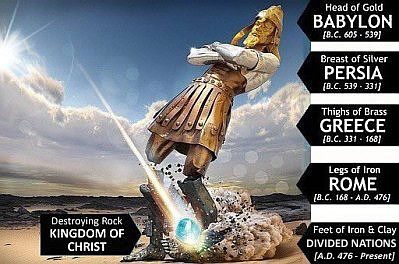
Most people in America are somewhat familiar with the dream of Nebuchadnezzar, described in the second chapter of Daniel. It is described by the prophet in Daniel 2:31-35. It is a figure of a man, with a head of gold, torso and arms of silver, thighs of bronze, shins of iron, and feet of blended iron and clay. Then a stone smashes into the feet of the man, shattering the figure. Then the stone grows into a mountain that fills the entire earth. The dream is then interpreted in Daniel 2:36-45. That interpretation tells us that the head is Nebuchadnezzar himself, the king of Babylon. The other kingdoms have been variously identified, but I think that the probable succession is that the Medo-Persian empire is the kingdom of silver, the Alexandrian empire the kingdom of bronze, and the Romans were the kingdom of iron. Notice that the kingdoms descend in value, from gold to iron, while ascending in power, from hard iron to soft gold.

The stone that smashes the figure is identified as the kingdom of God in verse 44.

The statue is identified as an "image." What is the significance of that term? The Second Commandment (Exodus 20:4-5) says, "You shall not make for yourself a carved image, or any likeness of anything that is in heaven above, or that is in the earth beneath, or that is in the water under the earth. 5You shall not bow down to them or serve them." That is to say, an "image" is not a piece of art, but rather an object of devotion. This particular image is of a man, thus representing the religious devotion to man as the standard of sovereignty. that is, the image represents, not a deity, but the religion of humanism.

What happens to the image? It is destroyed by a great stone, an asteroid, if you will, which is identified as the kingdom of God. And then the stone grows into a huge mountain which fills the whole world. Such a mountain is often used as an image of the kingdom of God, beginning with Mount Sinai and the Temple Mount in Jerusalem. it is also used as the image of the triumphant kingdom of God in the other prophets, such as Isaiah 2:2-3, 25:6, Micah 4:1-2, and Zechariah 8:3.

This vision is a prophecy of the coming of the kingdom in Jesus Christ during the time of the Roman Empire. Though all of the humanist power of Rome, with the cooperation of the apostate Jews, was devoted to destroying the kingdom, it was Rome, instead, that was destroyed. And, ever since, the kingdom of God has been growing around the world, literally filling the earth. This is a prophecy of the victory of Jesus Christ over the humanist idol of sovereign Man.