To the modern reader, there may be nothing written in Scripture more bewildering than one short phrase: "the fear of God." For example, believers are given this commandment: "You shall not wrong one another, but you shall fear your God, for I am the LORD your God" (Leviticus 25:17). In contrast, the fear of God is described as the one thing that unbelievers lack: "There is no fear of God before their eyes" (Romans 3:18).
Then we have this verse: "Do not fear, for God has come to test you, that the fear of Him may be before you, that you may not sin" (Exodus 20:20). Do not fear, but fear?
Ah, but then we see some light at the end of this tunnel: "That you may not sin."
Consider also this verse: "You shall walk after the LORD your God and fear Him and keep His
commandments and obey His voice, and you shall serve Him and hold fast
to Him" (Deuteronomy 13:4).
From our own cultural perspective, we naturally see "fear" as meaning "be afraid." And the example from Exodus shows that it means that in the Bible sometimes, too. However, it has a broader meaning than we give it today.
We Americans have never had a king, so we sometimes miss some of the imagery of the Bible, which unreservedly portrays God as an absolute king, even calling Him, "He who is the blessed and only Sovereign, the King of kings and Lord of lords" (I Timothy 6:15). The God of the Bible is King in such an absolute sense that He is king of all kings, and lord so absolutely that He is lord of all lords. We are to understand His rule as so singularly absolute that we have no higher words by which to name it.
Now think of the average person on the street who randomly runs into the President, or Prince William, or some TV or sports celebrity. In such a circumstance, the person is often struck dumb with awe, trembling even. He isn't afraid of the personage in the sense that he fears that he will be hurt. Rather, he is struck with such an awe that he cannot conceive of any other thought or action.
To a greater extent, that is the fear of God described in Scripture. The believer is so in awe that he cannot be distracted by any lesser concern or influence. That is why Moses can say that it is fear of God that inspires us to serve Him and hold fast to Him. This isn't a fear of punishment. Rather, it is an awe that precludes any lower considerations. Moreover, the hard part for an American is that it leaves no room for personal autonomy. God is the absolute sovereign, not me. This is not a democratic concept!
Showing posts with label formalism. Show all posts
Showing posts with label formalism. Show all posts
Saturday, June 27, 2020


Saturday, December 7, 2019
Apostasy and Its Leaders
We live in a time where the culture has returned to a pre-Christian stage, in which every man does what is right in his own eyes (Judges 21:25). Things which were considered too shameful for polite company within the lifetimes of man of us living today are now common fare in entertainment or taught to our children in government schools.
While it is true that the American government has been on a crusade to scrub the Christian presence from public society, I don't blame government. And while it is true that there are influencers in government and the media who hate the Gospel and seek to silence it, I don't blame them. Unbelievers must be expected to hate the Gospel (Romans 1:18). That's what makes them unbelievers.
However, when I see the church complacent in its own suppression, then I find cause for blame.
We have public religious figures - I don't call them Christians - such as Joel Osteen, who refuse to talk about sin because they don't want to offend anyone. That is who deserves the blame.
In 586 BC, Judah, the Southern Kingdom, was conquered by Babylon and carried away into exile. Why? Because they had abandoned the faith on which their kingdom was established, and turned to pagan deities and practice.
What did their religious leaders say about that apostasy? Did they denounce the sin of the people, and fight against that apostasy?
"Your prophets have seen for you false and deceptive visions; they have not exposed your iniquity to restore your fortunes, but have seen for you oracles that are false and misleading" (Lamentations 2:14). No, no denunciations; no warnings of judgment. Rather, the religious leaders joined in that apostasy, soothing the apostates with assurance that God was happy with their perverted worship and lives. Does that sound like today's religious world? I think so.
But what does God say? Is he bound by the soothing words of apostate preachers? "If I say to the wicked, ‘You shall surely die,’ and you give him no warning, nor speak to warn the wicked from his wicked way, in order to save his life, that wicked person shall die for his iniquity, but his blood I will require at your hand" (Ezekiel 3:18). Not in the smallest bit. Rather, He promises that judgment of sin will come, but it will begin with false teachers who failed to preach a warning about the consequences of sin.
While it is true that the American government has been on a crusade to scrub the Christian presence from public society, I don't blame government. And while it is true that there are influencers in government and the media who hate the Gospel and seek to silence it, I don't blame them. Unbelievers must be expected to hate the Gospel (Romans 1:18). That's what makes them unbelievers.
However, when I see the church complacent in its own suppression, then I find cause for blame.
We have public religious figures - I don't call them Christians - such as Joel Osteen, who refuse to talk about sin because they don't want to offend anyone. That is who deserves the blame.
In 586 BC, Judah, the Southern Kingdom, was conquered by Babylon and carried away into exile. Why? Because they had abandoned the faith on which their kingdom was established, and turned to pagan deities and practice.
What did their religious leaders say about that apostasy? Did they denounce the sin of the people, and fight against that apostasy?
"Your prophets have seen for you false and deceptive visions; they have not exposed your iniquity to restore your fortunes, but have seen for you oracles that are false and misleading" (Lamentations 2:14). No, no denunciations; no warnings of judgment. Rather, the religious leaders joined in that apostasy, soothing the apostates with assurance that God was happy with their perverted worship and lives. Does that sound like today's religious world? I think so.
But what does God say? Is he bound by the soothing words of apostate preachers? "If I say to the wicked, ‘You shall surely die,’ and you give him no warning, nor speak to warn the wicked from his wicked way, in order to save his life, that wicked person shall die for his iniquity, but his blood I will require at your hand" (Ezekiel 3:18). Not in the smallest bit. Rather, He promises that judgment of sin will come, but it will begin with false teachers who failed to preach a warning about the consequences of sin.
Wednesday, November 20, 2019
American Evangelical Tolerance: The Game Plan That Failed
However, that American religion is not at all like the biblical faith from which it came.
Here is what the Bible says about the justice of God: "That day [of judgment] is the day of the Lord GOD of hosts, a day of vengeance, to avenge Himself on His foes. The sword shall devour and be sated and drink its fill of their blood" (Jeremiah 46:10. Where is that tolerant, all-loving deity of today's Christian? Certainly not in this verse.
Here is another one: "The LORD has a sword; it is sated with blood; it is gorged with fat, with the blood of lambs and goats, with the fat of the kidneys of rams. For the LORD has a sacrifice in Bozrah, a great slaughter in the land of Edom" (Isaiah 34:6).
These verses are just examples, not alone in expressing the violence of the judgment of God. Moreover, they reveal a God who is utterly unlike the creampuff advocated by the average American professing evangelical. Why is that?
It is because of the content of the "love" advocated by that brand of evangelical. He thinks of God's love as requiring approval of whatever he wants to do. Only a meanie describes anything as wicked or as deserving of judgment.
The problem is that the love described by such people is love for them, and for what they want. They do not allow the other side of love, God's love for Himself. God is not allowed to love Himself or His holiness or His word. In other words, such people advocate a one-directional tolerance, a tolerance that benefits them. They feel no obligation to tolerate God or what He values. And, sadly for them, God does not feel bound to honor their definition of tolerance. "Woe to those who call evil good and good evil, who put darkness for light and light for darkness, who put bitter for sweet and sweet for bitter! Woe to those who are wise in their own eyes, and shrewd in their own sight!" (Isaiah 5:20-21).
You see, when these evangelicals created their religion of unconditional love and tolerance, they just assumed that God would go along with the gameplan. If they had consulted Him, though, they would have discovered that God doesn't play by their plan.
Saturday, October 20, 2018
The Storm Is from God's Hands: Contra American Deism
It is popular among Christians of every theological stripe to quote II Chronicles 7:14: "If My people who are called by My name humble themselves, and pray and
seek My face and turn from their wicked ways, then I will hear from
heaven and will forgive their sin and heal their land." And there is good reason to quote it; it is a promise that inspires great hope.
However, verse 14 is the second part of a sentence that begins in verse 13, which I have never heard quoted: "When I shut up the heavens so that there is no rain, or command the locust to devour the land, or send pestilence among My people..." That makes most people too uncomfortable. How can God say of Himself that He is the one who sends natural catastrophes?
The answer is that most American Christians have no concept of a biblical worldview. While nearly everyone claims to believe in Jesus, American religion is actually Deism, not Christianity, as I have said before. "God" is the name we put on our religious stuff, but it has nothing to do with the rest of our lives. We talk about God when someone is extremely ill, or has died. We don't talk about God when it comes to our jobs, child-rearing, politics, our relationships with our neighbors, or natural events.
As the saying goes, God don't play that. He claims absolute control over all things, including the weather or agricultural disasters. As I write this, it has been two weeks since Hurricane Florence brought massive flooding to my home state. I deny the Deist claim that a hurricane is just a natural event. Rather, it happened according to the purposes of God, even if I don't know what those purposes are. It was a supernatural event!

However, verse 14 is the second part of a sentence that begins in verse 13, which I have never heard quoted: "When I shut up the heavens so that there is no rain, or command the locust to devour the land, or send pestilence among My people..." That makes most people too uncomfortable. How can God say of Himself that He is the one who sends natural catastrophes?
The answer is that most American Christians have no concept of a biblical worldview. While nearly everyone claims to believe in Jesus, American religion is actually Deism, not Christianity, as I have said before. "God" is the name we put on our religious stuff, but it has nothing to do with the rest of our lives. We talk about God when someone is extremely ill, or has died. We don't talk about God when it comes to our jobs, child-rearing, politics, our relationships with our neighbors, or natural events.
As the saying goes, God don't play that. He claims absolute control over all things, including the weather or agricultural disasters. As I write this, it has been two weeks since Hurricane Florence brought massive flooding to my home state. I deny the Deist claim that a hurricane is just a natural event. Rather, it happened according to the purposes of God, even if I don't know what those purposes are. It was a supernatural event!
Saturday, October 6, 2018
American Pharisees: Lost Without a Physician
Among Americans, Satan's primary attack against biblical Christianity is not atheism, alternative religions, or evolutionism, as bad as those things are. Rather, he attacks the faith through complacency.
Luke describes the conversion of Levi (another name for the Apostle Matthew): "Levi made Him a great feast in his house, and there was a large company of tax collectors and others reclining at table with them. And the Pharisees and their scribes grumbled at his disciples, saying, 'Why do you eat and drink with tax collectors and sinners?' And Jesus answered them, 'Those who are well have no need of a physician, but those who are sick. I have not come to call the righteous but sinners to repentance'" (Luke 5:29-32). At the house of Matthew, Jesus sat at dinner with tax-collectors, a class hated by the Jews, and other sinners. The Pharisees saw this, and rebuked Him for His bad taste in companions. After all, were the Pharisees not the cream of Jewish society?
But the rebuke of Jesus must have caught those Pharisees completely flat-footed: "I have not come to call the [supposedly] righteous but sinners to repentance." In their moral satisfaction, the Pharisees had no desire for what Jesus had come to give, redemption in His blood. However, the tax-collectors and sinners in Matthew's house knew their spiritual condition, and were looking to Jesus to forgive their sins and restore them to righteousness: "Help us, O God of our salvation, for the glory of Your name; deliver us, and atone for our sins, for Your name’s sake!" (Psalm 79:9).
And this explains the spiritual anemia of America's professing Christians. Too many of us are satisfied with our moral superiority. Rare is the man who can say from his heart, "God, be merciful to me, a sinner!" (Luke 18:13). Yet Jesus tells us that is exactly the point to which we must come to find Him.
Saturday, July 15, 2017
Yes, It Is Black or White: Belief and Unbelief

The funny thing is that the overwhelming majority of those same people profess to be Christians, about 90% of Americans. How does their intolerant tolerance line up with His attitude? Did Jesus not say, "I am the way, and the truth, and the life. No one comes to the Father except through Me" (John 14:6)? Of course, He did say exactly that, and it is far from a tolerant statement.
He said some other intolerant things, too. We see Him, saying (John 3:18), "Whoever believes in Him is not condemned, but whoever does not believe is condemned already, because he has not believed in the name of the only Son of God." He also says of unbelievers (John 8:43-44), "Why do you not understand what I say? It is because you cannot bear to hear my word. You are of your father the devil, and your will is to do your father’s desires." Apart from commitment to Him, a person is under judgment. That is, now, not just in the hereafter. Why does a person not believe? Because he is acting consistently with his nature as the seed of Satan (Genesis 3:15). These are black and white categories. Either/or. Jesus is an absolutist!
Another categorical statement that Jesus made is, "Whoever is not with Me is against Me" (Matthew 12:30). That is a shocking statement, even to supposed Christians! I know that it is hip to be neutral. To be for or against anything is fanaticism. Except for certitude. One must absolutely be against that. Don't forget, "I can't tolerate intolerance." However, Jesus doesn't make any effort to be hip, or tolerant, or flexible. Nor does He allow His followers to be any such thing. Rather, if you aren't for Him, then He considers you to be against Him.
"Tolerance" has become the catchword for everyone who wants to be an "individual," just like everyone else. However, the biblical Christian is the real counter-cultural radical. The culture says, "Don't conform!" But it only means "don't conform to Christ." Conformity to culture is the modern standard of nonconformity, and it cannot be an option for the Christian.
The Bible commands us to a form of nonconformity (Romans 12:2): "Do not be conformed to this world, but be transformed by the renewal of your mind, that by testing you may discern what is the will of God, what is good and acceptable and perfect." When God says, "Don't conform," He means to the very worldview that is demanding our conformity. At the same time, He also commands a certain conformity (Romans 8:29): "Those whom He foreknew He also predestined to be conformed to the image of His Son, in order that He might be the firstborn among many brothers." Therefore, in a very black and white contrast, to conform as the world demands is rejected by God. The conformity that the world condemns is the exact conformity that God commands. There is no gray, no neutral territory, no safe zone. It's a matter of faithfulness, and to deny it is an act of idolatry.
Saturday, January 21, 2017
What Is the Reality of the Eucharist?
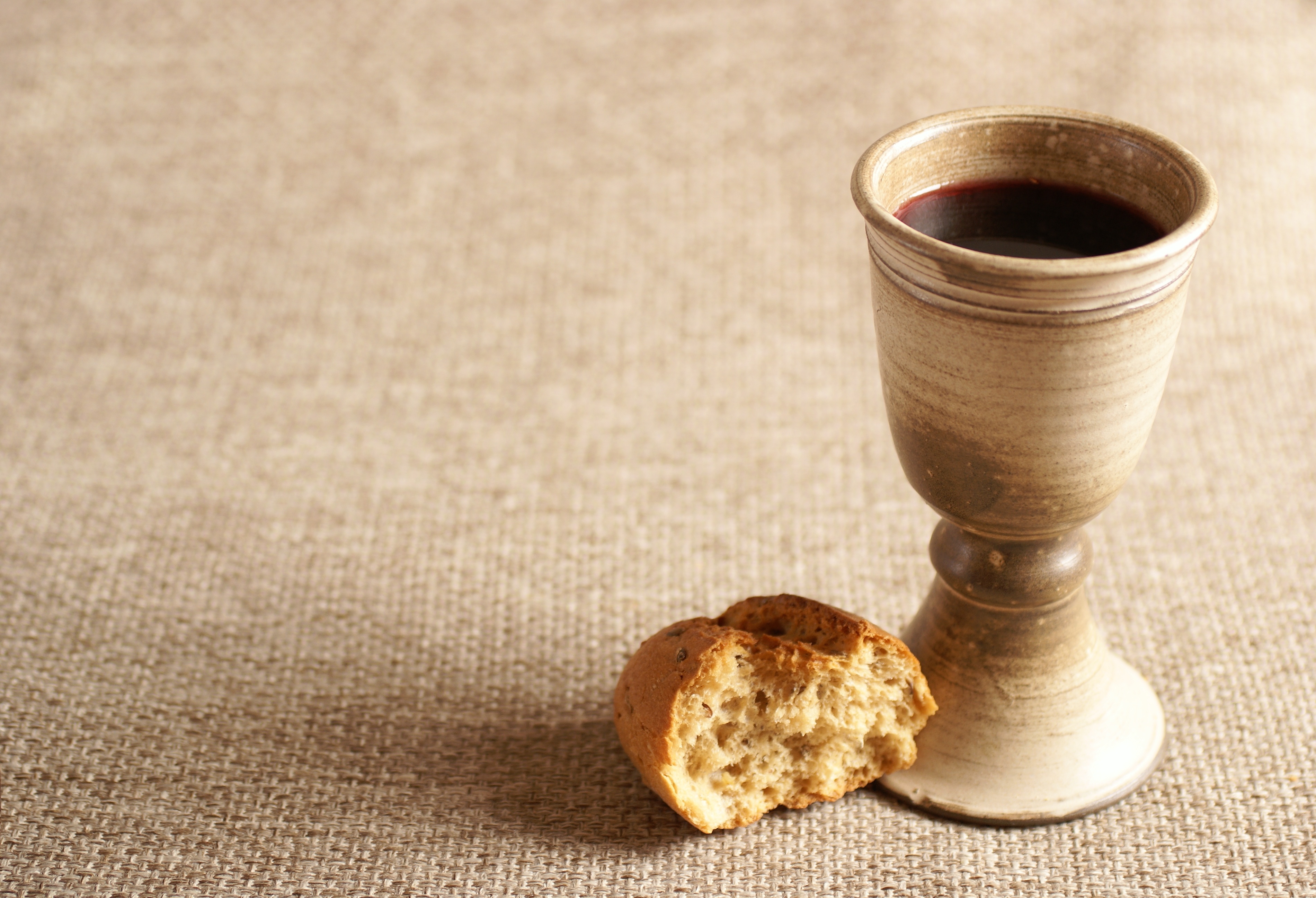
Both the Church of Rome and the Lutherans hold that Christ is physically present in the elements of communion, i. e., in the bread and wine. That's why, they say, that an unbeliever receiving those elements is "eating and drinking judgment to himself" (I Corinthians 11:29). If the elements remain mere bread and wine, how can there be consequences for eating and drinking unworthily, they ask.
While we Reformed deny that Christ is physically present in the elements, we gladly hold that He is spiritually present to those who receive in faith. Thus, eating and drinking judgment is not the result of having bits of Jesus in the stomach of His enemy, but is rather because that unbeliever is receiving the Gospel in visible form. He is seeing the broken body and the spilled blood of Jesus, but despising them, increasing his judgment for unbelief.
The Catholics claim that the Reformed teaching creates a false dichotomy in the eucharist, with Christ present in some portions, but not in others. However, one of their own saints, Augustine, refutes that accusation: "If thou receivest it carnally, still it ceases not to be spiritual, though it is not so to thee." The eucharist remains the means of grace that Christ intended it to be, even if an unbeliever fails to receive that grace because of that unbelief (compare Matthew 13:58).
We find these truths summarized well in the Westminster Confession of Faith XXIX:7-8: "Worthy receivers, outwardly partaking of the visible elements in this sacrament, do then also inwardly by faith, really and indeed, yet not carnally and corporally, but spiritually, receive and feed upon Christ crucified, and all benefits of his death: the body and blood of Christ being then not corporally or carnally in, with, or under the bread and wine; yet as really, but spiritually, present to the faith of believers in that ordinance, as the elements themselves are to their outward senses. Although ignorant and wicked men receive the outward elements in this sacrament, yet they receive not the thing signified thereby; but by their unworthy coming thereunto are guilty of the body and blood of the Lord, to their own damnation. Wherefore all ignorant and ungodly persons, as they are unfit to enjoy communion with him, so are they unworthy of the Lord's table, and can not, without great sin against Christ, while they remain such, partake of these holy mysteries, or be admitted thereunto."
Saturday, October 31, 2015
Hypocrisy and True Spiritual Peace
In Luke 18:9-14, Jesus told a deep parable, that of the Pharisee and the Tax Collector. In it, we see strikingly different attitudes in their approaches to God, representative of those of people everywhere. The Pharisee prays (verses 11-12), "God, I thank you that I am not like other men, extortioners, unjust,
adulterers, or even like this tax collector. I fast twice a week; I give tithes of all that I get." Then He turns to the tax collector, who prays (verse 13), "God, be merciful to me, a sinner!" Then the Lord ends the parable with His own inspired synopsis (verse 14): "I tell you, this man went down to his house justified,
rather than the other. For everyone who exalts himself will be humbled,
but the one who humbles himself will be exalted."
Notice how much longer the prayer of the Pharisee is (see Matthew 6:1-4). He uses thirty-three words in this English version, all of them extolling his virtues. In contrast, the tax collector uses just seven words, begging for God's mercy on his sins. What a contrast! Thirty-three words to stand condemned, but only seven to be justified!
The Pharisee in the story exemplifies something that the Puritan Thomas Watson said: "The wicked may have something which looks like peace, but is not. They may be fearless and stupid, but there is a great difference between a stupified conscience and a pacified conscience. 'When a strong man armed keepeth his palace, his goods are in peace.' Luke 11:21. This is the devil's peace. He rocks men in the cradle of security. He cries, 'Peace, peace,' when men are on the precipice of hell. The seeming peace that a sinner has is not from the knowledge of his happiness but from the ignorance of his danger."
This same false, self-deceived spiritual peace is spoken of by the Prophet Jeremiah (Jer. 3:3-5): "The showers have been withheld, and the spring rain has not come; yet you have the forehead of a whore; you refuse to be ashamed. Have you not just now called to Me, 'My father, you are the friend of my youth— will He be angry forever, will He be indignant to the end?' Behold, you have spoken, but you have done all the evil that you could." In a time of apostasy, the Jews spoke loving words to God, yet devoted themselves to their wicked deeds and idolatries, as if God could be deceived. Yet, He wasn't. And the Prophet Isaiah is even more blunt (Is. 57:21): "'There is no peace,' says my God, 'for the wicked.'"
Watson explains what is necessary for true peace between the sinner and his God: "The graft must first be inoculated into the tree before it can receive sap or nourishment from it; so we must first be
ingrafted into Christ
before we can receive peace from Him." It is only as the believer is connected to Christ by faith that he can experience true peace of conscience. Isaiah also teaches this (Is. 32:17): "The effect of righteousness will be peace, and the result of righteousness, quietness and trust forever." See also Isaiah 9:6-7 and John 16:33. In contrast, the one who depends on his own worthiness is described in Deuteronomy 29:19-20: "The one who, when he hears the words of this sworn covenant, blesses himself
in his heart, saying, 'I shall be safe, though I walk in the
stubbornness of my heart,' the Lord will not be willing to forgive him, but rather the anger of the Lord and His jealousy will smoke against that man, and the curses written in this book will settle upon him, and the Lord will blot out his name from under heaven." That is the fate of the Pharisee in the parable with which I began.
What is righteousness? It is a standard of action and motivation purely consistent with the commands and nature of God. Who meets that standard? No one but Jesus, "for all have sinned and fall short of the glory of God" (Romans 3:23). That's why it is His righteousness, not our own, that we need, when we seek to approach God: "[They] who pursued a law that would lead to righteousness did not succeed in reaching that law. Why? Because they did not pursue it by faith, but as if it were based on works" (Romans 9:31-32). What righteousness? "The righteousness of God through faith in Jesus Christ for all who believe" (Romans 3:22).
Anyone who follows the example of the Pharisee, satisfied with his own goodness to qualify him for eternal life, condemns himself. The one who, like the tax collector, recognizes his own unrighteousness, but looks to that of Christ alone, is justified, and receives both peace with God and peace of conscience.
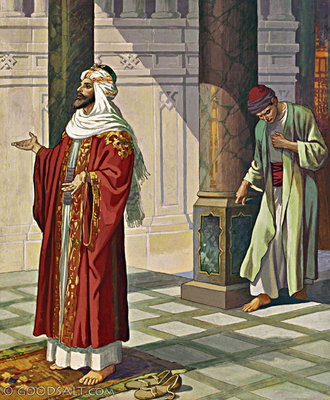 |
| The Pharisee and the Tax Collector |
Notice how much longer the prayer of the Pharisee is (see Matthew 6:1-4). He uses thirty-three words in this English version, all of them extolling his virtues. In contrast, the tax collector uses just seven words, begging for God's mercy on his sins. What a contrast! Thirty-three words to stand condemned, but only seven to be justified!
The Pharisee in the story exemplifies something that the Puritan Thomas Watson said: "The wicked may have something which looks like peace, but is not. They may be fearless and stupid, but there is a great difference between a stupified conscience and a pacified conscience. 'When a strong man armed keepeth his palace, his goods are in peace.' Luke 11:21. This is the devil's peace. He rocks men in the cradle of security. He cries, 'Peace, peace,' when men are on the precipice of hell. The seeming peace that a sinner has is not from the knowledge of his happiness but from the ignorance of his danger."
This same false, self-deceived spiritual peace is spoken of by the Prophet Jeremiah (Jer. 3:3-5): "The showers have been withheld, and the spring rain has not come; yet you have the forehead of a whore; you refuse to be ashamed. Have you not just now called to Me, 'My father, you are the friend of my youth— will He be angry forever, will He be indignant to the end?' Behold, you have spoken, but you have done all the evil that you could." In a time of apostasy, the Jews spoke loving words to God, yet devoted themselves to their wicked deeds and idolatries, as if God could be deceived. Yet, He wasn't. And the Prophet Isaiah is even more blunt (Is. 57:21): "'There is no peace,' says my God, 'for the wicked.'"
Watson explains what is necessary for true peace between the sinner and his God: "The graft must first be inoculated into the tree before it can receive sap or nourishment from it; so we must first be
 |
| A tree prepared for grafting in a new branch. |
What is righteousness? It is a standard of action and motivation purely consistent with the commands and nature of God. Who meets that standard? No one but Jesus, "for all have sinned and fall short of the glory of God" (Romans 3:23). That's why it is His righteousness, not our own, that we need, when we seek to approach God: "[They] who pursued a law that would lead to righteousness did not succeed in reaching that law. Why? Because they did not pursue it by faith, but as if it were based on works" (Romans 9:31-32). What righteousness? "The righteousness of God through faith in Jesus Christ for all who believe" (Romans 3:22).
Anyone who follows the example of the Pharisee, satisfied with his own goodness to qualify him for eternal life, condemns himself. The one who, like the tax collector, recognizes his own unrighteousness, but looks to that of Christ alone, is justified, and receives both peace with God and peace of conscience.
Tuesday, September 1, 2015
Doctrinal Accountability: Can Anyone Avoid It?
"They have spoken falsely of the Lord
and have said, ‘He will do nothing;
no disaster will come upon us,
nor shall we see sword or famine.
The prophets will become wind;
the word is not in them."
- Jeremiah 5:12-13
This is an Old Testament version of Romans 1:18: "For the wrath of God is revealed from heaven against all ungodliness and unrighteousness of men, who by their unrighteousness suppress the truth." Paul continues (verse 21): "For although they knew God, they did not honor Him as God or give thanks to Him, but they became futile in their thinking, and their foolish hearts were darkened." The Prophet and the Apostle are both testifying against the claim by some that they don't believe in God: those men and women are lying! They know full well that God exists and that they are accountable to Him. As Paul also says (verses 19-20), "For what can be known about God is plain to them, because God has shown it to them. For His invisible attributes, namely, His eternal power and divine nature, have been clearly perceived, ever since the creation of the world, in the things that have been made. So they are without excuse."
This is sometimes referred to as "natural theology," the witness that God has revealed of Himself in His creation, so that all men know of Him, even if they pretend otherwise. Why? That is what Jeremiah is talking about: they believe that they are not accountable for what they refuse to acknowledge. I compare it to the bratty child who sticks his fingers in his ears and sing-songs, "La-la-la, I can't hear you," with the belief that he can then claim not to know what his parents said to him.
Do responsible parents allow their children free rein under this pretense? Of course not! And neither does God allow the atheist to escape judgment, simply because he pretends that he doesn't know, or believe in, God.
Jeremiah also addresses a Catholic error, the concept of "implicit faith," i. e., the medieval doctrine that the Christian believes whatever the (Roman) church believes even if one does not know it personally.While Rome no longer teaches this doctrine explicitly (please forgive the pun), it is, nevertheless, the heart of the practice of most Catholics. In other words, they admit that they aren't personally familiar with the content of Roman doctrine, but accept it implicitly, not on the basis of evidence, but rather because their Church advocates it. Jeremiah's remarks here, directly, and Paul's indirectly, cut through this form of self-deception: intentional ignorance is no excuse!
Is there anything more explicit about where our doctrines should originate and be tested? I say, emphatically, yes, there is! In Isaiah 8:20, that prophet tells us God's prescription: "To the teaching and to the testimony! If they will not speak according to this word, it is because they have no dawn." Passively receiving the teachings of the Church of Rome (or of any church or teacher), without
checking them against the Scriptures, is to indicate that you are void of spiritual light.
no disaster will come upon us,
nor shall we see sword or famine.
The prophets will become wind;
the word is not in them."
- Jeremiah 5:12-13
This is an Old Testament version of Romans 1:18: "For the wrath of God is revealed from heaven against all ungodliness and unrighteousness of men, who by their unrighteousness suppress the truth." Paul continues (verse 21): "For although they knew God, they did not honor Him as God or give thanks to Him, but they became futile in their thinking, and their foolish hearts were darkened." The Prophet and the Apostle are both testifying against the claim by some that they don't believe in God: those men and women are lying! They know full well that God exists and that they are accountable to Him. As Paul also says (verses 19-20), "For what can be known about God is plain to them, because God has shown it to them. For His invisible attributes, namely, His eternal power and divine nature, have been clearly perceived, ever since the creation of the world, in the things that have been made. So they are without excuse."
This is sometimes referred to as "natural theology," the witness that God has revealed of Himself in His creation, so that all men know of Him, even if they pretend otherwise. Why? That is what Jeremiah is talking about: they believe that they are not accountable for what they refuse to acknowledge. I compare it to the bratty child who sticks his fingers in his ears and sing-songs, "La-la-la, I can't hear you," with the belief that he can then claim not to know what his parents said to him.
Do responsible parents allow their children free rein under this pretense? Of course not! And neither does God allow the atheist to escape judgment, simply because he pretends that he doesn't know, or believe in, God.
Jeremiah also addresses a Catholic error, the concept of "implicit faith," i. e., the medieval doctrine that the Christian believes whatever the (Roman) church believes even if one does not know it personally.While Rome no longer teaches this doctrine explicitly (please forgive the pun), it is, nevertheless, the heart of the practice of most Catholics. In other words, they admit that they aren't personally familiar with the content of Roman doctrine, but accept it implicitly, not on the basis of evidence, but rather because their Church advocates it. Jeremiah's remarks here, directly, and Paul's indirectly, cut through this form of self-deception: intentional ignorance is no excuse!
Is there anything more explicit about where our doctrines should originate and be tested? I say, emphatically, yes, there is! In Isaiah 8:20, that prophet tells us God's prescription: "To the teaching and to the testimony! If they will not speak according to this word, it is because they have no dawn." Passively receiving the teachings of the Church of Rome (or of any church or teacher), without
checking them against the Scriptures, is to indicate that you are void of spiritual light.
Remember what the bible says of the believers in Berea (Acts 17:10-11): "The brothers immediately sent Paul and Silas away by night to Berea, and, when they arrived, they went into the Jewish synagogue. Now
these Jews were more noble than those in Thessalonica; they received
the word with all eagerness, examining the Scriptures daily to see if
these things were so." I know that Catholic apologists have demonized the Protestant teaching of sola scriptura, but here it is, in Old Testament and in New. Your spiritual welfare depends on it!
Tuesday, April 16, 2013
Worship Worthy of the Holiness of God
"Now Nadab and Abihu, the sons of Aaron, each took his censer and put fire in it and laid incense on it and offered unauthorized fire before the Lord, which he had not commanded them. And fire came out from before the Lord and consumed them, and they died before the Lord. Then Moses said to Aaron, 'This is what the Lord has said, "Among those who are near Me I will be sanctified, and before all the people I will be glorified."' And Aaron held his peace."
- Leviticus 10:1-3
 We have this brief narrative, in which Moses tells of us two of the sons of Aaron, the newly-appointed high priest," offering "unauthorized fire" (KJV, "strange fire") on the altar of the Lord. This may mean that, where they had been commanded to keep a continuous fire on the altar, they instead began their work with a newly-kindled flame. Or, as in Keil and Delitzsch, this may refer to an unscheduled time or in an improper place. The text here doesn't explain the reference, presumably because it was written by Moses at the time, or soon after, so the details would have been publicly known.
The Lord's response is surprising. He doesn't ask simply, "Why didn't you do things the way I told you?" Rather, He rebukes it as an affront to His holiness.
We see a similar rebuke, also to the priests, in Malachi 1:6, "'A son honors his father, and a servant his master. If then I am a father, where is My honor? And if I am a master, where is My fear?' says the LORD of hosts to you, O priests, who despise My name. But you say, ‘How have we despised Your name?’" There, the priests feign ignorance of their sins: "How have we despised Your name?" they ask.
Manmade worship, labeled theologically as "will-worship," is an affront to God's holiness because it places His worship at the whim of fallen, sinful man. It brings His worship down to our level, rather than up to His. It treats His worship like actual manmade worship of pagan deities. It is no longer worship but abuse. John Calvin (II.8.17), describes it as, "the licentious daring which would subject the incomprehensible God to our senses..." This principle is known in Reformed theology as "the regulative principle of worship" (hereafter "RPW"). It is often phrased as, "Whatever is not commanded is forbidden."
This contrasts with the Lutheran concept, which holds that, "Whatever is not forbidden is permitted." These Protestant views I consider to be consistent with Paul's admonition in I Corinthians 1:40, that "all things should be done decently and in order." And, of course, it contrasts with Catholicism, which holds that the Pope is the Vicar of Christ, and can therefore create whatever he wants in God's name.
The RPW is prominent in Reformed confessional tradition. In the Second Helvetic Confession, the confessional standard of the Swiss and Hungarian Reformed churches, Chapter V, we read, "[W]e teach that God is to be adored and worshiped as He Himself has taught us to worship, namely, 'in spirit and in truth' (John 4:23 f.), not with any superstition, but with sincerity, according to His Word; lest at anytime He should say to us: 'Who has required these things from your hands?' (Isa. 1:12; Jer. 6:20). For Paul also says: 'God is not served by human hands, as though he needed anything,' etc. (Acts 17:25)." And in the Westminster Confession, the confessional standard of Reformed churches in the Scottish tradition, usually titled "Presbyterian," XXI:1, we read, "[T]he acceptable way of worshiping the true God is instituted by Himself, and so limited by His own revealed will, that He may not be worshiped according to the imaginations and devices of men, or the suggestions of Satan, under any visible representation or any other way not prescribed in the holy Scripture."
This narrative in Leviticus is a case-law application of the Second Commandment. The fact that God puts His worship in such a prominent place in His Law indicates how important it is in His estimation, regardless of how lackadaisically we treat it. That is why I personally could never, in good conscience, be a member of any but a Reformed church. That is not to say that I think that only the Reformed are Christians. In fact, if my family attended an orthodox Lutheran church, where now they attend none, I would bless God, and not quibble. But in my own actions, my conscience is more thoroughly trained, and I would not make that choice for myself.
- Leviticus 10:1-3
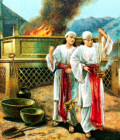 We have this brief narrative, in which Moses tells of us two of the sons of Aaron, the newly-appointed high priest," offering "unauthorized fire" (KJV, "strange fire") on the altar of the Lord. This may mean that, where they had been commanded to keep a continuous fire on the altar, they instead began their work with a newly-kindled flame. Or, as in Keil and Delitzsch, this may refer to an unscheduled time or in an improper place. The text here doesn't explain the reference, presumably because it was written by Moses at the time, or soon after, so the details would have been publicly known.
The Lord's response is surprising. He doesn't ask simply, "Why didn't you do things the way I told you?" Rather, He rebukes it as an affront to His holiness.
We see a similar rebuke, also to the priests, in Malachi 1:6, "'A son honors his father, and a servant his master. If then I am a father, where is My honor? And if I am a master, where is My fear?' says the LORD of hosts to you, O priests, who despise My name. But you say, ‘How have we despised Your name?’" There, the priests feign ignorance of their sins: "How have we despised Your name?" they ask.
Manmade worship, labeled theologically as "will-worship," is an affront to God's holiness because it places His worship at the whim of fallen, sinful man. It brings His worship down to our level, rather than up to His. It treats His worship like actual manmade worship of pagan deities. It is no longer worship but abuse. John Calvin (II.8.17), describes it as, "the licentious daring which would subject the incomprehensible God to our senses..." This principle is known in Reformed theology as "the regulative principle of worship" (hereafter "RPW"). It is often phrased as, "Whatever is not commanded is forbidden."
This contrasts with the Lutheran concept, which holds that, "Whatever is not forbidden is permitted." These Protestant views I consider to be consistent with Paul's admonition in I Corinthians 1:40, that "all things should be done decently and in order." And, of course, it contrasts with Catholicism, which holds that the Pope is the Vicar of Christ, and can therefore create whatever he wants in God's name.
The RPW is prominent in Reformed confessional tradition. In the Second Helvetic Confession, the confessional standard of the Swiss and Hungarian Reformed churches, Chapter V, we read, "[W]e teach that God is to be adored and worshiped as He Himself has taught us to worship, namely, 'in spirit and in truth' (John 4:23 f.), not with any superstition, but with sincerity, according to His Word; lest at anytime He should say to us: 'Who has required these things from your hands?' (Isa. 1:12; Jer. 6:20). For Paul also says: 'God is not served by human hands, as though he needed anything,' etc. (Acts 17:25)." And in the Westminster Confession, the confessional standard of Reformed churches in the Scottish tradition, usually titled "Presbyterian," XXI:1, we read, "[T]he acceptable way of worshiping the true God is instituted by Himself, and so limited by His own revealed will, that He may not be worshiped according to the imaginations and devices of men, or the suggestions of Satan, under any visible representation or any other way not prescribed in the holy Scripture."
This narrative in Leviticus is a case-law application of the Second Commandment. The fact that God puts His worship in such a prominent place in His Law indicates how important it is in His estimation, regardless of how lackadaisically we treat it. That is why I personally could never, in good conscience, be a member of any but a Reformed church. That is not to say that I think that only the Reformed are Christians. In fact, if my family attended an orthodox Lutheran church, where now they attend none, I would bless God, and not quibble. But in my own actions, my conscience is more thoroughly trained, and I would not make that choice for myself.
Monday, October 10, 2011
Isaiah 53:2, the Danger of Images
"For He grew up before Him like a young plant, and like a root out of dry ground; He had no form or majesty that we should look at Him, and no beauty that we should desire Him."
The picture here shows an iconostasis, which is the display of images in an Orthodox Church. Unlike the Church of Rome, the Orthodox hold that the Second Commandment forbids carved images, but not
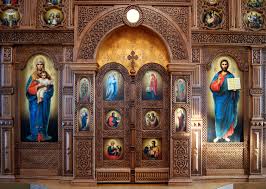 painted. Thus, no statues. However, I would contend that their distinction has no biblical foundation. As the Commandment (Exodus 20:4) says, "You shall not make for yourself a carved image, or any likeness of anything that is in heaven above, or that is in the earth beneath, or that is in the water under the earth" [emphasis mine]. Notice that it clearly states "carved" or "any likeness."
But, other than the sin of disobedience (I John 3:4), where is the harm? That is the most-frequent question asked by today's latitudinarian Christian. That great Puritan preacher John Owen, suggests a good answer: "[M]en who are complete strangers to seeing the person and glory of Christ by faith have turned to images, pictures, and music to help them in their worship." Owen's position was that we walk by faith in this life, in preparation for the life of sight that we will enjoy in the eternal state (I Corinthians 13:12, I John 3:2, II Corinthians 4:18, 5:7, Hebrews 11:1). Therefore, images enter the religion of the individual or church which does not know Christ by faith. It is a sort of short-circuit, and fools that person into believing that he is in a spiritual condition that he does not truly have. That is why I used the Isaiah text at the top: it precisely makes the point that the experience we need to have with Jesus, the Suffering Servant, is not found in looking upon His likeness.
That is the danger: that images would create a spiritual complacency in a person which blinds him to his real need for the Gospel. To use an analogy, it is like filling the stomach with sand, creating a false sense of fullness, while the person is actually starving to death.
The picture here shows an iconostasis, which is the display of images in an Orthodox Church. Unlike the Church of Rome, the Orthodox hold that the Second Commandment forbids carved images, but not
But, other than the sin of disobedience (I John 3:4), where is the harm? That is the most-frequent question asked by today's latitudinarian Christian. That great Puritan preacher John Owen, suggests a good answer: "[M]en who are complete strangers to seeing the person and glory of Christ by faith have turned to images, pictures, and music to help them in their worship." Owen's position was that we walk by faith in this life, in preparation for the life of sight that we will enjoy in the eternal state (I Corinthians 13:12, I John 3:2, II Corinthians 4:18, 5:7, Hebrews 11:1). Therefore, images enter the religion of the individual or church which does not know Christ by faith. It is a sort of short-circuit, and fools that person into believing that he is in a spiritual condition that he does not truly have. That is why I used the Isaiah text at the top: it precisely makes the point that the experience we need to have with Jesus, the Suffering Servant, is not found in looking upon His likeness.
That is the danger: that images would create a spiritual complacency in a person which blinds him to his real need for the Gospel. To use an analogy, it is like filling the stomach with sand, creating a false sense of fullness, while the person is actually starving to death.
Tuesday, June 21, 2011
Deism as the American National Religion

Colossians 2:6-10
About 90% of Americans are professing Christians. In fact, Islamists often refer to that fact, along with American materialism and immorality, as supposed evidence of what Christians are really like. I suggest that not only are they wrong, but that the profession of Christianity is based on self-deception.
In any discussion, that is, of the sort that we call "water-cooler" conversations, whatever the topic, how common is it to refer to the biblical standards for judging the matter? In fact, there is even a presumption that most subjects, e.g., economics, politics, education, employment, family, have no distinct Christian evaluation or solution. They are considered spiritually neutral. But that view itself is contrary to Scripture.
Look at I Corinthians 1:18-25. Look especially at the second half of verse 20, "Has not God made foolish the wisdom of the world?" Where is the wisdom of God found? Jesus Himself tells us (John 17:17): "Sanctify them in the truth; Your word is truth." The foundation of truth is the Word of God, not some supposed common ground we share with unbelievers.
In fact, "neutrality" is exactly the presumption of unbelief. The average American believes that there is a god (note lower-case "g"), while simultaneously believing that he/she/it is irrelevant to life. This is properly labeled "Deism," not Christianity. In other words, while most Americans label themselves Christian, they are in error. The true national religion of America is Deism!
Paul gives the contrasting position in Colossians 2, quoted above. He gives the contrast between naturalist precepts and biblical faith, which is founded on the deity of Christ. He uses that principle himself in his sermon on Mars Hill (Acts 17). Look especially at Acts 17:28: "In Him we live and move and have our being." Our lives exist in God's world, under His laws, according to His plans, whether we are willing or not. There is no neutrality here; rather, there is only truth contrasted with error. In fact, biblically-speaking, unbelief isn't neutral. In Romans 1:18-21, Paul warns us that unbelievers "by their unrighteousness suppress the truth," and are "futile in their thinking." To seek common ground with them is to seek futility, the very opposite of rationality!
Saturday, March 6, 2010
William Tyndale and the Marks of a True Christian
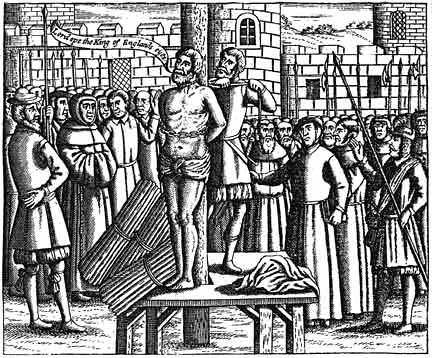
The Protestant martyr and Reformer William Tyndale is best known as the first person to translate the Bible into English from the original languages (Wycliffe's translation was earlier, but came from the Latin Vulgate). At that time, to do so was a capital crime in England, and he was indeed hunted down in his refuge in Antwerp (modern Belgium), strangled, and then burned at the stake.
Tyndale wrote other works, as well. I am just starting his Exposition of Matthew, Chapters 5-7, in which he seeks to rescue the proper understanding of the Law from Antinomianism on one side and Legalism (or Neonomianism) on the other. I am in the prologue, which is heavy enough! I heartily commend it.
One teaching that has particularly struck me so far is his simple, three-point distinction between the true Christian and the false, hypocritical professor (a revolutionary principle in those days of pre-Reformation England).

What he suggests is that the true believer believes in Christ's blood for the remission of sin and purchasing of all the promises, loves the law, and longs for the life to come. He says, "These three points are the profession and religion of a christian man, and the inward baptism of the heart, signified by the outward washing of the body. And they be that spiritual character, badge, or sign, wherewith God, through his Spirit, marketh all [that are] his immediately as soon as they be joined to Christ and made members of his church by true faith."
These principles he presumably derived from the First Epistle of John, the subject of another of his Expositions. I Jn 1:7 tells us that "the blood of Jesus His Son cleanses us from all sin," the first of Tyndale's principles. Then I Jn. 2:3 continues, "by this we know that we have come to know Him, if we keep His commandments." There's point number 2. And finally I Jn. 2:17 warns us that "the world is passing away along with its desires, but whoever does the will of God abides forever." And thus we complete Tyndale's triad. However, it is crucial that a searching believer pay attention to the image above of Tyndale's execution: ideas have consequences. Are you prepared for them?
Tyndale wrote other works, as well. I am just starting his Exposition of Matthew, Chapters 5-7, in which he seeks to rescue the proper understanding of the Law from Antinomianism on one side and Legalism (or Neonomianism) on the other. I am in the prologue, which is heavy enough! I heartily commend it.
One teaching that has particularly struck me so far is his simple, three-point distinction between the true Christian and the false, hypocritical professor (a revolutionary principle in those days of pre-Reformation England).
What he suggests is that the true believer believes in Christ's blood for the remission of sin and purchasing of all the promises, loves the law, and longs for the life to come. He says, "These three points are the profession and religion of a christian man, and the inward baptism of the heart, signified by the outward washing of the body. And they be that spiritual character, badge, or sign, wherewith God, through his Spirit, marketh all [that are] his immediately as soon as they be joined to Christ and made members of his church by true faith."
These principles he presumably derived from the First Epistle of John, the subject of another of his Expositions. I Jn 1:7 tells us that "the blood of Jesus His Son cleanses us from all sin," the first of Tyndale's principles. Then I Jn. 2:3 continues, "by this we know that we have come to know Him, if we keep His commandments." There's point number 2. And finally I Jn. 2:17 warns us that "the world is passing away along with its desires, but whoever does the will of God abides forever." And thus we complete Tyndale's triad. However, it is crucial that a searching believer pay attention to the image above of Tyndale's execution: ideas have consequences. Are you prepared for them?
Wednesday, August 12, 2009
True Peace and God's Judgment on Religious Formalism
"What to me is the multitude of your sacrifices? says the Lord; I have had enough of burnt offerings of rams and the fat of well-fed beasts; I do not delight in the blood of bulls, or of lambs, or of goats. When you come to appear before Me, who has required of you this trampling of My courts? Bring no more vain offerings; incense is an abomination to Me. New moon and Sabbath and the calling of convocations - I cannot endure iniquity and solemn assembly. Your new moons and your appointed feasts My soul hates; they have become a burden to Me; I am weary of bearing them. When you spread out your hands, I will hide My eyes from you; even though you make many prayers, I will not listen; your hands are full of blood."
- Isaiah 1:11-15
God isn't here rejecting the Mosaic ceremonies. He did, after all, command them Himself. Rather, He is angry with professing believers who continued to go through the motions of the ceremonies, but missed their point completely. The Apostle Paul referred to the same thing in II Timothy 3:5, "[people] having the appearance of godliness, but denying the power."
The ceremonies were never intended for their own sake; they aren't magic rituals that create spiritual miracles out of the thin air. Rather they were intended to reveal the holiness of God, His hatred of sin, and the necessity of atonement for it. As Hebrew 9:22 explains, "Indeed, under the Law almost everything is purified with blood, and without the shedding of blood there is no forgiveness of sins."
However, for the one who isn't numb to his own sins, the sacrifices should lead to a hatred of his sin, an appeal to the blood atonement, and the clear conscience that comes from knowing the Lamb who takes away the sins of the world (John 1:29). Again, we see in Hebrews 10:3-4, "But in these sacrifices there is a reminder of sin every year. For it is impossible for the blood of bulls and goats to take away sins."
So, what of the blood atonement for our sins? Is it never to be fulfilled? Are we left without the satisfaction of God's wrath? What freedom, what blessing to know that the atonement has been provided once for all! Hebrews 10:12-14, "When Christ had offered for all time a single sacrifice for sins, He sat down at the right hand of God, waiting from that time until His enemies should be made a footstool for His feet. For by a single offering He has perfected for all time those who are being sanctified." This verse disabuses the Church of Rome of its doctrine of the sacrifice in the mass: not only is that doctrine false, but it is a blasphemy against the once-for-all sacrifice of Christ on the cross.
When Israel performed their sacrifices as a formal ceremony, with no change of the heart, their consciences were clear, but Isaiah exposes that their peace was a deception. In contrast, for the one who truly places his faith in Christ, Hebrews 10:19-22 testifies, "Therefore, brothers, since we have confidence to enter the holy places by the blood of Jesus, by the new and living way that He opened for us through the curtain, that is, through His flesh, and since we have a great priest over the house of God, let us draw near with a true heart in full assurance of faith, with our hearts sprinkled clean from an evil conscience and out bodies washed with pure water."
- Isaiah 1:11-15
God isn't here rejecting the Mosaic ceremonies. He did, after all, command them Himself. Rather, He is angry with professing believers who continued to go through the motions of the ceremonies, but missed their point completely. The Apostle Paul referred to the same thing in II Timothy 3:5, "[people] having the appearance of godliness, but denying the power."
The ceremonies were never intended for their own sake; they aren't magic rituals that create spiritual miracles out of the thin air. Rather they were intended to reveal the holiness of God, His hatred of sin, and the necessity of atonement for it. As Hebrew 9:22 explains, "Indeed, under the Law almost everything is purified with blood, and without the shedding of blood there is no forgiveness of sins."
However, for the one who isn't numb to his own sins, the sacrifices should lead to a hatred of his sin, an appeal to the blood atonement, and the clear conscience that comes from knowing the Lamb who takes away the sins of the world (John 1:29). Again, we see in Hebrews 10:3-4, "But in these sacrifices there is a reminder of sin every year. For it is impossible for the blood of bulls and goats to take away sins."
So, what of the blood atonement for our sins? Is it never to be fulfilled? Are we left without the satisfaction of God's wrath? What freedom, what blessing to know that the atonement has been provided once for all! Hebrews 10:12-14, "When Christ had offered for all time a single sacrifice for sins, He sat down at the right hand of God, waiting from that time until His enemies should be made a footstool for His feet. For by a single offering He has perfected for all time those who are being sanctified." This verse disabuses the Church of Rome of its doctrine of the sacrifice in the mass: not only is that doctrine false, but it is a blasphemy against the once-for-all sacrifice of Christ on the cross.
When Israel performed their sacrifices as a formal ceremony, with no change of the heart, their consciences were clear, but Isaiah exposes that their peace was a deception. In contrast, for the one who truly places his faith in Christ, Hebrews 10:19-22 testifies, "Therefore, brothers, since we have confidence to enter the holy places by the blood of Jesus, by the new and living way that He opened for us through the curtain, that is, through His flesh, and since we have a great priest over the house of God, let us draw near with a true heart in full assurance of faith, with our hearts sprinkled clean from an evil conscience and out bodies washed with pure water."
Subscribe to:
Posts (Atom)