Showing posts with label 1 timothy. Show all posts

Wednesday, July 9, 2025

Anthropomorphisms for God Against Mormon Theology

One of the the doctrines that distinguish Mormons from biblical Christians is their belief that God the Father has a physical body like that of a human being. That is, they take references in the Bible literally, such as to His eyes, or arms, ears, feet. 

In contrast, biblical Christians take such references to be anthropomorphisms. That is, figures of speech in which is God is described as if He has human features, not because He does, but in order to make Him more relatable to mortal men. That is because He tells us explicitly that He is not a man: "God is not a man" (Numbers 23:29, I Samuel 15:29). Furthermore, we are told that His divine nature is invisible (Colossians 1:15, I Timothy 1:17). 

When I have denied their literal use of such anthropomorphisms in reference to God, I have had Mormons tell me that I demonstrate that I do not believe what the Bible says. 

However, anthropomorphisms in the Bible are not limited to references to God. 

"For you shall go out in joy and be led forth in peace; the mountains and the hills before you shall break forth into singing and all the trees of the field shall clap their hands" (Isaiah 55:12). Here there are anthropomorphisms of land features and trees expressing emotions like human beings. I posted the verse in a discussion group with Mormons and asked if they believe that mountains can sing or that trees have hands. Of course, they denied that they do. So then I asked, don't you believe the Bible? Then some fell silent while others turned to ridicule. None even attempted a rational distinction between this verse and the ones that they claim refer to literal body parts of God. 

Mormon exegesis falls apart under a little examination. 


Wednesday, July 21, 2021

Forgiving Sins and Priesthood Authority

I have been having discussions with Mormons recently on the place of "priests" in the Christian Church. They claim to have an exclusive "priesthood authority." According to the organization's website, that means "in mortality, priesthood is the authority that God gives to man to act in all things necessary for the salvation of God's children." What is that authority? From the organization's handbook: "The keys of the priesthood are the right to preside and direct the affairs of the Church within a jurisdiction. Jesus Christ holds all the keys of the priesthood pertaining to His Church. He has conferred upon each of His Apostles all the keys that pertain to the kingdom of God on earth. The senior living Apostle, the President of the Church, is the only person on earth authorized to exercise all priesthood keys." 

When I talk to Mormons, they claim that Jesus Himself created this authority in the church, when Peter first professed His Messianic office in  Matthew 16. Jesus said, "Blessed are you, Simon Bar-Jonah! For flesh and blood has not revealed this to you, but My Father who is in Heaven. And I tell you, you are Peter, and on this rock I will build My church, and the gates of Hell shall not prevail against it. I will give you the keys of the kingdom of Heaven, and whatever you bind on earth shall be bound in heaven, and whatever you loose on earth will be loosed in Heaven" (Matthew 16:17-19). Mormons (and Catholics) claim that Peter and his successors received here from Jesus his imprimatur allowing them to forgive sins, and, thus, mediating salvation to everyone else. 

To my mind, that claim is blasphemous, a denial of the sufficiency of Christ for the salvation of His people. As the Scriptures say, "There is one God, and there is one mediator between God and men, the man Christ Jesus, who gave Himself as a ransom for all" (I Timothy 2:5-6). That is what is said about Him. 

But is there anything which Jesus Himself said that directly refutes this claim of priesthood? 

Yes, there is. In the story of the paralytic, Jesus says to the frowning scribes, "Which is easier, to say, 'Your sins are forgiven,' or to say, 'Rise and walk'? But that you may know that the Son of Man has authority on earth to forgive sins - (He then turned to the paralytic) - Rise, pick up your bed and go home" (Matthew 19:5-6). In the parallel passage in Mark, we get an additional piece of information. That is that the scribes accused Him of blasphemy, because, "Who can forgive sins but God alone?" (Mark 2:7). And notice that Jesus does nothing to disabuse them of this opinion! They were correct that God alone can forgive sins. And in claiming that authority, Jesus blasphemed, in their view, because His claim was a claim to deity, equal to that of the Father! 

More to my point is that Jesus agreed that the authority belongs to God alone, and, therefore, cannot be held by any mere man, including Peter or anyone who claims to be his successor. Rather, as the representative of the only Head of the Church, Peter, the other apostles, and every true minister since their time has declared, not that they forgave sins, but rather that they brought the Gospel, the news that Jesus has purchased forgiveness of sins for everyone who believes (Acts 10:43). Jesus forgives, and the messenger announces

"With God are wisdom and might; He has counsel and understanding. If He tears down, none can rebuild; if He shuts a man in, none can open. If He withholds the waters, they dry up; if He sends them out, they overwhelm the land. With Him are strength and sound wisdom; the deceived and the deceiver are His. He leads counselors away stripped and overthrows the mighty. He deprives of speech those who are trusted and takes away the discernment of the elders" (Job 12:13-20). 


Wednesday, May 19, 2021

The End of the Apostolate in the First Century Contra Mormonism

"You are fellow citizens with the saints and members of the household of God, built on the foundation of the apostles and prophets, Christ Jesus Himself being the cornerstone, in whom the whole structure, being joined together, grows into a holy temple in the Lord. In Him you also are being built together into a dwelling place for God by the Spirit." 

-Ephesians 2:19-22

 In the passage above, the Apostle Paul is describing the development of the visible church, which began, of course, with the Person and work of Jesus, who then appointed the Apostles and prophets, who then provided the foundation for the rest of us in that church. Some aberrant groups, especially the Mormons, claim that Paul is teaching a continuous succession of apostles and prophets to govern the church. Yet, those same Mormons don't teach that the verse- in fact, the same sentence- teaches that they should have a succession of Jesuses  

There are other problems with the Mormon use of the passage. In addition to the contradiction in their interpretation, there is the simple fact that a building does not have a continuing succession of foundations. Rather, one foundation is laid, and then the other parts of the building are built upon that foundation. 

Another problem for the Mormon claim is found in other parts of Paul's writings. 

In Titus 1:5, the Apostle tells his student, "This is why I left you in Crete, so that you might put what remained into order, and appoint elders in every town as I directed you..." Appoint elders, not prophets, and not apostles. In I Timothy, chapter 3, and again in Titus 1, he gave instructions on the qualifications of those elders. Nowhere does Paul, or any other New Testament writer, give information about how to choose apostles or prophets! Yet, Mormons want us to believe that they have exactly those things of which the Bible never speaks! The implication is obvious, that those offices were temporary, foundational, and never intended for continuation. Rather, they have been replaced with elders and deacons who rule and teach, not by new revelation, but rather according to the completed word of God in the Old and New Testaments. 


Saturday, September 12, 2020

Apostolic Usage Demonstrates the Continuing Authority of the Law


One of the greatest errors of dispensationalism has passed to a wider audience of evangelicalism. It has become to claim that the moral law is not authoritative for the Christian. Except when quoting Leviticus 18:22 in conversations regarding homosexuality, the evangelical will dismiss quotations from the Pentateuch with a dismissive, "That's Old Testament," or "We're under grace, not under law." 

But, wow, do those same evangelicals turn mean when you cite particular examples in the New Testament of apostolic application of those laws. I have already discussed Paul's application of a law from Leviticus (and repeated in Deuteronomy) to the church at Corinth (I Corinthians 5:1).

I want to bring up another example today. In I Timothy 5:18, Paul write, "For the Scripture says, 'You shall not muzzle an ox when it treads out the grain,' and, 'The laborer deserves his wages.'" And in I Corinthians 9:9, he writes again to the church at Corinth, "It is written in the Law of Moses, 'You shall not muzzle an ox when it treads out the grain.' Is it for oxen that God is concerned?" So, from where does that quotation come? From Deuteronomy 25:4 (his other quotation to Timothy is from Luke 10:7). That is an Old Testament law. 

These usages should make it clear that the doctrine of the dispensationalists and the attitude of evangelicals toward the Old Testament moral law is not that of the Apostles. The Apostles took Jesus at His word: "Do not think that I have come to abolish the Law or the Prophets; I have not come to abolish them but to fulfill them. For truly, I say to you, until heaven and earth pass away, not an iota, not a dot, will pass from the Law until all is accomplished. Therefore whoever relaxes one of the least of these commandments and teaches others to do the same will be called least in the kingdom of heaven, but whoever does them and teaches them will be called great in the kingdom of heaven" (Matthew 5:17-19).

Saturday, June 27, 2020

What Is the Fear of God?

To the modern reader, there may be nothing written in Scripture more bewildering than one short phrase: "the fear of God." For example, believers are given this commandment: "You shall not wrong one another, but you shall fear your God, for I am the LORD your God" (Leviticus 25:17). In contrast, the fear of God is described as the one thing that unbelievers lack: "There is no fear of God before their eyes" (Romans 3:18).

Then we have this verse: "Do not fear, for God has come to test you, that the fear of Him may be before you, that you may not sin" (Exodus 20:20). Do not fear, but fear?

Ah, but then we see some light at the end of this tunnel: "That you may not sin."

Consider also this verse: "You shall walk after the LORD your God and fear Him and keep His commandments and obey His voice, and you shall serve Him and hold fast to Him" (Deuteronomy 13:4).

From our own cultural perspective, we naturally see "fear" as meaning "be afraid." And the example from Exodus shows that it means that in the Bible sometimes, too. However, it has a broader meaning than we give it today.

We Americans have never had a king, so we sometimes miss some of the imagery of the Bible, which unreservedly portrays God as an absolute king, even calling Him, "He who is the blessed and only Sovereign, the King of kings and Lord of lords" (I Timothy 6:15). The God of the Bible is King in such an absolute sense that He is king of all kings, and lord so absolutely that He is lord of all lords. We are to understand His rule as so singularly absolute that we have no higher words by which to name it.

Now think of the average person on the street who randomly runs into the President, or Prince William, or some TV or sports celebrity. In such a circumstance, the person is often struck dumb with awe, trembling even. He isn't afraid of the personage in the sense that he fears that he will be hurt. Rather, he is struck with such an awe that he cannot conceive of any other thought or action.

To a greater extent, that is the fear of God described in Scripture. The believer is so in awe that he cannot be distracted by any lesser concern or influence. That is why Moses can say that it is fear of God that inspires us to serve Him and hold fast to Him. This isn't a fear of punishment. Rather, it is an awe that precludes any lower considerations. Moreover, the hard part for an American is that it leaves no room for personal autonomy. God is the absolute sovereign, not me. This is not a democratic concept!

Saturday, May 16, 2020

False Teachers and Their Pompous Claims of Authority

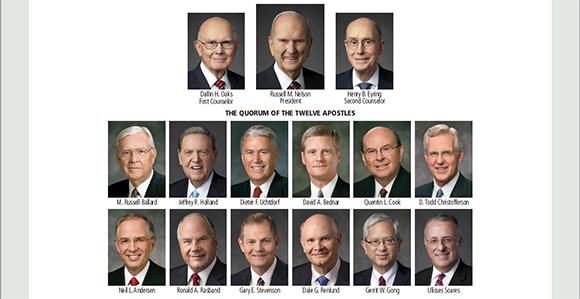
In our day, there are many "Christian" groups that claim grandiose titles for their organizational leaders. Mormons have their "Apostles and Prophets," various Pentecostal churches claim that their pastors are "Apostles," and, of course, the Pope has long claimed to occupy the "apostolic throne of Peter." I deny all such titles, and insist that all such claims mark false teachers. 

First, let me concede that the Bible does talk about Apostles and Prophets in the organization of the church: "He gave the apostles, the prophets, the evangelists, the shepherds and teachers, to equip the saints for the work of ministry, for building up the body of Christ, until we all attain to the unity of the faith and of the knowledge of the Son of God, to mature manhood, to the measure of the stature of the fullness of Christ, so that we may no longer be children, tossed to and fro by the waves and carried about by every wind of doctrine, by human cunning, by craftiness in deceitful schemes. Rather, speaking the truth in love, we are to grow up in every way into Him who is the Head, into Christ, from whom the whole body, joined and held together by every joint with which it is equipped, when each part is working properly, makes the body grow so that it builds itself up in love" (Ephesians 4:11-16). The Church is the Body of "Christ." He alone is the Head of the body, and has established how the members shall be organized (see also 1:22, 5:23,and Colossians 1:18). Among other things, this means that men are not left to ourselves to design the government of Christ's Church. 

"Shepherds" here is the equivalent of "elders" in the rest of Scripture, and "teachers' are what we call pastors (see I Timothy 5:17). Paul describes the selection of elders, with deacons as their assistants (Acts 6:1-7), in several places, especially in I Timothy 3 and Titus 1. And where does that same Apostle describe selecting new apostles or prophets? Nowhere. In fact, except for the selection of Matthias to replace Judas (Acts 1:12-26), a special circumstance, there is never a mention of selecting any more such men.

Does that not require us to accept that those were temporary offices, while the others were to be continuing offices in the Church? I think that the rationale is unavoidable, and demonstrates
that presbyterianism is the only scriptural system of congregational government, precluding congregational democracy, episcopalianism, or any claims to the offices of the Apostles and Prophets.


Saturday, February 1, 2020

Know the Bad News, then Recognize the Good News

"The law must be applied with power to the conscience, or the preciousness of grace will be very inadequately known. The superficial piety of the present day is owing, in a large degree, to feeble impressions of the malignity of sin" (James Henley Thornwell, "The necessity and Nature of Christianity").

The comment above was part of a long article in the Southern Presbyterian Review in 1849, but would be even more properly written in our current days. If anything, American evangelicalism has degenerated far past that described by Thornwell in his own time. What would he say about "churches" with female ministers, gay marriages, and that serve as laughingstocks to the world.

His diagnosis is correct. As the church has come to despise God's law, she has lost sight of the sinfulness of sin and its insult to the God she claims to serve. If the word is used at all, "sin" is left undefined, and only in occasions of unfortunate poverty and ignorance. Never is any person called a "sinner," because that is harsh and unloving.

A false Gospel that says only that "God loves you" to everyone leaves everyone satisfied with sin. God loves everyone unconditionally, so there is no need to repent. Church discipline is unheard of in our day.

The result is to use Thornwell's words, a feeble church, and people with a superficial piety.

That wasn't the way Jesus lived: "I tell you, there will be more joy in heaven over one sinner who repents than over ninety-nine righteous persons who need no repentance" (Luke 15:7). And His cousin and favorite Apostle tells us: "Whoever makes a practice of sinning is of the devil, for the devil has been sinning from the beginning. The reason the Son of God appeared was to destroy the works of the devil" (I John 3:8). When was the last time a minister called out sin as being the influence of the devil, rather than ignorance or poor economic conditions? And what does the Bible say about that silence? "If I say to the wicked, ‘You shall surely die,’ and you give him no warning, nor speak to warn the wicked from his wicked way, in order to save his life, that wicked person shall die for his iniquity, but his blood I will require at your hand" (Ezekiel 3:18).

Rather, this is how the Bible defines sin: "Sin is lawlessness" (I John 3:4). And this brings us back to the problem identified by Thornwell. If minsters do not preach on the Law, then their congregants never learn God's standard of right and wrong. And if Christians have no standard, then we have no standard to present to our world: "Now we know that the law is good, if one uses it lawfully, understanding this, that the law is not laid down for the just but for the lawless and disobedient, for the ungodly and sinners, for the unholy and profane, for those who strike their fathers and mothers, for murderers, the sexually immoral, men who practice homosexuality, enslavers, liars, perjurers, and whatever else is contrary to sound doctrine" (I Timothy 1:8-10).

Paul the Apostle

Wednesday, January 22, 2020

The Crucifixion, and What It Reveals About the Law

"That representation of Christianity which makes the sufferings of Jesus a full and perfect satisfaction of the penalty of the law, and His life of spotless obedience the ground to all claim of eternal bliss... rears the fabric of grace, not upon the ruins, but [upon] the fulfillment of the law. God is never seen to be more gloriously just, nor the law more awfully sacred, than when He spared not His own Son, but delivered Him up for us all. The impression which this event makes is, indeed, solemn, awful, sublime. It was a wonder in Heaven, a
Aspects of Crucifixion
terror in Hell, and is the grand instrument through which the rebellion of earth is subdued and the stout-hearted made to melt at the remembrance of sin" (James Henley Thornwell, "The Necessity and Nature of Christianity").

There is a common teaching among Evangelicals that God has rid us of the Law with the coming and crosswork of Jesus. That is not just the ceremonial law, with which I would agree, but also the moral law, with which I cannot. Some people simply deny the distinction between ceremonial and moral. However, then they have to ignore the usages of Paul who describes the abrogation of the former in Galatians, but maintains the latter in I Timothy 1:8-10, even referring to it as "in accordance with the gospel" in verse 11. And he specifically applies the law to members of the church at Corinth in I Corinthians 5:1 (Leviticus 18:8, Deuteronomy 22:30). Paul certainly didn't believe in the abrogation of the moral law!

There is also the problem of Christ's crosswork. Have we forgotten that He was beaten, whipped, and crucified? If the Son of God had to suffer so horribly "to magnify His law and make it glorious" (Isaiah 42:21, in one of the Servant passages), just for the law to be dispensed, was His suffering not unnecessary? What a horror for the Father to treat His Son in such a manner, when He was just going to get rid of the law anyway! Can we truly accuse God of such injustice?

Rather, as Isaiah says, the suffering and death of Jesus did not abrogate the law. Rather, it glorified it! The justice and holiness of God was revealed to the eyes of all men. The high price of rebellion against Him was revealed. At the same time, it revealed His grace, indicating what the love of the Son required that He undertake for His people.

Tuesday, February 26, 2019

Liberty under Law in the Life of the Christian

"I will keep Your law continually, forever and ever,
And I shall walk in a wide place, for I have sought Your precepts. 
I will also speak of Your testimonies before kings and shall not be put to shame, 
For I find my delight in Your commandments, which I love."
- Psalm 119:44-47

These four verses express an attitude which is strikingly different from that of most modern Christians toward the Law of God. Under the influence of dispensationalism, most professing evangelicals believe that the law is a taskmaster, an enemy to spiritual freedom, joy, and assurance. Yet, the anonymous author of this Psalm would clearly disagree. To him, the Law is liberating and a spiritual blessing.

How can there be such a contrast between the one believer, writing under the inspiration of the Holy Spirit, and so many others?

One thing that must be granted here is that the Psalmist is using the word "law" in a broad sense, to refer to all of the biblical teachings. However, it must be equally obvious that he is using the word in that sense because he includes the Law in the strict sense under that rubric.

A big part of the problem is the dispensationalist hermeneutic. In particular, it quotes Romans 6:14 ad nauseum, "You are not under law but under grace." However, the dispensationalist ignores one simple consideration: in the sense of justification, no one has ever been under the Law! Notice what Paul does not say in the verse: "You are no longer under law." Yet that is exactly how the dispensationalist reads it!

If any person is looking to the Law for justification, then he is truly under bondage, because it can provide none. Justification comes by grace through faith alone (Ephesians 2:8-9). However, if a justified person then uses the Law for its proper purpose, then it will serve as a bulwark against the sin that so easily besets us (I Timothy 1:8-11, Hebrews 12:1). Thus applied and empowered by the Holy Spirit, the Law is the Law of Liberty, indeed (James 1:25).

Saturday, January 19, 2019

The Creator-Creature Separation and Christ's Mediatorship

When Adam fell into sin, a separation occurred between him and his Creator: "Your iniquities have made a separation between you and your God, and your sins have hidden His face from you so that He does not hear" (Isaiah 59:2; see also Habakkuk 1:13). And since that time, every descendant of Adam (excluding Jesus) has experienced that separation. For the believer, a solution was provided: "For there is one God, and there is one mediator between God and men, the man Christ Jesus" (I Timothy 2:5, see also Galatians 3:20). By means of faith, Jesus reunites the redeemed sinner with His offended Heavenly Father: "Therefore He is the mediator of a new covenant, so that those who are called may receive the promised eternal inheritance, since a death has occurred that redeems them from the transgressions committed under the first covenant" (Hebrews 9:15).

I mentioned "redeemed sinners" on purpose, because that mediatorship is not available to anyone who has not yet received Christ. Until a person has done so, he experiences God only as an offended Judge, separated still because of sin.

However, the Scriptures tell us that the unbeliever is not unaware of his situation. He knows that God exists, that he is accountable to Him, and that he has offended Him (Romans 1:18-22). The unbeliever knows, but suppresses the knowledge, that he faces only eternal judgment, without the help of a mediator, just like the criminal knows that he faces punishment for his crime if he is without a lawyer. "The least transgression contracts guilt, guilt calls for punishment, and this punishment consists in that banishment from God which is attended, in every dependent being, with spiritual death and the unbroken dominion of sin. To be a sinner once, therefore, is to be a sinner forever, unless some agency should be interposed to arrest the natural and ordinary course of justice and law. Hence the office of Mediator must be, not to make repentance efficacious of pardon, but to make repentance possible" (James Henley Thornwell, "The Necessity and Nature of Christianity").

Saturday, November 17, 2018

The Continuing Obligation of the Law of God

Among professing Christians, there is a competition to find ways to twist the second clause of Romans 6:14: "You are not under law but under grace." For some reason, those interpretations never involve the first clause of the sentence. You will hear different versions, such as that the Law was done away in Christ, or that it was only for Jews, not Gentiles. But, in whatever way, such people think that the truly spiritual person despises the biblical Law.

I don't believe any such thing. Nor did the author of Romans, the Apostle Paul.

Consider what he said earlier in that same epistle: "Since they did not see fit to acknowledge God, God gave them up to a debased mind to do what ought not to be done. They were filled with all manner of unrighteousness, evil, covetousness, malice. They are full of envy, murder, strife, deceit, maliciousness. They are gossips, slanderers, haters of God, insolent, haughty, boastful, inventors of evil, disobedient to parents, foolish, faithless, heartless, ruthless. Though they know God’s righteous decree that those who practice such things deserve to die, they not only do them but give approval to those who practice them" (Romans 1:28-32). OK, so "they" who? The context is a description of the unrighteousness of unbelievers. And to whom is the passage addressed? While the Church at Rome included Jews, it was predominantly a Gentile church, including members even of the emperor's family (Philippians 4:22). So, Paul is talking to Gentile Christians about unbelievers, and describes horrific sins that are properly subject to capital punishment. According to what? Not according to Roman law. Rather, according to God's law (compare I Timothy 1:8-11).

These verses are contrary to the whole popular evangelical theology of Law, which is properly known as antinomianism. The moral law is still in force, whether for Jew or for Gentile.

The Westminster Confession of Faith (XIX:5) correctly summarizes this: "The moral law doth forever bind all, as well justified persons as others, to the obedience thereof; and that not only in regard of the matter contained in it, but also in respect of the authority of God the Creator who gave it. Neither doth Christ in the gospel any way dissolve, but much strengthen, this obligation."

Wednesday, June 6, 2018

The Catholic Apologetic for Scripture

While professing to believe in the inspiration and infallibility of the Bible, the Church of Rome claims that acceptance of that authority is dependent on the testimony of the Church. That is, her church. They enjoy quoting the words of Augustine: "I would not believe in the Gospel, had not the authority of the Catholic Church already moved me." Of course, they hide the fact that "catholic" is merely the Greek word for "universal.' It is circular reasoning to equate Augustine's use of the word with the Roman organization.

However, let us consider the logic of Rome's assertions. By doing so, I think we will conclude not only that her assertion is false, but that it is also destructive to real biblical faith.

First, it makes the basis of authority to be an organization, lodged in the hierarchy of Rome. They explicitly state this. They claim that the Bible even teaches this: "The church of the living God, a pillar and buttress of the truth" (I Timothy 3:15). This is both begging the question, equating "church" in this verse with Rome's organization, and cherry-picking, ignoring another applicable verse: "[The Church is] built on the foundation of the apostles and prophets, Christ Jesus Himself being the cornerstone" (Ephesians 2:20). Not only does the Scripture not make the Roman hierarchy the foundation of Scripture, but it, instead, makes the writings of the Apostles (the New Testament) and the prophets (the Old Testament) the foundation of the Church, the twofold witness of Christ, the real head of the Church, exactly the opposite of the claims of Rome.

Second, the implication of Rome's doctrine is that God can preserve the testimony of the church, but not of His own word. What does that say about the power of God? It is also contrary to the explicit statement of Scripture: "You have exalted above all things Your name and Your word" (Psalm 138:2). God prizes His name first, and His word second, over anything else.

And third, we have the testimony of the creation to her Creator: "The heavens declare the glory of God, and the sky above proclaims His handiwork. Day to day pours out speech, and night to night reveals knowledge. There is no speech, nor are there words, whose voice is not heard. Their voice goes out through all the earth, and their words to the end of the world" (Psalm 19:1-4). If even nature gives a testimony to God, such that it leaves no man with excuse (Romans 1:18ff), how much more must that be the case in His word!


Wednesday, May 9, 2018

The Clerical Collar: Wearing What Pertains to a Man

In today's culture wars, Deuteronomy 22:5 gets quoted often: "A woman shall not wear a man’s garment, nor shall a man put on a woman’s cloak, for whoever does these things is an abomination to the Lord your God." Or, for my use here, the King James Version: "The woman shall not wear that which pertaineth unto a man, neither shall a man put on a woman's garment: for all that do so are abomination unto the LORD thy God." I prefer the KJV here because there is far more that pertains to a man than mere clothing.

One thing that pertains to a man is God's calling to exercise authority in the church (and in the home, but that isn't my subject here): "I do not permit a woman to teach or to exercise authority over a man; rather, she is to remain quiet. For Adam was formed first, then Eve" (I Timothy 2:12-13, see also 3:2 and Titus 1:6). Here it is stated negatively, not what should be done by a man, but what must not be done by a woman. In fact, leadership by women is described as a curse: "My people—infants are their oppressors, and women rule over them. O My people, your guides mislead you and they have swallowed up the course of your paths" (Isaiah 3:12).

We know from the case of Deborah, for example, that there are times when a woman will be in leadership (Judges, chapters 4 and 5). But such a case is not normative. Rather, it exposes that a society is so degenerate that no men are qualified to lead. Notice what a wimp Deborah's general, Barak, is: "If you will go with me, then I will go [i. e., into battle with the Canaanite King Jabin, verse 2], but if you will not go with me, then I will not go" (Judges 4:8). Here the general of Israel's army, presumably its greatest military leader, is so timid that he will not go into battle unless this woman holds his hand the whole time! is it any wonder, then, that there are no men to lead Israel in her time of need? 

It can certainly be said that America is suffering from a lack of men capable of leadership. One often hears speakers lamenting the "feminization of men." I do not believe, however, that we are approaching the circumstances of Israel in Judges 4. Therefore, Deuteronomy 22:5 is still in force, and female clergy are wearing what pertains to men.

Wednesday, February 28, 2018

Moses As Covenant Head, Pointing to Jesus

There are several comparisons in the New Testament between Moses and Jesus, such as in their office of prophet (Acts 3:22, Deuteronomy 18:15) and as mediators (such as Hebrews 8:6). It is this latter parallel that I want to discuss here.

We talk a lot about the mediatorial office of Jesus: "There is one God, and there is one mediator between God and men, the man Christ Jesus" (I Timothy 2:5). And with good reason, for it is the basis of our justification before God.

But, if Moses was a type of Christ as mediator, where do we see his acting as mediator? There are obvious places, such as in the giving of the Law. But there is another, more-obscure occasion. Let us recall the one judgment against Moses that is recorded in Scripture: "Die on the mountain which you go up, and be gathered to your people, as Aaron your brother died in Mount Hor and was gathered to his people, because you broke faith with Me in the midst of the people of Israel at the waters of Meribah-kadesh, in the wilderness of Zin, and because you did not treat Me as holy in the midst of the people of Israel. For you shall see the land before you, but you shall not go there, into the land that I am giving to the people of Israel" (Deuteronomy 32:50-52). Do you recall the original event (Numbers 20:2-13)? The people of Israel were journeying through the Wilderness, a desert country, and needed water. God told Moses to command the water to come out of the rock. However, Moses rapped on the rock with his staff. This is often identified as the reason for God's judgment against him, but Scripture never indicates that.

Rather, this is what the Scriptures say: "It went ill with Moses on their account" (Psalm 106:32). While it may have been a sin for Moses to rap the rock, rather than merely commanding it, that is not the reason for God's severe punishment against him. Rather, God punishes him as the covenant representative of Israel! This is the way that Moses was a type of the mediatorial role of Jesus. Just as Moses is judged as the covenant head of Israel, Jesus on the cross was judged as the covenant head of all believers (John 6:37-40, Romans 5:15, Ephesians 5:25). 

As rich as this truth is, one application that comes immediately to mind is the condemnation of the atomistic view of salvation which is predominant among modern evangelicals. Don't they run around telling everyone, "Jesus loves you; Jesus died for you"? But that isn't the biblical gospel. According to Scripture, Jesus knew His bride, and was sacrificed, not for random millions, but explicitly for her (note especially Ephesians 5:25). Jesus knew His bride from all eternity, loved her and her alone, and knowingly gave Himself for her.

Wednesday, January 24, 2018

Ellen White and the Biblical View of Women's Ordination

In I Timothy 2:11-12, the Apostle Paul leaves this instruction for the church: "Let a woman learn quietly with all submissiveness. I do not permit a woman to teach or to exercise authority over a man; rather, she is to remain quiet." In the light of that text, I have a question for Seventh-Day Adventists: On what grounds do you overturn this biblical requirement by giving such prominence to the teachings of Ellen White?

Monday, November 27, 2017

The Law for All Men, Not Just for Israel

One form of antinomianism holds that the biblical Law is still valid (Matthew 5:18), but is, and has always been, only for Israel.

That is false.

Before I get to the Scriptural evidence against this assertion, let's just think about the logic of it. Israel was given a moral code to define her actions in the eyes of God: "Everyone who makes a practice of sinning also practices lawlessness; sin is lawlessness" (I John 3:4). Yet, according to the theologians of this stripe, Gentiles have no such standard. If sin is defined by the Law, but the Gentiles don't have the Law, does that not imply that Gentiles do not, therefore, have sin? If yes, according to what standard? And, whether one answers yes or no, does that not imply that Gentiles are not under the government of the God of the Bible? Isn't the source of their law their god, by definition?

I can't imagine how these antinomians can answer those questions. However, I don't have to wait for their answers because the Bible is explicitly opposed to any such concept of independence from God's Law. Paul tells us, "When Gentiles, who do not have the law, by nature do what the law requires, they are a law to themselves, even though they do not have the law. They show that the work of the law is written on their hearts, while their conscience also bears witness, and their conflicting thoughts accuse or even excuse them" (Romans 2:14-15). Every man has a conscience, even those who are so wicked as to heave seared their consciences into insensitivity. And, according to Paul, those consciences reflect the Law of God written in our hearts. This is part of the image of God, remaining in us since the creation of Adam, and restored in the New Covenant (Hebrews 8:10, 10:16, from Jeremiah 31:33). Of course, that image has been marred by sin, so the law is not recalled perfectly in the heart. In that way, Israel had an advantage over the Gentiles (Romans 3:2). While having the written Law was an advantage to Israel, that advantage falls far short of implying that the Gentiles were not accountable to God's Law. If that weren't the case, then would not the advantage have been with the Gentiles, for then they could never be accused of sin, and, therefore, had no need for a Savior? Yet, we know that is not the case, because Paul is specifically changed with carrying the Gospel to the Gentiles (Galatians 2:8, I Timothy 2:7)! Why carry to the Gentiles something that they didn't need?

Monday, November 13, 2017

Grace and Faith Do not Justify Antinomianism!

One thing at which Dispensationalism has succeeded is in making modern evangelicalism utterly hostile to God's Law. A phrase everyone seems to have memorized is, "We are under grace, not under law," a corruption of Romans 6:14. I bet you can't remember what the rest of the verse says!

However, one thing I have frequently noticed is that this shibboleth gets drawn out only when something in the Pentateuch disproves something an evangelical says. But, whenever the subject of homosexuality, for example, comes up, that same evangelical will pop out with Leviticus 18:22. And quoted correctly, unlike Romans 6:14!

There are so many problems with this doctrine, called antinomianism. Just logically speaking, it is offensive! The Law is the expression of God's moral nature. His precept for us is to reflect His holiness: "Consecrate yourselves, therefore, and be holy, for I am the Lord your God. Keep My statutes and do them; I am the Lord who sanctifies you" (Leviticus 20:7-8, quoted in I Peter 1:16). If a person rejects the Law out of hand, is he not rejecting the holiness of God? And with what is he replacing it? Whose holiness will he now imitate?

Also, biblically speaking, the assertion that Romans 6:14 eliminates the Law from the life of the Christian is contrary to what Paul himself tells us elsewhere in the same epistle: "Do we then overthrow the law by this faith? By no means! On the contrary, we uphold the law" (Romans 3:31). How can the same man in the same epistle endorse the Law in one verse and repudiate it in another? What does the assertion that he does so say about the view of Scripture of such persons? Or of the God who inspired the Scripture?

Let's look at another comment by Paul regarding the Law: "The law is not laid down for the just but for the lawless and disobedient, for the ungodly and sinners, for the unholy and profane, for those who strike their fathers and mothers, for murderers, the sexually immoral, men who practice homosexuality, enslavers, liars, perjurers, and whatever else is contrary to sound doctrine, in accordance with the gospel of the glory of the blessed God with which I have been entrusted" (I Timothy 1:9-11). Ah, here is the solution! The Law is not for those who are now living consistently with our new nature in Christ. It is for those who require an outside limit on their wickedness. Notice that he even includes false doctrine. That's something very few people will consider, a proper role of the state in the suppression of heresy.

Lets look once more at Romans 6:14, but the whole verse, properly quoted: "Sin will have no dominion over you, since you are not under law but under grace." Now we can see that Paul's contrast isn't between law and grace, but between grace and bondage to sin. This is exactly what he says in I Timothy, that the Spirit-controlled man has his sin nature shackled on the inside. But the natural man has no such control, and, therefore, requires an external control, the Law of God.

Monday, August 28, 2017

Oneness Pentecostals, Wrong on the Name of Jesus

Oneness Pentecostals make a lot of bizarre claims. Among them is that baptism is essential for salvation (based on their perverse interpretation of Acts 2:38). And not just any ol' baptism, but specifically immersion in Jesus's name only, absolutely not in the trinitarian formula of Matthew 28:19. This is based on the baptisms in Acts, as well as another perverse interpretation, this time of Acts 4:12: "There is salvation in no one else, for there is no other name under heaven given among men by which we must be saved." They allow the use of the word "name" to be only a term of address.

If you want to see a Oneness believer turn cross-eyed, ask him this question: When a police officer yells at a criminal to "stop in the name of the law," what name is it? That's because their rigidity regarding the word "name" cannot adapt to any other use of that word.

That rigidity gets them into trouble with other portions of Scripture. For example, when John describes the glorified Christ in Revelation 19:13, he says, "He is clothed in a robe dipped in blood, and the name by which He is called is The Word of God." Not "Jesus." So, has the name by which we must be saved changed? If the Oneness are correct, the answer to that question is of salvific significance! If they are right about the use of "name" in Acts 4:12, then John is now teaching a different Gospel (Galatians 1:9). Or, we might conclude that John is correct, but Luke was teaching a different Gospel!

Either way, Oneness rigidity, used to substantiate their manmade religion, produces chaos in the rest of Scripture. Moreover, since Scripture has only one Author, God (I Timothy 3:16), if the Scriptures are chaotic, then so is God. A capricious God is not the God of the Bible: that is the God of Islam!

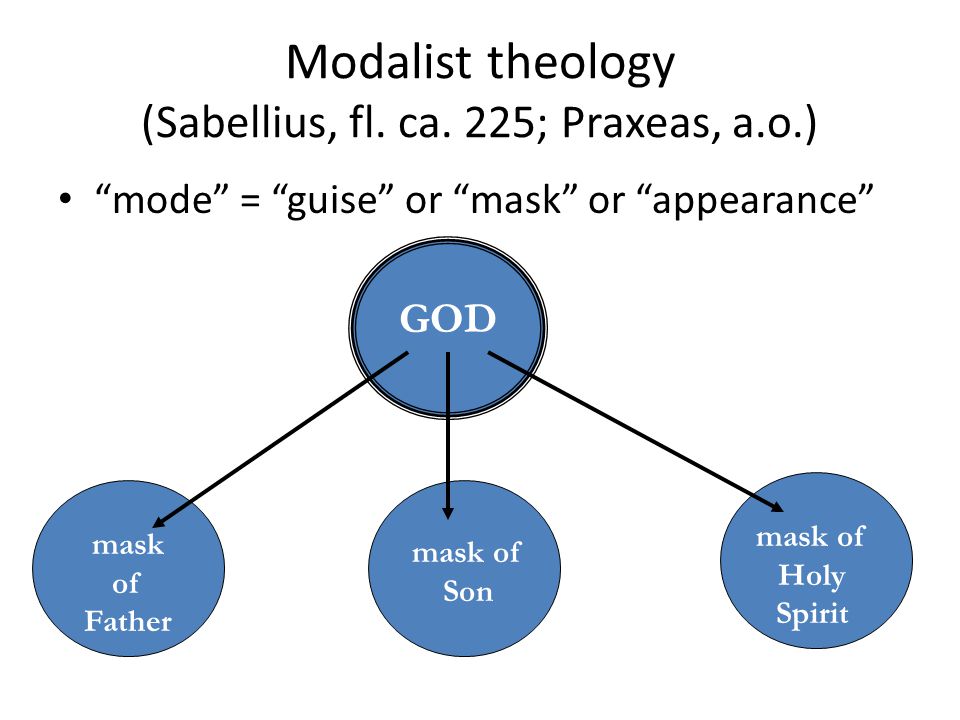
And that is, indeed, my conclusion. The god of Oneness is not the God of the Bible, the living and triune God. Their god is the manmade construct of Sabellius, an irrational god, producing irrational followers. That is not Biblical Christianity. It is baptized Islam.


Monday, March 20, 2017

"Everlasting Father" and "Father of Nations"


A major weakness of Modalism is the habit of its followers to take one isolated verse and interpret the rest of Scripture through that one verse. For example, they cite Acts 2:38 and subordinate all of the biblical references to justification by faith to their interpretation of that one verse. In the same way, they claim that Jesus is the incarnation of the Father on the basis of one reference, Isaiah 9:6: "For to us a Child is born, to us a Son is given; and the government shall be upon His shoulder, and His name shall be called Wonderful Counselor, Mighty God, Everlasting Father, Prince of Peace." If you challenge them to produce a place that names Jesus "the Father," this is the only one they can produce. 

I will certainly grant that the verse does refer to Jesus, and describes the ministry He was to have as the only Mediator between God and men (I Timothy 2:5). However, I deny vehemently that it says or implies that He was to be God the Father in the flesh.

First, the titles in the verse refer to various offices that the Messiah would hold. He would be a Wonderful Counselor. To whom? To us. He would be Mighty God. To whom? To us. He would be the Prince of Peace. To whom? To us. He would also be an Everlasting Father. To whom? Not to us, the Modalist claims, but to Himself. To do such violence to grammar is a sign of a false hermeneutic. Modalists will talk about the importance of context in understanding Scripture, while yet committing this brazen act of ripping two words out of the context of their very sentence!

In contrast, Abraham is called "father of nations" repeatedly, in both the Old and New Testaments. For example, the phrase is applied to him three times in Genesis 17:4-6. That's three times in three verses! Paul refers to him as "father of nations" twice in Romans 4:17-18. So, five times in just five verses, in both testaments. So, if anyone does, I would think that Abraham has a better claim to being the incarnate Father than Jesus does. After all, Jesus is called "Father" in just one verse, and never in the New Testament. Challenged to show any place where Jesus refers to Himself, or is referred to by any of the Apostles, as "Father," the Modalist will only respond with steely silence.

Saturday, September 24, 2016

Our Need for a Mediator with God: the Gospel According to Job

"For He is not a man, as I am, that I might answer Him,
that we should come to trial together.
There is no arbiter between us,
who might lay his hand on us both.
Let Him take his rod away from me,
and let not dread of Him terrify me.
Then I would speak without fear of Him,
 

for I am not so in myself."
- Job 9:32-35 

Scripture tells us that all men are sinners (Romans 3:23): "All have sinned and fall short of the glory of God." That is a condition with eternal consequences, because sin kills us spiritually (Romans 6:23): "The wages of sin is death," and "The soul who sins shall die" (Ezekiel 18:20). Our sinful condition separates us from God (Isaiah 59:2): "Your iniquities have made a separation between you and your God, and your sins have hidden His face from you so that He does not hear." Why is that? Because He is a holy God, and sin is rebellion against Him, and insults Him (Habakkuk 1:13): "You [God] are of purer eyes than to see evil and cannot look at wrong."

This is the spiritual situation addressed by Job in the verses above. He saw the condition of his heart and the affront this was to God. He despaired, because he could see no solution to his separation from God. "How can I be reconciled to my God?" was the cry of his heart. "Who will arbitrate between a guilty sinner and an offended God?" Who will bridge the separation between them?


Did he cry out without hope? No, for he gives the answer a little later (Job 19:25-27): "I know that my Redeemer lives, and at the last He will stand upon the earth. And after my skin has been thus destroyed, yet in my flesh I shall see God, whom I shall see for myself, and my eyes shall behold, and not another." This is one of the earliest expressions of the Gospel in the Bible. Job expressed his hope without knowing that Redeemer by name. But we know Him, because He is revealed in the New Testament (I Timothy 2:5-6): "There is one God, and there is one mediator between God and men, the man Christ Jesus, who gave Himself as a ransom for all, which is the testimony given at the proper time." That mediator, the arbitrator between sinful men and an offended God is the only God-man, Jesus Christ! "If you confess with your mouth that Jesus is Lord and believe in your heart that God raised Him from the dead, you will be saved, for with the heart one believes and is justified, and with the mouth one confesses and is saved" (Romans 10:9-10).