Showing posts with label habakkuk. Show all posts

Wednesday, February 9, 2022

Faith, Holiness, Assurance, and the Covenant of Grace

"This covenant [of grace] does not only give life upon terms of believing, but faith also and holiness the necessary means of attaining that [eternal] life. And this not upon your ingenious [sic, for "ingenuous"] compliance, as some term it, or better improvement of what you have in common with other men, (such allegations the Lord disallows, and often cautions against), but of grace. It is a covenant made up of promises, and promise, by scripture intention, is always free, both freely made and freely performed, without the desert or procurement of men." --Elisha Coles, "A Practical Discourse of God's Sovereignty" 

The difference between biblical Christianity and any of its competitors is that it stands on that great principle: Justification is by grace alone through faith alone in Christ alone for the glory of God alone. Every other religion, whether it falsely claims to be Christian or it is a distinctly-named religion, makes salvation based on the good works of the supplicant, whether in part or in whole. 

That is because the true Christian is aware that he has nothing in himself by which he can appeal to God as worthy of salvation. In answer, as the Puritan Coles says above, Jesus purchased everything, not just justification itself, but also the faith with which we respond and the holiness which it produces. By grace, He purchased them on the cross for everyone that the Father had given Him to be redeemed, and His blood cannot fail to achieve its purpose (John 6:37-39).

In contrast, the unbeliever is dead in trespasses and sins (Ephesians 2:1, Romans 3:23), and thereby under the just wrath of God (Ephesians 2:3, Romans 6:23). It is impossible for such a wretch to offer anything of himself to the offended God, because only a believer can do anything of spiritual good (Romans 14:23, Hebrews 12:14). The Father, apart from the intercession of the blood of Jesus, refuses even to look in love on such a one: "[God's] eyes are too pure to look on evil, and You cannot look on wickedness" (Habakkuk 1:13). Alas, even the prayers of the unbeliever are repugnant to Him (Proverbs 28:9). 

For those for whom Jesus died, that holy flood washed away our sins, the judgment for our sins, and purchased for us faith and holiness. It is only in Him that we can have hope, and have assurance that our hope is on a sound foundation.

Saturday, July 24, 2021

God, the Just Justifier


"The righteousness of God has been manifested apart from the law, although the Law and the Prophets bear witness to it— the righteousness of God through faith in Jesus Christ for all who believe. For there is no distinction: for all have sinned and fall short of the glory of God, and are justified by His grace as a gift, through the redemption that is in Christ Jesus, whom God put forward as a propitiation by His blood, to be received by faith. This was to show God’s righteousness, because in His divine forbearance He had passed over former sins. It was to show His righteousness at the present time, so that He might be just and the justifier of the one who has faith in Jesus."
- Romans 3:21-26 

In prehistory, when God decided to save a Church from their sins, God faced a dilemma (I am putting this in human terms). If sin is contrary to His nature, how could He save sinners without denying His own nature? How could God remain the holy deity which is He is, if He merely ignored the wickedness in men? As verse 26 puts it, how could God remain just while becoming the justifier of His people?

 First, let us consider whether the wickedness of men is contrary to God's nature. The Prophet Habakkuk asks God this question: "You who are of purer eyes than to see evil and cannot look at wrong why do You idly look at traitors and remain silent when the wicked swallows up the man more righteous than he?" (Habakkuk 1:13). The prophet asks the exact question that we are considering. How can the righteous God, to whom evil is an alien and contrary condition, allow wicked men to continue? Such a God cannot receive the evil of men into His fellowship. Therefore, the problem of sin requires a solution. How can His justice be satisfied apart from the destruction of every sinner? 

Then another steps forward and volunteers. This one is Himself God; not a different God, but God the Son, both the one God and a distinct Person within the Godhead. He voluntarily offered Himself, sinless and holy, just as God the Father is, on behalf of those whom the Father would give Him to be His body the Church (John 6:37-39, 10:7-18, 17:1-19, Ephesians 5:25). As represented by the Mosaic priestly sacrifices, Jesus's priestly offering of Himself as the true sacrifice (Hebrews 9:14) achieved the Father's desire. His judgment of sin fell on His own Son, so that His justice was satisfied, and the justification thus purchased was imputed to His elect, so that He could become their justifier. 

"Apart from the obedience and death of Christ in the stead of elect sinners, God may not justify guilty sinners. Apart from the cross of Christ, God would show Himself unrighteous were He to justify the ungodly. the Christian gospel is not simply that God justifies the sinner who believes in Jesus Christ. The Christian gospel is that God justifies the sinner who believes in Jesus Christ, on the ground of Christ's substitutionary obedience, especially the obedience of His suffering and death" (Rev. David Engelsma, "Gospel Truth of Justification," p. 266; emphasis in the original).

Saturday, May 15, 2021

God's Proper Love for Himself


"Regarding the guilty sinner, it is the perfection of God's being that requires and effects the maintenance of God's holy being - His Godhead! - by the infliction on the sinner of the punishment due the assault on, and denial of, the holy being of God. Ultimately, this deserved punishment is eternal, awful hell. As the heart, center, and foundation of the gospel of salvation, it is the substitutionary suffering of the punishment for sin by God Himself in the human flesh of Jesus, thus executing and satisfying His righteousness, which then is (legally) imputed to the elect but guilty sinner by means of the sinner's faith in Jesus Christ."

- Rev. David Engelsma, "Gospel Truth of Justification," pp. 151-2 

It is popular among American evangelicals to make claims about God or the Christian faith with statements that begin with, "Since/If God loves everybody, then He..." must forgive everything, or cannot send people to hell, or can't elect some people but not others. 

What one never hears is statements that begin with, "Since God loves Himself above all else..." 

And that is why there is so much bad theology among those professing evangelicals, such as universal salvation, annihilationism, the absence of discernment, etc. 

In the quote above, Engelsma effectively makes that rare statement, and then gives one of its implications. "Since God loves Himself, He loves His own holiness, which requires that He judge sin." We see this in Scripture in, for example, Habakkuk 1:13: "You who are of purer eyes than to see evil and cannot look at wrong, why do You idly look at traitors and remain silent when the wicked swallows up the man more righteous than he?" The prophet takes the opposite tack from the modern evangelical. His plea to God is that He would recall His love for Himself and thus judge those who act contrarily to that nature. 

So that is the challenge I make to those who spout syrupy nonsense about the love of God. While they want the world to believe that God loves every rebel who spits in His face, I ask, "What about God's love for Himself?"

Wednesday, February 24, 2021

The Continuing Stand for Justification by Faith Alone

"Justification is a legal act of God. It is strictly a legal act of God. By the act of justification, God changes the sinner's standing, or legal position, before Himself as judge. Whereas the sinner is guilty, the act of justification renders him not guilty. Whereas the sinner stands before the divine bar of justice as one who has transgressed all the commandments of God, justification constitutes him innocent. Whereas the sinner appears in the divine courtroom as one who has not kept the law of God and is, therefore, worthy of damnation, justification gives him the state or status, that is, the legal standing, of one who has perfectly satisfied all the demands of the law, including its demand of the punishment of everlasting damnation, and is, therefore, deserving of eternal life." 

- Rev. David Engelsma, "Gospel Truth of Justification," p. 93 

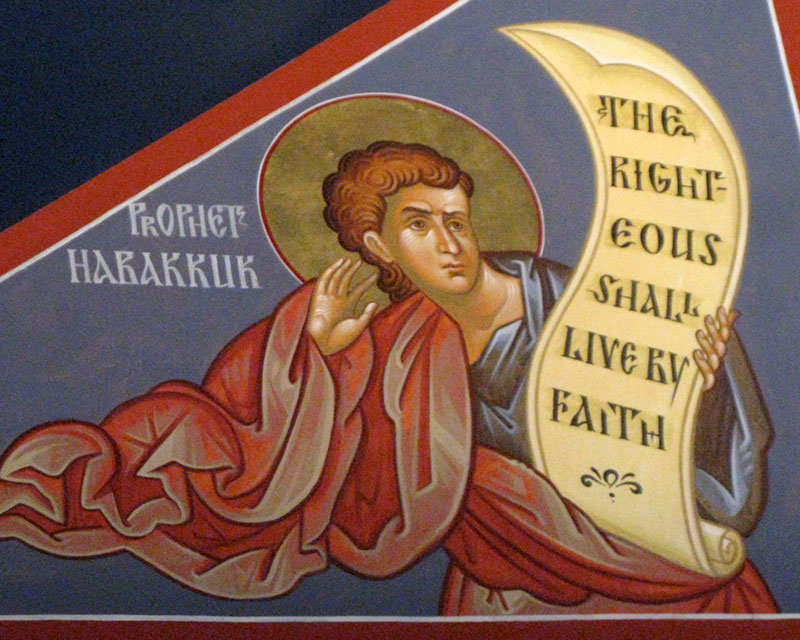
The importance of the statement above can be seen in its historical significance. it was the grounds for Martin Luther's revolt against the corruptions of the Roman Catholic Church. He had discovered the truth of justification by faith alone in his personal study of the Bible: "The righteous shall live by his faith" (Habakkuk 2:4, and quoted by Paul in Romans 1:17 and Galatians 3:11). However, he saw that this simple but profound expression of the only way of salvation had been buried under the manmade doctrines and ceremonies of the Catholic Church. 

Rome responded by declaring a curse against biblical justification: "Canon 9.  If anyone says that the sinner is justified by faith alone, meaning that nothing else is required to cooperate in order to obtain the grace of justification, and that it is not in any way necessary that he be prepared and disposed by the action of his own will, let him be anathema" (The Canons of the Council of Trent, still the official doctrine of the Roman Church). This assertion has never been repudiated by Rome, which is why any reunification between her and orthodox Protestants is still impossible. 

Rome has also caricatured the Reformers' doctrine is nothing more than a legal fiction. That accusation is false. It might have been true if God had merely cancelled our sin debt unpaid. Yet that is not what He has done. Rather, He has transferred that debt to a voluntary Surety, the Lord Jesus Christ. For those whom He undertook to redeem (John 6:37-39), Jesus the Sinless One stepped forward to pay a debt that He did not owe, that we may be freed from a debt that we could not pay. And a debt paid is a debt owed no more, in truth, not as a fiction.

Saturday, May 23, 2020

Faith, the Gift of God to the Elect Alone

Every Bible-believing Christian is distinguished by one doctrine: our justification before God is through fail alone. That was the message of Jesus (see the Parable of the Pharisee and the Tax-Collector, Luke 18:9-14), Paul (such as Romans 3:28), the Old Testament prophets (such as Habakkuk 2:4), and the Reformers.

But rare is the person who asks an important question: Who has such saving faith? As I demonstrate here, faith is given to us by God; it is not something that we add to the cross work of Jesus.

The Arminian claims that God gives faith equally to all men, so that all men are equally enable to respond to the Gospel. However, the Bible says otherwise: "Not all have faith" (II Thessalonians 3:2). So, contrary to the claim of the Arminian, not all have faith.

So, then, who does? "Paul, a servant of God and an apostle of Jesus Christ, for the sake of the faith of God’s elect and their knowledge of the truth, which accords with godliness" (Titus 1:1). So the answer that Paul provides has three parts: faith, knowledge, and godliness. Thus, we aren't talking about a mere ability to believe, as is the basis of Arminianism. Paul restricts these gifts to God's elect. The elect are given faith by which to be justified, knowledge of the Gospel, and godly lives. Paul here gives an explanation of the content of the promise of Jesus in John 6:39: "This is the will of Him who sent Me, that I should lose nothing of all that He has given Me, but raise it up on the last day."


Wednesday, September 18, 2019

The Necessity of Imputed, Exterior Righteousness

Every false religion, that is, every religion other than biblical Christianity, is based on innate human righteousness, the things that men can do to establish themselves as good enough for whatever value that religion holds, whether it is heaven or Nirvana or just a sense of moral superiority. In other words, they all teach some form of salvation by works, by law. Even secular humanism claims to be making the superior man, if we can just tweak the right government program.

In contrast, biblical Christianity says of men, "All have sinned and fall short of the glory of God" (Romans 3:23). And, "the wages of sin is death" (Romans 6:23), because "your iniquities have made a separation between you and your God, and your sins have hidden His face from you so that He does not hear" (Isaiah 59:2). Why? "Your [i. e., God's] eyes are too pure to look upon evil, and You cannot tolerate wrongdoing" (Habakkuk 1:13).

So, what about the answer given by humanism and other unbiblical religions? What about just straightening oneself up? What about producing human improvement through passing the right political law or public education? "We have all become like one who is unclean, and all our righteous deeds are like a polluted garment. We all fade like a leaf, and our iniquities, like the wind, take us away" (Isaiah 64:6). The problem with any system of salvation by good works is that men only have good works when compared to each other. However, compared to God's perfection, the best works of men are putrid garbage.

Why is that important? Because, without holiness, no one will see the Lord (Hebrews 12:14). Sin is such an insult to the holy God, that He will not accept it into His presence.

So, if all men are sinners, and thereby separated from God, then how can we have that relationship restored? Not by anything is us, but only by an alien, or exterior, holiness. "Then he showed me Joshua the high priest standing before the angel of the Lord, and Satan standing at his right hand to accuse him. And the Lord said to Satan, 'The Lord rebuke you, O Satan! The Lord who has chosen Jerusalem rebuke you! Is not this a brand plucked from the fire?' Now Joshua was standing before the angel, clothed with filthy garments. And the angel said to those who were standing before him, 'Remove the filthy garments from him.' And to him He said, 'Behold, I have taken your iniquity away from you, and I will clothe you with pure vestments.' And I said, 'Let them put a clean turban on his head.' So they put a clean turban on his head and clothed him with garments. And the angel of the Lord was standing by." (Zechariah 3:1-5). This vision symbolizes salvation, with our sin and its punishment taken away and replaced with the righteousness of Christ. This is called imputation.

This is salvation! The holiness that we need in order to be restored to fellowship with God comes not from ourselves, but from Jesus! "I will greatly rejoice in the LORD; my soul shall exult in my God, for He has clothed me with the garments of salvation; He has covered me with the robe of righteousness, as a bridegroom decks himself like a priest with a beautiful headdress, and as a bride adorns herself with her jewels" (Isaiah 61:10).

"O LORD, You will ordain peace for us, for You have indeed done for us all our works" (Isaiah 26:12).


Wednesday, January 30, 2019

In What Way Are We justified by Faith?

As the Reformers emphasized, the Bible says that the Christian is justified by faith. Luther even credited his conversion to Habakkuk 2:4: "The righteous shall live by his faith" (and quoted in the New Testament, such as Romans 1:7 and Galatians 3:11). That knowledge liberated huge swaths of Europe from bondage to Rome and its doctrine of justification by "faith and..."

But what do we mean by that? Do we believe that a person with faith is necessarily saved? No, we don't. There are all sorts of faith, such as faith in leaders, or faith in science, and even faith in faith. We hear all the time, "You just have to have faith." Rarely is it specified, faith in what? However, that is not what is meant by justifying faith.

Rather, justifying faith is justifying, not because of its presence, but because of its object. What object? Jesus Christ alone: "In Christ Jesus you are all sons of God, through faith" (Galatians 3:26). Notice the proposition Paul uses, "through." That is an instrumental reference. Therefore, justification isn't on the basis of faith, but rather applied by means of faith. It is the finished work of Jesus alone that justifies us. We also see the same instrumental implication in Ephesians 2:8: "For by grace you have been saved through faith." Thus we see again Paul's specifying of faith, not as the basis of justification, but rather the means of the application of Christ's saving blood. That is the Reformation principle of justification by Christ alone through faith alone.

The Presbyterian Theologian James Henley Thornwell explained this principle: "In the narrow sense of that which unites us to Christ and makes us actual partakers of redemption, the term 'condition' is, in our judgment, applicable only to faith. It is clear that the ground of all personal interest in the blessings of the covenant is union with Christ. Union with Christ secures justification, adoption, sanctification, and the whole salvation of the Gospel. The condition, and the sole condition, of union with Christ is faith. The man who believes is saved" ("Theology as a Life in Individuals and in the Church").

Saturday, January 19, 2019

The Creator-Creature Separation and Christ's Mediatorship

When Adam fell into sin, a separation occurred between him and his Creator: "Your iniquities have made a separation between you and your God, and your sins have hidden His face from you so that He does not hear" (Isaiah 59:2; see also Habakkuk 1:13). And since that time, every descendant of Adam (excluding Jesus) has experienced that separation. For the believer, a solution was provided: "For there is one God, and there is one mediator between God and men, the man Christ Jesus" (I Timothy 2:5, see also Galatians 3:20). By means of faith, Jesus reunites the redeemed sinner with His offended Heavenly Father: "Therefore He is the mediator of a new covenant, so that those who are called may receive the promised eternal inheritance, since a death has occurred that redeems them from the transgressions committed under the first covenant" (Hebrews 9:15).

I mentioned "redeemed sinners" on purpose, because that mediatorship is not available to anyone who has not yet received Christ. Until a person has done so, he experiences God only as an offended Judge, separated still because of sin.

However, the Scriptures tell us that the unbeliever is not unaware of his situation. He knows that God exists, that he is accountable to Him, and that he has offended Him (Romans 1:18-22). The unbeliever knows, but suppresses the knowledge, that he faces only eternal judgment, without the help of a mediator, just like the criminal knows that he faces punishment for his crime if he is without a lawyer. "The least transgression contracts guilt, guilt calls for punishment, and this punishment consists in that banishment from God which is attended, in every dependent being, with spiritual death and the unbroken dominion of sin. To be a sinner once, therefore, is to be a sinner forever, unless some agency should be interposed to arrest the natural and ordinary course of justice and law. Hence the office of Mediator must be, not to make repentance efficacious of pardon, but to make repentance possible" (James Henley Thornwell, "The Necessity and Nature of Christianity").

Monday, August 7, 2017

Why Do Men Sin? Did the Devil Make Me Do it?

It is unpopular to talk about sin, even among professing Christians. On one hand, we have the Osteen-style preachers who won't use the word lest they damage someone's self-esteem. On the other, we have liberals who deny sin, and claim that men are naturally good, but merely make mistakes, or have been led off the right track by their environment.

In contrast, the Bible, the expression of God's opinion on the subject, talks a lot about sin. For example, James, the half-brother (or step-brother) of Jesus, makes this declaration: "Each person is tempted when he is lured and enticed by his own desire. Then desire when it has conceived gives birth to sin, and sin when it is fully grown brings forth death" (James 1:14-15). He was paraphrasing the words of his better-known sibling: "Do you not see that whatever goes into the mouth passes into the stomach and is expelled? But what comes out of the mouth proceeds from the heart, and this defiles a person, for out of the heart come evil thoughts, murder, adultery, sexual immorality, theft, false witness, slander. These are what defile a person" (Matthew 15:17-20). Both men describe sin's origin, not in external influences, but rather from within, from a man's heart itself. As the Prophet Jeremiah also said, "The heart is deceitful above all things, and desperately sick" (Jeremiah 17:9).

When Scripture describes the hatred of God toward sin, it cannot be understood to mean that He is angry at poverty, or bad schools, or low self-esteem, or any of the other popular justifications for sin. Rather, as Jeremiah also says, "Your evil will chastise you, and your apostasy will reprove you" (Jeremiah 2:19). God's wrath is against what comes from us, not what goes into us! Therefore, the same Prophet asks, "Why should a living man complain, a man, about the punishment of his sins?" (Lamentations 3:39).

The self-esteem preachers are propagating a lie! God is no Santa Claus, no therapist, no personal life coach, no cheerleader. Rather, He is God, and an absolutely righteous one at that! He cannot, and will not, tolerate wickedness: "You [God] are of purer eyes than to see evil and cannot look at wrong" (Habakkuk 1:13). When the self-esteem preachers hide that information, then they are condemning men to Hell. And it is not good enough that anyone feel good about himself in Hell. God will judge those preachers, and hold them accountable for their wicked refusal to tell the truth (Ezekiel 3:18).

Saturday, August 5, 2017

Hope for the Sinner

"If You, O Lord, should mark iniquities,
     O Lord, who could stand?
But with You there is forgiveness,
     that You may be feared.

O Israel, hope in the Lord!
     For with the Lord there is steadfast love,
and with Him is plentiful redemption.
     And He will redeem Israel
from all his iniquities."
- Psalm 130:3-4, 7-8 

While it is rare in American evangelicalism to hear any mention of sin, among those who will utter the word, there is till a humanistic concept of righteousness. "Yes, I am a sinner, but I will try harder, and God will accept me on the basis of my sincerity." I will do my part, we say, and God will fill in the rest. Yet, that so far underestimates the sinfulness of sin that it eviscerates the word of any meaning. 

Observe, instead, what the Psalmist here says about sin. "If You, O Lord, should mark iniquities, O Lord, who could stand?" He starts with the consequences of sin. It isn't a mistake, or something we can overcome by trying harder. Rather, sin brings us into the judgment of God. He hates sin! "You [God] are of purer eyes than to see evil and cannot look at wrong" (Habakkuk 1:13). 

What answer can there be to a righteous God? Are we without hope? no, as the Psalmist also tells us: "with You there is forgiveness" (verse 4). How so? On what basis does He forgive? "With Him is plentiful redemption.  And He will redeem Israel from all his iniquities" (verses7-8). He has provided for the redemption of sinners. Every sinner? No, but the sinners of Israel, His people, called the church in the New Testament (Galatians 3:7, 6:16).

What is the method of redemption? "God shows His love for us in that while we were still sinners, Christ died for us" (Romans 5:8). The Psalmist had a proper concern: What can I do about my sin? And the answer is nothing. However, what can God do? Everything. And He did!

Wednesday, July 26, 2017

Adam Made It Rough: The Sin Nature

The hardest inheritance that all men have received from our first ancestor, Adam, is the promise of eternal life on the basis of perfect obedience to the covenant of works. As we know from subsequent events, Adam broke the covenant, forfeiting salvation by it, and bringing death, both spiritual and physical, on all his posterity (Romans 5:12-19). Yet our hearts have retained that consciousness of the original covenant, and find every opportunity to convince us that a little hard work will restore us to eternal life. This results in the Pelagianism that is inherent in all pagan religions, all forms of secularism, and much of popular Christianity. Apart from orthodox, biblical Christianity, all religions, including secular religions, hold that men are good, or, at least, good enough to claw our way to whatever vision of salvation we hold.

It is biblical Christianity alone that teaches consistently that the covenant of works is broken and hopeless. By its very nature, failure is permanent, leaving no opportunity for second chances: "The soul who sins shall die" (Ezekiel 18:20). And this isn't sin on a curve, i. e., the one who sins more than someone else. Rather, broken means broken, all or nothing: "Whoever keeps the whole law but fails in one point has become guilty of all of it. For he who said, 'Do not commit adultery,' also said, 'Do not murder.' If you do not commit adultery but do murder, you have become a transgressor of the law" (James 2:10-11).

Yet, we just naturally keep trying to get back on that train, though it long ago left the station. We all want to get the credit for saving ourselves. It is the same deceptive independence that Satan offered Adam and Eve in the garden: "God knows that when you eat of it [the Tree of the Knowledge of Good and Evil] your eyes will be opened, and you will be like God, knowing good and evil" (Genesis 3:5). "Don't let God rule you," Satan said. "Rule yourselves." And he continues to whisper that same deception in the ear of every human being since then, even Jesus (Matthew 4:8-9). Jesus alone never gave in to that temptation.

That same Jesus tells us the truth about what is left of the covenant of works: "When you have done all that you were commanded, say, ‘We are unworthy servants; we have only done what was our duty'" (Luke 17:10). He is not impressed with what impresses us. While we trumpet each prideful act, He says that ever our best is merely the minimum standard, not anything that gets merit in His eyes.

That's why every philosophy based on human autonomy is a pathway to judgment. It starts with a false premise. God's beginning premise is Himself, with the holiness that is essential to His nature (Habakkuk 1:13). Men always start with themselves, which means with the antiholiness that Adam has passed to all of us. When we agree with Him, then salvation is available in Jesus Christ. All other options are really just one option, judgment. Hear Jesus's words: "Enter by the narrow gate. For the gate is wide and the way is easy that leads to destruction, and those who enter by it are many. For the gate is narrow and the way is hard that leads to life, and those who find it are few" (Matthew 7:13-14).

Saturday, May 6, 2017

The Error of Baptismal Regeneration

"Baptismal regeneration" is the doctrine regarding baptism that claims that it is essential to salvation. The details vary. Some, such as the Catholic Church, the Eastern Orthodox, and some Lutherans and Anglicans, believe that baptism carries the power to cleanse sins and to make the person a Christian. Others, such as Oneness Pentecostals and the Church of Christ merely teach that it is required for salvation, but not that it gives salvation.

What I say here will apply to both forms.

There is no place in Scripture that says, "No one is saved by baptism." That isn't because Jesus and the Apostles didn't believe that. Rather, it was considered so obvious that no such statement was necessary. Why? Because it is faith which is the means of regeneration, not baptism: "The righteous shall live by his faith" (Habakkuk 2:4, Romans 1:17, Galatians 3:11, Hebrews 10:38). By saying what does justify, they eliminated the need to specify what did not.

But we can go further.

Paul said of his ministry, "Christ did not send me to baptize but to preach the gospel, and not with words of eloquent wisdom, lest the cross of Christ be emptied of its power" (I Corinthians 1:17). How did Paul join his hearers to the cross work of Jesus? If baptism did so, then that is what he would have done. But it's not! Rather, instead of baptism, Paul's calling was to preach! See also his description of all ministers in Romans 10:14-15: "How then will they call on him in whom they have not believed? And how are they to believe in him of whom they have never heard? And how are they to hear without someone preaching?" Since it is by faith that men are justified, the ministry requires, not baptizing, but preaching!

By this, I do not mean to imply that baptism is unimportant. We have the explicit ordinance of Christ Himself (Matthew 28:19-20): "Go therefore and make disciples of all nations, baptizing them in the name of the Father and of the Son and of the Holy Spirit, teaching them to observe all that I have commanded you. And behold, I am with you always, to the end of the age." But even here, He tells us to disciple the nations - that is the preaching part - and then to baptize them. Baptismal regeneration reverses that order.

The one verse that is sometimes claimed to demonstrate baptismal regeneration is I Peter 3:21: "Baptism now saves you." Sounds ironclad, doesn't it? Except that the sentence continues: "not as a removal of dirt from the body but as an appeal to God for a good conscience." So, not the washing but the good conscience is our appeal to God. "A good conscience" is another way of saying "faith." The verse actually teaches the opposite of "baptismal regeneration," when read in completion.

Wednesday, May 3, 2017

Sola Scriptura: The Best Defense Against Spiritual Bondage


One thing cults have in common is that they have some leader, whether alive or dead, whom they declare to be some paragon of truth. We have Ellen White, Mary Baker Eddy, Joseph Smith, an interminable list of popes, Victor Paul Wierwille, David Koresh. It is a long list, and adds more every day.

The Bible tells us how to resist even the most charismatic cultist: "Learn by us not to go beyond what is written, that none of you may be puffed up in favor of one against another" (I Corinthians 4:6). This is the Apostle Paul speaking, someone to whom the word of God was entrusted (I Thessalonians 2:13). If anyone could claim personal superiority, surely it was he. Yet, he tells the Christians of Corinth that mere men can be "puffed up." And the cure for that is not to go beyond what is written. That is, when any man claims spiritual knowledge outside of Scripture, then he is "puffed up," and is to be resisted. While he does not explicitly quote it, Paul is applying the principle taught in God's Law (Deuteronomy 18:20): "The prophet who presumes to speak a word in My name that I have not commanded him to speak, or who speaks in the name of other gods, that same prophet shall die."

This is what the Reformers did, starting in 1517. As they discovered and taught, more and more, that the declarations of the popes went beyond anything written in the Bible, people were liberated from hundreds of years of bondage to the erroneous teachings of men. Martin Luther said of the fathers of the Catholic Church, "Their holiness does not make them infallible, and it does not imply that one must rely and depend on all the dicta of the fathers or approve and believe all their teachings. Rather take the touchstone of God’s Word into your hands. Let this be your criterion for testing, trying and judging all that the fathers have preached, written and said, as well as all the precepts and human ordinances that have been promulgated. Otherwise one will be easily misled and deceived. And since this polishing stone was not applied to the pope in times past, he ran rampant and covered the church with errors."

It was in the Bible, not the teachings of the popes, that Luther learned that "the righteous shall live by faith" (Habakkuk 2:4, quoted in Romans 1:17, Galatians 3:11, and Hebrews 10:38). Suddenly, his conscience was freed. Having been a monk who spent hours in confession, and, yet, could find no relief for his conscience, he was transformed into a joyful Christian, who could now say, "If you try to deal with sin in your conscience, let it remain there, and continue to look at it in your heart, your sins will become too strong for you. They will seem to live forever. But when you think of your sins as being on Christ and boldly believe that He conquered them through His resurrection, then they are dead and gone. Sin can’t remain on Christ. His resurrection swallowed up sin."

False teachings have one consistent effect: they bring a man into bondage to a man or an organization. Sola Scriptura liberates a man through true knowledge. As Jesus said (John 17:17), "I am the way, and the truth, and the life. No one comes to the Father except through me." Scripture points a hopeless soul to Jesus. The teachings of men will point you to those men.

Saturday, September 24, 2016

Our Need for a Mediator with God: the Gospel According to Job

"For He is not a man, as I am, that I might answer Him,
that we should come to trial together.
There is no arbiter between us,
who might lay his hand on us both.
Let Him take his rod away from me,
and let not dread of Him terrify me.
Then I would speak without fear of Him,
 

for I am not so in myself."
- Job 9:32-35 

Scripture tells us that all men are sinners (Romans 3:23): "All have sinned and fall short of the glory of God." That is a condition with eternal consequences, because sin kills us spiritually (Romans 6:23): "The wages of sin is death," and "The soul who sins shall die" (Ezekiel 18:20). Our sinful condition separates us from God (Isaiah 59:2): "Your iniquities have made a separation between you and your God, and your sins have hidden His face from you so that He does not hear." Why is that? Because He is a holy God, and sin is rebellion against Him, and insults Him (Habakkuk 1:13): "You [God] are of purer eyes than to see evil and cannot look at wrong."

This is the spiritual situation addressed by Job in the verses above. He saw the condition of his heart and the affront this was to God. He despaired, because he could see no solution to his separation from God. "How can I be reconciled to my God?" was the cry of his heart. "Who will arbitrate between a guilty sinner and an offended God?" Who will bridge the separation between them?


Did he cry out without hope? No, for he gives the answer a little later (Job 19:25-27): "I know that my Redeemer lives, and at the last He will stand upon the earth. And after my skin has been thus destroyed, yet in my flesh I shall see God, whom I shall see for myself, and my eyes shall behold, and not another." This is one of the earliest expressions of the Gospel in the Bible. Job expressed his hope without knowing that Redeemer by name. But we know Him, because He is revealed in the New Testament (I Timothy 2:5-6): "There is one God, and there is one mediator between God and men, the man Christ Jesus, who gave Himself as a ransom for all, which is the testimony given at the proper time." That mediator, the arbitrator between sinful men and an offended God is the only God-man, Jesus Christ! "If you confess with your mouth that Jesus is Lord and believe in your heart that God raised Him from the dead, you will be saved, for with the heart one believes and is justified, and with the mouth one confesses and is saved" (Romans 10:9-10).

Friday, December 25, 2015

The Two Sides of the Character of God: Love and Wrath

People - those who are more ignorant of the Scriptures than they will admit - will often claim that there are contradictory images of God in the Bible, one of the loving God we see in Jesus, the other a wrathful God who, for example, told Israel to destroy the societies on Canaan. However, the problem isn't the God that we see in Scripture, but rather the view of God from which they make their judgment.

What these people, whether professing Christians or honest unbelievers, fail to acknowledge is that they are judging God, as He is presented in the Bible, from a humanistic worldview, that is, from an assumption that people are inherently good and deserving of hugs, self-esteem, flowers, and all the other syrupy slogans that have become so common in our society. However, that isn't the view of the Bible.

The worldview of the Bible includes the understanding that humans, from the moment of conception (Ps. 51:5), are wicked (Rom. 3:10-18), sinful (Is. 64:6, Jer. 17:9), and separated from God (Is. 59:2, Hab. 1:13). The Bible says that all men are "dead in trespasses and sins, by nature children of wrath" (Eph. 2:1-3). This is not a syrupy view!

Thus, we are forced to conclude that those who hold to this syrupy worldview are seeking to impose an anti-biblical presupposition onto a Bible that teaches a contrary worldview. Of course this results in conflict!

In contrast, we must view the Bible from its own worldview. Consider Psalm 34:15-16:
"The eyes of the Lord are toward the righteous
     and His ears toward their cry.
The face of the Lord is against those who do evil,
     to cut off the memory of them from the earth."


In these two verses, an example of Hebrew parallelism, we see God in two distinct fashions: in the first two lines, there is a kind God; in the latter two lines, there is an unkind God, as the two sides of a single coin. Do these two verses confirm the view I described above? I am sure those folks would say so. But that would only be because they avoid considering the other side of the verses, i. e., to whom is God kind or unkind. The first reaction is to the "righteous," an epithet for the people of God, or the Church. The second is to "those who do evil," that is, those who are not His people (Rom. 1:18, 2:8). In other words, these verses - and the rest of Scripture - are far from teaching contradictory views of God. Rather, they reveal one God who responds with justice to different types of people! That is the fundamental error of the humanistic interpretation of scripture, not that there are two kinds of God, but that there are two kinds of people, and His reaction is distinguished by which type of person a particular individual is. God's actions are always consistent with His nature.

For the man who submits to receive God on His terms, not ours, there is this message of kindness (Rom. 3:21-26): "But now the righteousness of God has been manifested apart from the law, although the Law and the Prophets bear witness to it— the righteousness of God through faith in Jesus Christ for all who believe. For there is no distinction: for all have sinned and fall short of the glory of God, and are justified by his grace as a gift, through the redemption that is in Christ Jesus, whom God put forward as a propitiation by His blood, to be received by faith. This was to show God’s righteousness, because in His divine forbearance He had passed over former sins. It was to show His righteousness at the present time, so that He might be just and the justifier of the one who has faith in Jesus." This passage shows that God's attitude to the particular individual is changeable. How does one move from the class of people under the wrath of God, to the class under His love? Through Jesus Christ alone. If you fear the wrathful God revealed in Scripture, as the unbeliever should, then He calls you to give up your unbelief, receive Him as He is offered in Scripture, and then you will be under His love (John 1:12), no longer under His wrath (Rom. 5:9).

Tuesday, December 16, 2014

How Can a Man Be Righteous Before God?

In the Bible, we find comments like this (Habakkuk 1:13): "You are of purer eyes than to see evil, and cannot look at wrong." Or Job 13:16: "The godless shall not come before Him." And Isaiah 59:2: "Your iniquities have made a separation between you and your God, and your sins have hidden His face from you, so that He does not hear." Or the hardest of all (Hebrews 12:14): "Strive for the holiness without which no one will see the Lord" [emphasis mine].

Any person who hasn't completely hardened his conscience should tremble at those verses, "for all have sinned, and fall short of the glory of God" (Romans 3:23). How can any of us stand before God, knowing in our hearts that "all our righteous deeds are like a polluted garment" (Isaiah 64:6)? If the best I can do is a filthy rag by the standards of God's righteousness, how can I have any hope for more than His just judgment?

Thank God that He has given us an undeserved solution for our sin natures. Just before the verse above from Romans, the Apostle Paul tells us (Rom. 3:21-22), "The righteousness of God has been manifested apart from the Law, although the Law and Prophets bear witness to it - the righteousness of God through faith in Jesus Christ for all who believe." Ah, here is hope! Here is the holiness that we do not have in ourselves!

In theology, this is called "imputed righteousness," i. e., a righteousness, a holiness, that is outside
ourselves, but is considered ours in God's eyes, by the means of faith. "With the heart one believes and is justified, and with the mouth one confesses and is saved, for, the Scripture says, 'Everyone who believes in Him will not be put to shame'" (Romans 10:10-11). Even the Patriarch Abraham needed this holiness: "If Abraham was justified by works, he has something to boast about, but not before God. For what does the Scripture say? 'Abraham believed God, and it was counted to him as righteousness'" (Romans 4:2-3).

The Catholic Church tries to steal our assurance in this righteousness by quoting James 2:24, "You see that a person is justified by works and not by faith alone." She claims that this verse means that we receive eternal life only by a mixture of faith and good works. I ask, how can a person be saved, even in part, by offering God a "polluted garment" (Isaiah 64:6)? But they make their case only by ignoring the rest of what James says. In the same paragraph (James 2:18), that brother of Jesus tells us, "Show me your faith apart from works and I will show you my faith by my works." So, where Paul is talking about our justification before God, James is talking about our justification before men. And he is correct: a faith that justifies us before God will necessarily result in a changed life that demonstrates our justification before the people around us. 

In contrast, the Westminster Confession of Faith (XVIII:1) says, "such as truly believe in the Lord Jesus, and love him in sincerity, endeavoring to walk in all good conscience before him, may in this life be certainly assured that they are in a state of grace, and may rejoice in the hope of the glory of God: which hope shall never make them ashamed." I take great comfort in that. And I find this, alone, to be sufficient grounds to be a Presbyterian.

And knowing that Satan will throw other doubts in our path, the Confession continues correctly (paragraph 4): "True believers may have the assurance of their salvation divers ways shaken, diminished, and intermitted; as, by negligence in preserving of it; by falling into some special sin, which woundeth the conscience, and grieveth the Spirit; by some sudden or vehement temptation; by God's withdrawing the light of his countenance and suffering even such as fear him to walk in darkness and to have no light: yet are they never utterly destitute of that seed of God, and life of faith, that love of Christ and the brethren, that sincerity of heart and conscience of duty, out of which, by the operation of the Spirit, this assurance may in due time be revived, and by the which, in the meantime, they are supported from utter despair."

Wednesday, May 14, 2014

When a Mega-Church Pastor Baptizes Pop Psychology, Does It Have to Be by Immersion?

I live in the area where Pastor Steven Furtick has his ministry, called Elevation Church. In fact, I live just down the road from one of their branch "campuses." Though it is never mentioned in their promotions, Elevation is affiliated with the Southern Baptist Convention. As their neighbor, when I joined Blogging for Books, I chose one of his books as the first one that I review for that program. Make note of that disclosure: I received a free copy of the book in return for posting a review here on my blog. A positive review was not required.

Crash the Chatterbox is available from Amazon. It is published by Multnomah, so I would expect that it would also be available from any bookstore.

The book has two separate sections, though I suspect that the division was unintentional. The first two-thirds, up to page 133 out of 210, can only be described as baptized pop psychology. While Furtick does include bible references, they are only to illustrate his point, not as the source of his
applications. But I'll come back to that.

This is no theological tome. Rather, it is filled with juvenile humor, and pop cultural references, such as to "The Voice" on pages 21-22. It seems to be more a matter of how clever the author is, rather than how wonderful the Author is. Furtick defines the chatterbox as "the lies we believe that keep us from accurately and actively hearing God's voice." Which leads to my view of "chatterbox": a minister who subsumes the Word of God to frivolity. If he reads this, I hope that my use of words above junior-high reading level doesn't throw him off.

In contrast to the chatterbox, God wants, according to Furtick, "to communicate with you in tones, pitches, and frequencies that this world is not wired for, to fulfill you with affirmation that your soul has been thirsting for" (p. 11). Really? Even ignoring the mixed metaphors, is that what the Bible says? I read in Isaiah 64:6 that "all our righteous deeds are like a polluted garment." And in Romans 3:12, "All have turned aside; together they have become worthless; no one does good, not even one." So, when the chatterbox is telling me that I am worthless, no good, it is telling the truth!

What is Furtick's solution? P. 15, "We become liberated from lies as we actively embrace the ways God wants to re-imagine and re-create our hearts." That is a load of mystical, new-age hogwash! P. 29, "The more adept you become at talking smack back to the chatterbox, the more ingrained the reality of who you are will become." I wish that he had included the reference for that, because I couldn't find "talking smack" in my Bible concordance. Maybe I can find it in some book about "the power of positive thinking," or in the sermons of some preacher of "positive confession." Another reference I would have liked to see was for "our inestimable worth in His [i. e., God's] eyes" (p. 65).

I especially found objectionable the use he makes use of questionable psychological methods. On page 128, he refers to a seminar by a Christian psychologist: "Toward the end of his last session, he started explaining something called 'learned helplessness' and the three p's of negative thinking. I was captivated because so much of what he was sharing coalesced with what I've been learning about the chatterbox." And on page 132, he quotes new-age psychologist Carl Jung. I can't understand how Furtick is not conscious of his inspiration, non- or even anti-Christian psychology, not the Bible.

Furtick almost fixes the problem when he finally reaches the final third of his book. He opens that section, beginning on page 133, by quoting Galatians 2:20, and talking about what Christ has done. On page 139, he quotes Romans 8:3-4, and adds, "What I could never do, God already did! As a believer, I no longer live under the tyranny of condemnation, because God, the righteous Judge, condemned my sin in Christ. All. All of it!" And that is right on the money! I only wish that Furtick had started his book at that point.

However, Furtick doesn't finish there. Instead, he returns to the garbage that he had spouted in the first two-thirds of the book. For example, on p. 196, he writes, "Your words will give weight to the very dread and discontent that the Enemy intends to use to discourage you." That is the same prosperity-gospel and pop-psychology nonsense that fills so much of the book.

Here is my solution to the "chatterbox": when Satan (or one's conscience) keeps throwing up the accusation that one is unworthy of God's love, then agree with him, because it's true. But don't stop there. I am unworthy, but Jesus is worthy! Revelation 5:12 says, "Worthy is the Lamb who was slain, to receive power and wealth and wisdom and might and honor and glory and blessing!" And, by grace through faith alone, I am clothed in His worthiness! Revelation 3:18 encourages us "to buy from me gold refined by fire, so that you may be rich and white garments so that you may clothe yourself and the shame of your nakedness may not be seen..." See also Zechariah 3:3-5.

So, to "crash the chatterbox," avoid this book, avoid clever TV preachers, and avoid cheesy psychology. Rather, let the truth of your sinfulness and the glory of redemption in Christ drown out the accuser. For the just shall live by faith (Habakkuk 2:4)!

Friday, February 14, 2014

People are Basically Good, Aren't They?

This is the mantra of American public religion. Yet, it actually reflects a humanist/secularist worldview. It is similar to surveys of drivers in which 90% consider themselves to be in the top 10% in driving skill.

Whether the speaker is a nominal Christian or a professing agnostic or atheist, he is applying an external moral system to himself. He's not a murderer, is he? Or a child molester? But by what standard does he determine that a murderer or child molester are worse than someone else? By the standard of biblical mores that have been absorbed into our culture since the days of the Pilgrims. This is called "precept stealing." In other words, in the process of denying biblical Christianity, he is acknowledging the truth of it. This is a real-world expression of what Paul talks about in Romans 1:18-21, especially verse 18, "men who by their unrighteousness suppress the truth." All men know the truth of the Lordship of God and their rebellion against Him. They merely pretend not to know, like the misbehaving child who sticks his fingers in his ears and declares, "La-la-la, I can't hear you."

Unfortunately for this hypothetical person, Scripture continues to be true, whether he listens, or not.

Sin is a violation of God's Law, whether it is doing something which He forbids, such as murder or theft, or it is failing to do something that He requires, such as loving Him with the whole heart, soul, and strength, or our neighbors as ourselves. And, while it true that some sins, such as murder, are worse than others, that doesn't give our speaker any wiggle room for self-comfort, because any violation, major or minor, makes us guilty of the whole Law. This is stated explicitly in James 2:10, "For whoever keeps the whole Law but fails in one point has become accountable for all of it." And every sin, whether major or minor, is an offense against the holiness of God, Habakkuk 1:13 (NASB), "Your eyes are too pure to approve evil, and You cannot look on wickedness with favor." And the consequence of that is that we, every single one of us, is separated from God. Isaiah 59:2, "Your iniquities have made a separation between you and your God, and your sins have hidden His face from you, so that He does not hear."

But the wonder of all this is that God did not leave the situation where we do. On His own initiative, He made a way for us to be reconciled with Him. Again, from Isaiah 53:6, "All we like sheep have gone astray, we have turned - every one - to his own way, and the Lord has laid on Him the iniquity of us all." God gave His own Son to assume the judgment that all of His people have earned, and we need but to receive it. Romans 10:9-10, "If you confess with your mouth that Jesus is Lord  and believe in your heart that God raised Him from the dead, you will be saved. For with the heart one believes and is justified, and with the mouth one confesses and is saved."

Whether a person professes to be a Christian or is a professed nonbeliever, the steps are the same: he must understand the bad news of his sin and its consequences before he can claim the good news of salvation through Jesus Christ!

Monday, September 6, 2010

Isaiah 25:6-10, The Lord Lifts the Veil from the Nations

"On this mountain the Lord of hosts will make for all peoples a feast of rich food, a feast of well-aged wine, of rich food full of marrow, of aged wine well refined. And He will swallow up on this mountain the covering that is cast over all peoples, the veil that is spread over all nations. He will swallow up death forever; and the Lord God will wipe away tears from all faces, and the reproach of His people He will take away from all the earth, for the Lord has spoken. It will be said on that day, 'Behold, this is our God; we have waited for Him, that He might save us. This is the Lord; we have waited for Him; let us be glad and rejoice in His salvation.' For the hand of the Lord will rest on this mountain..."

There were a few passages of Scripture that affected me deeply in the early days of my Christian profession, some thirty-odd years ago. For example, my first reading of Ephesians made me a Calvinist. And later, my first readings of the Old Testament Prophets, especially Isaiah, made me a postmillennialist.

Many of these prophetic passages start with this reference to "this mountain." Which mountain? I take it to refer to Mount Zion, the physical location of the Temple, but also a frequent symbol for the Church (see Hebrews 12:22). Related uses of the word can be found in Isaiah 2:2, 11:9, 56:7, Daniel 2:35, Joel 3:17, Obadiah 1:16, Micah 4:1-2, Zephaniah 3:11, and Zechariah 8:3.

In our passage here, Isaiah prophesies a time when God would remove the veil from the nations. This obviously is neither a literal veil over the face, nor the veil of the Temple, though both are biblical uses of the word, since neither fits the context. Compare the uses of the word in successive verses of II Corinthians 3:13-16. Paul begins with the placing of a literal veil over the face of Moses, then changes to the figurative meaning of spiritual blindness. Considering it the same way in Isaiah, we have a promise that a time will come when God will lift the blindness from the hearts of the nations. Not each individual exhaustively, but over the nations as a whole. This is expressed more literally in Isaiah 56:6, referring to "foreigners who join themselves to the Lord," and Micah 4:2, where "many nations" shall come to be taught the word of God.

The promise that the Earth will be filled with the knowledge of the Lord is a repeated one: Isaiah 11:9 and Habakkuk 2:14. After all, it was the mission that Jesus gave us before Hid ascension (Matthew 28:19-20). One wonders two things; first, why is a repeated promise overlooked by so many? and second, why is such a happy promise rejected and opposed by so many?

Wednesday, November 11, 2009

Revelation 11 and 70AD: The Judge Rules in Favor of the Plaintiffs

"The nations raged, but Your wrath came, and the time for the dead to be judged, and for rewarding Your servants, the prophets and saints, and those who fear Your name, both small and great, and for destroying the destroyers of the earth."
- Revelation 11:18

For years, I have had trouble understanding why this verse is located where it is. Why would John describe the great judgment halfway through his book, only to bring it up again near the end, in chapter 20? However, through an enlightening remark in a commentary, I have gotten it. The judgment here isn't of the dead, but rather a judgment for the righteous dead, in answer to their prayers in 6:9-10, "When He opened the fifth seal, I saw under the altar the souls of those who had been slain for the word of God and for the witness they had borne. They cried out with a loud voice, 'O Sovereign Lord, holy and true, how long before You will judge and avenge our blood on those who dwell on the earth?'" In other words, 11:18 is comparable to a civil lawsuit in our times, while 20:11ff is a criminal judgment.

We see parallels in some of the Davidic Psalms, such as 35:17, "How long, O Lord, will You look on? Rescue me from their destruction, my precious life from the lions." Compare verses 22-26. And again in 94:2, "Rise up, O judge of the earth, repay to the proud what they deserve!" Likewise the Prophet Habakkuk, such as 1:13b, "Why do You idly look at traitors and are silent when the wicked swallows up the man more righteous than he?"

I think this judgment in Revelation also comes in answer to Jesus's own words in Matthew 21:21, "Truly, I say to you, if you have faith and do not doubt, you will not only do what has been done to this fig tree, but even if you say to this mountain, 'Be taken up and thrown into the sea,' it will happen." While this verse is often misread, as if He said "a mountain," or even spiritualized to represent obstacles in life, notice that He actually specifies "this mountain." This is spoken as He returns to Jerusalem the morning after He cleansed the temple (v. 18). In other words, I think that He was instructing His disciples to pray for the overthrow of Jerusalem and the temple order, as actually occurred in 70AD. Revelation 6 describes the martyred saints making this prayer, and 11:18 describes their sovereign Redeemer vindicating their pleas with a judgment against their persecutors, represented in their emblem, the Temple Mount. This understanding of that verse brings much clarity in my mind, as to the intentions of God, speaking through the Apostle John, in the first half of Revelation.

While I have followed my own thinking in coming to these conclusions, I am not alone in them. The Preterist Archive has a page dedicated to this interpretation. And Kenneth Gentry gives a wide-ranging bibliography of publications on his website.