Showing posts with label covenant of grace. Show all posts

Friday, June 7, 2024

The Universal Sovereignty of God

"God reigns over the nations; God sits on His holy throne. The princes of the people have gathered together; the people of the God of Abraham. For the shields of the earth belong to God; He is greatly to be exalted" (Psalm 47:8-9). 

There is a common belief among evangelicals that only the church is accountable to God. In fact, dispensationalists would go even further and claim that only Israel is accountable to God, as a nation. But those assumptions are based on human presuppositions, not on any assertion of Scripture. 

Notice the verses above, in which the Psalmist tells us that God reigns, not over Israel, but explicitly over the "nations," which can also be translated as "Gentiles." When God created Adam, He created the founder of the human race, not of the people of Israel in particular. That is the establishment of His universal rule over all of mankind, of whatever nation we may be. 

The mistake that the dispensationalists make is that they overlook the role that Israel fulfilled as the reestablishment of a people in faithful covenant with God. Adam and Eve and their immediate descendants in the line of Seth were in such a faithful covenant. Yet they died out, such that God called Abraham, a pagan, into His covenant of grace, to restore the line of faith among men. Abraham, too, was not a Jew; they were to be his descendants. 

That is why Paul could refer to the Gentiles called by God's name, because this was not a new concept, contrary to the assertions of dispensationalists, but a return to God's original purpose, as described, not just in the psalm above, but also in Amos 9:11-12: "After this, I [God] will return and will rebuild the tabernacle of David, which has fallen down; I will rebuild its ruins, and I will set it up; so that the rest of mankind may seek the Lord, even all the Gentiles who are called by My name, says the Lord who does all these things" (in the Septuagint version, as quoted in Acts 15:16-17). 

After the Fall, the focus of God's revelation narrowed step by step to just one man, Abraham. From him, that revelation began to widen again step by step to its original scope, until it once again includes all elect men, whether Jewish or Gentile. Dispensationalists err when they try to distinguish between the Jews as the people of God and the Gentiles as a mere parenthesis in His plans of redemption. 


Wednesday, February 9, 2022

Faith, Holiness, Assurance, and the Covenant of Grace

"This covenant [of grace] does not only give life upon terms of believing, but faith also and holiness the necessary means of attaining that [eternal] life. And this not upon your ingenious [sic, for "ingenuous"] compliance, as some term it, or better improvement of what you have in common with other men, (such allegations the Lord disallows, and often cautions against), but of grace. It is a covenant made up of promises, and promise, by scripture intention, is always free, both freely made and freely performed, without the desert or procurement of men." --Elisha Coles, "A Practical Discourse of God's Sovereignty" 

The difference between biblical Christianity and any of its competitors is that it stands on that great principle: Justification is by grace alone through faith alone in Christ alone for the glory of God alone. Every other religion, whether it falsely claims to be Christian or it is a distinctly-named religion, makes salvation based on the good works of the supplicant, whether in part or in whole. 

That is because the true Christian is aware that he has nothing in himself by which he can appeal to God as worthy of salvation. In answer, as the Puritan Coles says above, Jesus purchased everything, not just justification itself, but also the faith with which we respond and the holiness which it produces. By grace, He purchased them on the cross for everyone that the Father had given Him to be redeemed, and His blood cannot fail to achieve its purpose (John 6:37-39).

In contrast, the unbeliever is dead in trespasses and sins (Ephesians 2:1, Romans 3:23), and thereby under the just wrath of God (Ephesians 2:3, Romans 6:23). It is impossible for such a wretch to offer anything of himself to the offended God, because only a believer can do anything of spiritual good (Romans 14:23, Hebrews 12:14). The Father, apart from the intercession of the blood of Jesus, refuses even to look in love on such a one: "[God's] eyes are too pure to look on evil, and You cannot look on wickedness" (Habakkuk 1:13). Alas, even the prayers of the unbeliever are repugnant to Him (Proverbs 28:9). 

For those for whom Jesus died, that holy flood washed away our sins, the judgment for our sins, and purchased for us faith and holiness. It is only in Him that we can have hope, and have assurance that our hope is on a sound foundation.

Wednesday, September 8, 2021

Our Covenant Heads: The First Adam and the Last Adam

"Because He is the covenantal head of elect believers, He [Jesus] may be and is their righteousness with God by faith alone in Him. Because He is the covenantal head of elect believers, the obedience of these believers need not be, may not be, and is not their righteousness with God. For their obedience to be their righteousness with God would be to dispossess, displace, disregard, and disgrace the head of the covenant, who is Jesus the Christ. It is the precise purpose of Galatians 3 to establish that the precious but contested truth of justification by faith alone in Jesus Christ has its ground in the covenantal headship of Jesus Christ."

- David Engelsma, "Gospel Truth of Justification," p. 303

The Apostle Paul describes a parallel and contrast between Adam and Jesus in Romans 5:12-21. 

First, he tells us of Adam in verse 12: "Sin came into the world through one man, and death through sin, and so death spread to all men because all sinned..." Theologians refer to this as the Covenant of Works, which God made with Adam, and, through him, with all his posterity. All of Adam's descendants, excepting Jesus alone, were represented by Adam. If Adam had fulfilled that covenant by perfect obedience during his period of probation, then not only he, but that posterity also, would have been confirmed in eternal life. The condition to be met in that covenant was perfect obedience. For how long? We aren't told. However, for some length of time. But Adam failed, taking himself and his posterity into death, both spiritual and physical. 

Then Paul tells us of a separate covenant between the Father and the Son, for which the application to us has been called the Covenant of Grace. "But the free gift is not like the trespass. For if many died through one man's [i. e., Adam's] trespass, much more have the grace of God and the free gift by the grace of that one man Jesus Christ abounded for [a different] many. And the free gift is not like the result of that one man's sin. For the judgment following one trespass brought condemnation, but the free gift following man trespasses brought justification. For if, because of one man's trespass, death reigned through that one man, much more will those who receive the abundance of grace and the free gift of righteousness reign in life through the one man Jesus Christ. Therefore, as one trespass led to condemnation for all men, so one act of righteousness leads to justification and life for all men. For as by the one man's disobedience the many were made sinners, so by the one man's obedience the many will be made righteous" (Romans 5:15-18).

Thus, Paul points to two covenants, one headed by Adam, the other by Jesus, whom he calls "the last Adam" in I Corinthians 15:45, and contrasts their effects. One renders men sinners while the other renders men righteous, not inherently, but rather by the imputation of the nature of the heads of the respective covenants. 

Modern Americans have a problem with covenant theology, because we do not live in a covenantal society. We believe that each person determines his own fortunes in life. Yet we same Americans are happy to talk about Jesus as our savior. We will gladly accept the imputation to us of His righteousness. However, we rarely accept the other side of the same coin, the imputation of Adam's fall. The two concepts follow the same covenantal logic, but they fall on our ears very differently. Yet, to accept the one necessarily implies the other, as I wrote here


Saturday, February 27, 2021

Covenant Theology and the Imputation of Sin and Righteousness.

Paul gives us this description of the Gospel and man's need of it: "Just as sin came into the world through one man, and death through sin, and so death spread to all men because all sinned— for sin indeed was in the world before the law was given, but sin is not counted where there is no law. Yet death reigned from Adam to Moses, even over those whose sinning was not like the transgression of Adam, who was a type of the One who was to come. But the free gift is not like the trespass. For if many died through one man’s trespass, much more have the grace of God and the free gift by the grace of that one Man Jesus Christ abounded for many. And the free gift is not like the result of that one man’s sin. For the judgment following one trespass brought condemnation, but the free gift following many trespasses brought justification. For if, because of one man’s trespass, death reigned through that one man, much more will those who receive the abundance of grace and the free gift of righteousness reign in life through the one Man Jesus Christ. Therefore, as one trespass led to condemnation for all men, so one act of righteousness leads to justification and life for all men. For as by the one man’s disobedience the many were made sinners, so by the one Man’s obedience the many will be made righteous" (Romans 5:12-19). 

This is covenant theology in one paragraph. Paul tells us that, in the sin of Adam, all of his posterity became sinners. That means every man, woman, and child, except Jesus, from conception to the end of his or her life, is a sinner. Theologians call this the Covenant of Works, because life and death, both physical and spiritual, were based on the perfect obedience of Adam. If he had remained faithful, his faithfulness would have been imputed to his posterity. However, since he fell, his sin was imputed to his posterity instead. 

Americans hate this biblical teaching, because it violates our cultural belief in the sovereignty of the individual. And I don't mean just atheists. Even professing Christians will hold to some form of individualistic religion, in which every person is responsible only for his own sin and for his own salvation. 

But let us continue with Paul in Romans. 

Paul also tells us that Jesus has a posterity, a posterity which, in Him, receives salvation because of His perfect sinlessness and substitutionary atoning act on the cross. Theologians call this the Covenant of Grace, exactly because it is graciously applied by imputation to all those who receive it by faith alone, which faith itself is a gracious gift of God. 

Strangely, this part of Paul's message is quite popular. Somehow, those individualists who object to sin by imputation don't see their personal sovereignty as violated by the imputation of righteousness

We can see the cultural role of this covenant headship in the history of Israel. In Second Samuel 24, the Bible gives us the story of David's census of the people of Israel, without God's command. In verse 1, we are told that it was because God planned judgment against Israel. However, in I Chronicles 21:1, we are told that Satan stirred up the idea in David's heart. Obviously, it was the purpose of God, which He worked through the means of Satan. 

The key verse, though, is II Samuel 24:16: "So the Lord sent a pestilence on Israel from the morning until the appointed time. And there died of the people from Dan to Beersheba 70,000 men." It was David who sinned, as he himself admits in verse 10, yet it was those 70,000 men who suffered the consequences. How can that be just? Well, if it is the individual who is primary, then it wasn't just. But that isn't the case. As king, David was the covenant head of the people of Israel, just as Adam and Jesus of their respective peoples. Therefore, when David sinned as king, the sin and its judgment fell on all who were in covenant with God through David. 

This covenant mentality is very different from our modern American culture. We cannot judge it according to our cultural values. Rather, we must understand and accept it on the basis of God's values. To reject the imputation of sin logically requires the equal rejection of the imputation of righteousness.

Wednesday, April 29, 2020

The Dominion Covenant, the New Earth, and the Defeat of Satan

In the opening of the Bible, we read, "In the beginning, God created the heavens and the earth. the earth was without form and void, and darkness was over the face of the deep" (Genesis 1:1-2). So, God's first step in creating the physical universe was to create the earth, but as a formless and empty ball. The physical universe was a place all of chaos. The remainder of the creation passage describes God's organizing and filling that creation, with both celestial objects and with life, culminating in His creation of man.

And then what was God's plan for man, as expressed in His creation mandates to that man? "Then God said, 'Let us make man in Our image, after Our likeness. And let them have dominion over the fish of the sea and over the birds of the air and over the livestock and over all the earth and over every creeping them that creeps on the earth...  be fruitful and multiply and fill the earth and subdue it, and have dominion over the fish of the sea and over the birds of the heavens and over every living thing that moves on the earth" (Genesis 1:26, 28). So God's plan for mankind was that we would extend His work of converting chaos into productive order. Men don't have the ability to create ex nihilo, so the expression of that was to be the use of the other living things to become productive under the rule of God.

However, that plan was interrupted by the Fall of Adam and Eve into sin. The consequences of that Fall included the disruption of God's order, and descent into disorder: "The Lord God said to the serpent, 'Because you have done this, cursed are you above all livestock and above all beasts of the field; on your belly you shall go, and dust you shall eat all the days of your life. I will put enmity between you and the woman, and between your offspring and her offspring; He shall bruise your head, and you shall bruise His heel.' To the woman He said, 'I will surely multiply your pain in childbearing; in pain you shall bring forth children. Your desire shall be contrary to your husband, but he shall rule over you.' And to Adam He said, 'Because you have listened to the voice of your wife and have eaten of the tree of which I commanded you, ‘You shall not eat of it,’ cursed is the ground because of you; in pain you shall eat of it all the days of your life; thorns and thistles it shall bring forth for you; and you shall eat the plants of the field. By the sweat of your face you shall eat bread, till you return to the ground, for out of it you were taken; for you are dust, and to dust you shall return'" (Genesis 3:14-19). 

Fist, notice who is speaking here, the Lord, i. e., Jehovah. This is the first appearance of this name, the covenant name of the preincarnate Son, who here first appears in His mediatorial role. After the Fall, all of the interactions between the triune Godhead and men occur through His mediation alone. He first curses the serpent, i. e., Satan, as the instigator of these events. The preincarnate Son curses the foe of the Church. Then He proclaims for the first time the covenant of grace, the promises to His church of His own work on our behalf, to defeat this foe and redeem us from the conseque4nces of the Fall. Then He turns to Eve, the first to sin, and pronounces a curse on the essence of her womanhood, childbirth. And last, He turns to Adam, the head of creation, and pronounces a curse on all of Adam's work in fulfilling his role as the viceroy of God. 

This first announcement of the hope of the Gospel will then be expanded in the rest of Scripture. For example, we have the promises of Yahweh of new blessings on agriculture in Isaiah. See, for example, Isaiah 44:3-4, which explicitly unites both childbearing and agricultural blessings with spiritual blessings: "For I will pour water on the thirsty land, and streams on the dry ground; I will pour My Spirit upon your offspring, and My blessing on your descendants. They shall spring up among the grass like willows by flowing streams. This one will say, ‘I am the Lord's,’ another will call on the name of Jacob, and another will write on his hand, ‘The Lord's,’ and name himself by the name of Israel.

The same prophet gives another promise of God with relates it back to the promise of Genesis 3:15: "They shall not labor in vain or bear children for calamity, for they shall be the offspring of the blessed of the Lord, and their descendants with them. Before they call I will answer; while they are yet speaking I will hear. The wolf and the lamb shall graze together; the lion shall eat straw like the ox, and dust shall be the serpent’s food. They shall not hurt or destroy in all My holy mountain" (Isaiah 65:23-24). As men experience the restoration of peace to the creation, we will also see the curse carried out of that old foe, the serpent. 

In the New Testament, the Apostle Paul picks up the same theme: "For the creation was subjected to futility, not willingly, but because of Him who subjected it, in hope that the creation itself will be set free from its bondage to corruption and obtain the freedom of the glory of the children of God. For we know that the whole creation has been groaning together in the pains of childbirth until now. And not only the creation, but we ourselves, who have the firstfruits of the Spirit, groan inwardly as we wait eagerly for adoption as sons, the redemption of our bodies. For in this hope we were saved. Now hope that is seen is not hope. For who hopes for what he sees? But if we hope for what we do not see, we wait for it with patience" (Romans 8:20-25). He personifies the physical creation as waiting impatiently for the Church to reach her glory, because the creation, too, will be released from the curse under which our sin has brought it. 

And Paul makes it explicit that these blessings flow from that first declaration of the Gospel in Genesis 3:15: "The God of peace will soon crush Satan under your feet." As the body of Christ, we the Church are credited with the victory of Christ through us, finally bringing the chaos we created back to the order which God intended. 

When will these times be seen? Only God knows. However, we can enjoy the hope today that they will come.

Wednesday, October 31, 2018

The God of the Covenant versus the God of Dispensationalism

The doctrine taught by dispensationalists (that is, classical dispensationalists, such as Scofield) that I find most objectionable is that God has provided different methods of salvation down through history, as man has failed each previous one. Some of them claim, for example, that Jews were (or still are, some say) saved by obeying the Law. They claim that salvation by grace through faith only became an option when the Jews rejected their Mosaic Messiah by killing Jesus. Grace through faith is Plan B. Actually it is Plan G, if you go by Scofield's seven dispensations.

I think that is ridiculous! And, apparently, so do most dispensationalists, because few still hold to that doctrine. Yet, even these progressive dispensationalists, as they call themselves, place a firewall between the Old Testament and the New Testament. In order still to be applicable, they claim, an Old Testament commandment must be repeated in the New Testament.

Where is the biblical justification for that claim? I can't seem to find it.

Rather, I find just the opposite.

One problem with that is that it has God coming up with a new plan, because His previous ones have failed. What kind of God is that?

In contrast, the bible tells us of God that, "God is not man, that He should lie, or a son of man, that He should change His mind. Has He said, and will He not do it? Or has He spoken, and will He not fulfill it?" (Numbers 23:19). And, "The Glory of Israel will not lie or have regret, for He is not a man, that He should have regret" (I Samuel 15:29). In other words, the God of the Bible is not a bumbling human being, who cannot achieve what He says, and has to come up with contingency plans! Yet, that is exactly the God described by dispensationalism.

In contrast, the God described by covenant theology is a God who has had one plan from before the creation of the world. He has had one expectation, that man would fall into sin; it was not a surprise. And He has had one plan to deal with sin, to send His divine Son to shed His own blood for those sinners chosen for salvation. That plan was first revealed, in seed form, in Genesis 3:15, called the Protevangelium by theologians: "I will put enmity between you and the woman, and between your offspring and her offspring; He shall bruise your head, and you shall bruise His heel." And that plan has been shown in increasing light ever since, until it was achieved on the cross and in the resurrection of that same Son, Jesus Christ. More light, not different light.

Wednesday, August 8, 2018

One God and One Salvation, Contra Dispensationalism

One of the worst doctrines found in classical dispensationalism is that history is divided into periods when believers were saved in different ways. For example, the Jews were supposedly saved by obeying the Law, while Christians live in a different dispensation, in which we are saved by grace. While most self-described dispensationalists now repudiate that concept, it has crept into a more-general evangelical audience. You will often run into people who claim that Old Testament salvation was by law, but the New testament is grace.

That assertion is false.

On one hand, it is true that the Bible says, "You shall therefore keep My statutes and My rules; if a person does them, he shall live by them: I am the LORD" (Leviticus 18:5). On the other hand - and no one seems to notice this - it is never stated that any person has achieved eternal life in that way! Even David, the man after God's own heart (I Samuel 13:14, Acts 13:22) is described as a sinner (Psalm 51), and never as one saved by his law obedience.

Why is that? Because, as David himself says, every man, woman, or child since the fall of Adam (excluding Jesus) is born a sinner, and any sin, even just one, makes that man, woman, or child a rebel under the Law (James 2:10). So, what about Leviticus 18:5? It is God's word, and, therefore, necessarily true. However, it is just hypothetical. If there were a man who was 100% consistent with the Law in thought and action, from his conception forward, then that man could claim eternal life as his due. However, besides Jesus, there has not been, nor could ever be, such a man.

Has the Law then deceived us with an impossible dream? Not at all. Rather, the Law should lead us to despair of that way of salvation. And, indeed, that same Law points us to the only alternative: "I will not spurn them, neither will I abhor them so as to destroy them utterly and break My covenant with them, for I am the Lord their God. But I will for their sake remember the covenant with their forefathers, whom I brought out of the land of Egypt in the sight of the nations, that I might be their God: I am the Lord" (Leviticus 26:44-45). In that same Law, God promises the salvation of His people, not on the basis of Law, but on the basis of His covenant to be gracious to His chosen people! 

Therefore, whenever anyone claims that there are two (or more) methods of salvation in the Bible, or that Jews are saved in a different way from Gentiles, then he is parroting something which he has been taught, because there is no such dichotomy in Scripture.

Saturday, February 25, 2017

Our Salvation Is All of God, and Nothing of Us: The Gospel According to Moses

Moses said something to Israel that the American Pelagian hates to hear (Deuteronomy 30:6): "The LORD your God will circumcise your heart and the heart of your offspring, so that you will love the LORD your God with all your heart and with all your soul, that you may live."

This is spoken to the elect among the Israelites (and now among Gentiles, too). For all of us, and for no others, God promises to give us a new heart, and also promises the blessing of covenant succession. That is, as Peter also says, "the promise is to you and to your children" (Acts 2:39). These promises are part of why Presbyterians baptize our children.

But what does He promise? First, a new heart. We see this described more fully in Ezekiel 36:26-27: "I will give you a new heart, and a new spirit I will put within you. And I will remove the heart of stone from your flesh and give you a heart of flesh. And I will put my Spirit within you, and cause you to walk in my statutes and be careful to obey my rules." Compare also Philippians 2:13. What was wrong with the old heart? "The heart is deceitful above all things, and desperately sick; who can understand it?" (Jeremiah 17:9). This is the condition that theologians call "total depravity," that is, a nature so corrupted by sin that our every spiritual inclination is to love sin and hate God. In the elect, God promises to remove that corrupt spiritual heart and replace it with a new heart that loves Him and desires to serve Him. Not perfectly in this life, but progressively, and perfectly in the new life to come.

Second, He promises that this new heart, out of the love that it now has for God, will love Him completely. This is what He commands in Deuteronomy 6:5: "You shall love the LORD your God with all your heart and with all your soul and with all your might." This is the same command that Jesus quotes and calls "the first and greatest commandment" (Matthew 22:38). This demonstrates the falsity of the Arminian claim that God cannot command from us what we cannot do of ourselves. Because we cannot. However, He can command us to do what He does in us (Isaiah 26:12)! As Augustine said, "Lord, give what You command and command what You will."

What a blessing to know that, in my spiritual helplessness, God did not abandon me. Rather, He worked in me what He required to be done for my salvation, purchased by Christ on the cross, and applied to me through faith, which, too, is His gift (Ephesians 2:8-9).

Saturday, July 2, 2016

Are the Children of Christians Little Pagans? A Case for Infant Baptism

At first, one may look at the title I have used and expect that I am about to address the issue of discipline in the home. I certainly acknowledge the importance of that, but, no, it isn't my concern here.

Rather, I want to address part of the prejudice among evangelicals against infant baptism. Do credobaptists, that is, those who hold to the baptism only of professing believers, really think of their children as pagans, heathens, idolaters, atheists? I think that is the question that will help to eliminate their prejudice against paedobaptists, that is, those of us who believe in baptizing also the children of one or both believing parents.

To my mind, the key verse is I Corinthians 7:14: "The unbelieving husband is made holy because of his [believing] wife, and the unbelieving wife is made holy because of her [believing] husband. Otherwise your children would be unclean, but as it is, they are holy." Paul is addressing a situation where one spouse in a marriage is converted to Christ, while the other remains in unbelief. He tells the believing spouse that he or she sanctifies the unbelieving spouse. On what grounds does he say so? Because, if that were not the case, then their children would be no different from the children of pagans. Since they are not, then there is something different about having a Christian parent.

I don't at all believe that Paul is teaching presumptive regeneration here (associated with Abraham Kuyper). That is, they aren't automatically Christians. After all, we are saved by faith in Christ, not by genetics. Rather, they are federally holy, or holy collectively with their parents, not necessarily in a personal, redemptive sense.

This is taught in other passages, as well, in both Testaments. In Isaiah 54:13, God says, "All your children shall be taught by the LORD, and great shall be the peace of your children." Our God takes a special interest in the children of His people. He even lays claim to them as His (Ezekiel 16:20)! He repeats Isaiah's promise in Acts 2:39: "The promise is for you and for your children and for all who are far off, everyone whom the Lord our God calls to Himself." These aren't promises that all of the children of believers will eventually become believers. We know of examples of children from godly homes who repudiated that heritage as adults. Think of Abraham and Ishmael. Abraham begged God to regenerate Ishmael (Genesis 17:18), but God's sovereign answer is "No" (verse 19). But God does promise that His eye is on our children, to bless them. Even in Ishmael's case, God says, "As for Ishmael, I have heard you [Abraham]; behold, I have blessed him and will make him fruitful and multiply him greatly" (verse 20).

This is part of why Presbyterians baptize our children. We don't believe that baptism will save them. Nor do we believe that baptism is a promise of their future salvation. Rather, we believe that God has placed His special claim on out children as His own, so that they have a right to the mark of the covenant of grace.

Saturday, November 7, 2015

The Mosaic Covenant: Grace, Not Works

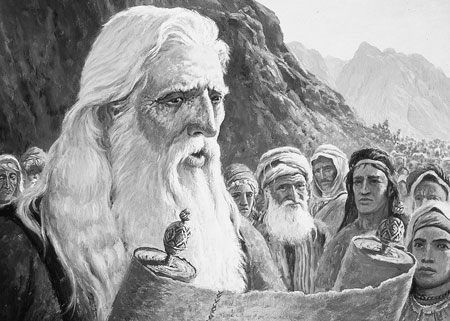
Moses, Reading the Law
There is a common misunderstanding, usually connected to a dispensational view of scripture, that holds that the Mosaic covenant is a religion of works salvation. In fairness, I admit that Paul refers to justification "by the works of the Law," but that reference is to the Pharisaic misuse of the Law (Rom. 9:32), not its proper purpose. Rather, the Law was to serve as a temporary guardian (KJV, "schoolmaster"), until the coming of Christ (Gal. 3:19, 24). The Law - and I am talking here of the ceremonial Law, not the moral - marked that which or who was clean, from that which or who was unclean. It created a hedge around the covenant people that separated them, sanctified them, as distinct from the rest of humanity. Why? That they would be reserved as a conduit through which the Messiah would come, the Savior of the world (John 3:16 and Acts 4:12).

Why did it matter among what nation the Redeemer would be born? That goes back to the original promise of the Gospel, Genesis 3:15: "I will put enmity between you and the woman, and between your offspring and her offspring; He shall bruise your head, and you shall bruise His heel." This promise was given immediately after the Fall, and especially touched Eve, the first human to give in to the temptations of Satan. It was a balm to her conscience to know that her descendant would also be the means of undoing what she and Adam had done. That is why the lineage of Christ is so carefully recorded. Of course, all mankind is the seed of Eve in a general sense, but His lineage is laid out explicitly, legally (i. e., covenantally) in Matthew 1, and genetically in Luke 3. A record is given of exactly in what way He represented her lineage. In our culture, that isn't considered important, but in theirs it was.

What makes me especially to marvel is that this story is carried all the way to the other end of the Bible. In Revelation 12:1-6, the Apostle John describes a woman who gives birth to a son, and a red dragon who persecutes both her and that son. I believe that the woman represents both Eve personally and the covenant people of Israel federally, and the son is, of course, Jesus Christ (see also Rom. 16:20). John explicitly tells us that the dragon is the serpent from the garden (Rev. 12:9). This is the end of the need for the restriction of the lineage, which is why God does away with the ceremonial law, and opens the Church to the Gentiles, those who had formerly been legally unclean (both aspects are described in the account of Peter's dream in Acts 10:10-29; see also Eph. 2:11-16).

This is why I insist that the Mosaic covenant is not a covenant of works, but is rather a temporary administrative stage of the covenant of grace. It was a necessary preparation for the coming of the full salvation that we have in Jesus Christ. It is not, and never was, an opportunity for the Jews - or anyone else - to earn their way to eternal life through good works. This is clear even in its establishment. The account of the giving of the Ten Commandments is found in Exodus 20:1-17. However, verse 2, the Preamble, says, "I am the Lord your God, who brought you out of the land of Egypt, out of the house of slavery." Before giving the shalls and shall-nots, God reminds the people of the redemption that He has already provided them, as the foundation on which the Law was to be built. Justification came before the Law (Rom. 4:10, 14; Gal. 3:17).

Contrary to the teachings of classical dispensationalism, there was never a time  - i. e., after the Fall of Adam - in which any man could be saved by works. In Adam, we all became sinners (Rom. 5:12). We start life as sinners (Psalm 51:5, 58:3). This is the key: sin does not make us sinners; we sin because we are already sinners. It is comparable to a runner in a race who runs facing the wrong way; no matter how fast he runs, he is incapable of winning the race. If that weren't the case, then Jesus would never have needed to come, to suffer, and to die on the cross. As Paul says (Gal. 3:21-22), "if a law had been given that could give life, then righteousness would indeed be by the law. But the Scripture imprisoned everything under sin, so that the promise by faith in Jesus Christ might be given to those who believe."

Friday, December 5, 2014

The Faithfulness of God, Seen in the Covenant with David

My fourth biblical-theology paper.

    David, son of Jesse, the second King of Israel, is the foremost character in the second half of I Samuel, beginning in chapter 16, all of II Samuel, and in I Kings, up to chapter 2, as well as their parallel passages in I Chronicles. He himself authored authored a large, though indefinite, portion of the Psalms. Thus, he rivals his descendant Jesus in the amount of Scripture devoted to his person.
    The first King, Saul, rebels against God in I Samuel 15. As a result, God removes His anointing from Saul and his line. In his place, in chapter 16, the Prophet Samuel is commanded to anoint a replacement. Samuel examines the son’s of Jesse, going down the line from eldest down, rejecting them one by one, until David, the youngest is brought before him, and God commands him to anoint David as king-elect. We next see him in chapter 17, as Israel is standing intimidated by the champion of the Philistines, the giant Goliath. David, too young to be a soldier, is sent by his father to carry food to his elder brothers. At the front, he is appalled by the failure of any Israelite to answer Goliath’s challenge. Then David, still a beardless youth, a mere shepherd, volunteers. He approaches, not as a swaggering warrior as God’s appointee. He tells Goliath (17:45), “I come to you in the name of the Lord of hosts, the God of the armies of Israel, Whom you have taunted.” He strikes down Goliath with his shepherd’s sling, cuts of his head, and the now-inspired Israel drives away the rest of the disheartened Philistine army.
    Saul is jealous of David, as he listens to the people sing, “Saul has slain his thousands, and David his ten thousands” (18:7). He knows that he has been rejected by God in favor of David, now his son-in-law (18:20-30), and resents him for it, especially in the face of the close friendship between David and Saul’s son Jonathan (ch. 20). Saul persecutes David in chps. 21-30, during which time David marries his second wife, the widow of Nabal (ch. 25). Saul and his sons, including Jonathan but not Ishbosheth. Ishbosheth becomes king of eleven tribes, while David is crowned over Judah. The divided kingdom lasts seven and a half years (II Sam. 5:5), until Ishbosheth is assassinated, and David is then crowned king over the reunited kingdom (v. 3). The only surviving member of Saul’s family, Jonathan’s lame son Mephibosheth (v. 4:4), was to remain an honored guest in David’s household (ch. 9).
    The most important segment of David’s history is in chapter 7:8-17 (I Chronicles 17:1-15), the Davidic covenant. As was standard in such covenants, it begins with a rehearsal of God’s past blessings on David (vv. 8-9), then promises blessings (vv. 13-16). God promises peace, and a lineage on the throne of Israel forever. Verse 16 is the culmination: “Your house and your kingdom shall be made sure forever before me. Your throne shall be established forever.” David responds in a prayer of thanksgiving in vv. 18-29, ending with a confidence in God’s promises: “For You, O Lord God, have spoken, and with Your blessing shall the house of your servant be blessed forever.”
    The next major event in David’s life is his sin with Bathsheba (ch. 11). After seeing her bathing on the roof of her house, David has her husband, Uriah the Hittite, exposed in battle with the Ammonites. With Uriah out of the way, David then takes the now-widow as his third wife. The sin is rebuked by the Prophet Nathan in chapter 12, and the newborn son of David with Bathsheba is struck down (vv. 15-23). However, their next son is Solomon, destined to be David’s heir. This demonstrates the human sinfulness of this man, of whom God said, “This is a man after my own heart” (I Sam. 13:14). As a result, David deals suffers from the sins of his own children” Amnon with Tamar, and the rebellion of Absalom. We see his nature again in his census of chap. 24, resulting in God’s striking down of 70 thousand of his people. I Kings 1 and 2 are the account of the transfer of the kingdom from David to Solomon, and then David’s passing (vv. 10-12).
    David’s son, Solomon, as the newly-anointed king, relies of God’s covenant with his father in I Kings 3:6-14: “You have kept for him this great and steadfast love, and have given him a son to sit on his throne this day.” This suggests that David made great effort to teach Solomon what God had promised and done for him. But 5:3 indicates that he was also aware of the consequences of David’s bloody hands. We see both sides of David’s relationship with God in 8:15-20. But Solomon continues confident in God’s covenant promises (vv. 24-26). And that confidence is shared by all of Israel in verse 66.
    God explicitly repeats the promises of the Davidic covenant with Solomon in 9:4-5. This is similar to the pattern of the Abrahamic covenant, with the terms renewed with each succeeding generation. However, unlike David, Solomon did not keep his side of the covenant. In 11:4-6, the writer of Kings shows Solomon following after the pagan deities of his multitudinous wives. Yet, God continues faithful (vv. 12-13), not for Solomon’s sake, but for David’s. Later in the chapter, God punishes the apostasy of Solomon by dividing the kingdom with a rebellion against his son, Rehoboam. Yet, even here, God remembers his covenant, and reserves the tribe of Judah to David’s line (vv. 32-39). This pattern is repeated with Rehoboam’s son, Abijam. In 15:3, the writer explicitly tells us that Abijam did not share the faith of his ancestor David, but vv.4-5 show us God acting out of faithfulness to David: “because David did what was right in the eyes of the Lord…” This is what Paul refers to, in II Timothy 2:13: “If we are faithless, he remains faithful - for He cannot deny Himself.” In II Kings 8:16ff, when Jehoram follows the apostate path of his Israelite kinsmen, even here, the writer tells us, “Yet the Lord was not willing to destroy Judah, for the sake of David His servant, since He promised to give a lamp to him and to his sons forever.”
    The writer of Kings continues to use David as the standard against whom to compare his posterity. His lineage rates badly in 14:3 and 16:2, but well in 18:3. God again recalls His covenant in 19:34 (parallel in Isaiah 37:33-35), as Assyria, after eliminating the northern kingdom, now attacks Jerusalem:  “I will defend this city to save it, for My own sake and for the sake of My servant David.” As Paul said to Timothy, God acts according to His covenant promises because He is watchful over His own truth and reputation, as well as the welfare of His elect.
    David himself writes of God’s establishment of His covenant. In Psalm 18:20-24, he wrote, “The Lord dealt with me according to my righteousness, according to the cleanness of my hands… The Lord has rewarded me according to my righteousness, according to the cleanness of my hands in His sight.” He does not claim that his righteousness is inherent for (v. 32), “[God] equipped me with strength and made my way blameless.” He remembers the particular elements of the covenant, as he credits God with “making me the head of the nations” (v. 43) and “subduing peoples under me” (v. 47), promises “to David and his offspring forever” (v. 50). Asaph sings of the covenant in Psalm 78:67-72: “He chose David His servant… to shepherd Jacob His people… [And] with upright heart he shepherded them.” Ethan the Ezrahite has the voice of God recalling (89:19-37), “I have found David My servant; with My holy oil I have anointed him, so that My hand shall be established with him… My faithfulness and My steadfast love shall be with him… He shall cry to Me, ‘You are my Father, my God, and the Rock of my salvation’... My steadfast love I will keep with him forever, and My covenant will stand firm for him. I will establish his offspring forever, and his throne as the days of the heavens… I will not remove from him my steadfast love or be false to My faithfulness. I will not violate My covenant or alter the word that went forth from My lips…” Ethan claims this faithfulness for all of God’s people (v. 49): “Lord, where is your steadfast love of old, which, by Your faithfulness, you swore to David?”
    The unnamed writer of Psalm 132 applied the same principle of prayer. In verse 1, he starts with, “Remember, O Lord, in David’s favor…” He claims God’s faithfulness to david for the benefit of all of Israel. Verses 11-12: “The Lord swore to David a sure oath from which He will not turn back: ‘One of the sons of your body I will set on your throne. If your sons keep My covenant and My testimonies that I shall teach them, their sons also forever shall sit on your throne.” The writer asks, “If Jerusalem is destroyed, how can You fulfill Your promise that there shall always be a son of David to rule there?” The promise to David, in his eyes, has positive implications for the whole nation.
    The Prophet Isaiah also applied the Davidic covenant to the people of God, as the promise according to which the Messiah would come. In Isaiah 9, the famous Christmas story, he writes (vv. 6-7): “For to us a child is born, to us a son is given; and the government shall be upon His shoulder… Of the increase of His government and of peace there will be no end, on the throne of David and over his kingdom, to establish it and to uphold it…” So, we see an expansion of the vision of the covenant. Where David had seen it as a political promise, with his dynasty established over ethnic Israel, Isaiah now expands that vision to point to a particular King, yet unnamed, who shall take that kingdom to a far greater glory. He repeats that vision in 16:5, “A throne will be established in steadfast love, and on it will sit in faithfulness in the tent of David one who judges and seeks justice and is swift to do  righteousness.” Again, he moves the covenant from a promise of a lineage of men to a particular One.
    Isaiah also makes use of the covenant to encourage the faithful remnant of Israel. In 55:1-5, he calls the people to repentance, assure of the faithfulness of God, as seen in His covenant with David. Verse 3: “Incline your ear and come to Me; hear, that Gsoul may live; and I will make with you an everlasting covenant, My steadfast, sure love for David.” David, the sinner of Bathsheba and Psalm 51 relied on the faithful mercy of God. If he did it, can’t I?
    God Himself made the same comparison through Jeremiah (17:24-25). Using the Sabbath as a test case, He calls the people to repent, and “then there shall enter by the gates of this city kings and princes who sit on the throne of David, riding in chariots and on horses, they and their officials, the men of Judah and the inhabitants of Jerusalem. And this city shall be inhabited forever.” Or, if they refuse (21:12, repeated in 22:2-4), “Hear the word of the Lord, O house of David! Thus says the Lord, ‘Execute justice in the morning, and deliver from the hand of the oppressor him who has been robbed, lest My wrath go forth like fire, and burn with none to quench it, because of your evil deeds.’” Repent and enjoy the blessings of David, but do not presume on them to excuse your wickedness.
    Then, as Isaiah 9, Jeremiah turns to the One who will ultimately fulfill God’s promises to David. 23:5: “I will raise up for David a righteous Branch, and He shall reign as king and deal wisely, and shall execute justice and righteousness in the land. In His days, Judah will be saved, and Israel will dwell securely. And this is the name by which He will be called: The Lord is our righteousness.” Where the writer of Kings lamented that king after king failed to evidence the faith of David, the One Davidic king to come will do so. And, on the side of the people (30:9): “They shall serve the Lord their God and David their king, Whom I will raise up for them.” Just as the One king will demonstrate the best of David’s faith, under His rule the people will do so, as well.
    The Branch appears again in 33:14-26. The content of the Davidic covenant is repeated in verse 17: “David shall never lack a man to sit on the throne of the house of Israel…” (and again in verses 21 and 26). The passage also adds a new element (v. 18): “The Levitical priests shall never lack a man in my presence…” (also verse 21). David wasn’t a priest, so this aspect of the Branch is an expansion, perhaps from the reference to the priesthood of Melchizedek in David’s Psalm 110:4. It isn’t relevant here, but Christ fulfilled this in His union of the offices of priest and king.
    The Prophet Ezekiel prophesies a coming Messiah as the fulfillment of God’s covenant promises to David in 34:22-24: “I will set up over them one Shepherd, my servant David, and He shall feed them; He shall feed them and be their Shepherd. And I, the Lord, will be their God, and my servant David shall be prince among them.” Ezekiel continues this theme in 37:24-28: “My servant David shall be king over them, and they shall all have one Shepherd… David My servant shall be their prince forever… My dwelling place shall be with them, and I will be their God. and they shall be My people…” Notice his resurrection of the servant theme of Isaiah.
    This Davidic king also makes a brief appearance in the prophecies of Hosea (3:5): “The children of Israel shall return and seek the Lord their God and David their king, and they shall come in fear to the Lord and to His goodness in the latter days.” And in Amos 9:11-12: “In that day I will raise up the booth of David that is fallen and repair its breaches,... that they may possess… all the nations who are called by My name.” And in Zechariah 12: 6-13:1, especially that last verse: “On that day there shall be a fountain opened for the house of David and the inhabitants of Jerusalem, to cleanse them from sin and uncleanness.”
    In the New Testament, David plays a prominent role in the apologetic efforts of the Apostles to prove that Jesus was the expected Messiah and Branch of the prophets.
    In the genealogy of Jesus as given by Matthew (1:1-17), not only is the line of David prominent, but the author emphasizes the number fourteen, even skipping generations to create the three sets of fourteen. Why? Because, in hebrew, the letters also represented numbers. The consonants of David’s name (daledh-waw-daledh) add up to fourteen. Thus, not only is Jesus a lineal descendant of David, but Matthew adds that name symbolically three more times to multiply the emphasis on that fact. Not only is Jesus addressed or referred to as the “Son of David” eleven times (e. g., 9:27 and 12:23), but He Himself uses David’s words from the Psalms to express the connection in His teachings (e. g., 22:43).
The words of the David covenant appear in Mark  11:10: “Blessed is the coming kingdom of our father David.” And again in Luke 1:32-33: “He will be great and will be called the Son of the Most High. And the Lord God will give to Him the throne of His father David, and He will reign over the house of Jacob forever, and of His kingdom there will be no end.” And again in verse 69: “[The Lord God of Israel] has raised up a horn of salvation for us in the house of His servant David.” And finally in John 7:42: “Has not the Scripture said that the Christ comes from the offspring of David, and comes from Bethlehem, the village where David was?” Thus, the Gospel writers confronted the Jews with their own covenantal expectations as pointing to this Jesus, whom they were to reject and crucify. This would serve as a direct apologetic against the claims of unbelieving Jews that the Messiah is still to be anticipated, because Jesus did not fulfill that role as they expected.
In Acts, Luke turned to David again, but with less of the covenantal emphasis. In 1:16, 2:25-30, 2:34-35, and 13:33-38, he borrows from Jesus own strategy, using David’s words to emphasize the connection between David and Jesus. He explicitly makes Jesus the hair of David in 13:23: “Of this man’s [i. e., David’s] offspring, God has brought to Israel a Savior, Jesus, as He promised.” This language is reminiscent of th Branch terminology of the Prophets. See also 15:16-17.
Paul also borrows this apologetic theme, such as in Romans 4:6-8, 11:9-10, and II Timothy 2:8. Yet, he never follows up on the covenantal theme, a role he gives, instead, to Abraham.
Jesus again picks up His “Son of David” role in Revelation 3:7: “The words of the Holy One, the True One, Who has the key of David…” And, in the words of an elder in 5:5: “Behold the Lion of the tribe of Judah, the Root of David, has conquered…” And in Jesus’s words again, in 22:16: “I, Jesus, have sent My angel to testify to you about these things for the churches. I am the root and the descendant of David, the bright morning star.”
So, the story of David min the Bible is the story of God’s faithfulness, both to him and to the people of God as a whole. Through His words to him, God establishes a theme of promised redemption, peace, and prosperity, not as the result of merit, but because of God’s covenantal promises of grace, justification, sanctification, and glorification. The New Testament writers continue the story of David, both in their own words and in the words of Jesus, to point Israel to Him. Here is the man promised for a thousand years! Here is the promise of God incarnate! All that we have waited for is here, standing embodied before you. And even in the last verses of the Bible, Jesus Himself points to His purposes as bringing to pass God’s faithfulness to David, and to all Israel in him.

Saturday, June 8, 2013

Covenantal Envy in Ruth 1:6-18

"Then Naomi arose with her daughters-in-law to return from the country of Moab, for she had heard in the fields of Moab that the LORD had visited his people and given them food. So she set out from the place where she was with her two daughters-in-law, and they went on the way to return to the land of Judah. But she said to her two daughters-in-law, 'Go, return each of you to her mother’s house. May the LORD deal kindly with you, as you have dealt with the dead and with me. The LORD grant that you may find rest, each of you in the house of her husband!' Then she kissed them, and they lifted up their voices and wept. And they said to her, 'No, we will return with you to your people.' But Naomi said, 'Turn back, my daughters; why will you go with me? Have I yet sons in my womb that they may become your husbands? Turn back, my daughters; go your way, for I am too old to have a husband. If I should say I have hope, even if I should have a husband this night and should bear sons, would you therefore wait till they were grown? Would you therefore refrain from marrying? No, my daughters, for it is exceedingly bitter to me for your sake that the hand of the LORD has gone out against me.' Then they lifted up their voices and wept again. And Orpah kissed her mother-in-law, but Ruth clung to her. And she said, 'See, your sister-in-law has gone back to her people and to her gods; return after your sister-in-law.' But Ruth said, 'Do not urge me to leave you or to return from following you. For where you go I will go, and where you lodge I will lodge. Your people shall be my people, and your God my God. Where you die I will die, and there will I be buried. May the LORD do so to me and more also if anything but death parts me from you.' And when Naomi saw that she was determined to go with her, she said no more."

 I am thinking about this passage as I prepare to substitute for the teacher of my Sunday School class tomorrow.

 It seems to me that the key verse for understanding the Book of Ruth is here, the latter part of the sixteenth verse of the first chapter: "Your people shall be my people, and your God my God." Note that I am not turning the book into an allegory, but rather seeking the purpose for including this historical event in the inspired text. Note the parallel phrasing here with the covenantal declarations of God: "I will be your God and you shall be My people," such as in Exodus 6:2-7, Leviticus 26:6-13, and Ezekiel 36:22-28. In those passages, it is Jehovah speaking in the first person of the covenant which He Himself is initiating, i.e., the Covenant of Grace. In contrast, Ruth is speaking only in the second person, referring to Naomi's people and Naomi's God. That is because she is speaking as one outside that covenantal relationship.

This is actually within the revealed purposes of God's covenant. In Deuteronomy 4:6, He says to Israel, "Keep them [i.e., the Law] and do them, for that will be your wisdom and your understanding in the sight of the peoples, who, when they hear all these statutes, will say, 'Surely this great nation is a wise and understanding people.'" Also Ezekiel 36:15-23, "And I will not let you hear anymore the reproach of the nations, and you shall no longer bear the disgrace of the peoples and no longer cause your nation to stumble, declares the Lord GOD. The word of the LORD came to me: 'Son of man, when the house of Israel lived in their own land, they defiled it by their ways and their deeds. Their ways before Me were like the uncleanness of a woman in her menstrual impurity. So I poured out My wrath upon them for the blood that they had shed in the land, for the idols with which they had defiled it. I scattered them among the nations, and they were dispersed through the countries. In accordance with their ways and their deeds I judged them. But when they came to the nations, wherever they came, they profaned My holy name, in that people said of them, 'These are the people of the LORD, and yet they had to go out of his land.' But I had concern for My holy name, which the house of Israel had profaned among the nations to which they came. 'Therefore say to the house of Israel, Thus says the Lord GOD: It is not for your sake, O house of Israel, that I am about to act, but for the sake of My holy name, which you have profaned among the nations to which you came. And I will vindicate the holiness of My great name, which has been profaned among the nations, and which you have profaned among them. And the nations will know that I am the LORD, declares the Lord GOD, when through you I vindicate my holiness before their eyes.'"

 Having ignited this envy among Israel's pagan neighbors, how did Jehovah then satisfy it? I think the clear clue is verse 2 of Ruth 1: "They were Ephrathites from Bethlehem in Judah." That little tidbit reminds us of I Chronicles 4:4, which says, in passing, "These were the sons of Hur, the firstborn of Ephrathah, the father of Bethlehem." Then Micah 5:2, "But you, O Bethlehem Ephrathah, who are too little to be among the clans of Judah, from you shall come forth for Me one who is to be ruler in Israel, whose coming forth is from of old, from ancient days." And its fulfillment in Matthew 2:6. This a shadowy connection to the coming of the Messiah, who was given to be a light to the Gentiles (Isaiah 42:6, Isaiah 49:6 [compare Luke 2:32], and Acts 13:47). And the writer of Ruth (probably the Prophet Samuel), brings this down to genealogy. From the marriage of Ruth and Boaz came Obed, the grandfather of David, and thus the lineal ancestor of Jesus the Messiah! Thus, this one literary work demonstrates the covenantal envy of Israel's pagan comptetitors, in the purposes of God, and His sovereign satisfaction of that envy centuries later. I love it when Scripture strands come together like this!

Monday, October 18, 2010

For the Hypocrite, Even Easy Religion Is Just Too Hard!


"[They] say to the seers, 'Do not see,' and to the prophets, 'Do not prophesy to us what is right; speak to us smooth things, prophesy illusions...'"
- Isaiah 30:10

The hypocritical believer continues his attachment to the Covenant of Works, believing that his own righteousness will carry him to heaven. Yet, such persons clamor for a lowering of God's standards. Picture the pole-vaulter in the Olympics, assuring everyone that he can overleap the bar at its competitive height, yet still begging to have it lowered.

I think this is part of what Paul talks about in Romans 2:15. From the rankest unbeliever to the purest hypocritical professor, a man's conscience knows that he has not lived without sin. But the fallen man seeks that righteousness which was forfeited by Adam in the Garden. Finding that he cannot live that righteousness, he seeks to have the standard lowered to his own level. And he rebels against that true believer who testifies against his unrighteousness, whether by word or just by contrasting lifestyle. We have all heard the codewords: "puritanical," "intolerant." He is inventive in exalting himself over the believer, because the truths that he hears from the believer prick his conscience and trip up his self-righteousness.

The Covenant of Grace holds forth God's way of salvation by free grace alone: "Come, everyone who thirsts, come to the waters; and he who has no money, come, buy and eat! Come, buy wine and milk without money and without price." (Isaiah 55:1) How hard it is for fallen man to receive what is free, because he has deceived himself into believing that he has wealth. It is as Jesus said to the Church at Laodicea in Revelation 3:17, "You say, 'I am rich. I have everything I want. I don't need a thing!' And you don't realize that you are wretched and miserable and poor and blind and naked."

Saturday, December 26, 2009

What of Eternity for Infants?


"Elect infants, dying in infancy, are regenerated and saved by Christ through the Spirit, who worketh when, and where, and how He pleaseth. So also are all other elect persons who are incapable of being outwardly called by the ministry of the Word."
-Westminster Confession of Faith, Chapter X, Section 3

A longtime cavil against Calvinists is that we supposedly believe in the damnation of infants. The above paragraph from the Confession is quoted, with various cries of outrage and superiority. Yet, notice that damnation is mentioned nowhere in the paragraph. Rather, only salvation is under consideration.

It is a common concern of spiritually-minded parents what the spiritual welfare is of young children who die, or miscarried, or of children with severe mental disabilities. Afterall, to be saved, we must confess the Lord Jesus with our mouths, and believe in our hearts that God raised Him from the dead (Romans 10:9). How can the infant do so? Or how can the mentally-disabled hear and respond to the Gospel? These are heartfelt questions. And logically, there are only four possibilities that can be discussed for their comfort.

First, some believe that children are spiritually innocent. This is a common view, though it is contrary to the explicit teachings of Scripture. David tells us in Psalm 51:5, "Behold, I was brought forth in iniquity, and in sin did my mother conceive me." And as Paul tells us in Romans 5, from 12 to the end, every human being fell in Adam, so the sin nature has already passed to the next generation, even if unborn. And Paul, again, in Romans, chapter 9, tells us that, before he was even born, "Esau I hated" (verse 13). Just as the sin nature is present from the earliest point of human existence, so that nature is under the just judgment of God.

Second, since we understand that faith in Christ is necessary for salvation, one could hold that all who die in infancy or in mental disability are condemned and lost. This is the real implication of the one who denies the truth of God's sovereign election.

Third, one can hold that all who die in infancy or mental inability are elect. Some Presbyterians take this position. For example, A. A. Hodge, the son of the more-famous Charles Hodge, says in his commentary on this passage in the Confession, "It is not positively revealed that all infants are elect, but we are left, for many reasons, to indulge a highly-probable hope that such is the fact." Personally, I believe that he exceeds the evidence of Scripture in that assertion.

And lastly, there is the position of the Confession, that we have the testimony of Scripture that we can expect that the covenant children of believers, lost in infancy or mental-disability, are regenerated by the Holy Spirit invisibly, apart from His usual means of grace. But we must then acknowledge the silence of Scripture regarding those outside the covenant. Are they lost? Are they taken out of this world because God has made them His own? In this life, we cannot know, because the Scriptures do not tell us. Thus, we must be silent on that question, just as the Confession is silent on it.

However, against our Arminian and Pelagian opponents, I testify that this issue is against them, not us. They have no basis for hope for bereaved parents. Yet, we have the comfort of Paul's teaching again in Romans 5:14. While God hated Esau in the womb, He also tells us that "Jacob I loved." In His gracious covenant, God has elected at least some even from the womb. The Christian parents of a lost child, or of one with severe disabilities, have that comfort and confidence from God's covenant promises.

Wednesday, November 25, 2009

Psalm 37:25-26, the Covenant and Our Daily Bread

"I have been young, and now am old: yet I saw never the righteous forsaken, nor his seed begging bread. But he is ever merciful and lendeth, and his seed enjoyeth the blessing." (Geneva Bible, 1599)

Another passage from The Gospel Covenant, by Rev. Peter Bulkeley. [spellings and grammar in the original.]

"Are we in want and doe we desire to enjoy a sufficiency of these outward blessings? would wee be set in a way in which wee may be sure to be provided for? wee have the way here set before us; wee heare that these blessings are promised in Gods Covenant: The promising of them is one branch of the covenant which the Lord makes with his people: The way then is this: First, to enter into a Covenant with God, and then to walk in Covenant with him, as becomes his people; Enter into a Covenant with him. Art thou in hunger, nakednesse, or (if not in such extremities, yet) wantest thou those things which thy condition stands in need of? It may be thou art a stranger to the Covenant betwixt God and his people, and hast lived an alien from God. Thou hast with the Prodigall forsaken thy Fathers house, departed away from God, living viciously and sinfully, and therefore the Lord hath brought thee to the same condition as the Prodigall was brought unto in these necessities; doe thou then as the Prodigall did, when he was in necessity, and knew not what to doe, he then bethinks himself; In my Fathers house (saith he) there is bread enough [Luke 15:17], but I am ready to perish for hunger; I will therefore arise and goe to my Father, and humble myself unto him, desiring to be as one of his hired servants. Think with thyself what provision the Lord makes for those that are of his household; his children and servants have bread enough. Arise therefore out of thy sin by repentance, goe unto him and sue to be taken into his family, and to be one of his servants; and then will the Father call for roabs to cover thy nakednesse, and bring out the fatted calfe to satisfie thy hunger, thou shalt be fed with food convenient for thee: Thy bread shall not fail, and thy water shall be sure [Isaiah 33:16]: Though he suffer aliens to want, yet his family shall be provided for; but then remember this withall, to walk in Covenant with God; walk as becomes one of the family of heaven, and of the houshold of God; be faithfull and diligent in his service, have a care of his honour; doe nothing to blemish his Name, be careful to please him in all things; be zealous for his glory: Be thankfull that he hath taken thee to be one of his: Bee thankfull in thy particular calling, as therein serving the Lord, and not to serve thine own turne. Study to be usefull and serviceable to others of Gods servants, which are of the same houshold of faith with thee, and in this way of the Covenant, look for, and expect the blessing of it; Doe good (saith the Prophet) and thou shalt be fed assuredly, Psal. 37:3. If yee be willing and obedient, yee shall eat the good things of the land, Isai. 1:19. and if at any time thou be put to straights and wants, doe as Jacob did, put God in minde of his Covenant and promise: Lord thou saidst (saith Jacob) that thou wouldst doe me good [Gen. 32:9]: Lord (say thou) thou hast said thou wilt care for me, and provide things needfull for thy servants, and therefore though I be not worthy of the least of all thy mercies, not worthy to be fed with the crummes which fall from thy childrens table [Mark 7:28], yet because thou hast said that thou wilt satiate thy people with thy goodnesse [Jer. 31:14], make good thy word which thou hast spoken; Let thy mercy come unto me, as I trust in thee [Psa. 33:22]. Thus doe and then lay thy life upon it, thou shalt not want: Bread shall be given thee, and thy waters shall not faile; thou shalt have thy daily portion provided for thee. Though thou hast not much laid up in store for many yeares or days, yet thou shalt have thine Omer day by day [Nehemiah 11:23 & 12:47]. And as those in Nehemiah 11:23 & 12:47, they had by the Kings appointment every day a set portion, so shalt thou have thy daily allowance, daily bread, with all such other things that concern this present life."

Sunday, October 4, 2009

The Blessing of Irresistible Grace

"For it is God who works in you, both to will and to work for His good pleasure."
- Philippians 2:13

I start here with Paul, because of his straightforward and economical expression of the doctrine of irresistible grace, i.e., that regeneration and sanctification are the effectual, sovereign work of God in us, not something we work up in ourselves. However, it is the expansion of this truth in Ezekiel that I especially want to highlight. I am referring to chapter 36.

Ezekiel 36:21-23: "I had concern for my holy name, which the house of Israel had profaned among the nations to which they came. Therefore say to the house of Israel, 'Thus says the Lord God: It is not for your sake, O house of Israel, that I am about to act, but for the sake of My holy name, which you have profaned among the nations to which you came. And I will vindicate the holiness of My great name, which has been profaned among the nations, and which you have profaned among them. And the nations will know that I am the Lord, declares the Lord God, when through you I vindicate My holiness before their eyes.'"

Notice this starting point: it isn't about us! God acts in His grace for the sake of His own holiness, His own glory, for the vindication of His own character. Therefore, when any person claims some special worthiness before God, whether for some supposed inherent holiness or even because of his own belief, he fails to give God the credit and glory that He has claimed for Himself. Paul emphasizes this point, as well, in Ephesians 2:8-9, "For by grace have you been saved through faith. And this is not your own doing; it is the gift of God, not a result of works, so that no one may boast."

But to continue in Ezekiel, verses 25-27: "I will sprinkle clean water on you, and you shall be clean from all your uncleannesses, and from all your idols I will cleanse you. And I will give you a new heart, and a new spirit I will put within you. And I will remove the heart of stone from your flesh and give you a heart of flesh. And I will put My Spirit within you, and cause you to walk in My statutes and be careful to obey My rules."

Paul explains the "heart of stone" in Ephesians 2:1, "And you were dead in trespasses and sins." Dead, not sick, so that we must be born again (John 3:3) and become a new creation (II Corinthians 5:17).

Ezekiel continues, verses 28-29: "You shall dwell in the land that I gave to your fathers, and you shall be My people, and I will be your God. And I will deliver you from all your uncleannesses." And thus God grounds His gracious promises in the same covenant of grace that He declared to Abraham (Genesis 17:7) and to his spiritual seed (Romans 4).

As with reprobation, this aspect of biblical doctrine allows no room for man's pride, but much for man's redemption. Why do so many clamor to reverse that?

Wednesday, September 30, 2009

The Abrahamic Covenant and Infant Baptism

In my continuing reading of "The Gospel Covenant", by New England Puritan Peter Bulkeley, I am currently at a portion in which he defends the identity of the Abrahamic Covenant with the New Covenant in substance, while distinguished in administration. He says (archaic spelling and grammar in original):

"This poynt, concerning the identity or sameness of the two covenants, doth lay a good foundation for communicating Baptisme to the infant children of believers. For if both these things be true, first that the old and new Covenant be in substance the same; and secondly, that children are within the new as they were within the old, then there can be no sufficient reason to deprive children of the seale of the Covenant now more than former times under the old; and, that argument drawne from Circumcision to Baptisme, will stand against all the batteries which are made against it, never to be beaten downe whiles heaven and earth doe endure. The Covenants are the same, and the signes of the Covenants (Circumcision and Baptisme) are in signification the same also; and the children of the faithfull have the same relation and right to the Covenant now as they had before; What reason then that children being before circumcised, in token of their being in covenant, should be forbidden to be baptized , that it might be to them a signe of the Covenant betwixt God and them? It is even a wonder of wonders, that in such cleare light so great mists should be raised up to darken the truth. Let humble mindes search the truth in love, and the Lord will reveale the same unto them."

The verses Bulkeley refers to are Genesis 17: 7, "I will establish my covenant between me and you and your offspring after you throughout their generations for an everlasting covenant, to be God to you and your offspring after you," leading to verse 10, the institution of circumcision as the sign of that covenant, administered to each male infant on his eighth day. Then he points to Paul's use of verse 7 in Galatians 3:16 (see also Romans 4), which he then relates to baptism in verse 27. Then in verse 29, Paul concludes, "And if you are Christ's, then you are Abraham's offspring, heirs according to the promise."

So, Bulkeley's logic proceeds like this:

1) God's covenant promise to Abraham explicitly included his children, who therefore received circumcision as the sign of the Covenant.

2) Christians are the children of Abaraham by faith, and therefore receive His covenantal promises.

3) One of those promises is to bless our offspring.

Therefore, our offspring have a right to receive the sign of the Covenant, i.e., baptism in the place of circumcision.

In the debate over the proper subjects of baptism, credobaptists demand an explicit commandment to baptize the children of believers. Rather, given Bulkeley's argument here, it is actually incumbent on the credobaptist to show an explicit commandment that children are not to receive baptism.