Showing posts with label engelsma. Show all posts

Saturday, October 16, 2021

The Believer Rewarded for Good Works

"There will be degrees of the glory of eternal life and of the blessedness of perfected salvation. These degrees of bliss and glory will be commensurate with the good works that God's people performed in their earthly lives. According as they worked out of love for God and the neighbor and in accordance with the good works they performed, they will receive from Christ the judge more splendid glory, more honorable responsibility, a higher place in the everlasting kingdom of Christ in the new creation." -David Engelsma, "Gospel Truth of Justification," pp. 389-90 

In this paragraph, Engelsma addresses the biblical truth that Christians will receive different levels of glory in the life to come in accordance with the good works we have done in this life. We see this, for example, in the words of Jesus in the Parable of the Ten Minas (Luke 19:11-27): "He said to [the first servant], 'Well done, good servant! Because you have been faithful in a very little, you shall have authority over ten cities.' And the second came, saying, 'Lord, your mina has made five minas.' And He said to him, "And you are to be over five cities'" (verses 17-18). 

What we don't see here is Jesus's offering the servants eternal life. Why? Because the unbeliever cannot do good works (Romans 3:12, Romans 14:23, Hebrews 11:6). Nowhere does the Bible describe justification as a reward for good works. Rather, good works are always the consequence of justification. No one is saved by good works; good works are what saved people do

As the writer of the Epistle to the Hebrews said to his readers, "Though we speak in this way, yet, in your case, beloved, we feel sure of better things - things that belong to salvation. For God is not unjust so as to overlook your work and the love that you have shown for His name in serving the saints, as you still do" (Hebrews 6:9-10). Notice to whom the writer directs his comments: to the beloved, to those who serve the saints. These cannot be qualities of unbelievers. Again, good works are something that only the believer can do, so it is impossible for any supposed good works to contribute to anyone's justification,.



Saturday, September 11, 2021

The Gift of Justification: Freely Given

"The righteousness imputed in justification is a gift - a free gift. The basis of justification is a gift: the lifelong obedience and the death of Jesus Christ. The content of justification is a gift: the righteousness of the substitutionary in life and in death of Jesus Christ. The divine act in the sinner's consciousness is a gift: declaring the sinner righteous. The faith by which the sinner receives the righteousness of God in Jesus Christ is a gift. All is a gift, according to grace, gratuitously given." 

- David Engelsma, "Gospel Truth of Justification," p. 327, emphasis in the original 

In the paragraph above, Engelsma describes the central distinction of biblical Christianity, contrasted with both false doctrines and false religions, that true salvation is attained externally to the believer, and then given to him. Every false expression of Christianity or of other religions will, in some way, make its version of salvation based on some action of the individual, an internal basis. The contrast is absolute and uncompromisable. 

The difficulty here is that bit of Adam which remains in us. Adam alone lived under the covenant of works, the promise of salvation based on his obedience. It has, therefore, been passed down in our spiritual DNA to continue to want to contribute something of ourselves toward our salvation. However, Adam also passed to us his fallen nature. When he fell into sin, he lost for himself and for us anything inherent to us that would have merit in God's eyes. 

The bad thing about being sinners is that we have nothing within ourselves to give to God as payment for justification. The good thing about being sinners is that it is exactly for such helpless sinners that the Gospel is given: "I am not shamed of the Gospel, for it is the power of God for salvation to everyone who believes..., for in it the righteousness of God is revealed from faith for faith, as it is written, 'The righteous shall live by faith'" (Romans 1:16-17, incorporating Habakkuk 2:4). Exactly where I am helpless, the biblical Gospel provides my lack by free grace. In what way is it free? In that I need not, and cannot, contribute anything to gain it. Was there a cost? Yes, and a great cost, for it cost the Son of God's suffering and bleeding on the Roman cross.  


Wednesday, September 8, 2021

Our Covenant Heads: The First Adam and the Last Adam

"Because He is the covenantal head of elect believers, He [Jesus] may be and is their righteousness with God by faith alone in Him. Because He is the covenantal head of elect believers, the obedience of these believers need not be, may not be, and is not their righteousness with God. For their obedience to be their righteousness with God would be to dispossess, displace, disregard, and disgrace the head of the covenant, who is Jesus the Christ. It is the precise purpose of Galatians 3 to establish that the precious but contested truth of justification by faith alone in Jesus Christ has its ground in the covenantal headship of Jesus Christ."

- David Engelsma, "Gospel Truth of Justification," p. 303

The Apostle Paul describes a parallel and contrast between Adam and Jesus in Romans 5:12-21. 

First, he tells us of Adam in verse 12: "Sin came into the world through one man, and death through sin, and so death spread to all men because all sinned..." Theologians refer to this as the Covenant of Works, which God made with Adam, and, through him, with all his posterity. All of Adam's descendants, excepting Jesus alone, were represented by Adam. If Adam had fulfilled that covenant by perfect obedience during his period of probation, then not only he, but that posterity also, would have been confirmed in eternal life. The condition to be met in that covenant was perfect obedience. For how long? We aren't told. However, for some length of time. But Adam failed, taking himself and his posterity into death, both spiritual and physical. 

Then Paul tells us of a separate covenant between the Father and the Son, for which the application to us has been called the Covenant of Grace. "But the free gift is not like the trespass. For if many died through one man's [i. e., Adam's] trespass, much more have the grace of God and the free gift by the grace of that one man Jesus Christ abounded for [a different] many. And the free gift is not like the result of that one man's sin. For the judgment following one trespass brought condemnation, but the free gift following man trespasses brought justification. For if, because of one man's trespass, death reigned through that one man, much more will those who receive the abundance of grace and the free gift of righteousness reign in life through the one man Jesus Christ. Therefore, as one trespass led to condemnation for all men, so one act of righteousness leads to justification and life for all men. For as by the one man's disobedience the many were made sinners, so by the one man's obedience the many will be made righteous" (Romans 5:15-18).

Thus, Paul points to two covenants, one headed by Adam, the other by Jesus, whom he calls "the last Adam" in I Corinthians 15:45, and contrasts their effects. One renders men sinners while the other renders men righteous, not inherently, but rather by the imputation of the nature of the heads of the respective covenants. 

Modern Americans have a problem with covenant theology, because we do not live in a covenantal society. We believe that each person determines his own fortunes in life. Yet we same Americans are happy to talk about Jesus as our savior. We will gladly accept the imputation to us of His righteousness. However, we rarely accept the other side of the same coin, the imputation of Adam's fall. The two concepts follow the same covenantal logic, but they fall on our ears very differently. Yet, to accept the one necessarily implies the other, as I wrote here


Saturday, August 21, 2021

Jesus as Surety for His People

"To Jesus Christ, to His account, as the one now responsible for the sins of those in whose stead He died, God imputed our sins. Although personally the man Jesus was sinless, the guilt of the others became His own on the cross, indeed, throughout all His life of suffering, by God's imputation of this guilt to Him. God held Jesus responsible for the sins and sinfulness of all the elect, for whom Jesus was the divinely-appointed substitute. God dealt with Him accordingly, cursing and damning Him." 

- David Engelsma, "Gospel Truth of Justification," p. 294 

In the paragraph above, Engelsma is summarizing and paraphrasing what Paul taught in three passages. The first was Galatians 3:13-14: "Christ redeemed us from the curse of the law by becoming a curse for us - for it is written, 'Cursed is everyone who is hanged on a tree' - so that, in Christ Jesus, the blessing of Abraham might come to the Gentiles, so that we might receive the promised Spirit through faith." The second is II Corinthians 5:21: "For our sake He [the Father] made Him [the Son] to be sin who knew no sin, so that, in Him [the Son], we might become the righteousness of God." And, finally, Galatians 2:20: "I have been crucified with Christ. It is no longer I who live, but Christ who lives in me. And the life I now live in the flesh, I live by faith in the Son of God, who loved me and gave Himself for me."

In theology, we say that Jesus gave Himself to be the surety for all those whom the Father had given Him. Or, to use our modern parlance, He became the "co-signor" for us. But that must be understood a little differently. When a person, call him John, co-signs a loan for another person, call him Bob, then John takes upon himself a risk. Bob is promising to repay his loan, but, if he fails, the loan then becomes John's responsibility. However, in the case of the suretyship of Jesus, He agreed to co-sign for the sin debt of His people, even knowing in advance that His people would indeed fail. He didn't just assume a risk; He assumed the certainty that His people would have a sin debt for which He was taking responsibility. Would any merely-human co-signor agree to such a responsibility? 

But notice further that Jesus, as surety, didn't undertake merely the debt of our sins. There was a further imputation, as well. As Paul said to the Corinthians, the redeemed become "the righteousness of God." The redeemed are not brought to some morally-neutral state, but rather we are brought to a positive account of righteousness, His righteousness, so that, as the same Apostle told the Galatians, we live the godly life as Jesus's righteousness is placed in us, by means of faith alone. That is an instantaneous exchange, not the progressive one pretended by Rome and other Pelagian sects. It is done


Saturday, August 14, 2021

Salvation Is Too Easy for Most Men

"The truth of justification by faith alone is contrary to depraved human nature, which always supposes and insists that the way to be righteous is by exerting oneself to attain this status, since righteousness makes one worthy of salvation and of every blessing. The truth of justification is truly amazing since faith is not a work that makes one worthy of righteousness, but merely a means, an instrument, by which God gives - by imputation - and the sinner passively receives righteousness as a gift. Indeed, the faith itself by which the sinner is justified is God's gift to the sinner." -Rev. David Engelsma, "Gospel truth of Justification," p. 191. 

In most things, we expect a person to choose the easiest way to attain his goals. To choose the hardest way is considered irrational. Yet we all exempt salvation from that plain rule. 

Recall the reactions of Adam and Eve immediately after their Fall into sin: "Then the eyes of both were opened, and they knew that they were naked. And they sewed fig leaves together and made themselves loincloths. And they heard the sound of the Lord God walking in the garden in the cool of the day, and the man and his wife hid themselves from the presence of the Lord God among the trees of the garden. But the Lord God called to the man and said to him, 'Where are you?' And he [i. e., Adam] said, 'I heard the sound of You in the garden, and I was afraid, because I was naked, and I hid myself.' He [i. e., the Lord] said, 'Who told you that you were naked? Have you eaten of the tree of which I commanded you not to eat?' The man said, 'The woman whom You gave to be with me, she gave me fruit of the tree, and I ate.' Then the Lord God said to the woman, 'What is this that you have done?' The woman said, 'The serpent deceived me, and I ate'" (Genesis 3:7-13). 

First, let us notice who is speaking. This is the Lord, the tetragrammaton, Yahweh. This is the covenantal name of the preincarnate Son. Where the Father could have come in proper wrath and justice, instead, the Son comes in the first instance of His mediatorial role. He is present with the now-sinful Adam and Eve, giving them an immediate opportunity to plead His mediatorial mercy and forgiveness. That would have been the easy solution. 

Instead, what did they do? Immediately they covered their nakedness with fig leaves. The consciousness of their nakedness is an indication of their loss of their pre-Fall innocence. So, they attempted to work out their own solution to their guilt: cover it up. Next, they hide themselves among the trees. They have hidden their sin from their own eyes with the leaves, and then they add hiding themselves from the eyes of God. After all, he cannot judge them if He doesn't know where they are, right? Or so they reasoned. Yet, when He finds them, as was inevitable, they resort to pointing fingers. It was the woman, Adam claims, and You gave her to me. So it is God's fault. Even in her place passed the blame to the serpent, that ancient Tempter, whom we know as Satan. For Adam and Eve, their defense boiled down to, No one here but us innocent little chickens! 

And to this day, the posterity of our first parents respond the same way. We always strive to avoid responsibility for our wickedness. It is someone else's fault, not mine. Or I will fix myself, and God can just go on about His business with those other wicked people. 

And while we scramble to make all of these efforts to hide or fix our sin, the only mediator between the just God and sinful men is Jesus Christ. How simple it is to turn to Him alone by faith alone. Then we need not make garments for ourselves, because He gives us His own white robe of righteousness: "I counsel you to buy from me gold refined by fire, so that you may be rich, and white garments so that you may clothe yourself and the shame of your nakedness may not be seen, and salve to anoint your eyes, so that you may see" (Revelation 3:18; compare Zechariah 3:3-4). We need not hide or fix our sin. Indeed, we cannot. But He can, and does. How easy salvation in Christ is!


Wednesday, August 4, 2021

Justification by Double Imputation, Through Faith Alone

Orthodox Protestants properly state that justification is by faith alone, without regard to works. That statement is true, and the only way of justification found in the Bible. But we are often week in defining what it is that is conveyed to the believer by means of - not on the basis of - his faith. What is conveyed to the believer is the negative obedience of Christ, i. e., His willing submission to the judgment of the Father for sin, and His positive obedience, i. e., His willing obedience to the law of God as the Second Adam.

The first cancels the sin debt that the elect carried for our sins, while the latter gives us a true righteousness in the eyes of God. 

"If faith in Christ is the only way to be righteous, to the exclusion of all the works of the sinner himself, then the sinner's righteousness with God consists exclusively of the works of Christ in his stead and on his behalf. In the saving work of God of justification the sinner's righteousness is solely the obedience of Christ - His lifelong, perfect obedience to all the commandments of the law in our stead and His obedience in our place to the demand of the law that we be cursed for our transgressions. 'By the obedience of one shall many be [constituted] righteous' (Romans 5:19)" Engelsma, Gospel Truth of Justification, p. 192.

For His negative obedience, we have many passages in the Bible, such as Isaiah 53:4-6: "Surely He has borne our griefs and carried our sorrows; yet we esteemed Him stricken, smitten by God, and afflicted. But He was pierced for our transgressions; He was crushed for our iniquities; upon Him was the chastisement that brought us peace, and with His wounds we are healed. All we like sheep have gone astray; we have turned—every one—to his own way; and the LORD has laid on Him the iniquity of us all.

That passage is well-known, but how many can point to the imputation of his perfect obedience? " You will ordain peace for us, for You have indeed done for us all our works" (Isaiah 26:12). See also II Corinthians 5:21 and Hebrews 13:20-21. When we stand before Jesus, not to be judged, but to have His righteousness and mercy displayed before the universe, we will not be without works. Rather we shall bear His works! 

Saturday, July 24, 2021

God, the Just Justifier


"The righteousness of God has been manifested apart from the law, although the Law and the Prophets bear witness to it— the righteousness of God through faith in Jesus Christ for all who believe. For there is no distinction: for all have sinned and fall short of the glory of God, and are justified by His grace as a gift, through the redemption that is in Christ Jesus, whom God put forward as a propitiation by His blood, to be received by faith. This was to show God’s righteousness, because in His divine forbearance He had passed over former sins. It was to show His righteousness at the present time, so that He might be just and the justifier of the one who has faith in Jesus."
- Romans 3:21-26 

In prehistory, when God decided to save a Church from their sins, God faced a dilemma (I am putting this in human terms). If sin is contrary to His nature, how could He save sinners without denying His own nature? How could God remain the holy deity which is He is, if He merely ignored the wickedness in men? As verse 26 puts it, how could God remain just while becoming the justifier of His people?

 First, let us consider whether the wickedness of men is contrary to God's nature. The Prophet Habakkuk asks God this question: "You who are of purer eyes than to see evil and cannot look at wrong why do You idly look at traitors and remain silent when the wicked swallows up the man more righteous than he?" (Habakkuk 1:13). The prophet asks the exact question that we are considering. How can the righteous God, to whom evil is an alien and contrary condition, allow wicked men to continue? Such a God cannot receive the evil of men into His fellowship. Therefore, the problem of sin requires a solution. How can His justice be satisfied apart from the destruction of every sinner? 

Then another steps forward and volunteers. This one is Himself God; not a different God, but God the Son, both the one God and a distinct Person within the Godhead. He voluntarily offered Himself, sinless and holy, just as God the Father is, on behalf of those whom the Father would give Him to be His body the Church (John 6:37-39, 10:7-18, 17:1-19, Ephesians 5:25). As represented by the Mosaic priestly sacrifices, Jesus's priestly offering of Himself as the true sacrifice (Hebrews 9:14) achieved the Father's desire. His judgment of sin fell on His own Son, so that His justice was satisfied, and the justification thus purchased was imputed to His elect, so that He could become their justifier. 

"Apart from the obedience and death of Christ in the stead of elect sinners, God may not justify guilty sinners. Apart from the cross of Christ, God would show Himself unrighteous were He to justify the ungodly. the Christian gospel is not simply that God justifies the sinner who believes in Jesus Christ. The Christian gospel is that God justifies the sinner who believes in Jesus Christ, on the ground of Christ's substitutionary obedience, especially the obedience of His suffering and death" (Rev. David Engelsma, "Gospel Truth of Justification," p. 266; emphasis in the original).

Saturday, June 5, 2021

Justification and That Essential Four-Letter Word: Alone


"In teaching justification by faith alone, Calvin and the Reformed creeds, like Luther before them, are biblical. Not only does the Bible teach that justification is by faith, but it teaches also that justification is by faith alone. The Bible teaches justification by faith alone not by using the word alone, but by contrasting faith as the means of justification with the only alternative, namely, the works of the sinner. When, in its great passages on justification, the Bible affirms that justification is by faith and immediately adds that justification is not by works, the Bible teaches not only that justification is by faith, but also that justification is by faith alone. So clearly, purposefully, and decisively does the Bible thus teach justification by faith alone that alone is, in fact, in the text. It is in the text implicitly." 

- Rev. David Engelsma, "Gospel Truth of Justification," p. 185, emphasis in original 

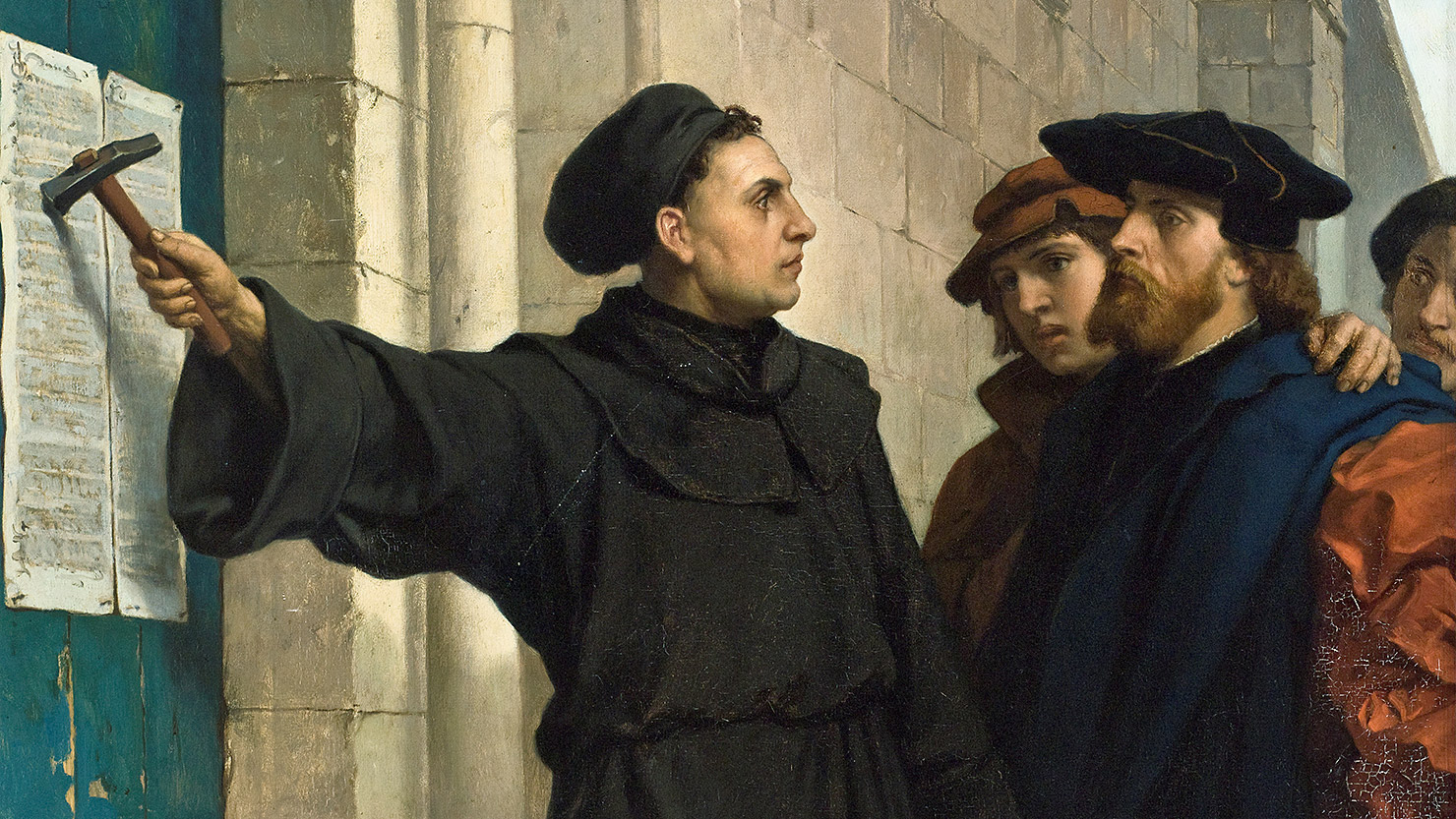
When Martin Luther first translated the Bible into his native German he added the word "alone" to Romans 3:28: ""So halten wir nun dafür, dass der Mensch gerecht werde ohne des Gesetzes Werke, allein durch den Glauben" (Literally: "We therefore conclude that a man is justified without the works of the law, alone through faith"). Rome has accused him ever since of adulterating the verse. More recently, Mormons have repeated the accusation, and applied it to all orthodox Protestants who hold to Sola Fide, justification by faith alone

As seen in the quote above, Luther might have added the word, but he did not add the concept. He merely made explicit what was already implicit. Not only is there nothing dishonest in doing so, but it is a common practice in translating. In fact, the King James Version used by the Mormons does it frequently (the words printed in italics). And Romanist translators have done it in preparing approved versions of the Scriptures. In other words, this is a painfully obvious case of the pot calling the kettle black! 

Part of the reason that Engelsma felt compelled to make his comment so firmly is because of a creeping loss of the Reformation doctrine, even among those who profess to walk in the footsteps of the Reformers. 

For example, in the Thirty-Nine Articles of Anglicanism (Church of England, Episcopal Church in the USA, etc.), number XI says, "Of the Justification of Man. We are accounted righteous before God only for the merit of our Lord and Savior Jesus Christ by faith, and not for our own works or deservings. Wherefore, that we are justified by faith only is a most wholesome doctrine, and very full of comfort..." "Only" appears twice in this one sentence, yet Anglican Theologian N. T. Wright says that the doctrine is an error, and adds works to his doctrine of justification. 

Likewise, the Westminster Confession of Faith, the main doctrinal document of the world's Presbyterians, says (Chapter XI:1 and 2): "Those whom God effectually calleth, He also freely justifieth: not by infusing righteousness into them, but by pardoning their sins, and by accounting and accepting their persons as righteous; not for any thing wrought in them, or done by them, but for Christ’s sake alone; not by imputing faith itself, the act of believing, or any other evangelical obedience to them, as their righteousness; but by imputing the obedience and satisfaction of Christ unto them, they receiving and resting on Him and His righteousness by faith; which faith they have not of themselves, it is the gift of God. Faith, thus receiving and resting on Christ and his righteousness, is the alone instrument of justification..." Yet a movement among professing Presbyterians known as the Federal Vision denies the propriety of "alone," and, like Wright, claims a form of justification by faith mixed with works. 

Such men are dishonest in their profession, pledging their commitment to their respective creeds, while denying such a fundamental doctrine. That is taking the Lord's Name in vain, and "the Lord will not hold him guiltless who takes His name in vain" (Exodus 20:7).

Wednesday, May 26, 2021

The Incompatibility of Works-Righteousness and Faith-Righteousness

"The truth is that the faith by which alone the elect sinner is justified is a knowing and trusting that renounce works and working for righteousness... The faith that renounces working and works for justification is true faith. Whatever supposed 'faith' insists on working for righteousness is thereby exposed as a false faith. No one is justified by a false faith."

- Rev. David Engelsma, "Gospel Truth of Justification," p. 190, emphasis added 

In this paragraph, Engelsma is making the same point that Paul made in his Epistle to the Romans. For example, he wrote in Romans 9:30-32, "What shall we say, then? That Gentiles who did not pursue righteousness have attained it, that is, a righteousness that is by faith; but that Israel who pursued a law that would lead to righteousness did not succeed in reaching that law. Why? Because they did not pursue it by faith, but as if it were based on works." 

The theme in both is a mutual exclusivity between justification by faith and justification by works. Dependence on one precludes dependence on the other. The seeking of a righteousness, i. e., justification, by works is the reason Paul gives for the excommunication of the Jews (see Romans 11:13ff). 

This shouldn't have been news to the Jews. After all, they looked to Abraham as their national progenitor. And of Abraham, the Jewish Scriptures record, "He believed the LORD, and He counted it to him as righteousness" (Genesis 15:6). That is why that verse is one of the most-frequently quoted in the New testament, e. g., Romans 4:3, Galatians 3:6, and James 2:23. 


Wednesday, March 31, 2021

The Righteousness of the Believer Not a Righteousness by Works

 "Christ, and Christ alone, is the source of righteousness, that is, the righteousness that we need and becomes ours by God's act of justification. God has worked out a righteousness in Christ for penitent, believing sinners, and this righteousness is now in that exalted Christ at the right hand of God in Heaven. To grant us and bestow on us this righteousness of God (by imputation), God is pleased to use faith. Faith is the bond of union with Christ through which the sinner receives righteousness." 

- Rev. David Engelsma, "Gospel Truth of Justification," pp. 141-2 

In this paragraph, Engelsma paraphrases what Paul tells us about the failure of the Jews: "Israel, who pursued a law that would lead to righteousness, did not succeed in reaching that law. Why? Because they did not pursue it by faith, but as if it were based on works" (Romans 9:31-32). Where was true righteousness to be found? "Now the righteousness of God has been manifested apart from the law, although the Law and the Prophets bear witness to it- the righteousness of God through faith in Jesus Christ for all who believe" (Romans 3:21-22). 

Jesus addressed this problem with the Pharisees: "Woe to you, scribes and Pharisees, hypocrites! For you are like whitewashed tombs, which outwardly appear beautiful but within are full of dead people's bones and all uncleanness. So you, also,m outwardly appear righteous to others, but, within, you are full of hypocrisy and lawlessness" (Matthew 23:27-28). 

For the unbelieving Jews, righteousness was a matter of checking off a list of do's and don't's. This is the way of pseudo-Christian cults even to this day: Catholics, Mormons, Jehovah's Witnesses, Seventh-Day Adventists. But it is not the way of Biblical Christianity, which is a righteousness by faith alone, the perfect righteousness of Christ, applied only by the gift of faith. "For our sake, He [the Father] made Him [Jesus, the Son] to be sin who knew no sin, so that, in Him, we might become the righteousness of God" (II Corinthians 5:21).