Showing posts with label 1 thessalonians. Show all posts

Saturday, October 9, 2021

Jesus the I Am of Exodus


"The Lord said to Moses, 'Behold, I am coming to you in a thick cloud, that the people may hear when I speak with you, and may also believe you forever.' When Moses told the words of the people to the Lord, the Lord said to Moses, 'Go to the the people and consecrate them today and tomorrow, and let them wash their garments and be ready for the third day. For on the third day the Lord will come down on Mount Sinai in the sight of all the people. And you shall set limits for the people all around, saying, Take care not to go up into the mountain or touch the edge of it. Whoever touches the mountain shall be put to death... When the trumpet sounds a long blast, they shall come up to the mountain'" (Exodus 19:9-13). 

That is part of the account of the Lord's appearance to Moses on Mount Sinai, in part for the giving of the Ten Commandments. 

"Then will appear in heaven the sign of the Son of Man, and then all the tribes of the earth will mourn, and they will see the Son of Man coming on the clouds of heaven with power and great glory. And He will send out His angels with a loud trumpet call, and they will gather His elect from the four winds, from one end of heaven to the other" (Matthew 24:30-31). 

"The Lord Himself will descend from heaven with a cry of command, with the voice of an archangel, and with the sound of the trumpet of God" (I Thessalonians 4:16). 

These latter two passages describe the coming of the Lord Jesus in 70 AD in judgment on apostate Israel. Notice the parallels in the two sets of descriptions, one of Yahweh to Exodus-era Israel, and the other to First-Century reprobates among the descendants of that same Israel. The signs associated with the two events are identical! 

The significance of these parallels is that we must conclude that the Person described in each is the same in each: the preincarnate Yahweh and the same Yahweh incarnated in the Person of Jesus. 

Wednesday, November 6, 2019

Contending for the Faith Against False Teachers

I have regular apologetic and evangelistic interactions with pseudo-Christian cults, mainly Mormons, Jehovah's Witnesses, and Oneness Pentecostals. In each case, someone always says something like this: "Why do you judge us? Why can't you just go practice your beliefs, and leave us to practice ours?" It's a form of guilt manipulation, trying to make it seem as if I am just a big meanie.

Yet, their repeated "why's" have an answer: the commandment of Scripture.

First, we have the warning against false teachers: "Do not listen to the words of the prophets who prophesy to you, filling you with vain hopes. They speak visions of their own minds, not from the mouth of the Lord. They say continually to those who despise the word of the Lord, ‘It shall be well with you’; and to everyone who stubbornly follows his own heart, they say, ‘No disaster shall come upon you'" (Jeremiah 23:16-17). The danger of false teachers is that they leave their followers under the wrath of God, while blithely imagining their safety. That is why false teachers are so popular. "While people are saying, 'There is peace and security,' then sudden destruction will come upon them as labor pains come upon a pregnant woman, and they will not escape" (I Thessalonians 5:3). And it isn't just the cults which are the danger here. The popular TV preachers, such as Joel Osteen, are equally dangerous. They promise peace and prosperity, but never mention sin or the wrath of God. So their followers march, grinning and satisfied, into the waiting maw of Hell. 

In the face of such deceivers, the Scriptures give me a stark warning: "If I say to the wicked, ‘You shall surely die,’ and you give him no warning, nor speak to warn the wicked from his wicked way, in order to save his life, that wicked person shall die for his iniquity, but his blood I will require at your hand" (Ezekiel 3:18). If I see the false teacher and those deceived by him, and I make no effort to warn them of God's judgment, then God holds me guilty of their death! 

That's why the New Testament also gives every true Christian this commandment: "I found it necessary to write appealing to you to contend for the faith that was once for all delivered to the saints" (Jude 1:3). I do not face accounting to cultists or other false teachers for challenging their errors; I face the wrath of God if I fail to do so.

Saturday, July 8, 2017

The Bible as the Only Means of Sanctification

"How can a young man keep his way pure?
     By guarding it according to Your word.

I have stored up Your word in my heart,
     that I might not sin against You.

Your word is a lamp to my feet
     and a light to my path.

Keep steady my steps according to Your promise, 
     and let no iniquity get dominion over me."
- Palm 119:9, 11, 105, 133

Muslims and cultists around the world speak of the morality of professing American Christians and claim that it is a reflection of the nature of Christianity. And, in a sense, they are right to look at us. After all, if we profess that faith, then we should live accordingly. What is sad, however, is that they understand that, but all of those professing Christians don't. As I have pointed out here, the religion of America ceased long ago to be Christianity, and is, instead, deism, though baptized with Christian terminology.  

However, for the true Christian, what brings moral failure? How should he judge whether his life reflects the Lord that he professes? In the four verses above, the Psalmist gives us clear and explicit counsel.

In each of these four verses, there is a reference to the Scriptures. In the first three, it is called the "word." That emphasizes that the Bible is no mere word of men, but is really the word of God (I Thessalonians 2:13), God-breathed (II Timothy 3:16). And the last verse calls it  the "promise," because it is God's word to us, His message of salvation, of sanctification, and of glorification (Romans 8:30).

Then, also in all four verses, the Psalmist describes a role for the Scriptures in our sanctification, that is, the process of repudiating sin and striving more and more to be like Jesus. He desires to be "pure" (verse 9), "not to sin" (verse 11), to be enlightened (verse 105), and that "iniquity will not have dominion" (verse 133). Each of those phrases describes his desire to repudiate his old life of sin and to live as the new creation he is in Christ (II Corinthians 5:17). He refuses the deistic, humanistic mindset, which says that doing right is what he feels is right. Rather, doing right is doing what God says is right. And that we can find only in Scripture.

Wednesday, May 3, 2017

Sola Scriptura: The Best Defense Against Spiritual Bondage


One thing cults have in common is that they have some leader, whether alive or dead, whom they declare to be some paragon of truth. We have Ellen White, Mary Baker Eddy, Joseph Smith, an interminable list of popes, Victor Paul Wierwille, David Koresh. It is a long list, and adds more every day.

The Bible tells us how to resist even the most charismatic cultist: "Learn by us not to go beyond what is written, that none of you may be puffed up in favor of one against another" (I Corinthians 4:6). This is the Apostle Paul speaking, someone to whom the word of God was entrusted (I Thessalonians 2:13). If anyone could claim personal superiority, surely it was he. Yet, he tells the Christians of Corinth that mere men can be "puffed up." And the cure for that is not to go beyond what is written. That is, when any man claims spiritual knowledge outside of Scripture, then he is "puffed up," and is to be resisted. While he does not explicitly quote it, Paul is applying the principle taught in God's Law (Deuteronomy 18:20): "The prophet who presumes to speak a word in My name that I have not commanded him to speak, or who speaks in the name of other gods, that same prophet shall die."

This is what the Reformers did, starting in 1517. As they discovered and taught, more and more, that the declarations of the popes went beyond anything written in the Bible, people were liberated from hundreds of years of bondage to the erroneous teachings of men. Martin Luther said of the fathers of the Catholic Church, "Their holiness does not make them infallible, and it does not imply that one must rely and depend on all the dicta of the fathers or approve and believe all their teachings. Rather take the touchstone of God’s Word into your hands. Let this be your criterion for testing, trying and judging all that the fathers have preached, written and said, as well as all the precepts and human ordinances that have been promulgated. Otherwise one will be easily misled and deceived. And since this polishing stone was not applied to the pope in times past, he ran rampant and covered the church with errors."

It was in the Bible, not the teachings of the popes, that Luther learned that "the righteous shall live by faith" (Habakkuk 2:4, quoted in Romans 1:17, Galatians 3:11, and Hebrews 10:38). Suddenly, his conscience was freed. Having been a monk who spent hours in confession, and, yet, could find no relief for his conscience, he was transformed into a joyful Christian, who could now say, "If you try to deal with sin in your conscience, let it remain there, and continue to look at it in your heart, your sins will become too strong for you. They will seem to live forever. But when you think of your sins as being on Christ and boldly believe that He conquered them through His resurrection, then they are dead and gone. Sin can’t remain on Christ. His resurrection swallowed up sin."

False teachings have one consistent effect: they bring a man into bondage to a man or an organization. Sola Scriptura liberates a man through true knowledge. As Jesus said (John 17:17), "I am the way, and the truth, and the life. No one comes to the Father except through me." Scripture points a hopeless soul to Jesus. The teachings of men will point you to those men.

Tuesday, May 19, 2015

Who REALLY Loves His Neighbor? Telling the Truth in a Relativistic Culture

I have been dealing with people online who criticize me for "lack of love" when I insist that one's relationship with Christ determines one's relationship with God the Father. That is, does the unbeliever, whether of another religion or none, have access to God, such as to have cause to expect His love and
answers to his or her prayers? I answer "no," without regard to any concept of personal worthiness in that person. My answer is the same whether the question regards Gandhi or Stalin. I have addressed the supposed universal love of God before, such as here.

But Scripture addresses the question I present here in a more-explicit fashion. In Proverbs 15:8-9, 26, we read,


"The sacrifice of the wicked is an abomination to the Lord,
     but the prayer of the upright is acceptable to Him.
The way of the wicked is an abomination to the Lord,
     but He loves him who pursues righteousness.
The thoughts of the wicked are an abomination to the Lord,
     but gracious words are pure."

We see three times in these verses that the spiritual activities of unbelievers, "the wicked," are an abomination to the Lord. That is not a word that indicates a universal love toward them, but rather wrath! In the words of John the Baptist (Matthew 3:7), we are to warn unbelievers to "flee the wrath to come." Instead, they must turn to "Jesus, who delivers us from the wrath to come" (I Thessalonians 1:10).

Biblical Christianity holds forth this contrast: If you remain in your unbelief, then you remain under the wrath of God. The way to escape that wrath is turn from your sin to Christ our redeemer. As Paul said to the Christians in Rome (Romans 5:9), "Since, therefore, we have now been justified by His blood, much more shall we be saved by Him from the wrath of God."

Will people be offended when we tell them this? Absolutely! The Bible even calls Jesus "a stone of stumbling and a rock of offense" (I Peter 2:8). To attempt to avoid offending people is to turn Jesus into something other than Who He is. And how is it loving? How can it be called love not to warn a person that he is on a path to destruction? If a person were about to walk over a cliff, wouldn't a loving person call out in warning? Of course! To warn a person of danger is to act in a loving manner.

Here I must, in love, give a warning to the preachers of love of the wrath that they risk themselves. God says (Ezekiel 3:18), "If I say to the wicked, ‘You shall surely die,’ and you give him no warning, nor speak to warn the wicked from his wicked way, in order to save his life, that wicked person shall die for his iniquity, but his blood I will require at your hand." If your concept of love is so syrupy that you will not warn your neighbor of his spiritual danger, then God will hold you accountable for your neighbor's destruction. If you don't love him enough to warn him, I hope that you love yourself enough to avoid that kind of judgment, so that you warn him, out of a sense of self-preservation.

Friday, April 24, 2015

"The Lord's Day"? Or "the Day of the Lord"?

In Revelation 1:10, the Apostle John wrote that he "was in the Spirit on the Lord's Day" as he wrote this final book of the Bible. In general, Christians have taken this to refer to the Christian Sabbath, the first day of the week. However, that tradition is challenged by seventh-day sabbatarians, such as Seventh-Day Adventists, who claim instead that he was in the Spirit on "the day of the Lord."

However, in favor of the traditional wording is that John uses a different word in the genitive here from what is used in the New Testament for "day of the Lord." In the passage at hand, the Greek reads "te kuriake hemera." In contrast, where the New Testament writers referred to "the day of the Lord," such as in I Thessalonians 5:2, the writers use "he hemera kuriou." "Kuriakos" is used only here and in I Corinthians 11:20 (to refer to "the Lord's Supper"). "Kurios," in contrast, is used 720 times, both for Christ and for higher authorities, in general, which is why it is sometimes translated "master." Thus, the difference is that "kurios" is the more-generic term, while "kuriakos" is used only for Christ, which is why it came into Germanic languages as the word for "church" ("kirk" in Scottish dialect, "kirche" in German), instead of the Greek and Latin "ekklesia" ("eglise" in French, "iglesia" in Spanish, "chiesa" in Italian).
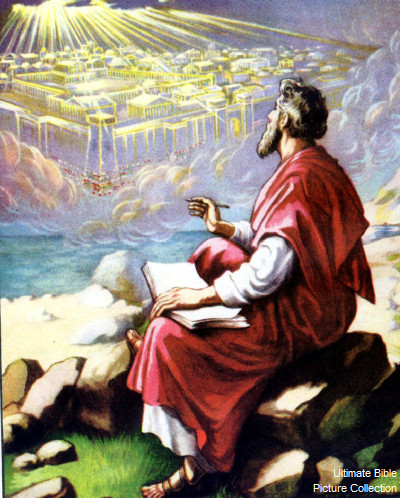
Apostle John

The point is this: the day in Rev. 1:10 is not the Day of the Lord, such as appears not just in I Thessalonians, but also in the Old Testament prophets (e. g., Amos 5:18, Zephaniah 1:14, and Joel 1:15). Rather, it is specifically the day of Christ! That is because the first day was the day of His resurrection (John 20:1ff), and when He revealed Himself glorified to His disciples (John 20:19), and when He sent the Holy Spirit (Acts 2:1; Pentecost was fifty days after Passover, i. e., seven seventh-days plus one, the first day of the week), and the day that the apostolic church gathered for worship (Acts 20:7 and I Corinthians 16:2). Thus, for John to have been involved in spiritual exercises on that day is only to be expected. To say that he was doing so on "the day of the Lord" makes no sense, at all.

Accordingly, I affirm the statement of the Westminster Confession of Faith (XXI:7): "As it is of the law of nature, that, in general, a due proportion of time be set apart for the worship of God; so, in His Word, by a positive, moral, and perpetual commandment, binding all men in all ages, He hath particularly appointed one day in seven for a Sabbath, to be kept holy unto Him: which, from the beginning of the world to the resurrection of Christ, was the last day of the week; and, from the resurrection of Christ, was changed into the first day of the week, which in Scripture is called the Lord's Day, and is to be continued to the end of the world as the Christian Sabbath." I find the biblical case for the first-day Sabbath, ever since the resurrection of Christ, to succeed over that for a continuing seventh-day Sabbath. I consider the latter to be an effort at judaizing the Christian faith, and, therefore, to be opposed.

Sunday, June 26, 2011

The Reformers and the Doctrine of Prayer

While it wasn't their only motivation to prayer, both Martin Luther and John Knox gave much attention to the commandments to pray.

Luther focused on the Third Commandment (Second Commandment according to the Lutheran division): "You shall not take the name of the Lord your God in vain, for the Lord will not hold him guiltless who takes his name in vain" (Exodus 20:7). According to Luther's understanding of this commandment, not taking the name of Jehovah in vain is a negative way of commanding that we are to use it only according to His word. Lack of prayer means not taking His name as He desires, and thus is a violation of this commandment.

On the other hand, Knox developed his position from a wider range of texts: Psalm 50:14-15, Matthew 7:7-11, Matthew 26:41, I Thessalonians 5:17, and I Timothy 2:13, 8. In his "Treatise on Prayer," Knox explained, "He who, when necessity constrains, desires not support and help of God, does provoke His wrath no less than such as make false gods or openly deny God." Thus, in Knox's mind, lack of prayer is tantamount to paganism or atheism!

Both men said - and I want to emphasize - that they did not mean the Christian of frail conscience who struggles to overcome his sense of unworthiness when approaching the throne of grace. We are unworthy! Anyone who approaches God on the basis of his own worthiness doesn't understand his sinful state nor the necessity of the atonement in Christ. However, for the believing sinner, that atonement covers his unrighteousness, so that he can come before a loving Father God. Consider the text that I would add to the list above, Hebrews 10. Consider especially Hebrews 10:14 and Hebrews 10:19-23.

Sunday, August 15, 2010

Does First Thessalonians Teach a Rapture of the Church?


There are three verses here that I want to consider.

First, 4:17, "Then we who are alive, who are left, will be caught up together with them in the clouds to meet the Lord in the air, and so we will always be with the Lord." This is the classic verse used by certain strains of premillenialists to prove that the church will be "raptured," i.e., taken out of the world, before the Second Advent.

However, two other verses prior to that rule out that literalistic interpretation.

Look at 3:13, "[S]o that he may establish your hearts blameless in holiness before our God and Father, at the coming of our Lord Jesus with all his saints." Notice that Jesus isn't taking away His saints. Rather, He is leading them here. Paul is instructing the living Thessalonian Christians to be prepared for the return of the blessed dead at the Second Advent!

Also, 4:14, "For since we believe that Jesus died and rose again, even so, through Jesus, God will bring with him those who have fallen asleep." Again, Jesus isn't taking believers there, he is returning with the saints in heaven to here!

Not only does the immediate context rule out the rapturist interpretation, the language used in 4:17 cannot possibly mean what the rapturists impose on it. The Greek word translated "meet" is used in only two other places in the New Testament. In Matthew 25:1-12, we read Jesus's own words in the Parable of the Ten Virgins. In verse 1, we read that the ten virgins "took their lamps and went to meet the bridegroom." The other is Acts 28:15. "Meet" in all three verses is the translation of a Greek diplomatic term, referring to a delegation sent out to greet a VIP, such as an ambassador, and escort him back to the city. It cannot mean to greet him and then leave with him. The word simply doesn't mean what rapturists teach it to mean.

Sunday, January 24, 2010

I Timothy 2:11-14, The Bible versus Women Preachers


"Let a woman learn quietly with all submissiveness. I do not permit a woman to teach or to exercise authority over a man; rather, she is to remain quiet [i.e., in church]. For Adam was formed first, then Eve; and Adam was not deceived, but the woman was deceived and became a transgressor."

I have written before on the ordination of women. To put it briefly, I'm against it! And it's not an issue of the ability or worth of women in general, or of any particular woman, but rather a matter of God's social order. He calls, empowers, and gifts men to proclaim His word (see especially I Timothy 3 and Titus 1).

In the Saturday edition, my local paper, the Charlotte Observer, prints a special religion section, a common practice among daily papers. Yesterday, they printed an article (now no longer online) borrowed from their sister paper in Raleigh regarding the Rev. Sheryl Brady, pastor (but not "spiritual head", an indecipherable distinction) of The River, a predominately-black Pentecostal church in Raleigh, denomination unspecified. Her husband, Joby, is "bishop" of the congregation, but not pastor, also an indecipherable distinction.

Recently, the Rev. Ms. Brady has become a Youtube sensation, with a video of her performing a healing of a brain-damaged infant, who is now described, not as healed, but as "more responsive." Ms. Brady is described as a former singer on T. D. Jakes TV program, and now sporting a "shouting" preaching style.

The Scriptures do not leave us to give honor to just anyone who impresses us, whether by spirited shouting, singing (good or bad), or by making babies more responsive. Rather, we are commanded to "test everything" (I Thessalonians 5:21), and, more specifically, "do not believe every spirit, but test the spirits to see whether they are from God," (I John 4:1), that is, against God's standards in the Bible. Since the Spirit will never call someone to do something that is forbidden in scripture, I deny that it is that Spirit who empowers Ms. Brady's ministry. The spirit behind Ms. Brady's ministry fails the test of Scripture. To my mind, that leaves only one other possible spirit giving power to her (see Revelation 13:2).