Showing posts with label colossians. Show all posts

Monday, September 1, 2025

A Witness for an Optimistic Eschatology

Eschatology is a popular topic for every radio and television preacher, for reams of books, and endless debates on every internet platform. And it is a topic which rarely produces healthy or edifying conversation. Why? Because it is titillating. The popular preachers make a lot of money by making predictions, and the more wild-eyed and frightening the more money they make. 

How do these discussions end up in such a theological rut? Well, in addition to the excitement that comes from particular interpretations, there is just bad exegesis in most cases. Biblical passages are wrenched out of context to apply to the time of Jesus's return as if there were no other events in the two-thousand years (so far) in between. And just on the basis of assumptions, not because of any reasoning or hermeneutical principles. If you get into a conversation about Matthew 24 and mention that Jesus applies it to the generation to which He was speaking (verse 34), you will be shouted down. Or if you point to His words, "the Gospel will be proclaimed throughout the whole world" (verse 14) and compare them to the words of Paul, "the hope of the Gospel that you heard, which has been proclaimed in all creation under Heaven" (Colossians 1:23), you will be decried as feeble-minded. 

Then other passages are simply not allowed into the discussion. One of which is my subject here. 

In Hebrews 1:13, that writer quotes from prehistory the words of the Father to the Son from the intra-Trinitarian covenant, "Sit at My right hand until I make your enemies a footstool for your feet." The quote is from Psalm 110:1, and is repeated in Hebrews 10:13. It is also found quoted in several other places in the New Testament. All refer to the awaited glory of Jesus before His return. 

What are some of those enemies that the Father shall subdue for the Glory of the Son? Paul gives us some prominent examples. 

Paul quotes the same verse indirectly, Psalm 110:1, in I Corinthians 15:25, and then gives the last enemy in verse 26: "He must reign until He has put all enemies under His feet. The last enemy to be destroyed is death." So death will be defeated as the last enemy before the return of Jesus. That completely eliminates the entire timeline of premillennialism, especially the dispensationalist variety. 

But Paul gives us another case which I find even sweeter to my soul. 

"Lest you be wise in your own sight, I do not want you to be unaware of this mystery, brothers: a partial hardening has come upon Israel, until the fullness of the Gentiles has come in. And in this way, all Israel will be saved, as it is written, 'The Deliverer will come from Zion, and He will banish ungodliness from Jacob; and this will be My covenant with them, when I take away their sins.' As regards the Gospel, they are enemies for your sake. But as regards elections, they are beloved for the sake of their forefathers" (Romans 11:25-28). At some point near the end of history, Paul tells us, the fullness, the majority, of Gentiles will have been converted, and then the blindness which was placed on the Jews will be lifted, so that they will be converted en masse to the Messiah whom they had rejected. 

If Jesus will return to an overwhelmingly converted world, how does that allow for the violence and persecution and unbelief described by the scary eschatology crowd? I see the two things as utterly incompatible, which is why I reject that scary eschatology. 


Wednesday, July 9, 2025

Anthropomorphisms for God Against Mormon Theology

One of the the doctrines that distinguish Mormons from biblical Christians is their belief that God the Father has a physical body like that of a human being. That is, they take references in the Bible literally, such as to His eyes, or arms, ears, feet. 

In contrast, biblical Christians take such references to be anthropomorphisms. That is, figures of speech in which is God is described as if He has human features, not because He does, but in order to make Him more relatable to mortal men. That is because He tells us explicitly that He is not a man: "God is not a man" (Numbers 23:29, I Samuel 15:29). Furthermore, we are told that His divine nature is invisible (Colossians 1:15, I Timothy 1:17). 

When I have denied their literal use of such anthropomorphisms in reference to God, I have had Mormons tell me that I demonstrate that I do not believe what the Bible says. 

However, anthropomorphisms in the Bible are not limited to references to God. 

"For you shall go out in joy and be led forth in peace; the mountains and the hills before you shall break forth into singing and all the trees of the field shall clap their hands" (Isaiah 55:12). Here there are anthropomorphisms of land features and trees expressing emotions like human beings. I posted the verse in a discussion group with Mormons and asked if they believe that mountains can sing or that trees have hands. Of course, they denied that they do. So then I asked, don't you believe the Bible? Then some fell silent while others turned to ridicule. None even attempted a rational distinction between this verse and the ones that they claim refer to literal body parts of God. 

Mormon exegesis falls apart under a little examination. 


Wednesday, October 13, 2021

The Anti-Sabbatarian Use of Colossians 2


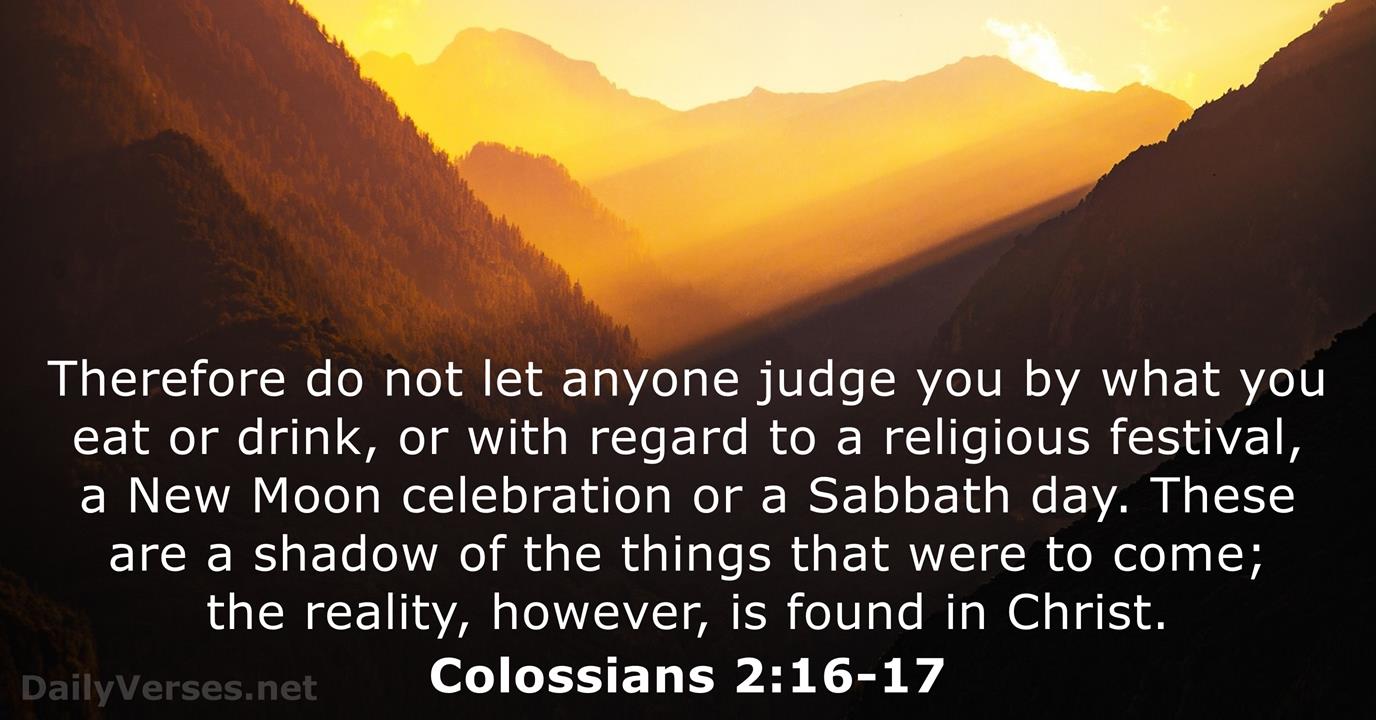
In almost every discussion of the abiding nature of the Christian Sabbath, my experience has been that the anti-Sabbatarian will refer to Colossians 2:16: "Therefore let no one pass judgment on you in questions of food and drink, or with regard to a festival or a new moon or a Sabbath." The argument is that Paul here is telling us that the Sabbath is adiaphora, a matter of preference only. 

What I have never had was an anti-Sabbatarian who mentioned the next verse, Colossians 2:17: "These are the shadow of things to come, but the substance belongs to Christ." 

This is one of those cases where the context is so obviously contrary to the argument being made that it is painful to hear yet again. In verse 16, the items mentioned are food rules, of which there are none ion Christianity, except to avoid meat sacrificed to idols, unlike the many rules in Judaism; to festivals, of which there are none prescribed in Christianity, but several in Judaism; new moons, which are celebrated in Judaism, but not in Christianity; and finally the Sabbath. According to the opponents, Paul rejected the Mosaic rules of Judaism for three things, but left the fourth to be taken generally. Context matters! 

This is confirmed in verse 17, where Paul refers to these ceremonies of Judaism as completed in Christ. As he said to the Galatians, why hold on to the shadows when we have now received the reality? And what is the reality of the Sabbath? 

"At that time Jesus went through the grainfields on the Sabbath. His disciples were hungry, and they began to pluck the heads of grain and to eat. But, when the Pharisees saw it, they said to Him, 'Look, Your disciples are doing what is not lawful to do on the Sabbath.' He said to them, 'Have you not read what David did when he was hungry, and those who were with him: how he entered the house of God and ate the bread of the Presence, which it was not lawful for him to eat nor for those who were with him, but only for the priests? Or have you not read in the Law how, on the Sabbath, the priests in the temple profane the Sabbath and are guiltless? I tell you something greater than the temple is here. And if you had known what this means, I desire mercy and not sacrifice, you would not have condemned the guiltless. For the Son of Man is Lord of the Sabbath'" (Matthew 12:1-8). 

If the Sabbath, as such, had been abrogated, this was the opportunity for Jesus to say so. Yet, He didn't. Why? Because, He says, He is the Lord of the Sabbath. Not was. That is why the writer of Hebrews can tell us that there remains a Sabbath rest for the people of God (Hebrews 4:9). It would have been silly for Jesus to claim to be the Lord of something which was passing away!

If a person were to argue that the code of Moses added ceremonial elements to the Sabbath, then he would be correct. However, if he were to assert that there is no Sabbath apart from those Mosaic elements, then he would be wrong. That is what Paul addresses in Colossians 2:16. If a Christian celebrates the Sabbath without the Jewish ceremonial elements, then he should be free from the judgment of others. Paul neither says nor implies that the person is thereby freed from the Fourth Commandment. That would be to be guilty exactly of that of which his critics accused him, of being an enemy of the Law (e. g., Acts 18:13). 

Saturday, May 16, 2020

False Teachers and Their Pompous Claims of Authority

In our day, there are many "Christian" groups that claim grandiose titles for their organizational leaders. Mormons have their "Apostles and Prophets," various Pentecostal churches claim that their pastors are "Apostles," and, of course, the Pope has long claimed to occupy the "apostolic throne of Peter." I deny all such titles, and insist that all such claims mark false teachers. 

First, let me concede that the Bible does talk about Apostles and Prophets in the organization of the church: "He gave the apostles, the prophets, the evangelists, the shepherds and teachers, to equip the saints for the work of ministry, for building up the body of Christ, until we all attain to the unity of the faith and of the knowledge of the Son of God, to mature manhood, to the measure of the stature of the fullness of Christ, so that we may no longer be children, tossed to and fro by the waves and carried about by every wind of doctrine, by human cunning, by craftiness in deceitful schemes. Rather, speaking the truth in love, we are to grow up in every way into Him who is the Head, into Christ, from whom the whole body, joined and held together by every joint with which it is equipped, when each part is working properly, makes the body grow so that it builds itself up in love" (Ephesians 4:11-16). The Church is the Body of "Christ." He alone is the Head of the body, and has established how the members shall be organized (see also 1:22, 5:23,and Colossians 1:18). Among other things, this means that men are not left to ourselves to design the government of Christ's Church. 

"Shepherds" here is the equivalent of "elders" in the rest of Scripture, and "teachers' are what we call pastors (see I Timothy 5:17). Paul describes the selection of elders, with deacons as their assistants (Acts 6:1-7), in several places, especially in I Timothy 3 and Titus 1. And where does that same Apostle describe selecting new apostles or prophets? Nowhere. In fact, except for the selection of Matthias to replace Judas (Acts 1:12-26), a special circumstance, there is never a mention of selecting any more such men.

Does that not require us to accept that those were temporary offices, while the others were to be continuing offices in the Church? I think that the rationale is unavoidable, and demonstrates
that presbyterianism is the only scriptural system of congregational government, precluding congregational democracy, episcopalianism, or any claims to the offices of the Apostles and Prophets.


Saturday, May 9, 2020

Colossians 2:16: Did Paul Abolish the Fourth Commandment?

In my dealings with anti-sabbatarians, i. e., those who claim that there is no Christian Sabbath, they almost always bring up Colossians 2:16: "Therefore let no one pass judgment on you in questions of food and drink, or with regard to a festival or a new moon or a Sabbath." The claim is that Paul here says that there is no binding requirement for Christians to honor the Sabbath. In general, my response is twofold, first, that it is not at all Pauline to dismiss one of the Ten Commandments so flippantly, and second, that the reference to food, drink, festivals, and new moons, all indicate that Paul is addressing the Jewish ceremonies, not the Sabbath per se. Unless someone wants to claim that Paul also intends to tell us that we don't need to eat food or drink fluids. Anyone want to try that?

However, I also want to add a biblical argument to my logic.

Look at Ezekiel 45:17: "It shall be the prince’s duty to furnish the burnt offerings, grain offerings, and drink offerings, at the feasts, the new moons, and the Sabbaths, all the appointed feasts of the house of Israel: he shall provide the sin offerings, grain offerings, burnt offerings, and peace offerings, to make atonement on behalf of the house of Israel." That prophet uses exactly the same wording in regard to temple ceremonies as Paul uses to the Colossians. Paul's word choices are not random. Rather, by using specific Mosaic terminology, the Apostle expects his readers to understand the same Mosaic ceremonies.

Therefore, I cannot accept the use of Colossians by the anti-sabbatarian, because it is inconsistent with the word usage of Scripture.


Saturday, February 8, 2020

The Knowledge of Election: Avoiding the Effort to Be Wise Above What is Written

When dealing with even professed Christians on Facebook, I get a continuous stream of questions about hypothetical issues. Today someone asked, "What if Noah were really the Archangel Gabriel?" I am not making that up. 

This is especially true when discussing the doctrines of grace with people not from a Reformed background. They are constantly demanding an answer -  i. e., one that will satisfy them - as to why God chooses one person over another. Other than according to mercy alone (Romans 9:16) for His glory alone (Ephesians 1:6), Scripture does not give us an answer. Rather, we are given this rebuke: "Who are you, O man, to answer back to God? Will what is molded say to its molder, 'Why have you made me like this?' Has the potter no right over the clay, to make out of the same lump one vessel for honorable use and another for dishonorable use?" (Romans 9:20-21). The answer is simple, Paul tells us. God makes His decision on the basis that he chooses because He is God and we are not, so stop prying into things above your station!

And Paul is answering on the basis of a longtime Biblical tradition, going back to Moses: "The secret things belong to the LORD our God, but the things that are revealed belong to us and to our children forever, that we may do all the words of this law" (Deuteronomy 29:29; see also Paul's remarks in I Corinthians 4:6 and Colossians 2:8). Moses tells us that God has given us everything we need to know for salvation and sanctification in the Bible. Beyond that revelation, whatever imaginations arise from our inordinate curiosity are to be cast aside. "The whole counsel of God, concerning all things necessary for his own glory, man’s salvation, faith, and life, is either expressly set down in Scripture, or by good and necessary consequence may be deduced from Scripture: unto which nothing at any time is to be added, whether by new revelations of the Spirit, or traditions of men" (Westminster Confession of Faith, I:6).

"Men of inquisitive and speculative minds are apt to forget that there are limits set to human investigation and research, beyond which it is impossible to pass with safety or satisfaction. To intrude with confidence unto the unrevealed secrets of God's wisdom and purpose manifests an arrogance and haughtiness of intellect which cannot fail to incur the marked disapprobation of heaven, and should always meet the prompt reprobation of the pious.Whatsoever is useful to be known, God has kindly and graciously revealed, and it argues no less ingratitude than presumption to attempt to be 'wise above what is written'" (I Corinthians 4:6, James Henley Thornwell, "Election and Reprobation").

Saturday, November 9, 2019

The Bible, Philosophy, and the Mormon Doctrine of Pre-existence

One of the least-known doctrines of Mormonism is the pre-existence of souls. One of their websites explains it this way: "Before we were born on the earth, we lived in the presence of our Heavenly Father as His spirit children. In this premortal existence, we attended a council with Heavenly Father’s other spirit children... Throughout our premortal lives, we developed our identity and increased our spiritual capabilities. Blessed with the gift of agency, we made important decisions, such as the decision to follow Heavenly Father’s plan. These decisions affected our life then and now. We grew in intelligence and learned to love the truth, and we prepared to come to the earth, where we could continue to progress. None of us on earth has a memory of the premortal existence.  This is because a 'veil of forgetfulness' has been drawn over our minds."

Another of their websites proudly proclaims that the Mormon doctrine is from philosophers, not from the Bible: "Several philosophers from Plato through Leibniz and Kant to twentieth-century Cambridge intellectuals, dozens of poets from antiquity to Robert Frost, and numerous religious thinkers throughout the Jewish and Christian traditions, propounded a pre-earthly realm peopled by the souls of men and women yet unborn. Pre-existence has been invoked to explain 'the better angels of our nature,' including the human yearning for transcendence and the sublime; it suggests a reason for the frequent sensation of alienation and the indelible sadness of human existence." This is in spite of their oft-repeated - but false - accusation that Christians have gotten the doctrine of the Trinity from philosophy. Apparently, what is good for the goose is not good for the gander.

Scripture warns us against undue influence from unbelieving philosophy: "See to it that no one takes you captive by philosophy and empty deceit, according to human tradition, according to the elemental spirits of the world, and not according to Christ" (Colossians 2:8).

Furthermore, the Scriptures, which Mormons profess to believe, are contrary to their doctrine: "Then King Zedekiah swore secretly to Jeremiah, 'As the LORD lives, who made our souls, I will not put you to death or deliver you into the hand of these men who seek your life'" (Jeremiah 38:16, cp. Zechariah 12:1). The Mormon must answer the question, If God created our souls within us, then how can you claim that we had some eternal pre-existence? Those two things are mutually-exclusive. Where does the the authority for your doctrines lie? 


The Source of the Doctrine of the Pre-existence of Souls

Wednesday, July 17, 2019

The Continuing Obligation of the Sabbath Defended: Colossians 2:16

"Therefore let no one pass judgment on you in questions of food and drink, or with regard to a festival or a new moon or a Sabbath" (Colossians 2:16)

I often get caught between two opposite in discussions regarding the continuing obligation of the Sabbath. On one side are the Seventh-Day Adventists, who claim that the Jewish Sabbath has continued in the Christian dispensation. I oppose their claims, and have addressed them here. On the other side are those who claim that there is no Sabbath of any kind for the Christian. Those folks are generally of two kinds. the first is those who claim that "Jesus is our Sabbath," so that there is no longer a Sabbath day. I have addressed that here. Others are of a dispensationalist type, who claim that the Sabbath was a Mosaic ceremony, and, therefore, abrogated by its fulfillment in the cross work of Christ. I have addressed that here.

Now, there is a third type that I want to address. That is those who hold that Sabbath-observance is now voluntary, no longer a commandment. These folks like to cite the verse quoted above, Colossians 2:16. 

Such folks claim that the Sabbath was a ceremony of the Jews, and, therefore, no more binding on Christians than are circumcision or the Passover. If a Christian profits from observing them, then he is free to do so. However, no one is required to observe that Sabbath any more than he is the other Jewish ceremonies. 

There are three main objections to that claim. First, the Sabbath was a creation ordinance, initially announced shortly after the creation of the first humans: "God blessed the seventh day and made it holy, because on it God rested from all His work that He had done in creation" (Genesis 2:3). While it is certainly true that the Law recognized the Sabbath, the claim is false that the Sabbath was created under the Law. That's why the writer of Hebrews could tell us, "There remains a Sabbath rest for the people of God" (Hebrews 4:9). Especially considering the effort of that author to show the superiority of Christ over the Mosaic ceremonies, his insistence that the Sabbath remains is especially telling!

Second, look at the rest of the verse in Colossians. "Questions of food and drink." Where do we find rules about food? In the Mosaic ceremonial law. "With regard to a festival or new moon." Where do we find the creation of ceremonies and the celebration of the new moon? Again, in the Mosaic ceremonies. Therefore, when Paul here mentions Sabbaths, does the grammar not compel us logically to infer that he means Jewish Sabbaths? That would be seventh-day Sabbaths, not the first-day Christian Sabbath. Also, if we fail to make that distinction, then we put Paul in contradiction with Hebrews. 

And, finally, I have one question of logic, rather than Scripture. Considering that the Sabbath was a commandment, not just some Pharisaic tradition, can we really imagine that Paul would so blithely dismiss one of the Ten Commandments? I cannot believe that he would.

Wednesday, February 20, 2019

Christ on the Throne of the Church

The Westminster Confession tells, "There is no other head of the Church but the Lord Jesus Christ: nor can the Pope of Rome in any sense be head thereof; but is that Antichrist, that man of sin and son of perdition, that exalteth himself in the Church against Christ, and all that is called God" (XXV:6). This assertion is based on, for example, Ephesians 4:15-16: "We are to grow up in every way into Him who is the head, into Christ, from whom the whole body, joined and held together by every joint with which it is equipped, when each part is working properly, [who] makes the body grow so that it builds itself up in love." And in Colossians 1:18: "He is the head of the body, the church."

The reason the Confession teaches that His headship precludes the Pope (as well as all of the papist offices, such as priest and bishop) is based on Ephesians 4:11-13, in which Christ, as Head of the Church, "gave the apostles, the prophets, the evangelists, the pastors and teachers, to equip the saints for the work of ministry, for building up the body of Christ, until we all attain to the unity of faith and of the knowledge of the Son of God, to mature manhood, [and] to the measure of the stature of the fullness of Christ..." As the Head of His Church, Christ gave her the officers and government that would best lead her to develop as He desired.

One thing that the Confession does not say, because it was taken as self-evident, is that the headship of Christ is an absolute monarchy. He decrees, and the church obeys. She is never left to decide her government, mission, or worship for herself. As Presbyterian theologian James Henley Thornwell wrote, "Existing in Christ, by Christ, and for Christ, she has no other law but His will. She can only speak the words which He puts in her mouth. Founded upon divine revelation and not in human nature, she has a divine faith, but no human opinion, and the only argument by which she authenticates either her doctrines or her precepts is, 'Thus saith the Lord.' Her province is not to reason, but to testify" ("Theology as a Life in Individuals and in the Church").

Saturday, September 29, 2018

Abraham, the Ancient Christian

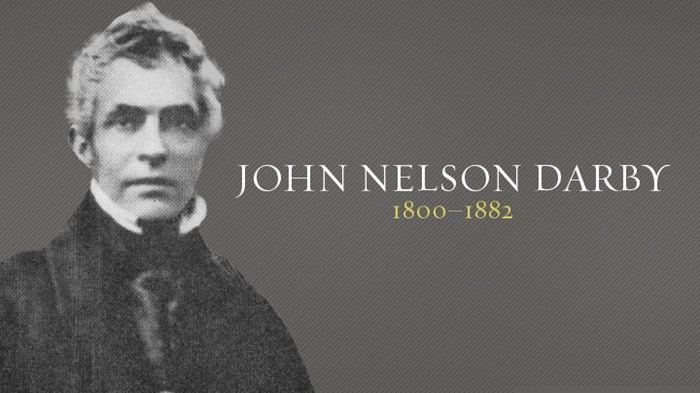
There is a heresy which has been going around at least since the time of J. N. Darby in 1830, that says that people in the Old testament were saved in a different way from the people in the New Testament. Sometimes it is said that Israel was saved by following the Law. Other times, it is said that they were saved by faith in the sacrifices. This doctrine is associated with various forms of the hermeneutical system created by Darby (and made popular by C. I Scofield) known as Dispensationalism.

Both forms of the doctrine are wrong.

Orthodox Protestants all agree that a Christian is saved by grace through faith, not by obedience to the Law, even in part. This is stated repeatedly in Scripture, such as Acts 13:39, Romans 3:28, and the whole Epistle to the Galatians. Where the Dispensationalist is wrong is his assertion that Old Testament believers were saved in a different way. The Apostle Peter, himself a Jew, said, "We [Jews] believe that we will be saved through the grace of the Lord Jesus, just as they {i. e., the Gentiles] will" (Acts 15:11).

And to be more specific, the Apostle Paul, another Jew, tells us, "And the Scripture, foreseeing that God would justify the Gentiles by faith, preached the gospel beforehand to Abraham, saying, 'In you shall all the nations be blessed'" (Galatians 3:8). Notice that Paul doesn't say just "faith," which might allow for faith in a different object. Rather, he explicitly states that Abraham received the Gospel! That is why Jesus could say, "Your father Abraham rejoiced that he would see My day. He saw it and was glad" (John 8:56).

Would the content of the Gospel to Israel have been more obscure? Sure. We understand that the Gospel was given under types and shadows (Colossians 2:17), so that Old Testament faith was more difficult to attain. That is why the New Covenant, the Gospel in the New Testament, is described by the Epistle to the Hebrews as far superior: the types and shadows have been removed, so that the reality is displayed in all its glory!

Saturday, September 8, 2018

The Sovereignty of God: Over Dice, Over Mice, and Over Men

"The lot is cast into the lap, but its every decision is from the LORD" (Proverbs 16:33)

We humans can have hopes for the future, or even plans for the future. However, what we cannot have is knowledge of the future. There is virtually an infinity of factors that will affect what happens tomorrow, and even more so as you consider further into the future. It is common to apply our human limitations. God cannot decide what will happen in the future, can He?

The problem is that such an assertion applies human limitations to God. They do not, and cannot, apply. Unlike men, God is omniscient. That is, He knows exhaustively all things, past, present, and future. And that is not only what will be, but what might be, every possible outcome from every possible contingency. "I distinguish the end from the beginning, and ancient times from what is still to come, saying: ‘My purpose will be established, and I will accomplish all My good pleasure'" (Isaiah 46:10). Notice that He asserts not just passive knowledge, but rather determinative knowledge. He knows for a certainty will will happen because all things happen according to His prior determination of them.

That is the fundamental difference between the knowledge of God and the knowledge of men. It isn't a difference of quantity, with God's knowing more and man's knowing less. Rather, God's a priori determination and exhaustive knowledge are inherently joined. This is repeated throughout the scriptures.

"In His hand is the life of every living thing and the breath of all mankind" (Job 12:10).

"In Him we live and move and have our being" (Acts 17:28).

"He is before all things, and in Him all things hold together" (Colossians 1:17).

Men cannot know the future, because the universe is autonomous of man. However, God can know and determine all things because no one and nothing is autonomous of Him.

Which brings me to the Proverb quoted above. Nothing could be more contingent than the casting of lots. In fact, we do so, i. e., throwing dice, exactly because the result is random, and cannot favor either party. However, as I noted above, nothing can be autonomous from God. Therefore, there can be no such thing as chance to Him. And if He determines even the rolls of dice, than which nothing can be freer from the human perspective, then neither can men expect to be autonomous from His sovereignty in our own choices, even the most powerful among us: "The king’s heart is a stream of water in the hand of the LORD; He turns it wherever He will" (Proverbs 21:1).

Saturday, January 27, 2018

The Immortality of the Human Spirit

Both Seventh-Day Adventists and Jehovah's Witnesses have a doctrine called "conditional immortality." This is not the same thing as annihilationism, but is related to it. According to their doctrine, a man's spirit is as mortal as is his body. If he believes in Jesus, then his spirit will be made immortal at the resurrection. However, in this life, they claim, there is no difference between the condition of the believer's spirit and the unbeliever's spirit. Only the believer has eternal life (and that doesn't become effectual until the resurrection).

That is not at all biblical.

Let's start with the logical fallacy of bait and switch which underlies the doctrine. The JW's and SDA's make eternal existence mean the same thing as eternal life. That would mean that only the believer, having eternal life, therefore has eternal existence. That equivalency is false.

Every human being, since Adam, and excluding Jesus alone, has entered life with a spirit with eternal existence, but dead: "You were dead in the trespasses and sins" (Ephesians 2:1). Contrary to the assumption of the conditionalists, men do not start in a neutral condition. They start out as spiritually dead, and enter continuing eternal death.

The unbeliever remains in his dead condition: "Whoever does not believe is condemned already, because he has not believed in the name of the only Son of God" (John 3:18). Therefore, when his body dies and he enters eternity, it is not as a person who now dies spiritually. That has always been his condition! Therefore, he enters eternity dead, and continues as such for all eternity in Hell (II Peter 2:9).

The believer on the other hand, at the moment he believes, becomes alive for the first time: "You, who were dead in your trespasses and the uncircumcision of your flesh, God made alive together with Him" (Colossians 2:13). The believer has changed condition, from death to new life, what the Bible calls being born again (John 3:3-7) and new creation (I Corinthians 5:17). He doesn't begin eternal life at the resurrection. he begins eternal life at the moment that he believes! And now, when his body dies, that principle of spiritual life remains, and he is immediately taken into the presence of the ascended Jesus (II Corinthians 5:8, Philippians 1:21-23).

All of this goes to show that there is nothing conditional about spiritual immortality. What is conditional is whether a man will remain eternally dead, or will he become alive in the new birth by Jesus Christ. The JW and SDA doctrine has much too low a view of the new life, in my opinion.

Wednesday, December 20, 2017

Why Does God Allow Evil to Continue?

In several places, the Bible talks about the effects of man's sins, not just on man himself, but on all of creation. That's because Adam was created to be the viceroy of God, the head of the creation. And, just as the bad decisions of a president affect our entire society, Adam's catastrophic choice brought ruin on the entire physical universe.

The primary reference is Genesis 3:17-19: "Cursed is the ground because of you; in pain you shall eat of it all the days of your life; thorns and thistles it shall bring forth for you; and you shall eat the plants of the field. By the sweat of your face you shall eat bread." Moses touches again on this just a little later, in Genesis 5:29, referring to Noah: "Out of the ground that the LORD has cursed, this one shall bring us relief from our work and from the painful toil of our hands."

The Prophet Isaiah is even more graphic: "The earth lies defiled under its inhabitants; for they have transgressed the laws, violated the statutes, broken the everlasting covenant" (Isaiah 24:5).

In the New Testament, Paul tells us (Romans 8:20-21), "The creation was subjected to futility, not willingly, but because of him who subjected it, in hope that the creation itself will be set free from its bondage to corruption and obtain the freedom of the glory of the children of God."

It is only natural to wonder why this curse continues. Why does God continue to allow hurricanes, earthquakes, AIDS, hunger, and war? And I think these verses allow us only one answer: God has ordained that the creation shall resist its human ruler until that ruler stops resisting God. That is, just as the creation was placed under a curse because of man's sin, it remains a curse until his sin ends. That is part of what is brought about as men turn to Christ in repentance and faith. "Through Him, [God shall] reconcile to Himself all things, whether on earth or in heaven, making peace by the blood of His cross" (Colossians 1:20).

"The creation waits with eager longing for the revealing of the sons of God. For the creation was subjected to futility, not willingly, but because of him who subjected it, in hope that the creation itself will be set free from its bondage to corruption and obtain the freedom of the glory of the children of God. For we know that the whole creation has been groaning together in the pains of childbirth until now. And not only the creation, but we ourselves, who have the firstfruits of the Spirit, groan inwardly as we wait eagerly for adoption as sons, the redemption of our bodies" (Romans 8:19-23).

So the answer to the question I ask in the title is another question: How long will God allow evil to continue? How long will mankind prefer suffering evil to submitting to his proper Lord and God? They are the opposite sides of the same coin.

Wednesday, November 22, 2017

A Universe Without God: The Irrationality of the Atheist

In order to understand our world around us, whether in the informal sense of day-to-day living or in a formal,scientific manner, we must accept that every object that has come into existence and every action must have a cause. That is, when the pool ball rolls across the table, we understand that something hit it. We could never develop an understanding of the laws of the universe if we didn't have this presupposition.

However, in order to avoid invoking God, the atheist posits that the universe had a beginning without a cause. He even gives it a name, the Big Bang, as if naming it explains it. Whether he believes that matter came into existence at that point, or holds to a steady state of pulsing matter with repeated big bangs, he must imagine an event of that unimaginable scale without a cause.

That presupposition, if consistently followed through, must eliminate the possibility of a comprehensible universe. If things or events can occur without causes, then irrationality rules, planning is impossible, science is impossible. Thinking is impossible.

Of course, people would not be able to function in the world if we lived according to that presupposition. How can I even fry an egg for breakfast if I operate as if events and things have no causal connection? Yet people do exactly that.

How does that happen?

It's easy enough to explain. The atheist makes such an extreme assumption to rule God out of his consciousness. Then he lives his life with the opposite supposition, that all things and events actually occur in a God-made world that operates according to rational laws, such as that of cause and effect.

The Bible describes exactly this schizophrenic mentality: "The wrath of God is revealed from heaven against all ungodliness and unrighteousness of men, who by their unrighteousness suppress the truth. For what can be known about God is plain to them, because God has shown it to them. For His invisible attributes, namely, His eternal power and divine nature, have been clearly perceived, ever since the creation of the world, in the things that have been made. So they are without excuse. For although they knew God, they did not honor Him as God or give thanks to Him, but they became futile in their thinking, and their foolish hearts were darkened. Claiming to be wise, they became fools" (Romans 1:18-22).

Speaking through the Apostle Paul, God exposes the self-deception of atheism. The created world shows the existence, sovereignty, and righteousness of God. That is why the universe is understandable to us. But the atheist seeks to maintain the illusion of autonomy, that he is sovereign, not God (confer Genesis 3:5), so he is forced to suppress his awareness of God. Since the triune biblical God is why the universe is rational (Acts 17:28, Colossians 1:17), by excluding God, the atheist's world becomes irrational and incomprehensible. Therefore, in order to function in God's world, the atheist compromises, without admitting the compromise, by denying God with his mouth, while acknowledging God with his life. Thus, to use Paul's words, they become fools.

Saturday, October 21, 2017

Science Without God Results in an Irrational Universe


Science assumes that things can be understood because they operate according to rules, resulting in predictable and testable outcomes. However, a philosophy of science that excludes God introduces an assumption that some things, at least, and fundamental things, in particular, happen by chance, and are, therefore, neither predictable nor testable.

This results in an atheism (or a theism which assumes that God is not relevant, i. e., deism) that depends for its rational basis on holding two mutually-exclusive presuppositions simultaneously. That is, to use the terminology of logic, it holds "A" and "not-A" together, in violation of the Law of Non-Contradiction. This basic law of logic says simply that a premise and its contrary cannot both be true at the same time.

In contrast, positing God as the origin, not chance, provides the basis of rationality on which science depends. It is the biblical God who testifies that it is "in Him [that] we live and move and have our being" (Acts 17:28). It is His a priori rationality that gives order and comprehensibility to all other things: "He is before all things, and in Him all things hold together" (Colossians 1:17).

In other words, the logic of science requires, not the exclusion of the concept of God, but rather the assumption of the biblical God. When scientists perform their research or their experiments, they are assuming the very rationality of God, while repudiating it in their conscious statements. In fact, that is the only way that science can function, by acting on principles that it denies, while advocating principles which undermine its very existence.

Wednesday, October 18, 2017

Astrology: Is Our Destiny in the Stars?

There's a big word that I want to talk about: syncretism. Have you ever heard it? Syncretism is the combination, usually unconscious, of contrasting worldviews. An example is the word that is being bandied about in some quarters, "Chrislam," to refer to a combination of Christianity and Islam. Paul describes syncretism in Colossians 2:8: "See to it that no one takes you captive by philosophy and empty deceit, according to human tradition, according to the elemental spirits of the world, and not according to Christ." The particular form that I want to address is the use of astrology by professing Christians, such as this woman who describes herself as "a Christian astrologer."

Her justification is from Genesis 1:14: "And God said, 'Let there be lights in the expanse of the heavens to separate the day from the night. And let them be for signs and for seasons, and for days and years.'" She says, "I feel that astrology was a tool created by God for us to understand ourselves better and to use as a spiritual tool. I feel that there are many biblical verses that support astrology." Notice her words, "I feel," not once, but twice. That is, her use of this verse (she also mentions Luke 21:25) isn't based on exegesis, an interpretation of the verse using grammar and its historical and biblical context, but rather on her feelings. That is always the start of syncretism, because "the heart is deceitful above all things, and desperately sick" (Jeremiah 17:9).

What does exegesis teach us about the role of the stars? Consider the case of Esau and Jacob, the twin sons of Isaac (Genesis 25:19-28). As twins, the two were born under the same planetary and stellar positions, the very things that are supposed to be determinative, according to astrologers. Yet, what do we know about their futures? "Jacob I loved, but Esau I hated" (Malachi 1:2-3, Romans 9:13), polar opposites. Paul uses these twins, born under the same astronomical circumstances, as a case study (Romans 9:16): "So then it depends not on human will or exertion, but on God, who has mercy." That is, Esau and Jacob don't tell us anything about the planets and stars, but rather about the sovereign grace of God.

And that's the problem with astrology. It posits ultimate sovereignty, not in the hands of a living, just, and loving God, but rather in the paths of stellar objects, though they, too, owe their existence and positions to that God (Genesis 1:14, Job 9:8, Zechariah 12:1). And God has no tolerance for giving His glory to anything or anyone else (Isaiah 42:8, 48:11). In fact, He rejects anyone who tries to do so (Deuteronomy 29:18-20): "Beware lest there be among you a man or woman or clan or tribe whose heart is turning away today from the Lord our God to go and serve the gods of those nations. Beware lest there be among you a root bearing poisonous and bitter fruit, one who, when he hears the words of this sworn covenant, blesses himself in his heart, saying, ‘I shall be safe, though I walk in the stubbornness of my heart.’ This will lead to the sweeping away of moist and dry alike. The Lord will not be willing to forgive him, but rather the anger of the Lord and His jealousy will smoke against that man, and the curses written in this book will settle upon him, and the Lord will blot out his name from under heaven."

Monday, August 14, 2017

Imago Dei: In What Way Did Adam Bear God's Image?

I have had conversations with Mormons in which they have insisted that being made in the image of God means that God has a physical body like us. We are in His image in that He had arms and legs, hair, the whole shebang. Oneness Pentecostals teach something similar, holding that we were made in the image of the body of Jesus. Of course, both are completely unbiblical, because we know that God doesn't have a body (John 4:24 with Luke 24:39). They then insist that there can be no other way in which Adam could have been the image of God.

Of course, that is merely a logical fallacy, a form of circular reasoning, asserting that their interpretation is the only one possible. And that is certainly not the case.

There are several texts that tell us something about the image of God in men.

The first is Ecclesiastes 7:29: "See, this alone I found, that God made man upright, but they have sought out many schemes." So, one of the characteristics with which Adam was created was moral uprightness. This aspect of the image was lost in the Fall (see, for example, Romans 5:12-19).

Second, look at Colossians 3:10: "Put on the new self, which is being renewed in knowledge after the image of its creator." So now we see knowledge as another aspect of the image of God. And, since it needs renewal, we understand that this aspect of the image, while not completely lost, was at least marred by the Fall.

And third, look at Ephesians 4:24: "Put on the new self, created after the likeness of God in true righteousness and holiness." This is a more-explicit version of Solomon's words above. However, Paul is talking about re-creation, that is, the restoration of that which Solomon describes as lost. Both refer to righteousness and holiness, a moral nature.

Thus, contrary to the assertion of the Mormons and the Oneness Pentecostals, we see that the image of God in Adam was a moral image, not a physical one. This is further confirmed in Genesis 5:3: "When Adam had lived 130 years, he fathered a son in his own likeness, after his image, and named him Seth." when Adam and Even had their son Seth, he was not in the image of God, but rather in the image of Adam. What was different? Not his physical appearance. Rather, it was his moral nature, which was not after the image of God, but after that of his sinful father Adam! This again proves that the image of God was no physical image, and, therefore, cannot be claimed to prove that God has a body.

Wednesday, June 7, 2017

Jesus and the Continuing Ordinance of the Sabbath

Jesus made a curious statement as part of His Olivet discourse: "Pray that your flight may not be in winter or on a Sabbath" (Matthew 24:20). I consider this to be a reference to the chaos surrounding the Roman destruction of Jerusalem. However, my point below is even greater for those who insist that He is talking about some future tribulation.

The reason that this sentence strikes me is because of His reference to the Sabbath. So many Christians claim that He fulfilled the Sabbath, so that it has no continuing significance. They often, but improperly, cite Colossians 2:16 to support this view.

However, the words of Jesus here indicate that He, at least, had no expectation of the cessation of the Sabbath. He anticipated that Christians would still be honoring it, and the concomitant command to cease from labor, at least forty years after He spoke these words!

This sentence is a major difficulty for the dispensationalist. First, he has been taught, erroneously though it be, that the Sabbath was part of the Law, and we "are under grace, not under Law" (Romans 6:14). Therefore, his hermeneutical presuppositions make no allowance for the future Sabbath. Second, he has been taught that Matthew 24 is about a tribulation that will happen just before the return of Jesus, sometime in the future. Therefore, by his own theological axioms, the words of Jesus require a continuing recognition of the Sabbath for at least two thousand years since the words were spoken. This one sentence completely overturns the dispensational hermeneutic.


Wednesday, March 1, 2017

Is Satan Still the God of This World?

Jehovah's Witnesses like to point out the Bible refers to Satan as "the god of this world" (II Corinthians 4:4). And, as far as that goes, they are correct, though their application of that verse is self-serving and exegetically-unwarranted. Paul is obviously referring to this world spiritual system, not this world as the totality of everything.

The problem is that there are a lot of other things said about Satan, that the Jehovah's Witnesses (and a lot of other people) don't address.

Consider Luke 11:21:22: "When a strong man, fully armed, guards his own palace, his goods are safe; but when one stronger than he attacks him and overcomes him, he takes away his armor in which he trusted and divides his spoil." In its context, Jesus had cast a demon out of a man who was deaf-mute. The Pharisees claimed that He had done this by the power of Satan, the ruler of demons. The response of Jesus was to compare His actions to those of a burglar, who would first bind the master of a house, before pillaging the house of its goods. While we may be uncomfortable with Jesus's using a thief as an analogy for Himself, His meaning is clear. He wasn't acting by the power of Satan. Rather, He had bound Satan's power, and was now pillaging Satan's kingdom of its spiritual goods, those in bondage to his control.

Next consider John 1:31: "Now is the judgment of this world; now will the ruler of this world be cast out." Jesus said this immediately after the Father had announced verbally that Jesus was His divine Son. Thus, His coming into the world was a strike against the power of Satan. Think of the demolition of a  building. Explosives are set at strategic points in the building, and then blown. the building doesn't collapse all in a single swoop. Rather, sections collapse in an orderly series into each other. This statement of Jesus doesn't indicate a single, catastrophic collapse of Satan's power, but rather a step in its systematic destruction.

We can confirm that interpretation with another verse, John 16:11: "The ruler of this world is judged." Jesus describes Satan in language equivalent to that of Paul. However, this ruler isn't basking in his power, for he has been judged. His destruction has been determined, and his overthrow has been initiated.

Paul repeated that assurance in Colossians 2:15: "He disarmed the rulers and authorities and put them to open shame, by triumphing over them in Him." In His ministry thus far, i. e., everything from His incarnation to His ascension, had all served to undermine and overthrow the spiritual powers that had dominated the nations. Thus, when Paul described Satan as "god of this world" in one passage, it was with the understanding that he expressed in this passage, that Satan may be the head of the humanistic worldview that is opposed to God, but that worldview and headship have been defeated in Jesus Christ!

Satan is defeated, and his ultimate state has been determined (Matthew 25:41). See also Revelation 12:8-9, Luke 10:18, and John 12:31. The New Testament consistently portrays Satan as an opponent of Jesus Christ, but a defeated opponent. And, as Revelation 12:12 indicates, even what influence Satan retains in his defeated state, is only for a short time.

Saturday, January 28, 2017

The History of the Christian First-Day Sabbath

The Seventh-Day Adventists claim that Christians celebrated the same seventh-day Sabbath as the Jews, until forced to change by Emperor Constantine (why is always Constantine? the anti-trinitarians blame him, too). While I have addressed the biblical refutation of that claim before (such as here), this time I want to address the historical evidence.

One of the earliest Church Fathers was Ignatius of Antioch, the first bishop of that city, who was a disciple of the Apostle John, and testifies to the practices of the church in the immediate post-Apostolic period. In his Epistle to the Magnesians 9:1, he says, ""If, then, those who had lived according to ancient practices came to the newness of hope, no longer keeping the [Jewish]  Sabbath, but living in accordance with the Lord's Day, on which our life also rose through Him and His death (which some deny), the mystery through which we came to believe, and because of which we patiently endure, in order that we may be found to be disciples of Jesus Christ, our only teacher." He is describing the historical practice of what Paul advises in Colossians 2:16: "So don't let anyone condemn you for what you eat or drink, or for not celebrating certain holy days or new moon ceremonies or Sabbaths." Notice the list of things that Paul lists, all of which were elements of the Jewish ceremonial law, and, therefore, abrogated as completed in the cross work of Christ. That is, Paul is not dismissing the Sabbath, per se. Who would he be to dismiss one of the Ten Commandments? Rather, he is disputing against the Jewish ceremony of Sabbath.

Ignatius describes the carrying out of that exhortation, with the replacement of the seventh-day Jewish Sabbath, with the Christian Sabbath, the first day of the week, because it was the Lord's day, the day of His resurrection and the completion of our redemption! Thus, the Christian Sabbath became the practice of the Christian Church, as described by Acts 20:7 and I Corinthians 16:2, almost three hundred years before the time of Constantine.