Showing posts with label 2 peter. Show all posts

Friday, January 23, 2026

Eternity in Hell and the Criteria for Destruction, Contra Annihilationism

Historical Christianity has defined the destiny of the unrepentant wicked as eternity in Hell. Eternal conscious torment, or ECT for short. In contrast, some of the aberrant sects, mainly the Jehovah's Witnesses and Seventh-Day Adventists, have claimed that the wicked are sent to Hell, but are then burned up there. A doctrine known as annihilationism, because the spirits of the wicked are annihilated. This doctrine has recently found new traction in broader evangelical circles.

In support of their doctrine, these sects point to references to destruction, such as the words of Jesus in Matthew 10:28: "Do not fear those who kill the body but cannot kill the soul. Rather fear Him who can destroy both soul and body in Hell." Eternal existence, they say, is not destruction. 

However, what is key is how a word is used in the Bible, which is not necessarily the same as its use is common conversation.  

In II Peter 3:6,that apostle says that "the world that then existed was deluged with water and perished." The word translated "deluge" here is a different tense of the same verb translated destroy in Matthew 10:28, but referring to the Flood of Noah. I must ask the Jehovah's Witnesses and Seventh-Day Adventists,was the world destroyed, that is, eliminate from existence, by the Flood? And they must concede that it was not. After all, we still walk up on the same earth. Neither, then do they have grounds for climbing that the spirits of the wicked are eliminated from existence after a certain time in Hell.

Destruction, then, is tormented punishment in place of a prior freedom to act in wicked rebellion. ECT fulfills that definition.

Thursday, January 2, 2025

"Progressive Christians" and Reinterpreting Scripture on Sodom and Homosexuality

"Progressive Christians" hate what the Bible says about homosexuality, so they rewrite it. For example, we have the story of Sodom, from which we get the word "sodomy," which tells the story of two angels who visit Sodom in the guise of men, in order to save Abraham's nephew Lot from the soon-coming judgment of God on that city and its neighbors. We know the story well. When the men of the city learn of the presence of these visitors in Lot's home, they demand access to the men for sexual relations (Genesis 18:16-19:29). 

According to the progressives, the judgment on Sodom is not due to the effort at homosexual molestation, but rather for the violation of God's standards of social justice. In support of the view, they cite Ezekiel 16:49: "Behold, this was the guilt of your sister Sodom: she and her daughters had pride , excess of food, and prosperous ease, but did not aid the poor and needy." That would seem clear, would it not? 

In isolation, maybe. But that is not a legitimate use of Scripture. 

The passage continues: "They were haughty and did an abomination before Me. So I removed them when I saw it" (verse 50). I attended a church at one time, where the pastor preached as described above, but stopped before reading this verse. I have no doubt that is the usual strategy of such progressives. 

We also have the fuller testimony of another portion of Scripture, this time in the New Testament. In II Peter 2:4-10, that Apostle tells us, "If God did not spare angels when they sinned, but cast them into hell and committed them to chains of gloomy darkness to be kept until the judgment; if He did not spare the ancient world, but preserved Noah, a herald of righteousness, with seven others, when he brought a flood upon the world of the ungodly; if by turning the cities of Sodom and Gomorrah to ashes, He condemned them to extinction, making them an example of what is going to happen to the ungodly; and if He rescued righteous Lot, greatly distressed by the sensual conduct of the wicked (for, as that righteous man lived among them day after day, he was tormenting his righteous soul over their lawless deeds that he saw and heard), then the Lord knows how to rescue the godly from trials, and to keep the unrighteous under punishment until the day of judgment, and especially those who indulge in the lust of defiling passion and despise authority." 

So, the progressive elevates the possible meaning of one verse over the explicit statements of several other passages. Their effort to replace biblical authority with a cultural fad lies exposed. And traditional Christian belief regarding the immorality of same-sex relations is sustained. 


Wednesday, January 29, 2020

Does the Bible Allow for a Doctrine of Reincarnation?

In Hebrews 9:27, we get this simple declaration from God: "It is appointed for man to die once, and after that comes judgment." Here is a totally unambiguous description of our personal eschatology, i. e., the events that will happen to each of us individually in the hereafter, as opposed to the big events that will affect the whole world.

It will be the normal event for every individual to die, and to be immediately judged. We get a similar indication in John 3:18, where Jesus tells us, "Whoever believes in Him is not condemned, but whoever does not believe is condemned already, because he has not believed in the name of the only Son of God." The key term here is "already," indicating that it is not something waiting for the future.

While there is a future Judgment, these verses tell us that it will be a judgment of ratification. Knowledge of our eternal state is not waiting for that day.

However, another implication of the Hebrews verse is something quite contrary to any Christian version of reincarnation. If the person is judged already, then he cannot have second, third, fourth, etc., chances in additional lives. Rather, we are explicitly told that both the godly (II Corinthians 5;8, Philippians 1:21-23) and the wicked (II Peter 2:9) are already spiritually present in their ultimate destinations, whether Heaven or Hell, awaiting the resurrection, not to learn their fates, but rather to have their bodies join their spirits in their designated abodes. There is nothing to indicate a return to this world for rebirth! Any assertion to the contrary must deny either the inerrancy of the Scripture or the judgment, turning a profession of Christianity into a baptized form of Hinduism.


Saturday, September 28, 2019

Peter and Paul Against Annihilationism: What of Judgment?


One thing that I have noticed when dealing with people from pseudo-Christian sects is that, when confronted with Scripture that flatly refute some peculiar doctrine of theirs, they will immediately turn to attacking me, instead of addressing the Scripture. "Do you mean you think...?" Well, what I think isn't the issue, so how about addressing what the Scripture says?

A good example is "soul sleep", the belief of Seventh-Day Adventists that the spirit of the dead remains unconscious with his physical remains, to be reawakened for the judgment. The Jehovah's Witnesses hold a related doctrine, claiming that the spirit is actually annihilated, to be recreated at the judgment. The two versions are remnants of their roots in the Millerite movement of the mid-Nineteenth Century.

The problem is that Scriptures say the opposite.

Paul addresses the destiny of the spirits of the righteous in two places. The first in II Corinthians 5:8: "We would rather be away from the body and at home with the Lord." The other is in Philippians 1:21-23: "For to me to live is Christ, and to die is gain. If I am to live in the flesh, that means fruitful labor for me. Yet which I shall choose I cannot tell. I am hard pressed between the two. My desire is to depart and be with Christ, for that is far better." Notice what he says, that absent from the body is present with the Lord, not waiting for Him. And again, to depart is to go to Jesus, not to sit in a grave for two-thousand years (so far) waiting for Him. Neither passage leaves any room for a gap between the death of the believer and his entrance into the heavenly presence of Jesus.

And what of the unbeliever? "The Lord knows how to rescue the godly from trials, and to keep the unrighteous under punishment until the day of judgment" (II Peter 2:9). Thus, unbelievers, too, proceed immediately to their destination, i. e., Hell. There is no gap of time in which they sleep or are annihilated.

When I confront annihilationists with these verses, they usually ask, "Well, then, what is the judgment at the end of history for?" Well, Scripture answers that question, too.

"In this you rejoice, though now for a little while, if necessary, you have been grieved by various trials, so that the tested genuineness of your faith—more precious than gold that perishes though it is tested by fire—may be found to result in praise and glory and honor at the revelation of Jesus Christ" (I Peter 1:6-7). Peter describes his fellow Christians as having two seemingly-contradictory experiences in this world: they were rejoicing in their salvation even as they experienced trials in life (see, for example, the actions of Paul, Acts 8:3, 9:1). To what end? That their tested faith would be displayed for the glory of our Savior Jesus Christ. And what of the unbeliever? "Whoever does not believe is condemned already, because he has not believed in the name of the only Son of God" (John 3:18). For him, too, judgment isn't waiting until the end of history. It occurs at death (Hebrews 9:27). Again, his appearance at the great judgment will be confirmatory of the judgment which has already occurred.

Wednesday, August 14, 2019

The Dual Judgment as a Refutation of Annihilationism

In interactions with annihilationists, I always insist that the Christian at death is immediately ushered into the presence of Jesus in Heaven (see II Corinthians 5:8 and Philippians 1:21-23), and the wicked are immediately delivered to Hell (II Peter 2:9). Their usual response is, "Then what is the Judgment for?" And I can see why they ask.

In John 3:18-21, we have these words from Jesus: "Whoever believes in Him is not condemned, but whoever does not believe is condemned already, because he has not believed in the name of the only Son of God. And this is the judgment: the light has come into the world, and people loved the darkness rather than the light because their works were evil. For everyone who does wicked things hates the light and does not come to the light, lest his works should be exposed. But
Apostle John
whoever does what is true comes to the light, so that it may be clearly seen that his works have been carried out in God
." Notice His words: "Whoever does not believe is condemned already." In other words, the judgment for sin occurs in life, unless atoned by the blood of Christ through faith. Judgment is not waiting for the end of history when Jesus returns. 


Does that mean that there won't be a great Judgment at the end of history? Not at all. As Paul tells us in II Corinthians 5:10: "For we must all appear before the judgment seat of Christ, so that each one may receive what is due for what he has done in the body, whether good or evil." See also II Timothy 4:1 and Revelation 20:12.

Is there a contradiction here? Of course not. Rather, the two passages are talking about two separate things. We are truly judged at death: "It is appointed for man to die once, and after that comes judgment" (Hebrews 9:27). Then what happens at the final judgment is told to us in John 3:21, quoted above: "Whoever practices the truth comes into the Light, so that it may be seen clearly that what he has done has been accomplished in God." The final Judgment is public, unlike the judgment that occurs at each person's death. In it, the works of each person are revealed, so that the justice of God is revealed to all, whether men, angels, or demons. The wicked are revealed in their wickedness, so that the glory of God's justice is displayed. At the same time, the wicked acts of the godly are also revealed, so that the glory of His grace is also displayed. 

Saturday, November 10, 2018

The Daughter of Jairus versus Soul Sleep

In Luke 8:40-42, 49-56, the Evangelist tells us the story of Jesus's healing of the daughter of Jairus, the leader of a synagogue. We aren't told what the girl's malady was. However, Jesus is interrupted on His way to her when He was distracted by the woman with the issue of blood (verses 43-48), and the girl dies. To say that He was interrupted is not to say that He was caught by surprise, of course. These events happened according to His providence.

In the case of the girl, Luke the Physician makes an odd observation: "Her spirit returned and she arose immediately" (verse 55). I don't recall a similar comment from any of His other healings or resuscitations.

I want to focus on that one phrase, "her spirit returned to her."

As is commonly known, Jehovah's Witnesses and Seventh-Day Adventists assert that the spirit has no existence apart from the body, commonly called "soul sleep." While the details differ, they both claim that whatever spirit there is remains in the grave with the body.

But then we have this verse. "Her spirit returned."

If the spirit of the dead is unconscious, remaining with the corpse, as SDA's believe, or obliterated, to be re-created at the Judgment, as Jehovah's Witnesses claim, then from where did her spirit return? At most, it should have remained unconscious in her body.

Of course, the orthodox view has no problem explaining this, since we understand that the existence of human spirit, while joined with the body, is distinct from it. When a believer dies, he or she is immediately ushered into the presence of Jesus in Heaven (II Corinthians 5:8, Philippians 1:21-23). The spirit of the unbeliever is immediately dismissed to Hell (John 3:18, II Peter 2:9). That is because each person is judged by his condition at death (Hebrews 9:27). Witnesses and SDA's (together with many misinformed Christians) wrongly believe that the judgment awaits the great Judgment at the return of Christ. Really? Are we supposed to believe that Jesus doesn't know our spiritual condition until then? No, but rather that judgment is a public display of the righteousness of God's justice.

Whether the girl was regenerate or not, we are not told. Whether she returned from Heaven or Hell, we cannot know.  Why she should want to return if she were in Heaven, we do not know. Those questions are often asked, but any possible answer would only be speculation.

Think of Pilate's judgment of Jesus. Pilate examined Him privately, and then went out to the crowd to announce his judgment. He didn't make that judgment in front of the crowd, but announced it "at the feast" (Matthew 27:15, Mark 15:6, Luke 23:13). This is the same division between the personal judgment of each person at death and the general judgment at the end of history

Saturday, January 27, 2018

The Immortality of the Human Spirit

Both Seventh-Day Adventists and Jehovah's Witnesses have a doctrine called "conditional immortality." This is not the same thing as annihilationism, but is related to it. According to their doctrine, a man's spirit is as mortal as is his body. If he believes in Jesus, then his spirit will be made immortal at the resurrection. However, in this life, they claim, there is no difference between the condition of the believer's spirit and the unbeliever's spirit. Only the believer has eternal life (and that doesn't become effectual until the resurrection).

That is not at all biblical.

Let's start with the logical fallacy of bait and switch which underlies the doctrine. The JW's and SDA's make eternal existence mean the same thing as eternal life. That would mean that only the believer, having eternal life, therefore has eternal existence. That equivalency is false.

Every human being, since Adam, and excluding Jesus alone, has entered life with a spirit with eternal existence, but dead: "You were dead in the trespasses and sins" (Ephesians 2:1). Contrary to the assumption of the conditionalists, men do not start in a neutral condition. They start out as spiritually dead, and enter continuing eternal death.

The unbeliever remains in his dead condition: "Whoever does not believe is condemned already, because he has not believed in the name of the only Son of God" (John 3:18). Therefore, when his body dies and he enters eternity, it is not as a person who now dies spiritually. That has always been his condition! Therefore, he enters eternity dead, and continues as such for all eternity in Hell (II Peter 2:9).

The believer on the other hand, at the moment he believes, becomes alive for the first time: "You, who were dead in your trespasses and the uncircumcision of your flesh, God made alive together with Him" (Colossians 2:13). The believer has changed condition, from death to new life, what the Bible calls being born again (John 3:3-7) and new creation (I Corinthians 5:17). He doesn't begin eternal life at the resurrection. he begins eternal life at the moment that he believes! And now, when his body dies, that principle of spiritual life remains, and he is immediately taken into the presence of the ascended Jesus (II Corinthians 5:8, Philippians 1:21-23).

All of this goes to show that there is nothing conditional about spiritual immortality. What is conditional is whether a man will remain eternally dead, or will he become alive in the new birth by Jesus Christ. The JW and SDA doctrine has much too low a view of the new life, in my opinion.

Wednesday, October 11, 2017

"Soul Sleep": Biblical History Says Otherwise


The Seventh-Day Adventists (and some other smaller groups) teach a doctrine of "soul sleep," i. e., the believe that the spirits of the dead are unconscious until the resurrection. The Jehovah's Witnesses - who come from the same Millerite roots - have a similar doctrine, holding that the spirits of the dead are actually annihilated, to be re-created at the resurrection.

Both doctrines are contrary to the orthodox, biblical view that the spirits of the dead are either in heaven (II Corinthians 5:8, Philippians 1:23) or in hell (II Peter 2:9), waiting to be rejoined to their bodies at the resurrection, to face the great judgment.

In addition to those verses, the concept of "soul sleep" runs contrary to the historical events described in Scripture.

In the Old Testament, we have accounts of two men who were whisked away to heaven, without first undergoing physical death. The first was Enoch, of whom we read (Genesis 5:24), "Enoch walked with God, and [then] he was not, for God took him." The other was the Prophet Elijah, of whom we read (II Kings 2:11), "Elijah went up by a whirlwind into heaven." Since neither man died, it cannot be asserted that his spirit went to sleep or was annihilated, can it?

In the New Testament, the Gospel writers (Matthew 17:1-13, Mark 9:2-13, Luke 9:28-36, see also II Peter 1:16-18) tell us of the Transfiguration of Jesus, at which His disciples saw Him with Elijah and Moses. If Elijah and Moses are unconscious, or more so if they are annihilated, how could they appear with Jesus?

Moreover, we have the testimony of Jesus to the Sadducees: "As for the resurrection of the dead, have you not read what was said to you by God: 'I am the God of Abraham, and the God of Isaac, and the God of Jacob'? He is not God of the dead, but of the living" (Matthew 22:31-32). The Sadducees had attempted deceptively to talk about life in the resurrection - deceptive because they didn't believe in the resurrection. In response, the Lord rebukes them, because God isn't God in some hypothetical future, but now, to the patriarchs, Abraham, Isaac, and Jacob, who had been long dead. They are alive now, He tells the Sadducees, and God is their God now

Soul sleep (or annihilation) is a false doctrine, contrary, not just to the doctrinal assertions of Scripture, but also to the experiences of the saints in Scripture.

Saturday, April 15, 2017

What Is The "World" of John 3:16?

Almost any American can recite John 3:16: "For God so loved the world, that He gave His only Son, that whoever believes in Him should not perish but have eternal life." We see it flashed at all sorts of public events, even sports games. Just the citation, not the full text.

But who stops to consider what it means? What is included in the "world"? What God? What Son? What does it mean to "believe"? "Perish" how? What is "eternal life"? I don't mean to consider all of those questions. Rather, I mean to point out how it has been turned into a slogan, with no awareness of its content.

As can be seen by my headline, I want to examine what "world" it is that God loves.

First of all, what is it not? The fact that it goes on to talk about those who believe, we can see that it isn't talk about a world, such as Mars or Vulcan. Rather, it is talking about the world of men. It is like we might say, "The whole world watched the moon landing on TV." Anyone would understand that we are not talking about a world in the sense of a ball of rock twirling through space.

The Bible refers often to this same world and God's plans for it.

In Isaiah 65:17, God gives us this promise: "For behold, I create new heavens and a new earth, and the former things shall not be remembered or come into mind." God has a plan for this world of men, this world with cancer, war, famine, and angst. It is to be replaced. He tells us more of His plan in Isaiah 66:22: "For as the new heavens and the new earth that I make shall remain before Me, says the Lord, so shall your offspring and your name remain. From new moon to new moon, and from Sabbath to Sabbath, all flesh shall come to worship before Me, declares the Lord." This new world that He is creating shall be distinguished from the old one by its relationship with Him, from one person to the next, generation after generation.

The Apostle Paul explained this idea. In Romans 8:19-23, he explained, "The creation waits with eager longing for the revealing of the sons of God. For the creation was subjected to futility, not willingly, but because of him who subjected it, in hope that the creation itself will be set free from its bondage to corruption and obtain the freedom of the glory of the children of God. For we know that the whole creation has been groaning together in the pains of childbirth until now. And not only the creation, but we ourselves, who have the firstfruits of the Spirit, groan inwardly as we wait eagerly for adoption as sons." This world around us was never meant to contain the suffering and futility that we see everyday. Rather, they result from the curse brought about by the sin of Adam (see Genesis 3:17-19). However, as God brings His people into our proper relationship with Him, to that same extent the curse is rolled back, and all of creation is released and restored to its proper state in service to man under God. How is that relationship brought about? John refers to "everyone who believes," and Paul expands this (II Corinthians 5:19): "In Christ, God was reconciling the world to Himself, not counting their trespasses against them, and entrusting to us the message of reconciliation." That is, "believing in Him" means being reconciled to God through Jesus Christ. That is, not believing in the sense that we believe that the sun will rise tomorrow, but rather being restored to our relationship with our Creator, who has reconciled us to Himself through His only Son.

The Apostle Peter adds his own testimony to this restoration. In II Peter 3:13, he tells us, "According to his promise we are waiting for new heavens and a new earth in which righteousness dwells." This is how the new earth, the world of John 3:16, will look: "in which righteousness dwells"!

How will this be attained? The same Apostle John tells us (I John 2:2): "He is the propitiation for our sins, and not for ours only but also for the sins of the whole world." Adam sinned, bringing God's curse on our world. However, He loved the world He made, and chose to remedy the destruction which man had wrought. He sent His Son to die on the cross to satisfy His justice for all who believe in Him. Through that and the changes that occur as a result, He is restoring the world He created.

In Revelation 21:1, 4, John continues describing us what this new world will be like: "Then I saw a new heaven and a new earth, for the first heaven and the first earth had passed away. [And there] He will wipe away every tear from their eyes, and death shall be no more, neither shall there be mourning, nor crying, nor pain anymore, for the former things have passed away." Where Adam had created a world of futility and hardship, God re-creates a new world where we will cease to know hardship or sorrow. That is the world that God loves, and which He is, even now, creating through Jesus's work of reconciliation in and through His people, the church.

Saturday, October 8, 2016

Is a Literal Hermeneutic Appropriate to Biblical Prophecy?


There is an interesting verse in Hosea, that is, written by a prophet, which gives direction on how prophecy is to be interpreted:

"I [God] spoke to the prophets;
It was I who multiplied visions,
And, through the prophets, gave parables."
- Hosea 12:10

It is on that last line that I wish to focus: "Through the prophets, I gave parables." What is a parable? we have all heard that popular definition: "A parable is an earthly story with a heavenly meaning." A more-technical definition might be, "short stories that teach a moral or spiritual lesson by analogy or similarity." I think the point is the same either way. They are stories told to make a point, not as a narrative of a (necessarily) historical person or event.

In this verse, the Holy Spirit, speaking through the Prophet Hosea (II Peter 1:21), tells us that the prophecies of the Bible, at least in part, are parables. Just as one cannot take the parables of Jesus as literal, neither can you approach the parables of the prophets as literal.Of course, this is a generalization, and some discernment is necessary. Sometimes prophecies are literal, such as the prophecy of the coming of Cyrus, God's means of delivering Israel from her captivity in Babylon (Isaiah 44:28). But this verse from Hosea cuts down the date-setting and charts that are so popular among certain types of evangelical Christians. How does one discern which prophecies are, and which are not to be taken literally? Not by searching the newspaper for some obscure, incidental parallels, but by the analogy of faith, that is, by comparing scripture to scripture. Is the passage quoted in the New Testament? If so, how did Jesus and/or the Apostles interpret it? Is the image in it used in other Scriptures? How was it used? These latter two questions are especially important is understanding the Revelation of John. And, please, don't pull out the old canard of "double fulfillments" That dodge is never used by the Apostles! Rather, it is a fallback claim by someone who understands that a text doesn't teach his "system," but he wants to use it anyway. It is not a legitimate principle of hermeneutics.

Friday, September 30, 2016

Sola Scriptura: Did God Give Us Secret Instructions through the Pope?

One of the claims of the Roman Catholic Church is the the Bible is not sufficient for the conversion and sanctification of the Christian. Rather, she says, the Apostles left a Sacred Tradition which has been passed from bishop to bishop, down through history, a process called "apostolic succession." As the Catholic apologetics site linked here says, "Isn't the Bible Alone [sic] sufficient for us without all of the 'Tradition' that pollutes the Word of God with man-made stuff?  The answer is absolutely not."

Against this teaching, the Reformers taught one of the five solas, "sola scriptura," Latin for "Scripture alone."

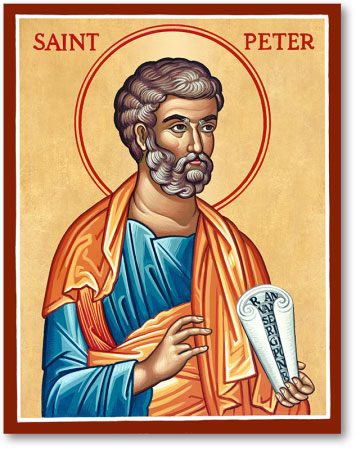
In support of the Protestant view, I want to look at one of the things that Scripture says about itself in II Peter 1:3-4 (emphasis mine): "His divine power has granted to us all things that pertain to life and
godliness, through the knowledge of Him who called us to His own glory and excellence, by which He has granted to us His precious and very great promises, so that through them you may become partakers of the divine nature, having escaped from the corruption that is in the world because of sinful desire."

First, I want to point out that these verses are from the Apostle Peter, the supposed first pope and founder of the apostolic succession of one pope to another. Second, I want the reader to notice the pronouns that Peter uses: "us" three times, and "you"  once. While he refers to "He" or "Him" several times, he never once says "I" or "me." "He," that is, God, has granted "us" "all things that pertain to [eternal] life and godliness." We whom? Peter and his readers, the same ones he addresses as "you"! His emphasis is on the sufficiency of the truth that he share already with his fellow Christians, not a secret that will be kept by the pope until some time that serves his purpose.

Peter, the very man claimed by Rome as the beginning of their apostolic superiority, says that all Christians have what we need for eternal life and sanctification. There is no secret tradition, whether sacred or otherwise, of information for which we are accountable.

If the claims of Rome are contrary to the words of the man they claim as their founder, why do they make them? To my mind the answer is obvious: if the hierarchy of Rome has information that is essential for our salvation, and that we can get in no other way, then she has an absolute control over our salvation. And that is the exact spiritual bondage against which John Hus, John Wyclif, Martin Luther, John Calvin, Thomas Cramner, John Knox, and all of the other Reformers rebelled in the Fifteenth and Sixteenth Centuries, and against which biblical Christian must battle even in our present day.

Monday, June 29, 2015

Jesus versus "Soul Sleep"

The Seventh-Day Adventists hold to a doctrine referred to as "soul sleep." Their belief is that the intermediate state, i. e., the state of the soul, is a condition of unconsciousness. This is in contrast to the view of orthodox Christians, who believe that the soul enters its eternal state (Hebrews 9:27), whether in heaven (Luke 16:25, 23:43, John 5:24) or in hell (John 3:18, II Peter 2:9), to be joined by the body at the resurrection, at which time the final judgment will confirm each person's eternal state.

Jesus addressed this question indirectly when He was challenged by the Sadducees, who denied the doctrine of resurrection (Matt. 22:23-33, Mark 12:18-27, Luke 20:27-40). In His answer (Matt. 22:31-32), Jesus reminds them, "As for the resurrection of the dead, have you not read what was said to you by God: ‘I am the God of Abraham, and the God of Isaac, and the God of Jacob’? He is not God of the dead, but of the living." In rejecting the error of the Sadducees, Jesus describes the patriarchs as alive now, and worshiping God now. His whole argument would be meaningless if those men were in their graves, unconscious, with no relationship with God in their current state.

Another passage in which the Redeemer addresses this question is John 14:2-3: "In My Father’s house are many rooms. If it were not so, would I have told you that I go to prepare a place for you? And if I go and prepare a place for you, I will come again and will take you to Myself, that where I am you may be also." If Jesus is going somewhere, from which He will return to us, where will that be? It can't be the grave; what meaning could there be for rooms built for us in the grave? Rather, He is obviously referring to heaven (see Acts 7:56, Col. 3:1, and Hebrews 1:3). Between His first and second Advents, Jesus is working to prepare for those who die during that same period. Would a Seventh-Day Adventist or Jehovah's Witness claim that He is preparing this home with the expectation that no one will make use of it? That would be futility, indeed.

The Jehovah's Witness have a distinct, though related, doctrine, that the souls of both believers and unbelievers are annihilated at death, to be reconstituted at the judgment. The words of Jesus in this story are even more telling against their doctrine. The SDA's and JW's share a common origin, but have diverged significantly. I don't know when they diverged on this doctrine, or who diverged from whom.

Saturday, July 26, 2014

Contra Annihilationism: "Destruction" is not the Same Thing as "Extinction"

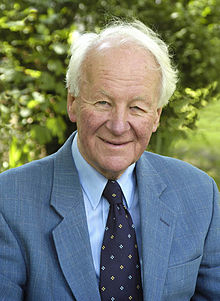
As exemplified by the late John Stott, the philosophy of annihilationism has been spreading, even among professed evangelicals. Annihilationism is the belief that unbelievers do not suffer eternal punishment in hell, the traditional view, but rather are extinguished, either at death or at the final Judgment. While it has been connected historically to the Jehovah's Witnesses and Seventh-Day Adventists (and their Armstronist offshoots), this heresy has been gaining acceptance in more otherwise-traditional churches.

I am currently reading the book Hell under Fire, edited by Christopher W. Morgan and Robert A. Peterson. While the book deals with evangelical universalism as well as annihilationism, I am currently reading just the annihilationism portion. In it is a chapter by theologian Douglas Moo, entitled "Paul on Hell," pp. 104-5. In it, he addresses the argument of annihilationists that "everlasting" and its synonyms refer to irrevocable extinction, rather than to continuous punishment. The Greek words at issue are olethros and apollumi/apoleia. He says: "Leaving aside, for the moment, judgment texts, none of the key terms usually has this meaning [i. e., 'irrevocable'] in the Old and New Testaments. Rather, they usually refer to the situation of a person or object that has lost the essence of its nature or function... The key words for 'destroy' and 'destruction' can also refer to land that has lost its fruitfulness (olethros in Ezek. 6:14; 14:16 [LXX]); to ointment that is poured out wastefully and to no purpose (apoleia in Matt. 26:; Mark 14:4); to wineskins that can no longer function because they have holes in them (apollumi in Matt. 9:17); Mark 2:22; Luke 5:37); to a coin that is useless because it is 'lost' (apollumi in Luke 15:9); or to an entire world that 'perishes,' as an inhabited world, in the Flood (2 Pet. 3:6). In none of these cases do the objects cease to exist; they cease to be useful or to exist in their original, intended state."

Saturday, July 5, 2014

I Peter 5:2, More Testimony from Scripture Against Bishops in the Church

The first three verses of the fifth chapter of I Peter have some serious implications for church government.

"So I exhort the elders among you, as a fellow elder and a witness of the sufferings of Christ, as well as a partaker in the glory that is going to be revealed: shepherd the flock of God that is among you, exercising oversight, not under compulsion, but willingly, as God would have you; not for shameful gain, but eagerly, not domineering over those in your charge, but being examples to the flock." [Emphasis mine]

The words translated here as "elder" and "fellow elder" are forms of the Greek word presbuteros. The word translated "exercising oversight" is episkopountes, a form of episkopos, from which we get the English word "bishop." So, it can be taken to be a message from the Apostle Peter to elders to "bishopize," if I may be allowed to make up a new word. The Apostle goes even further in II Peter 1:1, where he addresses Christians as "those who have obtained a faith of equal standing with ours..." While the Pope claims "the power of the keys" to include or exclude from the body of Christ whomever he chooses, the true apostle eschews any monarchical pretensions. If only the equality of all believers was the motto of the supposed heir of the throne of Peter, I would possibly give his faith a little benefit of doubt.

This seems to me to be a fatal blow to the episcopalian view of church government, as held by Anglicans, Eastern Orthodox, and Roman Catholics, all of whom hold to an office of bishop that rules over the church in a certain district.

This passage is especially destructive to the views of the Roman Catholic Church, which claims Peter himself as the beginning of their line of popes, the bishops of Rome. Rome claims that Paul was appointed by Christ in Matthew 16:13-20 to be the head of the Church, an office which he supposedly passed on to his heirs, the popes. However, in the passage here, we have Peter's own words stating that bishopizing is the work of elders. The New Jerusalem Bible, a Catholic translation, uses "elder" in  the passage, but then instructs the elders to "watch over" the church. The New American Bible, the main translation used by American Catholics, says "presbyters," refusing even to translate the term, with "overseeing." To my mind, that is a tacit admission that the American bishops are fully aware of the implications of this passage.

In addition to the positive assertions in Paul's letters, especially I Timothy 3:1-7 and Titus 1:5-9, we have here in I Peter the biblical basis for the system of church government commonly referred to as "presbyterian." It is neither "episcopalian" nor democratic. Church government is not an issue of choice. The Head of the Church has laid out how He intends to rule in His body, the Church. And the Pope of Rome is clearly the enemy of Christ's rule over that Church.

Sunday, April 15, 2012

The Testimony of the Bible to Its Own Infallibility


"Question 157: How is the Word of God to be read?
Answer: The holy Scriptures are to be read with an high and reverent esteem of them; with a firm persuasion that they are the very Word of God, and that he only can enable us to understand them; with desire to know, believe, and obey the will of God revealed in them; with diligence, and attention to the matter and scope of them; with meditation, application, self-denial, and prayer."
- Westminster Larger Catechism, Q&A 157

As a Presbyterian, I resent the association, in the minds of many, of me (and my fellow churchfolk) with the liberal Presbyterian Church (USA). That denomination is just one of the Presbyterian churches in this country, and in no way represents historical Presbyterianism. The question above comes from the Westminster Larger Catechism, one of the traditional doctrinal documents that Presbyterians have professed ever since 1647. As can be seen, it describes a proper Christian understanding that the Scriptures are the very word of God, and must be received and honored as such by the true Christian. The Catechism reflects what the Scriptures testify of themselves.

Isaiah 55:11:, "[S]o shall my word be that goes out from My mouth; it shall not return to Me empty, but it shall accomplish that which I purpose, and shall succeed in the thing for which I sent it." God acknowledges the Scriptures as His own word, and promises their spiritual effectiveness.

Jeremiah 23:29: "Is not My word like fire, declares the LORD, and like a hammer that breaks the rock in pieces?" The Word overcomes all resistance.

II Timothy 3:16-17: "All Scripture is breathed out by God and profitable for teaching, for reproof, for correction, and for training in righteousness, that the man of God may be competent, equipped for every good work." This is the central proof-text. The Scriptures are inerrant, because their divine Author is necessarily infallible!

II Peter 1:21: "For no prophecy was ever produced by the will of man, but men spoke from God as they were carried along by the Holy Spirit." Another powerful text, because of its simple and direct message. While the Bible certainly was written by human authors, it is not their word, but that of the Holy Spirit who moved them is such a way as to record His words.

Hebrews 4:12: "For the word of God is living and active, sharper than any two-edged sword, piercing to the division of soul and of spirit, of joints and of marrow, and discerning the thoughts and intentions of the heart." In a parallel to the Isaiah reference, the writer of Hebrews testifies to the power of the Scriptures to effect us in fundamental ways.

As you can see the Catechism correctly summarizes the very testimony that God gives to His own word. Those who deny the inerrancy of the Bible, yet claim to be Christians face this warning from Jesus Himself (John 14:28): "The one who rejects Me and does not receive My words has a judge; the word that I have spoken will judge him on the last day." To reject the Scriptures is to reject Christ, and that choice will be recalled as evidence against you in the Judgment to come.

Wednesday, September 23, 2009

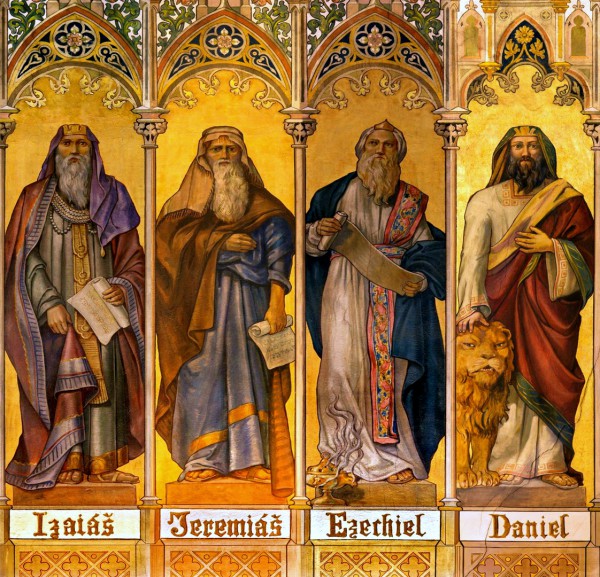
Ezekiel 3, the Commission of the Prophet of God

Verses 1-4: "And He said to me, 'Son of man, eat whatever you find here. Eat this scroll, and go, speak to the house of Israel.' So I opened my mouth, and He gave me this scroll to eat. And He said to me, 'Son of man, feed your belly with this scroll that I give you and fill your stomach with it.' Then I ate it, and it was in my mouth as sweet as honey. And He said to me, 'Son of man, go to the house of Israel and speak with My words to them."

Here we have an allegorical description of the process of inspiration. Ezekiel describes his subjective experience of what the Apostle Paul describes in II Timothy 3:16, "All scripture is breathed out by God...", and by the Apostle Peter in II Peter 1:21, "No prophecy was ever produced by the will of man, but men spoke from God as they were carried along by the Holy Spirit."

Verses 16-19: "And at the end of seven days, the word of the Lord came to me: 'Son of man, I have made you a watchman for the house of Israel. Whenever you hear a word from My mouth, you shall give them warning from Me. If I say to the wicked, "You shall surely die," and you give him no warning, nor speak to warn the wicked from his wicked way, in order to save his life, that wicked person shall die for his iniquity, but his blood I will require at your hand. But if you warn the wicked, and he does not turn from his wickedness, or from his wicked way, he shall die for his iniquity, but you will have delivered your soul.'"

The word that God has given to the prophet is not to be reserved or suppressed. Rather, he is to repeat it to the sinners around him. The prophet never assumes responsibility for the sins of others, but rather, he will bear consequences in failing to fulfill his God-given role in announcing the righteousness of God.

Verses 25-26: "'O son of man, behold, cords will be placed upon you, and you shall be bound with them, so that you cannot go out among the people. And I will make your tongue cling to the roof of your mouth, so that you shall be mute and unable to reprove them, for they are a rebellious house.'"

These verses are among the most frightening in Scripture. "Because the prophet may be bound with cords?" you ask. No, but because the hardness of the hearts of a people can reach the point where God refuses to continue to deal with them. That is a judgment, referred to as "judicial hardening," that brings Hell into the experience of a people in this life. May God grant us repentance (II Timothy 2:25), that America may never know that kind of hardening.