Showing posts with label hermeneutics. Show all posts

Wednesday, July 9, 2025

Anthropomorphisms for God Against Mormon Theology

One of the the doctrines that distinguish Mormons from biblical Christians is their belief that God the Father has a physical body like that of a human being. That is, they take references in the Bible literally, such as to His eyes, or arms, ears, feet. 

In contrast, biblical Christians take such references to be anthropomorphisms. That is, figures of speech in which is God is described as if He has human features, not because He does, but in order to make Him more relatable to mortal men. That is because He tells us explicitly that He is not a man: "God is not a man" (Numbers 23:29, I Samuel 15:29). Furthermore, we are told that His divine nature is invisible (Colossians 1:15, I Timothy 1:17). 

When I have denied their literal use of such anthropomorphisms in reference to God, I have had Mormons tell me that I demonstrate that I do not believe what the Bible says. 

However, anthropomorphisms in the Bible are not limited to references to God. 

"For you shall go out in joy and be led forth in peace; the mountains and the hills before you shall break forth into singing and all the trees of the field shall clap their hands" (Isaiah 55:12). Here there are anthropomorphisms of land features and trees expressing emotions like human beings. I posted the verse in a discussion group with Mormons and asked if they believe that mountains can sing or that trees have hands. Of course, they denied that they do. So then I asked, don't you believe the Bible? Then some fell silent while others turned to ridicule. None even attempted a rational distinction between this verse and the ones that they claim refer to literal body parts of God. 

Mormon exegesis falls apart under a little examination. 


Wednesday, March 23, 2022

What Works Are Excluded from Justification?

I have had discussions with both Mormons and Catholics about Romans 3:28: "For we hold that one is justified by faith apart from the works of the law." The topic was the doctrine of both groups that a person is justified by a mixture of faith and works, instead of by faith alone. They denied that a person is justified by faith alone, claiming that Paul rejects the works of the Mosaic code, such as circumcision, as contributing to justification. That is, they restrict the meaning of "law" just to the rules and ceremonies given to Israel through Moses. 

What neither will mention is Paul's other uses of "law," especially in Galatians. In Galatians 4:21-26, 28-31, he makes a case: "Tell me, you who desire to be under the law, do you not listen to the law? For it is written that Abraham had two sons, one by a slave woman and one by a free woman. But the son of the slave was born according to the flesh, while the son of the free woman was born through promise. Now this may be interpreted allegorically: these women are two covenants. One is from Mount Sinai, bearing children for slavery; she is Hagar. Now Hagar is Mount Sinai in Arabia, she corresponds to the present Jerusalem for she is in slavery with her children. But the Jerusalem above is free, and she is our mother... Now you, brothers, like Isaac, are children of promise. But, just as at that time he who was born according to the flesh persecuted him who was born according to the Spirit, so also it is now. But what does the Scripture say? 'Cast out the slave woman and her son, for the son of the slave woman shall not inherit with the son of the free woman.' So, brothers, we are not children of the slave but of the free woman." 

Paul makes a very clear distinction here. Is it between works of the Mosaic law and other works? Clearly not. Anyone with a modicum of biblical knowledge knows that Abraham lived four-hundred years before  Moses. Rather, he uses "law" to describe the works of the flesh, such as those of Moses, using the label of the part to represent the whole (a synecdoche), in distinction from the promise, which he uses to label grace alone through faith alone. 


Wednesday, February 23, 2022

The Nature of God: Biblical Versus the Corporeal Deity of Mormonism

"The right hand of the Lord does valiantly!" (Psalm 118:15).

The reference above mentions the right hand of God. We also see references to His arm and His back. Orthodox Christians call these references "anthropomorphisms," that is, metaphorical references to God as if He is a man, as an aid to human understanding. In other words, we say that they are never to be taken literally (apart from the true body of Jesus, but only as the result of His incarnation). 

In contrast, Mormons claim that they references are literally true, such that the Father has a literal, physical body, with hands, feet, hair, etc., and that the Son also had a body, even prior to His incarnation. On the other hand, their Holy Spirit does not have a body. As their scriptures say, "The Father has a body of flesh and bones, as tangible as man's; the Son also" (Doctrine and Covenants 130:22). 

However, something else we see in the Bible is this: "The Lord spoke to you out of the midst of the fire. You heard the sound of the words, but saw no form - only a voice was heard... Give good care to yourselves, for you saw no form on the day that the Lord spoke to you in Horeb from the midst of the fire, lest you corrupt yourselves in the form of any figure, the likeness of male or female..." (Deuteronomy 4: 12, 15-16). These verses are significant because they explicitly state that God did not reveal Himself with any form. In fact, Moses says, to represent Him with a form would be corruption! What I find even more significant is that He calls Himself Yahweh (represented here by the English word "Lord"), which I consider to be, not the Father, but rather the preincarnate Son in His mediatorial role. Whether or not one agrees, these verses plainly negate the claims of Mormons. 

On the issue of anthropomorphisms, that chapter contains another relevant reference: "I call heaven and earth to witness against you today..." (Deuteronomy 4:26). Moses calls on the physical creation to witness the commitment undertaken by the people of Israel. Taken literally, that would require that heaven and earth be sentient. Yet Mormons make no claim that anthropomorphisms are literal in this case. 

Does that not prove that they recognize the validity of the orthodox view? They must deny it, however, because to accept it would bring down the house of cards which is their manmade religion in a single stroke. 


Saturday, July 4, 2020

Romans 6:4 Says Nothing About the Mode of Baptism

"We were buried, therefore, with Him by baptism into death, in order that, just as Christ was raised from the dead by the glory of the Father, we too might walk in newness of life."
- Romans 6:4

This verse is one of those trump cards that some people plunk down in any debate, thinking that they outweigh any evidence to the contrary. In this case, it is plunked down by Baptists when discussing the mode of baptism. They claim that it means that the mode must look like the burial of Jesus. So they baptize by lowering a person backward, like a corpse lowering into a grave,and then raising him up, like a corpse rising in resurrection. But do you notice that the verse says nothing about "looking like"? Not one syllable. Rather, this is a case of begging the question, presupposing a conclusion, and then reading it into the premise.

However, Romans 6:4 is not about the mode of baptism. Rather, it uses "baptism" to indicate the covenantal connection between the elect and the death of Christ, ending the previous relationship to sin "by baptism into death" (no comma). When it was finished for Him, it was finished for us, too, because of the covenantal connection. In other words, Paul here is making the same point that he did in the following chapter: "You also have died to the law through the body of Christ, so that you may belong to another, to Him who has been raised from the dead, in order that we may bear fruit for God. For while we were living in the flesh, our sinful passions, aroused by the law, were at work in our members to bear fruit for death. But now we are released from the law, having died to that which held us captive, so that we serve in the new way of the Spirit and not in the old way of the written code" (Romans 7:4-6).

Since the believer is now in Christ, he is "dead to sin and alive to God in Christ Jesus" (Romans 6:11). To turn verse 4 into a reference to the mode of baptism is to ignore Paul's point about our new relationship to sin and righteousness. As always, context, context, context.

Saturday, February 29, 2020

The Extent of the Noachic Flood

There has long been a debate on the extent of the Flood of Noah. Was it literally worldwide? Or is that language intended to refer to the world as the Mosaic audience knew it. Either usage is possible, and can be seen in other uses.

Here is the primary description of the Flood (Genesis 7:17-24: "The flood continued forty days on the earth. The waters increased and bore up the ark, and it rose high above the earth. The waters prevailed and increased greatly on the earth, and the ark floated on the face of the waters. And the waters prevailed so mightily on the earth that all the high mountains under the whole heaven were covered. The waters prevailed above the mountains, covering them fifteen cubits deep. And all flesh died that moved on the earth, birds, livestock, beasts, all swarming creatures that swarm on the earth, and all mankind. Everything on the dry land in whose nostrils was the breath of life died. He blotted out every living thing that was on the face of the ground, man and animals and creeping things and birds of the heavens. They were blotted out from the earth. Only Noah was left, and those who were with him in the ark. And the waters prevailed on the earth 150 days."

However, I think that there are two contextual references that require a literal global interpretation of that passage.

The first is in the prior chapter (Genesis 6:11-13): "Now the earth was corrupt in God’s sight, and the earth was filled with violence. And God saw the earth, and behold, it was corrupt, for all flesh had corrupted their way on the earth. And God said to Noah, 'I have determined to make an end of all flesh, for the earth is filled with violence through them. Behold, I will destroy them with the earth.'" So, God tells us that mankind was thoroughly corrupt, such that He, anthropomorphically speaking, regretted creating them. The relevance of this is that a regional flood would not have dealt with a worldwide problem. Furthermore, to cut off any claim that this is mere hyperbole, it is not rational to believe that such a radical solution would have been required for a merely-regional problem. Therefore, we are logically compelled to believe that the Flood was necessarily worldwide.

The second issue is back in chapter 7 (Genesis 7:2-9): "'Take with you seven pairs of all clean animals, the male and his mate, and a pair of the animals that are not clean, the male and his mate, and seven pairs of the birds of the heavens also, male and female, to keep their offspring alive on the face of all the earth. For in seven days I will send rain on the earth forty days and forty nights, and every living thing that I have made I will blot out from the face of the ground.' And Noah did all that the Lord had commanded him. Noah was six hundred years old when the flood of waters came upon the earth. And Noah and his sons and his wife and his sons’ wives with him went into the ark to escape the waters of the flood. Of clean animals, and of animals that are not clean, and of birds, and of everything that creeps on the ground, two and two, male and female, went into the ark with Noah, as God had commanded Noah."

So, as part of the preparation for Noah and his family, God commanded him to collect samples of every animal, presumably limited to land animals ("everything on the dry land," 7:22), two of some kinds, seven (or seven pairs) of other kinds. Thus, provision is made for the entire ecological system on which man is dependent. But why? If the Flood were merely regional, then God could merely have caused them to migrate beyond the range of the Flood. They would have been preserved by not having to pass through the high waters at all. However, their survival is guaranteed, not by migration, but by resorting to the Ark with Noah. Again, that is rational only if we take the Flood as general, worldwide, and not merely regional.

Saturday, February 8, 2020

The Knowledge of Election: Avoiding the Effort to Be Wise Above What is Written

When dealing with even professed Christians on Facebook, I get a continuous stream of questions about hypothetical issues. Today someone asked, "What if Noah were really the Archangel Gabriel?" I am not making that up. 

This is especially true when discussing the doctrines of grace with people not from a Reformed background. They are constantly demanding an answer -  i. e., one that will satisfy them - as to why God chooses one person over another. Other than according to mercy alone (Romans 9:16) for His glory alone (Ephesians 1:6), Scripture does not give us an answer. Rather, we are given this rebuke: "Who are you, O man, to answer back to God? Will what is molded say to its molder, 'Why have you made me like this?' Has the potter no right over the clay, to make out of the same lump one vessel for honorable use and another for dishonorable use?" (Romans 9:20-21). The answer is simple, Paul tells us. God makes His decision on the basis that he chooses because He is God and we are not, so stop prying into things above your station!

And Paul is answering on the basis of a longtime Biblical tradition, going back to Moses: "The secret things belong to the LORD our God, but the things that are revealed belong to us and to our children forever, that we may do all the words of this law" (Deuteronomy 29:29; see also Paul's remarks in I Corinthians 4:6 and Colossians 2:8). Moses tells us that God has given us everything we need to know for salvation and sanctification in the Bible. Beyond that revelation, whatever imaginations arise from our inordinate curiosity are to be cast aside. "The whole counsel of God, concerning all things necessary for his own glory, man’s salvation, faith, and life, is either expressly set down in Scripture, or by good and necessary consequence may be deduced from Scripture: unto which nothing at any time is to be added, whether by new revelations of the Spirit, or traditions of men" (Westminster Confession of Faith, I:6).

"Men of inquisitive and speculative minds are apt to forget that there are limits set to human investigation and research, beyond which it is impossible to pass with safety or satisfaction. To intrude with confidence unto the unrevealed secrets of God's wisdom and purpose manifests an arrogance and haughtiness of intellect which cannot fail to incur the marked disapprobation of heaven, and should always meet the prompt reprobation of the pious.Whatsoever is useful to be known, God has kindly and graciously revealed, and it argues no less ingratitude than presumption to attempt to be 'wise above what is written'" (I Corinthians 4:6, James Henley Thornwell, "Election and Reprobation").

Saturday, November 16, 2019

Who Was the Whore of Babylon?

A strange description occurs near the end of the Bible: "'Come, I will show you the judgment of the great prostitute who is seated on many waters, with whom the kings of the earth have committed sexual immorality, and with the wine of whose sexual immorality the dwellers on earth have become drunk.' And he carried me away in the Spirit into a wilderness, and I saw a woman sitting on a scarlet beast that was full of blasphemous names, and it had seven heads and ten horns. The woman was arrayed in purple and scarlet, and adorned with gold and jewels and pearls, holding in her hand a golden cup full of abominations and the impurities of her sexual immorality. And on her forehead was written a name of mystery: 'Babylon the great, mother of prostitutes and of earth’s abominations.' And I saw the woman, drunk with the blood of the saints, the blood of the martyrs of Jesus'" (Revelation 17:1-6).

The account continues to verse 18, which tells us, "And the woman that you saw is the great city that has dominion over the kings of the earth." The woman is traditionally called the Whore of Babylon, from the King James Version of this passage. Her identity has been variously interpreted. The majority view is that she is a symbol of Rome. I, however, join with the minority in identifying her with apostate Israel, represented by Jerusalem, i. e., those Jews who rejected her Messiah and joined in crucifying Him 

I am going to speak to that here.

One of the challenges I have gotten from dispensationalists regarding this passage is that, supposedly, Jerusalem didn't rule the nations; rather, Rome did. However, the usage of Scripture does, actually, make Jerusalem the ruler of the nations: "How lonely sits the city that was full of people! How like a widow has she become, she who was great among the nations! She who was a princess among the provinces has become a slave. She weeps bitterly in the night, with tears on her cheeks; among all her lovers she has none to comfort her; all her friends have dealt treacherously with her; they have become her enemies" (Lamentations 1:1-2). Does this passage not echo John's words? It is a description of the destruction of Jerusalem by the Babylonians in 587 BC.

In fact, I think that this is a prominent flaw of dispensational interpretation: it consistently ignores Old testament usages in dealing with New Testament prophecy. the Bible is a whole, with the later revelations building on the earlier. While dispensationalists talk about "rightly dividing the word of truth," their practice is better described as "wrongly dividing" it. Their hermeneutic is built on presuppositions outside of Scripture.

Saturday, October 26, 2019

Polytheism and the Mormon Hermeneutic

Mormons claim that there are gods other than the God of the Bible. They deny, on the other hand, that their belief makes them polytheists, because they only worship one god. However, even that is not quite true, since they claim that the Father, Son, and Holy Spirit are three distinct gods, and they worship all three. But that is beside my point.

It is true that the Bible refers to other "gods," i. e., the idols worshiped by pagan nations. Furthermore, it describes them in active, anthropomorphic terms, such as Psalm 97:7: "Worship Him, all you gods!" As when the Bible talks about the body parts of God, Mormons insist that these references are literal

However, that assertion runs into trouble when the whole Bible is considered, rather than just isolated prooftexts. 

For example, there is a plain, nonpoetic reference in Jeremiah 2:11: "Has a nation changed its gods, even though they are no gods? But My people have changed their Glory for that which does not profit." Yes, that prophet tells us, the nations have gods, but they are not real gods. Surely, in a rational hermeneutic, the statements of plain narrative should take precedence over statements in poetry. Yet, that is not the hermeneutic of Mormonism. 


Saturday, July 20, 2019

A Priori Sovereign Grace

When discussing the doctrines of grace, also called the Five Points of Calvinism, I am often told that the Calvinist soteriology depends on a few isolated prooftexts taken out of context. I am always flabbergasted by that assertion, because each of the doctrines is seen all over Scripture. Rather, I see it as a problem of the Arminian's deliberate overlooking these doctrines, because they are inconsistent with his theological presuppositions.

Let's look at one of the verses that never comes up in those discussions, II Thessalonians 2:13: "We ought always to give thanks to God for you, brothers beloved by the Lord, because God chose you as the firstfruits to be saved, through sanctification by the Spirit and belief in the truth."

Here we see Paul's addressing the brothers explicitly, not mankind in general. We would have known that anyway, because the entire epistle is written to Christians (II Thess. 1:1). However, Paul reinforces that introduction with a second address to believers here. He tells these believers that God chose them, not that they chose God. For what were they chosen? Three things: to be the firstfruits of those who would be saved, to be sanctified, and to believe in the truth. Contrary to the commonly stated assertion of the Arminians, these believers were not chosen because of those things, but unto them. This precludes the possibility of the reactive predestination that Arminians often claim, that God predestines those whom He knows would believe.

That there are such plain statements of the sovereignty of God's grace is clear proof that free-will theology is imposed on Scripture, not derived from it.


Wednesday, May 15, 2019

The Physical Resurrection: One Event or Two?

The predominant eschatology among American evangelicals is premillennialism (which has different forms, but that isn't the issue here). One particular way in which premillennialism differs from other schools is in making literal the description of two resurrections (Revelation 20:5-6). According to the premillennial interpretation, the godly dead will be resurrected, then a period of a thousand years will elapse, at the end of which the wicked dead will be raised. Then the premillennialist denies the literal interpretation of other passages that point to a single resurrection.

As I describe here, comparing scripture to scripture gives us good grounds for taking the First Resurrection in a non-literal sense, to refer to regeneration of believers.

So, what of the references to a single, general resurrection?

We can start with Job 14:11-12: "As waters fail from a lake and a river wastes away and dries up, so a man lies down and rises not again; till the heavens are no more he will not awake or be roused out of his sleep." Without distinguishing between the types of people, he places resurrection at the end of this physical creation, not a thousand years before the end.

And what of the words of Jesus in John 6:40: "This is the will of My Father, that everyone who looks on the Son and believes in Him should have eternal life, and I will raise him up on the last day." Not only does Jesus place the resurrection at the end of history, not a thousand years before the end, but He explicitly tells us that this is the resurrection of the godly, whom the premillennialist claims will have been resurrected for a thousand years by that time.

The premillennialist view in general, and specifically regarding the resurrection, depends on a literal interpretation of a highly-figurative passage, and then forces that interpretation on other, clearer, not-at-all figurative passages in order to maintain its peculiar doctrine. That is just bad hermeneutics, which depends on the clearer passage to interpret the more obscure.

Wednesday, May 1, 2019

Love God, Love His Commandments

In general, people understand that Hebrew poetry is different from English poetry. For example, there is no rhyme in Hebrew poetry. And an element it has that English does not is the use of parallelism. Different lines can be parallel in saying the same thing in different ways. We see such a parallelism in this verse:

"Praise the Lord!
Blessed is the man who fears the Lord,
 

     who greatly delights in His commandments!"
- Psalm 112:1 

The parallelism is between the second and third lines, which describe the blessed man. He fears the Lord and delights in His commandments. In English, those appear as two different things in succession. However, in Hebrew, they are parallels, different ways of saying the same thing. In other words, this verse equates fearing the Lord with delighting in His commandments. 

This hermeneutical principle is important because it demonstrates the erroneous hermeneutic of the dispensationalist, who claims that there is a contrast, an opposition, between loving God and loving the commandments. Rather, they are necessarily complementary.

Wednesday, December 19, 2018

The Land Promises and the Unity of the People of God

One of the main distinctions between dispensationalism and covenantalism is over the relationship between Israel and the Church. The covenantalist sees them as different administrations of the same thing (see, for example, Acts 7:38 KJV). In contrast, the dispensationalist sees them as radically discontiguous, there having been no church in the Old Testament, and Israel's having a future separate from the church.

One aspect of this is the frequent references dispensationalists make to the promises God made to Israel. While the covenantalist takes the remaining promises to be given to the church, the Israel of God (Galatians 6:16), the dispensationalist sees them as necessarily remaining to be fulfilled to Israel, i. e., the Jews, in their distinct character.

I want to consider the land promises, in particular, here. Are there remaining land promises for the Jews? I don't think that Bible allows that conclusion, even apart from the identity of Israel and the church.

In Joshua 21:43-45, given after the conquest of the Promised Land, we read this comment: "Thus the Lord gave to Israel all the land that He swore to give to their fathers. And they took possession of it, and they settled there. And the Lord gave them rest on every side just as He had sworn to their fathers. Not one of all their enemies had withstood them, for the Lord had given all their enemies into their hands. Not one word of all the good promises that the Lord had made to the house of Israel had failed; all came to pass." Thus, the land promise had been fulfilled, not waiting for the modern state of Israel.

Furthermore, in I Kings 4:21, we read this: "Solomon ruled over all the kingdoms from the Euphrates to the land of the Philistines and to the border of Egypt. They brought tribute and served Solomon all the days of his life." This describes Solomon's enjoyment of that Land, not waiting for it. This is repeated in the parallel passage in II Chronicles 9:26.

In other words, the land promises to Israel aren't waiting for fulfillment! They were fulfilled three thousand years ago!

Moreover, something that dispensationalists fail to recognize is that the fulfillment of God's promises is always far more than the literal promise. In this case, by denying the bitestamental unity of the people of God, the dispensationalist is blind to Psalm 2:8: "Ask of Me, and I will make the nations Your heritage, and the ends of the earth Your possession." This promise is part of the intra-Trinitarian covenant, made before the world was created, and is a gift from the Father to the Son. And then in the New Testament, that same Son promises it to His church: "All authority in heaven and on earth has been given to Me. Go therefore and make disciples of all nations, baptizing them in the name of the Father and of the Son and of the Holy Spirit, teaching them to observe all that I have commanded you. And behold, I am with you always, to the end of the age" (Matthew 28:18-20). The rigid literalism and minimalism of dispensationalists causes them not to enjoy the real promises of God, and also to deny them to those same Jews that they have cast out of the church.

Wednesday, November 28, 2018

The One and the Many: Trinity in Unity in the Bible

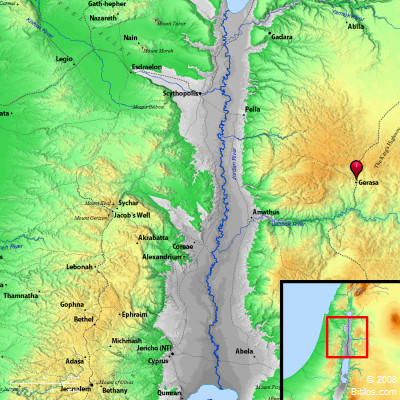
"They came to the other side of the sea, to the country of the Gerasenes. And when Jesus had stepped out of the boat, immediately there met Him out of the tombs a man with an unclean spirit. He lived among the tombs. And no one could bind him anymore, not even with a chain, for he had often been bound with shackles and chains, but he wrenched the chains apart, and he broke the shackles in pieces. No one had the strength to subdue him. Night and day among the tombs and on the mountains he was always crying out and cutting himself with stones. And when he saw Jesus from afar, he ran and fell down before Him. And crying out with a loud voice, he said, 'What have You to do with me, Jesus, Son of the Most High God? I adjure You by God, do not torment me.' For He was saying to him, 'Come out of the man, you unclean spirit!' And Jesus asked him, 'What is your name?' He replied, 'My name is Legion, for we are many.'"
- Mark 5:1-9

When I interact with anti-Trinitarians, whether of the Arian or Sabellian varieties, one strategy they all seem to try is to describe the Trinity in this way: "One plus one plus one equals three, so you believe in three gods." For some inconceivable reason, they think this is a very clever argument, even though math has nothing to do with it. Or, if you want to do math, why can't it be one times one times one equals one? Or one cubed is one? If you see what I mean, the argument is nowhere nearly as clever as they think it is. We talk about things as unities in one sense but manifold in a different sense all of the time. Have you heard of the three branches of the one federal government?

Yet, the anti-Trinitarian desperately holds on to this argument. Their answer is, "Well, we do that, but the Bible doesn't."

Really? I guess anti-Trinitarians don't read Mark 5. Notice the interaction between Jesus and the demoniac. Actually the demon in the demoniac. Notice that Mark refers to the demon consistently as "he," not "they." And notice that the demons say "me," not "we," except one time in verse 9. Even in verse 9, the demon says "my name is," not "our names are."

My point is that the Bible certainly does refer to things as one in one sense and manifold in another. In this case, we see one demon also described as a legion, a unit of Roman military consisting of about 6,000 soldiers. If the demon of Mark 5 can be 6,000 demons described as a unity, then why can't the three Persons of the Trinity be one God?


Saturday, September 29, 2018

Abraham, the Ancient Christian

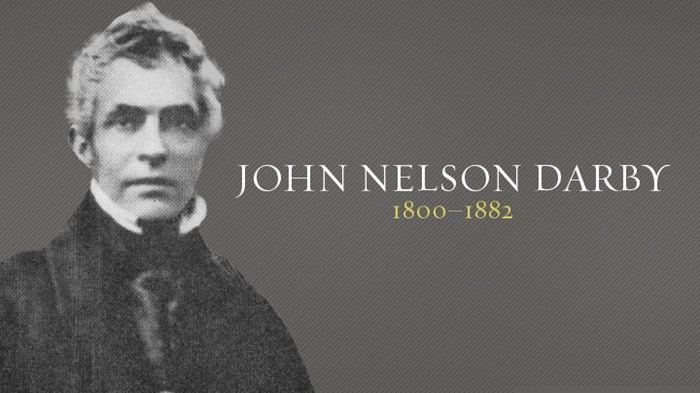
There is a heresy which has been going around at least since the time of J. N. Darby in 1830, that says that people in the Old testament were saved in a different way from the people in the New Testament. Sometimes it is said that Israel was saved by following the Law. Other times, it is said that they were saved by faith in the sacrifices. This doctrine is associated with various forms of the hermeneutical system created by Darby (and made popular by C. I Scofield) known as Dispensationalism.

Both forms of the doctrine are wrong.

Orthodox Protestants all agree that a Christian is saved by grace through faith, not by obedience to the Law, even in part. This is stated repeatedly in Scripture, such as Acts 13:39, Romans 3:28, and the whole Epistle to the Galatians. Where the Dispensationalist is wrong is his assertion that Old Testament believers were saved in a different way. The Apostle Peter, himself a Jew, said, "We [Jews] believe that we will be saved through the grace of the Lord Jesus, just as they {i. e., the Gentiles] will" (Acts 15:11).

And to be more specific, the Apostle Paul, another Jew, tells us, "And the Scripture, foreseeing that God would justify the Gentiles by faith, preached the gospel beforehand to Abraham, saying, 'In you shall all the nations be blessed'" (Galatians 3:8). Notice that Paul doesn't say just "faith," which might allow for faith in a different object. Rather, he explicitly states that Abraham received the Gospel! That is why Jesus could say, "Your father Abraham rejoiced that he would see My day. He saw it and was glad" (John 8:56).

Would the content of the Gospel to Israel have been more obscure? Sure. We understand that the Gospel was given under types and shadows (Colossians 2:17), so that Old Testament faith was more difficult to attain. That is why the New Covenant, the Gospel in the New Testament, is described by the Epistle to the Hebrews as far superior: the types and shadows have been removed, so that the reality is displayed in all its glory!

Saturday, June 30, 2018

Oneness Misuse of Scripture: John 14:9

Oneness like to quote John 14:9: "Whoever has seen Me has seen the Father." They claim that this is literal, that looking at Jesus with the eyes is seeing the Father with the eyes. However, Jesus also says (John 5:37): "The Father who sent Me has Himself borne witness about Me. His voice you have never heard, His form you have never seen."

Jesus spoke, yet no one has heard the Father's voice. Jesus had a visible physical form, yet no one has seen the Father's form. Therefore, Jesus cannot be the Father. and the literalist Oneness use of John 14:9 is the insertion of a presupposed manmade doctrine.

Saturday, May 12, 2018

The Beauty of the Church, the Bride of Christ

The Puritans made great use of the Song of Songs. It saddens me that it has become a neglected book. The literalism that has been popularized by the fundamentalists has turned this book into a sterile, purposeless poem. I have even been told that it should be removed from the canon as "pornographic." I deny that God's word can be either pornographic or useless.

Consider this verse:
"You are altogether beautiful, my love;
     There is no flaw in you."

Those two lines are as beautiful as any line in Shakespeare or Japanese haiku. Yet, I bet that most people reading this have never seen it before.

The Puritans considered the Song to be a poetic description of Christ and His bride, the Church. This verse is the address of the groom to the bride. This is the same one that he first saw as an infant in the blood of her birth (Ezekiel 16:6), in her age of nubility (Ez. 16:8), and finally in her bridal apparel (Ez. 16:10-13). After that, two paths are described, the one of an adulteress (Ez. 16:15-34, Revelation 17), and the other of a faithful bride (Revelation 19:6-9). This isn't a matter of one replacing the other. Rather,  it is the parallel development of a faithful seed and a faithless seed, side by side, as was predicted in the first scriptures (Genesis 3:15).

The Song is about Jesus and His faithful bride. He sees her, not in her nature, but as she is by His grace: "Drink that in, Christian. If ever there were a honeycomb full of virgin honey, it is here. Though in ourselves we are defiled, yet, in the eyes of Jesus, looked on as covered with His righteousness, we are 'absolutely beautiful.' We are as dear to Him as if we had never sinned" (Charles Spurgeon).

The Church is beautiful with the beauty that her divine Groom gives her!


Saturday, February 10, 2018

The Eternal Begetting of God the Son

One of the erroneous doctrines of Oneness Pentecostalism regarding Jesus is that His sonship began with His incarnation in the womb of Mary. Before that, His preexistence was as the Father. In contrast, orthodox Christians hold that His sonship was eternal. That is, that God the Son has been such from all of eternity.

The most explicit biblical reference to that truth is from Psalm 2:7: "The Lord said to Me, 'You are my Son; today I have begotten You.'" Oneness people cannot deny the reference of this verse, because we have the inspired interpretation of it in Hebrews 1:5, applying it to the Father's message to the Son.

Instead, the Oneness try to avoid the implications of the Psalm by pointing to its use of "today," which, they claim, must refer to a particular time. However, that assertion ignores the use of "today" in the Bible, especially in the Psalms, and as it is adopted in Hebrews. For example, we read in Hebrews 4:7, from Psalm 95:7, "He appoints a certain day, 'Today,' saying through David so long afterward, in the words already quoted, 'Today, if you hear His voice, do not harden your hearts.'" Here, it occurs three times, "a certain day" and "today" twice. About what day is the Psalmist talking, Oneness apologist? Well, every day, obviously. There is no day when we are allowed to harden our hearts.

Thus, the question about Psalm 2:7 and Hebrews 1:5, what day is the Father begetting the Son? Well, every day!

Having had this conversation with Oneness, I know their next quibble is, How can a father beget the same son every day? Of course, merely asking that question reveals what a carnal view they have of God, as if He fathers children like a human father does. Sometimes they will even demand, Well, then, who was His mother? Of course, the first response to that is to point out that their carnal demands are to the author of the Scripture, God Himself, not to me. But then, again, I cannot but notice what a carnal view of God they reveal, acting as if God reproduces, or that deity has parents. That is the Mormon doctrine, not anything that should be expected from the God of the Bible!


Saturday, December 9, 2017

Is It a Sin to Say That There Is Hyperbole in Scripture?

A Skyline in Canaan?
In discussing Isaiah 14:3-23, I have denied that it refers to the fall of Satan. I insist that it really is about the king of Babylon, just as it says in verse 4. There is always someone who points out that there are specific references in the passage that exceed something that could be true of a mere human king. And, if one insists on taking a literal approach, that would be true. However, is it not inconsistent to insist on being literal about that, while being figurative about the subject of the passage? After all, Satan is mentioned nowhere in it.

My answer is simply that the Prophet is using hyperbolic language to emphasize the arrogance of Babylon, and especially of her king (compare Daniel 4:30-33). Hyperbole is a widely used literary form, using exaggerated language to emphasize a point. Yet, people accuse me of denying the inerrancy of Scripture by claiming that it contains hyperbole. Would I do so if I claimed that it uses poetry? Or allegory? Or humor? Certainly not! God uses all of the literary forms that any other form of human literature uses.

Here is another example: "Hear, O Israel: you are to cross over the Jordan today, to go in to dispossess nations greater and mightier than you, cities great and fortified up to heaven" (Deuteronomy 9:1). Would anyone suggest that Moses was literally saying that the Canaanites had skyscrapers in their defensive walls? I hope not! Rather, he is using hyperbole, deliberately-exagerrated language, to impress on Israel how powerful their human foes were, before pointing them (verse 3) to the power of their God: "Know therefore today that He who goes over before you as a consuming fire is the Lord your God. He will destroy them and subdue them before you. So you shall drive them out and make them perish quickly, as the Lord has promised you."

Hermeneutics requires the awareness of the literary form used in any particular passage. That isn't liberalism, but merely sound exegesis.

Monday, September 4, 2017

The Book of Acts: The Record of Leadership, from Jesus to the Apostles

One of the basic rules of biblical hermeneutics, i. e., the proper interpretation of a document, is that a text must be considered according to the type of literature it is. The Bible contains all of the forms of literature that we see in any other context of written communication, such as poetry, narrative, law, etc. And one form of literature cannot be interpreted the same way as another. Poetry communicates in a way that narrative does not, for example.

The Book of Acts is a book of history, covering a period of about thirty years from the resurrection of Christ to the imprisonment of Paul. It is not primarily a book of doctrine, in contrast to the epistles, or a book of eschatology like the book of Revelation. Rather, it is a description of the historical events that happened at a certain time. Therefore, any doctrine that depends inordinately on Acts as its basis is likely to lead in an unorthodox direction. We see this in the Pentecostal movement, especially in its Oneness aberration. Acts is the Word of God, requiring that any doctrine in it must be infallible. However, to put undue emphasis on doctrinal statements in Acts, without vetting it with the rest of Scripture, will always lead to trouble.

What was Luke's purpose in writing Acts? We see where he gave some indications. Look especially at the first two verses (Acts 1:1-2): "In the first book, O Theophilus, I have dealt with all that Jesus began to do and teach, until the day when He was taken up, after He had given commands through the Holy Spirit to the apostles whom He had chosen." Luke's first book, that which is called by his name, was devoted to the person and direct teachings of Jesus. The second, on the other hand, was dedicated to His leaving and the growth of the new church under the care of His lieutenants, the Twelve Apostles (with Matthias in the place of Judas, and then augmented by His brother James and the converted Paul). So, according to Luke's own words, his intention was to describe a particular historical situation, not to give doctrinal tutoring. And that makes sense, since Luke was the companion of Paul. Paul's ministry was, in part, to develop the theology of the church. Luke, therefore, provides the historical complement to the ministry of Paul.

We immediately see Jesus's carrying out this program in verses 8 and 24 of the same chapter. In Acts 1:8, Jesus gives another version of His Great Commission: "You will be My witnesses in Jerusalem and in all Judea and Samaria, and to the end of the earth." The rest of the book would be a record of the first steps in the fulfillment of this commission. Verse 24 is the Apostles profession that they understood their offices to be, not an opportunity for power, but rather that same assignment from their Lord. 

We see the continuing development of this post-Jesus church government in chapter 6, where the Apostles this time, not Jesus by direct act, in the appointment of the seven deacons (Acts 6:1-6). The Apostles are now acting in their own authority (under the headship of Christ), a maturing of their sense of responsibility. We see this again in Acts 10:42: "He commanded us to preach to the people and to testify that He is the one appointed by God to be judge of the living and the dead." The Apostles, emboldened by the pouring out of the Holy Spirit (chapter 2), now took a personal responsibility for the ministry assigned to them by Christ, on which the rest of the organized church would be built: "The household of God, built on the foundation of the apostles and prophets, Christ Jesus Himself being the cornerstone" (Ephesians 2:20).

The logical conclusion from all of this is that Acts is a book of history, a description of events at a particular point in history, and not (speaking in general) a record of how things are supposed always to be. Compare the Old Testament. Only a lunatic would claim that the command given to Israel to conquer Canaan was intended to be normative for the rest of history. Is each generation of believers supposed to go conquer the land that is now Israel? No. In the same way, the tongues and other miraculous signs of Acts were intended for a particular point in the history of the church, that of its passing from a body in the physical presence of Jesus, to a body spiritually headed by Jesus, but organized by men appointed to that end, as evidenced by special abilities given to them, as Luke himself tells us (Acts 14:3): "They remained for a long time, speaking boldly for the Lord, who bore witness to the word of his grace, granting signs and wonders to be done by their hands" (see also Mark 16:20, II Corinthians 12:12, and Hebrews 2:3-4).

Monday, August 28, 2017

Oneness Pentecostals, Wrong on the Name of Jesus

Oneness Pentecostals make a lot of bizarre claims. Among them is that baptism is essential for salvation (based on their perverse interpretation of Acts 2:38). And not just any ol' baptism, but specifically immersion in Jesus's name only, absolutely not in the trinitarian formula of Matthew 28:19. This is based on the baptisms in Acts, as well as another perverse interpretation, this time of Acts 4:12: "There is salvation in no one else, for there is no other name under heaven given among men by which we must be saved." They allow the use of the word "name" to be only a term of address.

If you want to see a Oneness believer turn cross-eyed, ask him this question: When a police officer yells at a criminal to "stop in the name of the law," what name is it? That's because their rigidity regarding the word "name" cannot adapt to any other use of that word.

That rigidity gets them into trouble with other portions of Scripture. For example, when John describes the glorified Christ in Revelation 19:13, he says, "He is clothed in a robe dipped in blood, and the name by which He is called is The Word of God." Not "Jesus." So, has the name by which we must be saved changed? If the Oneness are correct, the answer to that question is of salvific significance! If they are right about the use of "name" in Acts 4:12, then John is now teaching a different Gospel (Galatians 1:9). Or, we might conclude that John is correct, but Luke was teaching a different Gospel!

Either way, Oneness rigidity, used to substantiate their manmade religion, produces chaos in the rest of Scripture. Moreover, since Scripture has only one Author, God (I Timothy 3:16), if the Scriptures are chaotic, then so is God. A capricious God is not the God of the Bible: that is the God of Islam!

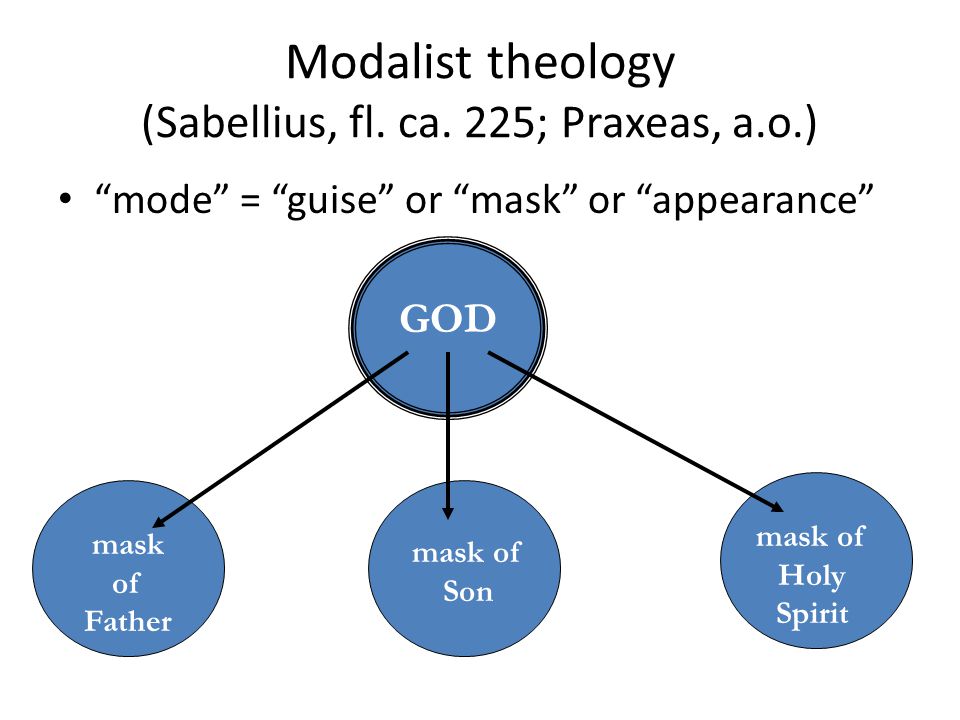
And that is, indeed, my conclusion. The god of Oneness is not the God of the Bible, the living and triune God. Their god is the manmade construct of Sabellius, an irrational god, producing irrational followers. That is not Biblical Christianity. It is baptized Islam.