Showing posts with label zechariah. Show all posts

Monday, April 20, 2026

The Restoration of the Jews according to Jeremiah 33, with Zechariah and Hebrews

"Behold, the days are coming, declares the Lord, when I will fulfill the promise I made to the house of Israel and the house of Judah. In those days and at that time I will cause a righteous branch to spring up for David, and He shall execute justice and righteousness in the land. In those days Judah will be saved and Jerusalem will dwell securely. And this is the name by which it will be called: 'The Lord is our righteousness.' for thus says the Lord: David shall never lack a man to sit on the throne of the house of Israel, and the Levitical priests shall never lack a man in My presence to offer burnt offerings, to burn grain offerings, and to make sacrifices forever." (Jeremiah 33:14-18) 

To my mind, this is an exhilarating passage, because it unites so many messianic themes. The Branch is an epithet used for the coming Messiah several times in Jeremiah, and points to the coming of Jesus, about 600 years after the historical events of the book. The prophet uses several confirmatory references that we know from the New Testament. First, the Branch will cause His people to bear the name "The Lord is our righteousness." This should cause any Christian to think immediately of the words of Paul in II Corinthians 5:21: "For our sake, He [the Father] made Him [Jesus] to be sin who knew no sin, so that, in Him, we might become the righteousness of God." Contrary to the claims of some dispensationalists, this proves that the future conversion of the Jews will occur on the same basis as the conversion of the Gentiles, by faith alone in Christ alone, so that His righteousness is imputed to the elect believer. There is no separate class of saved people among the Jews (Acts 15:11). They simply follow a different historical track to arrive at that same place. 

Furthermore, Jeremiah tells us that the Branch will fulfill a dual role, to fill the throne of David forever. "Once for all I have sworn by My holiness; I will not lie to David. His offspring shall endure forever, his throne as long as the sun before Me. Like the moon it shall be established forever, a faithful witness in the skies" (Psalm 89:35-37). The other is that He will sustain the work of the Levitical priests. We know that Jesus was of the tribe of Judah, not of Levi. However, the Epistle to the Hebrews addresses that question by telling us that Jesus's priesthood is not according to Levi, but according to the pattern of Melchizedek. "The one of whom these things are spoken belonged to another tribe, from which no one has ever served at the altar. For it is evident that out Lord was descended from Judah, and in connection with that tribe Moses said nothing about priests. This becomes even more evident when another priest arises in the likeness of Melchizedek, who has become a priest, not on the basis of a legal requirement concerning bodily descent, but by the power of an indestructible life. For it is witnessed of Him, 'You are a priest forever after the order of Melchizedek'" (Hebrews 7:13-17, quoting from Psalm 110:4; see also Hebrews 4:14-5:10). Together we have the Priest-King prophesied by Zechariah: "Behold the man whose name is the Branch, for he shall branch out from his place, and he shall build the temple of the Lord.It is he who shall build the temple of the Lord and shall bear royal honor, and shall sit and rule on his throne. An there shall be a priest on his throne, and the counsel of peace shall be between them both" (Zechariah 6:1-13, using Josiah the high priest as a type). 

There can be no doubt that that the restoration of Israel will come, not as the political event expected by dispensationalism, but as a Gospel event, founded upon Jesus Christ alone as savior. It won't be at the same time as Gentile believers, but it will be by exactly the same faith, atonement, and imputation of His righteousness alone.

Saturday, August 14, 2021

Salvation Is Too Easy for Most Men

"The truth of justification by faith alone is contrary to depraved human nature, which always supposes and insists that the way to be righteous is by exerting oneself to attain this status, since righteousness makes one worthy of salvation and of every blessing. The truth of justification is truly amazing since faith is not a work that makes one worthy of righteousness, but merely a means, an instrument, by which God gives - by imputation - and the sinner passively receives righteousness as a gift. Indeed, the faith itself by which the sinner is justified is God's gift to the sinner." -Rev. David Engelsma, "Gospel truth of Justification," p. 191. 

In most things, we expect a person to choose the easiest way to attain his goals. To choose the hardest way is considered irrational. Yet we all exempt salvation from that plain rule. 

Recall the reactions of Adam and Eve immediately after their Fall into sin: "Then the eyes of both were opened, and they knew that they were naked. And they sewed fig leaves together and made themselves loincloths. And they heard the sound of the Lord God walking in the garden in the cool of the day, and the man and his wife hid themselves from the presence of the Lord God among the trees of the garden. But the Lord God called to the man and said to him, 'Where are you?' And he [i. e., Adam] said, 'I heard the sound of You in the garden, and I was afraid, because I was naked, and I hid myself.' He [i. e., the Lord] said, 'Who told you that you were naked? Have you eaten of the tree of which I commanded you not to eat?' The man said, 'The woman whom You gave to be with me, she gave me fruit of the tree, and I ate.' Then the Lord God said to the woman, 'What is this that you have done?' The woman said, 'The serpent deceived me, and I ate'" (Genesis 3:7-13). 

First, let us notice who is speaking. This is the Lord, the tetragrammaton, Yahweh. This is the covenantal name of the preincarnate Son. Where the Father could have come in proper wrath and justice, instead, the Son comes in the first instance of His mediatorial role. He is present with the now-sinful Adam and Eve, giving them an immediate opportunity to plead His mediatorial mercy and forgiveness. That would have been the easy solution. 

Instead, what did they do? Immediately they covered their nakedness with fig leaves. The consciousness of their nakedness is an indication of their loss of their pre-Fall innocence. So, they attempted to work out their own solution to their guilt: cover it up. Next, they hide themselves among the trees. They have hidden their sin from their own eyes with the leaves, and then they add hiding themselves from the eyes of God. After all, he cannot judge them if He doesn't know where they are, right? Or so they reasoned. Yet, when He finds them, as was inevitable, they resort to pointing fingers. It was the woman, Adam claims, and You gave her to me. So it is God's fault. Even in her place passed the blame to the serpent, that ancient Tempter, whom we know as Satan. For Adam and Eve, their defense boiled down to, No one here but us innocent little chickens! 

And to this day, the posterity of our first parents respond the same way. We always strive to avoid responsibility for our wickedness. It is someone else's fault, not mine. Or I will fix myself, and God can just go on about His business with those other wicked people. 

And while we scramble to make all of these efforts to hide or fix our sin, the only mediator between the just God and sinful men is Jesus Christ. How simple it is to turn to Him alone by faith alone. Then we need not make garments for ourselves, because He gives us His own white robe of righteousness: "I counsel you to buy from me gold refined by fire, so that you may be rich, and white garments so that you may clothe yourself and the shame of your nakedness may not be seen, and salve to anoint your eyes, so that you may see" (Revelation 3:18; compare Zechariah 3:3-4). We need not hide or fix our sin. Indeed, we cannot. But He can, and does. How easy salvation in Christ is!


Saturday, November 9, 2019

The Bible, Philosophy, and the Mormon Doctrine of Pre-existence

One of the least-known doctrines of Mormonism is the pre-existence of souls. One of their websites explains it this way: "Before we were born on the earth, we lived in the presence of our Heavenly Father as His spirit children. In this premortal existence, we attended a council with Heavenly Father’s other spirit children... Throughout our premortal lives, we developed our identity and increased our spiritual capabilities. Blessed with the gift of agency, we made important decisions, such as the decision to follow Heavenly Father’s plan. These decisions affected our life then and now. We grew in intelligence and learned to love the truth, and we prepared to come to the earth, where we could continue to progress. None of us on earth has a memory of the premortal existence.  This is because a 'veil of forgetfulness' has been drawn over our minds."

Another of their websites proudly proclaims that the Mormon doctrine is from philosophers, not from the Bible: "Several philosophers from Plato through Leibniz and Kant to twentieth-century Cambridge intellectuals, dozens of poets from antiquity to Robert Frost, and numerous religious thinkers throughout the Jewish and Christian traditions, propounded a pre-earthly realm peopled by the souls of men and women yet unborn. Pre-existence has been invoked to explain 'the better angels of our nature,' including the human yearning for transcendence and the sublime; it suggests a reason for the frequent sensation of alienation and the indelible sadness of human existence." This is in spite of their oft-repeated - but false - accusation that Christians have gotten the doctrine of the Trinity from philosophy. Apparently, what is good for the goose is not good for the gander.

Scripture warns us against undue influence from unbelieving philosophy: "See to it that no one takes you captive by philosophy and empty deceit, according to human tradition, according to the elemental spirits of the world, and not according to Christ" (Colossians 2:8).

Furthermore, the Scriptures, which Mormons profess to believe, are contrary to their doctrine: "Then King Zedekiah swore secretly to Jeremiah, 'As the LORD lives, who made our souls, I will not put you to death or deliver you into the hand of these men who seek your life'" (Jeremiah 38:16, cp. Zechariah 12:1). The Mormon must answer the question, If God created our souls within us, then how can you claim that we had some eternal pre-existence? Those two things are mutually-exclusive. Where does the the authority for your doctrines lie? 


The Source of the Doctrine of the Pre-existence of Souls

Wednesday, September 18, 2019

The Necessity of Imputed, Exterior Righteousness

Every false religion, that is, every religion other than biblical Christianity, is based on innate human righteousness, the things that men can do to establish themselves as good enough for whatever value that religion holds, whether it is heaven or Nirvana or just a sense of moral superiority. In other words, they all teach some form of salvation by works, by law. Even secular humanism claims to be making the superior man, if we can just tweak the right government program.

In contrast, biblical Christianity says of men, "All have sinned and fall short of the glory of God" (Romans 3:23). And, "the wages of sin is death" (Romans 6:23), because "your iniquities have made a separation between you and your God, and your sins have hidden His face from you so that He does not hear" (Isaiah 59:2). Why? "Your [i. e., God's] eyes are too pure to look upon evil, and You cannot tolerate wrongdoing" (Habakkuk 1:13).

So, what about the answer given by humanism and other unbiblical religions? What about just straightening oneself up? What about producing human improvement through passing the right political law or public education? "We have all become like one who is unclean, and all our righteous deeds are like a polluted garment. We all fade like a leaf, and our iniquities, like the wind, take us away" (Isaiah 64:6). The problem with any system of salvation by good works is that men only have good works when compared to each other. However, compared to God's perfection, the best works of men are putrid garbage.

Why is that important? Because, without holiness, no one will see the Lord (Hebrews 12:14). Sin is such an insult to the holy God, that He will not accept it into His presence.

So, if all men are sinners, and thereby separated from God, then how can we have that relationship restored? Not by anything is us, but only by an alien, or exterior, holiness. "Then he showed me Joshua the high priest standing before the angel of the Lord, and Satan standing at his right hand to accuse him. And the Lord said to Satan, 'The Lord rebuke you, O Satan! The Lord who has chosen Jerusalem rebuke you! Is not this a brand plucked from the fire?' Now Joshua was standing before the angel, clothed with filthy garments. And the angel said to those who were standing before him, 'Remove the filthy garments from him.' And to him He said, 'Behold, I have taken your iniquity away from you, and I will clothe you with pure vestments.' And I said, 'Let them put a clean turban on his head.' So they put a clean turban on his head and clothed him with garments. And the angel of the Lord was standing by." (Zechariah 3:1-5). This vision symbolizes salvation, with our sin and its punishment taken away and replaced with the righteousness of Christ. This is called imputation.

This is salvation! The holiness that we need in order to be restored to fellowship with God comes not from ourselves, but from Jesus! "I will greatly rejoice in the LORD; my soul shall exult in my God, for He has clothed me with the garments of salvation; He has covered me with the robe of righteousness, as a bridegroom decks himself like a priest with a beautiful headdress, and as a bride adorns herself with her jewels" (Isaiah 61:10).

"O LORD, You will ordain peace for us, for You have indeed done for us all our works" (Isaiah 26:12).


Monday, April 1, 2019

Election and the Warrant to Believe

Anyone who looks at the topics that I explore in this blog would have to be deliberately obtuse not to notice that I am a Calvinist. That is, I hold to salvation only by the sovereign grace of God, with no admixture of human cooperation. A man chooses to believe in God, but only because the Holy Spirit gives him a new heart and draws him to believe.

In general, the objections to the doctrines of grace are not particularly clever. They are more comparable to the exalted notions of a person stoned on marijuana, that are actually moronic.

Among those clever responses is that it will cause a poor sinner to turn away from Jesus because he doesn't know whether he is elect. No one thinks that way. On the contrary, the Bible tells us that no one seeks God (Romans 3:11), unless the Father draws him (John 6:44). In other words, the Arminian uses an impossibility to make his case. By itself, that is sufficient proof that Arminianism is false.

Instead, for the affected sinner who doubts his election, the answer is not to repudiate the doctrine; that would be to call God's Word an embarrassment. Rather, the sinner is not to look at all to election; it is not for men to meddle in who is elect and who is not.

Rather, here is the biblical warrant for the sinner to know that he has the right to come to Jesus for salvation.

"Come, everyone who thirsts, come to the waters; and he who has no money, come, buy and eat! Come, buy wine and milk without money and without price. Why do you spend your money for that which is not bread, and your labor for that which does not satisfy? Listen diligently to Me, and eat what is good, and delight yourselves in rich food. Incline your ear, and come to Me; hear, that your soul may live; and I will make with you an everlasting covenant" (Isaiah 55:1-3). Is he a sinner, wearied by the load of sin, and exhausted by all his efforts at self-improval and self-forgiveness? Has he been left unsatisfied with his diet of human religions and philosophies, but without relief? Then he is the one that God has called to come to Jesus to receive true salvation by free grace alone, without works. 

"Thus declares the Lord of hosts: Return to me, says the Lord of hosts, and I will return to you, says the Lord of hosts" (Zechariah 1:3). The very God of Heaven binds Himself to be receptive to the repentant sinner who comes to Him for succor. He is the father to the prodigal sinner: "While he was still a long way off, his father saw him and felt compassion, and ran and embraced him and kissed him. And the son said to him, ‘Father, I have sinned against heaven and before you. I am no longer worthy to be called your son.’ But the father said to his servants, ‘Bring quickly the best robe, and put it on him, and put a ring on his hand, and shoes on his feet. And bring the fattened calf and kill it, and let us eat and celebrate. For this my son was dead, and is alive again; he was lost, and is found.’ And they began to celebrate" (Luke 15:20-24).

"Come to Me, all who labor and are heavy laden, and I will give you rest" (Matthew 11:28). Again, has he grown weary of the burden of sin and religious rules, or fighting to keep from acknowledging God? Then Jesus Himself invites him to come, and promises to relieve him of that burden. 

Thus, it is not on the basis of election that any man can know whether he is welcome to approach the throne of God. Rather, it is the invitations of the Father and of Jesus to come to Him which give every man a warrant to know that he is welcome - a golden ticket, if you will. Run to Him quickly! "For while we were still weak, at the right time Christ died for the ungodly. For one will scarcely die for a righteous person—though perhaps for a good person one would dare even to die— but God shows His love for us in that while we were still sinners, Christ died for us" (Romans 5:6-8).


Saturday, June 16, 2018

"Free Will," a False Response to the Question of Evil

Atheists will attack the Christian notion of God by pointing out that there is evil in the world. Since that is certainly an undeniable fact, some Christians will use the defense of free will. That is, they claim that God gives men autonomy to do good or to do evil. Men choose to do evil, so there is evil in the world, regardless of the desire of God.

In this case, the harm done to Christian theism by these "defenders" is worse than the attack against which they argue. They claim that God doesn't want evil in the world, but He is just unable to do anything about it, because man is sovereign.

That is false. It is a false view of God, and it is a false view of man.

Let's start with the truth about God. As the atheist grants (showing that his professed atheism is really just a cover for the hatred he has toward God), God is in control. And that includes the control of evil. For example, we read in Zechariah 8:10, "Before those days there was no wage for man or any wage for beast, neither was there any safety from the foe for him who went out or came in, for I set every man against his neighbor." That is an unequivocal statement that the evil of men toward other men is the result of God's purposes, a judgment for rebellion, as Calvin commented on this verse: "As then in God's judgments there ever shines forth the highest equity, there is no reason for men to try to implicate Him in their own perdition, or to devolve on Him a part of the blame. God then justly excites the hearts of men into madness, and yet men themselves bear the whole blame, though God draws them here and there against their wills, and makes use of them as His instruments; for the hidden purpose of God does not excuse them, while nothing is less their object than to obey His word, though they are guided by His hidden operation." It was in understanding this that Job was moved to say to his wife, "Shall we receive good from God, and shall we not receive evil?" (Job 2:10). This illustrates the assertion of Scripture, contrary to this supposed defense by ill-informed Christians, that God does everything as He desires to do: "Whatever the Lord pleases, He does, in heaven and on earth, in the seas and all deeps" (Psalm 135:6).

And that leads me to addressing the false view of man expressed above. Man is not sovereign. He does not have a veto on the intentions of God, whether or not it is claimed to be by God's permission. "All the inhabitants of earth are accounted as nothing, and He does according to His will among the hosts of heaven and among the inhabitants of the earth; and none can stay His hand or say to Him, 'What have you done?'" (Daniel 4:35). Rather, God always acts according to His own glory: "For My own sake, for My own sake, I do it, for how should My name be profaned? My glory I will not give to another" (Isaiah 48:11).

Wednesday, May 16, 2018

God's Right to Judge

We men, even Christian men, are often uncomfortable with God's justice. There are two reasons for that. The first is that we are mere creatures. That means that we do not have the infinitely-detailed big picture that God sees. There is no shame in that. However, the second is that we are sinners, and, therefore, hate God's pure justice. That should be a cause of shame.

One such case is Zechariah 8:10. God, through His prophet, refers to the judgment that had fallen on the ancestors of His audience: "There was no wage for man or any wage for beast, neither was there any safety from the foe for him who went out or came in, for I set every man against his neighbor." And this is exactly of what they had been warned by God through Moses: "A nation that you have not known shall eat up the fruit of your ground and of all your labors, and you shall be only oppressed and crushed continually" (Deuteronomy 28:33). If warning is given of a consequence for an action, is it unjust when that consequence is given? If a man warns his child that his toy will be taken away if he hits his brother again, do we not expect it to happen? Of course! But what is the response of the child? Wailing and gnashing of teeth, as if it is a big surprise.

There is a gap of about 800 to 900 years between Deuteronomy and Zechariah. Therefore, not only did Israel have plenty of advanced warning, but also plenty of opportunities to see it applied in their history. See the whole book of Judges for example.

So, how can God's actions be considered unjust? I think we see good reason to dispense with any pretense of ignorance. That leaves us with the other reason, the wickedness of men and our pretended right to judge the morality of God. Isn't that exactly what Satan offered to Adam and Eve (Genesis 3:5)?

Wednesday, October 18, 2017

Astrology: Is Our Destiny in the Stars?

There's a big word that I want to talk about: syncretism. Have you ever heard it? Syncretism is the combination, usually unconscious, of contrasting worldviews. An example is the word that is being bandied about in some quarters, "Chrislam," to refer to a combination of Christianity and Islam. Paul describes syncretism in Colossians 2:8: "See to it that no one takes you captive by philosophy and empty deceit, according to human tradition, according to the elemental spirits of the world, and not according to Christ." The particular form that I want to address is the use of astrology by professing Christians, such as this woman who describes herself as "a Christian astrologer."

Her justification is from Genesis 1:14: "And God said, 'Let there be lights in the expanse of the heavens to separate the day from the night. And let them be for signs and for seasons, and for days and years.'" She says, "I feel that astrology was a tool created by God for us to understand ourselves better and to use as a spiritual tool. I feel that there are many biblical verses that support astrology." Notice her words, "I feel," not once, but twice. That is, her use of this verse (she also mentions Luke 21:25) isn't based on exegesis, an interpretation of the verse using grammar and its historical and biblical context, but rather on her feelings. That is always the start of syncretism, because "the heart is deceitful above all things, and desperately sick" (Jeremiah 17:9).

What does exegesis teach us about the role of the stars? Consider the case of Esau and Jacob, the twin sons of Isaac (Genesis 25:19-28). As twins, the two were born under the same planetary and stellar positions, the very things that are supposed to be determinative, according to astrologers. Yet, what do we know about their futures? "Jacob I loved, but Esau I hated" (Malachi 1:2-3, Romans 9:13), polar opposites. Paul uses these twins, born under the same astronomical circumstances, as a case study (Romans 9:16): "So then it depends not on human will or exertion, but on God, who has mercy." That is, Esau and Jacob don't tell us anything about the planets and stars, but rather about the sovereign grace of God.

And that's the problem with astrology. It posits ultimate sovereignty, not in the hands of a living, just, and loving God, but rather in the paths of stellar objects, though they, too, owe their existence and positions to that God (Genesis 1:14, Job 9:8, Zechariah 12:1). And God has no tolerance for giving His glory to anything or anyone else (Isaiah 42:8, 48:11). In fact, He rejects anyone who tries to do so (Deuteronomy 29:18-20): "Beware lest there be among you a man or woman or clan or tribe whose heart is turning away today from the Lord our God to go and serve the gods of those nations. Beware lest there be among you a root bearing poisonous and bitter fruit, one who, when he hears the words of this sworn covenant, blesses himself in his heart, saying, ‘I shall be safe, though I walk in the stubbornness of my heart.’ This will lead to the sweeping away of moist and dry alike. The Lord will not be willing to forgive him, but rather the anger of the Lord and His jealousy will smoke against that man, and the curses written in this book will settle upon him, and the Lord will blot out his name from under heaven."

Wednesday, August 2, 2017

Judicial Hardening: When God Withdraws His Influences

"But My people did not listen to My voice;
     Israel would not submit to Me.
So I gave them over to their stubborn hearts,
     

     to follow their own counsels."
- Psalm 81:11-12 

This a hard message from God. His covenant people, the visible church, Israel, had become so enamored of her apostasy that God says, to paraphrase, "I wash My hands of you." What a sorrowful message! How could any child survive if a parent said this to him: "You are so evil that I cannot bear to be around you anymore"? Yet, Israel was content with this withdrawal of the God she professed. Why? Because she had resented His interference throughout her history. Read of her complaining after He liberated them from Egypt (e. g., Numbers 11:5). Especially egregious was the creation of the Golden Calf (Exodus 32:1-35).

And now, through Asaph, God tells Israel, "I have had enough." 

There were many judgments on Israel's apostasy. The Book of Judges gives the account of numerous foreign conquests, such as by the Midianites and the Philistines. Yet, each time, Israel repented, and God rescued them. Even greater was the conquest and deportation by the Assyrians in the Eighth Century BC, from which the Northern Kingdom never returned. And then the Southern Kingdom was destroyed and exiled by the Babylonians in the Sixth Century BC. Yet, God brought Judah back. Then the final destruction came in 70 AD, when the Romans destroyed Jerusalem and the Temple. It was nineteen centuries before the Jews returned this time, yet there has been no spiritual restoration. 

Her final restoration will bring Israel, not back to a physical land, but rather to her God. It has been prophesied in Zechariah, especially Zechariah 12:10, and in Romans 11. After almost three thousand years (and counting), Israel and her God will be Groom and Bride again. 

Monday, December 19, 2016

Jesus versus the Religion of Humanism


There is a myth that claims that the American government is, and is supposed to be, neutral regarding religion. The reason that is a myth is that the government doesn't play hands-off in religious matters. Rather, it actively promotes the religion of humanism. That is, government is actively hostile to religious people and their beliefs. "Hate speech" is the legal name for blasphemy against the doctrines of humanism.

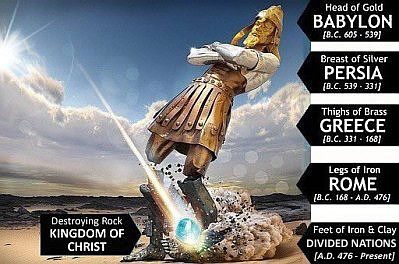
Most people in America are somewhat familiar with the dream of Nebuchadnezzar, described in the second chapter of Daniel. It is described by the prophet in Daniel 2:31-35. It is a figure of a man, with a head of gold, torso and arms of silver, thighs of bronze, shins of iron, and feet of blended iron and clay. Then a stone smashes into the feet of the man, shattering the figure. Then the stone grows into a mountain that fills the entire earth. The dream is then interpreted in Daniel 2:36-45. That interpretation tells us that the head is Nebuchadnezzar himself, the king of Babylon. The other kingdoms have been variously identified, but I think that the probable succession is that the Medo-Persian empire is the kingdom of silver, the Alexandrian empire the kingdom of bronze, and the Romans were the kingdom of iron. Notice that the kingdoms descend in value, from gold to iron, while ascending in power, from hard iron to soft gold.

The stone that smashes the figure is identified as the kingdom of God in verse 44.

The statue is identified as an "image." What is the significance of that term? The Second Commandment (Exodus 20:4-5) says, "You shall not make for yourself a carved image, or any likeness of anything that is in heaven above, or that is in the earth beneath, or that is in the water under the earth. 5You shall not bow down to them or serve them." That is to say, an "image" is not a piece of art, but rather an object of devotion. This particular image is of a man, thus representing the religious devotion to man as the standard of sovereignty. that is, the image represents, not a deity, but the religion of humanism.

What happens to the image? It is destroyed by a great stone, an asteroid, if you will, which is identified as the kingdom of God. And then the stone grows into a huge mountain which fills the whole world. Such a mountain is often used as an image of the kingdom of God, beginning with Mount Sinai and the Temple Mount in Jerusalem. it is also used as the image of the triumphant kingdom of God in the other prophets, such as Isaiah 2:2-3, 25:6, Micah 4:1-2, and Zechariah 8:3.

This vision is a prophecy of the coming of the kingdom in Jesus Christ during the time of the Roman Empire. Though all of the humanist power of Rome, with the cooperation of the apostate Jews, was devoted to destroying the kingdom, it was Rome, instead, that was destroyed. And, ever since, the kingdom of God has been growing around the world, literally filling the earth. This is a prophecy of the victory of Jesus Christ over the humanist idol of sovereign Man.

Saturday, December 10, 2016

A Prophecy of the Calling of Israel


"In that day the root of Jesse, who shall stand as a signal for the peoples—of him shall the nations inquire, and his resting place shall be glorious. In that day the Lord will extend his hand yet a second time to recover the remnant that remains of his people, from Assyria, from Egypt, from Pathros, from Cush, from Elam, from Shinar, from Hamath, and from the coastlands of the sea."
- Isaiah 11:10-11 

I often get caught between the dispensationalists on one side, who talk breathlessly of the founding of the modern State of Israel as a fulfillment of prophecy, and so-called "replacement theologians" on the other, who claim that God has no further plan for ethnic Israel, because the only Israel under the New Covenant is, they claim, the church. Each end wrongly puts lumps me with the other.

Let me start by saying that I do consider the church to be the true, spiritual Israel, both in the Old and in the New Testaments, consisting of all elect Jews and Gentiles. I deny that there are two peoples of God. That alone excludes me from the dispensationalist camp. However, I also deny that God has finished with His purposes for ethnic Israel, as a group, so that excludes me from the "replacement theology" camp.

These verses are part of why. They begin with a reference to "the root of Jesse." That phrase sounds odd, but it is merely a poetic reference to Jesus Christ. Notice that Paul applies the phrase exactly in the same way in Romans 15:8-12. Thus, these verses are a prophecy of something that will happen in Christ. That excludes the dispensationalist, literalist use of the following verse, verse, 12, which tells us that "[God] will assemble the banished of Israel, and gather the dispersed of Judah from the four corners of the earth." This cannot be a reference to the 1948 gathering of the Jews in the modern State of Israel, because that is not, emphatically not, in Christ. Rather, it must be a reference to the gathering of the Jews into the church, as they repent of their rebellion and turn to Jesus as their long-awaited Messiah.

We see this described beautifully in Zechariah 12:10: "I [God] will pour out on the house of David and the inhabitants of Jerusalem a spirit of grace and pleas for mercy, so that, when they look on Me, on Him whom they have pierced, they shall mourn for Him, as one mourns for an only child, and weep bitterly over Him, as one weeps over a firstborn." And also by Paul in Romans 11:25-28: "'The Deliverer will come from Zion, He will banish ungodliness from Jacob'; 'and this will be My covenant with them when I take away their sins.' Lest you be wise in your own sight, I do not want you to be unaware of this mystery, brothers: a partial hardening has come upon Israel, until the fullness of the Gentiles has come in. And in this way all Israel will be saved, as it is written, 'As regards the gospel, they are enemies for your sake. But as regards election, they are beloved for the sake of their forefathers.'"

God certainly has a plan for the remnant of ethnic Israel. Though they have been hardened, as a group, for their rejection of Christ two thousand years ago, a day will come when they will repent of that rejection, and be received again as God's people, not separately from the church, or from the Gentiles in the church, but as one people of God, the church!

Saturday, February 27, 2016

Is God Responsible for Sin?

Related to the so-called question of evil is the question, Is God the author of sin? Did He create sin? Is sin under His control?

Let me first address the Arminian answer to this question: sin is the result of man's free will, with the permission of God. This, the Arminian believes, relieves God of any responsibility for sin, as is supposedly required by James 1:13. However, I would suggest that the Arminian solution falls short of the weight that Arminians put on it. If I had a teenage son who told me that he intended to kill his schoolmates (as in the Columbine massacre), and I did not stop him, would I be considered free of guilt, because I merely permitted my son's wicked actions? Of course not! Both morally and legally, I would be culpable for not acting to prevent his actions. This is comparable to the Arminian attitude toward God's permission of sin. If God knew that Adam (or any of his descendants) would commit an evil act, and could have prevented it - with both of which statements the Arminian would agree - then was it not reprehensible for Him not to have prevented it? Of course, it was, so that the Arminian excuse of mere permission in no way meets his own criterion for avoiding responsibility.

In contrast, the Calvinist - including myself - insists that God is always God, and all things occur, not by His mere permission, but by His active decree. That includes things that we consider evil, whether properly so or not.

Do I then make God guilty of the acts of evil which I plainly say happen according to His decree? And the answer is no, I don't. How so?

Let me first demonstrate my assertion that all things, including what men would consider evil (whether properly so or otherwise), occur only according to the purposes of God. In Zechariah 1:14-15, that Prophet quotes God, saying, "I am exceedingly jealous for Jerusalem and for Zion, and I am exceedingly angry with the nations that are at ease. For, while I was angry but a little, they furthered the disaster." The situation is the time of the end of the exile in Babylon. As is commonly known, the Babylonians were God's tool for the punishment of Judah for idolatry. However, though Babylon was the tool of God, in her own intentions she had acted in evil, and thus incurred the wrath of God.


In Gen. 50:20, Joseph, the son of Jacob, told his brothers, "As for you, you meant evil against me, but God meant it for good, to bring it about that many people should be kept alive, as they are today." Do you recall the story? Joseph was favored by his father over his brothers, because his mother was Jacob's favorite wife. Out of jealousy, his brothers sold him into slavery, but told his father that he had been slain by beasts. After a series of adventures, Joseph became the prime minister of Egypt at a time when there was famine in Canaan. As a result, he was in a position to save his family from starvation. An act of sin on the part of the brothers was according to God's plan to save the covenant people.

In Acts 4:27-28, the Apostle Peter is preaching to the leaders of the Jews, and then prays: "Truly in this city there were gathered together against your holy servant Jesus, whom you anointed, both Herod and Pontius Pilate, along with the Gentiles and the peoples of Israel, to do whatever your hand and your plan had predestined to take place." He explicitly states that God had predestined - decreed before history began - that Jesus would suffer and be murdered for the salvation of His people. The greatest evil that has ever occurred in the bloody and violent history of mankind happened by the predetermined purpose of God.

So, now we come to the question at issue: is God thereby the author of sin, of evil, of the wickedness of men? No, He is not. What is sin? As Question 14 of the Westminster Shorter Catechism says, "Sin is any want of conformity unto, or transgression of, the law of God." Sin is the repudiation of God's authority. That definition self-evidently excludes the acts of God Himself. In addition, all that God does is for His own glory (see, for example, Isaiah 43:7) and for the good of the elect (Romans 8:28-29). That means that everything He does is necessarily good. In contrast, wicked men always act to spite the glory of God and to destroy the elect. That means that everything they do, in terms of their intent, is evil, sinful, wicked. As can be seen in the verses above, the same act, as committed by men, may be sin, but, as it is decreed by God, is only good.

Saturday, January 30, 2016

The Unbiblical Mormon Doctrine of the Pre-Existence of Souls


The Mormons hold to a doctrine of the pre-existence of the soul. That is, that the soul of each human being existed first in the spiritual realm. In their own words, "Before we were born on the earth, we lived in the presence of our Heavenly Father as His spirit children. In this premortal existence, we attended a council with Heavenly Father’s other spirit children." They claim that this doctrine is taught in Ecclesiastes 12:7: "[After death] the dust returns to the earth as it was, and the spirit returns to God who gave it." That is, Mormons claim, if it is returning to God, then it must have been with Him before it was incarnated in a body. Note that this isn't a form of reincarnation, since the Mormons do not claim that the soul existed in another body before its present incarnation.

However, as is their wont, the Mormons are being very selective in their use of Bible proofs. Another thing that God says on this matter can be found in Zechariah 12:1: "Thus declares the LORD, who stretched out the heavens and founded the earth and formed the spirit of man within him..." Here, the prophet clearly described the contemporaneous creation of, and incarnation of, a man's soul. So, when a Mormon asks where the soul was before its current incarnation, the answer is that it wasn't anywhere, any more than the body was somewhere before its conception.

In Ecclesiastes, Solomon is describing a circumstance analogous to ordering a pizza. When you order the pizza, it doesn't yet exist. Rather, it is prepared and then given to you. If you then return the pizza, let's say for being burnt, you do indeed give it back, because it existed before you returned it, not because it existed before you ordered it. In the same way, God creates the soul within the new body, apparently at conception (see Psalm 51:5), and it then returns to its Maker upon death. There is no time of spiritual existence prior to incarnation.

Thursday, September 17, 2015

The Calling of the Jews, as Described in Jeremiah

In Question 191, the Westminster Larger Catechism asks, "What do we pray for in the second petition [of the Lord's Prayer]?" The answer says, in part, "In the second petition (which is, Thy kingdom come), acknowledging ourselves and all mankind to be by nature under the dominion of sin and Satan, we pray, that the kingdom of sin and Satan may be destroyed, the gospel propagated throughout the world, the Jews called, the fulness of the Gentiles brought in..." And the Directory for the Publick Worship of God, under the heading of "prayer," directs that prayer be made, among other things, "for the conversion of the Jews, the fulness of the Gentiles..." That is almost a direct quote from the Apostle Paul in Romans 11:25-26: "a partial hardening has come upon Israel, until the fullness of the Gentiles has come in. And in this way all Israel will be saved..." It is these promises on which the catechism answer is based.

Did this concept originate with Paul? Is this a Christian imposition, and to be considered offensive by Jews? I answer no to both questions.

In Jeremiah 31:3-4, we find, "I have loved you with an everlasting love; therefore I have continued My faithfulness to you. Again I will build you, and you shall be built, O virgin Israel!" This promise appears after long passages protesting the apostasy of Israel, which God would judge with the seventy-year exile in Babylon (e. g., Jer. 25:18). The prophet continues in verse 6, "For there shall be a day when watchmen will call in the hill country of Ephraim: 'Arise, and let us go up to Zion, to the Lord our God.'" Verse 9, "With weeping they shall come, and with pleas for mercy I will lead them back..., for I am a father to Israel, and Ephraim is my firstborn." And 13-14, "I will turn their mourning into joy; I will comfort them, and give them gladness for sorrow. I will feast the soul of the priests with abundance, and My people shall be satisfied with My goodness, declares the Lord.

"Don't these verses refer to the return of Israel after the Exile?" someone may ask. Modern Jews limit it to that application. On the other hand, dispensationalists apply it to the modern State of Israel. The problem for either interpretation is further down the passage.

In verses 18-20, the prophet tells us, "I have heard Ephraim grieving, 'You have disciplined me, and I was disciplined, like an untrained calf; bring me back that I may be restored, for You are the Lord my God. For after I had turned away, I relented, I was ashamed, and I was confounded, because I bore the disgrace of my youth.' Is Ephraim My dear son? Is he My darling child? For as often as I speak against him, I do remember him still. Therefore My heart yearns for him; I will surely have mercy on him, declares the Lord." This is a description of the repentance of Israel, and return to faithfulness to her God, which certainly has not happened. Ancient Israel continued in apostasy, even rejecting and killing her Messiah, so that God destroyed their nation, city, and temple, in 70AD. And today's State of Israel is overwhelmingly secular. Under her laws, a Jew can be religious, agnostic, atheist, or even Buddhist or New Age. What he cannot be is a follower of Jesus the Messiah.

And in verses 33-34 (part of the same New Covenant passage quoted in Hebrews 8:8-12), God Himself says, "This is the covenant that I will make with the house of Israel after those days, declares the Lord: I will put My law within them, and I will write it on their hearts. And I will be their God, and they shall be My people. And no longer shall each one teach his neighbor and each his brother, saying, 'Know the Lord,' for they shall all know Me, from the least of them to the greatest, declares the Lord. For I will forgive their iniquity, and I will remember their sin no more."  This is what Paul talks about, when Israel repents of her apostasy and turns, as a nation, to her Messiah, Jesus Christ. The key is found in Jer. 30:9: "They shall serve the LORD their God and David their king, whom I will raise up for them." The restoration prophesied by Jeremiah isn't geographical or political, but rather a restoration through Jesus, the Davidic king (compare Isaiah 9:6-7 and Jer. 33:14-26). That has, demonstrably, not happened yet.

That same event is described by the Prophet Zechariah (Zech. 12:10): "And I will pour out on the house of David and the inhabitants of Jerusalem a spirit of grace and pleas for mercy, so that, when they look on Me, on Him Whom they have pierced, they shall mourn for Him, as one mourns for an only child, and weep bitterly over Him, as one weeps over a firstborn." Their God, Jehovah, promises to send His Holy Spirit to change their hearts, so that they will finally recognize Who Jesus is, and what they did to Him 2,000 years ago. And He shall receive them (Rom. 11:26-27, Isa. 59:20-21): "The Deliverer will come from Zion, He will banish ungodliness from Jacob; and this will be My covenant with them when I take away their sins." Thus, both Old and New Testaments prophecy of a time when the Jews, en masse, will repent of their hardheartedness, and turn to their God and Savior Jesus Christ.

Wednesday, April 15, 2015

Imputed Righteousness in the Old Testament

One of the doctrines of classical dispensationalism that I find most bizarre is its teaching that the Old Testament is a system of works righteousness, that is, the belief that Old Testament believers attained right standing with God by obedience to the Mosaic Law. Some, such as John Hagee, even teach that modern Jews are saved by that means. I understand that modern dispensationalists have generally repudiated that doctrine.

However, I see a very different teaching in the Old Testament.

Look, example, at Isaiah 26:12: "O LORD, You will ordain peace for us, for You have indeed done for us all our works." The prophet testifies that our good works have actually been done in us by God! And again in Isaiah 46:13: "I bring near My righteousness, it is not far off; and My salvation will not delay." Consider also Isaiah 52:1: "Awake, awake, put on your strength, O Zion; put on your beautiful garments, O Jerusalem, the holy city; for there shall no more come into you the uncircumcised and the unclean." This is the same imagery used in Zechariah 3:3-4, in which the High Priest Joshua is first seen in the filthy garments of his own unrighteousness (cp. Isaiah 64:6), to be clothed anew in Christ's righteousness: "'Remove the filthy garments from him.' And to him he said, 'Behold, I have taken your iniquity away from you, and I will clothe you with pure vestments.'" This imagery is picked up by the Apostle John in the Revelation, such as Rev. 3:18 and 7:14.

The Prophet Jeremiah even uses Christ as our righteousness as His name! Jeremiah 23:6 tells us of the Branch of David, "In his days Judah will be saved, and Israel will dwell securely. And this is the name by which he will be called: ‘The Lord is our righteousness.’" The prophet tells Israel that their righteousness is not by their own actions, but rather to be found in their Messiah to come!

It can be fairly said that these prophets are obscure, compared to the clarity of the Gospel in the New Testament. Of course that is so. The Old Testament contains the Gospel under types and shadows, both of which are removed in the New Testament. The glory of the person and work of Christ far exceed that of their obscurity in the Old Testament, just as the smell of baking bread, as wonderful as it is, is far exceeded by the taste of the bread, dripping with melted butter! But the fact that the New Testament glory is greater should never be allowed to deny the presence of the Gospel in the Old Testament.

And, on a side note, I think it is crucial to mention that these truths are what we need to be showing our Jewish neighbors, in the hope that we may see the day when God will remove the veil from their eyes, and they will come in repentance to the Messiah that they initially rejected (Romans 11:25-27).

Monday, March 30, 2015

The Preservation of the Church

Almost every Christian is familiar with Matthew 16:18: "I tell you, you are Peter, and on this rock I will build My church, and the gates of hell shall not prevail against it." We know that it has been perverted by the Catholic Church, which claims it as justification for their assumption of the infallibility of their church organization. Well, first, it doesn't say anything of the sort, and, second, I deny that they are a true branch of the Church of Christ, so they can make no legitimate claim on it, regardless of what it actually teaches.

Rather, it teaches that the Church of Christ - that mystical, invisible body of all true believers down through history, without regard to their respective organizational affiliations - can never be overcome by the evil forces that would seek to destroy her. This is the doctrine of the invisible church, as opposed to the visible organizations of Christians in denominations and individual congregations.

I am writing on this topic, because it was an underlying theme in my own church yesterday, the Lord's Day. Apparently, the Holy Spirit had a point to make.

In Sunday School, my class, one of three adult classes, is studying Zechariah. Yesterday, we were in chapter 12. Three verses stand out in my mind:

Verse 3: "On that day I will make Jerusalem a heavy stone for all the peoples. All who lift it will surely hurt themselves. And all the nations of the earth will gather against it."

Verse 8: "On that day the Lord will protect the inhabitants of Jerusalem, so that the feeblest among them on that day shall be like David, and the house of David shall be like God, like the angel of the Lord, going before them."

Verse 9:  "And on that day I will seek to destroy all the nations that come against Jerusalem."

Since I don't believe that God has a special concern about a plot of dirt, I don't believe that this passage is about physical Jerusalem, but rather about the heavenly Jerusalem of such passages as Galatians 4:26 and Hebrews 12:22, and the new Jerusalem of Revelation 3:12 and 21:2. So, in each of these three verses from Zechariah, their significance can be seen by making them literal, that is, by inserting "church" in each place where the prophetic imagery says "Jerusalem."

Then during worship, one of the passages read was Psalm 118, which reads, in part (verses 6, 10-13): "The Lord is on my side; I will not fear. What can man do to me?... All nations surrounded me; in the name of the Lord I cut them off! They surrounded me, surrounded me on every side; in the name of the Lord I cut them off! They surrounded me like bees; they went out like a fire among thorns; in the name of the Lord I cut them off! I was pushed hard, so that I was falling, but the Lord helped me."

The church is surrounded by her enemies, all of whom are serving her greatest enemy, Satan. Here in the United States, we are attacked by secularists, who hate her prophetic voice. In other countries, her persecutors may be Muslims, or Hindus, or Communists, or even enemies claiming to speak for her God, such as the Inquisition in the past. Yet, Jesus promises His presence (Matt. 28:20), that we are in His hands (John 10:28), and that His power surrounds us (Zech. 2:5). While there have certainly been times when she was at a low ebb, there has never been, and never can be, a time when she cannot be found, for her survival isn't a matter of her own strength, but rather that of the God who gave His blood to purchase her (Acts 20:28, Col. 1:20, Rev. 5:9), of which we are reminded each time we receive communion (Matt. 26:28, Mark 14:24, and Luke 22:20).

Friday, December 5, 2014

The Faithfulness of God, Seen in the Covenant with David

My fourth biblical-theology paper.

    David, son of Jesse, the second King of Israel, is the foremost character in the second half of I Samuel, beginning in chapter 16, all of II Samuel, and in I Kings, up to chapter 2, as well as their parallel passages in I Chronicles. He himself authored authored a large, though indefinite, portion of the Psalms. Thus, he rivals his descendant Jesus in the amount of Scripture devoted to his person.
    The first King, Saul, rebels against God in I Samuel 15. As a result, God removes His anointing from Saul and his line. In his place, in chapter 16, the Prophet Samuel is commanded to anoint a replacement. Samuel examines the son’s of Jesse, going down the line from eldest down, rejecting them one by one, until David, the youngest is brought before him, and God commands him to anoint David as king-elect. We next see him in chapter 17, as Israel is standing intimidated by the champion of the Philistines, the giant Goliath. David, too young to be a soldier, is sent by his father to carry food to his elder brothers. At the front, he is appalled by the failure of any Israelite to answer Goliath’s challenge. Then David, still a beardless youth, a mere shepherd, volunteers. He approaches, not as a swaggering warrior as God’s appointee. He tells Goliath (17:45), “I come to you in the name of the Lord of hosts, the God of the armies of Israel, Whom you have taunted.” He strikes down Goliath with his shepherd’s sling, cuts of his head, and the now-inspired Israel drives away the rest of the disheartened Philistine army.
    Saul is jealous of David, as he listens to the people sing, “Saul has slain his thousands, and David his ten thousands” (18:7). He knows that he has been rejected by God in favor of David, now his son-in-law (18:20-30), and resents him for it, especially in the face of the close friendship between David and Saul’s son Jonathan (ch. 20). Saul persecutes David in chps. 21-30, during which time David marries his second wife, the widow of Nabal (ch. 25). Saul and his sons, including Jonathan but not Ishbosheth. Ishbosheth becomes king of eleven tribes, while David is crowned over Judah. The divided kingdom lasts seven and a half years (II Sam. 5:5), until Ishbosheth is assassinated, and David is then crowned king over the reunited kingdom (v. 3). The only surviving member of Saul’s family, Jonathan’s lame son Mephibosheth (v. 4:4), was to remain an honored guest in David’s household (ch. 9).
    The most important segment of David’s history is in chapter 7:8-17 (I Chronicles 17:1-15), the Davidic covenant. As was standard in such covenants, it begins with a rehearsal of God’s past blessings on David (vv. 8-9), then promises blessings (vv. 13-16). God promises peace, and a lineage on the throne of Israel forever. Verse 16 is the culmination: “Your house and your kingdom shall be made sure forever before me. Your throne shall be established forever.” David responds in a prayer of thanksgiving in vv. 18-29, ending with a confidence in God’s promises: “For You, O Lord God, have spoken, and with Your blessing shall the house of your servant be blessed forever.”
    The next major event in David’s life is his sin with Bathsheba (ch. 11). After seeing her bathing on the roof of her house, David has her husband, Uriah the Hittite, exposed in battle with the Ammonites. With Uriah out of the way, David then takes the now-widow as his third wife. The sin is rebuked by the Prophet Nathan in chapter 12, and the newborn son of David with Bathsheba is struck down (vv. 15-23). However, their next son is Solomon, destined to be David’s heir. This demonstrates the human sinfulness of this man, of whom God said, “This is a man after my own heart” (I Sam. 13:14). As a result, David deals suffers from the sins of his own children” Amnon with Tamar, and the rebellion of Absalom. We see his nature again in his census of chap. 24, resulting in God’s striking down of 70 thousand of his people. I Kings 1 and 2 are the account of the transfer of the kingdom from David to Solomon, and then David’s passing (vv. 10-12).
    David’s son, Solomon, as the newly-anointed king, relies of God’s covenant with his father in I Kings 3:6-14: “You have kept for him this great and steadfast love, and have given him a son to sit on his throne this day.” This suggests that David made great effort to teach Solomon what God had promised and done for him. But 5:3 indicates that he was also aware of the consequences of David’s bloody hands. We see both sides of David’s relationship with God in 8:15-20. But Solomon continues confident in God’s covenant promises (vv. 24-26). And that confidence is shared by all of Israel in verse 66.
    God explicitly repeats the promises of the Davidic covenant with Solomon in 9:4-5. This is similar to the pattern of the Abrahamic covenant, with the terms renewed with each succeeding generation. However, unlike David, Solomon did not keep his side of the covenant. In 11:4-6, the writer of Kings shows Solomon following after the pagan deities of his multitudinous wives. Yet, God continues faithful (vv. 12-13), not for Solomon’s sake, but for David’s. Later in the chapter, God punishes the apostasy of Solomon by dividing the kingdom with a rebellion against his son, Rehoboam. Yet, even here, God remembers his covenant, and reserves the tribe of Judah to David’s line (vv. 32-39). This pattern is repeated with Rehoboam’s son, Abijam. In 15:3, the writer explicitly tells us that Abijam did not share the faith of his ancestor David, but vv.4-5 show us God acting out of faithfulness to David: “because David did what was right in the eyes of the Lord…” This is what Paul refers to, in II Timothy 2:13: “If we are faithless, he remains faithful - for He cannot deny Himself.” In II Kings 8:16ff, when Jehoram follows the apostate path of his Israelite kinsmen, even here, the writer tells us, “Yet the Lord was not willing to destroy Judah, for the sake of David His servant, since He promised to give a lamp to him and to his sons forever.”
    The writer of Kings continues to use David as the standard against whom to compare his posterity. His lineage rates badly in 14:3 and 16:2, but well in 18:3. God again recalls His covenant in 19:34 (parallel in Isaiah 37:33-35), as Assyria, after eliminating the northern kingdom, now attacks Jerusalem:  “I will defend this city to save it, for My own sake and for the sake of My servant David.” As Paul said to Timothy, God acts according to His covenant promises because He is watchful over His own truth and reputation, as well as the welfare of His elect.
    David himself writes of God’s establishment of His covenant. In Psalm 18:20-24, he wrote, “The Lord dealt with me according to my righteousness, according to the cleanness of my hands… The Lord has rewarded me according to my righteousness, according to the cleanness of my hands in His sight.” He does not claim that his righteousness is inherent for (v. 32), “[God] equipped me with strength and made my way blameless.” He remembers the particular elements of the covenant, as he credits God with “making me the head of the nations” (v. 43) and “subduing peoples under me” (v. 47), promises “to David and his offspring forever” (v. 50). Asaph sings of the covenant in Psalm 78:67-72: “He chose David His servant… to shepherd Jacob His people… [And] with upright heart he shepherded them.” Ethan the Ezrahite has the voice of God recalling (89:19-37), “I have found David My servant; with My holy oil I have anointed him, so that My hand shall be established with him… My faithfulness and My steadfast love shall be with him… He shall cry to Me, ‘You are my Father, my God, and the Rock of my salvation’... My steadfast love I will keep with him forever, and My covenant will stand firm for him. I will establish his offspring forever, and his throne as the days of the heavens… I will not remove from him my steadfast love or be false to My faithfulness. I will not violate My covenant or alter the word that went forth from My lips…” Ethan claims this faithfulness for all of God’s people (v. 49): “Lord, where is your steadfast love of old, which, by Your faithfulness, you swore to David?”
    The unnamed writer of Psalm 132 applied the same principle of prayer. In verse 1, he starts with, “Remember, O Lord, in David’s favor…” He claims God’s faithfulness to david for the benefit of all of Israel. Verses 11-12: “The Lord swore to David a sure oath from which He will not turn back: ‘One of the sons of your body I will set on your throne. If your sons keep My covenant and My testimonies that I shall teach them, their sons also forever shall sit on your throne.” The writer asks, “If Jerusalem is destroyed, how can You fulfill Your promise that there shall always be a son of David to rule there?” The promise to David, in his eyes, has positive implications for the whole nation.
    The Prophet Isaiah also applied the Davidic covenant to the people of God, as the promise according to which the Messiah would come. In Isaiah 9, the famous Christmas story, he writes (vv. 6-7): “For to us a child is born, to us a son is given; and the government shall be upon His shoulder… Of the increase of His government and of peace there will be no end, on the throne of David and over his kingdom, to establish it and to uphold it…” So, we see an expansion of the vision of the covenant. Where David had seen it as a political promise, with his dynasty established over ethnic Israel, Isaiah now expands that vision to point to a particular King, yet unnamed, who shall take that kingdom to a far greater glory. He repeats that vision in 16:5, “A throne will be established in steadfast love, and on it will sit in faithfulness in the tent of David one who judges and seeks justice and is swift to do  righteousness.” Again, he moves the covenant from a promise of a lineage of men to a particular One.
    Isaiah also makes use of the covenant to encourage the faithful remnant of Israel. In 55:1-5, he calls the people to repentance, assure of the faithfulness of God, as seen in His covenant with David. Verse 3: “Incline your ear and come to Me; hear, that Gsoul may live; and I will make with you an everlasting covenant, My steadfast, sure love for David.” David, the sinner of Bathsheba and Psalm 51 relied on the faithful mercy of God. If he did it, can’t I?
    God Himself made the same comparison through Jeremiah (17:24-25). Using the Sabbath as a test case, He calls the people to repent, and “then there shall enter by the gates of this city kings and princes who sit on the throne of David, riding in chariots and on horses, they and their officials, the men of Judah and the inhabitants of Jerusalem. And this city shall be inhabited forever.” Or, if they refuse (21:12, repeated in 22:2-4), “Hear the word of the Lord, O house of David! Thus says the Lord, ‘Execute justice in the morning, and deliver from the hand of the oppressor him who has been robbed, lest My wrath go forth like fire, and burn with none to quench it, because of your evil deeds.’” Repent and enjoy the blessings of David, but do not presume on them to excuse your wickedness.
    Then, as Isaiah 9, Jeremiah turns to the One who will ultimately fulfill God’s promises to David. 23:5: “I will raise up for David a righteous Branch, and He shall reign as king and deal wisely, and shall execute justice and righteousness in the land. In His days, Judah will be saved, and Israel will dwell securely. And this is the name by which He will be called: The Lord is our righteousness.” Where the writer of Kings lamented that king after king failed to evidence the faith of David, the One Davidic king to come will do so. And, on the side of the people (30:9): “They shall serve the Lord their God and David their king, Whom I will raise up for them.” Just as the One king will demonstrate the best of David’s faith, under His rule the people will do so, as well.
    The Branch appears again in 33:14-26. The content of the Davidic covenant is repeated in verse 17: “David shall never lack a man to sit on the throne of the house of Israel…” (and again in verses 21 and 26). The passage also adds a new element (v. 18): “The Levitical priests shall never lack a man in my presence…” (also verse 21). David wasn’t a priest, so this aspect of the Branch is an expansion, perhaps from the reference to the priesthood of Melchizedek in David’s Psalm 110:4. It isn’t relevant here, but Christ fulfilled this in His union of the offices of priest and king.
    The Prophet Ezekiel prophesies a coming Messiah as the fulfillment of God’s covenant promises to David in 34:22-24: “I will set up over them one Shepherd, my servant David, and He shall feed them; He shall feed them and be their Shepherd. And I, the Lord, will be their God, and my servant David shall be prince among them.” Ezekiel continues this theme in 37:24-28: “My servant David shall be king over them, and they shall all have one Shepherd… David My servant shall be their prince forever… My dwelling place shall be with them, and I will be their God. and they shall be My people…” Notice his resurrection of the servant theme of Isaiah.
    This Davidic king also makes a brief appearance in the prophecies of Hosea (3:5): “The children of Israel shall return and seek the Lord their God and David their king, and they shall come in fear to the Lord and to His goodness in the latter days.” And in Amos 9:11-12: “In that day I will raise up the booth of David that is fallen and repair its breaches,... that they may possess… all the nations who are called by My name.” And in Zechariah 12: 6-13:1, especially that last verse: “On that day there shall be a fountain opened for the house of David and the inhabitants of Jerusalem, to cleanse them from sin and uncleanness.”
    In the New Testament, David plays a prominent role in the apologetic efforts of the Apostles to prove that Jesus was the expected Messiah and Branch of the prophets.
    In the genealogy of Jesus as given by Matthew (1:1-17), not only is the line of David prominent, but the author emphasizes the number fourteen, even skipping generations to create the three sets of fourteen. Why? Because, in hebrew, the letters also represented numbers. The consonants of David’s name (daledh-waw-daledh) add up to fourteen. Thus, not only is Jesus a lineal descendant of David, but Matthew adds that name symbolically three more times to multiply the emphasis on that fact. Not only is Jesus addressed or referred to as the “Son of David” eleven times (e. g., 9:27 and 12:23), but He Himself uses David’s words from the Psalms to express the connection in His teachings (e. g., 22:43).
The words of the David covenant appear in Mark  11:10: “Blessed is the coming kingdom of our father David.” And again in Luke 1:32-33: “He will be great and will be called the Son of the Most High. And the Lord God will give to Him the throne of His father David, and He will reign over the house of Jacob forever, and of His kingdom there will be no end.” And again in verse 69: “[The Lord God of Israel] has raised up a horn of salvation for us in the house of His servant David.” And finally in John 7:42: “Has not the Scripture said that the Christ comes from the offspring of David, and comes from Bethlehem, the village where David was?” Thus, the Gospel writers confronted the Jews with their own covenantal expectations as pointing to this Jesus, whom they were to reject and crucify. This would serve as a direct apologetic against the claims of unbelieving Jews that the Messiah is still to be anticipated, because Jesus did not fulfill that role as they expected.
In Acts, Luke turned to David again, but with less of the covenantal emphasis. In 1:16, 2:25-30, 2:34-35, and 13:33-38, he borrows from Jesus own strategy, using David’s words to emphasize the connection between David and Jesus. He explicitly makes Jesus the hair of David in 13:23: “Of this man’s [i. e., David’s] offspring, God has brought to Israel a Savior, Jesus, as He promised.” This language is reminiscent of th Branch terminology of the Prophets. See also 15:16-17.
Paul also borrows this apologetic theme, such as in Romans 4:6-8, 11:9-10, and II Timothy 2:8. Yet, he never follows up on the covenantal theme, a role he gives, instead, to Abraham.
Jesus again picks up His “Son of David” role in Revelation 3:7: “The words of the Holy One, the True One, Who has the key of David…” And, in the words of an elder in 5:5: “Behold the Lion of the tribe of Judah, the Root of David, has conquered…” And in Jesus’s words again, in 22:16: “I, Jesus, have sent My angel to testify to you about these things for the churches. I am the root and the descendant of David, the bright morning star.”
So, the story of David min the Bible is the story of God’s faithfulness, both to him and to the people of God as a whole. Through His words to him, God establishes a theme of promised redemption, peace, and prosperity, not as the result of merit, but because of God’s covenantal promises of grace, justification, sanctification, and glorification. The New Testament writers continue the story of David, both in their own words and in the words of Jesus, to point Israel to Him. Here is the man promised for a thousand years! Here is the promise of God incarnate! All that we have waited for is here, standing embodied before you. And even in the last verses of the Bible, Jesus Himself points to His purposes as bringing to pass God’s faithfulness to David, and to all Israel in him.

Wednesday, September 24, 2014

Streams in the Desert: Israel in Prophecy

"For I will pour water on the thirsty land,
    and streams on the dry ground;
I will pour My Spirit upon your offspring,
    and My blessing on your descendants.
They shall spring up among the grass
    like willows by flowing streams.
This one will say, ‘I am the Lord's,’
    another will call on the name of Jacob,
and another will write on his hand, ‘The Lord's,’
    and name himself by the name of Israel."
- Isaiah 44:3-5

I have no issues with the modern State of Israel. However, as I have noted before, I oppose the Israelotry that seems to possess so much of American evangelicalism. I think much of it involves bad hermeneutics, changing spiritual prophecies into materialistic pandering.

That's why I quote the verses above. It is true that the Old Testament, especially the book of Isaiah, prophesies some wondrous events in Israel. I simply deny that those events are intended to be taken in a literal way. Rather, I see them as prophecies of the wondrous works of the Holy Spirit in the Gospel. Yet dispensationalists accuse me, and those who hold to the same view, of "spiritualizing" Scripture. I proudly admit my debt to the Puritans in this matter, as can be found described in the book, The Puritan Hope, by Iain Murray.

But is it fair to accuse me of spiritualizing? I don't believe so. Afterall, the proper hermeneutic method is to interpret the Bible, one passage compared to another, referred to as "the analogy of faith." The more difficult passage is interpreted in the light of the clearer passage.

In this case, we have an explicit interpretation of the symbols used by Isaiah. In verse 5, he quotes God, proclaiming that "I will pour water on the thirsty land, and streams on the dry ground." Then, in the pattern of Hebrew parallelism, that phrase is restated, "I will pour My Spirit upon your offspring, and My blessing on your descendants."  An equivalency is given: pouring out water and streams means pouring out the Holy Spirit.

While I equate Israel and the church, I also connect this to Paul's prophecy in Romans 11:25-27 (compare, for example, Zechariah 1:17 and 12:10) that a day will come when Israel, i. e., ethnic Israel, will turn as a people to Messiah Jesus, Him whom they had rejected. So, I do not deny that ethnic Israel has a particular place in the purposes of God. Rather, what I deny is that political Israel is the fulfillment of those purposes.