Showing posts with label Catholic Church. Show all posts

Saturday, March 26, 2022

The Five Solas: God's Perpetual War Against Rome


In the Reformation, the Reformers developed a systematic formulation that delineated the distinction of the biblical Christian faith from the corrupted version held by Rome. These doctrines have come to be known as the Five Solas, from their Latin forms.

Sola gratia, by grace alone. The Bible says that justification is by the condescending mercy of God. It cannot be due to any will or worthiness in the sinner because there is none. 

Sola fide, by faith alone. For those whom God has mercifully chosen to save, that justification is applied to them by means of faith. That is, faith is not meritorious, but is rather an instrument for applying justification. 

Solus Christus, on the basis of Christ alone. Everything necessary to justify God's people was achieved by the atoning work of Jesus, i. e., His perfect life, atoning death, and victorious resurrection. No additional intent, ritual, or action of men is necessary or possible, because Jesus did all that was necessary. 

Soli deo gloria, for the glory of God alone. God's purpose in justifying His people was not for our sakes, though we are certainly the beneficiaries. He did it to display the glories of His mercy and to glorify His Son with a church. 

Sola scriptura, in Scripture alone. Everything necessary to know about our sin, God's judgment, the redemption purchased by Christ, and the life of sanctification is and can be found in the Bible alone, using the ordinary means of reason, illuminated by the Holy Spirit. No human tradition added to Scripture or in its place can ever bind the conscience of the man of God. 

Even after the five centuries which have passed since the start of the Reformation, these truths have not changed. Nor has Rome ever repented of her errors here opposed. When professed Protestants practice fellowship and cooperation with the Catholic Church, it is not because she has given up her errors, but because the Protestants have accepted them.

Wednesday, March 23, 2022

What Works Are Excluded from Justification?

I have had discussions with both Mormons and Catholics about Romans 3:28: "For we hold that one is justified by faith apart from the works of the law." The topic was the doctrine of both groups that a person is justified by a mixture of faith and works, instead of by faith alone. They denied that a person is justified by faith alone, claiming that Paul rejects the works of the Mosaic code, such as circumcision, as contributing to justification. That is, they restrict the meaning of "law" just to the rules and ceremonies given to Israel through Moses. 

What neither will mention is Paul's other uses of "law," especially in Galatians. In Galatians 4:21-26, 28-31, he makes a case: "Tell me, you who desire to be under the law, do you not listen to the law? For it is written that Abraham had two sons, one by a slave woman and one by a free woman. But the son of the slave was born according to the flesh, while the son of the free woman was born through promise. Now this may be interpreted allegorically: these women are two covenants. One is from Mount Sinai, bearing children for slavery; she is Hagar. Now Hagar is Mount Sinai in Arabia, she corresponds to the present Jerusalem for she is in slavery with her children. But the Jerusalem above is free, and she is our mother... Now you, brothers, like Isaac, are children of promise. But, just as at that time he who was born according to the flesh persecuted him who was born according to the Spirit, so also it is now. But what does the Scripture say? 'Cast out the slave woman and her son, for the son of the slave woman shall not inherit with the son of the free woman.' So, brothers, we are not children of the slave but of the free woman." 

Paul makes a very clear distinction here. Is it between works of the Mosaic law and other works? Clearly not. Anyone with a modicum of biblical knowledge knows that Abraham lived four-hundred years before  Moses. Rather, he uses "law" to describe the works of the flesh, such as those of Moses, using the label of the part to represent the whole (a synecdoche), in distinction from the promise, which he uses to label grace alone through faith alone. 


Wednesday, November 24, 2021

The Works of a Christian As a Defining Line Between True and False Christianity

One of the consistent errors that mark cults is their perversion of salvation to some form of works righteousness. This is true of the largest cult, the Roman Catholic Church, as well as other well-known cults such as the Mormons, the Jehovah's Witnesses, Church of Christ, or any one that we could name. 

That one error is a defining distinction between cults and orthodox Christianity, i. e., biblical Protestantism. 

The error of each of these cults is that they mix justification with sanctification. That is, they make the good works of the professing Christian to be part of his justification before God, whether it is faith plus sacraments, or faith plus love. Always the error involves faith plus something, instead of biblical justification, which is by faith alone

This is not to profess the strawman argument used by such groups against Protestants, by which they claim that the denial of a role in justification means that Protestants believe that works do not matter. That accusation is false. With the Bible, Protestants hold that works are the necessary result of saving faith. That is the opposite of what the cults teach. The Protestant talks about works as the necessary result, while the cults make works a necessary component of justification. 

This is what we find in the New Testament. 

Acts 15:9: "He [God] made no distinction between us [Jews] and them [Gentiles], having cleansed their hearts by faith." 

Romans 6:1-6: "What shall we say then? Are we to continue in sin that grace may abound? By no means! How can we who died to sin still live in it? Do you not know that all of us who have been baptized into Christ Jesus were baptized into His death? We were buried, therefore, with Him by baptism into death, in order that, just as Christ was raised from the dead by the glory of the Father, we, too, might walk in newness of life." 

Galatians 2:20: "I have been crucified with Christ. It is no longer I who live, but Christ who lives in me. And the life I now live in the flesh, I live by faith in the Son of God, who loved me and gave Himself for me." 

This is far from an exhaustive list.

Wednesday, November 17, 2021

The Fullness of the Revelation of the Faith

In his epistle, Jude, the brother of Jesus, made an interesting comment: "Beloved, although I was very eager to write to you about our common salvation, I found it necessary to write appealing to you to contend for the faith that was once for all delivered to the saints" (Jude 1:3). "Delivered once for all" can mean nothing except that the content of the Christian faith, that is, all of her doctrine, had been fully revealed by the time Jude was forced to warn against false teachers who were striving to corrupt that faith. Paul made the same point to his young protégé in II Timothy 3:15-17). 

The importance of Jude's words here is to shut the door in the faces of pseudo-Christian sects who seek to claim that they have revelations of additional doctrines beyond those given by Jesus and His Apostles. The Mormons have their Book of Mormon and other "scriptures," while Rome makes lofty claims for her "sacred tradition." Both claims are their efforts to cover the manmade doctrines that they confess cannot be found in the Bible. 

Yet, according to Jude, that exclusion is sufficient proof that the doctrinal claims of Rome and the Mormons are precluded from true Christianity exactly because they were not revealed in the New testament once for all. 


Wednesday, July 21, 2021

Forgiving Sins and Priesthood Authority

I have been having discussions with Mormons recently on the place of "priests" in the Christian Church. They claim to have an exclusive "priesthood authority." According to the organization's website, that means "in mortality, priesthood is the authority that God gives to man to act in all things necessary for the salvation of God's children." What is that authority? From the organization's handbook: "The keys of the priesthood are the right to preside and direct the affairs of the Church within a jurisdiction. Jesus Christ holds all the keys of the priesthood pertaining to His Church. He has conferred upon each of His Apostles all the keys that pertain to the kingdom of God on earth. The senior living Apostle, the President of the Church, is the only person on earth authorized to exercise all priesthood keys." 

When I talk to Mormons, they claim that Jesus Himself created this authority in the church, when Peter first professed His Messianic office in  Matthew 16. Jesus said, "Blessed are you, Simon Bar-Jonah! For flesh and blood has not revealed this to you, but My Father who is in Heaven. And I tell you, you are Peter, and on this rock I will build My church, and the gates of Hell shall not prevail against it. I will give you the keys of the kingdom of Heaven, and whatever you bind on earth shall be bound in heaven, and whatever you loose on earth will be loosed in Heaven" (Matthew 16:17-19). Mormons (and Catholics) claim that Peter and his successors received here from Jesus his imprimatur allowing them to forgive sins, and, thus, mediating salvation to everyone else. 

To my mind, that claim is blasphemous, a denial of the sufficiency of Christ for the salvation of His people. As the Scriptures say, "There is one God, and there is one mediator between God and men, the man Christ Jesus, who gave Himself as a ransom for all" (I Timothy 2:5-6). That is what is said about Him. 

But is there anything which Jesus Himself said that directly refutes this claim of priesthood? 

Yes, there is. In the story of the paralytic, Jesus says to the frowning scribes, "Which is easier, to say, 'Your sins are forgiven,' or to say, 'Rise and walk'? But that you may know that the Son of Man has authority on earth to forgive sins - (He then turned to the paralytic) - Rise, pick up your bed and go home" (Matthew 19:5-6). In the parallel passage in Mark, we get an additional piece of information. That is that the scribes accused Him of blasphemy, because, "Who can forgive sins but God alone?" (Mark 2:7). And notice that Jesus does nothing to disabuse them of this opinion! They were correct that God alone can forgive sins. And in claiming that authority, Jesus blasphemed, in their view, because His claim was a claim to deity, equal to that of the Father! 

More to my point is that Jesus agreed that the authority belongs to God alone, and, therefore, cannot be held by any mere man, including Peter or anyone who claims to be his successor. Rather, as the representative of the only Head of the Church, Peter, the other apostles, and every true minister since their time has declared, not that they forgave sins, but rather that they brought the Gospel, the news that Jesus has purchased forgiveness of sins for everyone who believes (Acts 10:43). Jesus forgives, and the messenger announces

"With God are wisdom and might; He has counsel and understanding. If He tears down, none can rebuild; if He shuts a man in, none can open. If He withholds the waters, they dry up; if He sends them out, they overwhelm the land. With Him are strength and sound wisdom; the deceived and the deceiver are His. He leads counselors away stripped and overthrows the mighty. He deprives of speech those who are trusted and takes away the discernment of the elders" (Job 12:13-20). 


Saturday, July 17, 2021

Judgment According to the Imputed Righteousness of Jesus

When I am dealing with members of Pelagian sects, such as Mormons and Catholics, on the issue of justification by faith alone, some of them think they are clever by citing, for example, Revelation 20:13: "The sea gave up the dead that were in it, Death and Hades gave up the dead that were in them, and they were judged, each one of them, according to what they had done." Aha! the Pelagian proclaims. If we are judged according to our works, then we must be saved in part by our works, and not by faith alone! And taken in isolation, that verse may be taken that way. 

But the responsible Bible reader doesn't take individual verses in isolation. A doctrine must be built by comparing verse to verse to learn the overall teaching. 

For example, we have Romans 5:19: "As by one man's [i. e., Adam's] disobedience the many were made sinners, so by the one Man's [i. e., Jesus's] obedience the many will be made righteous." Paul shows us the contrast between the two imputations, of sin to Adam's posterity (except Jesus), and of righteousness to the posterity of Jesus (i. e., believers). The Apostle makes the same point in II Corinthians 5:21: "For our sake, God made Him to be sin who knew no sin, so that in Him we might become the righteousness of God." 

The problem is that the Pelagian doesn't understand justification by faith as well as he thinks he does. Pelagianism misrepresents justification as merely the cancellation of the sin debt, returning the sinner to a neutral state. That is why the Pelagian also believes that a believer can lose salvation; after the cancellation of his previous debt, he sins more and incurs new debt. That view is false. Rather, as Paul says, there is the complementary imputation of Christ's righteousness. The new believer is not brought merely to a neutral state by faith. Rather, he also receives to his heavenly account, by means of that same faith, all of the righteousness of Jesus. 

In the eyes of God, the believer is never a person of neutral moral status. Rather, the believer stands before God as a sinless and righteous man or woman. Thus, there is no judgment which we must fear.


Saturday, July 3, 2021

Peace of Spirit Through Justification by Faith Alone

The primary issue of controversy between the Reformers of the Sixteenth Century and the Roman Catholic Church was the question of justification: What is its basis? Faith alone? Or faith and works? The Reformers held, and correctly so, that justification before God occurs by grace alone through faith alone, and is, therefore, instantaneous. In contrast, Rome mixed (and continues to mix) faith with works, such that justification is a process, one which may not even be completed in this life, but continue into Purgatory. 

Here is the Protestant definition: "Justification is the divine declaration, the judicial verdict, that instantaneously and perfectly acquits the sinner of guilt before the tribunal of God and constitutes him perfectly righteous. Upon the instantaneous verdict of justification, there is nothing imperfect about the justified sinner regarding righteousness with God, nothing to improve and nothing to increase. It is with the justified sinner as though he were as guiltless as the perfect Jesus Christ, as though he had fully atoned for all his sins and perfectly obeyed all the commandments of God, and as though he had completely satisfied the justice of God" (Rev. David Engelsma, "Gospel Truth of Justification," p. 225, emphasis added). Notice his use of words such as "perfect" and "instantaneous." Biblical justification is a legal verdict, and, just like a judge's declaration of "not guilty" in a human court, justification occurs at a point of time, fully, and can never be increased or decreased, or wait for some additional action. If the justified sinner were to die immediately after professing his faith, such as the thief on the cross (Luke 23:42-43), he would be transported to the presence of Jesus just as surely as the man of God who has been faithful for decades before his death. 

In contrast, Rome denies those qualities of justification, because she blends justification with sanctification. She holds that a person is justified by faith plus the works that come from it. Her foundation for that claim is a misreading of James 2:24: "You see that a person is justified by works and not by faith alone." However, the context of that verse is not justification before God, but rather how that justification is demonstrated before men. Since no man can see the heart of another, he has no way to know whether his friend's profession of faith is real or false. How can he tell? By his friend's works or lack of them. 

One result of that difference is the assurance of salvation. The Protestant view of instantaneous justification apart from works enables the believer to know of his eternal welfare immediately and for the rest of his life, as the Apostle John told us: "This is the testimony, that God gave us eternal life, and this life is in His Son" (I John 5:11). Notice the present tense. He doesn't say "may have" or "could have" or someday could have." In contrast, Rome claims that it is arrogant to believe that one has eternal life now. In Rome's system, the believer can never know for sure his eternal status. He must continue to work, hoping that he has done enough, but unable to know. That is a system of bondage and fear, while the true Gospel brings peace: "Since we have been justified by faith, we have peace with God through our Lord Jesus Christ" (Romans 5:1).


Saturday, June 5, 2021

Justification and That Essential Four-Letter Word: Alone


"In teaching justification by faith alone, Calvin and the Reformed creeds, like Luther before them, are biblical. Not only does the Bible teach that justification is by faith, but it teaches also that justification is by faith alone. The Bible teaches justification by faith alone not by using the word alone, but by contrasting faith as the means of justification with the only alternative, namely, the works of the sinner. When, in its great passages on justification, the Bible affirms that justification is by faith and immediately adds that justification is not by works, the Bible teaches not only that justification is by faith, but also that justification is by faith alone. So clearly, purposefully, and decisively does the Bible thus teach justification by faith alone that alone is, in fact, in the text. It is in the text implicitly." 

- Rev. David Engelsma, "Gospel Truth of Justification," p. 185, emphasis in original 

When Martin Luther first translated the Bible into his native German he added the word "alone" to Romans 3:28: ""So halten wir nun dafür, dass der Mensch gerecht werde ohne des Gesetzes Werke, allein durch den Glauben" (Literally: "We therefore conclude that a man is justified without the works of the law, alone through faith"). Rome has accused him ever since of adulterating the verse. More recently, Mormons have repeated the accusation, and applied it to all orthodox Protestants who hold to Sola Fide, justification by faith alone

As seen in the quote above, Luther might have added the word, but he did not add the concept. He merely made explicit what was already implicit. Not only is there nothing dishonest in doing so, but it is a common practice in translating. In fact, the King James Version used by the Mormons does it frequently (the words printed in italics). And Romanist translators have done it in preparing approved versions of the Scriptures. In other words, this is a painfully obvious case of the pot calling the kettle black! 

Part of the reason that Engelsma felt compelled to make his comment so firmly is because of a creeping loss of the Reformation doctrine, even among those who profess to walk in the footsteps of the Reformers. 

For example, in the Thirty-Nine Articles of Anglicanism (Church of England, Episcopal Church in the USA, etc.), number XI says, "Of the Justification of Man. We are accounted righteous before God only for the merit of our Lord and Savior Jesus Christ by faith, and not for our own works or deservings. Wherefore, that we are justified by faith only is a most wholesome doctrine, and very full of comfort..." "Only" appears twice in this one sentence, yet Anglican Theologian N. T. Wright says that the doctrine is an error, and adds works to his doctrine of justification. 

Likewise, the Westminster Confession of Faith, the main doctrinal document of the world's Presbyterians, says (Chapter XI:1 and 2): "Those whom God effectually calleth, He also freely justifieth: not by infusing righteousness into them, but by pardoning their sins, and by accounting and accepting their persons as righteous; not for any thing wrought in them, or done by them, but for Christ’s sake alone; not by imputing faith itself, the act of believing, or any other evangelical obedience to them, as their righteousness; but by imputing the obedience and satisfaction of Christ unto them, they receiving and resting on Him and His righteousness by faith; which faith they have not of themselves, it is the gift of God. Faith, thus receiving and resting on Christ and his righteousness, is the alone instrument of justification..." Yet a movement among professing Presbyterians known as the Federal Vision denies the propriety of "alone," and, like Wright, claims a form of justification by faith mixed with works. 

Such men are dishonest in their profession, pledging their commitment to their respective creeds, while denying such a fundamental doctrine. That is taking the Lord's Name in vain, and "the Lord will not hold him guiltless who takes His name in vain" (Exodus 20:7).

Saturday, April 24, 2021

The Importance of "Alone" in the Doctrine of Justification

"The Papists will well-enough confess that we be justified by faith, howbeit they add that it is but partly. But that gloss marreth all. For here it is proved that we cannot be found righteous before God, but by the means of our Lord Jesus Christ, and by resting upon the salvation which He hath purchased for us. The Papists see this well enough: and, therefore, for fashion's sake, they say we be justified by faith, but not by faith alone: they will [have] none of that. That is the thing that they fight against, and it is the chief point that is in controversy between them and us." 

- John Calvin, sermon on Galatians 2:16, emphasis added

Evangelicals will often describe the difference between themselves and Roman Catholics as that evangelicals believe in salvation by faith, while Catholics believe in salvation by works. And some Catholics will grant that assessment. However, those evangelicals will have a problem if they run into an educated Catholic and say that. The fact is that Rome is happy to talk about salvation by faith, and has always done so, even in the documents of the Council of Trent in response to the Reformers see, for example, Canons XX and XXIV of Session 6). 

The problem isn't "salvation by faith," but rather the inclusion or exclusion of another word, "alone." The biblical Protestant affirms salvation by faith alone, without works. Romanism denies the application of "alone," claiming instead that salvation is a process in which faith leads to works which then make the person worthy of salvation. The effect of that distinction is that the Protestant also affirms salvation is an instantaneous event, while the Romanist considers it to be a process. When does that process reach the point of a saved status? No one knows in this life, they claim. You can only know when you get there. Or don't.

One result of this error on the part of evangelicals is that Rome has had increasing success in ecumenism. For example, the organization Evangelicals and Catholics Together proclaimed that a unifying understanding had been reached in this statement: "We affirm together that we are justified by grace through faith because of Christ" (ECT statement, XVIII). Do you see the problem with that statement? It is exactly what Rome has always advocated, while the evangelicals in the group betrayed the Reformation by leaving out the key term "alone." The breakthrough was that professing evangelicals converted en masse to Rome's doctrine of justification.

This is the verse to which Calvin refers: "We know that a person is not justified by works of the law but through faith in Jesus Christ, so we also have believed in Christ Jesus, in order to be justified by faith in Christ and not by works of the law, because by works of the law no one will be justified" (Galatians 2:16). 


Wednesday, April 21, 2021

True Christianity and the Imputation of Works

"What have you that you did not receive? If then you received it, why do you boast as if you had not received it?" (1Cor. 4:7). 

All non-Christian religions advocate some form of salvation by works. They say, "Change your behavior, and then your deity will love you." And this isn't just professing non-Christian religions. Many pseudo-Christians say some variation of the same thing. For example, the Roman Catholic Council of Trent, in


Canon XX (1547), said, " If any one shall say, that a man who is justified and how perfect soever, is not bound to the observance of the commandments of God and of the Church, but only to believe; as if, forsooth, the Gospel were a bare and absolute promise of eternal life, without the condition of observation of the commandments; let him be anathema."  

Yet, in the verse above, the Apostle Paul denies the very thing asserted by Trent. Justification is by grace alone through faith alone, apart from any works.  That is one side of the double imputation that occurs at the moment of true belief: the judgment due to our sins is transferred to our Surety, who paid for them on the cross. The other side is the imputation of His perfect works to the believer: "O LORD, You will ordain peace for us, for You have indeed done for us all our works" (Isaiah 26:12; see also II Corinthians 5:21 and Hebrews 13:20-21). 

Thus it is true that without holiness, no man shall see God (Hebrews 12:14). But, as Paul says, it is not a holiness produced by the man but which is imputed to him from Jesus by grace alone through faith alone. So, that same Paul is cursed according to Trent.

Wednesday, March 31, 2021

The Righteousness of the Believer Not a Righteousness by Works

 "Christ, and Christ alone, is the source of righteousness, that is, the righteousness that we need and becomes ours by God's act of justification. God has worked out a righteousness in Christ for penitent, believing sinners, and this righteousness is now in that exalted Christ at the right hand of God in Heaven. To grant us and bestow on us this righteousness of God (by imputation), God is pleased to use faith. Faith is the bond of union with Christ through which the sinner receives righteousness." 

- Rev. David Engelsma, "Gospel Truth of Justification," pp. 141-2 

In this paragraph, Engelsma paraphrases what Paul tells us about the failure of the Jews: "Israel, who pursued a law that would lead to righteousness, did not succeed in reaching that law. Why? Because they did not pursue it by faith, but as if it were based on works" (Romans 9:31-32). Where was true righteousness to be found? "Now the righteousness of God has been manifested apart from the law, although the Law and the Prophets bear witness to it- the righteousness of God through faith in Jesus Christ for all who believe" (Romans 3:21-22). 

Jesus addressed this problem with the Pharisees: "Woe to you, scribes and Pharisees, hypocrites! For you are like whitewashed tombs, which outwardly appear beautiful but within are full of dead people's bones and all uncleanness. So you, also,m outwardly appear righteous to others, but, within, you are full of hypocrisy and lawlessness" (Matthew 23:27-28). 

For the unbelieving Jews, righteousness was a matter of checking off a list of do's and don't's. This is the way of pseudo-Christian cults even to this day: Catholics, Mormons, Jehovah's Witnesses, Seventh-Day Adventists. But it is not the way of Biblical Christianity, which is a righteousness by faith alone, the perfect righteousness of Christ, applied only by the gift of faith. "For our sake, He [the Father] made Him [Jesus, the Son] to be sin who knew no sin, so that, in Him, we might become the righteousness of God" (II Corinthians 5:21).


Wednesday, March 24, 2021

Jesus Alone the Basis, and Faith Alone the Means, of the Justification of His People


"Faith is said to justify because it is the instrument by which we receive Christ, in whom righteousness is communicated to us. When we are made partakers of Christ, we are not only ourselves righteous, but our works also are counted righteous in the sight of God, because any imperfections in them are obliterated by the blood of Christ."

- John Calvin, commentary on Romans 3:22

When people profess that salvation is by faith alone, they express the biblical doctrine of justification. However, too often modern believers, even among evangelicals, don't understand the meaning of the words as they are in Scripture. We have been infiltrated by the doctrine of the Catholic Church, the same doctrine opposed by the Reformers, that justification by faith means by having faith, or faithfulness. This is how Rome (and her Arminian allies) has retained a role for works in justification. 

Sad as it is, that doctrine of justification cannot save, because it is not God's plan for justification. 

Notice what the Bible says, in the first passage in which justification as such is mentioned: ":He [i. e., Abraham] believed the Lord, and He counted it to him as righteousness" (Genesis 15:6). The Lord, the preincarnate Christ, accepted Abraham's faith, and declared him righteous. Jehovah does not make Abraham righteous, as Rome claims, but declares him righteous. That is the distinction between justification, a change in legal status, and sanctification, a change in nature. 

Does God merely erase Abraham's sin? No, nor that of nay other believer. To gloss over sin in such a way would be to substitute tolerance for justice. Rather, here is where we see the double imputation that is involved in justification. The sin of the elect, at the moment, of faith, is transferred to our Surety, Jesus Christ: "Surely He has borne our griefs and carried our sorrows; yet we esteemed Him stricken, smitten by God, and afflicted. But He was pierced for our transgressions; he was crushed for our iniquities; upon Him was the chastisement that brought us peace, and with His wounds, we are healed. All we like sheep have gone astray; and we have turned- every one- to his own way; and the Lord has laid on Him the iniquity of us all" (Isaiah 53:4-6).

But that was only half of our justification. In addition to taking the punishment for our sins, Jesus gave us His perfect record of works: "O Lord, You will ordain peace for us, for You have indeed done for all our works" (Isaiah 26:12). 

Thus, faith is not the basis of our justification. Jesus alone provides that. Rather, faith is the means of our justification. Or, to use, Calvin's term in the quote above, the instrument of our justification.

Wednesday, March 10, 2021

Justifying Faith Is Faith in Christ Alone

 "Faith - true faith - always has an object, and this object is the crucified and risen Christ, as revealed in the Gospel. Thus, as the embracing of Christ - in whom is forgiveness, righteousness, and adoption as children of God - is faith the source of justification." 

- David Engelsma, "Gospel Truth of Justification," p. 141 

It has become a reflex in American culture to respond to any sorrow or apprehension with an exhortation, "You just gotta have faith." And that is supposed to cover all of the bases, ranging from seeking a job to cancer to a severely-injured child. When it is said on TV, no definition of "faith" is ever given, nor a statement regarding faith in what or in whom. It is simply faith in faith itself. 

The faith that results in eternal life is not a faith in faith. As Reverend Engelsma says in the quote above, indeed, in the whole book, it isn't faith as a thing that justifies, but rather as faith with Jesus as its object that justifies. As he also says (on the same page), "Faith looks to Christ, trusts in Christ, and embraces Christ. From this Christ, faith receives Christ Himself as the believer's righteousness by imputation. Or to say it differently, from this Christ, to whom faith looks and on whom faith rests and whom faith embraces, the believer receives the righteousness of Christ as his own (by imputation)." 

This is why it is so important to share the Gospel with members of cults or false churches. They have a faith, but it is in a false object, and, therefore, cannot save them. Whether that faith is in the cultic organization, as with Jehovah's Witnesses, or is in the false Jesus created by the organization, as with Mormons, or in the false basis of justification created by the organization, as with Roman Catholics, it is a faith without a saving object, and, therefore, a faith that cannot justify. "We know that a person is not justified by works of the law but through faith in Jesus Christ, so we also have believed in Christ Jesus, in order to be justified by faith in Christ and not by works of the law, because by works of the law no one will be justified" (Galatians 2:16).

Wednesday, February 24, 2021

The Continuing Stand for Justification by Faith Alone

"Justification is a legal act of God. It is strictly a legal act of God. By the act of justification, God changes the sinner's standing, or legal position, before Himself as judge. Whereas the sinner is guilty, the act of justification renders him not guilty. Whereas the sinner stands before the divine bar of justice as one who has transgressed all the commandments of God, justification constitutes him innocent. Whereas the sinner appears in the divine courtroom as one who has not kept the law of God and is, therefore, worthy of damnation, justification gives him the state or status, that is, the legal standing, of one who has perfectly satisfied all the demands of the law, including its demand of the punishment of everlasting damnation, and is, therefore, deserving of eternal life." 

- Rev. David Engelsma, "Gospel Truth of Justification," p. 93 

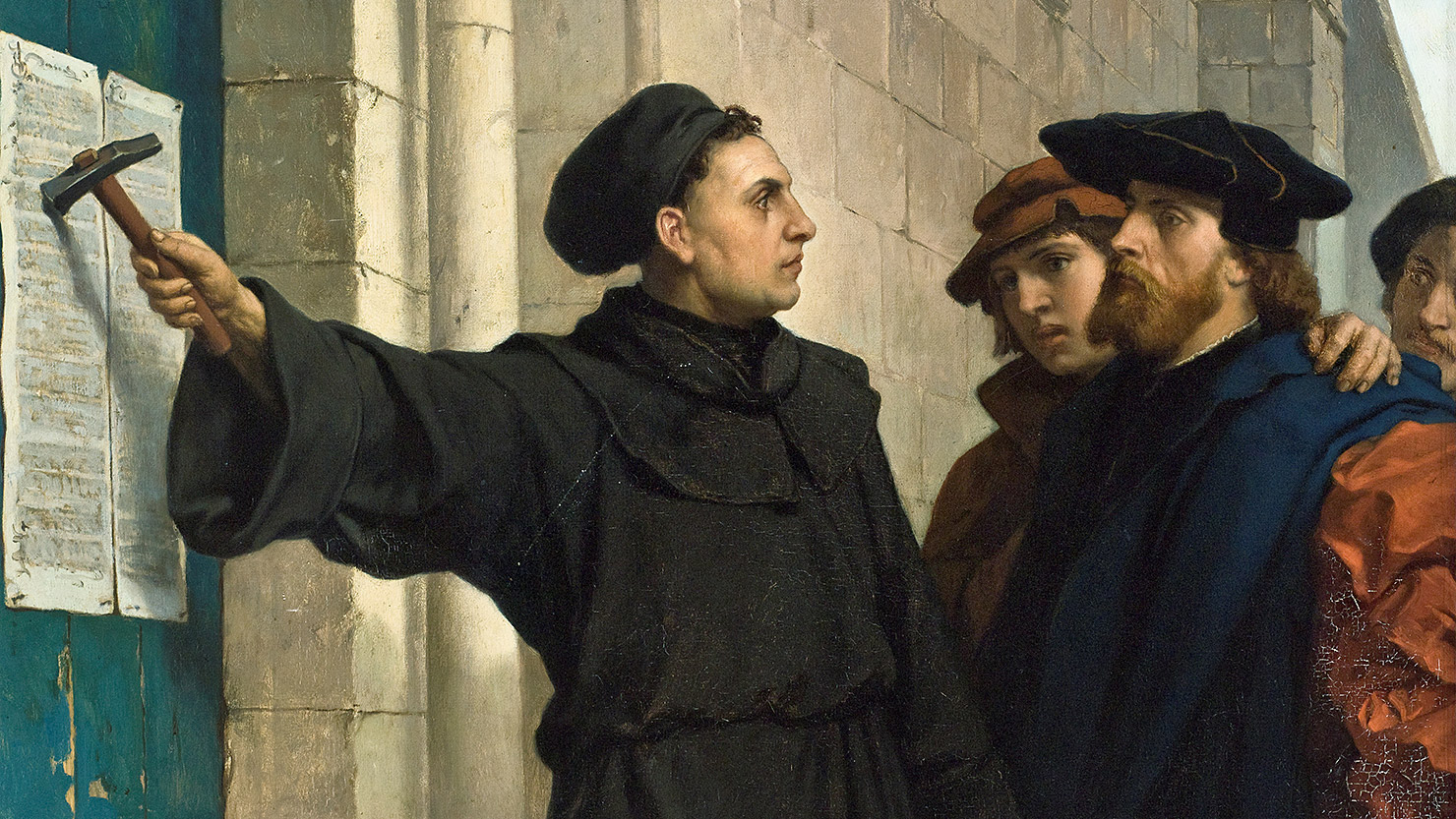
The importance of the statement above can be seen in its historical significance. it was the grounds for Martin Luther's revolt against the corruptions of the Roman Catholic Church. He had discovered the truth of justification by faith alone in his personal study of the Bible: "The righteous shall live by his faith" (Habakkuk 2:4, and quoted by Paul in Romans 1:17 and Galatians 3:11). However, he saw that this simple but profound expression of the only way of salvation had been buried under the manmade doctrines and ceremonies of the Catholic Church. 

Rome responded by declaring a curse against biblical justification: "Canon 9.  If anyone says that the sinner is justified by faith alone, meaning that nothing else is required to cooperate in order to obtain the grace of justification, and that it is not in any way necessary that he be prepared and disposed by the action of his own will, let him be anathema" (The Canons of the Council of Trent, still the official doctrine of the Roman Church). This assertion has never been repudiated by Rome, which is why any reunification between her and orthodox Protestants is still impossible. 

Rome has also caricatured the Reformers' doctrine is nothing more than a legal fiction. That accusation is false. It might have been true if God had merely cancelled our sin debt unpaid. Yet that is not what He has done. Rather, He has transferred that debt to a voluntary Surety, the Lord Jesus Christ. For those whom He undertook to redeem (John 6:37-39), Jesus the Sinless One stepped forward to pay a debt that He did not owe, that we may be freed from a debt that we could not pay. And a debt paid is a debt owed no more, in truth, not as a fiction.

Wednesday, June 3, 2020

Justification by Faith Can Never Be Justification for Sin

As an orthodox Protestant, I advocate and defend the doctrine of justification by faith alone as the standard against all false expressions of Christianity. And the consistent response from advocates of works righteousness is almost always that it means that a person can believe, and then live however wickedly he wants, and still be saved. They usually cite James 2:24 (an objection which I address here). I get this supposed trump-card most consistently from Mormons and Catholics.

Their claim is a caricature. Worse, it is a slogan, repeated from some apologetics book or class, not something thought through by the person making the accusation.

It is easy to refute. I have provided one such refutation in the link above. Another is found in the little epistle of Jude, especially verse 4: "Certain people have crept in unnoticed who long ago were designated for this condemnation, ungodly people, who pervert the grace of our God into sensuality and deny our only Master and Lord, Jesus Christ." Jude here describes people who profess to be Christians, but are then involved in some unspecified sin. But notice what else he tells us about them, that they are "condemned" as "ungodly." So, they do not have faith; they have a label. And that is a denial of Jesus, not faith.

This should be an indication to anyone who has been taught this as an argument against justification by faith that it is an accusation based on something that the Scriptures say is impossible. That means that the argument is false.

Then a far more important question should come to mind: If my religious teachers have taught me this falsehood, what are they trying to keep me from seeing as truth? They want to keep you from understanding justification by faith alone because that makes you dependent on Jesus alone, instead of them.

Saturday, May 16, 2020

False Teachers and Their Pompous Claims of Authority

In our day, there are many "Christian" groups that claim grandiose titles for their organizational leaders. Mormons have their "Apostles and Prophets," various Pentecostal churches claim that their pastors are "Apostles," and, of course, the Pope has long claimed to occupy the "apostolic throne of Peter." I deny all such titles, and insist that all such claims mark false teachers. 

First, let me concede that the Bible does talk about Apostles and Prophets in the organization of the church: "He gave the apostles, the prophets, the evangelists, the shepherds and teachers, to equip the saints for the work of ministry, for building up the body of Christ, until we all attain to the unity of the faith and of the knowledge of the Son of God, to mature manhood, to the measure of the stature of the fullness of Christ, so that we may no longer be children, tossed to and fro by the waves and carried about by every wind of doctrine, by human cunning, by craftiness in deceitful schemes. Rather, speaking the truth in love, we are to grow up in every way into Him who is the Head, into Christ, from whom the whole body, joined and held together by every joint with which it is equipped, when each part is working properly, makes the body grow so that it builds itself up in love" (Ephesians 4:11-16). The Church is the Body of "Christ." He alone is the Head of the body, and has established how the members shall be organized (see also 1:22, 5:23,and Colossians 1:18). Among other things, this means that men are not left to ourselves to design the government of Christ's Church. 

"Shepherds" here is the equivalent of "elders" in the rest of Scripture, and "teachers' are what we call pastors (see I Timothy 5:17). Paul describes the selection of elders, with deacons as their assistants (Acts 6:1-7), in several places, especially in I Timothy 3 and Titus 1. And where does that same Apostle describe selecting new apostles or prophets? Nowhere. In fact, except for the selection of Matthias to replace Judas (Acts 1:12-26), a special circumstance, there is never a mention of selecting any more such men.

Does that not require us to accept that those were temporary offices, while the others were to be continuing offices in the Church? I think that the rationale is unavoidable, and demonstrates
that presbyterianism is the only scriptural system of congregational government, precluding congregational democracy, episcopalianism, or any claims to the offices of the Apostles and Prophets.


Wednesday, November 20, 2019

American Evangelical Tolerance: The Game Plan That Failed

In America, the popular version of evangelical Christianity has followed our new national orthodoxy: "Thou shalt not offend." God loves everyone unconditionally. Even the Pope has joined in, claiming that atheists might be saved without knowing it. To talk about God's holiness, wrath, or judgment is to be considered too fanatical for polite company.

However, that American religion is not at all like the biblical faith from which it came.

Here is what the Bible says about the justice of God: "That day [of judgment] is the day of the Lord GOD of hosts, a day of vengeance, to avenge Himself on His foes. The sword shall devour and be sated and drink its fill of their blood" (Jeremiah 46:10. Where is that tolerant, all-loving deity of today's Christian? Certainly not in this verse.

Here is another one: "The LORD has a sword; it is sated with blood; it is gorged with fat, with the blood of lambs and goats, with the fat of the kidneys of rams. For the LORD has a sacrifice in Bozrah, a great slaughter in the land of Edom" (Isaiah 34:6).

These verses are just examples, not alone in expressing the violence of the judgment of God. Moreover, they reveal a God who is utterly unlike the creampuff advocated by the average American professing evangelical. Why is that?

It is because of the content of the "love" advocated by that brand of evangelical. He thinks of God's love as requiring approval of whatever he wants to do. Only a meanie describes anything as wicked or as deserving of judgment.

The problem is that the love described by such people is love for them, and for what they want. They do not allow the other side of love, God's love for Himself. God is not allowed to love Himself or His holiness or His word. In other words, such people advocate a one-directional tolerance, a tolerance that benefits them. They feel no obligation to tolerate God or what He values. And, sadly for them, God does not feel bound to honor their definition of tolerance. "Woe to those who call evil good and good evil, who put darkness for light and light for darkness, who put bitter for sweet and sweet for bitter! Woe to those who are wise in their own eyes, and shrewd in their own sight!" (Isaiah 5:20-21). 

You see, when these evangelicals created their religion of unconditional love and tolerance, they just assumed that God would go along with the gameplan. If they had consulted Him, though, they would have discovered that God doesn't play by their plan.

Wednesday, August 7, 2019

Justifying Faith Is a Working Faith

In my day to day ministry, I confront many sectarians who hold to some version of works righteousness, Catholics, Mormons, Jehovah's Witnesses, Oneness Pentecostals. They hate the doctrine of justification by free grace. Why? Part of it is the remainder of Adam in each of us, that seeks to be justified by the broken covenant of works. However, there is also a part which is bondage: the man who is free in Christ has no loyalty to organizational hierarchies. They simply have no hold over him.

These organizations point to the commands in Scripture to live holy lives. And those commands are truly there, and should be in the mind of every Christian. That isn't the problem. The problem is that they claim that those works commanded by Scripture are commanded in order to gain the favor of God, though they may phrase it in different ways. That is, they claim that justification is, in part, the result of these works. And that destroys the true doctrine of justification by grace alone through faith alone, apart from works (e. g., Romans 3:28). That is, they put the result for the cause, and, thus, destroy assurance of salvation.

In every discussion on this issue, we can expect these works-mongerers to refer to James 2:24: "You see that a person is justified by works and not by faith alone." They consistently block out the context of the paragraph that includes that verse, which is about the demonstration of justification before men, not justification before God.

Then they will bring up the accusation against the biblical Christian that "faith alone" means that works are irrelevant, allowing the Christian to live wickedly, and yet go to heaven. That is a caricature, which has been answered repeatedly down through history. Yet the works-mongerers consider themselves very clever to repeat it, regardless of the answer. What is that answer? "Faith, thus receiving and resting on Christ and his righteousness, is the alone instrument of justification; yet is it not alone in the person justified, but is ever accompanied with all other saving graces, and is no dead faith, but worketh by love" (Westminster Confession of Faith XI:2). True faith will necessarily result in good works.

Saturday, July 27, 2019

The Glorious Death of Christ Is Far More Than Any Mere Crucifix

Besides its Second Commandment issues, the Catholic crucifix bothers me because it shows a dead Jesus, crumpled on the cross, reminding us of His sufferings. Those things are true, as far as they go. However, the fault of the crucifix is that it takes us no further.

First, I think it is necessary to understand that those experiences were not imposed upon the Son by men: "Sovereign Lord, who made the heaven and the earth and the sea and everything in them, who through the mouth of our father David, Your servant, said by the Holy Spirit, 'Why did the Gentiles rage,and the peoples plot in vain? The kings of the earth set themselves, and the rulers were gathered together, against the Lord and against His Anointed’— for truly in this city there were gathered together against Your holy servant Jesus, whom You anointed, both Herod and Pontius Pilate, along with the Gentiles and the peoples of Israel, to do whatever Your hand and Your plan had predestined to take place" (Acts 4:24-28). Here we see that everything which Jesus underwent, though at the hands of men, was according to the plan of God in prehistory. Notice that Peter and John are quoting from the second Psalm, a prophecy of the overcoming power of the Messiah.

Second, His sufferings weren't imposed on the Son against even His own will: "No one takes it [i. e., life] from Me, but I lay it down of My own accord. I have authority to lay it down, and I have authority to take it up again. This charge I have received from My Father" (John 10:18). Jesus experienced what he did because He chose to do so. 

Why did He choose to suffer and die, though He was God, at the hands of men? "I am the bread of life; whoever comes to Me shall not hunger, and whoever believes in Me shall never thirst. But I said to you that you have seen Me and yet do not believe. All that the Father gives Me will come to Me, and whoever comes to Me I will never cast out. For I have come down from heaven, not to do My own will but the will of Him who sent Me. And this is the will of Him who sent Me, that I should lose nothing of all that He has given Me, but raise it up on the last day. For this is the will of My Father, that everyone who looks on the Son and believes in Him should have eternal life, and I will raise him up on the last day" (John 6:35-40). Jesus, God the Son, chose to face the suffering and death of the cross because He had His people, the Church (Ephesians 5:25), in His mind's eye. 

And that is the problem with the crucifix. It shows the cross work of Jesus as suffering, which it certainly was, but no more. Yet it was so much more, because it was the evidence of the love of God for His people, including me, that Jesus chose that experience out of His divine love. The empty cross in a Protestant church denies nothing of the horror of the crucifixion, but testifies to the risen Christ, who suffered for me, and rose from the grave in victory over sin, Satan, the grave, and the purposes of wicked men! That is why the Apostle Thomas was compelled to greet Him with those words, "My Lord and my God" (John 20:28)!

"The death of Jesus was glorious, not because it was His death, but because it could be the death of no other. A creature might as well have undertaken to create as to save a world. The work itself demands the interposition of God; and any theory which fails to represent the death of Christ as an event which, in its own nature, as clearly proclaims His divinity as His superintending care and preservation of all things, cannot be the Gospel which Paul preached at Rome, at Corinth, at Athens, and which extorted from Thomas, upon beholding the risen Savior, the memorable confession, 'My Lord and My God!'" (James Henley Thornwell, the Necessity and Nature of Christianity).

Wednesday, May 22, 2019

No Hierarchical Bishops in Scripture

In Acts 20, Luke gives us an account of a trip by Paul to Miletus. From there, he calls for the elders from the church in nearby Ephesus to come to meet with him: "Now from Miletus he sent to Ephesus and called the elders of the church to come to him." In today's parlance, we would call it a strategy meeting.

Then, when he is speaking to them, we find this interesting comment: "Pay careful attention to yourselves and to all the flock, in which the Holy Spirit has made you overseers" (Acts 20:28).

What makes such a seemingly-mundane statement interesting? Notice the title "elders" in verse 17. That is a translation of the Greek word "presbuteros." From it, we get the English word "priest." However, its basic meaning is "an older person," from which it has been adapted to designate the church office of "elder."

However, in verse 28, the same men get addressed, not by their title, but by their job, "overseers." That English word is used to translate the Greek word "episkopos," from which we get the English word, "bishop." But it simply means "one who oversees," or a manager (see also I Peter 5:1-2).

The significance of that is that it eliminates any claim by the Roman Catholic Church, the Eastern Orthodox Churches, or the Anglican Church, that their office of monarchical bishop is derived from Scripture. The word is there, of course, but of a kind completely different from the extravagant powers and privileges associated with that title, especially those blasphemous claims to the pope to be the Universal Bishop, with authority over all Christians in the world.