Showing posts with label sola scriptura. Show all posts

Saturday, September 17, 2022

The Scriptural Origin of Paul's Faith


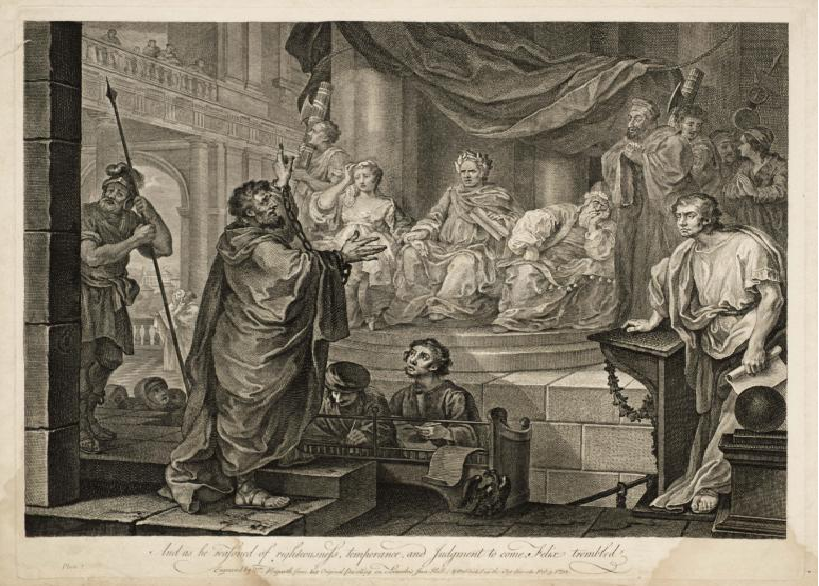
When he was called before Felix, the Roman procurator for the province of Judea, Paul gave an apologetic, that is, a defense, for the Christian faith for which the Jewish leaders had charged him of insurrection. Part of that defense, as recorded in Acts 24:14, is this statement: "This I [i. e., Paul] confess to you [Felix], that, according to the Way, which they [the Jewish leaders] call a sect, I worship the God of our fathers, believing everything laid down by the Law and written in the prophets." 

Paul's defense is not in any mystical revelation, whether by dreams or sensationalist evangelists, but strictly by the testimony that he found in the Bible, the Scriptures which we now know as the Old Testament (compare his later message to Timothy in II Timothy 3:14-15). 

If anyone could, Paul could have spoken of a mystical experience. In Acts 9:1-9, Luke the Physician gives us a record of Paul's, then still called Saul, persecution of the Christians, until he is literally thrown to the ground by Jesus, who challenges him, "Saul, Saul, why are you persecuting Me?" (verse 4). Yet, we are then told, verses 10-19, that this same Jesus then sent a disciple named Ananias to explain the faith to Saul/Paul. "The Lord said to him [i. e., Ananias], 'Go, for he is a chosen instrument of Mine, to carry My name before the Gentiles and kings and the children of Israel'" (verse 15). It is only after this meeting with Ananias that Paul is able to rise and be baptized, not after his vision. 

I think this record is one of the landmarks that distinguish between true Christian churches and the cults. Cults usually start with a leader who claims to have had a mystical experience, apart from Scripture, in which God supposedly taught him or her some new revelation. Nowhere does the New Testament describe conversions as occurring in this way. On the contrary, it is Paul himself who tells us that people are converted by the preaching of that same word of which he testified to Felix (Romans 10:14-17). 

We see this contrast most vividly in the Mormon religion, the founder of which, Joseph Smith, Jr., claimed revelatory visions, including new scriptures, to support his claims of a new religion, new though he claimed Christian terminology for it. The apologetic of Paul contrasts starkly with the claims of Smith, being one of the proofs that Mormonism has no legitimate claim to the name of Christ for its organization. 

Saturday, March 26, 2022

The Five Solas: God's Perpetual War Against Rome


In the Reformation, the Reformers developed a systematic formulation that delineated the distinction of the biblical Christian faith from the corrupted version held by Rome. These doctrines have come to be known as the Five Solas, from their Latin forms.

Sola gratia, by grace alone. The Bible says that justification is by the condescending mercy of God. It cannot be due to any will or worthiness in the sinner because there is none. 

Sola fide, by faith alone. For those whom God has mercifully chosen to save, that justification is applied to them by means of faith. That is, faith is not meritorious, but is rather an instrument for applying justification. 

Solus Christus, on the basis of Christ alone. Everything necessary to justify God's people was achieved by the atoning work of Jesus, i. e., His perfect life, atoning death, and victorious resurrection. No additional intent, ritual, or action of men is necessary or possible, because Jesus did all that was necessary. 

Soli deo gloria, for the glory of God alone. God's purpose in justifying His people was not for our sakes, though we are certainly the beneficiaries. He did it to display the glories of His mercy and to glorify His Son with a church. 

Sola scriptura, in Scripture alone. Everything necessary to know about our sin, God's judgment, the redemption purchased by Christ, and the life of sanctification is and can be found in the Bible alone, using the ordinary means of reason, illuminated by the Holy Spirit. No human tradition added to Scripture or in its place can ever bind the conscience of the man of God. 

Even after the five centuries which have passed since the start of the Reformation, these truths have not changed. Nor has Rome ever repented of her errors here opposed. When professed Protestants practice fellowship and cooperation with the Catholic Church, it is not because she has given up her errors, but because the Protestants have accepted them.

Wednesday, May 3, 2017

Sola Scriptura: The Best Defense Against Spiritual Bondage


One thing cults have in common is that they have some leader, whether alive or dead, whom they declare to be some paragon of truth. We have Ellen White, Mary Baker Eddy, Joseph Smith, an interminable list of popes, Victor Paul Wierwille, David Koresh. It is a long list, and adds more every day.

The Bible tells us how to resist even the most charismatic cultist: "Learn by us not to go beyond what is written, that none of you may be puffed up in favor of one against another" (I Corinthians 4:6). This is the Apostle Paul speaking, someone to whom the word of God was entrusted (I Thessalonians 2:13). If anyone could claim personal superiority, surely it was he. Yet, he tells the Christians of Corinth that mere men can be "puffed up." And the cure for that is not to go beyond what is written. That is, when any man claims spiritual knowledge outside of Scripture, then he is "puffed up," and is to be resisted. While he does not explicitly quote it, Paul is applying the principle taught in God's Law (Deuteronomy 18:20): "The prophet who presumes to speak a word in My name that I have not commanded him to speak, or who speaks in the name of other gods, that same prophet shall die."

This is what the Reformers did, starting in 1517. As they discovered and taught, more and more, that the declarations of the popes went beyond anything written in the Bible, people were liberated from hundreds of years of bondage to the erroneous teachings of men. Martin Luther said of the fathers of the Catholic Church, "Their holiness does not make them infallible, and it does not imply that one must rely and depend on all the dicta of the fathers or approve and believe all their teachings. Rather take the touchstone of God’s Word into your hands. Let this be your criterion for testing, trying and judging all that the fathers have preached, written and said, as well as all the precepts and human ordinances that have been promulgated. Otherwise one will be easily misled and deceived. And since this polishing stone was not applied to the pope in times past, he ran rampant and covered the church with errors."

It was in the Bible, not the teachings of the popes, that Luther learned that "the righteous shall live by faith" (Habakkuk 2:4, quoted in Romans 1:17, Galatians 3:11, and Hebrews 10:38). Suddenly, his conscience was freed. Having been a monk who spent hours in confession, and, yet, could find no relief for his conscience, he was transformed into a joyful Christian, who could now say, "If you try to deal with sin in your conscience, let it remain there, and continue to look at it in your heart, your sins will become too strong for you. They will seem to live forever. But when you think of your sins as being on Christ and boldly believe that He conquered them through His resurrection, then they are dead and gone. Sin can’t remain on Christ. His resurrection swallowed up sin."

False teachings have one consistent effect: they bring a man into bondage to a man or an organization. Sola Scriptura liberates a man through true knowledge. As Jesus said (John 17:17), "I am the way, and the truth, and the life. No one comes to the Father except through me." Scripture points a hopeless soul to Jesus. The teachings of men will point you to those men.

Saturday, February 18, 2017

Near-Death Experiences: Do People Really See Heaven and Then Come back?


I have been appalled by the number of books and videos on Amazon that supposedly describe the experience of people who have died, been to heaven, and then returned to the world of the living. There is also a video being promoted by the 700 Club on the subject. I won't list any title, because I don't want to promote awareness of them.

However, I must express my concern about such books, even if they are true, and not the mere commercial inventions that I suspect them to be.

Jesus tells a story (Luke 16:19-31): "There was a rich man who was clothed in purple and fine linen and who feasted sumptuously every day. And at his gate was laid a poor man named Lazarus, covered with sores, who desired to be fed with what fell from the rich man’s table. Moreover, even the dogs came and licked his sores. The poor man died and was carried by the angels to Abraham’s side. The rich man also died and was buried, and in Hades, being in torment, he lifted up his eyes and saw Abraham far off and Lazarus at his side. And he called out, ‘Father Abraham, have mercy on me, and send Lazarus to dip the end of his finger in water and cool my tongue, for I am in anguish in this flame.’ But Abraham said, ‘Child, remember that you in your lifetime received your good things, and Lazarus in like manner bad things; but now he is comforted here, and you are in anguish. And besides all this, between us and you a great chasm has been fixed, in order that those who would pass from here to you may not be able, and none may cross from there to us.’ And he said, ‘Then I beg you, father, to send him to my father’s house— for I have five brothers—so that he may warn them, lest they also come into this place of torment.’ But Abraham said, ‘They have Moses and the Prophets; let them hear them.’ And he said, ‘No, father Abraham, but if someone goes to them from the dead, they will repent.’ He said to him, ‘If they do not hear Moses and the Prophets, neither will they be convinced if someone should rise from the dead.'"

I especially want to focus on verse 31: "He said to him, ‘If they do not hear Moses and the Prophets, neither will they be convinced if someone should rise from the dead.’" Here we have the testimony that people will not be converted by such stories, if they reject the testimony of the Bible, which is the divinely-appointed means of conversion (John 17:17).

I also think of the words on Paul, in II Corinthians 12:1-4, especially verse 4: "...things that cannot be told, which man may not utter." In this passage, he describes a man, unnamed but known to Paul, who has such an experience, but was forbidden to repeat what he heard while he was in heaven. If that man was forbidden to speak, why does God allow all of these other people to publish their supposedly-same stories? I say "supposedly" because I am sceptical of them, not only on the bases that I mention here, but also because of the screwy theology promoted by so many of these books, especially the frequent New Age spin given them.

It is obvious that I cannot forbid anyone to write, much less purchase, these books. However, I can urge you to consider what the Scriptures say on the matter, and avoid them as unbiblical deceptions.

Saturday, January 14, 2017

Effectual Calling: God Entices the Elect


In Scripture, we see all sorts of experiences of salvation. Usually, there was a process, God's working in the person over a period of time, a process called "effectual calling." That was my own experience, going to churches and reading the Bible for about two years before I experienced the opening of my eyes. On the other hand, we also see the Apostle Paul, who was converted in a flash, completely unexpectedly. John the Baptist was regenerated in the womb, so he cannot be said to have had any preparation either.

However, conversion is usually a process, not an immediate enlightenment by the Holy Spirit. The Westminster Confession of Faith X:1 describes it well: "All those whom God hath predestinated unto life, and those only, He is pleased, in His appointed and accepted time, effectually to call, by His Word and Spirit, out of that state of sin and death in which they are by nature, to grace and salvation by Jesus Christ: enlightening their minds, spiritually and savingly, to understand the things of God, taking away their heart of stone, and giving unto them an heart of flesh; renewing their wills, and by His almighty power determining them to that which is good; and effectually drawing them to Jesus Christ; yet so as they come most freely, being made willing by his grace."

It is the Holy Spirit's working through the Scriptures which is the key to true conversion.

In Scripture (Psalm 119:105, 130), we read, "Your word is a lamp to my feet and a light to my path. The unfolding of Your words gives light; it imparts understanding to the simple." As is their wont, the Psalm presents the truth in simple, pithy language. The Bible, the word of God, is used by the Holy Spirit to change the heart of the unbeliever, to recognize his own unworthiness and the wrath of God, and to perceive the singular beauty and worthiness of Jesus, that he may be stirred to cling to Him alone for mercy and new life.

Evangelism today has been turned into a battle of facts, with books such as "Evidence that Demands a Verdict." Such books are good for boosting the assurance of Christians and for leaving unbelievers without excuse. However, it is not the way that God promises to bless unto salvation. What is His promise? "So shall My word be that goes out from My mouth; it shall not return to Me empty, but it shall accomplish that which I purpose, and shall succeed in the thing for which I sent it" (Isaiah 55:11). He doesn't promise to prosper our good logic or our collection of facts. Rather, He promises to bless His word, to make it, by the power of the Holy Spirit, effectual in the conversion of sinners. Not to all sinners, because that, too, is not His promise. Rather, effectual to the sinners for whom He sent it: "Come, everyone who thirsts, come to the waters; and he who has no money, come, buy and eat! Come, buy wine and milk without money and without price. Why do you spend your money for that which is not bread, and your labor for that which does not satisfy? Listen diligently to Me, and eat what is good, and delight yourselves in rich food. Incline your ear, and come to Me; hear, that your soul may live" (Isaiah 55:1-3).

In the elect, God creates a hunger, a famine of meaning and hope in the present life, and then, through His word, reveals Himself effectually as the one and only answer to that hunger. Just as there is satisfaction nowhere except in Him, there can be no regeneration in any means outside of His word.

Monday, October 3, 2016

What the Bible Says About Its Own Inspiration: Old Testament


I understand that an atheist, for example, won't be convinced by the Bible's description of itself as the Word of God. However, I'm not addressing that question here. Rather, I am presenting the Bible's testimony about itself as a first step. After all, if the Bible makes no claims of inspiration and inerrancy, then there is nothing to defend.

I want to look at three Old Testament passages.

First, Numbers 1:1: "The Lord spoke to Moses in the wilderness of Sinai, in the tent of meeting, on the first day of the second month, in the second year after they had come out of the land of Egypt." This is a very simple profession. The Bible says of itself that it is a record, not of men's words about God, but of God's words to men about Himself. That is the essential starting point, and what separates the Bible from traditional myths of, for example, Greece and Rome. Those myths come from plays or poems written by professionals, and make no claim or pretense of supernatural origin. They are men's stories about their ideas of the spiritual reality, not even claiming to be from that reality. In contrast, the Bible sets forth an unequivocal claim to be the words of God, though recorded by men.

Second, turn to Deuteronomy 18:18-19: "I will raise up for them a prophet like you from among their brothers. And I will put My words in his mouth, and He shall speak to them all that I command Him. And whoever will not listen to My words that He shall speak in my name, I myself will require it of him." This is a prophecy to Moses, predicting the coming of Christ, in His prophetic office (applied to Him in Acts 3:22). But that isn't my point in mentioning it here. the reason I cite it is because of its description of the inspirational process. What is the source of Moses's words (as he is the prophet to whom the words are given)? They are from the mouth of God. That is, as in Numbers 1:1 above, they do not have their origin in the mind of the prophet, but are rather given him by God to be recorded. So, again, the Bible claims for itself to have a divine origin (compare II Peter 1:21).

And third, turn to II Samuel 23:2-3: "The Spirit of the Lord speaks by me; His word is on my tongue. The God of Israel has spoken; the Rock of Israel has said to me." So we see for a third time that an Old Testament figure, in this case King David, claims that the words that are recorded are not from his mind, or his imagination, but rather are from God.

This is far from an exhaustive list. Rather, I chose three examples to represent the consistent testimony of the Old Testament. The testimony to what? To its own divine inspiration. The implication of that is, first, that the professing Christian who denies the inerrancy of Scripture is denying the basis of the faith that he professes. It is a self-refuting profession, and proof that he is either ignorant of his faith, or that he is irrational. Furthermore, it puts the professing unbeliever on notice. There is no such thing as agnosticism, some vague profession that one is noncommittal. We must be flexible, our culture says! But Scripture says, "This is what God says. Believe it, or accept the consequences." There is no in-between, neutral position (Matthew 12:30). To the professing unbeliever, the Bible doesn't congratulate you on your sophisticated scepticism. Rather, it says that you are commanded to believe (Acts 17:30). If you refuse, then you are saying that you accept the consequences. Don't deceive yourself: unbelief is not a form of immunity, as if refusing makes you free of the requirements of God.

Friday, September 30, 2016

Sola Scriptura: Did God Give Us Secret Instructions through the Pope?

One of the claims of the Roman Catholic Church is the the Bible is not sufficient for the conversion and sanctification of the Christian. Rather, she says, the Apostles left a Sacred Tradition which has been passed from bishop to bishop, down through history, a process called "apostolic succession." As the Catholic apologetics site linked here says, "Isn't the Bible Alone [sic] sufficient for us without all of the 'Tradition' that pollutes the Word of God with man-made stuff?  The answer is absolutely not."

Against this teaching, the Reformers taught one of the five solas, "sola scriptura," Latin for "Scripture alone."

In support of the Protestant view, I want to look at one of the things that Scripture says about itself in II Peter 1:3-4 (emphasis mine): "His divine power has granted to us all things that pertain to life and
godliness, through the knowledge of Him who called us to His own glory and excellence, by which He has granted to us His precious and very great promises, so that through them you may become partakers of the divine nature, having escaped from the corruption that is in the world because of sinful desire."

First, I want to point out that these verses are from the Apostle Peter, the supposed first pope and founder of the apostolic succession of one pope to another. Second, I want the reader to notice the pronouns that Peter uses: "us" three times, and "you"  once. While he refers to "He" or "Him" several times, he never once says "I" or "me." "He," that is, God, has granted "us" "all things that pertain to [eternal] life and godliness." We whom? Peter and his readers, the same ones he addresses as "you"! His emphasis is on the sufficiency of the truth that he share already with his fellow Christians, not a secret that will be kept by the pope until some time that serves his purpose.

Peter, the very man claimed by Rome as the beginning of their apostolic superiority, says that all Christians have what we need for eternal life and sanctification. There is no secret tradition, whether sacred or otherwise, of information for which we are accountable.

If the claims of Rome are contrary to the words of the man they claim as their founder, why do they make them? To my mind the answer is obvious: if the hierarchy of Rome has information that is essential for our salvation, and that we can get in no other way, then she has an absolute control over our salvation. And that is the exact spiritual bondage against which John Hus, John Wyclif, Martin Luther, John Calvin, Thomas Cramner, John Knox, and all of the other Reformers rebelled in the Fifteenth and Sixteenth Centuries, and against which biblical Christian must battle even in our present day.

Saturday, August 27, 2016

Does Having the Bible Allow Continuing Revelation?

The question in the title of this post should have brought immediate images to mind, such as the Book of Mormon. And that is certainly one of the things that I have in mind. However, we should also think of Pentecostal "prophets," the Pope, and a lot of common Christians who claim that "God told me."

I am opposed to all of these claims of revelation because they undermine the sufficiency of the true Scriptures, the Bible, in both the Old and the New testaments.

First, what does the Bible say about itself? Paul, writing to his apprentice Timothy, said (II Timothy 3:14-17): "As for you, continue in what you have learned and have firmly believed, knowing from whom you learned it and how from childhood you have been acquainted with the sacred writings, which are able to make you wise for salvation through faith in Christ Jesus. All Scripture is breathed out by God and profitable for teaching, for reproof, for correction, and for training in righteousness, that the man of God may be complete, equipped for every good work." Notice what he tells us about the Scriptures. First, they are "breathed out by God," i. e., their authority derives from their ultimate authorship by God. Second, they make us wise for salvation. And third, they equip the believer, so that he is complete, equipped for every good work.

The desire for additional revelation indicates that the person does not believe that the Scriptures are sufficient for salvation, and would leave a believer incomplete, ill-equipped for every good work. That is, that they fail to achieve their intended purpose (see Isaiah 55:11).

Notice, secondly, what Jude 1:3 also says: "Beloved, I found it necessary to write appealing to you to contend for the faith that was once for all delivered to the saints." While it may be true that the full explanation was not yet complete when Jude wrote, he clearly indicates that the content was delivered once for all. This brother of the Lord saw no need for the revelation of any new doctrines, as both Rome and the Mormons have done. The writer of the Epistle to the Hebrews said the same thing (Hebrews 1:1-2): "Long ago, at many times and in many ways, God spoke to our fathers by the prophets, but, in these last days, He has spoken to us by His Son, whom He appointed the heir of all things, through whom also He created the world." There is progressive revelation from the creation to the Gospels to the founding of the church, because all revelation was to point to Jesus Christ. Once He came, there was some apostolic explanation necessary, but no additional content was necessary or possible. That rules out the new dogmas decreed by Rome, such as papal infallibility, or the ascension of Mary, as well as "another testimony of Jesus Christ" pretended by the Mormons.

Saturday, January 23, 2016

How Catholic Translators Excised 'Sola Scriptura' from Their Own Bible

In the New American Bible - Revised Edition (hereafter, "NABRE"), the primary translation used among English-speaking American Catholics, Isaiah 8:19-20 reads this way: "When they say to you, 'Inquire of ghosts and soothsayers who chirp and mutter; should not a people inquire of their gods, consulting the dead on behalf of the living, for instruction and testimony?' Surely, those who speak like this this are the ones for whom there is no dawn." Notice the phrase that I have placed in italics. The translators of this version place it in the assertions of those who seek advice from mediums.

In contrast, the ESV reads, "When they say to you, 'Inquire of the mediums and the necromancers who chirp and mutter,' should not a people inquire of their God? Should they inquire of the dead on behalf of the living? To the teaching and to the testimony! If they will not speak according to this word, it is because they have no dawn." Here, the translators place the clause in the portion in which God rebukes this paganistic syncretism. It is placed the same way in the New King James Version and the Modern English Version, which follow a different manuscript tradition. It was even placed this way in the Douay-Rheims Version, a much-earlier Catholic bible, in even stranger phrasing: "To the law rather, and to the testimony."
Why would the NABRE disconnect the phrase from what follows, to place it with what preceded? Ah, the essence of the issue!

One of the five solas of the Reformation was "sola scriptura," or "scripture alone," the belief that the Bible alone is infallible, and is therefore the ultimate standard for judging any question of spiritual controversy. Protestants believe that God has placed all truth necessary to salvation and godly living in the Bible, so that any man or woman can read it for himself, without the need of a priest or pope to give him "the rest of the story." This doctrine freed the conscience of Christians from the bondage that they had known to the hierarchy of the Catholic Church. Thus, that hierarchy, the force behind the translation of the NABRE, had a vested interest in hiding the truth revealed in these verses, the truth of sola scriptura!

Catholic apologists love to challenge Protestants with the question, "But where does the Bible teach sola scriptura?" And, since most Protestants don't know their bibles, especially the Old Testament, they often do not know these verses. And the Catholic hierarchy works hard that their own people do not know them, either.

Wednesday, September 23, 2015

In Honor of the Pope's Visit to the United States

Back in 1987, then-Pope John-Paul II visited the United States, including a stop in neighboring South Carolina. At the time, a co-worker, a professing atheist, said to me, "You must be excited." "Why?" I asked her. "Because of the Pope's visit," she replied. "But I'm not Catholic," I explained, to her blank face. She didn't understand the distinction between Catholics and Protestants. I am saddened to say that my experiences, even with Protestants over the years, has convinced me that few of us understand, either.

Beginning with the nailing of his 95 Theses on the Wittenburg Church door by Martin Luther on October 31, 1517 (so the 500th anniversary is approaching), Protestants have systematized our conflict with Rome in the so-called Five Solas:

Sola Scriptura: that our only infallible standard for spiritual truth is the Holy Bible, in the Old and New Testaments, and what by necessary logical consequence might be based on them.

Soli Deo Gloria: that our salvation and sanctification are for the glory of God alone, not based on any works for which a man might claim credit.

Solus Christus: that our salvation is based on the finished work of Christ alone, in His life, crucifixion, resurrection, and eternal intercession.

Sola Gratia: by grace alone, that is, by God's voluntary condescension, not because of any obligation that we have placed upon Him.

Sola Fide: that it is by faith alone, as the instrumental means, that the works of Christ are imputed to us for our justification.

These Five Solas (Latin for "alone") are the essential points of conflict between the churches of the Reformation and the Church of Rome. She has never changed her denial of these five truths, so our repudiation of her legitimacy must be maintained, for the rest of human history, if need be. Any ecumenical relationship, while she continues in her apostasy from the Gospel, can only carry Protestants into judgment with her. As Jesus Himself says (Revelation 18:4): "Come out of her, My people, lest you take part in her sins, lest you share in her plagues."

Tuesday, September 1, 2015

Doctrinal Accountability: Can Anyone Avoid It?

"They have spoken falsely of the Lord
     and have said, ‘He will do nothing;
no disaster will come upon us,
     nor shall we see sword or famine.
The prophets will become wind;
 
     the word is not in them."
- Jeremiah 5:12-13 

This is an Old Testament version of Romans 1:18: "For the wrath of God is revealed from heaven against all ungodliness and unrighteousness of men, who by their unrighteousness suppress the truth." Paul continues (verse 21): "For although they knew God, they did not honor Him as God or give thanks to Him, but they became futile in their thinking, and their foolish hearts were darkened." The Prophet and the Apostle are both testifying against the claim by some that they don't believe in God: those men and women are lying! They know full well that God exists and that they are accountable to Him. As Paul also says (verses 19-20), "For what can be known about God is plain to them, because God has shown it to them. For His invisible attributes, namely, His eternal power and divine nature, have been clearly perceived, ever since the creation of the world, in the things that have been made. So they are without excuse."

This is sometimes referred to as "natural theology," the witness that God has revealed of Himself in His creation, so that all men know of Him, even if they pretend otherwise. Why? That is what Jeremiah is talking about: they believe that they are not accountable for what they refuse to acknowledge. I compare it to the bratty child who sticks his fingers in his ears and sing-songs, "La-la-la, I can't hear you," with the belief that he can then claim not to know what his parents said to him.

Do responsible parents allow their children free rein under this pretense? Of course not! And neither does God allow the atheist to escape judgment, simply because he pretends that he doesn't know, or believe in, God. 

Jeremiah also addresses a Catholic error, the concept of "implicit faith," i. e., the medieval doctrine that the Christian believes whatever the (Roman) church believes even if one does not know it personally.While Rome no longer teaches this doctrine explicitly (please forgive the pun), it is, nevertheless, the heart of the practice of most Catholics. In other words, they admit that they aren't personally familiar with the content of Roman doctrine, but accept it implicitly, not on the basis of evidence, but rather because their Church advocates it. Jeremiah's remarks here, directly, and Paul's indirectly, cut through this form of self-deception: intentional ignorance is no excuse!

Is there anything more explicit about where our doctrines should originate and be tested? I say, emphatically, yes, there is! In Isaiah 8:20, that prophet tells us God's prescription: "To the teaching and to the testimony! If they will not speak according to this word, it is because they have no dawn." Passively receiving the teachings of the Church of Rome (or of any church or teacher), without
checking them against the Scriptures, is to indicate that you are void of spiritual light.

Remember what the bible says of the believers in Berea (Acts 17:10-11): "The brothers immediately sent Paul and Silas away by night to Berea, and, when they arrived, they went into the Jewish synagogue. Now these Jews were more noble than those in Thessalonica; they received the word with all eagerness, examining the Scriptures daily to see if these things were so." I know that Catholic apologists have demonized the Protestant teaching of sola scriptura, but here it is, in Old Testament and in New. Your spiritual welfare depends on it!

Thursday, November 20, 2014

Where does the Bible Teach Sola Scriptura?

During the Reformation, one of the primary ssues was that of authority. And it is, indeed, the central issue that divides biblical Protestants from Catholics: by what standard do we judge truth? The Catholics answer with the Bible, church tradition, and the Magisterium, i. e., the church hierarchy. The Reformers answered with the Latin phrase, Sola Scriptura, Scripture alone. That does not mean that everything must be explicitly stated in the Bible, but rather that it must be either explicitly stated or necessarily logically required by it. In the words of the Westminster Confession of Faith I:6, "The whole counsel of God, concerning all things necessary for his own glory, man's salvation, faith, and life, is either expressly set down in Scripture, or by good and necessary consequence may be deduced from Scripture."

Protestants defend our position in various ways. An excellent one can be seen here, by the late Orthodox Presbyterian Rev. Greg Bahnsen. In response, Catholics ask the question, legitimately, if hypocritically, "Where does the Bible teach sola scriptura?" Again, various answers, some better, some worse, are given. I will offer one that I have not seen from anyone else.

"When they say to you, 'Inquire of the mediums and the necromancers who chirp and mutter,' should not a people inquire of their God? Should they inquire of the dead on behalf of the living? To the teaching and to the testimony! If they will not speak according to this word, it is because they have no dawn" (Isaiah 8:19-20). God, speaking here through the Prophet Isaiah, asks the very question I am addressing: how should the people of God judge truth and falsity? And He gives the only infallible answer: By comparing it to the Word that He had breathed out (II Timothy 3:16), i. e., the Bible.

Sunday, February 9, 2014

The Reformed Confessions and the Catholic Distortion of Sola Scriptura

"The whole counsel of God concerning all things necessary for His own glory, man's salvation, faith, and life, is either expressly set down in Scripture, or by good and necessary consequence may be deduced from Scripture... There are some circumstances concerning the worship of God and government of the church, common to human actions and societies, which are to be ordered by the light of nature and Christian prudence, according to the general rules of the Word..."

The portion above is from the Westminster Confession of Faith, Chapter I, section 6.

The Second Helvetic Confession, Chapter II, says (in part), "We do not admit any judge than God Himself, who proclaims by the Holy Scriptures what is true, what is false, what is to be followed, or what is to be avoided." But this comes only after, "We do not permit ourselves, in controversies about religion or matters of faith, to urge our case with only the opinions of the fathers or decrees of councils; much less by received customs, or by the large number of those who share the same opinion, or by prescription of a long time."

The Belgic Confession, Article 7, says, "This Holy Scripture most perfectly contains the whole will of God and... all things are taught in it abundantly, whatsoever is necessary to be believed by people in order to grasp salvation... No one, however much gifted with apostolic dignity, nor likewise any Angel cast down from heaven, as blessed Paul says, is lawfully allowed to teach otherwise than what we have already thoroughly learned long ago in the Holy Scriptures."

The reader may have a question, arising naturally from these extensive quotes, as to why I have presented these extensive quotes, repeating closely-related substance. And the answer is because of what I have seen, mainly on Amazon, in comments regarding books on the Reformation principle of sola scriptura, but also in comments on my own previous posts (click on the tag below), that this doctrine means that Protestants claim to believe only what is explicitly stated in Scripture, resulting in a "me and my bible" mentality.

While I certainly concede that there are people guilty of that attitude, I do not concede the Catholic red herring that it is representative of the successors of the Reformation. To the contrary, Protestants recognize both logical implications of the explicit statements of Scripture and the role of councils and tradition in maturing our understanding of those statements. What divides us from the Church of Rome is that we hold that Scripture alone is infallible, and, therefore, that all such councils and traditions, including our confessions, are inherently subordinate to the authority of Scripture. This separates orthodox Protestants from, on one side, the individualist Christian who claims authority for himself to despise the teachings of the biblical church, and, on the other side, the claims of the Church of Rome to infallibility for itself. Both errors are really opposite sides of the same coin: the rejection of the authority of Scripture as God's Word results in an elevation of the mind of sinful man to a pretense of that authority, the very temptation to Eve from the mouth of Satan (Genesis 3:5).

If you are asking if I equate the blasphemous claims of Rome with Satan, you can rest assured that I most certainly am (Revelation 17:3-4)!

Friday, November 1, 2013

Jeroboam and the Regulative Principle of Worship

In Reformed churches, there is a precept referred to as "the Regulative Principle of Worship" (hereafter, RPW). According to this principle, nothing is permitted in worship except that which is commanded in Scripture, or may be inferred from it. This contrasts with Lutheranism, which holds that all is permitted, except what is forbidden, and with Catholicism, which seems to have no principle of worship except the limits of papal imagination.

In the Directory for the Public Worship of God, adopted by the Church of Scotland with the Westminster Standards in the XVIIth Century, we read in the preface, "our care hath been to hold forth such things as are of divine institution in every ordinance; and other things we have endeavoured to set forth according to the rules of Christian prudence, agreeable to the general rules of the word of God."

The biblical basis for the RPW is primarily found in the IInd Commandment (Ex. 20:4-6, Deut. 5: 8-10): "You shall not make for yourself a carved image, or any likeness of anything that is in heaven above, or that is in the earth beneath, or that is in the water under the earth." While the commandment is narrowly tailored, addressing merely the use of images in worship, its application is broadened in the historical portions of the Old Testament.

In the story of Jeroboam, the first king of Israel after the dividing of the Davidic kingdom, we find two occasions of will-worship, i. e., worship after the desires of man, rather than the commandment of God.

In I Kings 12:33, Jeroboam goes "up to the altar that he had made in Bethel on the fifteenth day in the eighth month, in the month that he had devised from his own heart. And he instituted a feast for the people of Israel and went up to the altar to make offerings." Here, we see Jeroboam violate biblical worship in three ways: he changed the calendar of biblical feasts, to the point of creating a new month; he built an altar for worship away from the Temple in Israel; and he performed a rite which was properly for the levitical priests (compare Saul's similar sin in I Samuel 13:8-23).

Again, in I Kings 13:33, we see Jeroboam appointing a new class of priests for the "high places" (places of pagan worship). In fact, his standard was so lax, that "any who would, he ordained." This is a violation of God's institution of the Aaronic priesthood (Exodus 29:44).

And what are the consequences of Jeroboam's actions? I Kings 13:34, "this thing became a sin to the house of Jeroboam, so as to cut it off and to destroy it from the face of the earth."

Just as no responsible parent would leave it to his children to make the rules for the household, God does not leave it to His creatures to determine how to worship Him. That concept seems to me to be so obvious, even without the biblical instructions, that I cannot conceive how professing Christians can so easily disregard it. I have written before (use the tags below) on even Presbyterian churches which have become hardly more than pagans in their worship. Just as with His judgment on Saul, surely God will rebuke such rebellion among His professing people.

Saturday, July 6, 2013

The Apocrypha and the Catholic Doctrine of Scripture

"If it is well-composed and to the point, that is just what I wanted. If it is worthless and mediocre, that is all I could manage."
- II Maccabees 15:38, New Jerusalem Bible

This verse is the penultimate verse of the apocryphal Second Book of Maccabees. Along with First Maccabees, this book is an accepted part of the Roman Catholic and Eastern Orthodox canons of the Old Testament. The Eastern Orthodox also accept Third and Fourth Maccabees. These books describe the historical period between the prophecies of Malachi and the Gospel of Matthew.

All of these books are found in the Septuagint, the pre-Christian Greek translation of the Jewish scriptures. However, all four are excluded from the so-called Palestinian canon, the basis of both the modern Jewish and Protestant canons. The Orthodox accept all four simply on the grounds that they consider the Septuagint to be the authoritative basis for their Old Testament. And, it must be acknowledged, the manuscripts that survive of the Septuagint are far older than the oldest Hebrew manuscripts. The Church of Rome, on the other hand, pleads the actions of certain church councils (not any of the universal Ecumenical Councils), especially of the Third Council of Carthage, a provincial council that met in 397, and ratified by the Sixth Council of Carthage in 419. However, Rome rejects the Synod of Laodicea, 365, which excluded the Books of Maccabees. In addition, they claim the authority of Augustine, who accepted the books, but reject the opinion of Jerome who excluded them from his canon, i.e., the Vulgate Bible.

My point in mentioning these councils and church Fathers is that the Church of Rome cherry-picks its authorities. Since the Council of Trent "infallibly" determined to include the books, the Roman Church is forced by its own claims to profess only those authorities that agree with that decree.

The problem for the Catholic (and Orthodox) view is that it is contradicted by the very text that they are claiming as canonical. Look at the quote at the top of this page. The writer of Second Maccabees is worried that his book will be found to be mediocre! Would he have that fear if he were inspired, as, for example, Paul was? Rome claims that he was merely mistaken, unaware of his inspiration, because, they claim, the Scriptures aren't infallible in matters of science or history, i.e., "objective" facts. A-hah! Here we have the crux of the issue: in order to maintain its own infallibility, Rome is perfectly willing to cast away the infallibility of God! This is the reason the Reformers pointed their fingers at the papacy with the cry of "Antichrist"!

In contrast, Jesus, speaking to His heavenly Father, trustingly confessed, "Your word is truth" (John 17:17). That is the authority that I accept. As the Psalmist says (Psalm 119:160), "The sum of Your word is truth." Since no pope has ever died for my sins or risen from the dead, I will choose the words of Jesus over the words of Rome. I am secure in the trust that those words will never change.

Sunday, March 10, 2013

Sola Scriptura: Biblical Authority versus Catholic Tradition

"...[T]he [Catholic] Church, to whom the transmission and interpretation of Revelation is entrusted, does not derive her certainty about all revealed truths from the Holy Scriptures alone. Both Scripture and Tradition must be accepted and honored with equal sentiments of devotion and reverence."

The statement above is from the Catechism of the Catholic Church (1997), the official doctrinal organ of the Roman Catholic Church in the United States. I quote it here as proof from their own words that Scripture, contained in the Old and New Testaments of the Bible, is not their ultimate source of authority. They confess that they hold their extra-biblical tradition to be of equal authority. I consider this to be a gross equivocation; I believe that they give their tradition superior authority.

With the Reformers, I hold that such an equation is impossible. That is, I would suggest that the Scriptures forbid any comparable authority outside of themselves. Therefore, to claim that tradition is equal to scripture is actually a roundabout repudiation of the authority of scripture. Jesus addressed this issue Himself in two portions of the New Testament.

First, in Matthew 6:24, He said, "No one can serve two masters, for either he will hate the one and love the other, or he will be devoted to the one and despise the other." He was explicitly addressing the rule of money, but His principle applies to any dual system of authority.

And second, He criticized the Pharisees for this very act of equivocation, in Mark 7:6-8, "And He said to them, 'Well did Isaiah prophesy of you hypocrites, as it is written, "This people honors Me with their lips, but their heart is far from Me; in vain do they worship Me, teaching as doctrines the commandments of men." You leave the commandment of God and hold to the tradition of men.'" In almost parallel phrasing, our Lord condemns the very act that the Catholic Church officially endorses!

The scriptures testify to their own sufficiency. II Timothy 3:16-17 tells us, "All Scripture is breathed out by God and profitable for teaching, for reproof, for correction, and for training in righteousness, that the man of God may be competent, equipped for every good work." Not "for some good work," thus needing additional revelation, but "for every good work."

That is why the Westminster Confession of Faith I:10 reads, "The Supreme Judge, by which all controversies of religion are to be determined, and all decrees of councils, opinions of ancient writers, doctrines of men, and private spirits, are to be examined, and in whose sentence we are to rest, can be no other but the Holy Spirit speaking in the Scripture." Someone might object that the Confession is a tradition. And that is certainly true. The principle of sola scriptura doesn't mean the repudiation of all tradition. That would be impossible. Rather, it means that ultimate authority resides in scripture alone; the confession, and all other traditions, are subordinate to the authority of scripture.

Saturday, March 12, 2011

Strange Fire: The Abandonment of Sola Scriptura by American Evangelicals


I have written before about the abandonment of the opposition to Rome by modern Protestantism. Today, I want to write about the abandonment of Protestantism itself.

The Reformers established five principles which divided them from Rome, traditionally designated by their Latin forms: sola fide, sola gratia, sola Christus, sola scriptura, and soli gloria Deo. You can go here for my explanation of them.

Here in my hometown, a large church, called Lake Forest Church, promoted its Ash Wednesday service in the local newspaper (no longer available online). Lake Forest is a congregation of the Evangelical Presbyterian Chrurch, but check their website, and see how hard you have to look to find that connection. It never appears in their promotional announcements and advertising. According to the article, Lake Forest Pastor Mike Moses extolled the event on the basis that his congregation is "a modern church that delights in ancient practices."

And there lies my objection: instead of the Reformation principle of sola scriptura, scripture alone, Moses uses the Roman Catholic standard, i.e., tradition. As the Westminster Confession (XXI:1) says, "the acceptable way of worshiping the true God is instituted by Himself, and so limited by His own revealed will, that He may not be worshiped according to the imaginations and devices of men, or the suggestions of Satan, under any visible representation or any other way not prescribed in the holy Scripture." The Larger Catechism, answer 109, reads in part, "The sins forbidden in the second commandment are all devising, counseling, commanding, using, and anywise approving, any religious worship not instituted by God Himself." As a Presbyterian Church, the EPC, and Lake Forest Church as an affiliate thereof, are constitutionally committed to the WCF as its primary subordinate standard of doctrine (however, the EPC has extensively amended the WCF, and may actually have removed this passage; I simply don't know).

The WCF position, commonly referred to as "the regulative principle of worship," is based primarily on Deuteronomy 12:32, "Everything that I command you, you shall be careful to do. You shall not add to it or take from it." But it can be seen historically in the story of Aaron's sons, Nadab and Abihu, whom God executed for offering "strange fire," or "unauthorized fire" as worded by the ESV, on the altar of the tabernacle. See Leviticus 10:1, Leviticus 16:1, Numbers 3:4, and Numbers 26:61, for references to the story. Further explanation can be found in this article from Archibald Alexander Hodge, the son of Charles Hodge.

What separates Protestants from Catholics is that Protestants ask, "What do the Scriptures say?" while the Catholic apologetic appeals to the historicity of a practice. My question to Rev. Mike Moses is this: Human sacrifice is far more ancient than Ash Wednesday: according to your theology, does that make it equally- or even more valid? Sola scriptura gives one answer, but your apologetic seems to lead to another.

Sunday, October 31, 2010

Five Reasons to Celebrate the Reformation!


On October 31, 1517, Martin Luther nailed his 95 Theses to the church door in Wittenberg. That event is considered to be the official beginning of the Protestant Reformation.

The controversy between the Reformers and the Church of Rome boiled down to what are often called the Five Solas of the Reformation.

Sola Scriptura, "scripture alone", i.e., the belief that the Bible alone is the infallible rule of faith and life, in opposition to the Catholic advocacy for an equal authority for church tradition.

Solus Christus, "Christ alone," i.e., the belief that salvation is in Christ alone, not in the church, not in Mary, not in the sacraments, and not in any saints.

Sola Gratia, "grace alone," i.e., that salvation is a free gift from God, not the reward for any works on our part, much less the supererogation of the saints or the indulgences from the Pope.

Sola fide, "through faith alone." Our faith is the response created in us by his grace. That is, we aren't saved by faith, per se, but rather through faith.

Soli deo gloria, "for the glory of God alone." God doesn't need to save us. God isn't obligated to save us. In fact there is nothing within us to inspire Him to save us (Isaiah 64:6).

 Also, as a Presbyterian, I celebrate this year as the 450th anniversary of the Reformation of Scotland, under the leadership of John Knox, a converted Catholic priest.

Wednesday, September 8, 2010

By What Standard? The Doctrine of Sola Scriptura

"And the Lord said:
     'Because this people draw near with their mouth
and honor Me with their lips,
     while their hearts are far from Me,
and their fear of Me is a commandment taught by men,
     therefore, behold, I will again
do wonderful things with this people,
     with wonder upon wonder;
and the wisdom of their wise men shall perish,
     and the discernment of their discerning men shall be hidden.'
- Isaiah 29:13-14


One of the five Solas of the Reformation was Sola Scriptura, the belief that the Bible is the only infallible rule of faith and practice. In contrast, the Church of Rome held to an equal authority for church tradition. The Catholic Encyclopedia states it this way: "Catholics, on the other hand, hold that there may be, that there is, in fact, and that there must of necessity be, certain revealed truths apart from those contained in the Bible; they hold, furthermore, that Jesus Christ has established in fact, and that to adapt the means to the end He should have established, a living organ as much to transmit Scripture and written Revelation as to place revealed truth within reach of everyone always and everywhere." And the First Vatican Council was even plainer: "Moreover, by divine and Catholic faith, everything must be believed that is contained in the written word of God or in tradition, and that is proposed by the Church as a divinely revealed object of belief, either in a solemn decree or in her ordinary, universal teaching.”

But what does the text above say? "Their fear of Me is a commandment taught by men." In Mark 7:6-7, Jesus quotes this text, then adds in verse 8, "You leave the commandment of God and hold to the tradition of men." And Paul warns of the attraction of such traditions in Colossians 2:23, "These have indeed an appearance of wisdom in promoting self-made religion ..."

So, we have the prophet warning against man-made doctrines, quoted and reinforced by our God and Savior Jesus Christ, and repeated by the Apostolic author of much of the New Testament. If the Catholic Church taught that the Bible is wrong, to be corrected by Church teachings (actually the position of Mormons), at least they would have a consistent apologetic. However, when one standard that they acknowledge condemns the other, their error becomes obvious! The Reformers got it right!