Showing posts with label superstition. Show all posts

Saturday, November 9, 2019

The Bible, Philosophy, and the Mormon Doctrine of Pre-existence

One of the least-known doctrines of Mormonism is the pre-existence of souls. One of their websites explains it this way: "Before we were born on the earth, we lived in the presence of our Heavenly Father as His spirit children. In this premortal existence, we attended a council with Heavenly Father’s other spirit children... Throughout our premortal lives, we developed our identity and increased our spiritual capabilities. Blessed with the gift of agency, we made important decisions, such as the decision to follow Heavenly Father’s plan. These decisions affected our life then and now. We grew in intelligence and learned to love the truth, and we prepared to come to the earth, where we could continue to progress. None of us on earth has a memory of the premortal existence.  This is because a 'veil of forgetfulness' has been drawn over our minds."

Another of their websites proudly proclaims that the Mormon doctrine is from philosophers, not from the Bible: "Several philosophers from Plato through Leibniz and Kant to twentieth-century Cambridge intellectuals, dozens of poets from antiquity to Robert Frost, and numerous religious thinkers throughout the Jewish and Christian traditions, propounded a pre-earthly realm peopled by the souls of men and women yet unborn. Pre-existence has been invoked to explain 'the better angels of our nature,' including the human yearning for transcendence and the sublime; it suggests a reason for the frequent sensation of alienation and the indelible sadness of human existence." This is in spite of their oft-repeated - but false - accusation that Christians have gotten the doctrine of the Trinity from philosophy. Apparently, what is good for the goose is not good for the gander.

Scripture warns us against undue influence from unbelieving philosophy: "See to it that no one takes you captive by philosophy and empty deceit, according to human tradition, according to the elemental spirits of the world, and not according to Christ" (Colossians 2:8).

Furthermore, the Scriptures, which Mormons profess to believe, are contrary to their doctrine: "Then King Zedekiah swore secretly to Jeremiah, 'As the LORD lives, who made our souls, I will not put you to death or deliver you into the hand of these men who seek your life'" (Jeremiah 38:16, cp. Zechariah 12:1). The Mormon must answer the question, If God created our souls within us, then how can you claim that we had some eternal pre-existence? Those two things are mutually-exclusive. Where does the the authority for your doctrines lie? 


The Source of the Doctrine of the Pre-existence of Souls

Wednesday, August 1, 2018

Transubstantiation and Eating Blood

Before I start, I wanted to mention that this is my 600th post!

In the Old Testament, God makes clear the point that He didn't want His people to consume blood.

It started when men first started eating meat, after the Flood: "You shall not eat flesh with its life, that is, its blood" (Genesis 9:4). Thus, it wasn't part of the Mosaic laws of ceremonial cleanness.

It did, however, continue under the Mosaic ceremonies: "If any one of the house of Israel or of the strangers who sojourn among them eats any blood, I will set my face against that person who eats blood and will cut him off from among his people" (Leviticus 17:10). And, "Only be sure that you do not eat the blood, for the blood is the life, and you shall not eat the life with the flesh" (Deuteronomy 12:23).

It is also found in the New Testament: "You [shall] abstain from what has been sacrificed to idols, and from blood, and from what has been strangled, and from sexual immorality. If you keep yourselves from these, you will do well" (Acts 15:29).

I bring this up because of the Catholic doctrine of the eucharist, according to which Rome claims that the wine and bread of communion literally become the blood and flesh of Jesus. Their official statement on the matter comes form the Council of Trent: "Because Christ our Redeemer said that it was truly his body that he was offering under the species of bread, it has always been the conviction of the Church of God, and this holy Council now declares again, that by the consecration of the bread and wine there takes place a change of the whole substance of the bread into the substance of the body of Christ our Lord and of the whole substance of the wine into the substance of his blood. This change the holy Catholic Church has fittingly and properly called transubstantiation" (CCC 1376). 

Do you see the conflict? While the scriptures repeatedly condemn consuming blood, the Church of Rome claims that her members do literally that in the eucharist! That shows, first, that Rome's eucharist, in spite of the name, is no act of thanksgiving, but is, instead, a rite of superstition; and second, that the words of Jesus, "This is My blood," cannot be taken literally.

Why did God forbid the consuming of blood? Because it is life. The animal cannot live if it loses its blood. And, more importantly, it is the blood of Christ that is ultimate life, because it alone is the basis of eternal life. While Rome is correct in pointing to the blood of Jesus for salvation (John 6:54), she is wrong in how it is applied. There is no salvation in ceremonies. It is only by faith that the benefits of Christ's blood are received: "We are justified by His grace as a gift, through the redemption that is in Christ Jesus, whom God put forward as a propitiation by His blood, to be received by faith" (Romans 3:24-25, see also Ephesians 2:13, Hebrews 9:14, and I Peter 1:19). While talking about the blood of Christ, Rome makes her priests the conduits of salvation, in place of faith. that is one of the reasons that the Catholic eucharist is a blasphemy, in which no true Christian should participate.

Saturday, December 30, 2017

Catholic Images and the Second Commandment

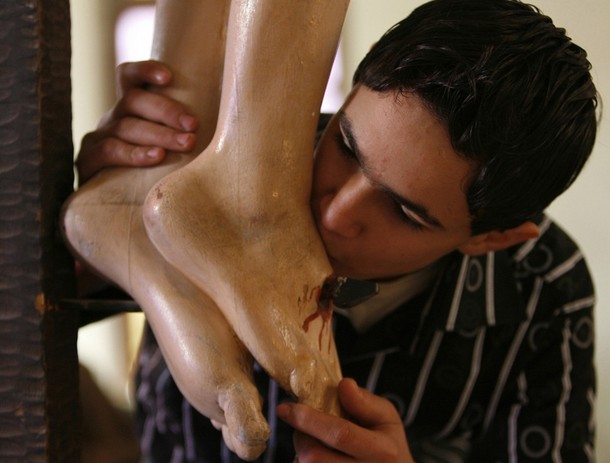
Most Americans are familiar with the Ten Commandments from our Sunday School days as kids. Some of us can even recite them from memory. For those who can't, the Commandments are found in Exodus 20:2-17 (and repeated in Deuteronomy 5:6-21). The Second reads, "You shall not make for yourself a carved image or any likeness of anything that is in heaven above or on the earth beneath or that is in the water under the earth. You shall not bow down to them or serve them, for I the Lord your God am a jealous God..." In spite of such a plain ban, buildings of the Roman Catholic Church are notorious for the presence of images and statues, especially of the Virgin Mary. Shrines are even built to them in Catholic homes.

The first problem is that Catholic portrayals of the Commandments hide the Second, a problem which I address here.

However, when confronted, Catholics will dodge the implications of the commandment by claiming that their use of images of saints is a matter of devotion, not worship, and, therefore, not a violation of the commandment. For statues of Jesus, they claim to be worshiping Christ Himself, not the statue; the statue is merely an aid.

I have dealt with the issue of saint worship elsewhere (such as here). I want now to address the worship of Jesus by use of images of Him.

In Deuteronomy 12:29-30, Moses gives the Israelites a grave warning: "When the Lord your God cuts off before you the nations whom you go in to dispossess, and you dispossess them and dwell in their land, take care that you be not ensnared to follow them, after they have been destroyed before you, and that you do not inquire about their gods, saying, 'How did these nations serve their gods?—that I also may do the same.'" This was written during the Conquest, as the Israelites were driving out the pagans in the Promised Land, as God had commanded them. We see immediately that He is warning them not to get sucked into the worship of the deities of the pagans, the very perversions for which God had judged the Canaanites. However, that wasn't the end of the warning: "You shall not worship the Lord your God in that way, for every abominable thing that the Lord hates they have done for their gods, for they even burn their sons and their daughters in the fire to their gods" (Deuteronomy 12:31). Not only did Jehovah forbid the Israelites to worship the Canaanite deities, He also forbade them to use pagan forms of worship to worship Him!

This was an error that Israel had already made in their travels in the Wilderness. When Aaron, Moses's brother, had made for them the Golden Calf (Exodus 32:1-6), in imitation of the pagan rituals that they had known in Egypt, they did not call it a new god, as is often mistakenly thought. Rather, they called the image "Jehovah" (verse 5)!

This is the death blow to all of the pretenses of Rome. She claims that there is no harm in using an image of Jesus, an image just like those used by the pagan Romans in earlier Christian history (just as Israel had learned from the Egyptians), because it is an image of Jesus, not of Jupiter. Yet, that is exactly the pretense of the Israelites as they called the Golden Calf "Jehovah"! And it is equally judged by God's words through Moses: "You shall not worship the Lord your God in that way, for every abominable thing that the Lord hates they have done for their gods" (Deuteronomy 12:31).

Saturday, February 18, 2017

Near-Death Experiences: Do People Really See Heaven and Then Come back?


I have been appalled by the number of books and videos on Amazon that supposedly describe the experience of people who have died, been to heaven, and then returned to the world of the living. There is also a video being promoted by the 700 Club on the subject. I won't list any title, because I don't want to promote awareness of them.

However, I must express my concern about such books, even if they are true, and not the mere commercial inventions that I suspect them to be.

Jesus tells a story (Luke 16:19-31): "There was a rich man who was clothed in purple and fine linen and who feasted sumptuously every day. And at his gate was laid a poor man named Lazarus, covered with sores, who desired to be fed with what fell from the rich man’s table. Moreover, even the dogs came and licked his sores. The poor man died and was carried by the angels to Abraham’s side. The rich man also died and was buried, and in Hades, being in torment, he lifted up his eyes and saw Abraham far off and Lazarus at his side. And he called out, ‘Father Abraham, have mercy on me, and send Lazarus to dip the end of his finger in water and cool my tongue, for I am in anguish in this flame.’ But Abraham said, ‘Child, remember that you in your lifetime received your good things, and Lazarus in like manner bad things; but now he is comforted here, and you are in anguish. And besides all this, between us and you a great chasm has been fixed, in order that those who would pass from here to you may not be able, and none may cross from there to us.’ And he said, ‘Then I beg you, father, to send him to my father’s house— for I have five brothers—so that he may warn them, lest they also come into this place of torment.’ But Abraham said, ‘They have Moses and the Prophets; let them hear them.’ And he said, ‘No, father Abraham, but if someone goes to them from the dead, they will repent.’ He said to him, ‘If they do not hear Moses and the Prophets, neither will they be convinced if someone should rise from the dead.'"

I especially want to focus on verse 31: "He said to him, ‘If they do not hear Moses and the Prophets, neither will they be convinced if someone should rise from the dead.’" Here we have the testimony that people will not be converted by such stories, if they reject the testimony of the Bible, which is the divinely-appointed means of conversion (John 17:17).

I also think of the words on Paul, in II Corinthians 12:1-4, especially verse 4: "...things that cannot be told, which man may not utter." In this passage, he describes a man, unnamed but known to Paul, who has such an experience, but was forbidden to repeat what he heard while he was in heaven. If that man was forbidden to speak, why does God allow all of these other people to publish their supposedly-same stories? I say "supposedly" because I am sceptical of them, not only on the bases that I mention here, but also because of the screwy theology promoted by so many of these books, especially the frequent New Age spin given them.

It is obvious that I cannot forbid anyone to write, much less purchase, these books. However, I can urge you to consider what the Scriptures say on the matter, and avoid them as unbiblical deceptions.

Monday, October 24, 2016

Baptismal Regeneration: The Papal Foot in Luther's Wittenberg Door


In the earliest days of the Reformation, Martin Luther based his stand on justification by faith alone. And with good reason, as history has show. it continues to be the point of confrontation between Evangelicals and the Church of Rome. However, on lesser doctrines, he struggled to break free from his own popish upbringing and training, particularly regarding the sacraments. While he properly jettisoned the additional but unbiblical Catholic sacraments, holding only to baptism and the Lord's Supper, he held essentially-popish views of those two.

In the Lord's Supper, Luther continued to hold to the corporeal Real Presence, that is, that Christ is literally and physically present in the bread and wine. Like Rome, Luther taught that the human nature of Christ was included in the ubiquity of His divine nature. The Reformed, however, reject such a view because it mixes the human and divine natures, as did the heretic Eutyches, contrary to the orthodox formulation of the Creed of Chalcedon, which said, in part, "acknowledged in two natures, inconfusedly, unchangeably, indivisibly, inseparably; the distinction of natures being by no means taken away by the union, but rather the property of each nature being preserved." Note that this is the official doctrine of both Lutherans and of Rome, yet they do not see a conflict between it and their sacramental view. I do, as have the Reformed through history. in fact, it was the issue at the colloquy of Marburg that led Luther to declare the Reformed worse than papists or heathen.

In baptism, Luther retained the popish doctrine of baptismal regeneration. That is, both held that baptism effectually applied the merits of Christ, such that the person was truly regenerated and joined with Christ. While Zwingli agreed, Calvin and the Reformed since him have rejected the doctrine as unscriptural.

As the Westminster Confession XXVII:3 says of both sacraments, "The grace which is exhibited in or by the sacraments, rightly used, is not conferred by any power in them..." And of baptism, XXVIII:6 says, "The efficacy of baptism... is not only offered but really exhibited and conferred by the Holy Ghost to such as the grace belongeth unto, according to the counsel of God's own will, in His appointed time." Of the Lord's Supper, XXIX:5 says, "The outward elements in this sacrament... remain truly and only bread and wine, as they were before." Further, in section 7, it adds, "Worthy receivers, outwardly partaking of the visible elements in this sacrament, do then also, inwardly by faith, really and indeed, yet not carnally and corporally, but spiritually, receive and feed upon Christ crucified, and all benefits of His death..." Thus, the Reformed view is spiritual. Whether the water of baptism or the bread and wine of the Supper, the benefits are received, not from the elements, but from Christ, received, not in the flesh, but in the spirit, not automatically or mechanically, but only by faith. Also, the Reformed view maintains the true humanity of Christ, instead of swallowing it up in a divine-human hybrid, who isn't truly either one.

Saturday, June 11, 2016

Idolatry, Images, and the Second Commandment

In Exodus 32:1-10, Moses tells us of a time when he was on Mount Sinai, receiving the revelation of the Law, including the Ten Commandments, written on tablets by God's own finger. While he was there, acting
The Golden Calf
as covenant mediator for the people of Israel, those same people were on the plain below, impatiently waiting for his return. They demanded of Aaron, Moses's brother and lieutenant, that he make a new god for them. So, Aaron gathered their gold jewelry, melted it down, and made             ,, a statue of a calf, traditionally called the Golden Calf.

Most of us have heard that story in Sunday School, as we were growing up. However, while our story-telling stops at that point, Moses's account does not. After referring to the calf in verse 4, "These are your gods [sic], O Israel, who brought you up out of the land of Egypt!"  Then note what Aaron says in verse 5: "Tomorrow shall be a feast to the Lord [i. e., Yahweh]." That is key, because it shows that the calf wasn't presented as a new god, but rather as a representation of the God they claimed already to know!

This passage is an application of the Second Commandment. One might note that the people hadn't seen the Second Commandment, yet, because Moses hadn't yet brought it down to them. That objection is true. But let us continue with consideration of God's reaction to this event.

Look at what God says to Moses in verse 8: "They have turned aside quickly out of the way that I commanded them. They have made for themselves a golden calf and have worshiped it and sacrificed to it." Thus, while He has yet to give them the commandment, He is holding them accountable for earlier revelation, such as Exodus 18:11. And what does He do? Verse 35: "Then the Lord sent a plague on the people, because they made the calf, the one that Aaron made."

The Church of Rome sets up its images, but claims that they do not conflict with the Scriptures because they aren't directing the people to worship false gods. Zeus or Thor, for example. However,  in this passage, God actually consigns some of the Israelites to capital punishment, not for worshiping Osiris, but rather for putting the name of God on an image. In the same way, Catholics are claiming to serve that same jealous God with statues of Mary, etc. If God was inspired to wrath by having His name worshiped in an idol, how much more His judgment must be against prayers to an image of lesser beings!

The claims of Rome are a subterfuge, just as the creation of the calf was. And she must be judged as idolatrous, just as Israel was.

Wednesday, October 29, 2014

The Anti-Traditional Essence of the Catholic Doctrine of Transubstantiation

According to the doctrine of the Roman Catholic Church, the elements of bread and wine in the Eucharist (or communion, or Lord's Supper, depending on one's tradition) are physically transformed in substance, though not in form, into the literal flesh and blood of Christ by the words of institution, i. e., when the priest says the words "this is my body" and "this is my blood." This change in substance is called "transubstantiation."

The Catholic Apologist Dave Armstrong explains this mystery by analogy to the Incarnation. He says (in his book, A Biblical Defense of Catholicism) that the relationship of the elements before and after their transubstantiation is like the union of deity and humanity in the Person of Christ. The Catholic Encyclopedia also explains the doctrine in incarnational terms. I do not know whether that makes it official dogma, but I am responding to it as such, until shown otherwise.

That analogy presents a serious problem, even worse that the error of transubstantiation itself.

I agree with the Catholic Church that Christ is one Person, uniting in Himself the deity of the Second Person of the Trinity and the humanity born of the Virgin Mary. We also agree that these two natures are distinct, though not separate, not mixed or confused, but each retaining its respective nature. This is formulated in the Chalcedonian Creed. For me, the official statement is found in the Westminster Confession of Faith VIII:2, "So that two whole, perfect, and distinct natures, the Godhead and the manhood, were inseparably joined together in one person, without conversion, composition, or confusion."

In contrast, in the Fifth Century, a man named Eutyches argued that the Person of Christ was of one nature, which was both divine and human.This doctrine is known as Eutychianism, in his honor, or Monophysitism. It is the official doctrine of the Coptic, Armenian, and Syriac churches, but is rejected by Catholic, Orthodox, and Protestant churches, as a perversion of the Person of Christ, in that it turns Him, not into God or man, but rather into a hybrid which is neither fully one or the other. This was the historical situation which resulted in the Council of Chalcedon in 451.

Do you see why I bring this up? If Jesus is fully human, as both I and the Catholic Church affirm, then He has a body with the essential attributes of any other human being. That includes two things, off the top of my head, which are relevant here: first, that He can only be physically in one place at a time, and second, that His flesh is itself, neither transformable into something else, nor subject to transformation from something else. One aspect of that is the question of where Jesus now is. So, where does the Bible say that is? Heaven (Luke 24:51 and Rom. 8:34)!

The Church of Rome, on the other hand, claims that the flesh of Christ is wherever His deity is, which is, of course, everywhere! Is that not the teaching of Eutyches? Is that not what was rejected by Chalcedon, almost sixteen centuries ago? Yes, it is! The Catholic doctrine of transubstantiation intermixes the humanity and divinity of Christ, so that each shares in the attributes of the other.

Rome claims that their doctrine is from "tradition," yet it wasn't formally adopted until the Fourth Lateran Council in 1215. Thus, the orthodox doctrine which was expressed in the Fifth Century was denied by Rome in the Thirteenth. That, to my mind, puts the lie to Catholic claims of tradition, not that tradition would have justified a doctrine of such superstitious and idolatrous implications. It also indicates that no person, claiming the Name of Christ and housing the Holy Spirit in his heart, can participate in a Catholic eucharist, as if it were the same thing as true communion in the body and blood of Christ.

Wednesday, October 8, 2014

Evangelical Lunatics: "Blood Moon" Madness

"Thus says the Lord:
'Learn not the way of the  nations,
Nor be dismayed by the signs of  the heavens
Because the nations are  dismayed at them,
for the customs of the peoples  are vanity.'"
- Jeremiah 10:2-3

It seems less than a coincidence that I watched the lunar eclipse this morning, and then the verses above, Jeremiah 10:2-3, came up in my daily Bible reading. This eclipse was the second (the first was April 14-15) in a rare tetrad of eclipses, i. e., successive total eclipses, with no intervening partial eclipses. The other two will be in 2015.

These eclipses have been designated "blood moons" by John Hagee, due to the redness associated with the appearance of the moon during a full eclipse (the refraction of sunlight through the earth's atmosphere appears red, the same phenomenon that causes the red light at sunrise and sunset), as a way to connect them to prophecies regarding Israel (according to his interpretation) that describe the moon appearing like blood (such as Joel 2:31). In other words, while all full eclipses appear red, Hagee has designated these eclipses as "blood moons" purely on the basis of his whim. The fact that it also sells his book is completely coincidental.

Hagee claims that past "blood moons" were signs of significant events in modern-day Israel. for example, he mentions the independence of Israel in 1948. Perhaps it was a mistake to be so specific, because those "blood moons" took place in 1949-50, not 1948. Furthermore, of the current "blood moons," three of the four - including the one this morning - won't even be visible in Israel. How can they be signs to Israel, if they aren't visible in Israel?

The problem is that the whole thing is an invention of the fevered imagination of John Hagee. Yet it has a segment of the evangelical community whipped up in fear. Or, as Jeremiah says, in superstition.

The Bible certainly does mention astronomical signs for eschatological events. I happen not to think they're intended to be taken literally. However, whether they are figurative or literal, to look to the heavens as predictors of coming events is the mentality of the pagan, not the Christian. I am sure that both Hagee and his Hagettes would loudly, and properly, decry the use of astrology by Christians, yet they have done that exactly, simply changing the terminology! It is this pagan worldview, baptized though it be, that is judged by God in the words of Jeremiah above.

No matter what name a person puts on it, to adopt a pagan worldview is to be a pagan, and thus to be under the judgment of God.

And for John Hagee, to lead people into superstition brings an extra judgment, as Jeremiah also says. He adds (Jer. 10:21), "For the shepherds are stupid and do not inquire of the Lord; therefore they have not prospered, and all their flock is scattered." The stupidity of Hagee is already plain to see; I hope that his deceived flock will scatter, as soon as the falsity of his prophecies is revealed.