Showing posts with label lord's supper. Show all posts

Wednesday, February 6, 2019

Our Union with Christ and All His Benefits

Evangelicals don't talk about our union with Christ. I think that is because it sounds very Catholic. However, it is a completely biblical doctrine, and of great use to the believer. We deprive ourselves by avoiding the subject.

We find the principle described in Scripture in several places, but the best one is Galatians 2:20: "I have been crucified with Christ. It is no longer I who live, but Christ who lives in me. And the life I now live in the flesh I live by faith in the Son of God, who loved me and gave Himself for me." By faith, the believer is united with Jesus spiritually, so that all that He is and did becomes ours, and all that we are and did becomes His. This is the basis of the doctrine of double imputation. In the Bible, it is described mystically as becoming His members: "We are members of His body" (Ephesians 5:30; see also I Corinthians 6:15). We hear this and think of "members" in the sense of "members of an organization," such as the PTA. However, that is not at all the meaning of "members" here. Rather, it is an analogy to "members" in the sense of "body parts" (see Romans 12:4-5). We are incorporated mystically into the spiritual body of Christ!

Of what benefit is that union? We think quickly, of course, of the imputation of His righteousness (II Corinthians 5:21), as I mentioned above. That is the basis of our justification, so it is certainly a wondrous benefit! But we receive so much more, as is symbolized by communion. As the bread and wine sustain our physical bodies, we are sustained spiritually by means of our union with Him, receiving all of the grace and other benefits which He purchased for us on the cross. "United to Christ, we receive two classes of benefits - inward and outward; the inward all included under the generic name of 'repentance,' and appertaining to the entire destruction of sin and the complete restoration of the image of God; the outward having reference to all those benefits which affect our relations to God as a Ruler and Judge. Both classes of blessings are equally the promise of the covenant. Both are treasured up in the Lord Jesus Christ. We obtain both by being in Him, and as we are in Him only by faith, faith must be the exclusive condition of the covenant" (James Henley Thornwell, "Theology as a Life in Individuals and in the Church").


Saturday, October 27, 2018

The True Tradition of the Eucharist Held by the Reformed

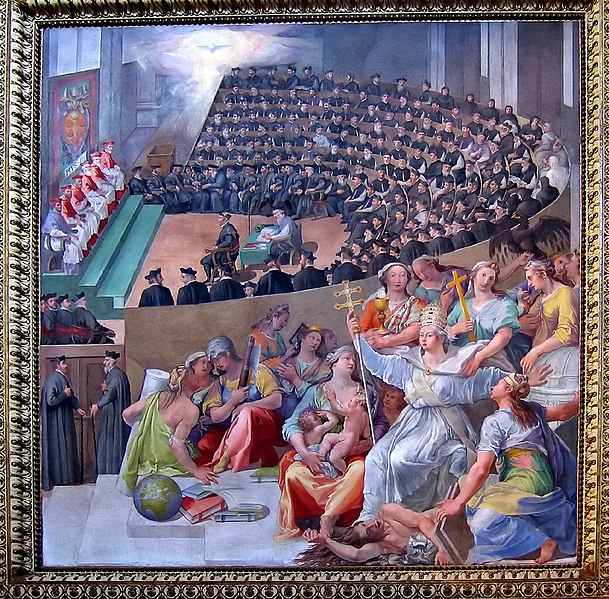
The Church of Rome teaches that the elements of the Eucharist - or communion, if you prefer - are literally changed into the flesh and blood of Jesus. The Council of Trent made that dogma official: "Because Christ our Redeemer said that it was truly His body that He was offering under the species of bread, it has always been the conviction of the Church of God, and this holy Council now declares again, that by the consecration of the bread and wine there takes place a change of the whole substance of the bread into the substance of the body of Christ our Lord and of the whole substance of the wine into the substance of His blood. This change the holy Catholic Church has fittingly and properly called transubstantiation." Notice especially the assertion that "it has always been the conviction of the Church of God." 

However, I deny that it has "always been the conviction." Rather, within the Catholic Church, there was a debate on the topic, and the doctrine of transubstantiation merely became the dominant view.

For example, Saint Augustine very explicitly states that Jesus is present in the Eucharist, but only to the faithful! He starts Sermon 272, which is about this very topic, with, "What you see on God's altar, you've already observed during the night that has now ended. But you've heard nothing about just what it might be, or what it might mean, or what great thing it might be said to symbolize. For what you see is simply bread and cup - this is the information your eyes report. But your faith demands far subtler insight: the bread is Christ's body; the cup is Christ's blood. Faith can grasp the fundamentals quickly, succinctly, yet it hungers for a fuller account of the matter." I recommend reading the whole thing (it is very brief), so that you can see that I have not  misrepresented his overall message. He describes the elements as the body and blood of Christ to the faithful, not as a physical reality to which the unbeliever would have access.

This view was unchallenged until a debate broke out between Radbertus and Ratramnus in the Ninth Century. Radbertus advocated the doctrine of transubstantiation as we now know it. Ratramnus defended the Augustinian view of a spiritual real presence to the believer only. The position of Radbertus came to dominate, and was later spread further by Aquinas and, as quoted above, Trent.

The significance of this is that the view expounded by Augustine and Ratrumnus is exactly that taught by Calvin and held by the orthodox Reformed (excluding Zwingli and his descendants) to this day. For example, the Westminster Confession of Faith XXIX:7 (1646) says, "Worthy receivers, outwardly partaking of the visible elements in this sacrament, do then also inwardly by faith, really and indeed, yet not carnally and corporally, but spiritually, receive and feed upon Christ crucified, and all benefits of His death: the body and blood of Christ being then not corporally or carnally in, with, or under the bread and wine; yet as really, but spiritually, present to the faith of believers in that ordinance, as the elements themselves are to their outward senses."

What we see here is that the claims of Rome to be holding to the "traditional" view in her doctrine of transubstantiation is committing historical revision. The fact is that she repudiated what had been the historical view to adopt a particularly-superstitious perversion. It is the Reformed alone who hold the historical doctrine of the church.

Saturday, January 21, 2017

What Is the Reality of the Eucharist?


Both the Church of Rome and the Lutherans hold that Christ is physically present in the elements of communion, i. e., in the bread and wine. That's why, they say, that an unbeliever receiving those elements is "eating and drinking judgment to himself" (I Corinthians 11:29). If the elements remain mere bread and wine, how can there be consequences for eating and drinking unworthily, they ask.

While we Reformed deny that Christ is physically present in the elements, we gladly hold that He is spiritually present to those who receive in faith. Thus, eating and drinking judgment is not the result of having bits of Jesus in the stomach of His enemy, but is rather because that unbeliever is receiving the Gospel in visible form. He is seeing the broken body and the spilled blood of Jesus, but despising them, increasing his judgment for unbelief.

The Catholics claim that the Reformed teaching creates a false dichotomy in the eucharist, with Christ present in some portions, but not in others. However, one of their own saints, Augustine, refutes that accusation: "If thou receivest it carnally, still it ceases not to be spiritual, though it is not so to thee." The eucharist remains the means of grace that Christ intended it to be, even if an unbeliever fails to receive that grace because of that unbelief (compare Matthew 13:58).

We find these truths summarized well in the Westminster Confession of Faith XXIX:7-8: "Worthy receivers, outwardly partaking of the visible elements in this sacrament, do then also inwardly by faith, really and indeed, yet not carnally and corporally, but spiritually, receive and feed upon Christ crucified, and all benefits of his death: the body and blood of Christ being then not corporally or carnally in, with, or under the bread and wine; yet as really, but spiritually, present to the faith of believers in that ordinance, as the elements themselves are to their outward senses. Although ignorant and wicked men receive the outward elements in this sacrament, yet they receive not the thing signified thereby; but by their unworthy coming thereunto are guilty of the body and blood of the Lord, to their own damnation. Wherefore all ignorant and ungodly persons, as they are unfit to enjoy communion with him, so are they unworthy of the Lord's table, and can not, without great sin against Christ, while they remain such, partake of these holy mysteries, or be admitted thereunto." 

Wednesday, January 4, 2017

The Creed of Chalcedon Against Rome's Doctrine of Transubstantiation

 
The Church of Rome professes commitment to the creeds of the historical church. In fact, she elevates them to sacred tradition, a status not given to them by Protestants. Those are the Apostles' Creed, the Nicene (or Niceno-Constantinopolitcan) Creed, and the Creed (or Definition) of Chalcedon. This status is important: Rome gives the creeds the status of Scripture, and claims them as standards of her theology.

My assertion is that they fall short of that profession.

Part of the doctrine of Chalcedon (and I consider it to be biblically correct) is that Christ exited - and shall forever continue to exist - in His two natures, fully God and fully human: "the same perfect in Godhead and also perfect in manhood; truly God and truly man." So far, we have no problem. However, the Creed continues: "to be acknowledged in two natures, inconfusedly, unchangeably, indivisibly, inseparably; the distinction of natures being by no means taken away by the union, but rather the property of each nature being preserved."

It is here that the problem arises. I agree with this sentence. Rome professes it, as well. However, Rome also professes the doctrine of communicatio idiomatum, or, in English, the "communication of attributes" of one nature to the other. This is also the doctrine of the Lutherans. It is the basis of the assertion of both that, therefore, the humanity of Christ is ubiquitous, that is, everywhere, because it receives that attribute from His divine nature. They apply this understanding in their respective doctrines of transubstantiation and consusbstantiation, that is, that the flesh and blood of Christ are, or are in, the elements of the Eucharist literally.

In contrast, the Reformed have always denied the iniquity of the humanity of Christ, and thus have held that a literal, corporeal presence of Christ in the elements is a violation of the Creed, for the straightforward reason that to give the human nature of Christ a divine characteristic is to make it thereby not human. That is, to assert transubstantiation or consubstantiation, traditional as it may be, is a denial of the creedal basis claimed by all three groups.

The Reformed do not by this reasoning make the Eucharist a mere ritual, nothing more than a memorial, as Baptists, for example, do. Rather, we believe in the Real Presence. the difference is that we believe that the body of Christ remains a human body, confined to a specific place, i. e., in heaven (Acts 1:11, Hebrews 1:3). However, we are connected to His humanity, not by its acting inhumanly, but rather by the Holy Spirit, who, as God, does have the divine attribute of ubiquity. We thus preserve the true humanity of Jesus.

Saturday, December 31, 2016

In What Way Is Jesus Present in the Lord's Supper?

I think that it is quite apropos that my four-hundredth post falls on the last day of the year!

One of the last actions by Jesus recorded in Scripture before His crucifixion was His Last Supper with the Apostles. It is the basis of what is variously called the Lord's Supper (cf. I Corinthians 11:20), communion, or the eucharist. It is recorded in several places. the version in Matthew 26:26-29 says, "Now as they were eating, Jesus took bread, and after blessing it broke it and gave it to the disciples, and said, 'Take, eat; this is My body.' And He took a cup, and when He had given thanks He gave it to them, saying, 'Drink of it, all of you, for this is My blood of the covenant, which is poured out for many for the forgiveness of sins. I tell you I will not drink again of this fruit of the vine until that day when I drink it new with you in My Father’s kingdom.'"

This passage was a contentious focus during the Reformation. On one side, the Lutherans and Catholics agreed together that "this is My body" was to be taken literally. That is, the Church of Rome believes that the bread and wine are literally transformed into the physical flesh and blood of Jesus. The Lutherans teach that the bread and wine remain bread and wine, but the flesh and blood of Jesus are received under the form of the bread and wine. Both teach that the recipient of the elements receives the corporeal, physical, flesh and blood of Jesus.

In opposition to that corporeal view, other Protestants have divided between those who follow Huldrych Zwingli, that the Supper is a memorial, and that Jesus is not present in any literal sense, and those who follow John Calvin, who taught that Jesus is spiritually present in the sacrament, when it is received in faith. 

The views may be described as those who hold that "this is My body" means ":this becomes my body," and those who hold "this is My body" means "this represents My body." I am of the latter group.

Here I want to argue against the corporeal view.

First is just a logical issue. If "this is MY body" must be literal, what about "I am the vine" (John 15:5). Must that also be taken literally? Was Jesus telling us that He is actually a grapevine under the "accidents" of skin, teeth, and hair? If not, then why must "My body" be taken literally?They are grammatically-equivalent sentences.

Second, consider another portion where Jesus talks about our being sustained by His flesh, John 6:52-59, 63: "The Jews then disputed among themselves, saying, 'How can this man give us his flesh to eat?' So Jesus said to them, 'Truly, truly, I say to you, unless you eat the flesh of the Son of Man and drink His blood, you have no life in you. Whoever feeds on My flesh and drinks My blood has eternal life, and I will raise him up on the last day. For My flesh is true food, and My blood is true drink. Whoever feeds on My flesh and drinks My blood abides in Me, and I in him. As the living Father sent Me, and I live because of the Father, so whoever feeds on Me, he also will live because of Me. This is the bread that came down from heaven, not like the bread the fathers ate, and died. Whoever feeds on this bread will live forever.' Jesus said these things in the synagogue, as he taught at Capernaum. [And He said,] 'It is the Spirit who gives life; the flesh is no help at all. The words that I have spoken to you are spirit and life.'" Jesus uses the same image of feeding on His flesh and blood, and His Pharisaic audience takes Him literally. But what is His reaction? Wouldn't He commend them if they were correct? But no, He corrects them, instead, telling them that it isn't His flesh which sustains the believer, but the Spirit! He repudiates a corporeal, literalist interpretation exactly equivalent to what is taught by Catholics and Lutherans, even to this day.


Tuesday, November 11, 2014

The Sacrifice of the Catholic Mass, and Its Offense to the Gospel

"If anyone saith that the sacrifice of the Mass is only a sacrifice of praise and thanksgiving, or that it is a bare commemoration of the sacrifice consummated on the cross, but not a propitiatory sacrifice, or that it profits him only who receives, and that it ought not to be offered for the living and the dead for sins, pains, satisfactions, and other necessities, let him be anathema."
The Council of Trent

The above statement is a quote from the decrees of the Council of Trent, chapter 9, canon 3. This council was called by the Roman Catholic Church to address the crisis created by the budding of the Reformation. It defined, officially and infallibly (Rome claims), Catholic doctrine, in perpetuity. I have highlighted in boldface the key phrases in that statement. They claim for this statement the support of Malachi 1:11, "For from the rising of the sun to its setting, my name will be great among the nations, and, in every place, incense will be offered to my name, and a pure offering."

When dealing with Catholic apologists, I find that they consistently claim that the Mass is not a sacrifice. For example, Dave Armstrong writes, "It is crucial to understand that the Sacrifice of the Mass is not a 're-sacrifice' of Christ, as is the common misconception. Jesus does not die every time a priest offers Mass, since He died once, in history, on earth" (A Biblical Defense of Catholicism, p. 95). Yet, he says in the very next paragraph, "in the Mass, Jesus Christ ultimately offers the sacrifice of Himself (just as at the Last Supper), with the priest merely acting in His stead, as a purely secondary, instrumental agent." So, as Trent says, it is a sacrifice, but it's not, because it is Christ sacrificing Himself, not the priest sacrificing Him. To me, that sounds like Rome is trying to play both sides of the matter.

However, whether Christ is supposedly sacrificing Himself, or the priest is sacrificing Him, the claim should be anathema (to reclaim their word) to any true Christian.

The writer of Hebrews (10:5) quotes Jesus Himself, using the words of Psalm 40:6, "Sacrifice and offerings You have not desired." So, in His own words, Jesus is telling us that we do not need a continuing sacrifice, whether offered by Himself, or "with the priest merely acting in His stead." Why is that? Because (Heb. 10:11, emphasis added) "we have been sanctified through the offering of the body of Jesus Christ once for all." The whole point of this chapter of Hebrews is to establish the superiority of Christ's priestly offering of Himself over the Jewish Aaronic priests exactly because their sacrifices had to be repeated. In contrast (Heb. 10:12-14, emphasis added), "when Christ had offered for all time a single sacrifice for sins, He sat down at the right hand of God..., for, by a single offering, He has perfected for all time those who are being sanctified." And I think that the final nail in the coffin is seen in verses 17 and 18: "'I will remember their sins and their lawless deeds no more.' Where there is forgiveness of sins, there is no longer any offering for sin."

By claiming a continuing sacrifice in the Mass, the Catholic Church is claiming that it must complete an insufficiency in the sacrifice of Christ. And, as the writer of Hebrews (10:1) points out, "it can never, by the same sacrifices, that are continually offered every year [or every Sunday], make perfect those who draw near." That is, if the sacrifice must be continually offered, then it is never sufficient to achieve the purpose of sanctification. The Catholic has no assurance that he has partaken in the sacrifice of the Mass enough times to know when he has been saved from his sins.

That is bondage of an horrific sort! That is why the Reformation was necessary! And it is why bible-believing Protestants must never cease to point the finger at Rome and denounce it as a perversion of Christianity.

On which will you rely, Catholic reader? A Savior who gave His life for His people, once for all, or a Mass with nothing but the claims of the Pope, contrary to the Scriptures themselves?

Wednesday, October 29, 2014

The Anti-Traditional Essence of the Catholic Doctrine of Transubstantiation

According to the doctrine of the Roman Catholic Church, the elements of bread and wine in the Eucharist (or communion, or Lord's Supper, depending on one's tradition) are physically transformed in substance, though not in form, into the literal flesh and blood of Christ by the words of institution, i. e., when the priest says the words "this is my body" and "this is my blood." This change in substance is called "transubstantiation."

The Catholic Apologist Dave Armstrong explains this mystery by analogy to the Incarnation. He says (in his book, A Biblical Defense of Catholicism) that the relationship of the elements before and after their transubstantiation is like the union of deity and humanity in the Person of Christ. The Catholic Encyclopedia also explains the doctrine in incarnational terms. I do not know whether that makes it official dogma, but I am responding to it as such, until shown otherwise.

That analogy presents a serious problem, even worse that the error of transubstantiation itself.

I agree with the Catholic Church that Christ is one Person, uniting in Himself the deity of the Second Person of the Trinity and the humanity born of the Virgin Mary. We also agree that these two natures are distinct, though not separate, not mixed or confused, but each retaining its respective nature. This is formulated in the Chalcedonian Creed. For me, the official statement is found in the Westminster Confession of Faith VIII:2, "So that two whole, perfect, and distinct natures, the Godhead and the manhood, were inseparably joined together in one person, without conversion, composition, or confusion."

In contrast, in the Fifth Century, a man named Eutyches argued that the Person of Christ was of one nature, which was both divine and human.This doctrine is known as Eutychianism, in his honor, or Monophysitism. It is the official doctrine of the Coptic, Armenian, and Syriac churches, but is rejected by Catholic, Orthodox, and Protestant churches, as a perversion of the Person of Christ, in that it turns Him, not into God or man, but rather into a hybrid which is neither fully one or the other. This was the historical situation which resulted in the Council of Chalcedon in 451.

Do you see why I bring this up? If Jesus is fully human, as both I and the Catholic Church affirm, then He has a body with the essential attributes of any other human being. That includes two things, off the top of my head, which are relevant here: first, that He can only be physically in one place at a time, and second, that His flesh is itself, neither transformable into something else, nor subject to transformation from something else. One aspect of that is the question of where Jesus now is. So, where does the Bible say that is? Heaven (Luke 24:51 and Rom. 8:34)!

The Church of Rome, on the other hand, claims that the flesh of Christ is wherever His deity is, which is, of course, everywhere! Is that not the teaching of Eutyches? Is that not what was rejected by Chalcedon, almost sixteen centuries ago? Yes, it is! The Catholic doctrine of transubstantiation intermixes the humanity and divinity of Christ, so that each shares in the attributes of the other.

Rome claims that their doctrine is from "tradition," yet it wasn't formally adopted until the Fourth Lateran Council in 1215. Thus, the orthodox doctrine which was expressed in the Fifth Century was denied by Rome in the Thirteenth. That, to my mind, puts the lie to Catholic claims of tradition, not that tradition would have justified a doctrine of such superstitious and idolatrous implications. It also indicates that no person, claiming the Name of Christ and housing the Holy Spirit in his heart, can participate in a Catholic eucharist, as if it were the same thing as true communion in the body and blood of Christ.