Showing posts with label pharisees. Show all posts

Saturday, April 11, 2020

Jesus, Justice, and the Woman Caught in Adultery

There is a strange and controversial story found in John 7:53-8:11. In the story, the Pharisees bring to Jesus a woman who was caught in adultery. They say, and correctly, that the Law required those convicted of adultery to be put to death (see Leviticus 20:10 and Deuteronomy 22:22). Yet, we notice at least one problem with their presentation: Where was the man caught with her? So, the Pharisees ask Jesus, what do You say that we should do with her?

Jesus does not respond with law. Rather, His response is to point at the character of the woman's accusers. Rather, He says, "Let him who is without sin among you be the first to throw a stone at her" (verse 7). In our popular culture, this has been taken to mean that any person with any sin has no grounds for criticizing the actions of any other person. Well, we know that Jesus meant no such thing, because He had prescribed righteous judgment just before this story (John 7:24). And that indicates the problem that He had with the Pharisees in this case. Their accusations did not come from righteous grounds, regardless of their pious citation of Moses. Note that these are men who had allowed a guilty man to depart without punishment, while they were prepared to punish the woman with death! I think that this was the specific intent of the response of Jesus, quoted above. These men had justified the man because they shared his same proclivities for illicit sex, but they still wanted to play at being righteous! They all walked away in shame because Jesus had torn off the bandage with which they had been hiding their perversion. 

If the text is a legitimate part of John, a question which I am not qualified to answer, then why is it here? 

I started thinking about this story because of something I read in my private Bible study this morning: "I will not punish your daughters when they play the whore, nor your brides when they commit adultery; for the men themselves go aside with prostitutes and sacrifice with cult prostitutes, and a people without understanding shall come to ruin" (Hosea 4:14). Doesn't that sound a lot like the story from John? And in it I found what I surmised about the story that I described above. Jesus was exemplifying the same redemptive purpose that He, in His preincarnate state, had inspired in the prophecy of Hosea. 

Jesus was not, and is not, opposed to true justice. After all, He was also the source of the Law. He was the Yahweh who revealed the commandments to Moses in Exodus 20:1. However, He is also our compassionate Redeemer who went to the cross on behalf of His people. Notice how He deals with the repentant thief on the cross next to Him (Luke 23:40-43). He promised the thief that he would be with Him in Paradise in just a few hours. However, He did not take the thief down from the cross. The thief was redeemed and forgiven, but still received the due temporal, legal consequence of his wicked acts (Luke 23:41). There is no sign here of the sentimental supposition that no one can judge the sins of someone else.

Saturday, October 28, 2017

Abandoning the Law is Abandoning Righteousness

I admit that it is chic to speak against biblical Law. Even among non-dispensationalists, the idea has become accepted that the Law was a standard of righteousness under the Old Testament, but not under the New. It is usually expressed by a perversion of Romans 6:14: "You are not under law but under grace." That it is a perversion, not a legitimate use of Paul, is evident if the reader continues to the next verse: "What then? Are we to sin because we are not under law but under grace? By no means!" And, of course, none of these people ever quotes Romans 3:31: "Do we then overthrow the law by this faith? By no means! On the contrary, we uphold the law." Paul is addressing the question of the origin of righteousness. Can any man be made righteous by the Law? No! Righteousness comes only by grace through faith: "Not having a righteousness of my own that comes from the law, but that which comes through faith in Christ, the righteousness from God that depends on faith" (Philippians 3:9, see also Romans 9:31-32).

This error among Christians has had a devastating effect on American society. By presupposing a false view of the Law, Christians have had no platform for addressing public wickedness. And Scripture warns of this consequence: "Those who forsake the law praise the wicked, but those who keep the law strive against them" (Proverbs 28:4). The great catastrophes of today's society, such as abortion, are not the result of abandonment of biblical morality by the wicked, but by its abandonment by Christians

Christians hold protests, rallies, prayer meetings, in fact every variety of spiritual activity, hoping to change society. Why has our effort been such a dismal failure? Scripture answers that question, too: "If one turns away his ear from hearing the law, even his prayer is an abomination" (Proverbs 28:9). While God's professing people are refusing to hear His word, He is refusing to hear our prayers. Immoral people are not the cause of that; the self-righteous supposed people of God are!

Jesus's words to the Pharisees apply equally to modern America's evangelicals: "You leave the commandment of God and hold to the tradition of men" (Mark 7:8). What tradition? The tradition of despising God's Law.


Saturday, October 31, 2015

Hypocrisy and True Spiritual Peace

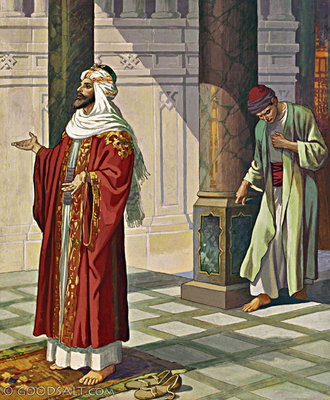
In Luke 18:9-14, Jesus told a deep parable, that of the Pharisee and the Tax Collector. In it, we see strikingly different attitudes in their approaches to God, representative of those of people everywhere. The Pharisee prays (verses 11-12), "God, I thank you that I am not like other men, extortioners, unjust,
The Pharisee and the Tax Collector
adulterers, or even like this tax collector.
I fast twice a week; I give tithes of all that I get." Then He turns to the tax collector, who prays (verse 13), "God, be merciful to me, a sinner!" Then the Lord ends the parable with His own inspired synopsis (verse 14): "I tell you, this man went down to his house justified, rather than the other. For everyone who exalts himself will be humbled, but the one who humbles himself will be exalted."

Notice how much longer the prayer of the Pharisee is (see Matthew 6:1-4). He uses thirty-three words in this English version, all of them extolling his virtues. In contrast, the tax collector uses just seven words, begging for God's mercy on his sins. What a contrast! Thirty-three words to stand condemned, but only seven to be justified!

The Pharisee in the story exemplifies something that the Puritan Thomas Watson said: "The wicked may have something which looks like peace, but is not. They may be fearless and stupid, but there is a great difference between a stupified conscience and a pacified conscience. 'When a strong man armed keepeth his palace, his goods are in peace.' Luke 11:21. This is the devil's peace. He rocks men in the cradle of security. He cries, 'Peace, peace,' when men are on the precipice of hell. The seeming peace that a sinner has is not from the knowledge of his happiness but from the ignorance of his danger."

This same false, self-deceived spiritual peace is spoken of by the Prophet Jeremiah (Jer.  3:3-5): "The showers have been withheld, and the spring rain has not come; yet you have the forehead of a whore; you refuse to be ashamed. Have you not just now called to Me, 'My father, you are the friend of my youth— will He be angry forever, will He be indignant to the end?' Behold, you have spoken, but you have done all the evil that you could." In a time of apostasy, the Jews spoke loving words to God, yet devoted themselves to their wicked deeds and idolatries, as if God could be deceived. Yet, He wasn't. And the Prophet Isaiah is even more blunt (Is. 57:21): "'There is no peace,' says my God, 'for the wicked.'"

Watson explains what is necessary for true peace between the sinner and his God: "The graft must first be inoculated into the tree before it can receive sap or nourishment from it; so we must first be
A tree prepared for grafting in a new branch.
ingrafted into Christ before we can receive peace from Him." It is only as the believer is connected to Christ by faith that he can experience true peace of conscience. Isaiah also teaches this (Is. 32:17): "The effect of righteousness will be peace, and the result of righteousness, quietness and trust forever." See also Isaiah 9:6-7 and John 16:33. In contrast, the one who depends on his own worthiness is described in Deuteronomy 29:19-20: "The one who, when he hears the words of this sworn covenant, blesses himself in his heart, saying, 'I shall be safe, though I walk in the stubbornness of my heart,' the Lord will not be willing to forgive him, but rather the anger of the Lord and His jealousy will smoke against that man, and the curses written in this book will settle upon him, and the Lord will blot out his name from under heaven." That is the fate of the Pharisee in the parable with which I began.

What is righteousness? It is a standard of action and motivation purely consistent with the commands and nature of God. Who meets that standard? No one but Jesus, "for all have sinned and fall short of the glory of God" (Romans 3:23). That's why it is His righteousness, not our own, that we need, when we seek to approach God: "[They] who pursued a law that would lead to righteousness did not succeed in reaching that law. Why? Because they did not pursue it by faith, but as if it were based on works" (Romans 9:31-32). What righteousness? "The righteousness of God through faith in Jesus Christ for all who believe" (Romans 3:22).

Anyone who follows the example of the Pharisee, satisfied with his own goodness to qualify him for eternal life, condemns himself. The one who, like the tax collector, recognizes his own unrighteousness, but looks to that of Christ alone, is justified, and receives both peace with God and peace of conscience.

Sunday, March 10, 2013

Sola Scriptura: Biblical Authority versus Catholic Tradition

"...[T]he [Catholic] Church, to whom the transmission and interpretation of Revelation is entrusted, does not derive her certainty about all revealed truths from the Holy Scriptures alone. Both Scripture and Tradition must be accepted and honored with equal sentiments of devotion and reverence."

The statement above is from the Catechism of the Catholic Church (1997), the official doctrinal organ of the Roman Catholic Church in the United States. I quote it here as proof from their own words that Scripture, contained in the Old and New Testaments of the Bible, is not their ultimate source of authority. They confess that they hold their extra-biblical tradition to be of equal authority. I consider this to be a gross equivocation; I believe that they give their tradition superior authority.

With the Reformers, I hold that such an equation is impossible. That is, I would suggest that the Scriptures forbid any comparable authority outside of themselves. Therefore, to claim that tradition is equal to scripture is actually a roundabout repudiation of the authority of scripture. Jesus addressed this issue Himself in two portions of the New Testament.

First, in Matthew 6:24, He said, "No one can serve two masters, for either he will hate the one and love the other, or he will be devoted to the one and despise the other." He was explicitly addressing the rule of money, but His principle applies to any dual system of authority.

And second, He criticized the Pharisees for this very act of equivocation, in Mark 7:6-8, "And He said to them, 'Well did Isaiah prophesy of you hypocrites, as it is written, "This people honors Me with their lips, but their heart is far from Me; in vain do they worship Me, teaching as doctrines the commandments of men." You leave the commandment of God and hold to the tradition of men.'" In almost parallel phrasing, our Lord condemns the very act that the Catholic Church officially endorses!

The scriptures testify to their own sufficiency. II Timothy 3:16-17 tells us, "All Scripture is breathed out by God and profitable for teaching, for reproof, for correction, and for training in righteousness, that the man of God may be competent, equipped for every good work." Not "for some good work," thus needing additional revelation, but "for every good work."

That is why the Westminster Confession of Faith I:10 reads, "The Supreme Judge, by which all controversies of religion are to be determined, and all decrees of councils, opinions of ancient writers, doctrines of men, and private spirits, are to be examined, and in whose sentence we are to rest, can be no other but the Holy Spirit speaking in the Scripture." Someone might object that the Confession is a tradition. And that is certainly true. The principle of sola scriptura doesn't mean the repudiation of all tradition. That would be impossible. Rather, it means that ultimate authority resides in scripture alone; the confession, and all other traditions, are subordinate to the authority of scripture.

Thursday, July 30, 2009

The Hardening of the Jewish Leaders


"Jesus cried out again with a loud voice and yielded up His spirit. And behold, the curtain of the temple was torn in two, from top to bottom. And the earth shook, and the rocks were split. The tombs also were opened. And many bodies of the saints who had fallen asleep were raised, and coming out of the tombs after His resurrection they went into the holy city and appeared to many. When the centurion and those who were with him, keeping watch over Jesus, saw the earthquake and what took place, they were filled with awe, and said, 'Truly this was the Son of God!'"
- Matthew 27:50-54

Upon the death of Jesus on the cross, several extraordinary occurrences took place that testified that this was the death of no mere man: the veil of the temple was torn open, an earthquake shook the ground, the rock of the mountains of the area split, and some of the local dead rose from their graves (the last, though described here, apparently actually coincided with Christ's resurrection on Sunday following). Such a fundamental reaction by the creation would surely be expected to attract the attention of many to the significance of the event. In fact, here in our passage, even pagan Romans were moved to acknowledge the Godhead of the man they themselves had crucified.

Who was unmoved? The very leaders of the Jews who had harried Jesus to His death. In fact, we read of them, plotting against His followers, in Acts 4. In verses 5-6, we see them gathered: "On the next day [after Peter and John had testified before the Jewish crowds] their rulers and elders and scribes gathered together in Jerusalem, with Annas the high priest and Caiaphas and John and Alexander, and all who were of the high-priestly family." What was their decision? Verses 16-17: "'What shall we do with these men? For that a notable sign has been performed through them is evident to all the inhabitants of Jerusalem, and we cannot deny it. But in order that it may spread no further among the people, let us warn them to speak no more to anyone in this name.'" So, even while acknowledging the significance of the events that occurred before them, they do not repent, but rather turn to subterfuge to suppress the very truth that they recognize.

16th-Century Scottish Presbyterian commentator Robert Rollock says of this passage, "It is a wonderful thing to see, that they who had judgment and understanding, and who had read all the prophecies of the Messiah to come, got no sense, yet a silly multitude ["silly" in the historical sense of simple and uneducated, referring to the five thousand of verse 4] gets some sight and sense." In other words, those with the most biblical knowledge, who should have been the first to acknowledge the messianic role of Jesus, instead hardened their hearts against Him, while those who had been most in spiritual ignorance embraced Him. Jesus anticipated this, when He said (Luke 10:21), "I thank you, Father, Lord of heaven and earth, that You have hidden these things from the wise and understanding and revealed them to little children; yes, Father, for such was Your gracious will." And Paul looked back to these events, when he said (I Corinthians 1:27), "God chose what is foolish in the world to shame the wise..."

Rollock responds with this admonition, which should still be heard in our day, even after more than four-hundred years: "Whosoever thou are who opposest thee to the brightness of the Gospel, thou crucifiest the Lord of Glory; and as it shall be laid to the charge of the high priests and Pharisees, and of Pilate and Herod, in that great day, that they crucified Jesus Christ, so it shall be laid to thy charge, and thou shalt be as guilty of his blood as they. Woe to that soul which will resist that Word and the Holy Spirit! Woe shall be to the great men in this land who against conscience conspire against Christ, religion, and their native country [i.e,. by opposing the spread of the Gospel], for wrath and vengeance remaineth for them, if they leave not off this unhappy course."