Showing posts with label assurance. Show all posts

Saturday, May 14, 2022

The Character of God as Guarantee of the Saint's Perseverance

"It is impossible [that] we should lose the thing we were wrought for, because it is God that wrought it for us. It is not the designment of an idol; that is, of some ignorant, rash, fallible, or mutable agent, such a one as may possibly be surprised by unlooked-for accidents, circumvented by a sublimer understanding, overborne by a power above him, or recede from his purpose through levity and fickleness of his nature, etc. But it is God who is 'wise in heart and mighty in strength,' Job 9:4. It is He from whom all things that are have their being and are perfectly under His rule and obeisance. He had eternity before Him, to lay His design surely; and, accordingly, 'He declared the end from the beginning.' It is, therefore, as impossible for Him either to do or to neglect to do, or to suffer to be done, anything whereby His purpose might suffer disappointment, as it is impossible that God should lie. He would never have set up those ends as the sum and substance of His design, if He had not determined to see them made good." -Puritan Elisha Coles, "A Practical Discourse of God's Sovereignty 

Part of the Creator/creature distinction is that the Creator is omniscient, omnipotent, and eternal, while the creature has all but three of those attributes. A creaturely awareness is conscious of our inability to plan for all contingencies, at all times, as may disrupt our best-laid plans. For example, the farmer cannot know of the coming hurricane that wipes out his crop. In contrast, the triune God of the Bible has infinite awareness across all time, all space, and under all contingencies, such that His plans are infallibly achieved. As in the verse that Coles quotes, "I am God, and there is none like Me, declaring the end from the beginning and from ancient times things not yet done, saying, 'My counsel shall stand, and I will accomplish My purpose'" (Isaiah 46:10). It would be comical hubris for any human to make such an assertion. 

However, it is also unforgiveable hubris to assert such infallibility for any man's ability to keep himself in a state of grace. Yet that is what the Arminian does, when he claims that no man can keep himself saved, and, therefore, he should never be assured of his hold on eternal life. If the fundamental assumption of the Arminian, that it is the will of the man that should thus preserve him, then it would be true that no man could ever know an assurance of salvation in this life. 

But this is exactly what perseverance is not. It does not, has never, and never shall, depend on the will and power of the creature to maintain his state of grace. It is the work of God alone, He whose irrepeatable attributes of deity guarantee that any man, truly saved, can never fully and finally lose his salvation. Thus, his assurance is sound, not because of any ability of his own, but because of the infallible character of the God who saved him to begin with. 



Saturday, July 11, 2020

The Promises of God Defined by His Mercy


Isaiah 55:11 is a verse which is well-known among orthodox Protestants: "So shall My word be that goes out from My mouth; it shall not return to Me empty, but it shall accomplish that which I purpose, and shall succeed in the thing for which I sent it." And there is good reason for it to be well-known, because it powerfully teaches that the Bible is infallible and trustworthy. Where we are weak, the Scriptures are invincible!

However, there is another aspect to that verse that many such Protestants pass over: the Scriptures don't achieve what we plan, but what God plans. This is where orthodoxy stands against the so-called Prosperity Gospel - which is really no gospel at all - which claims that spouting some claim from anyone on the basis of his personal desire and interpretation guarantees that God is obligated to give it.

Where this is especially important is in evangelism. Paul tells us that "faith comes from hearing, and hearing through the word of Christ" (Romans 10:17). That is, the preaching of the Word is God's usual means of converting unbelievers (see the Westminster Confession of Faith Chapter X). Some people claim that means that we are just to proclaim the Word, and then every person has an equal ability to respond, based on his choice to believe or not. Yet, we know that not all believe, even when presented with the Gospel through the Scriptures. Doesn't this "choice" doctrine then imply that the promise of Isaiah 55:11 is false? or, at least, unreliable? God forbid such a blasphemous assertion!

Rather, such people ignore the third and fourth lines of the verse: "It shall accomplish that which I purpose, and shall succeed in the thing for which I sent it." The promise of God never fails! The mere idea is impossible! Rather, it is effectual when He intends it, not us. As Paul also says: "So then it depends not on human will or exertion, but on God, who has mercy" (Romans 9:16; see also John 1:12-13).

More importantly, we have the assertion of Jesus: "All that the Father gives Me will come to Me, and whoever comes to Me I will never cast out. For I have come down from heaven, not to do My own will but the will of Him who sent Me. And this is the will of Him who sent Me, that I should lose nothing of all that He has given Me, but raise it up on the last day" (John 6:37-39). His promise here parallels the one in Isaiah, but is more explicit. To whom does the promise apply? To those who choose? No, it says no such thing. Rather, Jesus specifies that it applies to those whom the Father has given Him. Does He know who those people are? Of course. Can we know? Of course not. That is a part of the creator/creature distinction. Therefore, we are to proclaim the Word to whomever will hear us, knowing that those redeemed by Jesus will respond in faith, and the others will reject it (II Corinthians 2:16). What we must remember is that the promise of Isaiah is effectual, and that promise should stimulate us in our evangelism (Acts 18:10), knowing that God will apply that word to the conversion of all whom He intends (Acts 13:48).

Wednesday, March 25, 2020

The Effectual Atonement of the Cross

"It is, and must be, an indispensable element in anything which deserves the name of atonement that it satisfies the justice of God, or lays the foundation of a claim of right to exemption from punishment" James Henley Thornwell, "The Necessity and Nature of Christianity"). 

This statement from one of the forefront theologians of the Southern Presbyterian Church in its heyday represents why the Calvinist view of atonement is logically necessary (together with its biblical evidences) and the Arminian doctrine cannot satisfy the simple meaning of the word.  

An atonement is a sacrifice given to assuage the just wrath of God upon an action or person. We see this first in the Old Testament, in which there is even a Day of Atonement (still celebrated, though deprived of content, by modern Jews): "It shall be a statute to you forever that in the seventh month, on the tenth day of the month, you shall afflict yourselves and shall do no work, either the native or the stranger who sojourns among you. For on this day shall atonement be made for you to cleanse you. You shall be clean before the Lord from all your sins. It is a Sabbath of solemn rest to you, and you shall afflict yourselves; it is a statute forever. And the priest who is anointed and consecrated as priest in his father’s place shall make atonement, wearing the holy linen garments. He shall make atonement for the holy sanctuary, and he shall make atonement for the tent of meeting and for the altar, and he shall make atonement for the priests and for all the people of the assembly. And this shall be a statute forever for you, that atonement may be made for the people of Israel once in the year because of all their sins" (Leviticus 16:29-34). This follows the description of the sin offering. These requirements indicate several things. First, that all of the people are guilty of sin. It is presupposed in the requirement of an atonement for all of the people, not excluding the children or the clergy or any other class among them. Second, it implies that the sin condition brings the judgment of God. And third, it demonstrates the heinousness of, not just particularly bad sins, but of all sins. God hates sin, and requires that a price be paid for it. 

In the New Testament, those implications are stated briefly and explicitly. That all have sinned, we find in Romans 3:22-23: "There is no distinction, for all have sinned and fall short of the glory of God." And that sin brings the judgment of God we find in Romans 6:23: "The wages of sin is death." And that all sin, whether men consider it great or small, is under the wrath of God, we find in James 2:10: "Whoever keeps the whole law but fails in one point has become guilty of all of it."  

However, there is also a strong contrast between the atonement displayed in the Old Testament and that achieved in the New Testament. In both testaments, we have one lesson: "Without the shedding of blood there is no forgiveness of sins" (Hebrews 9:22). Old Testament believers saw that truth displayed in the daily slaying of animals. However, "since the law has but a shadow of the good things to come instead of the true form of these realities, it can never, by the same sacrifices that are continually offered every year, make perfect those who draw near. Otherwise, would they not have ceased to be offered, since the worshipers, having once been cleansed, would no longer have any consciousness of sins? But in these sacrifices there is a reminder of sins every year. For it is impossible for the blood of bulls and goats to take away sins" (Hebrews 10:1-4). Israel saw this annual atonement, yet they continued to be aware of sin and its consequences. Therefore, it was not the sacrifices themselves which provided atonement. Rather, when observed with faith, they pointed to an atonement which was to come

It is in the New Testament that the atonement was no longer merely displayed but was truly, once for all achieved. "Christ has entered, not into holy places made with hands, which are copies of the true things, but into heaven itself, now to appear in the presence of God on our behalf. Nor was it to offer Himself repeatedly, as the high priest enters the holy places every year with blood not his own, for then He would have had to suffer repeatedly since the foundation of the world. But as it is, He has appeared once for all at the end of the ages to put away sin by the sacrifice of Himself. And just as it is appointed for man to die once, and after that comes judgment, so Christ, having been offered once to bear the sins of many, will appear a second time, not to deal with sin but to save those who are eagerly waiting for Him" (Hebrews 9:24-28).

Here we see the fulfillment of what is described by Thornwell, satisfying the justice of God and relieving the consciences of believing men. It fully saves everyone for whom it was given (6:39). As He promises, it cannot fail to achieve its purpose.

Wednesday, October 16, 2019

Sovereign Grace, the Trinity, and the Christian Life

"Peter, an apostle of Jesus Christ, To those who are elect exiles of the Dispersion in Pontus, Galatia, Cappadocia, Asia, and Bithynia, according to the foreknowledge of God the Father, in the
sanctification of the Spirit, for obedience to Jesus Christ and for sprinkling with His blood: May grace and peace be multiplied to you."
- I Peter 1:1-2 

This is the opening salutation from Peter's first epistle. Notice that it is not written to men in general but specifically to Christians, whom he identifies as the true Israel (compare Romans 9:8, Galatians 3:7, 6:16, etc.), gathered by the sovereign grace of God. 

And when I say God, I don't mean in a vague, generic sense. Rather, Peter identifies our election as the work of the triune God of the Bible: the foreknowledge of the Father, the sanctification of the Holy Spirit, and the obedience of the Son, applied, figuratively speaking, by the sprinkling with His blood, an image from the Old Testament sacrifices (such as Leviticus 7:2 and 14:7). Peter does not contemplate a unitary deity, whether of the Arian type or the Sabellian. 

Nor does Peter contemplate any sort of works religion, as is taught by those pseudo-Christian sects. Rather, he tells us that the Father chose us, the Holy Spirit changed us, and the Son fulfilled all righteousness for us, that it might be imputed to us. In just these two verses, Peter teaches us to see our reunion with our God as fully trinitarian and fully by His sovereign grace, which is why he could add, in verse 4, that we have "an inheritance that is imperishable, undefiled, and unfading, kept in heaven for you." The same sovereign, trinitarian grace that saved us also keeps us secure until we reach our heavenly goal."I am sure of this, that he who began a good work in you will bring it to completion at the day of Jesus Christ" (Philippians 1:6).

Saturday, January 12, 2019

There Can Be No Salvation Which Does Not Result in Good Works


Both Catholics and Mormons caricature the biblical doctrine of justification by faith alone as meaning that works don't matter, so that a person can consider himself saved, no matter what profligacy he exhibits in his life. According to their understanding of salvation, assurance of eternal life must remain a carrot hanging on a stick, never received in this life, but rather only spurring a person on in an effort to achieve salvation at death. What a horror!

First, let's note that their attack isn't just on biblical Protestants, but rather on the Scriptures themselves. In them, the believer receives this assurance: "I write these things to you who believe in the name of the Son of God, that you may know that you have eternal life" (I John 5:13). Not "might have eternal life," or "that you may hope." The Apostle John explicitly states that the true believer can have that assurance in this life.

However, more-generally speaking, can we not see an aspersion cast on the Holy Spirit in these accusations? What does it say about the attitude of these Mormons and Catholics toward the Holy Spirit, if He can reside in a person whose life is given over to wickedness? Is it that the Holy Spirit is wicked? Or is He merely impotent in His influence? Either way, I think such aspersion must cast doubt on the salvation, not of Protestants, but rather of these Mormon and Catholic accusers.

The true Protestant view is stated well by Presbyterian theologian James Henley Thornwell: "It is precisely because faith is the exercise of a renewed soul that it is incompetent to those who cherish the love of sin; true faith includes in it the renunciation of the flesh as well as the reception of the Savior. The very purpose for which it receives Christ is that it may be freed as well from the dominion as from the guilt of sin. Salvation, the blessing to be obtained, means nothing, unless it includes holiness" ("Theology as a Life in Individuals and in the Church").

Wednesday, August 22, 2018

God's Holy Discrimination and Bearing False Witness in Evangelism

"The sacrifice of the wicked is an abomination to the Lord,
     but the prayer of the upright is acceptable to Him.
 
The way of the wicked is an abomination to the Lord,
     but He loves Him who pursues righteousness... 

The thoughts of the wicked are an abomination to the Lord,
     but gracious words are pure... 

The Lord is far from the wicked,    
     but He hears the prayer of the righteous."
- Proverbs 15:8-9, 26, 29 

We often hear well-meaning Christians wax passionate about God's love for everybody. They like to add qualifiers, such as "equally" or "unconditionally." In evangelism, they tell even the rankest unbeliever, "Jesus loves you." However, not only are those proclamations unbiblical, but they are destructive.

Think about this: If you convince an unbeliever that God loves him as he is, then why should he repent of his unbelief? Why should he repent of his wicked lifestyle? After all, you have just devoted your passion to telling him that God loves him unconditionally! Why change? 

Yet, the Scriptures, to the contrary, tell us that even the religious performances of the unbeliever are an abomination (see also I Corinthians 11:27). The prayers of the unbeliever are unacceptable. His lifestyle is abominable. His thoughts are a wicked abomination. God is not contemplating love for the unbeliever, but is, rather, far from him (Isaiah 59:2). Those are descriptions of an enemy, not someone whom God loves.

Evangelism can never be the telling of an unbeliever that God loves him. That would be bearing false witness (Exodus 20:16, Deuteronomy 5:20). Rather, he must be warned that God is his enemy, and that His wrath is upon him: "Because of your hard and impenitent heart you are storing up wrath for yourself on the day of wrath when God’s righteous judgment will be revealed" (Romans 2:5). He must be warned to flee to Jesus for refuge from that wrath, not encouraged to a false security in a supposed love of God for everyone. 


Wednesday, July 4, 2018

Biblical Assurance Allows no Conditional Immortality

"You have come to Mount Zion and to the city of the living God, the heavenly Jerusalem, and to innumerable angels in festal gathering, and to the assembly of the firstborn who are enrolled in heaven, and to God, the judge of all, and to the spirits of the righteous made perfect, and to Jesus, the mediator of a new covenant, and to the sprinkled blood that speaks a better word than the blood of Abel" (Hebrews 12:22-24). 


Both Jehovah's Witnesses and Seventh-Day Adventists teach a doctrine called "conditional immortality," in which they claim that the human spirit becomes immortal only after the resurrection, and then only for believers. Unbelievers are then annihilated. 

The passage above doesn't address that second doctrine. However, it clearly refutes any claim that there is no spiritual immortality for the believer until sometime in the future. What is his status now? Not conditional! It is very definite! He has the status of one who is positionally in heaven now, with the glorified saints now. How are the glorified believers assembled in Heaven if they are not now enjoying spiritual immortality, already made perfect? And how are believers in this life come to that status, if our spiritual status is waiting for a future event to be established? 

Both groups, the Witnesses and the Adventists, claim that our spiritual felicity has no guarantee in the present, because we can lose our salvation. Yet, the passage above allows no such uncertainty. The believer has rational grounds for his assurance, because his citizenship is already in Heaven, with the saints that have preceded him to glory. I consider that a wonderful truth. And my hope is that Witnesses and Adventists will come to the truth, and escape the hamster's wheel of uncertainty on which their religions leave them.

Wednesday, January 31, 2018

Perseverance in the Hands of Jesus, What a blessing!

The doctrine of the perseverance of the saints is probably the doctrine of grace which is most accepted by non-Calvinists. They usually call it "once saved always saved" or "eternal security." I have said elsewhere why I think the Reformed phrasing is much more biblical. Of course, any Arminian who holds the doctrine, by whatever title, is acting inconsistently with his theological worldview.

For me, the knowledge that my eternal state is in the hands of Jesus, not my own, is a source of great comfort. The strength of His hands cannot fail: "My sheep hear My voice, and I know them, and they follow Me. I give them eternal life, and they will never perish, and no one will snatch them out of My hand. My Father, who has given them to Me, is greater than all, and no one is able to snatch them out of the Father’s hand" (John 10:27-29). The Father and the Son act together to keep me in their love, not just for the rest of my life, but for all eternity. What peace there is in that knowledge! I can understand why Arminians want to hold this truth, contrary to the rest of their free-will theology.

Paul also has a very tender statement about the doctrine of perseverance: "As for the one who is weak in faith, welcome him, but not to quarrel over opinions. One person believes he may eat anything, while the weak person eats only vegetables. Let not the one who eats despise the one who abstains, and let not the one who abstains pass judgment on the one who eats, for God has welcomed him. Who are you to pass judgment on the servant of another? It is before his own master that he stands or falls. And he will be upheld, for the Lord is able to make him stand" (Romans 14:1-4). In a passage about the weaker brother, Paul tells us that it is not our solicitude for that brother that will keep him from falling. Solicitude is merely the natural outworking of brotherly love. Rather, it is the Lord who keeps him from falling! 

The Arminians who hold to eternal security do so for sentimental reasons, not theological. It feels good to be safe for eternity! And I am certainly glad that they have better sense in the sentiment than they do in their theology. However, their sentimentality comes from their failure to understand all that Scripture says about the grace of our sovereign God. I am glad that, when sentiment runs out, I have a sound biblical foundation for my assurance.

Friday, November 17, 2017

What Is Faith?


We have a lot of common sayings on the issue of faith. Two that I sincerely hate are "a leap of faith" and "you just gotta have faith." The first means that we should go through life making hazardous decisions with insufficient information. The second is what we say to people dealing with personal or general catastrophes. Faith in what? Or whom? Well, faith in faith, i. e., the New Age concept that insistent belief creates reality.

In contrast, Theologian John Frame, in his "Apologetics," p. 53, says, "Faith is not mere rational thought, but it is not irrational either. It is not 'belief in the absence of evidence'; rather, it is a trust that rests on sufficient evidence... So faith does not believe despite the absence of evidence; rather, faith honors God's Word as sufficient evidence." In other words, "faith" is not a mental insistence without regard to objective circumstances. Rather, it is a belief in the power of God on the basis of His Word, the Bible. Faith isn't the vacuous stubbornness of popular psychology and New Age religion, but rather has a particular foundation and explicit content.

We see that for example, in Jude 1:3: "Contend for the faith that was once for all delivered to the saints." Here the brother of Jesus is referring to faith as a body of belief, of doctrine, which was held in common by believers. He is telling us that the content of our faith matters! That is the opposite of what we say in the phrase I quoted above. Paul referred to the same thing in Titus 1:4: "To Titus, my true child in a common faith..." The emphasis here is on content, too, but a content held in common among believers, equivalent to Jude's "that was once for all delivered to the saints." Both inspired writers reject faith as a feeling or as an individual insistence, but rather as something held in common among all true believers, with a specific content of truth.

Luke describes that content in Acts 6:7: "The word of God continued to increase, and the number of the disciples multiplied greatly in Jerusalem, and a great many of the priests became obedient to the faith." The content of the faith is the word of God, i. e., the Bible, and to believe it is to be obedient. Or, to express the converse, not to believe it is to be disobedient.

Therein lies the problem with faith in faith, without content. it assumes, contrary to Scripture, that God honors disobedience as if it were obedience. Again quoting Paul (Ephesians 5:6): "Let no one deceive you with empty words, for ... the wrath of God comes upon the sons of disobedience." Not doing things God's way cannot be the source of assurance that our common encouragements assume, because they bring, not His blessings, but His wrath.

Here is a definition of biblical faith (Westminster Larger Catechism 72): "Question 72: What is justifying faith? Answer: Justifying faith is a saving grace, wrought in the heart of a sinner by the Spirit and Word of God, whereby he, being convinced of his sin and misery, and of the disability in himself and all other creatures to recover him out of his lost condition, not only assents to the truth of the promise of the gospel, but receives and rests upon Christ and his righteousness, therein held forth, for pardon of sin, and for the accepting and accounting of his person righteous in the sight of God for salvation."

Wednesday, October 4, 2017

Assurance Requires a Sound Foundation on God's Sovereignty

Building on a foundation of sand
My greatest objection to Arminianism is not that it is contrary to Scripture. It is, but so are a lot of things. Rather, my foremost objection is to the kind of God that Arminianism presents. The Arminian makes every man, every act of nature, even every animal, to be sovereign. That is, the Arminian believes that things can and do act apart from, or even contrary to, the will of God. Therefore, in the Arminian universe, God is the only entity is who is not sovereign. He is the doddering grandfather of Deism who created the world, set it in motion, and just wrings His hands, hoping that everything works out OK. Such a concept should make the Christian wretch in disgust!

In contrast, the biblical God, the God described by the Calvinist, is a God in charge, on the basis of whom the Christian has a rational hope and assurance, not only in this world, but in eternity, because he knows that they are under the intimate control of God on His throne.

Consider, for example, Jeremiah 23:4: "I will set shepherds over them who will care for them, and they shall fear no more, nor be dismayed, neither shall any be missing, declares the Lord." This is an unequivocal declaration by God of His intent to protect and prosper His people. There is no hemming and hawing, no hoping, no wishing. Rather, it is a straightforward statement of intent, and the expectation that His intent will succeed.

We see the same sentiment in the New Testament, in the words of Jesus Himself (John 6:39): "This is the will of Him who sent Me, that I should lose nothing of all that He has given Me, but raise it up on the last day." Again, take note of the divine certitude. This will happen! Not might, should, would, or could. Jesus is confident, not in men or fate, but rather in His own sovereign decree, to achieve His purpose.

Even apart from the simple truth issue, why would anyone want a God like the God of Arminianism? I don't think I could survive the day with the assurance that I could have on that foundation of sand. I thank God that He is sovereign, and I am not!

Wednesday, September 20, 2017

God's Love: The Fly in the Oneness Ointment

"Beloved, let us love one another, for love is from God, and whoever loves has been born of God and knows God. Anyone who does not love does not know God, because God is love. God is love, and whoever abides in love abides in God, and God abides in him. By this is love perfected with us, so that we may have confidence for the day of judgment, because as He is so also are we in this world. There is no fear in love, but perfect love casts out fear. For fear has to do with punishment, and whoever fears has not been perfected in love. We love because He first loved us."
- I John 4:7-8, 16-19

This passage was written by the same Apostle John who gave us the Revelation. Yet, while that book can often be mystifying, I don't think anyone can say that of the portion I quote here. There is one central point, and he makes it eminently clear: It is, and has always been, God's nature to love. Therefore, we, His people, can express love confidently.

Orthodox Christians hold that the love God shows to us is a manifestation of that same nature of love that He had shared so intimately within the Trinity, the Father's loving the Son and the Holy Spirit, the Son's loving the Father and the Holy Spirit, and the Holy Spirit's loving the Father and the Son. We have assurance of His love because it is an infinite and eternal love, preceding even our existence.

However, the Sabellian (or Modalist, or Oneness) believes in a monadic deity, a unitary oneness that had no companionship for the unknowable eternity before Genesis 1. He must ask the question, Whom did God love? Since he believes that there was no one else there to be loved, then his answer can only be "no one." And that presents a problem.

We do know from Scripture that it is contrary to God's nature to change: "I the LORD do not change" (Malachi 3:6, compare Numbers 23:19 and I Samuel 15:29). Therefore, since the Sabellian God did not have love in eternity past, then neither could He become loving, since that would have been a change of nature. A God without love would not be a redeemer, a sanctifier, or a merciful Father. Therefore, the Sabellian God cannot be the God of the Bible (John 3:16).

Wednesday, September 6, 2017

God's Sovereign Grace: His Gift to the Church

In Psalm 148, an anonymous poet exhorts nature and all classes of men to praise Jehovah. I especially want to emphasize the last two verses:
"Let them praise the name of the Lord,
     for His name alone is exalted; 

His majesty is above earth and heaven.
      He has raised up a horn for His people,
praise for all His saints,
for the people of Israel who are near to Him. 

     Praise the Lord!"
     - Psalm 148:13-14

My emphasis is on the line, "He has raised up a horn for His people."  As most of my readers will be aware, "horn" is a Hebrew metaphor for power, or strength. That is, the Psalmist tells us that we have a special reason to praise Jehovah because He has exercised His strength on behalf of His people, the Church. 

The Apostle Paul described the same principle in his literate prose: "We know that for those who love God all things work together for good, for those who are called according to His purpose" (Romans 8:28). It is sad that this verse has been turned into a truism. Every time someone is suffering, we can depend on someone's quoting of the first half of this verse, but rarely the second. It is true that God always brings all experiences to some good purpose. But for whom? The touchy-feely types would have us believe everyone. However, Paul excludes that misrepresentation by limiting the principle to God's chosen people, the elect, those who love Him, i. e., to the Church. He was even more explicit in Ephesians 1:22: "He [the Father] put all things under His [the Son's] feet and gave Him [the Son] as head over all things to the church." That is, the glorified Christ rules over every thing, not just as God, but for the benefit of His church!

This is a big part of why I am a Calvinist. Even without the positive reinforcement, I would acknowledge it as a summary of biblical truth. However, my commitment is strengthened by the additional awareness of the assurance that He rules all things, not just for Himself (though that would be sufficient justification), but also for me!

Wednesday, June 14, 2017

Precious Perseverance in the Psalms


Knowing my own heart, as well as what Scripture says about it (such as Jeremiah 17:9 and Romans 3:10-12), I know that my salvation has been all of Christ and none of myself. One aspect of that is my perseverance. As prone to treason as the Scripture says my heart is, how could I have any hope of staying saved for a mere hour, if it depended on my free will, my effort, or on anything at all from me? There could be no hope at all. That is why people in Pelagian "churches," such as Rome, the so-called Churches of Christ," and the United Pentecostal Church, add so many things to salvation, trying to find something that will give them an assurance of eternal life. Yet, they always return to their state of terror when their questions return: How many masses will make sure I get to heaven? How many times raising my hand? Being baptized the right way? What will give me security of conscience? How much gibbering will satisfy the wrath of God?

And the answer will always be, if you look to yourself for assurance, then you will never find any.

The author of Psalm 119 talks about where he found his assurance (Ps. 119:33-40):
"Teach me, O Lord, the way of Your statutes;
     and I will keep it to the end.
Give me understanding, that I may keep Your law
     and observe it with my whole heart.
Lead me in the path of Your commandments,
     for I delight in it.
Incline my heart to Your testimonies,
     and not to selfish gain!
Turn my eyes from looking at worthless things;
     and give me life in Your ways.
Confirm to Your servant Your promise,
     that You may be feared.
Turn away the reproach that I dread,
     for Your rules are good.
Behold, I long for Your precepts;
 

     in Your righteousness give me life!"

Notice the imperative verbs he uses: "teach me," "give me," "lead me," "incline me," "turn me," "confirm to me," "turn away." All of these verbs are requests that God will exercise His sovereign grace in the author's spiritual life. not once here does he make any claim to have power in himself to do these things. There is no appeal to free will. Rather, they all appeal for God to do these things in him (see also Isaiah 26:12). And that prayer is very appropriate, because it is a promise of God to do exactly that: "It is God who works in you, both to will and to work for His good pleasure" (Philippians 2:13).

One further point must be made here. Notice from this that the perseverance of the saints is no "once saved, always saved." No saint can find assurance in raising his hand or signing some response card. Rather, perseverance involves the working of the Holy Spirit in the heart of the truly converted. We do not persevere as a convert left as he was, but rather as the convert is changed to be more and more like Jesus. He will change the true believers in will and life, not in passivity.

Monday, June 5, 2017

Perseverance and God's Warnings Against Apostasy

A house built on sand
God warns His people against apostasy in many places in Scripture, both in the Old And New Testaments. For example, in Jeremiah 2:19, He said to Israel, "Your evil will chastise you, and your apostasy will reprove you. Know and see that it is evil and bitter for you to forsake the LORD your God; the fear of Me is not in you, declares the Lord GOD of hosts." And in Hebrews 6:4-6, that writer tells us, "in the case of those who have once been enlightened... and then have fallen away, to restore them again to repentance."

Those are serious warnings. I think no one would deny it.

The problem comes when Arminians cite such verses as supposed proof that a true believer can fall away from the faith. I oppose that assertion as both unbiblical and destructive of any Christian assurance. It turns the Christian life into agony and terror: Am I saved today? What about tomorrow?

Biblically speaking, that assertion by the Arminians is exactly that, an assertion, and no more. It is opposed by so much more of Scripture. Consider the words of Jesus Himself: "My sheep hear My voice, and I know them, and they follow Me. I give them eternal life, and they will never perish, and no one will snatch them out of My hand. My Father, who has given them to Me, is greater than all, and no one is able to snatch them out of the Father’s hand. I and the Father are one" (John 10:27-30).

But what about the apostasy references above, and ones like them? Notice the difference between the subjects in the two groups of verses. In the apostasy verses, God addresses the failures of the professing believers. But in the words of Jesus from the Gospel of John, the eye is not on believers, but on the power and love of Jesus.

The difference is the object of faith, whether in my own good works or in Jesus, the only-begotten God. Consider another verse, one that is more explicit than the two I cited above: "When a righteous person turns away from his righteousness and does injustice and does the same abominations that the wicked person does, shall he live? None of the righteous deeds that he has done shall be remembered; for the treachery of which he is guilty and the sin he has committed, for them he shall die" (Ezekiel 18:24). Here the prophet defines the apostate, something that neither Jeremiah nor the writer of Hebrews did above. The apostate person is one who was confident in his own righteousness, and then falls from his own moral status (compare the rich young ruler, Matthew 19:16-22, and the Pharisee in the temple, Luke 18:11).

The Apostle John makes this distinction even clearer: "They went out from us, but they were not of us; for if they had been of us, they would have continued with us. But they went out, that it might become plain that they all are not of us. But you have been anointed by the Holy One, and you all have knowledge" (I John 2:19-20). He, too, refers to two discrete groups of people. "They" went out, i. e., committed apostasy, because they were never truly part of Christ's body. But "you" are held by the Holy One, i. e., Christ. 

Apostasy is not something that can happen from Christ, because it doesn't depend on the believer, but on Christ. Rather, it is something that can only happen to the hypocrite, the one who holds up his own righteousness, and depends on that, only to find it a foundation of sand (Matthew 7:26-27).

Wednesday, April 5, 2017

Yes, Virginia, God Keeps His Church Without Consulting Our Free Will

Almost any professing Christian knows the story of the Prophet Elijah, especially of his altar battle with the priests of Baal (I Kings 18:20-40). However, I have noticed something about the use of his story: while plenty of attention is given to that element, others are overlooked. Conveniently? I suspect so.

One in particular is I Kings 19:18 (see also Romans 11:4), just after the exciting part. Elijah complains to god that there is no one faithful in all of Israel, except himself (verse 10): "I have been very jealous for the Lord, the God of hosts. For the people of Israel have forsaken Your covenant, thrown down your altars, and killed Your prophets with the sword, and I, even I only, am left, and they seek my life, to take it away." This is a place many Christians have been, when it seems that the whole world has only abuse to heap upon us. However, God says otherwise: "I will leave seven thousand in Israel, all the knees that have not bowed to Baal, and every mouth that has not kissed him."

Elijah cannot see all of his fellow countrymen. In particular, he cannot see their hearts. He bewails what appears to him to be the complete failure of God among His covenant people. "Couldn't you hold on to anyone other than me?" he cries.God quickly rebukes him. "Not only have I kept you, Elijah," He says, "but I have kept seven thousand others, too, to be faithful to Me."

Notice what He doesn't say. God doesn't express hope that there are others. He knows so. Nor does He leave it as some vague assertion, as if there were some, somewhere. No, He knows that there are seven thousand, and that is in Israel, the rebellious northern kingdom. And, most startlingly of all, He doesn't refer to anyone who has remained faithful because of some inherent superiority, but because He has retained them!

These words of God Himself say nothing of free will, but rather of His own actions to produce a definite event, the retention of a faithful church in a rebellious and paganistic culture. This is unconditional election and perseverance of the saints, not any antinomian concept of "once saved, always saved." We don't hear this verse preached because it so thoroughly casts down human pride and sufficiency and lifts up God's sovereign grace. And it is such a shame that the people of God are denied the assurance of faith that this kind of God engenders.

Wednesday, March 29, 2017

Absolution: Purchased by Christ, Declared by a Minister, not Granted by a Priest

According to the Catholic Church, "Absolution proper is that act of the priest whereby, in the Sacrament of Penance, he frees man from sin." That is, a Catholic member can go to his priest, confess his sins, and receive forgiveness from that priest. Granted, the article goes on to explain, "It presupposes on the part of the penitent, contrition, confession, and promise at least of satisfaction; on the part of the minister, valid reception of the Order of Priesthood and jurisdiction, granted by competent authority, over the person
receiving the sacrament." Notice what is not mentioned: the satisfaction for sin in Jesus Christ on the cross. Thus, the source of forgiveness is the dispensation of the church organization, not by the Person and work of the Savior.

The Catholic doctrine is explained as an application of the words of Jesus (John 20:20-23): "When He had said this, He showed them His hands and His side. Then the disciples were glad when they saw the Lord. Jesus said to them again, 'Peace be with you. As the Father has sent Me, even so I am sending you.' And when He had said this, He breathed on them and said to them, 'Receive the Holy Spirit. If you forgive the sins of any, they are forgiven them; if you withhold forgiveness from any, it is withheld.'" This passage is from one of the post-resurrection appearances of Jesus. Therefore, it was after, and presupposes, His redemptive work in the crucifixion and resurrection. Therefore, He had already achieved what Paul describes in Romans 3:25: "Jesus Christ, whom God put forward as a propitiation by His blood, to be received by faith."

What that means is that Jesus wasn't giving an original power to the Apostles - much less to any church hierarchy - to forgive sins. Ministers, instead, have the authority to declare to the true believer what Jesus has done on his behalf (Romans 5:6): "While we were still weak, at the right time Christ died for the ungodly." If the person lacks faith, then any declaration by the minister is ineffectual (Matthew 10:13). It cannot save him apart from faith, not in the minister, but in Jesus Christ.

One may claim that there is no harm done by Rome to the person who understands the truth. And I would grant that (except, why then is he looking to a priest for absolution?). However, what about the person who doesn't understand? The harm is that he has been convinced to find his salvation in a man and the organization that man represents. And there can be none there! Rather, his only hope for absolution is by faith in the God-man who purchased that absolution on the cross two-thousand years ago. His conscience has been assuaged on a false basis, leaving him still in his sins! It is as if he has a cancer and thinks he has been cured by a sugar pill.

Monday, January 9, 2017

Predestination as the Basis of Assurance in Prayer

Daniel in the Lion's Den
In the story of Daniel, there is a striking account of a special visitation (Daniel 9:20-23): "While I was speaking and praying, confessing my sin and the sin of my people Israel, and presenting my plea before the Lord my God for the holy hill of my God, while I was speaking in prayer, the man Gabriel, whom I had seen in the vision at the first, came to me in swift flight at the time of the evening sacrifice. He made me understand, speaking with me and saying, 'O Daniel, I have now come out to give you insight and understanding. At the beginning of your pleas for mercy a word went out, and I have come to tell it to you, for you are greatly loved. Therefore consider the word and understand the vision.'"

This is the Angel Gabriel, the same person who would later announce the coming birth of Jesus (Luke 1:19, 26). He is sometimes called an archangel, but that is just a tradition. That word isn't applied to him in Scripture.

There is no problem for anyone in the idea that an angel would be sent in response to a prayer. In fact, it happens again in the very next chapter of Daniel. However, it is too easy to pass over the fact that this is not what happens in this story.

Rather, Gabriel was sent "at the beginning of [Daniel's] pleas," not after them. When Daniel started to pray, God acted by sending Gabriel. Not reacted. Now we have a problem for the Arminian. How could God have responded before Daniel even prayed what he desired?

This is made even more-explicit by another Prophet (Isaiah 65:24): "Before they call I will answer; while they are yet speaking I will hear." That is, in the earlier Prophet, Jehovah promised exactly what we see taking place in Daniel. But the Arminian cannot explain God's promise, because he believes that men act according to free will. God cannot do something that is contingent on the will of a creature.

However, this experience is completely consistent with Calvinism. The Reformed believer understands that it is God who is sovereign, not the will of man. Therefore, when we pray, we are not informing God of something of which He is not aware, or on which He has not already determined to act. Rather, as in all things, the prayer and His response to it are both according to the predestined purposes of God.

"Why pray if God has already decided what to do?" the Arminian asks. Rather, "Why pray if God does not determine all things?" is the Calvinist's answer. How can a believer have any assurance in prayer if he imagines that God does not know, and is unprepared to address, his need of the moment? That wasn't Daniel's confidence. Rather, our confidence is in that promise from Isaiah, that God knows our needs before we do, and has determined to act before we can even think to ask Him. That is security!

Saturday, November 5, 2016

Evangelical Assurance: The True Believer Can Have It!

One of the most horrible teachings, to my mind, of the cults is that a person cannot know for sure that he has eternal life. The Roman Catholic Church says that it is presumptuous to be assured of heaven. The Church of Christ says that a person can be a believer today, and then be an unbeliever tomorrow. For them, one can be confident if one dies right now, but there can be no assurance for tomorrow. Most Arminians aren't that extreme. They claim that one can have assurance right now, but the future holds no certainty.

Those views turn the Christian walk into a terror! The person has come to understand the eternal consequences of sin, but is not set free of that fear of death.

The Westminster Confession of Faith (XVIII:1) says something wonderful on this topic: "Although hypocrites, and other unregenerate men, may vainly deceive themselves with false hopes and carnal presumptions: of being in the favor of God and estate of salvation; which hope of theirs shall perish: yet such as truly believe in the Lord Jesus, and love Him in sincerity, endeavoring to walk in all good conscience before Him, may in this life be certainly assured that they are in a state of grace, and may rejoice in the hope of the glory of God: which hope shall never make them ashamed."

On what basis did the divines assert this wonderful truth? It is all over Scripture, the word of God! Here are just a few examples.

In Job 19:25-27, we read, "For I know that my Redeemer lives, and at the last He will stand upon the earth. And after my skin has been thus destroyed, yet in my flesh I shall see God, whom I shall see for myself, and my eyes shall behold, and not another." That patriarch, even after all of the horrible things that have happened to him, looks with confidence to the day when he will stand before his redeemer in the resurrection.


In a better-known passage, Psalm 23:4-6, King David wrote, "Even though I walk through the valley of the shadow of death, I will fear no evil, for You are with me; Your rod and Your staff, they comfort me. You prepare a table before me in the presence of my enemies; You anoint my head with oil; my cup overflows. Surely goodness and mercy shall follow me all the days of my life, and I shall dwell in the house of the Lord forever." Like Job, David was in a dark period in his life, but his confidence is in the knowledge that he would "dwell in the house of the Lord forever." Not "I might"; not "I hope so." But "I shall."

In Isaiah 26:1, that Prophet proclaims, "You keep him in perfect peace whose mind is stayed on you, because he trusts in you." And in Isaiah 32:17, he adds, "The effect of righteousness will be peace, and the result of righteousness, quietness and trust forever." Notice the use of "peace" in both verses. The believer has no reason to fear for his eternal security, but rather can have have peace.

In the New Testament, the Apostle Paul adds his testimony in Romans 8:38-39: "For I am sure that neither death nor life, nor angels nor rulers, nor things present nor things to come, nor powers, nor height nor depth, nor anything else in all creation, will be able to separate us from the love of God in Christ Jesus our Lord." Isn't that wonderful? Isn't it liberating? There is nothing in creation, even our own weakness, that can cause us to lose God's love.

The same Apostle also said, in II Timothy 4:6-8, "The time of my departure has come. I have fought the good fight, I have finished the race, I have kept the faith. Henceforth there is laid up for me the crown of righteousness, which the Lord, the righteous judge, will award to me on that day." He is contemplating the approach of the end of his life. Is he shivering in fear? Is there trepidation in his words to his apprentice? No! Rather, he expresses absolute confidence in his eternal reward.

The next time some priest or preacher claims that the believer cannot be certain of heaven until he gets there, remember these verses. And this is not an exhaustive list. That man is a false teacher. He wants you to depend on him for your confidence, rather than on Jesus. Flee that place!That is the surest mark of a cult.


Saturday, October 31, 2015

Hypocrisy and True Spiritual Peace

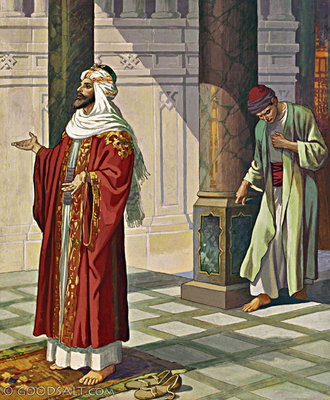
In Luke 18:9-14, Jesus told a deep parable, that of the Pharisee and the Tax Collector. In it, we see strikingly different attitudes in their approaches to God, representative of those of people everywhere. The Pharisee prays (verses 11-12), "God, I thank you that I am not like other men, extortioners, unjust,
The Pharisee and the Tax Collector
adulterers, or even like this tax collector.
I fast twice a week; I give tithes of all that I get." Then He turns to the tax collector, who prays (verse 13), "God, be merciful to me, a sinner!" Then the Lord ends the parable with His own inspired synopsis (verse 14): "I tell you, this man went down to his house justified, rather than the other. For everyone who exalts himself will be humbled, but the one who humbles himself will be exalted."

Notice how much longer the prayer of the Pharisee is (see Matthew 6:1-4). He uses thirty-three words in this English version, all of them extolling his virtues. In contrast, the tax collector uses just seven words, begging for God's mercy on his sins. What a contrast! Thirty-three words to stand condemned, but only seven to be justified!

The Pharisee in the story exemplifies something that the Puritan Thomas Watson said: "The wicked may have something which looks like peace, but is not. They may be fearless and stupid, but there is a great difference between a stupified conscience and a pacified conscience. 'When a strong man armed keepeth his palace, his goods are in peace.' Luke 11:21. This is the devil's peace. He rocks men in the cradle of security. He cries, 'Peace, peace,' when men are on the precipice of hell. The seeming peace that a sinner has is not from the knowledge of his happiness but from the ignorance of his danger."

This same false, self-deceived spiritual peace is spoken of by the Prophet Jeremiah (Jer.  3:3-5): "The showers have been withheld, and the spring rain has not come; yet you have the forehead of a whore; you refuse to be ashamed. Have you not just now called to Me, 'My father, you are the friend of my youth— will He be angry forever, will He be indignant to the end?' Behold, you have spoken, but you have done all the evil that you could." In a time of apostasy, the Jews spoke loving words to God, yet devoted themselves to their wicked deeds and idolatries, as if God could be deceived. Yet, He wasn't. And the Prophet Isaiah is even more blunt (Is. 57:21): "'There is no peace,' says my God, 'for the wicked.'"

Watson explains what is necessary for true peace between the sinner and his God: "The graft must first be inoculated into the tree before it can receive sap or nourishment from it; so we must first be
A tree prepared for grafting in a new branch.
ingrafted into Christ before we can receive peace from Him." It is only as the believer is connected to Christ by faith that he can experience true peace of conscience. Isaiah also teaches this (Is. 32:17): "The effect of righteousness will be peace, and the result of righteousness, quietness and trust forever." See also Isaiah 9:6-7 and John 16:33. In contrast, the one who depends on his own worthiness is described in Deuteronomy 29:19-20: "The one who, when he hears the words of this sworn covenant, blesses himself in his heart, saying, 'I shall be safe, though I walk in the stubbornness of my heart,' the Lord will not be willing to forgive him, but rather the anger of the Lord and His jealousy will smoke against that man, and the curses written in this book will settle upon him, and the Lord will blot out his name from under heaven." That is the fate of the Pharisee in the parable with which I began.

What is righteousness? It is a standard of action and motivation purely consistent with the commands and nature of God. Who meets that standard? No one but Jesus, "for all have sinned and fall short of the glory of God" (Romans 3:23). That's why it is His righteousness, not our own, that we need, when we seek to approach God: "[They] who pursued a law that would lead to righteousness did not succeed in reaching that law. Why? Because they did not pursue it by faith, but as if it were based on works" (Romans 9:31-32). What righteousness? "The righteousness of God through faith in Jesus Christ for all who believe" (Romans 3:22).

Anyone who follows the example of the Pharisee, satisfied with his own goodness to qualify him for eternal life, condemns himself. The one who, like the tax collector, recognizes his own unrighteousness, but looks to that of Christ alone, is justified, and receives both peace with God and peace of conscience.

Sunday, October 18, 2015

Predestination: The Simple Contradiction in the Arminian Response

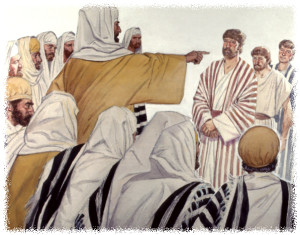
Peter and John Before the Sanhedrin
In Romans 8:29, the Apostle Paul says, "Those whom He foreknew, He predestined to be conformed to the image of His Son, so that He might be the firstborn among many brothers." That seems straightforward to me. However, Arminians usually claim that Paul has the order confused, and that it is those who are conformed to Christ that have been foreknown by God, and then predestined. That is, their predestination results from their faith, as foreseen by God. Their faith is not, they insist, the result of His predestination.

I consider it sufficient refutation of that view that it is the opposite of what Paul actually says, a twisting of the Scripture. However, I think it also gets the Arminian into serious trouble elsewhere.

In Acts, chapter 4, the Apostles Peter and John have been summoned before the Sanhedrin. Contrary, perhaps, to common sense, the Apostles tell these Jewish leaders (Acts 4:10-11), "Let it be known to all of you and to all the people of Israel that by the name of Jesus Christ of Nazareth, whom you crucified, whom God raised from the dead—by Him this man is standing before you well. This Jesus is the stone that was rejected by you, the builders, which has become the cornerstone." Afterward, the Apostles pray (Acts 4:27-28), "Truly in this city there were gathered together against Your holy servant Jesus, whom You anointed, both Herod and Pontius Pilate, along with the Gentiles and the peoples of Israel, to do whatever Your hand and Your plan had predestined to take place."

Now, the question raised by this passage is this: if predestination is simply God's declaration of what He has foreseen will happen, does the Arminian then suggest that the events described here happened by human will, were foreseen by God, and then predestined by Him? That makes complete nonsense out of the reactions of the Apostles! They express their security in the knowledge that the events, as frightening as they must have been, were in the predetermined will of God, so that there was no danger to them, outside the providence of God.

As a Calvinist, that is the security I derive from the doctrine of predestination for everything in my life. While I certainly have the same emotions as any other man, they are tempered by my foundational belief that everything, as scary as it may seem, is in the purposes of God, in which all things happen for my good (Romans 8:28). If there were events which are truly contingent on the will of men, that is, outside God's determining will, then would I be truly terrified.