Showing posts with label repentance. Show all posts

Saturday, February 1, 2020

Know the Bad News, then Recognize the Good News

"The law must be applied with power to the conscience, or the preciousness of grace will be very inadequately known. The superficial piety of the present day is owing, in a large degree, to feeble impressions of the malignity of sin" (James Henley Thornwell, "The necessity and Nature of Christianity").

The comment above was part of a long article in the Southern Presbyterian Review in 1849, but would be even more properly written in our current days. If anything, American evangelicalism has degenerated far past that described by Thornwell in his own time. What would he say about "churches" with female ministers, gay marriages, and that serve as laughingstocks to the world.

His diagnosis is correct. As the church has come to despise God's law, she has lost sight of the sinfulness of sin and its insult to the God she claims to serve. If the word is used at all, "sin" is left undefined, and only in occasions of unfortunate poverty and ignorance. Never is any person called a "sinner," because that is harsh and unloving.

A false Gospel that says only that "God loves you" to everyone leaves everyone satisfied with sin. God loves everyone unconditionally, so there is no need to repent. Church discipline is unheard of in our day.

The result is to use Thornwell's words, a feeble church, and people with a superficial piety.

That wasn't the way Jesus lived: "I tell you, there will be more joy in heaven over one sinner who repents than over ninety-nine righteous persons who need no repentance" (Luke 15:7). And His cousin and favorite Apostle tells us: "Whoever makes a practice of sinning is of the devil, for the devil has been sinning from the beginning. The reason the Son of God appeared was to destroy the works of the devil" (I John 3:8). When was the last time a minister called out sin as being the influence of the devil, rather than ignorance or poor economic conditions? And what does the Bible say about that silence? "If I say to the wicked, ‘You shall surely die,’ and you give him no warning, nor speak to warn the wicked from his wicked way, in order to save his life, that wicked person shall die for his iniquity, but his blood I will require at your hand" (Ezekiel 3:18).

Rather, this is how the Bible defines sin: "Sin is lawlessness" (I John 3:4). And this brings us back to the problem identified by Thornwell. If minsters do not preach on the Law, then their congregants never learn God's standard of right and wrong. And if Christians have no standard, then we have no standard to present to our world: "Now we know that the law is good, if one uses it lawfully, understanding this, that the law is not laid down for the just but for the lawless and disobedient, for the ungodly and sinners, for the unholy and profane, for those who strike their fathers and mothers, for murderers, the sexually immoral, men who practice homosexuality, enslavers, liars, perjurers, and whatever else is contrary to sound doctrine" (I Timothy 1:8-10).

Paul the Apostle

Saturday, June 22, 2019

Repentance and Judgment

In court proceedings, we often see the perpetrator apologize to his victims as a sign of contrition. If the judge is convinced, he may lower the penalty for the crime. Parents often tell miscreant children to say, "I'm sorry," in order to mitigate punishment. My own parents did that when I was a child.

Is repentance for the sake of mitigating punishment legitimate repentance? I certainly don't think so. So why repent?

In his book, The Necessity and Nature of Christianity, Southern Presbyterian Theologian James Henley Thornwell wrote, "[In Paul's sermon at the Areopagus], the general judgement is not presented as a motive to amendment, but as proof that it is commanded. He does not say that men ought to repent because they will be judged, but that they are commanded to do it. He first collects the command from a general judgment in righteousness, and then proves, not that there will be a judgment, but that it will be in righteousness, because Jesus has been raised from the dead."

Thornwell is referring to Acts 17:30-31: "Now He commands all people everywhere to repent, because He has fixed a day on which He will judge the world in righteousness by a man whom He has appointed; and of this He has given assurance to all by raising Him from the dead." There are three things that Paul here tells the Athenians. The first is that God commands all men to repent. It is not a plea or an offer; it is a command. The second is that a general judgment by God is coming. And third, the proof of the coming judgment is the raising of Jesus from the dead. 

Picture a car speeding toward a cliff (thanks to Star Trek for the analogy). The driver is commanded to stop, because a deadly crash is not merely possible, but is a definite, approaching consequence of the current action. Stopping is not just a nice thing to do, or to be cajoled as a favor. There is an explicit choice between stopping and dying. In the same way, repentance is commanded because judgment is coming, and Jesus has been displayed as the only qualified judge by His resurrection.

Repentance is not for the mitigation of punishment, but for the acknowledgement of the justice of our judgment. And then, by faith alone, we can plead our surety, that same Judge, Jesus, who has already taken the judgment for all that are His.

Wednesday, June 5, 2019

God Kicks Away Every Competing Support

In the book known by his name, the Patriarch Job tells a very sad tale.

Starting with verse 6, he first tells us how God has opposed Himself to Job:
"Now then that God has put me in the wrong
     and closed His net about me.
Behold, I cry out, ‘Violence!’ but I am not answered;
     I call for help, but there is no justice.
He has walled up my way, so that I cannot pass,
     and He has set darkness upon my paths.
He has stripped from me my glory
     and taken the crown from my head.
He breaks me down on every side, and I am gone,
     and my hope has He pulled up like a tree.
He has kindled His wrath against me
     and counts me as His adversary.
His troops come on together;
     they have cast up their siege ramp against me 

and encamp around my tent."
- Job 19:6-12 

Then, in the next section, God isolates Job from even his family: 
"He has put my brothers far from me,
     and those who knew me are wholly estranged from me.
My relatives have failed me,
     my close friends have forgotten me.
The guests in my house and my maidservants count me as a stranger;
     I have become a foreigner in their eyes.
I call to my servant, but He gives me no answer;
     I must plead with Him with my mouth for mercy.
My breath is strange to my wife,
     and I am a stench to the children of my own mother.
Even young children despise me;
     when I rise they talk against me.
All my intimate friends abhor me, 

     and those whom I loved have turned against me."
- Job 19:13-19 

This is part of the process of effectual calling, the events God uses to break down our unbelief, and to eliminate whatever competing source of support we maintain. In Job's case, he depended on his relatives for sustaining strength in life, so God separated those relationships. The same with his friends. This is an application of the First Commandment: "You shall have no other gods before Me" (Exodus 20:3). Someone might object that Job never worshiped other deities. Nor do most modern Americans pray to other gods. Yet, to God, another god doesn't just mean Thor or Ganesha. Rather, to Him another god is any support we have in life for not depending on Him as our only God, whether that deity is self-confidence or supportive family. In His eyes, they are competitors, and He removes them from the lives of His elect, until we throw ourselves on Him alone: "I am the LORD; that is My name; My glory I give to no other, nor My praise to carved idols" (Isaiah 42:8).

And in the case of Job, this work was successful: 
"I know that my Redeemer lives,
     and at the last he will stand upon the earth.
And after my skin has been thus destroyed,
     yet in my flesh I shall see God,
whom I shall see for myself,
     and my eyes shall behold, and not another. 

My heart faints within me!"
-Job 19:25-27 

Now that Job has been deprived of his crutches, he is able to see the glory of God. And, where he had been experiencing such unmitigated sorrow, now he experiences hope, the sure hope that he has been given new life, and will thus have his place in the resurrection, where he will see Jesus his Redeemer, with the same eyes with which he now sees only the sky. 

This is the question that every unbeliever faces: when you experience things like this, and feel the tug on your heart to turn from your unbelief (the meaning of repentance), how long will you resist? How long will you watch what you value in your life get pulled away? Surrender now, before the price goes up.

Jesus experienced this separation, but in the opposite order. He had perfect fellowship with His divine Father for unknown ages before He was born: "Father, I desire that they also, whom you have given Me, may be with Me where I am, to see My glory that you have given Me because you loved Me before the foundation of the world." (John 17:24). But He also experienced the loss of His companions (Matthew 26:31, Mark 14:50). And, just before He died, He experienced separation, for the fist time ever, even from His own Father: "My God, My God, why have You forsaken Me?" (Matthew 27:46; compare Isaiah 59:2). He experienced that separation on behalf of everyone who believes in Him. He was separated so that we can be reunited with His God, who is our God.


Wednesday, April 17, 2019

Free Grace Justification versus the Cults

The Pelagian cults - by which I mean primarily the Church of Rome, the Mormons, Jehovah's Witnesses, and Oneness Pentecostals - hate the doctrine of salvation by free grace, apart from works. They hate it because it liberates the believer from dependency on their organizational hierarchy. However, their stated reason for opposing it is that it supposedly results in antinomianism, a freedom to sin without the expectation of spiritual consequences.

They will always cite in this regard James 2:24: "You see that a person is justified by works and not by faith alone." I have addressed their perversion of that verse here. Mormonism even makes it more explicit in their own scriptures (Doctrine and Covenants 76:52): "That by keeping the commandments they might be washed and cleansed from all their sins, and receive the Holy Spirit by the laying on of the hands of him who is ordained and sealed unto this power."

However, the truth is the opposite of their assertion. True good works can only be the result of free grace. That is because the natural man is incapable of doing meritorious works: "No one does good, not even one" (Romans 3:12). The Pelagian puts the effect for the cause, and thus puts the supposed righteousness of the sinner in the place of the real righteousness of Christ (Mark 10:18), which is imputed to the repentant sinner by grace through faith alone, to make him righteous (II Corinthians 5:21). In other words, by teaching a doctrine of salvation that is impossible, the Pelagian blocks men from knowing true salvation! Surely there can be no greater sin (Matthew 23:13).

Nineteenth-Century Presbyterian theologian James Henley Thornwell explains the difference: "A penitent sinner is one who has been a transgressor, but is now just; the laws of God are now put within his mind and written on his heart, and his moral condition is evidently one which renders the supposition of punishment incongruous and contradictory. Such a man is as unfit for the atmosphere of Hell as an impenitent transgressor is unfit for the atmosphere of Heaven. There is obviously, therefore, no principle of reason or nature, as there is, unquestionably, none of revelation, which teaches that a man may be penitent and [yet] perish - that he may be driven into final punishment with the love of God in his heart and the praise of God upon his tongue" ("The Necessity and Nature of Christianity").

He is expressing the same idea that God does in Ezekiel 33:12: "The righteousness of the righteous shall not deliver him when he transgresses, and as for the wickedness of the wicked, he shall not fall by it when he turns from his wickedness, and the righteous shall not be able to live by his righteousness when he sins."

Saturday, October 6, 2018

American Pharisees: Lost Without a Physician


"There are those who are clean in their own eyes but are not washed of their filth. There are those—how lofty are their eyes, how high their eyelids lift!" (Proverbs 30:12-13). 

Among Americans, Satan's primary attack against biblical Christianity is not atheism, alternative religions, or evolutionism, as bad as those things are. Rather, he attacks the faith through complacency.

Luke describes the conversion of Levi (another name for the Apostle Matthew): "Levi made Him a great feast in his house, and there was a large company of tax collectors and others reclining at table with them. And the Pharisees and their scribes grumbled at his disciples, saying, 'Why do you eat and drink with tax collectors and sinners?' And Jesus answered them, 'Those who are well have no need of a physician, but those who are sick. I have not come to call the righteous but sinners to repentance'" (Luke 5:29-32). At the house of Matthew, Jesus sat at dinner with tax-collectors, a class hated by the Jews, and other sinners. The Pharisees saw this, and rebuked Him for His bad taste in companions. After all, were the Pharisees not the cream of Jewish society? 

But the rebuke of Jesus must have caught those Pharisees completely flat-footed: "I have not come to call the [supposedly] righteous but sinners to repentance." In their moral satisfaction, the Pharisees had no desire for what Jesus had come to give, redemption in His blood. However, the tax-collectors and sinners in Matthew's house knew their spiritual condition, and were looking to Jesus to forgive their sins and restore them to righteousness: "Help us, O God of our salvation, for the glory of Your name; deliver us, and atone for our sins, for Your name’s sake!" (Psalm 79:9).

And this explains the spiritual anemia of America's professing Christians. Too many of us are satisfied with our moral superiority. Rare is the man who can say from his heart, "God, be merciful to me, a sinner!" (Luke 18:13). Yet Jesus tells us that is exactly the point to which we must come to find Him.

Wednesday, August 22, 2018

God's Holy Discrimination and Bearing False Witness in Evangelism

"The sacrifice of the wicked is an abomination to the Lord,
     but the prayer of the upright is acceptable to Him.
 
The way of the wicked is an abomination to the Lord,
     but He loves Him who pursues righteousness... 

The thoughts of the wicked are an abomination to the Lord,
     but gracious words are pure... 

The Lord is far from the wicked,    
     but He hears the prayer of the righteous."
- Proverbs 15:8-9, 26, 29 

We often hear well-meaning Christians wax passionate about God's love for everybody. They like to add qualifiers, such as "equally" or "unconditionally." In evangelism, they tell even the rankest unbeliever, "Jesus loves you." However, not only are those proclamations unbiblical, but they are destructive.

Think about this: If you convince an unbeliever that God loves him as he is, then why should he repent of his unbelief? Why should he repent of his wicked lifestyle? After all, you have just devoted your passion to telling him that God loves him unconditionally! Why change? 

Yet, the Scriptures, to the contrary, tell us that even the religious performances of the unbeliever are an abomination (see also I Corinthians 11:27). The prayers of the unbeliever are unacceptable. His lifestyle is abominable. His thoughts are a wicked abomination. God is not contemplating love for the unbeliever, but is, rather, far from him (Isaiah 59:2). Those are descriptions of an enemy, not someone whom God loves.

Evangelism can never be the telling of an unbeliever that God loves him. That would be bearing false witness (Exodus 20:16, Deuteronomy 5:20). Rather, he must be warned that God is his enemy, and that His wrath is upon him: "Because of your hard and impenitent heart you are storing up wrath for yourself on the day of wrath when God’s righteous judgment will be revealed" (Romans 2:5). He must be warned to flee to Jesus for refuge from that wrath, not encouraged to a false security in a supposed love of God for everyone. 


Monday, September 11, 2017

The Ordo Salutis: Justification Before Repentance

The contrast between Calvinists and Arminians is most visible in our understanding of the ordo salutis (theological terminology for "the order of salvation"). In what order (whether logically or chronologically) do the steps occur when a person is converted. Specifically, I want to address the place of repentance in that order: does justification precede repentance, as Calvinists hold? or does repentance precede justification, as the Arminians insist?

To my mind, there is an obvious logical requirement that justification must precede repentance. And in saying that, I mean logically, not that there will be a time gap between them. My question to the Arminian is, How can a man turn from his sin to a God whom he does not yet know? The writer of the Epistle to the Hebrews addresses that same question: "Without faith it is impossible to please Him, for whoever would draw near to God must believe that He exists and that He rewards those who seek Him" (Hebrews 11:6). If repentance precedes justification, i. e., saving faith, then, by definition, it cannot have merit before God, because He rejects anything that is not of faith! The person must have the assurance by faith that God is now favorably disposed toward him, and will receive him as redeemed in Christ. Therefore, repentance cannot precede that act of grace.

The Old Testament also teaches us this truth.

Through the Prophet Isaiah, God tells us, "I have blotted out your transgressions like a cloud and your sins like mist; return to Me, for I have redeemed you" (Isaiah 44:22). In the application of Christ's blood, the sins of the elect are blotted out, the meaning of "justification." We have been redeemed. Therefore, He says, return to Him, the definition of "repentance." God Himself makes explicit that repentance is not the basis of justification. Rather, just the opposite, justification must be the basis of repentance!


Wednesday, August 9, 2017

There Is No Merit in Repentance


When he preached at the Areopagus in Athens (Acts 17:16-34), one of the things the Apostle Paul told his hearers was, "[God] commands everyone everywhere to repent of their sins and turn to Him" (verse 30). Pelagians will often claim that a command to repent must imply that the ability to do so is natural to every man. Of course, that claim is consistent with the a priori belief of the Pelagian that men are capable of all forms of spiritual good, not just repentance. And it is just as false.

That is certainly not how repentance is described in Scripture.

Consider, first, Psalm 80:3: "Restore us, O God; let Your face shine, that we may be saved." The word "repentance" does not appear here. However, in order to be "restored," do we not have to repent? Yet, restoration in this verse is something that God does, not us.

Second, look at Jeremiah 31:18: "Bring me back that I may be restored, for You are the Lord my God." This sentence contains two verbs, "bring" and "restore," that make the same point, that it is God's initiative to bring us to repentance, not something that a sinner creates in himself.

And third, turn to Lamentations 5:21: "Restore us to Yourself, O Lord, that we may be restored!" Again, the same Prophet uses that word, "restore."

In the New Testament, we find the same concept, but using the word "repent," in Acts 5:31: "God exalted Him at his right hand as Leader and Savior, to give repentance to Israel and forgiveness of sins." Just as fallen Israel cannot forgive her own sins, neither can she create her own repentance. Rather, God must give both. This verse is especially important, because, by pairing those two things, no one can claim that one is by free will, without the implication that the other is, as well.

Also, look at the words of Paul in II Timothy 2:24-25: "And the Lord’s servant must not be quarrelsome but kind to everyone, able to teach, patiently enduring evil, correcting his opponents with gentleness. God may perhaps grant them repentance leading to a knowledge of the truth." Not only does he describe repentance as having its origin in God, not in us, but he also tells us that God is under no obligation to give it. When He does, it is an act of grace and mercy, not of imperative.

Unlike its common perversion even among Evangelicals, repentance is not an act of human merit. It is not a thing that fallen man can produce and offer to God. Rather, it is something that God, out of His goodness, mercy, and sovereign will, gives to the elect alone. Pelagianism is the natural religion of the sinful human heart, but the Scriptures refute it.

Saturday, May 27, 2017

Regeneration and Repentance

Peter on Solomon's Portico
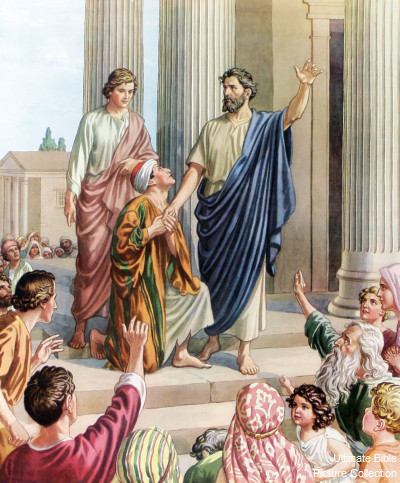
In Acts 3:15-21, Luke gives us an account of a sermon to the Jews in front of the Temple. "You killed the Author of life, whom God raised from the dead. To this we are witnesses. And His name—by faith in His name—has made this man strong whom you see and know, and the faith that is through Jesus has given the man this perfect health in the presence of you all. And now, brothers, I know that you acted in ignorance, as did also your rulers. But what God foretold by the mouth of all the prophets, that His Christ would suffer, He thus fulfilled. Repent therefore, and turn back, that your sins may be blotted out, that times of refreshing may come from the presence of the Lord, and that He may send the Christ appointed for you, Jesus, whom heaven must receive until the time for restoring all the things about which God spoke by the mouth of His holy prophets long ago."

As God had planned (see Acts 4:27-28),  the Jews had rejected their Messiah and killed Him on the cross. This was God's purpose, to bring to pass the redemption of His church (Ephesians 5:25). But the perpetrators of that crime, the unbelieving Jews, had declared a curse upon themselves: "His blood be on us and on our children!" (Matthew 27:25). Yet, notwithstanding their self-cursing, Peter tells them how to escape the wrath of God: "Repent and turn back, that your sins may be blotted out" (Acts 3:19). And this was no new doctrine, for it was exactly what had been proclaimed in their Hebrew Scriptures: "Come now, let us reason together, says the LORD: though your sins are like scarlet, they shall be as white as snow; though they are red like crimson, they shall become like wool" (Isaiah 1:18).

Many people put an incorrect order to this. They suppose that an unregenerate man first repudiates his sin, and then believes in God, and then, finally, is justified. That, in fact, is impossible. The unregenerate man has no interest in forsaking sin or turning to God: "None is righteous, no, not one; no one understands; no one seeks for God" (Romans 3:10-11). First, God must work regeneration in the heart of that man (Ezekiel 36:26). Then, God gives Him faith to recognize a reconciled God in the redeeming blood of Jesus (Ephesians 2:8-9), by which means God then inspires him to repent of his sins (Acts 5:31 and II Timothy 2:25). Note that each step is by the initiation of God, never by man: "For those whom He foreknew He also predestined to be conformed to the image of His Son, in order that he might be the firstborn among many brothers. And those whom He predestined He also called, and those whom He called He also justified, and those whom He justified He also glorified" (Romans 8:29-30).

Peter's answer to the Jews was that they needed to repent. And being knowledgeable of their Old Testament Scriptures. they know what he meant. However, even Christians today are ignorant of the Scriptures, especially the Old testament, so we don't have a proper understanding of how it occurs. It is not something which one can do by working at it. Rather, it can only be something that God works in him: "I have heard Ephraim grieving, 'You have disciplined me, and I was disciplined, like an untrained calf; bring me back that I may be restored, for you are the Lord my God" (Jeremiah 31:18). See also Acts 5:31 and II Timothy 2:25. And it is something that He promises to do in His elect: "I, I am He who blots out your transgressions for my own sake, and I will not remember your sins" (Isaiah 43:25).

Wednesday, March 29, 2017

Absolution: Purchased by Christ, Declared by a Minister, not Granted by a Priest

According to the Catholic Church, "Absolution proper is that act of the priest whereby, in the Sacrament of Penance, he frees man from sin." That is, a Catholic member can go to his priest, confess his sins, and receive forgiveness from that priest. Granted, the article goes on to explain, "It presupposes on the part of the penitent, contrition, confession, and promise at least of satisfaction; on the part of the minister, valid reception of the Order of Priesthood and jurisdiction, granted by competent authority, over the person
receiving the sacrament." Notice what is not mentioned: the satisfaction for sin in Jesus Christ on the cross. Thus, the source of forgiveness is the dispensation of the church organization, not by the Person and work of the Savior.

The Catholic doctrine is explained as an application of the words of Jesus (John 20:20-23): "When He had said this, He showed them His hands and His side. Then the disciples were glad when they saw the Lord. Jesus said to them again, 'Peace be with you. As the Father has sent Me, even so I am sending you.' And when He had said this, He breathed on them and said to them, 'Receive the Holy Spirit. If you forgive the sins of any, they are forgiven them; if you withhold forgiveness from any, it is withheld.'" This passage is from one of the post-resurrection appearances of Jesus. Therefore, it was after, and presupposes, His redemptive work in the crucifixion and resurrection. Therefore, He had already achieved what Paul describes in Romans 3:25: "Jesus Christ, whom God put forward as a propitiation by His blood, to be received by faith."

What that means is that Jesus wasn't giving an original power to the Apostles - much less to any church hierarchy - to forgive sins. Ministers, instead, have the authority to declare to the true believer what Jesus has done on his behalf (Romans 5:6): "While we were still weak, at the right time Christ died for the ungodly." If the person lacks faith, then any declaration by the minister is ineffectual (Matthew 10:13). It cannot save him apart from faith, not in the minister, but in Jesus Christ.

One may claim that there is no harm done by Rome to the person who understands the truth. And I would grant that (except, why then is he looking to a priest for absolution?). However, what about the person who doesn't understand? The harm is that he has been convinced to find his salvation in a man and the organization that man represents. And there can be none there! Rather, his only hope for absolution is by faith in the God-man who purchased that absolution on the cross two-thousand years ago. His conscience has been assuaged on a false basis, leaving him still in his sins! It is as if he has a cancer and thinks he has been cured by a sugar pill.

Saturday, May 7, 2016

Repentance Is Not Optional

I have noticed an attitude among Christians that says that repentance is a good thing, but nothing more. One can repent, or not, as he sees fit. It has become more of a matter of feelings. That is, if a sinful act has brought feelings of guilt, then repent, so you can feel better about yourself. But that is certainly not a biblical view of repentance.

First of all, repentance is a command, not a suggestion. Consider Acts 17:30: "[God] commands all people everywhere to repent." From Whom does the command originate? From God. To whom is it directed? To all, man, woman, and child, whether professing Christian or not. And people where? Everywhere, i. e., in every nation, of whatever culture. And the logic is compelling. Since every human being (Jesus excepted, of course) is a sinner (Romans 3:23), without regard to age (Psalm 51:5), and is under judgment for that sin (Romans 6:23), there is no human being (again excepting Jesus) who is not in need of repentance.See also Luke 24:47.

However, since we are sinners, we are incapable of any spiritual good (Isaiah 64:6, Romans 3:10-12). That is because sin has killed us, spiritually speaking (Ephesians 2:1). That leaves us without the ability to fulfill this command out of our mere will to do so. In fact, it is impossible for us to will to do so. Rather, it is necessary for God to change our wills (Philippians 2:13). When He does so, then He enables the regenerate sinner to repent of sin (Acts 5:31, II Timothy 2:25). What a wonder that is, that He creates in us the thing that He demands from us!

But the amazement continues: when He grants repentance to the sinner, there is celebration, both on earth and in heaven. When men see a sinner repent, they give glory to God for His grace (Acts 11:18). And in heaven, even the angels celebrate (Psalm 89:5, Luke 15:10).

In writing this, my hope is that someone, somewhere, feeling the oppression of his sin, will answer the Lord's command to repent, turn to Jesus for the forgiveness of that sin, that I and the angels may celebrate! My email address is in the panel to the right. I hope that someone will write me to tell of that experience. But, even if you don't, I hope that you will receive and experience this gift of God, and know that the angels in heaven celebrate with you.

Someone may be saying that he doesn't understand what repentance is. I will give you an historical answer, question 87 from the Westminster Shorter Catechism, one of the doctrinal documents used in Presbyterian churches: "What is repentance unto life? Repentance unto life is a saving grace, whereby a sinner, out of a true sense of his sin, and apprehension of the mercy of God in Christ, doth, with grief and hatred of his sin, turn from it unto God, with full purpose of, and endeavour after, new obedience."

Saturday, April 30, 2016

Each Day the Unbeliever Builds Up the Wrath of God Against Himself

While the unbeliever justifies himself every day, with his professions that "there is no proof for God," each breath he draws, each draft of water he drinks, and every crumb of food he consumes comes as a gift from God.

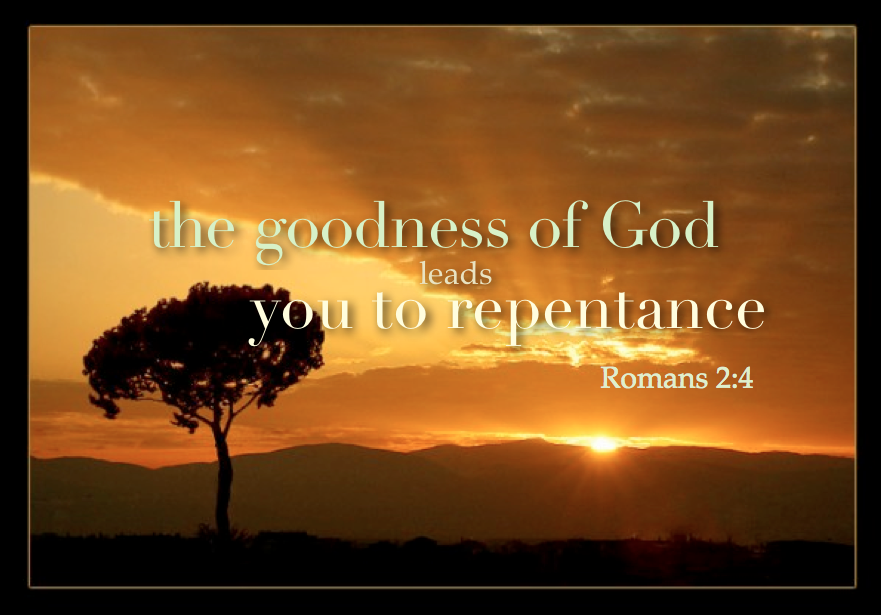
In Romans 2:4-5, the Apostle Paul asks us, "Do you presume on the riches of his kindness and forbearance and patience, not knowing that God’s kindness is meant to lead you to repentance? But because of your hard and impenitent heart you are storing up wrath for yourself on the day of wrath when God’s righteous judgment will be revealed."

That is a stark warning! God gives each of His creatures the gifts of life (Matthew 5:45). Yet the unbeliever not only refuses to thank Him for His gifts but even denies Him who has provided these gifts. How can God not be offended by such abuse? Or that of the idol-worshiper who attributes God's gifts to some demon, whether he calls it Mary or Ganesh or Allah? If a human father were to give a gift to his son, and that son were to respond by spitting in his face and running to thank some passing stranger, would that father not feel abused?

In Psalm 103:10, David tells us, "He does not deal with us according to our sins, nor repay us according to our iniquities." Centuries later, the priest Ezra repeated those words (Ezra 9:13): "You, our God, have punished us less than our iniquities deserved." They pointed to a simple truth: our sins deserve eternity in Hell because they are acts of rebellion against our eternal Creator and Lord. Therefore, every moment we spend outside Hell is a gift from God.

These are the gifts of God: our existence (Acts 17:28), our daily sustenance (Matthew 5:45), and our daily experience of His mercy (Psalm 103:10). Why does He grant them to us? That they may inspire us to turn to him in repentance. It is much like when a man waves a bit of food to entice a wild animal to approach and eat from his hand. But unbelief is like such an animal biting, not the gift, but the hand of the giver. In an unthinking animal, such a reaction can be understood, but in a rational human being it is an act of evil.

However, as long as a man draws breath, repentance is available to him. To every person who acknowledges his rebellion and turns to his King for pardon, that King, God, extends this invitation (Isaiah 55:1-3):

"Come, everyone who thirsts,
come to the waters;
and he who has no money,
come, buy and eat!
Come, buy wine and milk
without money and without price.
Why do you spend your money for that which is not bread,
and your labor for that which does not satisfy?
Listen diligently to Me, and eat what is good,
and delight yourselves in rich food.
Incline your ear, and come to Me;
hear, that your soul may live."

Monday, October 6, 2014

Biblical Repentance

My previous post on the idolatry of Mormonism has gotten a lot of attention. My prayer is that someone in bondage to that cult has had his eyes opened by the Holy Spirit. If so, he may be wondering what to do, how to move to a new relationship with the true and living God. So that is what I want to address here.

In Jeremiah 3:12-14, God says:
"Go, and proclaim these words toward the north, and say,
‘Return, faithless Israel, declares the Lord.
I will not look on you in anger, for I am merciful, declares the Lord;
I will not be angry forever.
Only acknowledge your guilt,
that you rebelled against the Lord your God
and scattered your favors among foreigners under every green tree,
and that you have not obeyed My voice, declares the Lord.
Return, O faithless children, declares the Lord;
for I am your master;
I will take you, one from a city and two from a family,
and I will bring you to Zion.'"

The circumstances of this prophecy are that Israel, the northern kingdom, has already been deported by her Assyrian conquerors, never to be seen again. Yet, Judah, the southern kingdom, has failed to learn the lesson laid out before her eyes. Israel had turned to idols, and Jehovah her God had judged her. Even with this testimony, Judah is also guilty of idolatry, and refuses to put away her idols. And now Jehovah pleads with her to repent, before He is provoked to judgment. It is sad to know how the story proceeds. Judah refused to repent, and God judged her through the Babylonians.

But anyone reading this, whether an idolatrous Mormon, or Jehovah's Witness, or mere unbeliever, you can learn the lesson that Judah failed to heed.

What does God say? He promises not to hold his anger against you, for He is merciful. And what does He expect from you? To acknowledge your guilt and rebellion against Him, for you have given what you owe to Him to gods of the imagination, instead - gods invented, whether by Joseph Smith or by the Watchtower. And if you do so, if you make that reversal, He will bring you to Zion, His true bride, the true Church of Christ (I'm not using that as a denominational name).

This is repentance, to turn from your sin and to God. But this isn't a trade. He doesn't say that your repentance is equal to His forgiveness. He doesn't say that your repentance earns His forgiveness. It's not a magical formula. Rather, the Bible tells us that God grants us repentance! We see this is Acts 5:31 and II Timothy 2:25 (hold your cursor over the references, and the text will come up in a box). Repentance is something that He does in your heart, not something that you work as some kind of favor to Him. So, if you have come to the point of sorrowing for your idolatry, and looking to Him for His forgiveness and redemption, then you should also glorify Him for this, His merciful gift to you.

And that has been my prayer, that He would soften hearts trapped in the poisoned claws of pseudo-Christian cults, that they may turn to the biblical Jesus, God in the flesh, for forgiveness and new birth.

Saturday, November 9, 2013

I Kings 22:20, God Deceives the Wicked

Arminians snarl whenever the Calvinist doctrine of reprobation comes up. Reprobation is God's intentional hardening of the hearts of those that He has passed over in election, leaving them to the judgment that their wickedness earns them. Arminians claim that this makes God the author of sin, in violation of James 1:13.

And it must be confessed that James does indeed say there that "God tempts no one."

Yet, in I Kings 22:20, the inspired text has Jehovah seeking a spirit to "entice" (some versions, "deceive") Ahab, the wicked king of Israel. See also Jeremiah 20:7 and Ezekiel 14:9, where the same Hebrew word is used for God's deceiving of false prophets.

I think that the distinction between these two contrasting concepts is that James is addressing Christians, while the Old Testament references are to unbelievers. That is, God does not place stumblingblocks in the paths of believers, His elect and beloved people, but does trip up hypocritical professors, using their own wickedness to bring consequences into their present lives as a foretaste of their judgment to come.

This is reprobation! This is God provoking the sin nature in those whom He has rejected! And it not to bring about their repentance, but rather to confirm them in their spiritual rebellion.

This should be a thunderous warning to unbelievers. If you are reading this, but have never submitted to the lordship of Christ, you have great reason for fear. Judgment isn't waiting for you to die and pass into eternity. Rather, it is happening now, in this life, and is a costly burden to bear. The last chapter of I Kings goes on to describe the death of Ahab, lost without any remaining hope of redemption. I beg you not to follow his path!

Thursday, April 5, 2012

Romans 4:1-8, the New American Gospel of Legalism

"What then shall we say was gained by Abraham, our forefather according to the flesh? For if Abraham was justified by works, he has something to boast about, but not before God. For what does the Scripture say? 'Abraham believed God, and it was counted to him as righteousness.' Now to the one who works, his wages are not counted as a gift but as his due. And to the one who does not work but believes in Him who justifies the ungodly, his faith is counted as righteousness, just as David also speaks of the blessing of the one to whom God counts righteousness apart from works: 'Blessed are those whose lawless deeds are forgiven, and whose sins are covered; blessed is the man against whom the Lord will not count his sin.'"

Part of the background of my church is the Associate Presbytery of Scotland, usually called by their nickname of "Seceders." I have studied them extensively, both because of that historical connection and because of the spiritual issues involved in their secession from the established Church of Scotland. I especially concentrate on the issues of that division which we see arising again in our modern time.

I won't go into the complex of issues that led to the secession. Rather, I want to address the one issue of neonomianism. Neonomianism is the teaching, not usually explicitly stated, that the Gospel is a form of Law ("neo" new+ "nomos" law), such that a person is not saved by acts of the Mosaic law, but rather through a new form of merit through repentance and works of new obedience.

The dominant party in the Church of Scotland General Assembly held that the recipient of the Gospel had to go through several steps of preparation, through sorrow and repentance of sin and moral reformation. In opposition to these forms of merit, the Seceders, centered around a book called The Marrow of Modern Divinity, held to a Gospel of free grace. They insisted that all of the merit in the Gospel is in Christ alone, by grace alone, received by faith alone. In other words, they were defending the same solas that led to the Protestant Reformation two hundred years earlier.

The reason that I refer to this as the "New American Gospel of Legalism" is that the same errors that destroyed the Church of Scotland have become the doctrine of mainstream American Evangelicals. Even in the psychobabble that has become part of our daily conversation, "Just have faith," arises from this error. "Faith" has become the new works-righteousness. We supposedly merit salvation by having enough faith. This is even made explicit by the prosperity preachers. But isn't it what most people expect? "If I just believe hard enough, God has to give me what I want and take me to heaven."

However, notice what Paul says above about Abraham: "Abraham believed God." He doesn't say, "Abraham believed in God." Everyone believes in God, even if he doesn't admit it (Romans 1:18-21). James 2:19 says that even the demons believe in God! That puts the spiritual commitment of most Americans on par with that of demons!

But Abraham didn't just believe in God. He believed God, that is, he believed the promises of God. Go to Romans 4:20-25, "No distrust made him waver concerning the promise of God, but he grew strong in his faith as he gave glory to God, fully convinced that God was able to do what He had promised. That is why his faith was 'counted to him as righteousness.' But the words 'it was counted to him' were not written for his sake alone, but for ours also. It will be counted to us who believe in Him Who raised from the dead Jesus our Lord, Who was delivered up for our trespasses and raised for our justification."

That is to say, our faith doesn't earn us salvation (or blessings). Our repentance doesn't earn us salvation. Our reformation of our lives doesn't earn us salvation. The only thing that earns our salvation is the finished work of Christ in His crucifixion and resurrection. That sole merit is then applied to us by means of faith.

The biblical order is Christ, then justification, then faith, then repentance, and with all resulting in sanctification. Any other order requires the hearer to act upon a person and work that he doesn't yet believe in. Logic alone should convince us that is impossible!

Monday, October 31, 2011

Psalm 51:10-12, a Dividing Line between Hypocritical and True Believers


"Create in me a clean heart, O God,
     and renew a right spirit within me.
Cast me not away from Your presence,
     and take not Your Holy Spirit from me.
Restore to me the joy of your salvation,
     and uphold me with a willing spirit."

In an earlier post, I defined a hypocritical believer as a professing, but false, Christian who has hidden from himself the reality of his spiritual lostness. I believe that the text before us reinforces that contrast.

In it, we see David after II Samuel 11. In that story, he had been looking out over the city of Jerusalem from his palace. He saw Bathsheba bathing on her roof. Stirred by lust, he had arranged for the murder of her husband, Uriah the Hittite, so that he could gain her for himself. After the Prophet Nathan rebuked David (II Samuel 12), David was overcome by sorrow over what he had done. Psalm 51 is the prayer he wrote, confessing his sin, and seeking a restoration of his damaged relationship with Jehovah, his God.

Consider also Psalm 38, another psalm by David. In verse 3, he describes the physical trauma caused by sin. In verse 6, "all the day I go about mourning." And verse 8, "I groan because of the tumult of my heart."

In both of these psalms, we see a man traumatized, sorrowful and cast down, because he is aware of his sin. That doesn't happen in a hypocrite. The hypocritical believer is self-satisfied with his spirituality, and would be quite insulted if anyone were to suggest that he isn't as holy as he imagines himself to be. He wears blinders, so he won't see the reality within him (though, of course, those blinders don't prevent him from seeing faults in others).

Further, even if a hypocrite were to recognize that maybe he isn't so spiritual after all, another aspect of his condition is that he won't consider his shortfall something to be concerned about, something that needs to be dealt with. And he certainly isn't going to respond positively if someone were to confront him about his complacency! Since he has no real relationship with God in Christ, he isn't conscious of lacking that relationship.

Prophets like Nathan make a true believer change. But they merely reinforce the blindness of the hypocrite. With just one exception: if the sovereign Lord sees fit to grant the hypocrite repentance (Acts 5:31 and II Timothy 2:25).

Monday, July 4, 2011

Zechariah and Biblical Repentance


"The Lord was very angry with your fathers. Therefore say to them, Thus declares the Lord of hosts: Return to Me, says the Lord of hosts, and I will return to you, says the Lord of hosts. Do not be like your fathers, to whom the former prophets cried out, ‘Thus says the Lord of hosts, Return from your evil ways and from your evil deeds.’ But they did not hear or pay attention to me, declares the Lord. Your fathers, where are they? And the prophets, do they live forever? But My words and My statutes, which I commanded my servants the prophets, did they not overtake your fathers? So they repented and said, 'As the Lord of hosts purposed to deal with us for our ways and deeds, so has He dealt with us.'"
- Zechariah 1:2-6

The Prophet Zechariah shared the ministry with the Prophet Haggai in the period immediately following the return of the Jews to the land of Israel after their exile in Babylon. In a curious aside, archeologists may recently have found his tomb!

As I have noted before, repentance is a prominent theme among the writings of the Jewish prophets. When I consider the claim of classical dispensationalists that the Gospel isn't found in the Old Testament, I often wonder whether they are reading the same Bible that I am. But I digress...

Matthew Henry paraphrases verse 2, "Turn you to me in a way of faith and repentance, duty and obedience, and I will turn to you in a way of favour and mercy, peace and reconciliation." I think Henry brings out the essence of repentance: it isn't merely a sorrowing over one's sins, though that is part of it, but rather a change of course, a turning away from one's old path to a new path in fellowship with God. The Westminster Confession of Faith, in the chapter on Repentance unto Life, states it wonderfully (XV:2): "By it a sinner, out of the sight and sense, not only of the danger, but also of the filthiness and odiousness of his sins, as contrary to the holy nature and righteous law of God, and upon the apprehension of his mercy in Christ to such as are penitent, so grieves for, and hates his sins, as to turn from them all unto God, purposing and endeavoring to walk with him in all the ways of his commandments."

Zechariah illustrates where Judas failed to repent. The story is told in Matthew 27:3-10. In verse 3, we see that Judas "changed his mind." But what does he then do? Plead for the forgiveness of God and the disciples? No, as verse 5 tells us, he committed suicide. In other words, Judas certainly sorrowed over his sin, but he didn't depart from it to walk in a new way. That is what distinguishes his sorrow from repentance.

Returning to Zechariah, we see that God has punished the forefathers of the prophet's audience, and this remnant acknowledges the justice of God's judgment (verse 6), a step that Judas failed to take. Then in verse 12, a new character appears, the Angel of the Lord, who pleads, "O Lord of hosts, how long will you have no mercy on Jerusalem and the cities of Judah, against which you have been angry these seventy years?" Along with most orthodox readers, I consider this Angel to be the preincarnate Second Person of the Trinity, because He is frequently addressed alternatively as the Lord Himself. Here, He intercedes on behalf of Jerusalem, acting in His role as Mediator. This is another essential difference between sorrow and repentance: true repentance relies on the intercession of Jesus Christ, the Mediator. Repentance doesn't restore or create holiness; rather, it serves as a step in applying the imputed righteousness of Christ, which alone restores our standing before God the Father.

Then in verses 16-17, Jehovah responds to this intercession: "Therefore, thus says the Lord, I have returned to Jerusalem with mercy; my house shall be built in it, declares the Lord of hosts, and the measuring line shall be stretched out over Jerusalem. Cry out again, Thus says the Lord of hosts: My cities shall again overflow with prosperity, and the Lord will again comfort Zion and again choose Jerusalem.’"

Here are the steps that Zechariah shows for true repentance: sorrow for sins, a new path of obedience (not that this can be done infallibly, since the person is still a sinner), dependence on the intercession and imputed righteousness of Jesus Christ, and a restored relationship with God. Leaving out any step necessarily overthrows the reality of the others.

Friday, May 27, 2011

Ezekiel 33 and Simple Repentance

In the Westminster Confession of Faith, Chapter XV, Section 2, we find this profound statement regarding repentance: "By it a sinner, out of the sight and sense, not only of the danger, but also of the filthiness and odiousness of his sins, as contrary to the holy nature and righteous law of God, and upon the apprehension of His mercy in Christ to such as are penitent, so grieves for, and hates his sins, as to turn from them all unto God, purposing and endeavoring to walk with Him in all the ways of His commandments." We find almost identical wording in Question 76 of the Larger Catechism.

I love these expressions, and I am grateful to God for the wise men who summarized the teaching of the Bible on this subject in such succinct but profound words.

However, there is also a precious simplicity and child-like joy in the expressions of Scripture on the same matter. Consider the words of the Prophet Ezekiel (Ezekiel 33:11), "Say to them, As I live, declares the Lord God, I have no pleasure in the death of the wicked, but that the wicked turn from his way and live; turn back, turn back from your evil ways, for why will you die, O house of Israel?" Here we see the turning to which the Westminster Standards refer, but notice the appeal in them. Jehovah doesn't simply lay out the nature of repentance, but strenuously urges the elect to avail themselves of it.

And verse 19, "When the wicked turns from his wickedness and does what is just and right, he shall live by this." This is more of the dictionary-style definition we see in the Standards. As if God lays out for us precisely what repentance is, to ease our finding of it in our hearts.

And here, both in the words of the Standards and the words of God Himself, the nature of what He requires is laid out as simply as possible. Therefore, He adds this promise (verses 14-16), "though I say to the wicked, ‘You shall surely die,’ yet if he turns from his sin and does what is just and right, if the wicked restores the pledge, gives back what he has taken by robbery, and walks in the statutes of life, not doing injustice, he shall surely live; he shall not die. None of the sins that he has committed shall be remembered against him. He has done what is just and right; he shall surely live." Is the very promise of Jehovah Himself enough?

Tuesday, September 21, 2010

Shall We Be Guided by Feelings? Or by God's Word?


"David built houses for himself in the city of David. And he prepared a place for the ark of God and pitched a tent for it. Then David said that no one but the Levites may carry the ark of God, for the Lord had chosen them to carry the ark of the Lord and to minister to him forever. And David assembled all Israel at Jerusalem to bring up the ark of the Lord to its place, which he had prepared for it. And David gathered together the sons of Aaron and the Levites..., and said to them, 'You are the heads of the fathers’ houses of the Levites. Consecrate yourselves, you and your brothers, so that you may bring up the ark of the Lord, the God of Israel, to the place that I have prepared for it. Because you did not carry it the first time, the Lord our God broke out
against us, because we did not seek Him according to the rule.' So the priests and the Levites consecrated themselves to bring up the ark of the Lord, the God of Israel. And the Levites carried the ark of God on their shoulders with the poles, as Moses had commanded according to the word of the Lord."
- I Chronicles 15:1-15

The background of this passage is a prior attempt by David described in chapter 13 (and the parallel in II Samuel 6) to move the Ark of the Covenant from Kiriath-Jearim to Jerusalem. In that effort, the procedures of the Law for handling the Ark were ignored in the enthusiasm of king and people. As a consequence (verse 10), "the anger of the Lord was kindled against Uzza, and He struck him down because he put out his hand to the ark, and he died there before God." This was occasioned by the failure of David to follow the procedures specified by Moses in Exodus 25:12-15 and Numbers 4:15. In a renewed respect for God's holiness, David commands the second effort to proceed "according to the rule."

Paul makes a similar point in II Timothy 2:5: "An athlete is not crowned unless he competes according to the rules."

How often have you heard a Christian justify his decisions with sentences that begin with "I feel" or "I think"? Or perhaps the more spiritual form, "I feel led." Rarely are choices made with an explanation that begins with "The Scripture says," or "God has said..." It isn't a matter of the lack of sincerity or enthusiasm, but rather an error of authority. As David discovered to his chagrin, God is not compelled to honor our sincerity. Rather, He honors His word, because He is God and we aren't. As He says in Isaiah 48:11, "My glory I will not give to another."