Showing posts with label atonement. Show all posts

Wednesday, May 27, 2020

The Limited Atonement of Arminianism

Arminians often accuse Calvinists of denying the atonement to some people by our biblical claim that it was particular. That is, we Calvinists follow the words of Jesus that He would die for those whom  the Father had given Him, His friends, His sheep (John 6:37-39, etc.), or, in the words of Paul, for His Church (Ephesians 5:25). Yes, we believe that the Groom had the right and responsibility to love His Bride, not strange women (Proverbs 5:15).

However, in denying that biblical truth, the Arminian replaces it with an assertion that the atonement was universal, but only partial. That is, Jesus didn't necessarily die to save anyone. Rather, He died merely to make salvation possible.

So, for what purpose did Jesus die: "She will bear a son, and you shall call His name Jesus, for He will save his people from their sins" (Matthew 1:21). Or, "He himself bore our sins in His body on the tree, that we might die to sin and live to righteousness. By His wounds you have been healed. For you were straying like sheep, but have now returned to the Shepherd and Overseer of your souls" (I Peter 2:24-25, cp. Isaiah 52:13-53:12). There are two things evident in these verses. First, that the blood of Jesus was intended to cleanse its objects from sins. And notice the pronouns that Peter uses, "our," "you," and "your." Those are particular pronouns, referring his comment to the audience of his epistle. Who was that? "To those who are elect exiles of the Dispersion in Pontus, Galatia, Cappadocia, Asia, and Bithynia, according to the foreknowledge of God the Father, in the sanctification of the Spirit, for obedience to Jesus Christ and for sprinkling with His blood: May grace and peace be multiplied to you. Blessed be the God and Father of our Lord Jesus Christ! According to His great mercy, He has caused us to be born again" (I Peter 1:1-3). Peter was speaking to Christians, not to non-Christians. And second, notice that there is no conditionality in these verses. There is no hemming and hawing about what men must do to make the atonement effectual. In fact, the Apostle even says that it is God who causes us to be born again.


However, the Arminian reads those same verses and blanks out the parts that refute him

So, I will ask these questions of the Arminian. Jesus tells us of men who will "die in their sins" (John 8:21). Then He mentions those whose "sin remains" (John 9:41). If Jesus died for the sins of all men, then why do these men still have sin when they die? Then the Arminian is forced to answer, "because they don't respond in faith." Ah, there it is: the Arminian limited atonement! Jesus died somewhat for all men, but that atonement is insufficient, until the man adds his assent.

So, when the Arminian thinks that he is morally superior because the Calvinist says that Jesus fully and effectually redeemed particular people, he is really suppressing his tacit claim that the atonement of his version of Jesus is so limited that it cannot save anyone without a little help from sinful men.

I deny that the Arminian doctrine is moral at all, much less more so that is the doctrine of Calvinism.

Saturday, May 2, 2020

Jesus and His Friends, a View of Particular Atonement

In John 15:13-14, that Apostle reports to us these words of Jesus: "Greater love has no one than this, that someone lay down his life for his friends. You are My friends if you do what I command you." The Lord tells us that the highest love is to die for one's friends, a description of what yet lay ahead of Him when He spoke those words. Was He contradicting what we are told elsewhere in Scripture? For example, in Romans 5:8, the Apostle Paul tells us, "God shows His love for us in that, while we were still sinners, Christ died for us." No, there is no contradiction. Paul tells us what we were before the application of Christ's atonement, while Jesus describes what we became after that application. We were enemies, but His blood turned us into friends. 

But the part I want to discuss is what Jesus says, that He would soon die on the cross, not for men in general, but for those who would thereby be turned into His friends. That is, those who remain His enemies do so because He did not die for them. 

To my mind, this is one of the biggest differences between Calvinism and Arminianism. Calvinism teaches - because Jesus taught - that the blood of Jesus is effectual. As He Himself also says, every man whom the Father gave Him to be redeemed would unfailingly be converted (John 6:39). In contrast, Arminianism claims that Jesus died equally for all men in general, so that salvation would be possible for everyone, but certain for no one. If that were so, then it would have been hypothetically possible for not a single person ever to have been saved. And even worse, it also means that the Arminian believes that Jesus died just as much for every person in Hell as He did for every person in Heaven. 

To my mind, that is a grotesque view of the atonement.

And I think these words of Jesus indicate that He never imagined such a thing either, but looked forward to all of the friends that He was gaining for each moment that He suffered on the cross, just as the Father promised Him in prehistory: "Out of the anguish of His soul He shall see and be satisfied; by His knowledge shall the righteous one, My servant, make many to be accounted righteous, and He shall bear their iniquities" (Isaiah 53:11).

Wednesday, March 25, 2020

The Effectual Atonement of the Cross

"It is, and must be, an indispensable element in anything which deserves the name of atonement that it satisfies the justice of God, or lays the foundation of a claim of right to exemption from punishment" James Henley Thornwell, "The Necessity and Nature of Christianity"). 

This statement from one of the forefront theologians of the Southern Presbyterian Church in its heyday represents why the Calvinist view of atonement is logically necessary (together with its biblical evidences) and the Arminian doctrine cannot satisfy the simple meaning of the word.  

An atonement is a sacrifice given to assuage the just wrath of God upon an action or person. We see this first in the Old Testament, in which there is even a Day of Atonement (still celebrated, though deprived of content, by modern Jews): "It shall be a statute to you forever that in the seventh month, on the tenth day of the month, you shall afflict yourselves and shall do no work, either the native or the stranger who sojourns among you. For on this day shall atonement be made for you to cleanse you. You shall be clean before the Lord from all your sins. It is a Sabbath of solemn rest to you, and you shall afflict yourselves; it is a statute forever. And the priest who is anointed and consecrated as priest in his father’s place shall make atonement, wearing the holy linen garments. He shall make atonement for the holy sanctuary, and he shall make atonement for the tent of meeting and for the altar, and he shall make atonement for the priests and for all the people of the assembly. And this shall be a statute forever for you, that atonement may be made for the people of Israel once in the year because of all their sins" (Leviticus 16:29-34). This follows the description of the sin offering. These requirements indicate several things. First, that all of the people are guilty of sin. It is presupposed in the requirement of an atonement for all of the people, not excluding the children or the clergy or any other class among them. Second, it implies that the sin condition brings the judgment of God. And third, it demonstrates the heinousness of, not just particularly bad sins, but of all sins. God hates sin, and requires that a price be paid for it. 

In the New Testament, those implications are stated briefly and explicitly. That all have sinned, we find in Romans 3:22-23: "There is no distinction, for all have sinned and fall short of the glory of God." And that sin brings the judgment of God we find in Romans 6:23: "The wages of sin is death." And that all sin, whether men consider it great or small, is under the wrath of God, we find in James 2:10: "Whoever keeps the whole law but fails in one point has become guilty of all of it."  

However, there is also a strong contrast between the atonement displayed in the Old Testament and that achieved in the New Testament. In both testaments, we have one lesson: "Without the shedding of blood there is no forgiveness of sins" (Hebrews 9:22). Old Testament believers saw that truth displayed in the daily slaying of animals. However, "since the law has but a shadow of the good things to come instead of the true form of these realities, it can never, by the same sacrifices that are continually offered every year, make perfect those who draw near. Otherwise, would they not have ceased to be offered, since the worshipers, having once been cleansed, would no longer have any consciousness of sins? But in these sacrifices there is a reminder of sins every year. For it is impossible for the blood of bulls and goats to take away sins" (Hebrews 10:1-4). Israel saw this annual atonement, yet they continued to be aware of sin and its consequences. Therefore, it was not the sacrifices themselves which provided atonement. Rather, when observed with faith, they pointed to an atonement which was to come

It is in the New Testament that the atonement was no longer merely displayed but was truly, once for all achieved. "Christ has entered, not into holy places made with hands, which are copies of the true things, but into heaven itself, now to appear in the presence of God on our behalf. Nor was it to offer Himself repeatedly, as the high priest enters the holy places every year with blood not his own, for then He would have had to suffer repeatedly since the foundation of the world. But as it is, He has appeared once for all at the end of the ages to put away sin by the sacrifice of Himself. And just as it is appointed for man to die once, and after that comes judgment, so Christ, having been offered once to bear the sins of many, will appear a second time, not to deal with sin but to save those who are eagerly waiting for Him" (Hebrews 9:24-28).

Here we see the fulfillment of what is described by Thornwell, satisfying the justice of God and relieving the consciences of believing men. It fully saves everyone for whom it was given (6:39). As He promises, it cannot fail to achieve its purpose.

Saturday, February 22, 2020

For Whom Does Jesus Pray? Particular Atonement in the Words of Jesus

"When Jesus had spoken these words, He lifted up His eyes to heaven, and said, 'Father, the hour has come; glorify Your Son that the Son may glorify You, since You have given Him authority over all flesh, to give eternal life to all whom You have given Him. And this is eternal life, that they know You, the only true God, and Jesus Christ whom You have sent. I glorified You on earth, having accomplished the work that You gave Me to do. And now, Father, glorify Me in Your own presence with the glory that I had with You before the world existed" (John 17:1-5).

I deal often with people who claim that Jesus loves every person in the world equally, and that He has done everything He can to save everyone, but He leaves it to our free will to reject Him. Those claims are humanistic nonsense and refuted by the words of Jesus Himself. 

We have here Jesus, speaking to His Father. About what? "The work that you gave Me to do." What was that work? "To give eternal life." To whom? "All whom You have given Me" (compare His words in John 6:37-39). So we see His own view of the work He came to do and for whom He was to do it. 

But He continues. 

"I have manifested Your name to the people whom You gave Me out of the world. Yours they were, and You gave them to Me, and they have kept Your word. Now they know that everything that You have given Me is from You. For I have given them the words that You gave Me, and they have received them and have come to know in truth that I came from You; and they have believed that You sent Me. I am praying for them. I am not praying for the world but for those whom You have given Me, for they are Yours. All Mine are Yours, and Yours are Mine, and I am glorified in them. And I am no longer in the world, but they are in the world, and I am coming to You. Holy Father, keep them in Your name, which You have given Me, that they may be one, even as We are one. While I was with them, I kept them in Your name, which You have given Me. I have guarded them" (John 17:6-12a). He continues to refer to those whom the Father had given Him. Here he adds that that group of people already belonged to the Father, who then gave them to the Son to be redeemed. When did this occur? We know from other Scriptures, especially Ephesians 1:4, that this was before the foundation of the world. that is, in prehistory. And these same men He keeps secure, as the Father also does (compare John 10:28-29).

So, we have the words of Jesus Himself that He was not concerned about every person in the world. Rather, He was concerned about a particular group of people, those who had belonged to the Father, and whom the Father had given to Him to be redeemed. That group is not of the world, for whom Jesus did not pray. Therefore, we see the words of Jesus, rejecting the common assertions of the modern evangelical. He never loved all men in the world. He did not die for every man in the world. Furthermore, He explicitly states that His death would be effectual : "They have believed" (see also John 6:37). Therefore, not only has He done everything that He can, as the evangelical asserts, but He has done everything necessary for the salvation of those for whom it was intended.

Are His words limited to the Apostles, who were with Him at that time? "I do not ask for these only, but also for those who will believe in Me through their word" (verse 20). No, He prays for all Christians down through history, even to the time of His return.

My point here is to rescue the Gospel from the syrupy, man-centered drivel into which it has been perverted by modern American evangelicalism. It is a glorious thing, lifting up the mercy and love of Jesus, while casting down the pride and self-righteousness of men!

Saturday, December 21, 2019

The Substitutionary Atonement by Jesus Our Surety

One of the things that distinguishes Christianity from all other religions is the doctrine of the substitutionary atonement. This is the doctrine that says that the elect sinner, through faith alone, is justified in the eyes of God, not because of anything he has done, but because the justice due to his sins has been applied instead to his surety, Jesus Christ. A surety is like the co-signer on a loan. When the insured person fails in his responsibilities, then the surety steps in and settles the debt on his behalf. The elect sinner is the failed borrower, and Jesus is his surety. No other religion has such a concept of salvation. Every non-Biblical religion contains some system of actions or rituals for the believer to do, to make himself worthy of forgiveness of his sins. Therefore, Christianity is not merely a separate religion, but is, instead, a different kind of religion.

I am not going to discuss here the judgment due to our sins. I have dealt with that elsewhere, such as here.

Rather, I want to deal with some Scriptures that address the substitution of Jesus for the elect sinner.

The best passage, in my opinion, is that of the Suffering Servant: "Surely He has borne our griefs and carried our sorrows; yet we esteemed Him stricken, smitten by God, and afflicted. But He was pierced for our transgressions; He was crushed for our iniquities; upon Him was the chastisement that brought us peace, and with His wounds we are healed. All we like sheep have gone astray; we have turned—every one—to his own way; and the Lord has laid on Him the iniquity of us all" (Isaiah 53:4-6). These verses have been turned into a beautiful hymn.

"Jesus, in the name of His people, and as their federal head and representative, has endured the curse, and the justice of God is now solemnly pledged to Him to exempt them from personal subjection to its woes. He has died the death of the law, and, upon an obvious principle of justice from the relations in which they stand to him, His death is their death. If one died for all, then all died" (James Henley Thornwell, "The Necessity and Nature of Christianity").

Saturday, November 30, 2019

The Conscience: Which Way Shall It Lead?

An important theme in the New Testament is the role that conscience plays in human lives. We immediately think of its role in the life of the believer, but we should never forget that the unbeliever has a conscience, too, though he deals with it in a very different way.

Let's start with the origin of the conscience: "They [i. e., the Gentiles] show that the work of the law is written on their hearts, while their conscience also bears witness, and their conflicting thoughts accuse or even excuse them" (Romans 2:15). This verse shows that the conscience is part of the image of God, which, though marred by sin, remains in every man. It is a remnant of the Law of God which had been implanted in the heart of Adam, and which is renewed in the heart of every believer as part of regeneration (Hebrews 10:16).

That conscience in the unbeliever will always produce a reaction, but that reaction can be in either of two directions, as the verse above indicates. For the reprobate, the conscience is solely a source of accusation. We see this, for example, in Judas after the crucifixion of Jesus (Matthew 27:3). Did Judas seek forgiveness for his betrayal? No. Rather, he committed suicide (Matthew 27:5, Acts 1:18-19). These possibilities, guilt or forgiveness, are the only two possible reactions to the truth of the Gospel (II Corinthians 2:16).

For the elect, his conscience drives him to the only place that he can clear his conscience, to faith in Jesus's atoning blood (I Peter 3:21). For the reprobate, the conscience can never be salved, but can only be suppressed (Romans 1:18).

"The burden which presses with intolerable weight upon the soul is the terrible conviction, wrung from the depths of our moral natures. that we have done wrong and deserve to die. It is this feeling that we deserve our doom which kindles the hell within us. If we would strip ourselves of the burning consciousness of this fact, no amount of evil could ever be regarded in the light of punishment."
James Henley Thornwell, "The Necessity and Nature of Christianity"

Saturday, July 27, 2019

The Glorious Death of Christ Is Far More Than Any Mere Crucifix

Besides its Second Commandment issues, the Catholic crucifix bothers me because it shows a dead Jesus, crumpled on the cross, reminding us of His sufferings. Those things are true, as far as they go. However, the fault of the crucifix is that it takes us no further.

First, I think it is necessary to understand that those experiences were not imposed upon the Son by men: "Sovereign Lord, who made the heaven and the earth and the sea and everything in them, who through the mouth of our father David, Your servant, said by the Holy Spirit, 'Why did the Gentiles rage,and the peoples plot in vain? The kings of the earth set themselves, and the rulers were gathered together, against the Lord and against His Anointed’— for truly in this city there were gathered together against Your holy servant Jesus, whom You anointed, both Herod and Pontius Pilate, along with the Gentiles and the peoples of Israel, to do whatever Your hand and Your plan had predestined to take place" (Acts 4:24-28). Here we see that everything which Jesus underwent, though at the hands of men, was according to the plan of God in prehistory. Notice that Peter and John are quoting from the second Psalm, a prophecy of the overcoming power of the Messiah.

Second, His sufferings weren't imposed on the Son against even His own will: "No one takes it [i. e., life] from Me, but I lay it down of My own accord. I have authority to lay it down, and I have authority to take it up again. This charge I have received from My Father" (John 10:18). Jesus experienced what he did because He chose to do so. 

Why did He choose to suffer and die, though He was God, at the hands of men? "I am the bread of life; whoever comes to Me shall not hunger, and whoever believes in Me shall never thirst. But I said to you that you have seen Me and yet do not believe. All that the Father gives Me will come to Me, and whoever comes to Me I will never cast out. For I have come down from heaven, not to do My own will but the will of Him who sent Me. And this is the will of Him who sent Me, that I should lose nothing of all that He has given Me, but raise it up on the last day. For this is the will of My Father, that everyone who looks on the Son and believes in Him should have eternal life, and I will raise him up on the last day" (John 6:35-40). Jesus, God the Son, chose to face the suffering and death of the cross because He had His people, the Church (Ephesians 5:25), in His mind's eye. 

And that is the problem with the crucifix. It shows the cross work of Jesus as suffering, which it certainly was, but no more. Yet it was so much more, because it was the evidence of the love of God for His people, including me, that Jesus chose that experience out of His divine love. The empty cross in a Protestant church denies nothing of the horror of the crucifixion, but testifies to the risen Christ, who suffered for me, and rose from the grave in victory over sin, Satan, the grave, and the purposes of wicked men! That is why the Apostle Thomas was compelled to greet Him with those words, "My Lord and my God" (John 20:28)!

"The death of Jesus was glorious, not because it was His death, but because it could be the death of no other. A creature might as well have undertaken to create as to save a world. The work itself demands the interposition of God; and any theory which fails to represent the death of Christ as an event which, in its own nature, as clearly proclaims His divinity as His superintending care and preservation of all things, cannot be the Gospel which Paul preached at Rome, at Corinth, at Athens, and which extorted from Thomas, upon beholding the risen Savior, the memorable confession, 'My Lord and My God!'" (James Henley Thornwell, the Necessity and Nature of Christianity).

Saturday, July 21, 2018

Pride and the Burden of Sin

Martin Luther said something with which I agree completely: "For as long as he [i. e., man] is persuaded that he himself can do even the least thing toward his salvation, he retains some self-confidence and does not altogether despair of himself, and therefore he is not humbled before God, but presumes that there is - or at least hopes or desires that there may be - some place, time, and work for him, by which he may at length attain salvation."

He is putting into his own words the principle of I Peter 5:5 (quoting in turn from Proverbs 3:34): "God opposes the proud but gives grace to the humble." 


This is the same fault with which Jesus charged the Pharisees in the parable of Luke 18:9-14: "He also told this parable to some who trusted in themselves that they were righteous, and treated others with contempt: 'Two men went up into the temple to pray, one a Pharisee and the other a tax collector. The Pharisee, standing by himself, prayed thus: "God, I thank you that I am not like other men, extortioners, unjust, adulterers, or even like this tax collector. I fast twice a week; I give tithes of all that I get." But the tax collector, standing far off, would not even lift up his eyes to heaven, but beat his breast, saying, "God, be merciful to me, a sinner!" I tell you, this man went down to his house justified, rather than the other. For everyone who exalts himself will be humbled, but the one who humbles himself will be exalted.'" The Pharisee erroneously believed that sin is a problem that other people have. Jesus said that His ministry isn't directed to such people, because "God opposes the proud." Rather, He would give grace, His attention, to those who understand their sinfulness and need for salvation: "Those who are well have no need of a physician, but those who are sick" (Luke 5:31). I am writing this because I run into people, mainly Catholics and Mormons, who say they believe in the atoning work of Jesus, but not as salvation itself. They see it, instead, as as the completion of their own works. Mormons even have a phrase for it, "We know that it is by grace that we are saved, after all we can do" (II Nephi 25:23, in the Book of Mormon). 
It is only when the Holy Spirit, through the Law, exposes to such people the true wickedness of their hearts, as in the case of the tax-collector above, that they are then enabled to look to Jesus alone for salvation.

Monday, December 11, 2017

Where Did the Righteous Go Upon Death Before Jesus?

This is an issue that has come up in several conversations recently. People keep asserting that they, i. e., Old Testament saints, went to someplace called "Abraham's Bosom," a phrase that occurs nowhere in the Old Testament, and only once in the New. You may recall that Jesus tells the story (Luke 16:19-31) of Lazarus and the Rich Man (traditionally nicknamed "Dives"). Dives went to Hell, but Lazarus went to Abraham's Bosom. The burden of proof is on those who want to claim that it is not an epithet for Heaven. So far, I have been given lots of insistence, but zero evidence.

Behind this evangelical version of Limbo is an assumption that the atonement in Jesus's blood could not have applied before it occurred in history. Why not? Don't we do anything analogous? When I sit down to eat at a restaurant, I receive my meal in expectation of the money I will pay for it after I eat it. A person gets to move into an apartment in the expectation of the rent he will pay later, not that he has already paid! That is the significance of the Revelation 13:8: "All who dwell on earth will worship it, everyone whose name has not been written before the foundation of the world in the book of life of the Lamb who was slain." The elect are written in the book of life in anticipation of the blood that will be shed for our redemption.

There is the answer to the question of the spiritual status of the godly down through history before the physical appearing of Jesus in Bethlehem. We were chosen, with the expectation of the blood atonement that would be applied at a later historical point (John 6:39). Therefore, the Old Testament saints were saved in no way different from us in the New Testament era (Acts 15:11). Why, then, should those saints require a different spiritual home from that which we will enjoy? There is no reason for such an assertion.

We also have more-explicit information on the subject. Most people know the story of Elijah, who was transported away without ever undergoing physical death. Where did he go? The text tells us: "As they [i. e., Elijah and Elisha] still went on and talked, behold, chariots of fire and horses of fire separated the two of them. And Elijah went up by a whirlwind into heaven."

There is no Limbo. There is no Limbo-substitute called "Abraham's Bosom." There are, and have only ever been, Heaven and Hell.

Wednesday, March 29, 2017

Absolution: Purchased by Christ, Declared by a Minister, not Granted by a Priest

According to the Catholic Church, "Absolution proper is that act of the priest whereby, in the Sacrament of Penance, he frees man from sin." That is, a Catholic member can go to his priest, confess his sins, and receive forgiveness from that priest. Granted, the article goes on to explain, "It presupposes on the part of the penitent, contrition, confession, and promise at least of satisfaction; on the part of the minister, valid reception of the Order of Priesthood and jurisdiction, granted by competent authority, over the person
receiving the sacrament." Notice what is not mentioned: the satisfaction for sin in Jesus Christ on the cross. Thus, the source of forgiveness is the dispensation of the church organization, not by the Person and work of the Savior.

The Catholic doctrine is explained as an application of the words of Jesus (John 20:20-23): "When He had said this, He showed them His hands and His side. Then the disciples were glad when they saw the Lord. Jesus said to them again, 'Peace be with you. As the Father has sent Me, even so I am sending you.' And when He had said this, He breathed on them and said to them, 'Receive the Holy Spirit. If you forgive the sins of any, they are forgiven them; if you withhold forgiveness from any, it is withheld.'" This passage is from one of the post-resurrection appearances of Jesus. Therefore, it was after, and presupposes, His redemptive work in the crucifixion and resurrection. Therefore, He had already achieved what Paul describes in Romans 3:25: "Jesus Christ, whom God put forward as a propitiation by His blood, to be received by faith."

What that means is that Jesus wasn't giving an original power to the Apostles - much less to any church hierarchy - to forgive sins. Ministers, instead, have the authority to declare to the true believer what Jesus has done on his behalf (Romans 5:6): "While we were still weak, at the right time Christ died for the ungodly." If the person lacks faith, then any declaration by the minister is ineffectual (Matthew 10:13). It cannot save him apart from faith, not in the minister, but in Jesus Christ.

One may claim that there is no harm done by Rome to the person who understands the truth. And I would grant that (except, why then is he looking to a priest for absolution?). However, what about the person who doesn't understand? The harm is that he has been convinced to find his salvation in a man and the organization that man represents. And there can be none there! Rather, his only hope for absolution is by faith in the God-man who purchased that absolution on the cross two-thousand years ago. His conscience has been assuaged on a false basis, leaving him still in his sins! It is as if he has a cancer and thinks he has been cured by a sugar pill.

Saturday, January 16, 2016

The Promise of a Church in the Intra-Trinitarian Covenant

We are taught to pray by claiming the promises of God - and I consider that a good thing. In fact, I believe that is what is meant by John, when he tells us to pray according to God's will (I John 5:14). One of the things that amazes me about this is that Jesus followed the same principle.

In two places in Isaiah, the Father promises a people, a posterity, to the pre-incarnate Son. In Isaiah 42:6, He says, "I am the Lord; I have called you in righteousness; I will take You by the hand and keep You; I will give You as a covenant for the people, a light for the nations." The promise is even grander in Isaiah 49:6: "It is too light a thing that You should be my servant to raise up the tribes of Jacob and to bring back the preserved of Israel; I will make You as a light for the nations, that My salvation may reach to the end of the earth." The first could refer just to the Jews, but the second expands the promise to the Gentiles, as well, to give a fuller glory to the Son.

The Son responds in Isaiah 8:18, "Behold, I and the children whom the LORD has given me are signs and portents in Israel from the LORD of hosts, who dwells on Mount Zion." And again in Psalm 22:22: "I will tell of your name to my brothers." As the Father glorifies the Son with a posterity, so does the Son glorify the Father to that posterity. These last two verses are explicitly applied to the Son in Hebrews 2:12-13.

In the New Testament, we see Jesus claiming these promises of the Father in the Gospel of John. He refers to "those You have given me" in John 10:29: "My Father has given them to Me" [i. e., His "sheep"]. He makes similar remarks several times in John 17:4, 6, 9, 11-12, and 24. 

These verses describe what I have called the Intra-Trinitarian covenant. It is also called the covenant of redemption. There is more to that covenant than I describe here; I am merely describing one aspect of it. It is the basis of our salvation. The Father elected a church from all eternity, and gave it to the Son for redemption. I don't describe it here, but the Holy Spirit is also involved, undertaking to apply the redemption to the elect. This covenant, however, as much as we benefit from it, is not about us. it is about the glory that each Person of the Trinity gives to the others. I compare it to life insurance. Since it only pays upon the death of the party insured, he receives no benefit from it; rather, the benefits go to the beneficiaries, who are third parties to the contract. In the same way, the elect are the beneficiaries of the intra-Trinitarian covenant: we were not consulted, nor is it for our glory, but from it we receive redemption from our sins.

This covenant goes against two false doctrines. The first is that the love of God and the atonement of the cross are intended for everybody, but not necessarily effectual to anyone. The second is far more heinous, i. e., the doctrine of the Oneness pentecostals, who deny the Trinity, deny the person of the Father and the Holy Spirit. All three Persons of the Trinity are, and have always been, involved in our salvation. Without the Trinity, therefore, there can be no one saved.

This doctrine is described in the Westminster Confession of Faith (VIII:1): "It pleased God, in His eternal purpose, to choose and ordain the Lord Jesus, His only-begotten Son, to be the Mediator between God and men, the prophet, priest, and king; the head and Savior of the Church, the heir or all things, and judge of the world; unto whom He did, from all eternity, give a people to be His seed, and to be by Him in time redeemed, called, justified, sanctified, and glorified."

Thursday, July 14, 2011

Is a Universal Gospel Inconsistent with a Particular Atonement?

"For to this end we toil and strive, because we have our hope set on the living God, who is the Savior of all people, especially of those who believe." - I Timothy 4:10

I've written on this topic before, but it has been on my mind again today.

There are several verses in Scripture which declare that the Gospel is universal, i.e., worldwide, without restriction of time or ethnicity, "no respecter of persons" (e.g., Acts 10:34). The verse above is one. John 3:16 is well-known. I John 2:2 is another. These verses are often thrown up in the face of Calvinists, as if our critics think that we have never seen them before.

The doctrine at controversy is the extent of the atonement. Most Christians hold to a universal atonement, that is, that Christ on the cross died in an equal sense for every person without discrimination. Calvinists, such as myself, hold to a particular, or definite, atonement, i.e., for a specific class of named individuals, known only to God. We would say that the doctrine of universal atonement suffers from two fatal flaws: first, that it is thereby a hypothetical atonement only, not a certain one, or second, that there are and will be people in Hell for whom Christ died. I am appalled by either option and sickened that so many Christians are agreeable to such blasphemies.

Let me list a couple of places in Scripture that I understand to teach a particular atonement.

"At that time the Feast of Dedication took place at Jerusalem. It was winter, and Jesus was walking in the temple, in the colonnade of Solomon. So the Jews gathered around Him and said to Him, 'How long will You keep us in suspense? If You are the Christ, tell us plainly.' Jesus answered them, 'I told you, and you do not believe. The works that I do in My Father’s name bear witness about Me, but you do not believe because you are not part of My flock. My sheep hear My voice, and I know them, and they follow Me. I give them eternal life, and they will never perish, and no one will snatch them out of My hand. My Father, who has given them to Me, is greater than all, and no one is able to snatch them out of the Father’s hand. I and the Father are one.'" -John 10: 22-30

"When Jesus had spoken these words, He lifted up his eyes to heaven, and said, 'Father, the hour has come; glorify Your Son that the Son may glorify You, since You have given Him authority over all flesh, to give eternal life to all whom You have given Him. I have manifested Your name to the people whom You gave Me out of the world. Yours they were, and You gave them to Me, and they have kept Your word. Now they know that everything that You have given Me is from You. For I have given them the words that You gave Me, and they have received them and have come to know in truth that I came from You; and they have believed that You sent Me. I am praying for them. I am not praying for the world but for those whom You have given me, for they are Yours. Father, I desire that they also, whom You have given Me, may be with Me where I am, to see My glory that You have given Me because You loved Me before the foundation of the world. O righteous Father, even though the world does not know You, I know You, and these know that You have sent Me. I made known to them Your name, and I will continue to make it known, that the love with which You have loved Me may be in them, and I in them.'" -John 17:1-2, 6-9, 24-26

Is there a conflict here? I would certainly deny so. It seems rather clear to me. Jesus received a known (to Him) class of named individuals to redeem on the cross. That part is clear from the passages from John just above. But it is equally and gloriously true that He is the Savior of the world! How so? Because the latter is taken in general, while the former is taken individually. Jesus is the Savior of every believing man, woman, and child anywhere in the world, of any ethnic background, from Adam to the end of the world. Every person who is saved is saved in Him (such as Romans 10:9-13). Furthermore, no one who is saved is or can be saved by any person or means other than Him (such as Acts 4:12 and II Thessalonians 2:12).

The Gospel is universal because it is the message of salvation to every time, place, and people (Mark 16:15). And because the atonement is definite and particular, every individual can know that His atonement is sufficient to satisfy the justice of God, and restore a right relationship between the Father and the repentant sinner. The universal Gospel is the warrant for every hearer to believe. The atonement is what satisfies both God and sinner that all his sins are forgiven (Isaiah 53:6).

No one can know in an a priori sense that he is one of the elect, for whom Christ died. This is only an a posteriori knowledge, arising from having believed. In fact, we are forbidden to meddle in the secret decrees of God (Deuteronomy 29:29). But no knowledge of election is required to take hold of that universal Gospel, and thus to be saved in Christ Jesus!

Saturday, December 18, 2010

Psalm 74:2, the Eternal Intention of Redemption in Christ

"Remember your congregation, which You have purchased of old, which You have redeemed to be the tribe of your heritage! Remember Mount Zion, where You have dwelt."

One of the many errors of Scofieldism, or classical Dispensationalism, is that history consists of a series of plans of salvation set up by God, failed in by men, to be replaced by a new plan. Dispensationalists hold that redemption in Christ was a new plan, unforeseen prior to the actual coming of Christ.
C. I. Scofield

Yet, we see in this verse from Psalms that, not only is the Atonement foreseen, but it is actually seen as so certain as to have been already accomplished!

It is in this same sense that the Apostle John refers to Christ as the "lamb that was slain before the foundation of the world" (Revelation 13:8).

In contrast, covenant theology holds that all of history, though under varying administrations, has always been directed toward the Atonement, the Old Testament looking forward in time, but with a faith in its certitude, and the New Testament looking back.

Sunday, December 27, 2009

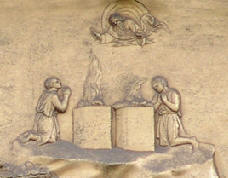
Genesis 4:1-8, An Interesting Thing about God's Words to Cain

"Now Adam knew Eve his wife, and she conceived and bore Cain, and said, I have gotten a man from the Lord. And she again bore his brother Abel, and Abel was a keeper of sheep, but Cain was a tiller of the ground.

"And in process of time it came to pass that Cain brought of the fruit of the ground an offering unto the Lord. And Abel, he also brought of the firstlings of his flock, and of the fat thereof: and the Lord had respect unto Abel and to his offering. But unto Cain and to his offering he had no respect: and Cain was very wroth, and his countenance fell.

"And the Lord said unto Cain, Why art thou wroth? And why is thy countenance fallen? If thou do well, shalt thou not be accepted? and if thou doest not well, sin lieth at the door: And unto thee shall be his desire, and thou shalt rule over him.

"And Cain talked with Abel his brother: and it came to pass when they were in the field, that Cain rose up against Abel his brother, and slew him." [KJV]

This passage has always bewildered me. What did it mean for sin to be waiting at the door? I chose the KJV here, instead of my accustomed ESV, because of its use of "him" here, rather than "it."


I am reading On the Atonement and Intercession of Jesus Christ, by the Covenanter William Symington, and he references this text as an underlying reference to atoning sacrifice, as a type and preparation of the coming crucifixion of Jesus, the Lamb of God who takes away the sins of the world. According to him, the Hebrew word used here, "khatta't," can mean either "sin" or "sin offering." However, when used for "sin", the grammatically-feminine word takes feminine modifiers, while its use for "sin offering" takes masculine modifiers. That's why I used the KJV here, which refers to "him" in place of the ESV's "it."

Symington suggests that God's admonition isn't a warning that sin lies at the door, which he calls a tautology. That is, if Cain does wrong, then he is a sinner, it isn't something of which he need beware. Rather, God encourages Cain with the promise that his sin has an answer, the atoning sacrifice of the lamb outside the door, over which Cain has mastery. Compare Leviticus 3:2, which describes the peace offering killed "at the entrance" of the tabernacle, later the temple. Cain then rejects God's gracious offer, even to the extent of murdering his righteous brother. Thus is the writer of Hebrews justified in writing (11:4) that God accepts Abel's sacrifice because of his faith. Yet, Cain, who apparently received greater revelation concerning sacrifice, rejects God's chosen lamb - both in type and antitype - and instead substitutes his own vegetable offering, i.e., his own works in place of God's gracious atoning sacrifice.

Ah, now both the Genesis and Hebrews passages make much more sense to me!

Wednesday, August 12, 2009

True Peace and God's Judgment on Religious Formalism

"What to me is the multitude of your sacrifices? says the Lord; I have had enough of burnt offerings of rams and the fat of well-fed beasts; I do not delight in the blood of bulls, or of lambs, or of goats. When you come to appear before Me, who has required of you this trampling of My courts? Bring no more vain offerings; incense is an abomination to Me. New moon and Sabbath and the calling of convocations - I cannot endure iniquity and solemn assembly. Your new moons and your appointed feasts My soul hates; they have become a burden to Me; I am weary of bearing them. When you spread out your hands, I will hide My eyes from you; even though you make many prayers, I will not listen; your hands are full of blood."
- Isaiah 1:11-15

God isn't here rejecting the Mosaic ceremonies. He did, after all, command them Himself. Rather, He is angry with professing believers who continued to go through the motions of the ceremonies, but missed their point completely. The Apostle Paul referred to the same thing in II Timothy 3:5, "[people] having the appearance of godliness, but denying the power."

The ceremonies were never intended for their own sake; they aren't magic rituals that create spiritual miracles out of the thin air. Rather they were intended to reveal the holiness of God, His hatred of sin, and the necessity of atonement for it. As Hebrew 9:22 explains, "Indeed, under the Law almost everything is purified with blood, and without the shedding of blood there is no forgiveness of sins."

However, for the one who isn't numb to his own sins, the sacrifices should lead to a hatred of his sin, an appeal to the blood atonement, and the clear conscience that comes from knowing the Lamb who takes away the sins of the world (John 1:29). Again, we see in Hebrews 10:3-4, "But in these sacrifices there is a reminder of sin every year. For it is impossible for the blood of bulls and goats to take away sins."

So, what of the blood atonement for our sins? Is it never to be fulfilled? Are we left without the satisfaction of God's wrath? What freedom, what blessing to know that the atonement has been provided once for all! Hebrews 10:12-14, "When Christ had offered for all time a single sacrifice for sins, He sat down at the right hand of God, waiting from that time until His enemies should be made a footstool for His feet. For by a single offering He has perfected for all time those who are being sanctified." This verse disabuses the Church of Rome of its doctrine of the sacrifice in the mass: not only is that doctrine false, but it is a blasphemy against the once-for-all sacrifice of Christ on the cross.

When Israel performed their sacrifices as a formal ceremony, with no change of the heart, their consciences were clear, but Isaiah exposes that their peace was a deception. In contrast, for the one who truly places his faith in Christ, Hebrews 10:19-22 testifies, "Therefore, brothers, since we have confidence to enter the holy places by the blood of Jesus, by the new and living way that He opened for us through the curtain, that is, through His flesh, and since we have a great priest over the house of God, let us draw near with a true heart in full assurance of faith, with our hearts sprinkled clean from an evil conscience and out bodies washed with pure water."