Showing posts with label daniel. Show all posts

Saturday, April 16, 2022

Weariness and the Call of the Gospel

One of the most comforting statements in the Bible comes from the mouth of Jesus Himself: "Come to Me, all who labor and are heavy laden, and I will give you rest. Take My yoke upon you, and learn from Me, for I am gentle and lowly in heart, and you will find rest for your souls. For My yoke is easy, and my burden is light" (Matthew 11:28-30). His reference to "rest for your souls" is an indication that He was not speaking of physical weariness, or, at least, not primarily. Rather, He was describing the burden of sin, of which He alone is the cure. 

Turning from the weight of sin to liberation in Jesus is something that only the elect person can do. The reprobate, in contrast, while they experience the futility of sin, will turn to any other source for relief, whether it is substance abuse, moral reform, or a false religion. But, by his very nature, the reprobate is unable to depend on the only solution that works, i. e., redemption and sanctification by Jesus, received by grace alone through faith alone. 

An error is often committed here, even among folks who profess the Reformed Faith. And that error is to teach that Jesus is appealing to the undistinguished mass of humanity, whether elect or reprobate, because, they suppose, God wants "all to be saved" (out of context from I Timothy 2:4). They believe that God has two wills at war with each other, the will to save some, elected from prehistory, but not others, and another will that wants all to be saved. This is called by the misleading phrase "the well-meant gospel offer." That is, offered by God. No one disagrees that we men cannot know who is or is not elect, so we sincerely desire everyone with whom we share the Gospel to respond in saving faith. 

God, however, certainly does know. Yet this doctrine, admittedly the majority doctrine, holds that He, nevertheless, desires everyone without exception to believe unto salvation. This is in spite of what Jesus also tells us in another place: "No one can come to Me unless the Father who sent Me draws him" (John 6:44). So we have this doctrine of the well-meant offer claiming that God works at cross purposes, both drawing and refraining to draw the same men. How can such a schizophrenic being be God? 

Rather, God gives a general outward announcement of the gospel, to which He has decreed that a portion, the elect, will respond in saving faith.  To the reprobate, the hearing of the Gospel is not an invitation to believe, but is, instead, a declaration of judgment, because God has decided to harden them against the word that they hear. That increases their judgment. It is not an effort at cross purposes to the secret will of God. 

The doctrine of the well-meant gospel offer seems to be an effort by Calvinists to take the edge off the doctrine of election, to make it more palatable to the Arminians around us. Yet, how can the insult to the omnipotence of God be worth any softening of our opponents toward us? Not that I believe that Arminians are made any more hospitable thereby. The doctrine puts God in violation of the logical principle of non-contradiction; it violates the Scriptures that tell us that God necessarily achieves His will (e. g., Daniel 4:35 and Psalm 135:6). In support of it is no Scripture or logically-consistent principle. 

Therefore, I am compelled to reject it. 


Wednesday, October 6, 2021

Jehovah's Witnesses and the Archangel Michael

One of the doctrines that distinguishes Jehovah's Witnesses from Christians is the Witness claim that Jesus is not God, but is, rather, an incarnation of the Archangel Michael. They base their argument, in part, on Jude 1:9: "When the Archangel Michael, contending with the devil, was disputing about the body of Moses..." They claim that "archangel" means "chief angel," which is true, and that the use of the article means that he is the only one, which is not true. 

The funny thing about their use of that passage is what it goes on to say: "When the Archangel Michael, contending with the devil, was disputing about the body of Moses, he did not presume to pronounce a blasphemous judgment, but said [instead], 'The Lord rebuke you'" (Jude 1:9, in full). Michael did not pronounce a judgment on Satan, but rather left it to the Lord to do so. 

Is this what we see from Jesus? 

At the end of His temptation, Jesus said, "Be gone, Satan!" (Matthew 4:10). And again in Matthew 16:23, he says, "Get away from Me, Satan!" So Jesus had no hesitation in rebuking Satan, and He did so by His own authority, not by referring the rebuke to another party. Jesus acted not at all like Jude's description of Michael. 

Look further at Daniel 10:13, which is also mentioned (but not quoted) by the Witnesses: "The prince of the kingdom of Persia withstood me [i. e., the angel in Daniel's vision] twenty-one days, but Michael, one of the chief princes, came to help me, for I was left there with the kings of Persia..." So this angel has come from a three-week conflict with a prince of Persia. Whether this is a term for a literal prince or for a demonic spirit behind the power of Persia, cannot be determined. Either way, the angel required assistance, which is given by Michael, who is called "one of the chief princes." "Chief" there is of the same significance as "arch-" in "archangel." But notice the article and the plural. We are here explicitly told that the office of Michael is not his alone, but one that he shares with unnamed others. The article does not imply singularity. Every claim made by the Witnesses regarding Michael is here overturned. 

The office of Jesus is, indeed, singular, because He alone is the only-begotten God, described explicitly so throughout the New Testament, not in one obscure verse that must be elided in order to make it appear what the Witnesses claim from it. 


Wednesday, May 12, 2021

The Father Certifies the Son's Atoning Work


"Between the throne and the four living creatures and among the elders I saw a Lamb standing, as though it had been slain, with seven horns and with seven eyes, which are the seven spirits of God sent out into all the earth. And He went and took the scroll from the right hand of Him who was seated on the throne. And when He had taken the scroll, the four living creatures and the twenty-four elders fell down before the Lamb, each holding a harp, and golden bowls full of incense, which are the prayers of the saints. And they sang a new song, saying, 'Worthy are You to take the scroll and to open its seals, for You were slain, and by Your blood You ransomed people for God from every tribe and language and people and nation, and You have made them a kingdom and priests to our God, and they shall reign on earth'" (Revelation 5:6-10). 

The passage above is one of the most beautiful in the New Testament. It parallels a similar scene in Daniel 7:9-14. I think that both passages describe the same event, Daniel prophetically in advance and John by vision after the event: the entry of Jesus into the heavenly throne room after His ascension. He receives His commission from the hand of the Father, a diploma, if you will. The Father acknowledges the Son's successful completion of the work of redemption, and rewards Him with the glory of a church, consisting of men from every culture, just as the Father had promised Him in Psalm 2:6-8: "As for Me, I have set My King on Zion, My holy hill. I will tell of the decree: The Lord said to Me, 'You are My Son; today I have begotten You. Ask of Me, and I will make the nations Your heritage, and the ends of the earth Your possession.'" Compare this promise to the declaration of Jesus in the Great Commission: "All authority in heaven and on earth has been given to me. Go therefore and make disciples of all nations, baptizing them in the name of the Father and of the Son and of the Holy Spirit, teaching them to observe all that I have commanded you" (Matthew 28:18-20).

While there are many things that we can take out of this series of verses, my intent now is to turn from Who achieved it, to for whom He achieved it. 

Look again at Revelation 5, especially verse 9: "by Your blood You ransomed people for God from every tribe and language and people and nation." The common view of the redemptive work of Jesus is that He performed it for every person in the world throughout history. That is the view of Arminianism. That is, the Arminian reads John's words as, "by Your blood You ransomed all people for God." However, that isn't what the verse says. It says, "people from every tribe, etc." The difference is the assumption of a universal atonement in the Arminian version, but a particularization to certain men in John's actual words. 

This passage teaches the doctrine of particular atonement, also sometimes called definite or limited atonement, usually associated with the Calvinist system of doctrine. It does not permit the universal atonement advocated by the Arminian system.

Saturday, December 26, 2020

Jesus Contra "Soul Sleep": Absent from the Body, Present with the Lord

As we know, Jesus was a frequent target of the Pharisees, as they asked Him questions that they expected to baffle Him or to expose Him to punishment by the Romans. Their opponents, the Sadducees attempted to trip up Jesus, too, but only one time. In Mark 12, they asked Him whose wife a woman would be in the resurrection, after she had been married and widowed by seven brothers. This was actually a double trap, because the Sadducees didn't believe in the resurrection.

In His response, Jesus answered both challenges, the one spoken, while the other was a trap waiting silently. "Is this not the reason you are wrong, because you know neither the Scriptures nor the power of God? For when they rise from the dead, they neither marry nor are given in marriage, but are like angels in heaven. And as for the dead being raised, have you not read in the book of Moses, in the passage about the bush, how God spoke to him, saying, ‘I am the God of Abraham, and the God of Isaac, and the God of Jacob’? He is not God of the dead, but of the living. You are quite wrong" (Mark 12:24-27). He rebukes their failure to believe the Scriptures, which tell us of the resurrection of the dead at the end of history (such as Job 19:26 and Daniel 12:2). Only then does He answer their surface question, denying that resurrected men will continue our social functions: "When they rise from the dead, they neither marry nor are given in marriage, but are like angels in heaven" (Mark 12:25). 

But He also rebukes the Sadducees for supposing that God  is related to men only in this physical life and no more: "Have you not read in the book of Moses, in the passage about the bush, how God spoke to him, saying, I am the God of Abraham, and the God of Isaac, and the God of Jacob? He is not God of the dead, but of the living. You are quite wrong" (Mark 12:26-27).

I bring up this story because it addresses a modern heresy, that of "soul sleep." That doctrine, with some differences, is especially associated with the Jehovah's Witnesses and Seventh-Day Adventists. They deny that the dead believers are conscious, and spiritually in Heaven with Jesus. This is the same doctrine for which Jesus rebukes the Sadducees.

The point of Jesus is the dead saints are alive now, enjoying fellowship with God now. They are not nonsexistent as the Sadducees believed, or nonexistent now to be recreated later as the Jehovah's Witnesses claim, or unconscious in the grave with their bodies as the Seventh-Day Adventists claim.

Instead, we can joyfully claim, as Paul did, "Away from the body and present with the Lord" (II Corinthians 5:8).

Wednesday, September 9, 2020

The Dispensational Antichrist Disproves Dispensationalism

"I will bless those who bless you, and him who dishonors you I will curse, and in you all the families of the earth shall be blessed." 

- Genesis 12:31 (see also Numbers 24:9) 

This verse is one of the favorites among dispensationalists. According to their interpretation, it is an eternal and unconditional promise by God to ethnic Israel. Among other things, it is used to justify political action to keep the American government in a policy of unconditional endorsement and assistance to the modern State of Israel

Another verse used by dispensationalists is Daniel 9:27: "He shall make a strong covenant with many for one week, and for half of the week he shall put an end to sacrifice and offering. And on the wing of abominations shall come one who makes desolate, until the decreed end is poured out on the desolator." According to their interpretation, this verse means that Israel will make a treaty with the Antichrist. Now understand, the dispensationalist considers the Antichrist to be a really bad dude. 

Do you see the problem with this juxtaposition? 

The dispensationalist tells us that anyone who assists the nation of Israel will be blessed  by God. He also tells us that the Antichrist assists Israel with a treaty. Doesn't syllogistic logic tell us that those two premises result in the conclusion that God will bless the Antichrist? 

I guess it's a good thing that I am not a dispensationalist. I reject both premises. Therefore, i don't have to deal with the nonsense that results from them.


Wednesday, May 20, 2020

Old Testament Usage Proves that "Baptizo" Cannot Necessarily Mean "Immerse"

One of the claims made by certain groups, such as Baptists and Seventh-Day Adventists, regarding baptism is that immersion is the required mode. I am sure that you have seen the pictures of a person lowered back first - always back first - into a baptismal pool. Or just a swimming pool, pond, seaside, in a bath tub - I've seen them all. One of the reasons they give is that "baptizo," the Greek verb from which we get the word "baptism," supposedly means "to immerse."

It is that assertion that I wish to address here.

As I have said before, I agree with the Westminster Confession regarding the mode of baptism: "Dipping of the person into the water is not necessary; but baptism is rightly administered by pouring or sprinkling water upon the person" (XXVIII:3). I do not claim, nor does the Confession state, that baptism by immersion invalidates the rite. In fact, I was personally baptized by immersion, and it was in a swimming pool! However, as I have grown in my knowledge of Scripture, I have come to conclude that sprinkling is the intended mode of baptism.

The problem with the claim about the word "baptizo" is that it is inconsistent with the usage of that word. In the New Testament, does anyone claim that the pharisees immersed their dining couches (Mark 7:4)? The word translated "wash" there is "baptizo" in the Greek. The problem is even greater in the Greek version of the Old Testament, the Septuagint. In that version, "baptizo" or "bapto" appear five times. Of those, two are used in situations in which sprinkling, not immersion, are logically or explicitly required.

The first is in Daniel 4:33 (verse 30 in the LXX), the description of Nebuchadnezzar's curse of madness. We are told that he was "bathed in the dew of Heaven." "Bathed" there is a translation of "ebapso," a tense of "bapto." Could any sensible person suggest that he was immersed in the dew?

The other is Ecclesiasticus 34:25 (not Ecclesiastes; also called Sirach): "He that washeth himself after the touching of a dead body, if he touch it again, what availeth his washing?" The first use of "washing" is a translation of "baptizomenos," a tense of "baptizo." Some might object that this verse is from the Apocrypha, which is true. However, I cite it only as an example of usage. Compare it to the Mosaic laws regarding purification washings (e. g., Numbers 19:9; and Judith 12:7, in a fountain), and we see that the ceremonies described by Sirach were done by sprinkling, not by immersion.

The conclusion is unavoidable that the claim that "baptizo" refers only to "immersion" is not biblically sustainable. To insistence on it is to put a denominational prejudice ahead of the words in the text.

Saturday, November 24, 2018

The Watchtower: Jumping Through Hoops for False Doctrine

The Watchtower Society (the corporate name of the Jehovah's Witnesses) claims that the kingdom of God is something that will appear in the future. Their website says, "'This good news of the Kingdom will be preached in all the inhabited earth for a witness to all the nations, and then the end will come.' (Matthew 24:14) Once the good news has been fully preached, the Kingdom will come to bring the present wicked system to an end."

Do you see the bait-and-switch in their statement? They quote a verse regarding the preaching of the kingdom, and then apply it to the kingdom itself. Matthew describes a worldwide preaching of the kingdom. While I consider this a reference to the period prior to the Roman sacking of Jerusalem in 70 AD, the point is the same if you apply it to the period before His second advent. The Watchtower then interprets the verse to mean that the Kingdom will not appear until He returns.

However, what did Jesus say about His kingdom? "The kingdom of God has come upon you" (Luke 11:20). He spoke to His audience during His first advent, telling them that they were witnessing the appearance of His kingdom. On another occasion, He told them, "Behold, the kingdom of God is in the midst of you" (Luke 17:21). Twice, then, Jesus vocally told His First-Century audience that the kingdom had come among them in the presence of His person. This is consistent with the Old Testament prophecy of the coming of the kingdom: "The stone that struck the image became a great mountain and filled the whole earth" (Daniel 2:35; see the entire vision in verses 31-45). The kingdom would start as just a small rock (see Matthew 16:18), and grow until it fills the earth. That is what is happening between the first and second advents. That is why John can refer to Jesus as "the ruler of kings on earth" (Revelation 1:5) at the beginning of that book.

The Watchtower is aware of this weakness in their doctrine, and try to address it: "The Kingdom of heaven was 'with' or 'among' the Pharisees, in that Jesus, the one designated by God to rule as King, was standing before them.​—Luke 1:​32, 33." Here they change what Jesus says, "Kingdom of heaven," to a reference to Himself as coming King! Another example of bait-and-switch!

To my mind, to use such blatant fallacies to support their doctrine demonstrates that the Watchtower Governing Board is well-aware that their doctrine is unbiblical. And that brings up an obvious question for Watchtower members: If your leadership is so clearly aware of the falsity of their doctrines, why do you remain loyal to those doctrines?

Saturday, July 7, 2018

God's Justice and the Eternality of Hell

Seventh-Day Adventists and Jehovah's Witnesses (mainly, but others, too) hold to the doctrine of annihilationism, the supposed destruction of the wicked in the great judgment. They reject the traditional teaching of an everlasting judgment in Hell. In fact, they object to the nature of God, as suggested by the doctrine of eternal punishment.

The resurrection is described in a couple of places in Scripture. However, Daniel 12:2 is clearest in naming resurrection to what: "Many of those who sleep in the dust of the earth shall awake, some to everlasting life, and some to shame and everlasting contempt."

I specifically use this verse, because others get twisted, such as Revelation 14:11, "The smoke of their torment goes up forever and ever." Annihilationists claim that the smoke might be eternal, but that doesn't imply that the torment is, too. They never explain how smoke can continue to rise from fuel which has been exhausted.

However, Daniel mentions neither flames nor fire, but explicitly states that it is the contempt for the wicked that is everlasting. Someone will surely object that the object of the contempt doesn't have to continue eternally in order for the contempt for it to remain. But is that really a rational objection? Can we expect the emotional reaction to something to outlast that thing into eternity? No, even the strongest of reactions must fade without further stimulation by their object.

Annihilationists make hysterical protests against the supposed injustice of God for punishing eternally sins which were only temporal. That is the essence of their error, mistaking sinful acts, which do, indeed, occur in time, not eternity, for sin itself. The wicked aren't judged primarily for the sinful acts that they committed, but rather for the wicked and rebellious hearts from which those acts arose (Matthew 15:18-20). While annihilationists are complaining about the morality of God, they are glossing over the sinfulness of the wicked. When the wicked die, and pass into eternity, they do not cease to be wicked. Rather, they continue to hate God and curse Him in Hell, earning for themselves continuing punishment.

God is perfectly just and moral. It is His annihilationist critics who are not.


Saturday, June 16, 2018

"Free Will," a False Response to the Question of Evil

Atheists will attack the Christian notion of God by pointing out that there is evil in the world. Since that is certainly an undeniable fact, some Christians will use the defense of free will. That is, they claim that God gives men autonomy to do good or to do evil. Men choose to do evil, so there is evil in the world, regardless of the desire of God.

In this case, the harm done to Christian theism by these "defenders" is worse than the attack against which they argue. They claim that God doesn't want evil in the world, but He is just unable to do anything about it, because man is sovereign.

That is false. It is a false view of God, and it is a false view of man.

Let's start with the truth about God. As the atheist grants (showing that his professed atheism is really just a cover for the hatred he has toward God), God is in control. And that includes the control of evil. For example, we read in Zechariah 8:10, "Before those days there was no wage for man or any wage for beast, neither was there any safety from the foe for him who went out or came in, for I set every man against his neighbor." That is an unequivocal statement that the evil of men toward other men is the result of God's purposes, a judgment for rebellion, as Calvin commented on this verse: "As then in God's judgments there ever shines forth the highest equity, there is no reason for men to try to implicate Him in their own perdition, or to devolve on Him a part of the blame. God then justly excites the hearts of men into madness, and yet men themselves bear the whole blame, though God draws them here and there against their wills, and makes use of them as His instruments; for the hidden purpose of God does not excuse them, while nothing is less their object than to obey His word, though they are guided by His hidden operation." It was in understanding this that Job was moved to say to his wife, "Shall we receive good from God, and shall we not receive evil?" (Job 2:10). This illustrates the assertion of Scripture, contrary to this supposed defense by ill-informed Christians, that God does everything as He desires to do: "Whatever the Lord pleases, He does, in heaven and on earth, in the seas and all deeps" (Psalm 135:6).

And that leads me to addressing the false view of man expressed above. Man is not sovereign. He does not have a veto on the intentions of God, whether or not it is claimed to be by God's permission. "All the inhabitants of earth are accounted as nothing, and He does according to His will among the hosts of heaven and among the inhabitants of the earth; and none can stay His hand or say to Him, 'What have you done?'" (Daniel 4:35). Rather, God always acts according to His own glory: "For My own sake, for My own sake, I do it, for how should My name be profaned? My glory I will not give to another" (Isaiah 48:11).

Saturday, February 3, 2018

That Moronic Arminian Question

One response I frequently get from Arminians strikes me as particularly bizarre. When I assert God's absolute predestination of all things, they respond with, "Well then why do (fill in the blank)?" I find it incomprehensible that they think that predestination implies that we should all stand around in a catatonic state while God operates the universe around us. How can they not be conscious of what a silly caricature that is?

Predestination answers the question of why things occur. Things occur because it is the purpose of God that they should do so: "He does according to His will among the host of heaven and among the inhabitants of the earth; and none can stay His hand or say to Him, 'What have You done?'" (Daniel 4:35). To my mind, the concept of God implies exactly what this verse asserts, that He must be in sovereign control of all things.

However, the Arminian pretends that Calvinist thought stops there, as if "why" were the only issue. Does he really believe that a Calvinist cannot conceive of the question of "how"?

Why do things happen? Because God has determined that they shall. How do they happen? Well, why am I alive? Because God has so determined. But how do I live? By eating, drinking, breathing, keeping warm, etc. The error of the Arminian is his assumption that the answer to the first question covers the answer to the second, and that is obviously not the case. God has chosen that I live (for this moment, at least) by food, water, air, warmth, etc. That is, by means. The answer to the first question does not include the answer to the second.

Saturday, December 9, 2017

Is It a Sin to Say That There Is Hyperbole in Scripture?

A Skyline in Canaan?
In discussing Isaiah 14:3-23, I have denied that it refers to the fall of Satan. I insist that it really is about the king of Babylon, just as it says in verse 4. There is always someone who points out that there are specific references in the passage that exceed something that could be true of a mere human king. And, if one insists on taking a literal approach, that would be true. However, is it not inconsistent to insist on being literal about that, while being figurative about the subject of the passage? After all, Satan is mentioned nowhere in it.

My answer is simply that the Prophet is using hyperbolic language to emphasize the arrogance of Babylon, and especially of her king (compare Daniel 4:30-33). Hyperbole is a widely used literary form, using exaggerated language to emphasize a point. Yet, people accuse me of denying the inerrancy of Scripture by claiming that it contains hyperbole. Would I do so if I claimed that it uses poetry? Or allegory? Or humor? Certainly not! God uses all of the literary forms that any other form of human literature uses.

Here is another example: "Hear, O Israel: you are to cross over the Jordan today, to go in to dispossess nations greater and mightier than you, cities great and fortified up to heaven" (Deuteronomy 9:1). Would anyone suggest that Moses was literally saying that the Canaanites had skyscrapers in their defensive walls? I hope not! Rather, he is using hyperbole, deliberately-exagerrated language, to impress on Israel how powerful their human foes were, before pointing them (verse 3) to the power of their God: "Know therefore today that He who goes over before you as a consuming fire is the Lord your God. He will destroy them and subdue them before you. So you shall drive them out and make them perish quickly, as the Lord has promised you."

Hermeneutics requires the awareness of the literary form used in any particular passage. That isn't liberalism, but merely sound exegesis.

Monday, October 16, 2017

Christ, Our Conquering King!

Question 45 of the Westminster Larger Catechism asks, How does Christ execute the office of a king? And answers it this way: "Christ executes the office of a king, in calling out of the world a people to himself, and giving them officers, laws, and censures, by which he visibly governs them; in bestowing saving grace upon his elect, rewarding their obedience, and correcting them for their sins, preserving and supporting them under all their temptations and sufferings, restraining and overcoming all their enemies, and powerfully ordering all things for his own glory, and their good; and also in taking vengeance on the rest, who know not God, and obey not the gospel."

There's a lot there, and I won't even try to address it all.

In Psalm 110:1, the Father gave a promise to the Son as part of the intra-Trinitarian covenant in prehistory: "Sit at My right hand, until I make Your enemies Your footstool" (applied to the Son in Hebrews 1:13). The Father had determined to glorify the Son by giving Him visible rule over the creation. History has been the record of the fulfillment of that promise, as the rule of Christ is established over the kingdoms of the world (compare Daniel 2:44-45, Revelation 11:15).

The theme of the royal destiny of the Son is especially described in the second Psalm:
"'As for Me, I have set my King
     on Zion, My holy hill.' 

I will tell of the decree:
     The Lord said to Me, 'You are My Son;
today I have begotten You.       
     Ask of Me, and I will make the nations Your heritage,
and the ends of the earth Your possession.
     You shall break them with a rod of iron
and dash them in pieces like a potter’s vessel.' 

     Now therefore, O kings, be wise;
be warned, O rulers of the earth.
     Serve the Lord with fear,
and rejoice with trembling.
     Kiss the Son,
lest He be angry, and you perish in the way,
     for His wrath is quickly kindled.
 
Blessed are all who take refuge in Him."
- Psalm 2:6-12 

What we don't see here is a description of the means of that conquest. There are militaristic expressions, but no mention of armies or weapons. In fact, Scripture denies a spiritual role for weapons of war: "The weapons of our warfare are not of the flesh but have divine power to destroy strongholds" (II Corinthians 10:4). So, no tanks or nuclear bombs, or even swords or arrows. What then?

Some of Jesus's last words during His earthly ministry are found in the Great Commission: "Jesus came and said to them, 'All authority in heaven and on earth has been given to Me. Go therefore and make disciples of all nations, baptizing them in the name of the Father and of the Son and of the Holy Spirit, teaching them to observe all that I have commanded you. And behold, I am with you always, to the end of the age'" (Matthew 28:18-20). Here, Jesus claims "all authority," that is, the very delegation of royal prerogative we find in Psalm 2. As King, what assignment does He then give His captains, the Apostles (and we after them)? To disciple the nations, part of which is to teach them to obey His Law.

Therefore, the answer to the assignment in Psalm 2 is no military conquest. Nor is it some waving of a divine hand from heaven. This is in spite of the obvious fact that either one would be within the power on omnipotent deity. Rather, the submission of all things to the crown rights of Jesus is through His people, as we proclaim the Gospel and train the nations to live as Christians. Evangelism and missions will conquer the world, because our Savior is already king!

Wednesday, January 11, 2017

People Don't Believe Because They Are Pre-Determined Vessels of Wrath

In John, chapter 12, Jesus is preaching to a group of Pharisees (verse 19). In contrast to a group of God-fearing Gentiles (verse 20), however, these Pharisees rejected Him. His response is described in verses 37-41: " Though He had done so many signs before them, they still did not believe in Him, so that the word spoken by the prophet Isaiah might be fulfilled: 'Lord, who has believed what he heard from us, and to whom has the arm of the Lord been revealed?' Therefore they could not believe. For again Isaiah said, 'He has blinded their eyes and hardened their hearts, lest they see with their eyes, and understand with their heart, and turn, and I would heal them.' Isaiah said these things because he saw His glory and spoke of Him" (John 12:37-41).  

How does the passage describe the Pharisees? As unbelieving. However, why were they unbelieving? Because they "could not." Could not? Not would not? That is a stunning choice of words. And John continues that description: "He has blinded their eyes and hardened their hearts." No doubt there was a judicial element to this, i. e., that the Pharisees had refused to believe, so God punishes them with even greater hardness. However, John explicitly states the God's decree is the source of their rigid unbelief.

This is a shocking thought to our egalitarian American ears. It's not fair! Not fair? Really? The Apostle Paul described that exact question from a hypothetical opponent (Romans 9:19): "You will say to me then, 'Why does He still find fault? For who can resist His will?" But what answer does he give? Does Paul back down to such a progressive view? Does he attempt to defend God's fairness? Not at all. Rather, he answers, not with a justification of God's sovereignty, but rather with a refusal to concede that it needs any such justification (Romans 9:20-22): "But who are you, O man, to answer back to God? Will what is molded say to its molder, Why have you made me like this?' Has the potter no right over the clay, to make out of the same lump one vessel for honorable use and another for dishonorable use? What if God, desiring to show His wrath and to make known his power, has endured with much patience vessels of wrath prepared for destruction?" That is, as our Creator, does God not have an absolute right to use us for His own glory and purpose? Of course! Specifically, He has such a right to use some as a demonstration of His holy wrath. There is no concession to egalitarianism here. It is, rather, an unequivocal assertion of the absolute and irresistible sovereignty of God. 

Daniel 4:35: "All the inhabitants of the earth are accounted as nothing, and He does according to His will among the host of heaven and among the inhabitants of the earth; and none can stay His hand or say to Him, 'What have You done?'"

Monday, January 9, 2017

Predestination as the Basis of Assurance in Prayer

Daniel in the Lion's Den
In the story of Daniel, there is a striking account of a special visitation (Daniel 9:20-23): "While I was speaking and praying, confessing my sin and the sin of my people Israel, and presenting my plea before the Lord my God for the holy hill of my God, while I was speaking in prayer, the man Gabriel, whom I had seen in the vision at the first, came to me in swift flight at the time of the evening sacrifice. He made me understand, speaking with me and saying, 'O Daniel, I have now come out to give you insight and understanding. At the beginning of your pleas for mercy a word went out, and I have come to tell it to you, for you are greatly loved. Therefore consider the word and understand the vision.'"

This is the Angel Gabriel, the same person who would later announce the coming birth of Jesus (Luke 1:19, 26). He is sometimes called an archangel, but that is just a tradition. That word isn't applied to him in Scripture.

There is no problem for anyone in the idea that an angel would be sent in response to a prayer. In fact, it happens again in the very next chapter of Daniel. However, it is too easy to pass over the fact that this is not what happens in this story.

Rather, Gabriel was sent "at the beginning of [Daniel's] pleas," not after them. When Daniel started to pray, God acted by sending Gabriel. Not reacted. Now we have a problem for the Arminian. How could God have responded before Daniel even prayed what he desired?

This is made even more-explicit by another Prophet (Isaiah 65:24): "Before they call I will answer; while they are yet speaking I will hear." That is, in the earlier Prophet, Jehovah promised exactly what we see taking place in Daniel. But the Arminian cannot explain God's promise, because he believes that men act according to free will. God cannot do something that is contingent on the will of a creature.

However, this experience is completely consistent with Calvinism. The Reformed believer understands that it is God who is sovereign, not the will of man. Therefore, when we pray, we are not informing God of something of which He is not aware, or on which He has not already determined to act. Rather, as in all things, the prayer and His response to it are both according to the predestined purposes of God.

"Why pray if God has already decided what to do?" the Arminian asks. Rather, "Why pray if God does not determine all things?" is the Calvinist's answer. How can a believer have any assurance in prayer if he imagines that God does not know, and is unprepared to address, his need of the moment? That wasn't Daniel's confidence. Rather, our confidence is in that promise from Isaiah, that God knows our needs before we do, and has determined to act before we can even think to ask Him. That is security!

Monday, December 19, 2016

Jesus versus the Religion of Humanism


There is a myth that claims that the American government is, and is supposed to be, neutral regarding religion. The reason that is a myth is that the government doesn't play hands-off in religious matters. Rather, it actively promotes the religion of humanism. That is, government is actively hostile to religious people and their beliefs. "Hate speech" is the legal name for blasphemy against the doctrines of humanism.

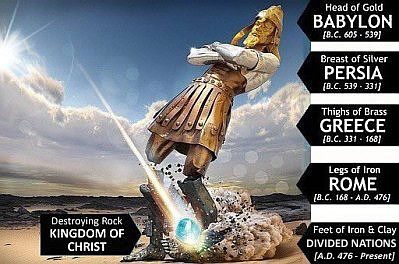
Most people in America are somewhat familiar with the dream of Nebuchadnezzar, described in the second chapter of Daniel. It is described by the prophet in Daniel 2:31-35. It is a figure of a man, with a head of gold, torso and arms of silver, thighs of bronze, shins of iron, and feet of blended iron and clay. Then a stone smashes into the feet of the man, shattering the figure. Then the stone grows into a mountain that fills the entire earth. The dream is then interpreted in Daniel 2:36-45. That interpretation tells us that the head is Nebuchadnezzar himself, the king of Babylon. The other kingdoms have been variously identified, but I think that the probable succession is that the Medo-Persian empire is the kingdom of silver, the Alexandrian empire the kingdom of bronze, and the Romans were the kingdom of iron. Notice that the kingdoms descend in value, from gold to iron, while ascending in power, from hard iron to soft gold.

The stone that smashes the figure is identified as the kingdom of God in verse 44.

The statue is identified as an "image." What is the significance of that term? The Second Commandment (Exodus 20:4-5) says, "You shall not make for yourself a carved image, or any likeness of anything that is in heaven above, or that is in the earth beneath, or that is in the water under the earth. 5You shall not bow down to them or serve them." That is to say, an "image" is not a piece of art, but rather an object of devotion. This particular image is of a man, thus representing the religious devotion to man as the standard of sovereignty. that is, the image represents, not a deity, but the religion of humanism.

What happens to the image? It is destroyed by a great stone, an asteroid, if you will, which is identified as the kingdom of God. And then the stone grows into a huge mountain which fills the whole world. Such a mountain is often used as an image of the kingdom of God, beginning with Mount Sinai and the Temple Mount in Jerusalem. it is also used as the image of the triumphant kingdom of God in the other prophets, such as Isaiah 2:2-3, 25:6, Micah 4:1-2, and Zechariah 8:3.

This vision is a prophecy of the coming of the kingdom in Jesus Christ during the time of the Roman Empire. Though all of the humanist power of Rome, with the cooperation of the apostate Jews, was devoted to destroying the kingdom, it was Rome, instead, that was destroyed. And, ever since, the kingdom of God has been growing around the world, literally filling the earth. This is a prophecy of the victory of Jesus Christ over the humanist idol of sovereign Man.

Monday, October 31, 2016

Irresistible Grace: Can a Mere Man Say No to God's Electing Grace?

I have never understood the resistance of Arminians to the doctrine of irresistible grace. I know that, sometimes, it is a matter of misdefinition, a caricature of the doctrine as teaching that God tackles an unbeliever, and forces him to believe in Jesus, like force-feeding a hunger-striking prisoner. And that is not, at all, what it means. Rather, the doctrine teaches that God's love and grace are effectual in the salvation of the elect.

First, let us consider what that grace does. In the process of effectual calling, God deals with a man who is spiritually dead (Ephesians 2:1). He replaces that man's dead spiritual heart with a new living heart (Ezekiel 36:26), with new desires and a new will to seek Him (Philippians 2:13). Thus, this man has become a new creation (II Corinthians 5:17), and has been born again (John 3:3). God doesn't jump on the unbeliever, like a farmer chasing a chicken for his dinner. Rather, He changes a dead man into a living man who desires to know and to serve Him. This is no different from a parent who uses discipline to change a disobedient, misbehaving child into a responsible adult, a bending process. It is different in one way, however: where a human parent can end up disappointed as his grown child makes bad or destructive choices, God is never disappointed in His efforts, because He cannot fail.

That last phrase is what I will address now.

I often wonder if Arminians have forgotten that God is God, and we are not. Is a puny human able to tell God "no," like a naughty two-year-old? Yeah, I guess he can say it, but God is hardly blocked by it. Rather, God tells us that He always achieves what He intends. Consider Isaiah 46:10, where He says, "My counsel will stand, and I will accomplish My purpose." And even more direct is Daniel 4:35: "All the inhabitants of the earth are accounted as nothing, and He does according to His will... among the inhabitants of the earth; and none can stay His hand or say to Him, 'What have You done?'" "None can stay His hand?" Really? No one can demand, "What have You done?" Amazing! Who does He think He is? God or something? Well, yeah, He does, actually, and rightly so, which is My point. God acts in a godlike manner, not as a man can.

Saint Augustine said, "Lord, command what you will, and give what You command." And that statement is biblical, a paraphrase of Isaiah 26:12: "O Lord, You will ordain peace for us, for You have indeed done for us all our works." This is what irresistible grace means. God takes a sinful, condemned man, and changes him, from the inside out. He makes that man what He demands that he be. And that is a merciful act, reader, for it is something that no one can do for himself (Isaiah 64:6): "We have all become like one who is unclean, and all our righteous deeds are like a polluted garment. We fade like a leaf, and our iniquities, like the wind, take us away." I thank God for His irresistible grace, because I know that I would have been headed for Hell, without hope, without it.

Thursday, January 15, 2015

The Antichrist in Saint Peter's

Reposted from the Contra Mundum blog, with permission. As I have mentioned elsewhere, here for example, I do not take a futurist approach to New Testament prophecy. In particular, I don't believe in a personal Antichrist. That term occurs only in the Epistles of John, who says (I John 2:18), "now many antichrists have come." However, I give a lot of deference to the view expressed below because it was also the view of the Reformers. Even the Westminster Confession of Faith (XXV:6) says, "There is no other head of the Church but the Lord Jesus Christ: nor can the Pope of Rome in any sense be head thereof; but is that Antichrist, that man of sin and son of perdition, that exalteth himself in the Church against Christ, and all that is called God." It's just that, in my mind, while the papacy is certainly antichristian, I wouldn't thereby name it Antichrist.

Hippolytus On The Antichrist 
 
The Reformers are frequently accused of malice when they identify the Pope with the Antichrist. It is asserted, or at least, assumed, that they were retaliating against Rome for persecuting them. What has been largely forgotten is the eschatology of the early Church Fathers, particularly the 2nd & 3rd Century Fathers, such as Irenaeus, Tertullian, and Hippolytus.
Of particular interest is the short work of Hippolytus (died ca. 236), entitled “On the Antichrist.” Several factors are highly prominent in this work.

1. Rome is the 4th beast of Daniel 7.
2. The great whore in Revelation 17 is identical with the reorganized Roman kingdom, ruled by the Antichrist. 
3. The Antichrist will rule over a “whore,” which is a universally understood Scriptural figure for an apostate church.
4. This “whore” will be a kingdom that will arise out of the remnants of a destroyed Roman Empire.
5. This “whore” will be Latin in orientation.
6. Antichrist, as head to this whore church-kingdom, will wage war on the saints, sending a second crop of martyrs to join those who were crying out under the altar (Rev. 6:9-10).
7. The Roman Empire is that which “letteth,” (hinders) the rise of Antichrist (2 Thess. 2:7).
8.  Antichrist is the “little horn” of Daniel 7 & 8.
9. Antichrist is the man of sin/son of perdition (2 Thess. 2).
These are all amazing observations. First of all, the idea that Rome would fall and be divided into 10 lesser kingdoms could never have been guessed without the prophecy of Daniel. Identifying Rome with Daniel’s 4th Beast is easy for us, centuries after the fact. It is astounding though for Hippolytus to have realized this and to have understood that Christ’s church would ultimately be victorious over pagan Rome. Hippolytus wrote during the Age of Martyrs!
Secondly, Hippolytus bluntly says that the Roman Empire is the hindrance, “that which letteth,” (2 Thess. 2:7) which must be removed for the Antichrist to rise to power. Again, this would have been easy to see in the 16th Century, but Hippolytus wrote during the 3rd. Tertullian had made the exact same assertion. In chapter 24 of “Resurrection of the Flesh,” Tertullian wrote, ““What obstacle is there but the Roman state, the falling away of which, by being scattered into ten kingdoms, shall introduce Antichrist upon its own ruins?” Compare this with the following from the commentary of Matthew Henry on 2 Thessalonians 2:7 – “Something hindered or withheld the man of sin. It is supposed to be the power of the Roman Empire, which the apostle did not mention more plainly at that time…These prophecies have, in a great measure, come to pass, and confirm the truth of the Scriptures. This passage exactly agrees with the system of popery, as it prevails in the Romish church, and under the Romish popes.”
Thirdly, he identifies the Antichrist with the little horn of Daniel 7 & 8. He identifies the great whore Babylon in Revelation 17 with the kingdom ruled by the little horn (Antichrist) who comes to power out of the remnants of the Roman Empire that is broken into 10 lesser kingdoms.
Fourthly, he affirms that this Antichristian kingdom will be Latin in orientation, based on understanding the number 666 as referring to Rome. Irenaeus made the exact same identification (Against Heresies 5.30.3).
Fifthly, Antichrist would persecute the Church with more ferocity than pagan Rome ever did. The martyrs of pagan Rome were under the altar (Rev. 6:9-10) crying out to God for justice. These martyrs would have to wait for their brothers who Antichrist’s Rome would kill. Tertullian understood Revelation 6 in exactly the same way. In chapter 25 of his “Resurrection of the Flesh,” Tertullian writes, “In the Revelation of John, again, the order of these times is spread out to view, which “the souls of the martyrs” are taught to wait for beneath the altar, whilst they earnestly pray to be avenged and judged: (taught, I say, to wait), in order that the world may first drink to the dregs the plagues that await it out of the vials of the angels, and that the city of fornication may receive from the ten kings its deserved doom, and that the beast Antichrist with his false prophet may wage war on the Church of God; and that, after the casting of the devil into the bottomless pit for a while, the blessed prerogative of the first resurrection may be ordained from the thrones; and then again, after the consignment of him to the fire, that the judgment of the final and universal resurrection may be determined out of the books.”
To read Hippolytus’ work on the Antichrist, you would think it was written in the 16th Century by a Reformer. The main difference was that the Fathers believed that the 1260 days of Revelation were a literal 3 ½ years. They knew Rome would fall, but they seemed to have expected Antichrist’s Rome to fall after only 3 ½ years.
It is therefore quite libelous against the Reformers to quibble with their interpretation of Scripture with regard to the Antichrist. Christ is the head of His Church. Antichrist, if he be an impostor (which he is), must be the head of a false church. Antichrist is not a secular political figure. The Fathers held the exact same view as the Reformers in this regard. How incredible is it to realize that in the 230's AD someone was asserting that the Antichrist will be the head of an apostate kingdom-church based in Rome, built on the ruins of the fallen Roman Empire? The Reformers were not innovators!
Hippolytus’ work can be found here.

Sunday, May 22, 2011

Isaiah's Vision of a Converted World

"It shall come to pass in the latter days
that the mountain of the house of the Lord
shall be established as the highest of the mountains,
and shall be lifted up above the hills;
and all the nations shall flow to it,
and many peoples shall come, and say:
'Come, let us go up to the mountain of the Lord,
to the house of the God of Jacob,
that He may teach us His ways
and that we may walk in His paths.'
For out of Zion shall go the law,
and the word of the Lord from Jerusalem."

- Isaiah 2:2-3

How much plainer can the scriptures be, than that the nations shall flow to the mountain of the Lord? The mountain of the Lord is Mt. Moriah, the Temple Mount, a type of the church (compare Isaiah 56:7, and Psalm 48:1). This prophecy is repeated verbatim in Micah 4:1. It is the second aspect of the prophecy of Daniel 2:35 (with 2:44): the Prophet Daniel saw the kingdom of God as a rock which smashed the great empires and then grew into a great mountain. Compare also Zechariah 8:3. Isaiah saw the peoples flocking to that mountain to be instructed by the Lord. "Law" here is not a reference to the Mosaic Law, but rather is an inclusive term for "teachings," as used in Psalm 119:18, etc.

Monday, September 6, 2010

Isaiah 25:6-10, The Lord Lifts the Veil from the Nations

"On this mountain the Lord of hosts will make for all peoples a feast of rich food, a feast of well-aged wine, of rich food full of marrow, of aged wine well refined. And He will swallow up on this mountain the covering that is cast over all peoples, the veil that is spread over all nations. He will swallow up death forever; and the Lord God will wipe away tears from all faces, and the reproach of His people He will take away from all the earth, for the Lord has spoken. It will be said on that day, 'Behold, this is our God; we have waited for Him, that He might save us. This is the Lord; we have waited for Him; let us be glad and rejoice in His salvation.' For the hand of the Lord will rest on this mountain..."

There were a few passages of Scripture that affected me deeply in the early days of my Christian profession, some thirty-odd years ago. For example, my first reading of Ephesians made me a Calvinist. And later, my first readings of the Old Testament Prophets, especially Isaiah, made me a postmillennialist.

Many of these prophetic passages start with this reference to "this mountain." Which mountain? I take it to refer to Mount Zion, the physical location of the Temple, but also a frequent symbol for the Church (see Hebrews 12:22). Related uses of the word can be found in Isaiah 2:2, 11:9, 56:7, Daniel 2:35, Joel 3:17, Obadiah 1:16, Micah 4:1-2, Zephaniah 3:11, and Zechariah 8:3.

In our passage here, Isaiah prophesies a time when God would remove the veil from the nations. This obviously is neither a literal veil over the face, nor the veil of the Temple, though both are biblical uses of the word, since neither fits the context. Compare the uses of the word in successive verses of II Corinthians 3:13-16. Paul begins with the placing of a literal veil over the face of Moses, then changes to the figurative meaning of spiritual blindness. Considering it the same way in Isaiah, we have a promise that a time will come when God will lift the blindness from the hearts of the nations. Not each individual exhaustively, but over the nations as a whole. This is expressed more literally in Isaiah 56:6, referring to "foreigners who join themselves to the Lord," and Micah 4:2, where "many nations" shall come to be taught the word of God.

The promise that the Earth will be filled with the knowledge of the Lord is a repeated one: Isaiah 11:9 and Habakkuk 2:14. After all, it was the mission that Jesus gave us before Hid ascension (Matthew 28:19-20). One wonders two things; first, why is a repeated promise overlooked by so many? and second, why is such a happy promise rejected and opposed by so many?

Sunday, March 14, 2010

The Mode of Baptism, According to the Scriptures, Part 2


Continuing with A. A. Hodge's refutation of the immersion-only view of baptism, I come to his discussion of the Greek word adopted into English as "baptize."

In the New Testament, that word is always baptizo, which can indeed mean "immerse," but also "dip, moisten, purify, wash," depending of course on context. The Septuagint uses bapto and baptizo, with no apparent distinction between the two variants. In the Greek version of Daniel 4:33, Nebuchadnezzar is said to be "baptized with the dew of heaven." That could hardly mean immersion. And in the apocryphal book of Ecclesiasticus 34:30, reference is made to one "who baptizes himself after the touching of a dead body." Yet, Numbers 19:9, 13, and 20, describe that rite as done through sprinkling.

In Mark 7:3-4 and Luke 11:38, Jesus refers to the Pharisees "washing their hands" with baptizo, but in the parallel passage in Matthew 15:2, 20, the Greek has nipto, which simply means "to wash." The emphasis in using baptizo, therefore, is not on the method, whether immersion or otherwise, but on the use, i.e., cleansing. The same meaning for baptizo is seen in its use by the disciples of John in John 3:25 and 4:2.

In Hebrews 9:10, the author describes the use of the earthly tabernacle for "diverse baptisms" ("washings" in contemporary English versions), then gives specific "baptisms" in verse 13 ("the sprinkling of defiled persons with the blood"), verse 19 ("sprinkled both the book itself and all the people"), and verse 21 ("he sprinkled with the blood"). Thus the writer of Hebrews explicitly uses "baptize" to describe a rite of sprinkling, not immersion.

I will add one additional passage to those mentioned by Hodges. In I Corinthians 10:2, Israel is said to have been "baptized into Moses in the cloud and in the sea", that is, in the crossing of the Red Sea. Yet, not only was Israel not immersed, they are even explicitly said not to have gotten wet (Exodus 14:16, 21, 22, and 29)! It was the Egyptians that were immersed, yet they are not described as "baptized"!

To go to part 3, click here.