Showing posts with label soul sleep. Show all posts

Wednesday, September 28, 2022

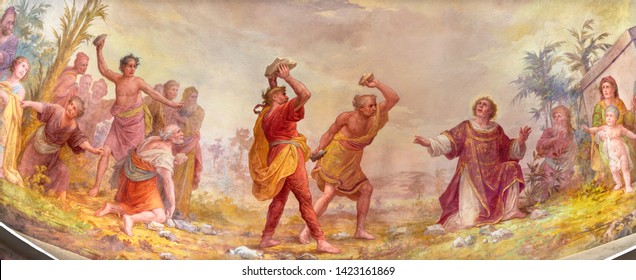
The Martyrdom of Stephen as a Refutation of "Soul Sleep"

Where was the spirit of Stephen after he was stoned to death? The Seventh-Day Adventists claim that it was asleep with his body in the grave. The Jehovah's Witnesses claim that it disintegrated, to be recreated at the final judgment. Those two doctrines are variants of what is commonly called "soul sleep." It is in sharp contrast to the traditional Christian belief that the spirits of the godly passed immediately upon death into the heavenly presence of Jesus (see II Corinthians 5:8). 

The story of Stephen is found in Acts, chapter 7. We are introduced to him in the previous chapter, where we are told that the church elected him to the diaconate, because he was "full of faith and of the Holy Spirit" (Acts 6:5). In chapter 7, he gives a long sermon about Jesus to a Jewish crowd, culminating in verses 51-53: "You stiff-necked people, uncircumcised in heart and ears, you always resist the Holy Spirit. As your fathers did, so do you. Which of the prophets did your fathers not persecute? And they killed those who announced beforehand the coming of the Righteous One, whom you have now betrayed and murdered, you who received the law as delivered by angels and did not keep it." As might be expected, his audience was not happy with his words: "Now when they heard these things they were enraged, and they ground their teeth at him... They cried out with a loud voice and stopped their ears and rushed together at him. Then they cast him out of the city and stoned him" (Acts 7:54, 57-58). 

How did Stephen respond to this persecution? "He, full of the Holy Spirit, gazed into Heaven and saw the glory of God, and Jesus standing at the right hand of God. And he said, 'Behold, I see the heavens opened, and the Son of Man standing at the right hand of God'... And, as they were stoning Stephen, he called out, 'Lord Jesus, receive my spirit.' And, falling to his knees, he cried out with a loud voice, 'Lord, do not hold this sin against them.' And when he had said this, he fell asleep [i. e., died]" (Acts 7:55, 59-60). 

This spiritual man knew that death was upon him, but his expectation was to enter thereupon into the presence of Jesus, as orthodox Christians have always said. He knows nothing of a two-thousand year (and counting) gap between his death and rising to see Jesus only then. Stephen the Deacon was surely no Adventist or Jehovah's Witness. 


Wednesday, March 2, 2022

The Bible and The Watchtower Doctrine of "Soul Sleep"


According to the doctrine of the Watchtower, the human spirit disintegrates at death, and is then recreated at the final judgment. This doctrine is called informally "soul sleep," or more formally "conditional immortality."

In support of their doctrine, Jehovah's Witnesses cite Ecclesiastes 9:5, 10: "The living know that they will die, but the dead know nothing, and they have no more reward, for the memory of them is forgotten... for there is no work or thought or knowledge or wisdom in Sheol, to which you are going." They claim that these verses describe the dead as unknowing and without memory. Is that what they say? Hardly. "Sheol" is the grave, something which Witnesses repeat tediously in other circumstances. What is in the grave? A corpse. Solomon here is dealing with the bodies of the dead, which, of course, have no activity, whether mental, physical, or spiritual. Then the Watchtower commits a logical fallacy called "false equivalency." Even though Solomon is dealing with dead bodies, the Watchtower claims that his statements apply to the spirits of the dead. They offer no exegesis for that transfer; rather, the Society merely expects its membership to swallow the assertion without thought. 

In contrast to the Watchtower's doctrine, we have the words of Jesus in response to the Sadducees, those we might call the Watchtower of His time. He said to them, "Have you not read what was said to you by God: 'I am the God of Abraham and the God of Isaac and the God of Jacob'? He is not the God of the dead, but of the living" (Matthew 22:32, quoting from Exodus 3:6). Did Jesus mean that the bodies of the patriarchs were walking around among His audience. Of course not! Their bodies lay mouldering in their graves. Yet He says that they are alive, present tense, and that God is the God of such. Jesus had no concept of soul sleep or disintegration. 

Saturday, December 26, 2020

Jesus Contra "Soul Sleep": Absent from the Body, Present with the Lord

As we know, Jesus was a frequent target of the Pharisees, as they asked Him questions that they expected to baffle Him or to expose Him to punishment by the Romans. Their opponents, the Sadducees attempted to trip up Jesus, too, but only one time. In Mark 12, they asked Him whose wife a woman would be in the resurrection, after she had been married and widowed by seven brothers. This was actually a double trap, because the Sadducees didn't believe in the resurrection.

In His response, Jesus answered both challenges, the one spoken, while the other was a trap waiting silently. "Is this not the reason you are wrong, because you know neither the Scriptures nor the power of God? For when they rise from the dead, they neither marry nor are given in marriage, but are like angels in heaven. And as for the dead being raised, have you not read in the book of Moses, in the passage about the bush, how God spoke to him, saying, ‘I am the God of Abraham, and the God of Isaac, and the God of Jacob’? He is not God of the dead, but of the living. You are quite wrong" (Mark 12:24-27). He rebukes their failure to believe the Scriptures, which tell us of the resurrection of the dead at the end of history (such as Job 19:26 and Daniel 12:2). Only then does He answer their surface question, denying that resurrected men will continue our social functions: "When they rise from the dead, they neither marry nor are given in marriage, but are like angels in heaven" (Mark 12:25). 

But He also rebukes the Sadducees for supposing that God  is related to men only in this physical life and no more: "Have you not read in the book of Moses, in the passage about the bush, how God spoke to him, saying, I am the God of Abraham, and the God of Isaac, and the God of Jacob? He is not God of the dead, but of the living. You are quite wrong" (Mark 12:26-27).

I bring up this story because it addresses a modern heresy, that of "soul sleep." That doctrine, with some differences, is especially associated with the Jehovah's Witnesses and Seventh-Day Adventists. They deny that the dead believers are conscious, and spiritually in Heaven with Jesus. This is the same doctrine for which Jesus rebukes the Sadducees.

The point of Jesus is the dead saints are alive now, enjoying fellowship with God now. They are not nonsexistent as the Sadducees believed, or nonexistent now to be recreated later as the Jehovah's Witnesses claim, or unconscious in the grave with their bodies as the Seventh-Day Adventists claim.

Instead, we can joyfully claim, as Paul did, "Away from the body and present with the Lord" (II Corinthians 5:8).

Saturday, October 17, 2020

Jesus Contra "Soul Sleep"

"Let not your hearts be troubled. Believe in God; believe also in Me. In My Father’s house are many rooms. If it were not so, would I have told you that I go to prepare a place for you? And if I go and prepare a place for you, I will come again and will take you to Myself, that where I am you may be also.

- John 14:1-3 

Jehovah's Witnesses and Seventh-Day Adventists share a doctrine called "soul sleep." For SDA's, that doctrine says that the spirits of the dead remain, unconscious, with their bodies until the resurrection. For Jehovah's Witnesses, the doctrine is that the spirit of the dead ceases to exist, and is then recreated at the resurrection. So, while there are significant differences between the two, they both deny that there is an intermediate state for the spirits of the dead, whether for the godly in Heaven or for the wicked in Hell. That is a denial of the traditional doctrine of Christians, and I address them together here. 

Look at what Jesus says in the quote above. He was to go away to prepare a place for us to be with Him. Do Witnesses or SDA's claim that Jesus is currently unconscious in a grave? I hope they don't say anything so awful. Rather, we know that He rose into Heaven after His resurrection (Acts 1:9-11). Therefore, logic only allows us to take His words in Matthew to mean that He has been preparing a place with Him in Heaven

Even without considering any other scriptures, these words of Jesus preclude any interpretation comparable to "soul sleep." 

Saturday, September 28, 2019

Peter and Paul Against Annihilationism: What of Judgment?


One thing that I have noticed when dealing with people from pseudo-Christian sects is that, when confronted with Scripture that flatly refute some peculiar doctrine of theirs, they will immediately turn to attacking me, instead of addressing the Scripture. "Do you mean you think...?" Well, what I think isn't the issue, so how about addressing what the Scripture says?

A good example is "soul sleep", the belief of Seventh-Day Adventists that the spirit of the dead remains unconscious with his physical remains, to be reawakened for the judgment. The Jehovah's Witnesses hold a related doctrine, claiming that the spirit is actually annihilated, to be recreated at the judgment. The two versions are remnants of their roots in the Millerite movement of the mid-Nineteenth Century.

The problem is that Scriptures say the opposite.

Paul addresses the destiny of the spirits of the righteous in two places. The first in II Corinthians 5:8: "We would rather be away from the body and at home with the Lord." The other is in Philippians 1:21-23: "For to me to live is Christ, and to die is gain. If I am to live in the flesh, that means fruitful labor for me. Yet which I shall choose I cannot tell. I am hard pressed between the two. My desire is to depart and be with Christ, for that is far better." Notice what he says, that absent from the body is present with the Lord, not waiting for Him. And again, to depart is to go to Jesus, not to sit in a grave for two-thousand years (so far) waiting for Him. Neither passage leaves any room for a gap between the death of the believer and his entrance into the heavenly presence of Jesus.

And what of the unbeliever? "The Lord knows how to rescue the godly from trials, and to keep the unrighteous under punishment until the day of judgment" (II Peter 2:9). Thus, unbelievers, too, proceed immediately to their destination, i. e., Hell. There is no gap of time in which they sleep or are annihilated.

When I confront annihilationists with these verses, they usually ask, "Well, then, what is the judgment at the end of history for?" Well, Scripture answers that question, too.

"In this you rejoice, though now for a little while, if necessary, you have been grieved by various trials, so that the tested genuineness of your faith—more precious than gold that perishes though it is tested by fire—may be found to result in praise and glory and honor at the revelation of Jesus Christ" (I Peter 1:6-7). Peter describes his fellow Christians as having two seemingly-contradictory experiences in this world: they were rejoicing in their salvation even as they experienced trials in life (see, for example, the actions of Paul, Acts 8:3, 9:1). To what end? That their tested faith would be displayed for the glory of our Savior Jesus Christ. And what of the unbeliever? "Whoever does not believe is condemned already, because he has not believed in the name of the only Son of God" (John 3:18). For him, too, judgment isn't waiting until the end of history. It occurs at death (Hebrews 9:27). Again, his appearance at the great judgment will be confirmatory of the judgment which has already occurred.

Saturday, August 17, 2019

Further Biblical Testimony Against "Soul Sleep"

I have covered the issue of soul sleep before. One version is held by Seventh-Day Adventists and teaches exactly that, that the spirit of the dead is asleep in the grave, waiting to be revived at the Second Coming. The Jehovah's Witnesses hold a different version, according to which the spirit of the dead disintegrates, and is recreated at the Second Coming.  Either way, the doctrine is unbiblical.

First, consider Acts 7:59: "And as they were stoning Stephen, he called out, 'Lord Jesus, receive my spirit.'" The context is the account of the martyrdom of Stephen. Just as he is about to die, he proclaims the words recorded here. The verb "receive" is a present tense imperative. Present tense, not future tense. He expects to pass in the coming seconds from his current circumstances into the waiting arms of Jesus. He expected no intervening period of two-thousand years - so far - before that meeting. Unlike the members of the Watchtower, he expected that blessing now

Next, look at Hebrews 12:23: "[You have come] to the assembly of the firstborn who are enrolled in heaven, and to God, the judge of all, and to the spirits of the righteous made perfect." Here the author describes the Heavenly Jerusalem, the glorified church, sometimes called the Church Triumphant, which consists of "spirits made perfect." Notice again the present tense. These spirits are the saints already in Heaven, in their glorified state. They are not spirits in the author's far future, as the Watchtower and SDA's claim. 

On top of the proofs I have given in the past (use the "soul sleep" tag at the bottom), these verses easily demonstrate that the soul sleep doctrine, whether of the Seventh-Day Adventist version or of the Jehovah's Witness version, is a manmade doctrine, invented in spite of the biblical testimony, not derived from it. 

Wednesday, April 24, 2019

The Fellowship of the Dead Precludes "Soul Sleep"

There the wicked cease from troubling,
     and there the weary are at rest.
There the prisoners are at ease together;
     they hear not the voice of the taskmaster.
The small and the great are there,
     and the slave is free from his master.

- Job 3:17-10 

Regarding the spirits of the deceased, the Seventh-Day Adventists and Jehovah's Witnesses teach distinct, though related, doctrines. SDA's claim that the spirit is unconscious, remaining with the body until the resurrection and judgment. Witnesses, on the other hand, teach the annihilation of the spirit at death, to be recreated at the judgment. This is in contrast to the historic Christian doctrine, which is that the spirit passes to the place of its eternal repose, whether Heaven or Hell, conscious in bliss or torment, until the judgment, when the spirit is rejoined to the body in the resurrection, its eternal state confirmed, and both body and spirit return to its place. 

Both groups argue from Bible verses, often from the more-obscure portions, that address the state of the bodies of the dead, and then commit a bait-and-switch, assuming that those verses also describe the state of the spirit. That is a simple logical fallacy, and is erroneous. 

The verses above are an example. As verse 17 says, the weary are at rest in death, and verse 18 adds that they are at ease. That immediately precludes the Witness doctrine; non-existence is not resting or being at ease. However, what of the SDA's "soul sleep"? 

Notice that the spirits of the dead are at ease together. Being unconscious in their graves would not be being together. Notice also what the weary dead enjoy: freedom from their taskmasters and slavemasters. How does a person enjoy freedom when he is unconscious? The Adventist intermediate state is not that described here (or in the rest of Scripture).

Saturday, March 30, 2019

A Scriptural Refutation of "Soul Sleep"

The Jehovah's Witnesses and Seventh-Day Adventists deny that the Christian goes to Heaven upon death. The former claim that the spirit is destroyed at death, to be recreated at the Judgment. The latter claim that the spirit remains, unconscious, with the body, often referred to as "soul sleep." Though their doctrines are different, they both derive from the earlier Millerite movement.

While both groups claim to be Bible-cased, this doctrine is certainly not Bible-based. And it is very easy to demonstrate that assertion.

"When He opened the fifth seal, I saw under the altar the souls of those who had been slain for the word of God and for the witness they had borne. They cried out with a loud voice, 'O Sovereign Lord, holy and true, how long before You will judge and avenge our blood on those who dwell on the earth?' Then they were each given a white robe and told to rest a little longer, until the number of their fellow servants and their brothers should be complete, who were to be killed as they themselves had been" (Revelation 6:9-11).

We see several things about these martyrs which are inconsistent with the JW and SDA claims. First, we can see that they are dead, because it explicitly states that they were slain. Yet, they are crying and speaking, so they are neither annihilated nor unconscious. Then they are given heavenly garments and commanded to wait. Not to sleep. That is, they are to be conscious of the accumulation around them of the spirits of Christians down through the ages, until the end of mortal existence.


Saturday, November 10, 2018

The Daughter of Jairus versus Soul Sleep

In Luke 8:40-42, 49-56, the Evangelist tells us the story of Jesus's healing of the daughter of Jairus, the leader of a synagogue. We aren't told what the girl's malady was. However, Jesus is interrupted on His way to her when He was distracted by the woman with the issue of blood (verses 43-48), and the girl dies. To say that He was interrupted is not to say that He was caught by surprise, of course. These events happened according to His providence.

In the case of the girl, Luke the Physician makes an odd observation: "Her spirit returned and she arose immediately" (verse 55). I don't recall a similar comment from any of His other healings or resuscitations.

I want to focus on that one phrase, "her spirit returned to her."

As is commonly known, Jehovah's Witnesses and Seventh-Day Adventists assert that the spirit has no existence apart from the body, commonly called "soul sleep." While the details differ, they both claim that whatever spirit there is remains in the grave with the body.

But then we have this verse. "Her spirit returned."

If the spirit of the dead is unconscious, remaining with the corpse, as SDA's believe, or obliterated, to be re-created at the Judgment, as Jehovah's Witnesses claim, then from where did her spirit return? At most, it should have remained unconscious in her body.

Of course, the orthodox view has no problem explaining this, since we understand that the existence of human spirit, while joined with the body, is distinct from it. When a believer dies, he or she is immediately ushered into the presence of Jesus in Heaven (II Corinthians 5:8, Philippians 1:21-23). The spirit of the unbeliever is immediately dismissed to Hell (John 3:18, II Peter 2:9). That is because each person is judged by his condition at death (Hebrews 9:27). Witnesses and SDA's (together with many misinformed Christians) wrongly believe that the judgment awaits the great Judgment at the return of Christ. Really? Are we supposed to believe that Jesus doesn't know our spiritual condition until then? No, but rather that judgment is a public display of the righteousness of God's justice.

Whether the girl was regenerate or not, we are not told. Whether she returned from Heaven or Hell, we cannot know.  Why she should want to return if she were in Heaven, we do not know. Those questions are often asked, but any possible answer would only be speculation.

Think of Pilate's judgment of Jesus. Pilate examined Him privately, and then went out to the crowd to announce his judgment. He didn't make that judgment in front of the crowd, but announced it "at the feast" (Matthew 27:15, Mark 15:6, Luke 23:13). This is the same division between the personal judgment of each person at death and the general judgment at the end of history

Saturday, October 13, 2018

The Words of Jesus Contra "Soul Sleep"

The Seventh-Day Adventists and Jehovah's Witnesses have a similar doctrine regarding the intermediate state of the human spirit. According to that doctrine, the soul sleeps (SDA's) or is destroyed (JW's) after the death of the body, only to be awakened or reconstructed at the judgment. Both deny that the spirit of the Christian goes to heaven. However, whichever view one considers, it isn't biblical.

The proof is actually very easy to find. In Mark 13:27, Jesus says of Himself, "Then He will send out the angels and gather His elect from the four winds, from the ends of the earth to the ends of heaven." The essential element here is the last phrase, "the ends of heaven." That is, Jesus Himself, surely a trustworthy witness regarding the matter, tells us that some of the elect are already in heaven. The others are on the earth, i. e., still alive.

Wednesday, October 11, 2017

"Soul Sleep": Biblical History Says Otherwise


The Seventh-Day Adventists (and some other smaller groups) teach a doctrine of "soul sleep," i. e., the believe that the spirits of the dead are unconscious until the resurrection. The Jehovah's Witnesses - who come from the same Millerite roots - have a similar doctrine, holding that the spirits of the dead are actually annihilated, to be re-created at the resurrection.

Both doctrines are contrary to the orthodox, biblical view that the spirits of the dead are either in heaven (II Corinthians 5:8, Philippians 1:23) or in hell (II Peter 2:9), waiting to be rejoined to their bodies at the resurrection, to face the great judgment.

In addition to those verses, the concept of "soul sleep" runs contrary to the historical events described in Scripture.

In the Old Testament, we have accounts of two men who were whisked away to heaven, without first undergoing physical death. The first was Enoch, of whom we read (Genesis 5:24), "Enoch walked with God, and [then] he was not, for God took him." The other was the Prophet Elijah, of whom we read (II Kings 2:11), "Elijah went up by a whirlwind into heaven." Since neither man died, it cannot be asserted that his spirit went to sleep or was annihilated, can it?

In the New Testament, the Gospel writers (Matthew 17:1-13, Mark 9:2-13, Luke 9:28-36, see also II Peter 1:16-18) tell us of the Transfiguration of Jesus, at which His disciples saw Him with Elijah and Moses. If Elijah and Moses are unconscious, or more so if they are annihilated, how could they appear with Jesus?

Moreover, we have the testimony of Jesus to the Sadducees: "As for the resurrection of the dead, have you not read what was said to you by God: 'I am the God of Abraham, and the God of Isaac, and the God of Jacob'? He is not God of the dead, but of the living" (Matthew 22:31-32). The Sadducees had attempted deceptively to talk about life in the resurrection - deceptive because they didn't believe in the resurrection. In response, the Lord rebukes them, because God isn't God in some hypothetical future, but now, to the patriarchs, Abraham, Isaac, and Jacob, who had been long dead. They are alive now, He tells the Sadducees, and God is their God now

Soul sleep (or annihilation) is a false doctrine, contrary, not just to the doctrinal assertions of Scripture, but also to the experiences of the saints in Scripture.

Saturday, July 23, 2016

Does Job Teach "Soul Sleep"?

"Why did you bring me out from the womb?
     Would that I had died before any eye had seen me and were as though I had not been, 
     carried from the womb to the grave.
Are not my days few?
     Then cease, and leave me alone, that I may find a little cheer
before I go—and I shall not return—
     to the land of darkness and deep shadow,
the land of gloom like thick darkness,
     like deep shadow without any order,
 
where light is as thick darkness."
- Job 10:18-22 

The book of Job is often considered the earliest biblical book, set in a time before the revelations given to the faithful, even in the first books of the Old Testament. That means that Job was dealing with harsh spiritual experiences with very little knowledge of God's covenants or of His dealings with believers in history. Thus, we cannot look to him for an advanced theology of eternal life or the destinies of men. Some, as we can see in Job 19:25-27, but nothing compared to what a modern Christian knows as we read the book.

Given that limitation, what does he describe here? He is miserable, as can only be expected, after losing not just his material wealth, but also his ten children, all in one calamitous moment. In his misery, he is wishing that he had never lived. In the verses above, he is lamenting that he had not died at birth, so that the gap between birth and death would have been brief, with no opportunity for hardship. But now, his only relief is in the knowledge that his suffering will soon end in death, so that he can have a little cheer in that knowledge before he goes. Ah! Goes where? Not into the grave to sleep until the resurrection, but rather to a dark place. Not "dark" in the sense that he won't be able to see, but "dark" in the sense of unknown. As I pointed out above, he didn't have the revelation that we have of heaven and Christ's presence there. Job feared the realm of death, not as a bad place, but simply as a place about which he had no knowledge. Yet he had enough knowledge that he was headed to a place, one from which he could - hypothetically, but not actually, for now - return, a place that he calls "a land."

Seventh-Day Adventists and Jehovah's Witnesses like to find obscure verses in the Old Testament to deny the orthodox view of the afterlife. Their view is that the souls of the dead are in the grave, unconscious, with their bodies, a doctrine often called "soul sleep." However, even the earliest and most-obscure passages refute their error.

Job with His Friends

I also have a broader view of "soul sleep" here.

Monday, June 29, 2015

Jesus versus "Soul Sleep"

The Seventh-Day Adventists hold to a doctrine referred to as "soul sleep." Their belief is that the intermediate state, i. e., the state of the soul, is a condition of unconsciousness. This is in contrast to the view of orthodox Christians, who believe that the soul enters its eternal state (Hebrews 9:27), whether in heaven (Luke 16:25, 23:43, John 5:24) or in hell (John 3:18, II Peter 2:9), to be joined by the body at the resurrection, at which time the final judgment will confirm each person's eternal state.

Jesus addressed this question indirectly when He was challenged by the Sadducees, who denied the doctrine of resurrection (Matt. 22:23-33, Mark 12:18-27, Luke 20:27-40). In His answer (Matt. 22:31-32), Jesus reminds them, "As for the resurrection of the dead, have you not read what was said to you by God: ‘I am the God of Abraham, and the God of Isaac, and the God of Jacob’? He is not God of the dead, but of the living." In rejecting the error of the Sadducees, Jesus describes the patriarchs as alive now, and worshiping God now. His whole argument would be meaningless if those men were in their graves, unconscious, with no relationship with God in their current state.

Another passage in which the Redeemer addresses this question is John 14:2-3: "In My Father’s house are many rooms. If it were not so, would I have told you that I go to prepare a place for you? And if I go and prepare a place for you, I will come again and will take you to Myself, that where I am you may be also." If Jesus is going somewhere, from which He will return to us, where will that be? It can't be the grave; what meaning could there be for rooms built for us in the grave? Rather, He is obviously referring to heaven (see Acts 7:56, Col. 3:1, and Hebrews 1:3). Between His first and second Advents, Jesus is working to prepare for those who die during that same period. Would a Seventh-Day Adventist or Jehovah's Witness claim that He is preparing this home with the expectation that no one will make use of it? That would be futility, indeed.

The Jehovah's Witness have a distinct, though related, doctrine, that the souls of both believers and unbelievers are annihilated at death, to be reconstituted at the judgment. The words of Jesus in this story are even more telling against their doctrine. The SDA's and JW's share a common origin, but have diverged significantly. I don't know when they diverged on this doctrine, or who diverged from whom.