Showing posts with label satan. Show all posts

Saturday, September 19, 2020

Man as the Creature and as the Sinner

"When a man sins, he thereby brings a covenantal lawsuit against God. His action violates all five points of the covenant. First, he denies that God is who He says He is: the Lawgiver and eternal Judge. Second, he declares himself no longer under God's hierarchical authority. Third, he says that God's ethical standards do not apply to him. Fourth, he denies that God can or will apply His sanctions, either in history or eternity. Fifth, he asserts that covenant-breakers shall inherit the earth."

- Gary North, "Tools of Dominion"

What North describes here is autonomy, the false belief that mankind is or can be free of God's government. It is the same thing that Satan offered in the temptation of Adam and Eve: "Your eyes will be opened, and you will be like God, knowing good and evil" (Genesis 3:5). We tend to see these words and think of knowing about good and evil. However, Adam had already been taught about good and evil when God gave him the commandment not to eat of the tree and the consequences if he disobeyed. Rather, Satan is lying to Adam and Eve, promising them that eating of the forbidden fruit will give them the power to decide good and evil. Satan was offering autonomy to Adam and Eve, autonomy from their previous creaturely status, in which they received God's interpretation of good and evil. That is the way in which they would supposedly be like God, having power and authority to interpret for themselves what would be good and evil.

That brings us back to North's comments above. In the reception of Satan's interpretation, a man repudiates his status as God's creation, and seeks to dethrone God as Lawgiver and Judge, imagining, falsely, that he will then be promoted to sit in God's throne. 

Saturday, August 29, 2020

The Eternal Reality of Hell Contra Annihilationism

 I have noticed a curious trend among professing evangelicals to adopt the doctrine of annihilationism. That doctrine holds that the wicked who are sent to Hell are burned into nothingness. That is, contrary to the traditional belief, there is no such thing as the eternal, conscious consignment of the wicked to a state of punishment. They are annihilated, hence the name. 

Historically, this doctrine has been associated with the sects, primarily the Jehovah's Witnesses and the Seventh-Day Adventists. But in our recent times, it has become mainstream. Even the otherwise orthodox teacher, the late John Stott, adopted it. The spread is because of a growing embarrassment among many over the supposed harshness of the doctrine of an eternal, conscious punishment in Hell. I have been told that annihilationism serves to remove one stumblingblock that keeps unbelievers from accepting the Gospel. 

My response is this: Removing every distinctive doctrine of Christianity would make it more palatable to unbelievers. But, what then do you have left? You have unbelief. You would certainly have no Christianity, and no Jesus. Not in any meaningful sense. The unbeliever hasn't moved to a position of faith. Rather, faith has become unbelief. I cannot accept that as a means of evangelism. 

Furthermore, how does truth change in order to make it palatable to those who deny it? If someone believes that two plus two equals 749, do we stop saying that it really equals four in order to make math palatable to him? I would hope not! 

The proper question is not what the unbeliever thinks, but rather what does God say? 

In answer to that, we have God's word on the subject in Revelation 20:10: "[Then] the devil who had deceived them was thrown into the lake of fire and sulfur where the beast and the false prophet were, and they will be tormented day and night forever and ever." There is no equivocation here! The torment of the wicked is eternal. They never escape. God's justice never finds satisfaction in mere ashes. 

The problem with the annihilationist assumptions about unbelievers is the acceptance that the stated reason for unbelief is the true reason. The Bible tells us that unbelief is a cover, not an issue in itself. Every person knows that there is a God, and that we are answerable to Him. The issue is that, apart from the intervention of the Holy Spirit, every person hates that knowledge, because he loves his sin. Since those two things are incompatible, he must either give up his sin or give up his knowledge of God. His choice? He chooses to suppress his knowledge of God (Romans 1:18-19). Appeasing him by doing away with the doctrine of eternal Hell does nothing to address that deliberate choice. It is like taking an antibiotic in an effort to cure a virus. 


Saturday, July 6, 2019

Humanistic Autonomy and God's Rule over the Wicked

If you ask a random person, at least among professing Christians, "Is God sovereign?" virtually 100% will answer "yes." However, if you dig a little more deeply and ask, "Over what is God sovereign?" you will probably get blank stares.

That's because most people hold to mixed worldviews, with some elements from a Christian tradition mixed with humanistic elements that they have absorbed from the society around us, properly known as "syncretism." They just blank out whatever conflicts occur between the parts of the worldview, like oil and vinegar as they separate in the bottle.

I have discussed God's sovereignty in salvation numerous times, but that isn't my issue this time. My question today is, Is God sovereign over evil, especially over evil people? Most people will answer something like, "Of course not; the wicked have used their free will to oppose God." In other words, men are autonomous from God, and good and evil depend on our choice to be under His government.

That is false. In fact, that answer is an example of an idea from the humanistic worldview. To go further, it is an expression of Satan's worldview, a paraphrase of his temptation to Adam and Eve in Genesis 3:5: "God knows that when you eat of it your eyes will be opened, and you will be like God, knowing good and evil." "Knowing" here doesn't mean "knowing about," but rather "knowing by choice." Satan was offering, though falsely, autonomy from the interpretive will of God, so that Adam and Eve could decide good and evil for themselves. 

What the humanistic worldview avoids is the knowledge that there is no such autonomy: "The LORD has made everything for His purpose, even the wicked for the day of trouble" (Proverbs 16:4). What Solomon tells us here is that all things, even the wicked, exist to serve the purposes of God, not their supposedly-autonomous self-will. And that's why the idea is so unpopular with Americans. We, especially, think of ourselves as the rulers of our own destinies. However, the Bible reveals to us that that idea comes from Satan. It is improperly the part of the worldview of any Christian, as we can see in the consequences that it brought on our first parents (Genesis 3:14-19).

Saturday, June 29, 2019

Does Supralapsarianism make God the Author of Sin?

"If our unrighteousness serves to show the righteousness of God, what shall we say? That God is unrighteous to inflict wrath on us? (I speak in a human way.) By no means! For then how could God judge the world? But if through my lie God’s truth abounds to his glory, why am I still being condemned as a sinner?" (Romans 3:5-7).

A common accusation against supralapsarianism, especially from Arminians, but also even from professing Calvinists, is that it makes God the author of sin. They point out, correctly, that supralapsarianism teaches that God predestined the Fall. Therefore, they say, He forced Adam and Eve to sin. However, that is a false equivalency. Predestination does not imply force, as Calvinists have always said: "Nor is violence offered to the will of the creatures, nor is the liberty or contingency of second causes taken away, but rather established" (Westminster Confession of Faith III:1). Adam and Eve chose to sin. The fact that their choice was consistent with God's decree doesn't change the fact that it represented what they wanted to do. 

Furthermore, the choice of Adam and Eve was to commit an evil act. They knew the commandment of God regarding the tree. They understood that they were disobeying that commandment. And they knew that the desire underlying that choice was to achieve Satan's promise of autonomy from the lordship of God (Genesis 3:5). In every way, what they sought was wickedness. And that was why their choice properly brought them under the judgment of God.

In His decree, however, God had a very different purpose, as Paul describes in the verses above. God's decree of the Fall was certainly not to grant autonomy to Adam and Eve. That would, indeed, have been to seek a sinful end. Rather, the decree was intended to bring about His own glory, the highest good that is possible! That is, God's decree that Adam would fall into wickedness was to the highest good that any end could be.And, therefore, the cavil of the Arminian is refuted.

Saturday, June 1, 2019

Sovereignty and the Monotheism of God

"See now that I, even I, am He, and there is no god beside Me; I kill and I make alive; I wound and I heal; and there is none that can deliver out of My hand" (Deuteronomy 32:39).

The Bible is a thoroughly monotheistic book. This verse is just one of many such explicit statements by God that He alone is God. An even more-explicit example is Isaiah 43:10: "'You are My witnesses, declares the LORD, 'and My servant whom I have chosen, that you may know and believe Me and understand that I am He. Before Me no god was formed, nor shall there be any after Me.'"

The reason that I chose to emphasize the verse from Deuteronomy is that it doesn't merely assert monotheism, but also establishes one of the implications of the truth: "There is none that can deliver out of My hand." God not only declares Himself of singular status, but then warns men that, therefore, there is no opposing force that can rescue us from His judgment. He was addressing pagan deities then, but His declaration applies equally to the deities of our own age, such as science or "progress." Yet, we see even explicit pagan blasphemy, as in the picture above. Yet, God's hand of judgment cannot be restrained by any power outside Himself. That woman, appealing even to Satan, will be judged together with Satan, unless she repent.

Saturday, April 13, 2019

Is the Church Teaching the Lie of Satan?

We often talk about Europe as a "post-Christian culture." Then the conversation often moves to America, which is already "post-modern," and moving in the same direction as Europe. The so-called "nones," those who say they have no religion, are increasing as a proportion of the American population. The church has less and less influence in social issues.

Why is that?

In Europe, we see portions that have never known the biblical Gospel, because they were controlled by the Catholic Church. As that organization, not truly a church, lost political power, people were freed from its power, but had no spiritual reality to take its place. In the areas that had known the Gospel because of the Reformation, its influence had been undermined by the influence of higher criticism, and the failure of the
churches to exercise discipline in the face of  bald unbelief. As state churches, they were expected to include the entire population in their membership, and depended on state subsidies for their finances. They simply surrendered to the spirit of unbelief.

Here in America, evangelicalism has always been stronger than in Europe. The separation from the state and a voluntary membership has enabled the churches to exercise discipline - when they chose. While some church organizations have given in to the same higher criticism that conquered Europe, others have maintained their faithfulness to the Gospel and our God and Savior Jesus Christ.

However, now that evangelical remnant is decaying from the inside out. Prominent place has been given to mysticism, mainly through the Pentecostal movement, so that faith has become subjective rather than a faith in objective historical truths and events. A pietistic mentality has taken over, in which one's private spiritual experience takes precedence over the objective facts of the historic Christian faith. And a growing Prosperity movement has come to equate faith with personal success.

In other words, we witness with our eyes the professing evangelical movement's giving itself over to the very promise with which Satan brought down Adam and Eve: "God knows that when you eat of it [i. e., the Tree of the Knowledge of Good and Evil] your eyes will be opened, and you will be like God, knowing good and evil" (Genesis 3:5). The deception of Satan was his promise to Adam and Even that betraying the God who made them would make them autonomous, with the authority to decide good and evil for themselves, rather than receiving their definitions from God.

And this is what has deprived the American evangelical movement of influence and effect. If personal prosperity and sovereignty are valid, then the truth of God is just an optional alternative. There can be no grounds for calling to account either individuals or officials who stand for wickedness. Wickedness and righteousness become equally valid. The salt has lost its savor: "You are the salt of the earth, but if salt has lost its taste, how shall its saltiness be restored? It is no longer good for anything except to be thrown out and trampled under people’s feet" (Matthew 5:13).

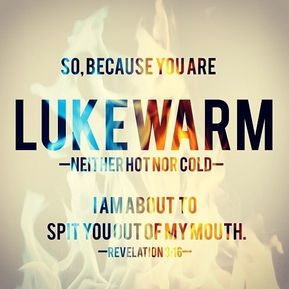
My message of warning is less to the apostates in American society than it is to the remnants of the church: "I know your works: you are neither cold nor hot. Would that you were either cold or hot! So, because you are lukewarm, and neither hot nor cold, I will spit you out of My mouth. For you say, I am rich, I have prospered, and I need nothing, not realizing that you are wretched, pitiable, poor, blind, and naked. I counsel you to buy from Me gold refined by fire, so that you may be rich, and white garments so that you may clothe yourself and the shame of your nakedness may not be seen, and salve to anoint your eyes, so that you may see. Those whom I love, I reprove and discipline, so be zealous and repent" (Revelation 3:15-19).

Wednesday, December 5, 2018

Mormonism: The Devil Made Me Do It

In the Bible, the temptation that Satan made to Adam and Eve is quoted in Genesis 3:5: "God knows that, when you eat of it, your eyes will be opened, and you will be like God, knowing good and evil." This doesn't mean "knowing" in the sense of "recognizing," but rather in the sense of "determining." Satan tells the first couple that disobeying God will liberate them from the control of God, so that they can determine good and evil for themselves, apart from the standards of God.

That temptation is a lie (John 8:44). There is no autonomy from God, not even for Satan himself (Job 1:6-12). It should be obvious that Satan cannot give what he himself does not have.

In Mormonism, there is a doctrine that says that Jesus and Satan were brothers in their preexistence. The Father put a challenge to them to carry out His plan of salvation. Satan offered, instead, a plan of universal salvation. The LDS website explains it this way (references are to Mormon scriptures): "It was in this setting that Satan made an unwelcome and arrogant proposal to change Heavenly Father’s plan so that it provided universal salvation for everyone (see Moses 4:1). Before we discuss how he claimed to accomplish this, it is important to note that Satan is referred to in these verses as 'the father of all lies' (Moses 4:4). On another occasion he is called 'a liar from the beginning' (D&C 93:25). We would be absurdly naïve to assume that Satan was telling the truth when he made this exaggerated claim of universal salvation."

According to Mormonism, how is the individual supposed to make the right choice between the Father's plan of salvation and Satan's? Their answer is found in Doctrine and Covenants 9:8: "Behold, I say unto you, that you must study it out in your mind; then you must ask me if it be right, and if it is right I will cause that your bosom shall burn within you; therefore, you shall feel that it is right."

Do you see any parallels there? While the biblical God commands us to believe on the basis of His word alone, the Mormon God says that each person will be able to decide on the basis of a subjective feeling. Go back to Genesis 3:5 above. Is that not the same thing that Satan offered, falsely, to Adam and Eve?

While Mormons claim that their doctrine is the rejection of Satan's lies, that doctrine is the same as Satan's lies, as recorded in the Bible.

The only hope for the Mormon is to repudiate his autonomous determination of what is right or wrong and to submit to the infallible declaration of truth by the triune God of the Bible.

Wednesday, July 25, 2018

Only the Regenerate Have Free Will

Arminians have enshrined their doctrine of free will, making it the concept that trumps all others. Yet, it has no biblical basis. Ask them! They will hem and haw about why it should be true, but they will offer zero biblical justification.

I suggest, instead, that Scripture is against their doctrine of free will (not that I deny the reality of free will, as I have said before). Rather, I deny their use of it, to mean that men have a will that can choose to seek and obey God. "Free" merely means without coercion. No one, including God, coerces the unregenerate to hate God and to rebel against Him. That is their nature, and they freely, even gladly, choose to act according to it, just as a bird freely wills to fly or a fish to breathe water. But the Arminian would never claim that a man is free to will either of those, since both are contrary to the nature of a man. However, the Arminian blanks out the logical parallel between that and a choice by the unregenerate to act regenerate.

Paul says, "God may perhaps grant them repentance leading to a knowledge of the truth, and they may come to their senses and escape from the snare of the devil, after being captured by him to do his will" (II Timothy 2:25-26). Whose will does the sinner freely follow? Not his own. Rather, he wills the will of Satan. The coercion isn't by God, or predestination, but rather by Satan. Yet the Arminian never criticizes Satan for ignoring man's free will! That misdirection is very telling!

What breaks that bondage? It is only by the prevenient act of the Holy Spirit in regenerating the elect sinner. It is by this intervention that Jesus, in His kingly office, overthrows the power of Satan and brings that man to repentance and faith: "When a strong man, fully armed, guards his own palace, his goods are safe; but when one stronger than he attacks him and overcomes him, He takes away his armor in which he trusted and divides his spoil" (Luke 11:21-22).

Turning to Paul again, he summarizes this in Romans 9:16: "So then it depends not on human will or exertion, but on God, who has mercy."

Wednesday, April 19, 2017

The World Belongs to Jesus, Not to Satan

There is a common mentality that holds that this world belongs to Satan. We are merely to rescue a soul here and there, but the rest of the world is literally going to Hell. Working for change is ridiculed as "polishing brass on a sinking ship."

But that is far from a biblical worldview.

To begin with, it has never been true. The false view is based on a misuse of II Corinthians 4:4: "In their case the god of this world has blinded the minds of the unbelievers, to keep them from seeing the light of the gospel of the glory of Christ, who is the image of God." While it is true that "god of this world" here refers to Satan, it is not true that he is a god, at all, or that "world" means "everything." Rather, this verse refers to the minds of the unbelieving world of men. Notice that his power is explicitly applied to the minds of unbelievers alone.

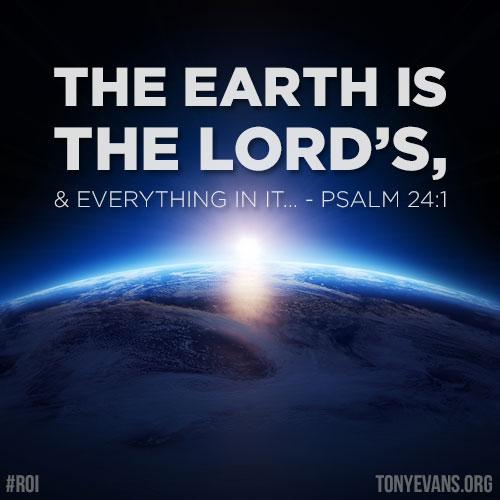
Furthermore, this world does not belong, and has never belonged, to Satan, or even to man, but rather to God. "The earth is the Lord’s and the fullness thereof, the world and those who dwell therein, for He has founded it upon the seas and established it upon the rivers" (Psalm 24:1). The earth and everything in it belong to God, because He created it. He has never ceded its rule to anyone else, including especially to Satan. He even tells us, "My glory I will not give to another" (Isaiah 42:8 and 48:11). There are people, such as Jehovah's Witnesses and some dispensationalists, who would have us turn the glory of God over to Satan, but He allows no such sacrilege.

We do know that Satan is a dangerous threat. The Apostle Peter warned us, "Your adversary the devil prowls around like a roaring lion, seeking someone to devour" (I Peter 5:8). That is clearly intended to indicate that he is powerful. However, it is a far cry from all-powerful.

While a believer cannot afford complacency, it is not a call to terror, as if we may be consumed by the power of the devil at any moment. Why? Because Jesus has defeated Satan. Jesus told us (John 16:33), "I have said these things to you, that in Me you may have peace. In the world you will have tribulation. But take heart; I have overcome the world." This is where these dispensationalists truly fall short. As bad as it is that they exaggerate the power of the enemy, it is a magnitude worse that they undervalue the redemptive work of Christ. Jesus hasn't merely saved a person here and a person there, while Satan wins everything else. Instead, Jesus won the victory over all the power of the devil: "Since therefore the children share in flesh and blood, He himself likewise partook of the same things, that through death He might destroy the one who has the power of death, that is, the devil" (Hebrews 2:14).

When anyone acts as if he thinks that Satan is hiding behind every bush, remember the words of Jesus: "Now is the judgment of this world; now will the ruler of this world be cast out" (John 12:31).

Monday, April 10, 2017

Who Is Lord? Me or God?


In the Garden of Eden, one basic temptation was given by Satan, leading to the Fall of Adam and Eve: "God knows that when you eat of it your eyes will be opened, and you will be like God, knowing good and evil" (Genesis 3:5). Satan convinced the first couple that eating the forbidden fruit would enable them to exercise divine autonomy, deciding for themselves what would constitute good and evil. God, the devil claimed, hid this from them, because He wanted a monopoly on moral truth. As usual, the temptation contained a mixture of truth and falsehood. That was certainly the intent of God, because He claims singular sovereignty over all things, including the choices of men. However, Satan also gave an illusory promise in claiming that eating the fruit would free men from that sovereignty.

God never gives up His deity, no matter what men or devils imagine: "I am the LORD; that is my name; my glory I give to no other" (Isaiah 42:8, 48:11).

God's sovereignty is the very basis of all morality: "I am the Lord your God, who brought you out of the land of Egypt, out of the house of slavery. You shall have no other gods before Me" (Exodus 20:2-3). This is the First Commandment, God's declaration of His exclusive deity, the foundation for the other nine. And it excludes even a man's efforts to set himself up as god of his own life, as Adam attempted in Genesis.

In our modern age, it has become a secular orthodoxy that every man or woman has the right to choose his own values, his goals, his standards of right or wrong. We assume the right to judge truth. Right and wrong are determined according to our feelings. These are all forms of autonomy, of sovereignty of each over his life. Yet, no one, even among professing Christians, hears the echo in those cultural assumptions of the words of Satan quoted above.

If a person's words are a quote of Satan, is that not a warning that he is on a destructive path? We know that Adam was.

"Therefore, just as sin came into the world through one man, and death through sin, and so death spread to all men because all sinned— for sin indeed was in the world before the law was given, but sin is not counted where there is no law. Yet death reigned from Adam to Moses, even over those whose sinning was not like the transgression of Adam, who was a type of the one who was to come. But the free gift is not like the trespass. For if many died through one man’s trespass, much more have the grace of God and the free gift by the grace of that one man Jesus Christ abounded for many. And the free gift is not like the result of that one man’s sin. For the judgment following one trespass brought condemnation, but the free gift following many trespasses brought justification. For if, because of one man’s trespass, death reigned through that one man, much more will those who receive the abundance of grace and the free gift of righteousness reign in life through the one man Jesus Christ" (Romans 5:12-17).

Wednesday, March 1, 2017

Is Satan Still the God of This World?

Jehovah's Witnesses like to point out the Bible refers to Satan as "the god of this world" (II Corinthians 4:4). And, as far as that goes, they are correct, though their application of that verse is self-serving and exegetically-unwarranted. Paul is obviously referring to this world spiritual system, not this world as the totality of everything.

The problem is that there are a lot of other things said about Satan, that the Jehovah's Witnesses (and a lot of other people) don't address.

Consider Luke 11:21:22: "When a strong man, fully armed, guards his own palace, his goods are safe; but when one stronger than he attacks him and overcomes him, he takes away his armor in which he trusted and divides his spoil." In its context, Jesus had cast a demon out of a man who was deaf-mute. The Pharisees claimed that He had done this by the power of Satan, the ruler of demons. The response of Jesus was to compare His actions to those of a burglar, who would first bind the master of a house, before pillaging the house of its goods. While we may be uncomfortable with Jesus's using a thief as an analogy for Himself, His meaning is clear. He wasn't acting by the power of Satan. Rather, He had bound Satan's power, and was now pillaging Satan's kingdom of its spiritual goods, those in bondage to his control.

Next consider John 1:31: "Now is the judgment of this world; now will the ruler of this world be cast out." Jesus said this immediately after the Father had announced verbally that Jesus was His divine Son. Thus, His coming into the world was a strike against the power of Satan. Think of the demolition of a  building. Explosives are set at strategic points in the building, and then blown. the building doesn't collapse all in a single swoop. Rather, sections collapse in an orderly series into each other. This statement of Jesus doesn't indicate a single, catastrophic collapse of Satan's power, but rather a step in its systematic destruction.

We can confirm that interpretation with another verse, John 16:11: "The ruler of this world is judged." Jesus describes Satan in language equivalent to that of Paul. However, this ruler isn't basking in his power, for he has been judged. His destruction has been determined, and his overthrow has been initiated.

Paul repeated that assurance in Colossians 2:15: "He disarmed the rulers and authorities and put them to open shame, by triumphing over them in Him." In His ministry thus far, i. e., everything from His incarnation to His ascension, had all served to undermine and overthrow the spiritual powers that had dominated the nations. Thus, when Paul described Satan as "god of this world" in one passage, it was with the understanding that he expressed in this passage, that Satan may be the head of the humanistic worldview that is opposed to God, but that worldview and headship have been defeated in Jesus Christ!

Satan is defeated, and his ultimate state has been determined (Matthew 25:41). See also Revelation 12:8-9, Luke 10:18, and John 12:31. The New Testament consistently portrays Satan as an opponent of Jesus Christ, but a defeated opponent. And, as Revelation 12:12 indicates, even what influence Satan retains in his defeated state, is only for a short time.

Saturday, November 7, 2015

The Mosaic Covenant: Grace, Not Works

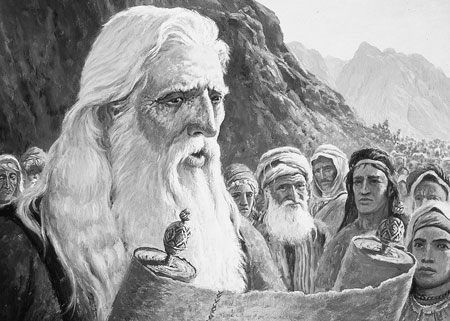
Moses, Reading the Law
There is a common misunderstanding, usually connected to a dispensational view of scripture, that holds that the Mosaic covenant is a religion of works salvation. In fairness, I admit that Paul refers to justification "by the works of the Law," but that reference is to the Pharisaic misuse of the Law (Rom. 9:32), not its proper purpose. Rather, the Law was to serve as a temporary guardian (KJV, "schoolmaster"), until the coming of Christ (Gal. 3:19, 24). The Law - and I am talking here of the ceremonial Law, not the moral - marked that which or who was clean, from that which or who was unclean. It created a hedge around the covenant people that separated them, sanctified them, as distinct from the rest of humanity. Why? That they would be reserved as a conduit through which the Messiah would come, the Savior of the world (John 3:16 and Acts 4:12).

Why did it matter among what nation the Redeemer would be born? That goes back to the original promise of the Gospel, Genesis 3:15: "I will put enmity between you and the woman, and between your offspring and her offspring; He shall bruise your head, and you shall bruise His heel." This promise was given immediately after the Fall, and especially touched Eve, the first human to give in to the temptations of Satan. It was a balm to her conscience to know that her descendant would also be the means of undoing what she and Adam had done. That is why the lineage of Christ is so carefully recorded. Of course, all mankind is the seed of Eve in a general sense, but His lineage is laid out explicitly, legally (i. e., covenantally) in Matthew 1, and genetically in Luke 3. A record is given of exactly in what way He represented her lineage. In our culture, that isn't considered important, but in theirs it was.

What makes me especially to marvel is that this story is carried all the way to the other end of the Bible. In Revelation 12:1-6, the Apostle John describes a woman who gives birth to a son, and a red dragon who persecutes both her and that son. I believe that the woman represents both Eve personally and the covenant people of Israel federally, and the son is, of course, Jesus Christ (see also Rom. 16:20). John explicitly tells us that the dragon is the serpent from the garden (Rev. 12:9). This is the end of the need for the restriction of the lineage, which is why God does away with the ceremonial law, and opens the Church to the Gentiles, those who had formerly been legally unclean (both aspects are described in the account of Peter's dream in Acts 10:10-29; see also Eph. 2:11-16).

This is why I insist that the Mosaic covenant is not a covenant of works, but is rather a temporary administrative stage of the covenant of grace. It was a necessary preparation for the coming of the full salvation that we have in Jesus Christ. It is not, and never was, an opportunity for the Jews - or anyone else - to earn their way to eternal life through good works. This is clear even in its establishment. The account of the giving of the Ten Commandments is found in Exodus 20:1-17. However, verse 2, the Preamble, says, "I am the Lord your God, who brought you out of the land of Egypt, out of the house of slavery." Before giving the shalls and shall-nots, God reminds the people of the redemption that He has already provided them, as the foundation on which the Law was to be built. Justification came before the Law (Rom. 4:10, 14; Gal. 3:17).

Contrary to the teachings of classical dispensationalism, there was never a time  - i. e., after the Fall of Adam - in which any man could be saved by works. In Adam, we all became sinners (Rom. 5:12). We start life as sinners (Psalm 51:5, 58:3). This is the key: sin does not make us sinners; we sin because we are already sinners. It is comparable to a runner in a race who runs facing the wrong way; no matter how fast he runs, he is incapable of winning the race. If that weren't the case, then Jesus would never have needed to come, to suffer, and to die on the cross. As Paul says (Gal. 3:21-22), "if a law had been given that could give life, then righteousness would indeed be by the law. But the Scripture imprisoned everything under sin, so that the promise by faith in Jesus Christ might be given to those who believe."

Sunday, October 4, 2015

Do We Understand How Sinful Sin Really Is? The Puritans Did!

The Puritan Thomas Watson, in his Body of Divinity, lists ten ways in which sin is truly sinful:

     1) Incredulity: Our first parents did not believe that what God had spoken was truth (Gen. 2:16-17, 3:4). They believed not that they should die, because they could not be persuaded that such fair fruit had death at the door. Thus, by unbelief they made God a liar. In fact, what was worse was that they believed the devil rather than God.

     2) Unthankfulness: God had enriched Adam with a variety of mercies, stamped His own image on him, made him lord of the world, and given him the fruit of all the trees for food, with just one excepted. Thus, to take from that one tree was high ingratitude.

     3) Discontent: Adam differed little from the angels (Ps. 8:5), had native innocence, and enjoyed the glory of Paradise as his realm. Yet, he had to have more, because his heart could not be satisfied with all that he had.

     4) Pride: he loved the offer of Satan to become like God (Gen. 3:5)!

     5) Disobedience: God had given him his existence and all his subsistence, so it was right to expect his obedience.

     6) Curiosity: Adam sought to meddle with what was not his, though it was to cost him everything.

     7) Wantonness: With the choice of all other trees, Adam had all of his needs filled, but demanded the satisfaction of his lusts as well. Watson is expressing the same truth as in James 1:14-15: "Each person is tempted when he is lured and enticed by his own desire. Then desire when it has conceived gives birth to sin, and sin when it is fully grown brings forth death."

     8) Sacrilege: God had reserved this one tree of the garden for Himself, yet Adam deigned to rob Him of what was His alone.

     9) Murder: as the federal head of all his posterity in the covenant of works, Adam represented us in his actions, and chose to bring the curse of death on all of humanity (Rom. 5:12).

     10) Presumption: Adam presumed, contrary to God's warning, that he would not die, regardless of his actions. "Surely," he decided, "God must relent if I choose to do as I wish."

And later in the same book, Watson makes this observation: "The sight of Christ's bleeding body should incense us against sin. Let us not parley with it; let that not be our joy, which made Christ a man of sorrow." This is, again, a precept from James 2:10: "Whoever keeps the whole law but fails in one point has become accountable for all of it." Whatever sin any person holds onto, thinking it just isn't really so bad, he must think differently if he understands that any sin makes the sinner guilty of breaking the whole law (James 2:11). This especially overthrows the Catholic distinction between "mortal" and "venial" sins. According to James (a book that they otherwise enjoy quoting), and, as repeated by Watson, every sin is mortal (Ezekiel 18:4, Rom. 6:23).

Monday, March 30, 2015

The Preservation of the Church

Almost every Christian is familiar with Matthew 16:18: "I tell you, you are Peter, and on this rock I will build My church, and the gates of hell shall not prevail against it." We know that it has been perverted by the Catholic Church, which claims it as justification for their assumption of the infallibility of their church organization. Well, first, it doesn't say anything of the sort, and, second, I deny that they are a true branch of the Church of Christ, so they can make no legitimate claim on it, regardless of what it actually teaches.

Rather, it teaches that the Church of Christ - that mystical, invisible body of all true believers down through history, without regard to their respective organizational affiliations - can never be overcome by the evil forces that would seek to destroy her. This is the doctrine of the invisible church, as opposed to the visible organizations of Christians in denominations and individual congregations.

I am writing on this topic, because it was an underlying theme in my own church yesterday, the Lord's Day. Apparently, the Holy Spirit had a point to make.

In Sunday School, my class, one of three adult classes, is studying Zechariah. Yesterday, we were in chapter 12. Three verses stand out in my mind:

Verse 3: "On that day I will make Jerusalem a heavy stone for all the peoples. All who lift it will surely hurt themselves. And all the nations of the earth will gather against it."

Verse 8: "On that day the Lord will protect the inhabitants of Jerusalem, so that the feeblest among them on that day shall be like David, and the house of David shall be like God, like the angel of the Lord, going before them."

Verse 9:  "And on that day I will seek to destroy all the nations that come against Jerusalem."

Since I don't believe that God has a special concern about a plot of dirt, I don't believe that this passage is about physical Jerusalem, but rather about the heavenly Jerusalem of such passages as Galatians 4:26 and Hebrews 12:22, and the new Jerusalem of Revelation 3:12 and 21:2. So, in each of these three verses from Zechariah, their significance can be seen by making them literal, that is, by inserting "church" in each place where the prophetic imagery says "Jerusalem."

Then during worship, one of the passages read was Psalm 118, which reads, in part (verses 6, 10-13): "The Lord is on my side; I will not fear. What can man do to me?... All nations surrounded me; in the name of the Lord I cut them off! They surrounded me, surrounded me on every side; in the name of the Lord I cut them off! They surrounded me like bees; they went out like a fire among thorns; in the name of the Lord I cut them off! I was pushed hard, so that I was falling, but the Lord helped me."

The church is surrounded by her enemies, all of whom are serving her greatest enemy, Satan. Here in the United States, we are attacked by secularists, who hate her prophetic voice. In other countries, her persecutors may be Muslims, or Hindus, or Communists, or even enemies claiming to speak for her God, such as the Inquisition in the past. Yet, Jesus promises His presence (Matt. 28:20), that we are in His hands (John 10:28), and that His power surrounds us (Zech. 2:5). While there have certainly been times when she was at a low ebb, there has never been, and never can be, a time when she cannot be found, for her survival isn't a matter of her own strength, but rather that of the God who gave His blood to purchase her (Acts 20:28, Col. 1:20, Rev. 5:9), of which we are reminded each time we receive communion (Matt. 26:28, Mark 14:24, and Luke 22:20).

Friday, November 21, 2014

The Fall of Man and the Unfolding of God's Redemptive Purpose

The following is the result of an assignment in my biblical theology class, to examine the description and application of the Fall across the Scriptures. I have found it so profitable that I have decided also to post it here. May the Lord bless it in the lives of readers, as well.

    Even though we associate this story with the writings of Moses, he actually only deals with it in the first portion of Genesis.
    We have the original account in chapter 3. In 2:16-17, we have the only recorded restriction on Adam and Eve: “You may surely eat of every tree of the garden, but of the tree of the knowledge of good and evil, you shall not eat, for in the day that you eat of it, you shall surely die.” However, in chapter 3, the serpent questions that restriction. In verse 1, he asks the woman, “Did God actually say, ‘You shall not eat of any tree…?’” Thus, the fall starts with doubting the word of God. Then the serpent escalates the confrontation in verse 4: “You will not surely die.” He has moved from doubting God to directly contravening His commands. He continues in verse 5, “For God knows that, when you eat of it, your eyes will be opened, and you will be like God…” Now, the serpent caps his temptation with an insinuation regarding God’s motivation in the command. In consequence of which, Eve eats of the fruit, and shares it with Adam, in verse 6.
    The consequences come quickly. In the next verse, the two humans recognize for the first time that they are naked. This realization leads them to hide in shame from God, when He next comes looking for them. Upon their confession of their rebellious act, God pronounces His response: first, in verse 14, the serpent is cursed for his role in tempting the two; next, in verse 16, the woman is cursed with pain in childbearing and conflict with her husband; and third, he is cursed with hardship and futility in his labors in verses 17-19. These curses correspond exactly with the calling that God had given humanity in 1:26-31, to be fruitful and to rule and cultivate the creation.
    The fall snowballs in its effects. In 4:5-8, the next generation, consisting of Cain and Abel (at this point, the only posterity of the first couple), jealousy erupts and sin breaks out in fratricide, as Cain murders Abel. In verse 12, God repeats that part of the curse involving futility in man’s God-given task of making the earth fruitful. And with one more generation, Cain’s son Lamech repeats his father’s sin of murder, and even doubles it (4:23).
    The snowball of sin continues its expansion in chapter 6, where the wickedness of men has consumed their entire existences (verse 5). The only exception is Noah, who, with his family, is preserved from God’s general judgment in the Flood (6:9-8:19).
    In these passages, we see only hints of God’s redemptive purpose in the world of man. 3:15 gives us the protevangelium, the promise of the seed of Eve Who would crush the head of the serpent. In 3:21, we see the first deaths in the world, apparently in sacrifice, to provide coverings of fur for the now-modest first couple. The conflict between Cain and Abel arises during sacrificial offerings (4:3-4). And immediately after the flood, Noah responds with offerings of some of the clean animals from the ark (8:20). So, even as the effects of the fall are manifest, God begins to show His plan of redemption, a substitutionary sacrifice for the forgiveness of sin.
    The subject of the fall doesn’t appear again until the book of Job, and then only in passing. In 31:33, Job, speaking to his friends, in a list of hypothetical failures, includes, “if I have concealed my transgressions as others do by hiding my iniquity in my bosom…” He acknowledges, not just individual sins, but his sinful state, the inherits consequence of Adam’s failure. Is his reference to “concealing transgressions” an allusion to Adam’s fig-leaf apron and hiding among the trees?
    In the Psalms, we get passing references to man’s inheritance of sin.
    In 14:3, David says of fools, “They have all turned aside; together they have become corrupt; there is none who does good, not even one.” Referring to his own sin with Bathsheba, David also says, in 51:5, “Behold, I was brought forth in iniquity, and in sin did my mother conceive me.” In 53:1-3, he repeats his confession: “...They are corrupt, doing abominable iniquity; there is none who does good… They have all fallen away; together they have become corrupt; there is none who does good, not even one.” In his mind, iniquity isn’t an action, but a condition, which reflects the teaching of Moses that Adam’s particular sin had resulted in a condition of sin in his posterity. That is, men are not sinners because they sin, but rather, men sin because they are sinners.
    David apparently taught this lesson to his own children, because we find Solomon repeating it in Ecclesiastes 7:29: “This alone I found, that God made man upright, but they [sic] have sought out many schemes.” In one sentence, he describes the original creation in innocence, a state which was lost, resulting in the present condition of perpetual sin.
    The theme of man’s corruption appears a number of times in the writings of the Prophet Isaiah. He portrays it very vividly in his account of his own calling. In chapter 6, he contrasts (v. 3) the thrice holy nature of Jehovah, with his own self-consciousness in verse 5: “Woe is me me! For I am lost; for I am a man of unclean lips, and I dwell in the midst of a people of unclean lips…” He continues the the themes of relating his personal sinful nature with the corrupt nature of all men. But he includes verse 7: “Your sin is taken away, and your sin is atoned for.” So he also repeats the Mosaic theme of following the declaration of sin with a discrete declaration of God’s redemptive purpose as sin’s solution.
    The prophet applies the judgment of God to his fellow Israelites in 9:17b: For everyone is godless and an evildoer, and every mouth speaks folly. For all this, His anger has not turned away, and His hand is stretched out still.” And he continues in verse 18, with the impact of sin on the created world: “For wickedness burns like a fire; it consumes briers and thorns; it kindles the thickets of the forest, and they roll upward in a column of smoke.” He imitates the curse of Gen. 3 in 14:3: “When the Lord has given you rest from your pain and turmoil and the hard service with which you were made to serve…” Babylon is seen to apply the hardships of Gen. 3:19. The same theme appears again in 24:4-6, with the earth bearing the curse of man’s sin. See, for example, verse 6a: “Therefore, a curse devours the earth, and its inhabitants suffer for their guilt…” God’s reaction of Gen. 6:5-6 is also seen in Isaiah 43:24b: “You have burdened Me with your sins; you have wearied me with your iniquities.” That sinfulness corrupts man’s whole nature (54:6), and He puts it away from His presence (59:2a), “Your iniquities have made a separation between you and your God, and your sins have hidden His face from you…”
    The next prophet, Jeremiah, also describes the general sinfulness that resulted from the fall. In 17:9, he says of Judah, “The heart is deceitful above all things, and desperately sick; who can understand it?” Then, to emphasize the awareness God has of our sin, he answers his own question in the next verse (10): “I The Lord search the heart and test the mind…” The prophet accuses Judah of being so corrupt that he isn’t even conscious of his corruption. Yet, in contrast, Jehovah is aware, just as He was before the flood.
    The next prophet, Ezekiel, recalls the words of the serpent in the prince of Tyre in 28:2: “Your heart is proud, and you have said, ‘I am a god, I seat in the seat of the gods, in the heart of the seas,’ yet you are but a man, and no god…” The serpent appealed to Adam and Eve with the expectation of godhood, and here the prince believes he has what was offered. And as happened to the first pair, the prince is cast out (verse 16): “You were filled with violence in your midst, and you sinned; so I cast you as a profane thing from the mountain of God…” And in 36:33-34, Ezekiel has God renewing the dominion covenant, originally given to Adam: “On the day that I cleanse you from all your iniquities, I will cause the cities to be inhabited, and the waste places shall be rebuilt. And the land that was desolate shall be tilled, instead of being the desolation that it was…” Thus, the redemptive purpose is renewed, in terminology describing the reversing of the curse, that man may again be fruitful and multiply and exercise dominion over the earth.
    And finally, in the prophets and in the Old Testament, we have a passing reference in Hosea 6:7: "Like Adam, they transgressed the covenant; there they dealt faithlessly with me." The prophet uses the original fall as an object lesson for the then-current faithlessness of Judah and Israel.
    In the New Testament, the fall is again an issue in the writings of Paul.
    In Romans 5:12-21, Paul places responsibility for sin on Adam (v.12, “sin came into the world through one man”), with all sins arising from this federal sinfulness (v. 14). However, he also renews the answer of God’s redemptive purpose to undo man’s fallenness. Verse 15, “If many died through one man’s trespass, much more have the grace of God and the free gift by the grace of that one man Jesus Christ abounded for many.” And verse 18,”As one trespass led to condemnation for all men, so one act of righteousness leads to justification and life for all men.” So, in this passage, we also see the pairing of man’s sin, on one hand, with God’s redemptive purpose, on the other.
    In the same epistle, 8:19-25, Paul also reminds us of the consequences for the nonhuman creation in the fall of man. In verse 19, he writes, “The creation waits with eager longing for the revealing of the sons of God.” Because, verse 20, “The creation was subjected to futility, not willingly, but because of him who subjected it.” And then the redemptive purpose in verse 21, “[in hope] that the creation itself will be set free from its bondage to decay…” And verses 23-24, “we ourselves… groan inwardly as we wait eagerly for adoption as sons, the redemption of our bodies, for in this hope we were saved.” Paul repeats the theme of general sinfulness followed by the hope of God’s redemptive purpose.
    In my final example, I Timothy 2:9-15, Paul isn’t addressing the issue of sin or of redemption, but rather applying the story of Genesis 3 to social behavior. He is addressing the behavior of women in the church, in terms of apparel and good works (vv. 9-10), and then during corporate worship, in quietness and submission (11-12), and not in authority over men (v. 12), for (verse 13-14), “It was Adam who was first created, and then Eve. And it was not Adam who was deceived, but the woman, being deceived, fell into transgression.” WHile Paul is addressing a nonsoteriological matter in this passage, his use of the creation and fall indicates his assumption of the reality of the story. He obviously knew the Mosaic record in Genesis, and assumed its truth.
    And finally, the story appears again in John’s Revelation, 12:9,: And the great dragon was thrown down, that ancient serpent, who is called the devil and Satan, the deceiver of the whole world - he was thrown down to the earth, and his angels were thrown down with him.” Here we have the first revelation of the identity of the serpent. In the words of Moses, it is just an animal, though cleverer than is natural for its kind. Here we have its identification as the chief evil, Satan. Then, in verses 10-11: “Now the salvation and the power and the kingdom of our God and the authority of His Christ have come, for the accuser of our brothers has been thrown down, who accuses them day and night before our God. And they have conquered him by the blood of the Lamb and by the word of their testimony, for they loved not their lives, even unto death.” These verses bring us full circle to Genesis 3:15. there the serpent was promised that the seed of the woman would crush his head. Here we see that promise fulfilled. Where Genesis 3 gave the account of man’s fall into the dominion of sin, here we see the redemptive victory of Jesus Christ over that sin. What had been promised has now been revealed. The repeated pairing of the judgment of sin with God’s redemptive purpose, is now experiential, with the judgment and destruction of sinfulness itself.

Sunday, July 19, 2009

Revelation 12:7-9, the Binding of Satan

"Now war arose in heaven, Michael and his angels fighting against the dragon. And the dragon and his angels fought back, but he was defeated, and there was no longer any place for them in heaven. And the great dragon was thrown down, that ancient serpent, who is called the devil and Satan, the deceiver of the whole world- he was thrown down to the earth, and his angels were thrown down with him."

Where were they thrown? Jude 1:6, "And the angels who did not stay within their own position of authority, but left their proper dwelling, He has kept in eternal chains under gloomy darkness until the judgment of the great day."

There is a common error in our day that teaches that Satan has great power, and that his judgment is something that will be in the future. Indeed, the Bible does teach the threat of Satan. For example, I Peter 5:8 says, "Your adversary the devil prowls around like a roaring lion, seeking someone to devour." But, do you recall the multitude of demon possessions described in the Gospels, such as the Gerasene demoniac (Mark5:1-20)? Some have cast aspersions on the New Testament because we do not see such possessions in our time. Yet, Jude reveals that we shouldn't expect them, because Satan has been bound. Others see a demon behind every bush.

Satan was definitively judged in the resurrection of Christ. His judgment is progressively applied during the New Testament era, through the Gospel (Rev. 12:10-11). Yet, his death throes are hazardous (v. 12, and I Pet. 5:8). And his judgment will be finalized, after a brief rebellion, in the great judgment (Rev. 20:7-10). Imagine a rabid dog: he is captured, and put in a cage, so that his ability to cause harm has been constrained; however, if you put your hand into the cage, the dog will attack you, so there is still danger from him, but only to the careless; and finally, the dog is destroyed, such that the danger is eliminated permanently and completely. Such is the condition of Satan.