Showing posts with label dominion covenant. Show all posts

Saturday, June 25, 2022

The Destiny in This World of the Godly and of the Wicked: Psalm 37

In Deuteronomy, Moses laid out for the Israelites the blessings and curses that would come from the obeying or disobeying of the commandments of God. In Psalm 37, David, the man after God's own heart, lays out the same dichotomy in poetic form. Even as poetry, though, the psalm has much to say to modern America regarding her growing devolution from biblical Christianity. 

On the plus side, the godly are shown a wonderful future. Though David speaks generally, not necessarily as to individual experience, the blessings should produce a delighted hope in the heart of the believer. 

"Trust in the Lord and do good; dwell in the land and befriend faithfulness. Delight yourself in the Lord, and He will give you the desires of your heart. Commit your way to the Lord; trust in Him and He will act... The meek shall inherit the land and delight themselves in abundant peace... The Lord knows the days of the blameless, and their heritage will remain forever; they are not put to shame in evil times; in the days of famine, they have abundance... The steps of a man are established by the Lord, when he delights in His way; though he fall, he shall not be cast headlong, for the Lord upholds his hand. I have been young, and now am old, yet I have not seen the righteous forsaken or his children begging for bread. He is ever lending generously, and his children become a blessing... Wait for the Lord and keep His way, and He will exalt you to inherit the land; you will look on when the wicked are cut off... The salvation of the righteous is from the Lord; He is their stronghold in the time of trouble. The Lord helps them and delivers them from the wicked and saves them, because they take refuge in Him" (Psalm 37:3-5, 11, 18-19, 23-26, 34, 39-40). 

In these verses, we see the same blessings promised for obedience in Deuteronomy 28: agricultural bounty, happy and blessed children, wealth, and the inheritance of the land. 

The cursings promised to the wicked provide a stark contrast: "They will soon fade like the grass and wither like the green herb... In just a little while, the wicked will be no more; though you look carefully at his place, he will not be there... The wicked plots against the righteous and gnashes his teeth at him, but the lord laughs at the wicked, for He sees that his day is coming. the wicked draw the sword and bend their bows to bring down the poor and needy, to slay those whose way is upright; their sword shall enter their own heart, and their bows shall be broken... The wicked will perish; the enemies of the Lord are like the glory of the pastures; they vanish - like smoke they vanish away... The wicked watches for the righteous and seeks to put him to death. The Lord will not abandon him to his power or let him be condemned when he is brought to trial... I have seen a wicked, ruthless man, spreading himself like a green laurel tree. But he passed away, and behold, he was no more; though I sought him, he could not be found... Transgressors shall be altogether destroyed; the future of the wicked shall be cut off" (Psalm 37:2, 10, 12-15, 20, 32-33, 35-36, 38). 

What we see of the wicked is a delusion of cleverness, but his ways lead only to futility and brevity of life. His posterity are cut off, and the land passes to the righteous. 


Saturday, August 8, 2020

The Impotence of the Church

These two quotes from Gary North ("Tools of Dominion," p. 48), written in 1990, explain why the church is impotent in the face of the crises of humanistic 2020 America.

"To retreat from this task of applied Christianity is to to turn over the running of the world to pagan humanists and their theological allies, Christian antinomians. It is to turn the medical world over to the God-hating abortionists who are opposed so vigorously by Dr. [James] Dobson. Yet this is precisely what every publicly-visible Christian leader has done throughout the Twentieth Century, and what almost all of them did after the late-Seventeenth Century. It is universally assumed by Christians that the case laws of Exodus are null and void, and should be" (emphasis in the original).

"The tools of dominion, God's law, sit unused, and generally-unread by those who call themselves Christians. They are the best weapons that Christians possess for moral self-defense, since the best defense is a good offense, yet they steadfastly refuse to use them. To use God's revealed law effectively would require them to become intimately familiar with its many subtleties and complex applications, and, even less appealing, to discipline themselves in terms of it. They prefer to let is sit unopened, either in their laps or on their shelves. Christians, therefore, continue to lose the war for civilization."

Wednesday, April 29, 2020

The Dominion Covenant, the New Earth, and the Defeat of Satan

In the opening of the Bible, we read, "In the beginning, God created the heavens and the earth. the earth was without form and void, and darkness was over the face of the deep" (Genesis 1:1-2). So, God's first step in creating the physical universe was to create the earth, but as a formless and empty ball. The physical universe was a place all of chaos. The remainder of the creation passage describes God's organizing and filling that creation, with both celestial objects and with life, culminating in His creation of man.

And then what was God's plan for man, as expressed in His creation mandates to that man? "Then God said, 'Let us make man in Our image, after Our likeness. And let them have dominion over the fish of the sea and over the birds of the air and over the livestock and over all the earth and over every creeping them that creeps on the earth...  be fruitful and multiply and fill the earth and subdue it, and have dominion over the fish of the sea and over the birds of the heavens and over every living thing that moves on the earth" (Genesis 1:26, 28). So God's plan for mankind was that we would extend His work of converting chaos into productive order. Men don't have the ability to create ex nihilo, so the expression of that was to be the use of the other living things to become productive under the rule of God.

However, that plan was interrupted by the Fall of Adam and Eve into sin. The consequences of that Fall included the disruption of God's order, and descent into disorder: "The Lord God said to the serpent, 'Because you have done this, cursed are you above all livestock and above all beasts of the field; on your belly you shall go, and dust you shall eat all the days of your life. I will put enmity between you and the woman, and between your offspring and her offspring; He shall bruise your head, and you shall bruise His heel.' To the woman He said, 'I will surely multiply your pain in childbearing; in pain you shall bring forth children. Your desire shall be contrary to your husband, but he shall rule over you.' And to Adam He said, 'Because you have listened to the voice of your wife and have eaten of the tree of which I commanded you, ‘You shall not eat of it,’ cursed is the ground because of you; in pain you shall eat of it all the days of your life; thorns and thistles it shall bring forth for you; and you shall eat the plants of the field. By the sweat of your face you shall eat bread, till you return to the ground, for out of it you were taken; for you are dust, and to dust you shall return'" (Genesis 3:14-19). 

Fist, notice who is speaking here, the Lord, i. e., Jehovah. This is the first appearance of this name, the covenant name of the preincarnate Son, who here first appears in His mediatorial role. After the Fall, all of the interactions between the triune Godhead and men occur through His mediation alone. He first curses the serpent, i. e., Satan, as the instigator of these events. The preincarnate Son curses the foe of the Church. Then He proclaims for the first time the covenant of grace, the promises to His church of His own work on our behalf, to defeat this foe and redeem us from the conseque4nces of the Fall. Then He turns to Eve, the first to sin, and pronounces a curse on the essence of her womanhood, childbirth. And last, He turns to Adam, the head of creation, and pronounces a curse on all of Adam's work in fulfilling his role as the viceroy of God. 

This first announcement of the hope of the Gospel will then be expanded in the rest of Scripture. For example, we have the promises of Yahweh of new blessings on agriculture in Isaiah. See, for example, Isaiah 44:3-4, which explicitly unites both childbearing and agricultural blessings with spiritual blessings: "For I will pour water on the thirsty land, and streams on the dry ground; I will pour My Spirit upon your offspring, and My blessing on your descendants. They shall spring up among the grass like willows by flowing streams. This one will say, ‘I am the Lord's,’ another will call on the name of Jacob, and another will write on his hand, ‘The Lord's,’ and name himself by the name of Israel.

The same prophet gives another promise of God with relates it back to the promise of Genesis 3:15: "They shall not labor in vain or bear children for calamity, for they shall be the offspring of the blessed of the Lord, and their descendants with them. Before they call I will answer; while they are yet speaking I will hear. The wolf and the lamb shall graze together; the lion shall eat straw like the ox, and dust shall be the serpent’s food. They shall not hurt or destroy in all My holy mountain" (Isaiah 65:23-24). As men experience the restoration of peace to the creation, we will also see the curse carried out of that old foe, the serpent. 

In the New Testament, the Apostle Paul picks up the same theme: "For the creation was subjected to futility, not willingly, but because of Him who subjected it, in hope that the creation itself will be set free from its bondage to corruption and obtain the freedom of the glory of the children of God. For we know that the whole creation has been groaning together in the pains of childbirth until now. And not only the creation, but we ourselves, who have the firstfruits of the Spirit, groan inwardly as we wait eagerly for adoption as sons, the redemption of our bodies. For in this hope we were saved. Now hope that is seen is not hope. For who hopes for what he sees? But if we hope for what we do not see, we wait for it with patience" (Romans 8:20-25). He personifies the physical creation as waiting impatiently for the Church to reach her glory, because the creation, too, will be released from the curse under which our sin has brought it. 

And Paul makes it explicit that these blessings flow from that first declaration of the Gospel in Genesis 3:15: "The God of peace will soon crush Satan under your feet." As the body of Christ, we the Church are credited with the victory of Christ through us, finally bringing the chaos we created back to the order which God intended. 

When will these times be seen? Only God knows. However, we can enjoy the hope today that they will come.

Saturday, January 4, 2020

The Fall and the Dominion Covenant

In Luke 17:10, Jesus makes a surprising comment: "So you also, when you have done all that you were commanded, [should] say, ‘We are unworthy servants; we have only done what was our duty.'" This is the nail in the coffin for any works-righteousness religion. If a man were to perfectly fulfill the law of God, then he has still not earned eternal life, because he has only done what he was supposed to do. It is like the employee who completes his assigned duties. Should his boss, therefore, give him a bonus? No, he has only done what he was required to do, and has contributed no additional value beyond what his wage has already purchased.

Think back to the first days of man. The one recorded restriction given to Adam was not to eat from the Tree of the Knowledge of Good and Evil (Genesis 2:17). And the Fall occurred when Adam broke that one restriction (3:6). Adam forsook all of the blessings of Eden by that particular sin. Yet, was he thereby promised eternal life if he refrained from eating that fruit? No, he retained his probationary status as long as he did not eat. But His assignment in Eden was far wider than that. Rather, he was to make it fruitful through the practice of agriculture (2:15), to exercise dominion (1:26) and to have families (1:28). Adam actually had an extensive list of responsibilities. The difference here was that the command not to eat the fruit, even if it had been obeyed, would not have advanced the purposes of God. Jesus, the Second Adam, talked about this, too, in the Parable of the Talents (Matthew 25:14-30). The servants who are praised are the ones who took the master's talents, invested them, and returned a profit. The servant who is cursed is the one who returned what he had been given, with no advancement - no loss, but no profit, either.

"It is only to the just that the confirmed state of blessedness, which the Scriptures mean by life, is infallibly promised. Obedience to the law, righteousness, is the indispensable condition of God's everlasting favor. If, therefore, the scheme of redemption had done nothing more than deliver us from the curse of the law, though it would have conferred an incalculable benefit upon us, an unutterably great salvation, it would not have done all, that the necessities of the case required, to secure the perfection and blessedness of our nature" (James Henley Thornwell, "The Necessity and Nature of Christianity," emphasis in the original).

Saturday, April 6, 2019

Dispensationalism Bows to the Kingship of Satan

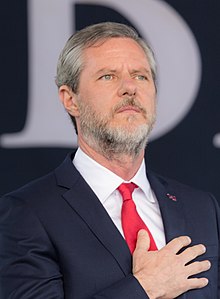
I recently came across this interview with Jerry Falwell, Jr., the son of the late-founder of the Moral Majority, that bogeyman of liberals back in the Reagan era. In it, Falwell is quoted as saying, "It’s such a distortion of the teachings of Jesus to say that what he taught us to do personally — to love our neighbors as ourselves, help the poor — can somehow be imputed on a nation. Jesus never told Caesar how to run Rome." I am appalled by the statement, and I think that the elder Falwell would have been appalled, too.

Fist, let me say that Junior's statement is consistent with his dispensationalist hermeneutic. Senior's political activism was inconsistent with that same hermeneutic. I am not suggesting any hypocrisy on the part of Falwell.

Falwell, Jr.
However, I must question the rationality of the statement. Mr, Falwell, how can you say that Jesus advocated a morality only for individuals, that He did not also intend for us to live collectively? That would be like saying that the Sixth Commandment forbids me to murder, but places no obligation on society to strive to prevent or punish murder!

In addition, has Falwell not read the Old Testament? I often wonder that when addressing dispensationalists. If he has, then he is deliberately ignoring the statements in the Law and the history books that God judges a society for its injustices. He doesn't merely judge individuals. When the Assyrians destroyed the Northern Kingdom, or when the Babylonians destroyed the Southern Kingdom, are we to imagine that there were no godly residents in either country who suffered together with their societies? That would not be a rational expectation.

I refer to this tendency among dispensationalists as "surrenderism," a presupposition that the Bible, Christianity, and the Church are doomed to fail, so we are to make no more than token efforts to apply God's word to all of life. That attitude is the opposite of the first instruction that God gave to humanity: "Be fruitful and multiply and fill the earth and subdue it, and have dominion over the fish of the sea and over the birds of the heavens and over every living thing that moves on the earth" (Genesis 1:28). Instead of subduing and exercising dominion, the dispensationalist will have us remain behind our church doors, doing nothing more than talk about selected portions of Scripture, while the world goes to Hell.

Monday, October 2, 2017

The Baptism of Households as God's Plan to Build His Church

One conclusion that I have had from the debate over believers' baptism versus infant baptism is that it is not a matter of the scriptural evidence about baptism. Rather, it is a disagreement over God's aim in salvation. Is it the individual? I think the credobaptist would say yes. However, the paedobaptist would say no.

In the account of the Philippian jailer (Acts 16:16-40), we see this question addressed. When the doors of his jail are thrown open, the jailer, thinking that he would be executed for negligence, asks Paul and Silas, "Sirs, what must I do to be saved?" (verse 30). His concern is about his own eternal welfare. But the answer of Paul and Silas is a little different: "Believe in the Lord Jesus, and you will be saved, you and your household" (verse 31). They address his question, "You will be saved," but go further, "and your household."

We also see this in the conversion of Lydia, in the same chapter, verses11-15. When she is converted, who gets baptized? "She was baptized, and her household as well" (verse 15). We see again the inclusion, not just of the one professing faith, but of his or her entire family! My pastor calls this "oikobaptism," from the Greek word for house or household.

These accounts show us that God's target for faith isn't just the individual, but families. And that is the dividing line between credobaptists, who tend to have an atomistic view of conversion, that the individual is all that matters, and the paedobaptist, or oikobaptist, who attends to the family.

Baptists will often refer to themselves as "New Testament Christians." And it is that semi-blindness that produces their error. While I have shown above that the atomisitic view is contrary to New Testament teaching, it is essential to note that the New Testament teaching is merely a carry-over from the Old Testament: "The LORD your God will circumcise your heart and the heart of your offspring, so that you will love the LORD your God with all your heart and with all your soul, that you may live" (Deuteronomy 30:6). God has never had an atomistic view of His plans for the regeneration of the world. And it is the failure to recognize that that leads to the Baptist error of rejecting the continuity between circumcision and baptism, including its application to the children of believers.

When God converts a man or woman, He gives promises that go beyond that individual: "All your children shall be taught by the LORD, and great shall be the peace of your children" (Isaiah 53:13). The conversion of the individual is God's plan for then growing His church, because His plan doesn't stop even with the conversion of the family: "Go therefore and make disciples of all nations, baptizing them in the name of the Father and of the Son and of the Holy Spirit, teaching them to observe all that I have commanded you. And behold, I am with you always, to the end of the age" (Matthew 28:19-20, compare Genesis 1:28). God's missionary plan is to convert individuals first, then our families, and then our nations, and that terraced system is connected by baptism. Therefore, when Baptists deny baptism to the children of believers, they are inserting their manmade doctrine into the longterm strategy of God!

God's Plan, One Step Leads to the Next

Tuesday, December 9, 2014

A Fallen Creation in Adam, but a New Creation in the Second Adam

This biblical theology assignment was to trace the theme of the creation through the Bible. I found it a real joy to work through. My prayer is that it will encourage others as well.

    The creation is described, logically, in the opening verses of the Bible, Genesis 1:1-2:4. The actor is God, Elohim, not given as Yahweh. Again that is logical, since the revelation of God by His covenantal name would have no meaning in the then-absence of the subordinates in the covenant, i. e., mankind. I take the plural form as an indication of a united effort by the Godhead, not of the individual Persons, before the Spirit departs to His particular work in verse 2.
    The creation proceeds in a roughly hierarchical pattern, from the physical substrate, i. e., the earth in its chaotic state, to a primitive form of the surrounding universe, to the land and waters as organized elements. The God directs His attention to the first life, the vegetative element, and then its sustenance in sun and stars, to the self-motive element of sea- and air-life, the dwellers of the land, and finally Man. Its last day is a day of rest, of God’s self-religion of satisfaction in His works, for they were “very good” (1:31).
    To the crown of His creation, Adam and Eve, God gave the task of viceroyalty, to exercise dominion under God, ruling, organizing, and filling the creation. He gave the couple only one explicit restriction in their labor: they were restricted from eating the fruit of the tree of the knowledge of good and evil. I am sure this was not the only rule of life that they were to obey. However, in their prelapsarian state, His law was naturally-engraved in their nature. The tree was added as a counter-intuitive law, a visible sign that their rule was not independent, but subject to the a priori government of God as their Maker and Owner.
    Job recognized this relationship among Creator, creation, and human headship in Job 12:7-10. He cites beasts, birds, vegetation, and fish, as witnesses “that the hand of the Lord has done this [i. e., the disasters that he had experienced].” In this book, probably pre-Mosaic, the writer is using the relationship among the branches of the Creation to give meaning to the losses that he had undergone, losing wealth and posterity. Later in the same book, Job 38:4-11, God does the same thing. Speaking as Yahweh, indicating, I think, the mediatorial involvement of the Second Person, He challenges Job and his friends: “Where were you when I laid the foundation of the earth?” Obviously, Job wasn’t anywhere. “Who determined its measurements… and prescribed limits for it?” The answer to Job’s question, why had these things happened to him, was that he had neither capacity nor right to challenge what he had received from the hands of God, because he had neither the standing nor the experience from which to judge, nor even to understand the hand of God. In Job 40:15-24, God continues by describing just one creature in His creation, a creation beyond human understanding or control. Yet, Job expects to have the perspective from which to comprehend the actions of God?
    In the Psalms, David emphasizes the creation mandate to demonstrate the spiritual significance of mankind. In Ps. 8:5-8, he reminds God that He had “given him dominion over the works of Your hands; You have put all things under his feet.” Of course, this ultimately refers to the Son of Man and Second Adam, Jesus Christ, who restores the dominion lost by Adam’s fall (I Cor. 15:27 and Heb. 2:8. In Ps. 65:5-13, David recalls God’s creation activity, creating the mountains, watering the earth, and prospering the fertility of land and beast, as proof that we can look to Him in prayer, and satisfy the elect with His goodness. Asaph makes the same case in Psalm 74. He refers to God’s victory over Leviathan (as He Himself did in Job), and especially the creation of night and day (v. 16) as a reminder of God’s faithfulness in the past, apparently during a time of God’s wrath. Ethan the Ezrahite makes the same case in Ps. 89:11: “The heavens are Yours; the earth also is Yours; the world and all that is in it, You have founded them.” He is exulting in the wondrous works of God as the undergirding of His promises to David. Moses applies that power to all the people of God in Ps. 90:2: “Before the mountains were brought forth, or ever You had formed the earth and the world, from everlasting to everlasting, You are God.” An anonymous sufferer repeats the words of Moses in Ps. 102:25-27: “Of old You laid the foundation of the earth, and the heavens are the work of Your hands… [for] You are the same, and your years have no end.” Doing great deeds of creation are passing moments to God, so doing great works on our behalf are easy for Him, not endangered by the flash-in-the-pan existence of mere men.
    The anonymous Psalm 104:5-30 makes extended use of the theme of God as creator. “He set the earth on its foundations… covered it with the deep. The mountains rose, the valleys sank down.” The birds and beasts are considered, along with the sun and moon. Leviathan makes his third appearance. The Holy Spirit goes forth. Why does the writer give this litany of the works of God? Verses 33-35: “I will sing to the Lord as long as I live… for I rejoice in the Lord. Let sinners be consumed from the earth, and let the wicked be no more.” All of the mighty works of God are signs. To the faithful, they give a basis for praise and assurance. For the wicked, they guarantee the certainty of judgment.
    The various authors of the Proverbs used the divine Creation to demonstrate the wisdom of God. Solomon, well-known for his own subordinate wisdom, says of God’s (Pr. 3:19-20): “The Lord by wisdom founded the earth; by understanding He established the heavens; by His knowledge the deeps broke open, and the clouds drop down the dew.” Notice that he couches the creation in a covenantal context, Yahweh instead of Elohim, drawing a relational aspect that Moses did not.In Pr. 8:22-31. Solomon continues this theme of wisdom, personifying it: “The Lord possessed me at the beginning of His work, the first of His acts of old… When He established the heavens, I was there… When He marked out the foundations of the earth, then I was beside Him…, and I was His delight…, delighting in the children of man.” Solomon gives an abbreviated description of the days of creation, culminating in the delight of Wisdom in mankind. Is this the pre-incarnate Christ? It uses the covenantal name of God, so I am inclined to say so. Nevertheless, it expresses a confidence in God, founded on His nature as revealed in His great acts of creation. And lastly, in Pr. 30:4, Agur, son of Jakeh, asks, “Who has established all the ends of the earth? What is His name, and what is His son’s name?” Not the petty idols of this city or that one, but the One God Who overrules them all!
    It is only a passing remark, but Solomon makes another interesting use of the Creation account in Ecclesiastes 3:10-13: “I have seen the business that God has given to the children of man to be busy with.” He recalls the dominion covenant of Gen. 1:26-31. For, “He has put eternity into man’s heart.” That mandate has been incorporated into man’s nature. “I perceived that there is nothing better for them than to be joyful and to do good as long as they live.” Human happiness is bound up in fulfilling the purpose that God built into our creation way back in Genesis. “This is God’s gift to man.” It isn’t drudgery; that is the curse. The calling brings contentment and fulfillment. He brings that principle up again in 12:1: “Remember also your Creator in the days of your youth, before the evil days come and the years draw near of which you will say, ‘I have no pleasure in them.’” The physical breakdown of aging is also part of the curse, so find fulfillment in dominion before that inhibition makes your work impossible.
    The Prophet Isaiah relies on creation theology in much of the latter half of his prophecies. In Is. 40:25-31, God makes much the same case as in Job: how can a man or a people question Him, considering the lofty things that He has done? Of the stars, He says (v. 26), “[I am] He Who brings out their host by number, calling them all by name.” When the sinner seeks to comfort himself in his sin 9v. 27), He responds (v. 28), “The Lord is the everlasting God, the Creator of the ends of the earth. He does not faint or grow weary.” And, given that (v. 31), “They who wait for the Lord shall renew their strength; they shall mount up with wings like eagles; they shall run and not be weary; they shall walk and not faint.”
    This same sustenance is promised to the Servant to come in Is. 42:5-6: “Thus says God, the Lord, Who created the heavens and stretched them out…, I will take You by the hand and keep You; I will give You as a covenant for the people, a light for the nations…” The God Who made all things will sustain the Servant, that He, in turn, may be a Savior for that same world. For (Is. 43:1), “thus says the Lord, He Who created you, O Jacob, He Who formed you, O Israel, ‘Fear not, for I have redeemed you; I have called you by name, you are Mine.” And again (Is. 44:24-28), “I am the Lord, Who made all things, Who alone stretched out the heavens, Who spread out the earth by Myself,... Who says of Jerusalem, She shall be inhabited, and of the cities of Judah, They shall be built, and I will raise up their ruins…” The promise of release from exile by Cyrus is sure, because (Is. 45:7) “I form light and create darkness,” and (v. 12) “I made the earth and created man on it; it was My hands that stretched out the heavens, and I commanded all their host.” Consider what I have done, and then you will understand that it is a small thing to bring to pass the release of Israel by the hand of Cyrus. The manifest power of God makes His promises secure.
    And, just as God made the heavens and the earth, He will recreate them, restored to their “good” state of Genesis 1:31, and even better. In Isaiah 65:17, God through the prophet says, “For behold, I create a new heavens and a new earth.” And v. 10, “Behold, I create Jerusalem to be a joy, and her people to be a gladness.” He will reestablish His good creation with a renewed church to replace the failed viceroyalty of Adam. And the curse shall be undone. Verses 20, 23: “No more shall there be in it an infant who lives but a few days or an old man who does not fill out his days. They shall not labor in vain or bear children for calamity…” Thus, God recreates the world, in part, by undoing the exact curses as they were given to Eve, in her children, and to Adam, in his labor. The futility and hardship of both, consequences of their fall, will be undone by Him Who created it in the beginning. For (Is. 66:2), “All these things My hand has made, and so all these things came to be, declares the Lord.”
    In the New Testament, the creation is again taken up briefly by Paul. In Romans 8:19-23, he describes the creation waiting for the restoration of the people of God, as described by Isaiah. Paul says, “The creation waits with eager longing for the revealing of the sons of God, for the creation was subjected to futility, not willingly, in hope that that the creation itself will be set free from its bondage to corruption and obtain the freedom of the glory of the children of God.” And in II Corinthians 5:17, applying it to each individual, he adds, “If anyone is in Christ, he is a new creation. The old [creation] has passed away; behold, the new [creation] has come.”
    Peter also takes up this theme in II Peter 3:10-13. He reminds us of God’s promise through Isaiah in verse 13: “According to His promise, we are waiting for the new heavens and a new earth in which righteousness dwells.” The old creation, in which unrighteousness dwells, is to be wiped away (v. 10), again restoring the creation to it “very good” intended state.
    And finally the Apostle John in Revelation 21:1-6: “Then I saw a new heaven and a new earth, for the first heaven and the first earth had passed away. And I saw the holy city, new Jerusalem, coming down out of heaven from God. ‘Behold, the dwelling place of God is with man. He will dwell with them, and they will be His people… He will wipe away every tear from their eyes, and death shall be no more, neither shall there be mourning, nor crying, nor pain anymore, for the former things have passed away.” Jesus gives John a wonderful vision of the new creation, with the new people of God, with all the sorrows of the fallen old creation passed away.
    Thus, we have another full cycle, from a good creation from the hand of God, then brought under a curse of pain and futility through the sin of Adam, now restored to its original goodness in the Second Adam, freed from all the pain and futility. The secure knowledge of the latter is based on the historical surety of the former.

Friday, November 21, 2014

The Fall of Man and the Unfolding of God's Redemptive Purpose

The following is the result of an assignment in my biblical theology class, to examine the description and application of the Fall across the Scriptures. I have found it so profitable that I have decided also to post it here. May the Lord bless it in the lives of readers, as well.

    Even though we associate this story with the writings of Moses, he actually only deals with it in the first portion of Genesis.
    We have the original account in chapter 3. In 2:16-17, we have the only recorded restriction on Adam and Eve: “You may surely eat of every tree of the garden, but of the tree of the knowledge of good and evil, you shall not eat, for in the day that you eat of it, you shall surely die.” However, in chapter 3, the serpent questions that restriction. In verse 1, he asks the woman, “Did God actually say, ‘You shall not eat of any tree…?’” Thus, the fall starts with doubting the word of God. Then the serpent escalates the confrontation in verse 4: “You will not surely die.” He has moved from doubting God to directly contravening His commands. He continues in verse 5, “For God knows that, when you eat of it, your eyes will be opened, and you will be like God…” Now, the serpent caps his temptation with an insinuation regarding God’s motivation in the command. In consequence of which, Eve eats of the fruit, and shares it with Adam, in verse 6.
    The consequences come quickly. In the next verse, the two humans recognize for the first time that they are naked. This realization leads them to hide in shame from God, when He next comes looking for them. Upon their confession of their rebellious act, God pronounces His response: first, in verse 14, the serpent is cursed for his role in tempting the two; next, in verse 16, the woman is cursed with pain in childbearing and conflict with her husband; and third, he is cursed with hardship and futility in his labors in verses 17-19. These curses correspond exactly with the calling that God had given humanity in 1:26-31, to be fruitful and to rule and cultivate the creation.
    The fall snowballs in its effects. In 4:5-8, the next generation, consisting of Cain and Abel (at this point, the only posterity of the first couple), jealousy erupts and sin breaks out in fratricide, as Cain murders Abel. In verse 12, God repeats that part of the curse involving futility in man’s God-given task of making the earth fruitful. And with one more generation, Cain’s son Lamech repeats his father’s sin of murder, and even doubles it (4:23).
    The snowball of sin continues its expansion in chapter 6, where the wickedness of men has consumed their entire existences (verse 5). The only exception is Noah, who, with his family, is preserved from God’s general judgment in the Flood (6:9-8:19).
    In these passages, we see only hints of God’s redemptive purpose in the world of man. 3:15 gives us the protevangelium, the promise of the seed of Eve Who would crush the head of the serpent. In 3:21, we see the first deaths in the world, apparently in sacrifice, to provide coverings of fur for the now-modest first couple. The conflict between Cain and Abel arises during sacrificial offerings (4:3-4). And immediately after the flood, Noah responds with offerings of some of the clean animals from the ark (8:20). So, even as the effects of the fall are manifest, God begins to show His plan of redemption, a substitutionary sacrifice for the forgiveness of sin.
    The subject of the fall doesn’t appear again until the book of Job, and then only in passing. In 31:33, Job, speaking to his friends, in a list of hypothetical failures, includes, “if I have concealed my transgressions as others do by hiding my iniquity in my bosom…” He acknowledges, not just individual sins, but his sinful state, the inherits consequence of Adam’s failure. Is his reference to “concealing transgressions” an allusion to Adam’s fig-leaf apron and hiding among the trees?
    In the Psalms, we get passing references to man’s inheritance of sin.
    In 14:3, David says of fools, “They have all turned aside; together they have become corrupt; there is none who does good, not even one.” Referring to his own sin with Bathsheba, David also says, in 51:5, “Behold, I was brought forth in iniquity, and in sin did my mother conceive me.” In 53:1-3, he repeats his confession: “...They are corrupt, doing abominable iniquity; there is none who does good… They have all fallen away; together they have become corrupt; there is none who does good, not even one.” In his mind, iniquity isn’t an action, but a condition, which reflects the teaching of Moses that Adam’s particular sin had resulted in a condition of sin in his posterity. That is, men are not sinners because they sin, but rather, men sin because they are sinners.
    David apparently taught this lesson to his own children, because we find Solomon repeating it in Ecclesiastes 7:29: “This alone I found, that God made man upright, but they [sic] have sought out many schemes.” In one sentence, he describes the original creation in innocence, a state which was lost, resulting in the present condition of perpetual sin.
    The theme of man’s corruption appears a number of times in the writings of the Prophet Isaiah. He portrays it very vividly in his account of his own calling. In chapter 6, he contrasts (v. 3) the thrice holy nature of Jehovah, with his own self-consciousness in verse 5: “Woe is me me! For I am lost; for I am a man of unclean lips, and I dwell in the midst of a people of unclean lips…” He continues the the themes of relating his personal sinful nature with the corrupt nature of all men. But he includes verse 7: “Your sin is taken away, and your sin is atoned for.” So he also repeats the Mosaic theme of following the declaration of sin with a discrete declaration of God’s redemptive purpose as sin’s solution.
    The prophet applies the judgment of God to his fellow Israelites in 9:17b: For everyone is godless and an evildoer, and every mouth speaks folly. For all this, His anger has not turned away, and His hand is stretched out still.” And he continues in verse 18, with the impact of sin on the created world: “For wickedness burns like a fire; it consumes briers and thorns; it kindles the thickets of the forest, and they roll upward in a column of smoke.” He imitates the curse of Gen. 3 in 14:3: “When the Lord has given you rest from your pain and turmoil and the hard service with which you were made to serve…” Babylon is seen to apply the hardships of Gen. 3:19. The same theme appears again in 24:4-6, with the earth bearing the curse of man’s sin. See, for example, verse 6a: “Therefore, a curse devours the earth, and its inhabitants suffer for their guilt…” God’s reaction of Gen. 6:5-6 is also seen in Isaiah 43:24b: “You have burdened Me with your sins; you have wearied me with your iniquities.” That sinfulness corrupts man’s whole nature (54:6), and He puts it away from His presence (59:2a), “Your iniquities have made a separation between you and your God, and your sins have hidden His face from you…”
    The next prophet, Jeremiah, also describes the general sinfulness that resulted from the fall. In 17:9, he says of Judah, “The heart is deceitful above all things, and desperately sick; who can understand it?” Then, to emphasize the awareness God has of our sin, he answers his own question in the next verse (10): “I The Lord search the heart and test the mind…” The prophet accuses Judah of being so corrupt that he isn’t even conscious of his corruption. Yet, in contrast, Jehovah is aware, just as He was before the flood.
    The next prophet, Ezekiel, recalls the words of the serpent in the prince of Tyre in 28:2: “Your heart is proud, and you have said, ‘I am a god, I seat in the seat of the gods, in the heart of the seas,’ yet you are but a man, and no god…” The serpent appealed to Adam and Eve with the expectation of godhood, and here the prince believes he has what was offered. And as happened to the first pair, the prince is cast out (verse 16): “You were filled with violence in your midst, and you sinned; so I cast you as a profane thing from the mountain of God…” And in 36:33-34, Ezekiel has God renewing the dominion covenant, originally given to Adam: “On the day that I cleanse you from all your iniquities, I will cause the cities to be inhabited, and the waste places shall be rebuilt. And the land that was desolate shall be tilled, instead of being the desolation that it was…” Thus, the redemptive purpose is renewed, in terminology describing the reversing of the curse, that man may again be fruitful and multiply and exercise dominion over the earth.
    And finally, in the prophets and in the Old Testament, we have a passing reference in Hosea 6:7: "Like Adam, they transgressed the covenant; there they dealt faithlessly with me." The prophet uses the original fall as an object lesson for the then-current faithlessness of Judah and Israel.
    In the New Testament, the fall is again an issue in the writings of Paul.
    In Romans 5:12-21, Paul places responsibility for sin on Adam (v.12, “sin came into the world through one man”), with all sins arising from this federal sinfulness (v. 14). However, he also renews the answer of God’s redemptive purpose to undo man’s fallenness. Verse 15, “If many died through one man’s trespass, much more have the grace of God and the free gift by the grace of that one man Jesus Christ abounded for many.” And verse 18,”As one trespass led to condemnation for all men, so one act of righteousness leads to justification and life for all men.” So, in this passage, we also see the pairing of man’s sin, on one hand, with God’s redemptive purpose, on the other.
    In the same epistle, 8:19-25, Paul also reminds us of the consequences for the nonhuman creation in the fall of man. In verse 19, he writes, “The creation waits with eager longing for the revealing of the sons of God.” Because, verse 20, “The creation was subjected to futility, not willingly, but because of him who subjected it.” And then the redemptive purpose in verse 21, “[in hope] that the creation itself will be set free from its bondage to decay…” And verses 23-24, “we ourselves… groan inwardly as we wait eagerly for adoption as sons, the redemption of our bodies, for in this hope we were saved.” Paul repeats the theme of general sinfulness followed by the hope of God’s redemptive purpose.
    In my final example, I Timothy 2:9-15, Paul isn’t addressing the issue of sin or of redemption, but rather applying the story of Genesis 3 to social behavior. He is addressing the behavior of women in the church, in terms of apparel and good works (vv. 9-10), and then during corporate worship, in quietness and submission (11-12), and not in authority over men (v. 12), for (verse 13-14), “It was Adam who was first created, and then Eve. And it was not Adam who was deceived, but the woman, being deceived, fell into transgression.” WHile Paul is addressing a nonsoteriological matter in this passage, his use of the creation and fall indicates his assumption of the reality of the story. He obviously knew the Mosaic record in Genesis, and assumed its truth.
    And finally, the story appears again in John’s Revelation, 12:9,: And the great dragon was thrown down, that ancient serpent, who is called the devil and Satan, the deceiver of the whole world - he was thrown down to the earth, and his angels were thrown down with him.” Here we have the first revelation of the identity of the serpent. In the words of Moses, it is just an animal, though cleverer than is natural for its kind. Here we have its identification as the chief evil, Satan. Then, in verses 10-11: “Now the salvation and the power and the kingdom of our God and the authority of His Christ have come, for the accuser of our brothers has been thrown down, who accuses them day and night before our God. And they have conquered him by the blood of the Lamb and by the word of their testimony, for they loved not their lives, even unto death.” These verses bring us full circle to Genesis 3:15. there the serpent was promised that the seed of the woman would crush his head. Here we see that promise fulfilled. Where Genesis 3 gave the account of man’s fall into the dominion of sin, here we see the redemptive victory of Jesus Christ over that sin. What had been promised has now been revealed. The repeated pairing of the judgment of sin with God’s redemptive purpose, is now experiential, with the judgment and destruction of sinfulness itself.

Wednesday, September 11, 2013

The Problem of Evil: A Biblical Answer


A common argument against Biblical Christianity goes something like this: A good, omnipotent, and omniscient God is incompatible with the presence of evil in the world. Ironically, this argument from atheists is something that a Christian can actually agree with: evil is incompatible with the nature of God! However, the atheist then goes a step further and adds, there is evil in the world; therefore, there cannot be a good, omnipotent, and omniscient God, i.e., the God of Biblical Christianity.

The biblical answer to this dilemma must begin in Genesis, where God creates both the physical universe and mankind. These creations, by His own testimony, were "very good" (Genesis 1: 4, 10, 12, 18, 21, 25, and 31). There was no aging, sickness, death, or futility, in the lives of men. However, Adam chose to reject the goodness of the world and rebel against God (Genesis 3:1-19). Thus, Man chose to bring the debilitation of age, sickness, death, and futility, both for himself and for the physical world over which God had given him dominion. See the explanations of these curses in Romans 5:12 and 8:22.

So, the response of the Christian to this challenge of the atheists is straightforward: God did not create a world containing evil. Rather, mankind chose to reject the good world we had been given, for a world of hardship. And, out of justice, God allowed Man to have the world he preferred.

Now, we can turn this question back on the atheist: by what standard do you claim that some of the conditions in this world are evil? Afterall, the atheist rejects the overarching authority of God to define good and evil. This is what apologists call "precept stealing." The atheist actually requires the truth of Christian theism to provide his understanding of evil. His very question assumes the truth of what he seeks to undermine! By positing the very idea of "evil," the atheist demonstrates the truth of Paul's words in Romans 1:18-19, "[They] by their unrighteousness suppress the truth. For what can be known about God is plain to them, because God has shown it to them." That word "atheist" is a misnomer, in fact, a deception. The atheist knows the truth of the existence and righteousness of the triune God of the Bible. He then suppresses that knowledge, because he commits that sin of Adam all over again: he chooses to be his own god, but refuses to confess the consequences of that choice.

[This argument is borrowed, in part, from Scott Oliphint, the Professor of Apologetics at Westminster Theological Seminary, Philadelphia.]

Wednesday, July 29, 2009

Biblical Principles of Godly Wealth vs Worldly Wealth

"Whoever works his land will have plenty of bread, but he who follows worthless pursuits lacks sense."
- Proverbs 12:11

"Wealth gained hastily will dwindle, but whoever gathers little by little will increase it."
- Proverbs 13:11

One of the things I love about Proverbs is the way God exposes an entire wrong attitude in just a few words. Here, He contrasts, in the way of Hebrew poetry, honest day-by-day labor with get-rich-quick schemes. Isn't this such a major aspect of today's economic crisis? Those who would use the stock market or home loans for a quick buck? Even though agriculture is the example used in this text, I don't think it's a matter of setting up some agrarian ideal. That was merely the best visual aid in the society of the time.

This proverb is a rephrasing of the dominion, or cultural, mandate given in Genesis 1:28, "And God blessed them. And God said to them, 'Be fruitful and multiply and fill the earth and subdue it and have dominion..." It is repeated in Psalm 8:6, "You have given him dominion over the works of your hands; you have put all things under his feet."

Where I work, I deal with a lot of people who play the state lottery. They lay down their money every week, out of the delusion that their dollar ticket is going to win them gazillions of dollars without any additional effort on their parts. However, statistically speaking, if they simply took that same money and put it in a savings account, they would generate more wealth than they can expect to gain from the lottery. But the gleam of quick wealth blinds them to the dullness of actually saving money. Isn't the hare always more glorious than the tortoise? But which one won the race, hmmm? Even the pagan Aesop understood the principle of this Proverb better than do most modern Christians.