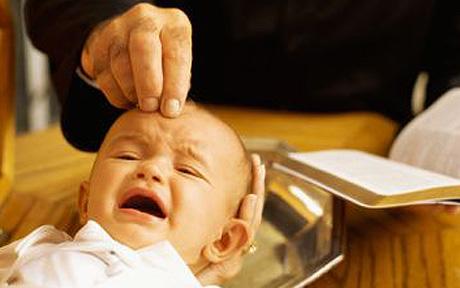
Showing posts with label infant baptism. Show all posts

Saturday, March 5, 2022

Infant Baptism, the Covenant, and the Reformed View


"Upon You have I leaned from before my birth; You are He who took me from my mother's womb. My praise is continually of You"(Psalm 71:6). 

When discussing the baptism of infants with Baptists, they often tell me that a little baby can't know anything about God. We should, they claim, wait until a person grows to an age of accountability or moral awareness. It is phrased in different ways. 

Yet, look at the words above from Scripture. Is that not to be our authority? We are not to look to pop psychology or secular educational assumptions. 

Unlike other psalms, Psalm 71 includes no superscription with its authorship. I think it sounds like David. Whether or not it is, is obviously the words of a covenant child, i. e., one born to a believing home. He professes even a preborn experience of the promise of God: "All your children shall be taught of the Lord, and great shall be the peace of your children" (Isaiah 54:13). Note that He doesn't say all children; rather, He says your children. Why the distinction? Because God claims the children of believers as His own (Ezekiel 16:20). Not that He promises that they are or will ever be regenerate, but that He distinguishes them covenantally from the children of pagans. We see it in His discrimination between the sons of Abraham, Isaac and Ishmael. While Ishmael is the heir of the promise, He also blesses Ishmael because of his covenantal status (Genesis 17:18-21). Both sons are members of the visible church, while only Isaac is a member of the invisible church, a proviso that Baptists consistently fail to consider. 

That is why the Reformed baptize the children of our members. God has claimed them as His own, a great privilege! Therefore, they have a right to His covenant sign, baptism. I am not attempting here to explain the Catholic or Lutheran views of baptism; that is for them to do. But the Reformed do not assume the regeneration of our infants, contrary to the oft-repeated strawman argument of Baptists. We just give them the status that God has declared of them. 

Wednesday, October 7, 2020

The Covenant and the Children of Believers


One of the distinctive doctrines that I love about Presbyterianism is what is called "covenant succession," the belief that the children of believers are claimed by God and set apart from the children of unbelievers. 

There are a number of Bible verses that describe this special relationship. 

In the Old Testament, God chastised Israel for sacrificing their children to idols: "You took your sons and your daughters, whom you had borne to me, and these you sacrificed to them to be devoured" (Ezekiel 16:20). As horrific as human sacrifice is, under any circumstances, Israel had compounded their sin by sacrificing the children that God claimed for Himself by covenant.

In that covenant, God had promised a blessing to His children: "And the LORD your God will circumcise your heart and the heart of your offspring, so that you will love the LORD your God with all your heart and with all your soul, that you may live." (Deuteronomy 30:6). The same promise is repeated in Isaiah 54:13: "All your children shall be taught by the LORD, and great shall be the peace of your children." And again in the New Testament: "The promise is for you and for your children and for all who are far off, everyone whom the Lord our God calls to Himself" (Acts 2:39).

It is important to understand that these promises are covenantal. The children of believers are placed in the visible church. It is not an absolute promise that the children of believers will themselves be believers. We know this from experience. We also have the explicit statement of God to Abraham: "Abraham said to God, 'Oh, that Ishmael might live before You!' God said, 'No, but Sarah your wife shall bear you a son, and you shall call his name Isaac. I will establish My covenant with him as an everlasting covenant for his offspring after him. As for Ishmael, I have heard you; behold, I have blessed him and will make him fruitful, and multiply him greatly'" (Genesis 17:18-20). Abraham had a son by his servant Hagar, Ishmael, and begged God to grant him salvation. Yet, God explicitly refuses, promising material blessings, but not eternal life. The distinction would be made again with Isaac's sons, Esau and Jacob. The Apostle Paul would use their example to illustrate God's sovereignty in grace (Romans 9:6-13). He applies the principle to the children of Christians in I Corinthians 7:14: "For the unbelieving husband is made holy because of his wife, and the unbelieving wife is made holy because of her husband. Otherwise your children would be unclean, but, as it is, they are holy." That is, federally holy, not personally holy.

While it isn't my topic here, this is the basis for infant baptism, just as it was the basis for the circumcision of Israel's children.

Saturday, October 5, 2019

Infant Baptism in Paul to the Ephesians

Among Reformed Christians, the children of believers are baptized, not as a sign that they are saved, but because they are - by right - members of the visible church. Thus, we reject both the errors of baptismal regeneration as taught by, for example, Roman Catholicism, and the view that the children of believers are no different from the children of nonbelievers, as is taught by Baptists,

I have addressed this matter before, from I Corinthians 7:14, but I want to turn to a different text this time.

Paul says, "Children, obey your parents in the Lord, for this is right. 'Honor your father and mother' (this is the first commandment with a promise), 'that it may go well with you and that you may live long in the land'" (Ephesians 6:1-3). This command is addressed to children of Christian parents, not to children in general. Of course, all children should obey their parents, but that isn't the audience of Paul's statement. The children in Christian homes are to obey their parents "in the Lord." That is, they have a relationship that children and unbelieving parents don't have. The children of Christians are in the Lord! Again, that doesn't have to mean that they are necessarily converted. Rather, they are covenantally distinct.

And that is what the Reformed say, that our children are covenantally set apart by God, enjoying the privileges of the visible church, and, therefore, have a right to be baptized. We acknowledge this confessionally, such as Question 166 of the Westminster Larger Catechism: "Unto whom is Baptism to be administered? Answer : Baptism is not to be administered to any that are out of the visible church, and so strangers from the covenant of promise, till they profess their faith in Christ, and obedience to him, but infants descending from parents, either both, or but one of them, professing faith in Christ, and obedience to Him, are in that respect within the covenant, and to be baptized." 


Wednesday, January 2, 2019

The Connection Between Abortionism and Anti-Paedobaptism

The Bible says a lot of things about babies, both before and after birth. For example, they are creations of God (Psalm 139:13), and they are sinners (Psalm 51:5, Psalm 58:3), but they can also be regenerate (Luke 1:15). For the children of believers, we have the additional awareness that our children belong to God, not ourselves (Ezekiel 16:20, I Corinthians 7:14). Our children are very important to God.

Yet, in the face of these biblical truths, we have two egregious offenses against children in today's American society: the refusal to baptize the children of believers and the genocide of unborn children called euphemistically "abortion." (By mentioning them together, I do not mean to imply that they are at all morally equivalent.)

Both arise from an attitude of dismissal toward children as a gift from God (Psalm 127:3). Both as a church and as a society, we despise these gifts from God, and fail in our responsibility for them.


Wednesday, July 11, 2018

Infant Baptism and a Thousand Generations of God's Faithfulness

Opponents of infant baptism will often make arguments such as, "God has no grandchildren." Which is both true and irrelevant to the discussion. Would it be sufficient answer is I were to say, "And God has no orphans either"? I am assuming  that it would not be, though it is equally to the point.

In Deuteronomy 30:6, God said, "The LORD your God will circumcise your heart and the heart of your offspring, so that you will love the LORD your God with all your heart and with all your soul, that you may live." Is that a promise that all of the descendants of a believer will be regenerate? Of course not! The cases of Ishmael and Esau demonstrate the contrary. However, it does indicate a generality, that God, while He converts men one by one, yet intends for the family to be the basis of His mission in this fallen world.

This is what I meant by my remark above about orphans. The exclusive emphasis that credobaptists (i. e., those who hold to the baptism of professing believers only) places on individual decisions denies God's plan for dealing with people in their generations, not as random individuals (see also, for example, Deuteronomy 7:9). Certainly conversions happen one by one, but they continue especially in the family line.

In the New Testament, Paul makes the same point, when he tells us that the children of believing parents are holy (I Corinthians 7:14). God explicitly claims them for His own (Ezekiel 16:20). He promises blessings to them that He never offers to the children of unbelievers: "All your children shall be taught by the LORD, and great shall be the peace of your children" (Isaiah 54:13). Yet, the credobaptist wants us to believe that the children of believers are no less little pagans than are the children of unbelievers!

What I find amusing about that attitude is that many credobaptists demonstrate that their hearts know better than do their heads when they hold "infant dedications." They use a completely manmade ceremony to show exactly that they do not view their children as little pagans! They merely keep the ceremony dry to avoid the implication that they are really practicing infant baptism.

Saturday, February 24, 2018

The Passover and the Salvation of Households

Have you ever had one of those moments when two things you have known forever just seem to come together in a way that seems so obvious now? I just had that experience with two portions of Scripture.

The first is the account of the original Passover (Exodus 12). I am thinking especially of Exodus 12:7: "Then they shall take some of the blood and put it on the two doorposts and the lintel of the houses in which they eat it." An elementary aspect of that verse is the typology of the redeeming sacrificial blood of Jesus, applied to the elect, that the judgment of the Father would pass us by. However, that is not the only thing taught in that sentence. Notice first what it does not say. Nowhere does Moses tell the people to apply the blood to themselves, as if they would be saved from death one by one. Rather, it was applied to the entrance to the house, so that everyone inside was preserved.

Making that connection made me think of some of the words of Peter in the New Testament: "The promise is for you and for your children" (Acts 2:39). We also have the words of Paul to the Philippian jailer: "Believe in the Lord Jesus, and you will be saved, you and your household" (Acts 16:31). This is not the atomistic view of evangelism that we see in our baptistic society, with one convert here and another there. God's evangelism is directed toward the conversion of whole families. And that shouldn't be news, considering the Exodus account above, and God's promise: "All your children shall be taught by the LORD, and great shall be the peace of your children" (Isaiah 53:13).

This is the basis of Paul's encouraging words to Christian parents: "The unbelieving husband is made holy because of his wife, and the unbelieving wife is made holy because of her husband. Otherwise your children would be unclean, but as it is, they are holy" (I Corinthians 7:14). God isn't primarily concerned about individuals, but rather about families!

Monday, October 2, 2017

The Baptism of Households as God's Plan to Build His Church

One conclusion that I have had from the debate over believers' baptism versus infant baptism is that it is not a matter of the scriptural evidence about baptism. Rather, it is a disagreement over God's aim in salvation. Is it the individual? I think the credobaptist would say yes. However, the paedobaptist would say no.

In the account of the Philippian jailer (Acts 16:16-40), we see this question addressed. When the doors of his jail are thrown open, the jailer, thinking that he would be executed for negligence, asks Paul and Silas, "Sirs, what must I do to be saved?" (verse 30). His concern is about his own eternal welfare. But the answer of Paul and Silas is a little different: "Believe in the Lord Jesus, and you will be saved, you and your household" (verse 31). They address his question, "You will be saved," but go further, "and your household."

We also see this in the conversion of Lydia, in the same chapter, verses11-15. When she is converted, who gets baptized? "She was baptized, and her household as well" (verse 15). We see again the inclusion, not just of the one professing faith, but of his or her entire family! My pastor calls this "oikobaptism," from the Greek word for house or household.

These accounts show us that God's target for faith isn't just the individual, but families. And that is the dividing line between credobaptists, who tend to have an atomistic view of conversion, that the individual is all that matters, and the paedobaptist, or oikobaptist, who attends to the family.

Baptists will often refer to themselves as "New Testament Christians." And it is that semi-blindness that produces their error. While I have shown above that the atomisitic view is contrary to New Testament teaching, it is essential to note that the New Testament teaching is merely a carry-over from the Old Testament: "The LORD your God will circumcise your heart and the heart of your offspring, so that you will love the LORD your God with all your heart and with all your soul, that you may live" (Deuteronomy 30:6). God has never had an atomistic view of His plans for the regeneration of the world. And it is the failure to recognize that that leads to the Baptist error of rejecting the continuity between circumcision and baptism, including its application to the children of believers.

When God converts a man or woman, He gives promises that go beyond that individual: "All your children shall be taught by the LORD, and great shall be the peace of your children" (Isaiah 53:13). The conversion of the individual is God's plan for then growing His church, because His plan doesn't stop even with the conversion of the family: "Go therefore and make disciples of all nations, baptizing them in the name of the Father and of the Son and of the Holy Spirit, teaching them to observe all that I have commanded you. And behold, I am with you always, to the end of the age" (Matthew 28:19-20, compare Genesis 1:28). God's missionary plan is to convert individuals first, then our families, and then our nations, and that terraced system is connected by baptism. Therefore, when Baptists deny baptism to the children of believers, they are inserting their manmade doctrine into the longterm strategy of God!

God's Plan, One Step Leads to the Next

Saturday, February 25, 2017

Our Salvation Is All of God, and Nothing of Us: The Gospel According to Moses

Moses said something to Israel that the American Pelagian hates to hear (Deuteronomy 30:6): "The LORD your God will circumcise your heart and the heart of your offspring, so that you will love the LORD your God with all your heart and with all your soul, that you may live."

This is spoken to the elect among the Israelites (and now among Gentiles, too). For all of us, and for no others, God promises to give us a new heart, and also promises the blessing of covenant succession. That is, as Peter also says, "the promise is to you and to your children" (Acts 2:39). These promises are part of why Presbyterians baptize our children.

But what does He promise? First, a new heart. We see this described more fully in Ezekiel 36:26-27: "I will give you a new heart, and a new spirit I will put within you. And I will remove the heart of stone from your flesh and give you a heart of flesh. And I will put my Spirit within you, and cause you to walk in my statutes and be careful to obey my rules." Compare also Philippians 2:13. What was wrong with the old heart? "The heart is deceitful above all things, and desperately sick; who can understand it?" (Jeremiah 17:9). This is the condition that theologians call "total depravity," that is, a nature so corrupted by sin that our every spiritual inclination is to love sin and hate God. In the elect, God promises to remove that corrupt spiritual heart and replace it with a new heart that loves Him and desires to serve Him. Not perfectly in this life, but progressively, and perfectly in the new life to come.

Second, He promises that this new heart, out of the love that it now has for God, will love Him completely. This is what He commands in Deuteronomy 6:5: "You shall love the LORD your God with all your heart and with all your soul and with all your might." This is the same command that Jesus quotes and calls "the first and greatest commandment" (Matthew 22:38). This demonstrates the falsity of the Arminian claim that God cannot command from us what we cannot do of ourselves. Because we cannot. However, He can command us to do what He does in us (Isaiah 26:12)! As Augustine said, "Lord, give what You command and command what You will."

What a blessing to know that, in my spiritual helplessness, God did not abandon me. Rather, He worked in me what He required to be done for my salvation, purchased by Christ on the cross, and applied to me through faith, which, too, is His gift (Ephesians 2:8-9).

Saturday, July 2, 2016

Are the Children of Christians Little Pagans? A Case for Infant Baptism

At first, one may look at the title I have used and expect that I am about to address the issue of discipline in the home. I certainly acknowledge the importance of that, but, no, it isn't my concern here.

Rather, I want to address part of the prejudice among evangelicals against infant baptism. Do credobaptists, that is, those who hold to the baptism only of professing believers, really think of their children as pagans, heathens, idolaters, atheists? I think that is the question that will help to eliminate their prejudice against paedobaptists, that is, those of us who believe in baptizing also the children of one or both believing parents.

To my mind, the key verse is I Corinthians 7:14: "The unbelieving husband is made holy because of his [believing] wife, and the unbelieving wife is made holy because of her [believing] husband. Otherwise your children would be unclean, but as it is, they are holy." Paul is addressing a situation where one spouse in a marriage is converted to Christ, while the other remains in unbelief. He tells the believing spouse that he or she sanctifies the unbelieving spouse. On what grounds does he say so? Because, if that were not the case, then their children would be no different from the children of pagans. Since they are not, then there is something different about having a Christian parent.

I don't at all believe that Paul is teaching presumptive regeneration here (associated with Abraham Kuyper). That is, they aren't automatically Christians. After all, we are saved by faith in Christ, not by genetics. Rather, they are federally holy, or holy collectively with their parents, not necessarily in a personal, redemptive sense.

This is taught in other passages, as well, in both Testaments. In Isaiah 54:13, God says, "All your children shall be taught by the LORD, and great shall be the peace of your children." Our God takes a special interest in the children of His people. He even lays claim to them as His (Ezekiel 16:20)! He repeats Isaiah's promise in Acts 2:39: "The promise is for you and for your children and for all who are far off, everyone whom the Lord our God calls to Himself." These aren't promises that all of the children of believers will eventually become believers. We know of examples of children from godly homes who repudiated that heritage as adults. Think of Abraham and Ishmael. Abraham begged God to regenerate Ishmael (Genesis 17:18), but God's sovereign answer is "No" (verse 19). But God does promise that His eye is on our children, to bless them. Even in Ishmael's case, God says, "As for Ishmael, I have heard you [Abraham]; behold, I have blessed him and will make him fruitful and multiply him greatly" (verse 20).

This is part of why Presbyterians baptize our children. We don't believe that baptism will save them. Nor do we believe that baptism is a promise of their future salvation. Rather, we believe that God has placed His special claim on out children as His own, so that they have a right to the mark of the covenant of grace.

Friday, July 24, 2015

Infant Baptism: Explaining the Obvious, Romans 4:11

"[Abraham] received the sign of circumcision as a seal of the righteousness that he had by faith while he was still uncircumcised. The purpose was to make him the father of all who believe without being circumcised, so that righteousness would be counted to them as well."

As I have demonstrated on this website, I am a paedobaptist. I know someone is asking, "Is that anything like a  Southern Baptist?" But no, it's not. Rather, a paedobaptist (from the Greek words for "child" and "baptizer") is a person who believes in the baptism of the minor children of believers. This is in contrast to a credobaptist (from the Latin word for "belief" and "baptism," so "believer's baptism"). Paedobaptists include Catholics, Eastern Orthodox, Lutherans, Methodists, and Presbyterians, though for various different, even opposed, reasons. Credobaptists include Baptists (obviously!), most Pentecostals, Mormons, and Jehovah's Witnesses, again for various reasons.

I am, to be more specific, a Reformed Paedobaptist, so I do not necessarily endorse the explanations of others, especially Catholics and Eastern Orthodox. The resemblance between our rite and theirs is strictly coincidental.

The passage above refers back to the events of Genesis 17. I bring the specific verse above into the conversation because it explicitly states that circumcision is a seal, i. e., a sacramental sign, of righteousness by faith. Yet, Abraham was explicitly commanded to circumcise the infant and juvenile male members of his household (Gen. 17:12-13).

This aims directly at credobaptist objections to the baptism of infants. As water baptism is the sign and seal of righteousness by faith (I Peter 3:18-21), they say, it cannot be applied to infants, since they are incapable of believing.

That argument runs smack into the argument of Paul in this verse. Circumcision, he says, is this same sort of seal, yet it is to be applied to the infants of believers, who, as the Baptists insist, are themselves still incapable of belief (we will set aside the case of John  the Baptist for this discussion, Luke 1:41). Therefore, there are no biblical grounds for withholding baptism from those same infants, under the New Covenant. Let me re-emphasize: if circumcision, as a seal of faith, was not to be withheld from the infants of believers, then neither is baptism to be withheld from them as such.

While he doesn't make the point in this passage, Paul's theology here is the same as that which he explains in I Corinthians 7:14: "the unbelieving husband is made holy because of his wife, and the unbelieving wife is made holy because of her husband. Otherwise your children would be unclean, but as it is, they are holy." The children of one or both believing parents are holy, not individually, because of the righteousness of faith, but rather federally, under the umbrella - so to speak - of their parent's or parents' faith. Thus, they were to be circumcised under the Old Covenant, and are to baptized under the New Covenant.

I think that this is a very clear refutation of the views of my credobaptist brethren. At the very least, they should have the charity to stop accusing Presbyterians of baptizing our children merely as a holdover tradition from Roman Catholicism.

Friday, August 15, 2014

Is It True that the New Testament Doesn't Mention Infant Baptism?

"For I do not want you to be unaware, brothers, that our fathers were all under the cloud, and all passed through the sea,  and all were baptized into Moses in the cloud and in the sea,  and all ate the same spiritual food,  and all drank the same spiritual drink. For they drank from the spiritual Rock that followed them, and the Rock was Christ."
- I Cor. 10:1-4

I have heard it repeated by Baptists, over and over, ad nauseum, that the New Testament never mentions the baptism of infants, as if that would settle the question. But, as often as it is stated, is it true? No, it's not!
 
Look at the passage quoted above, I Corinthians 10:1-4, referring to the people of Israel during the Exodus from Egypt. This is a familiar story. The Israelites had been given permission by Pharaoh to leave their bondage in Goshen. However, Pharaoh had had a change of heart, and set out in pursuit, intending to retrieve his unpaid workforce. When the Israelites approached the Red Sea (Hebrew, "Sea of Reeds"), their God, Jehovah, made a way for them, dividing the sea to the right and to the left. After they passed through, the Egyptians attempted to follow, but God sent the sea back, crushing the Egyptian troops between two walls of water. The account can be found in Exodus, chapter 14.

Paul uses this experience as a metaphor for baptism. Who was baptized? Adults? Believers? That's what Baptists would have us believe. But what is the actuality? Everyone among the covenant people, men, women, elderly, and children! And this is exactly the case that Presbyterians make. We do not advocate the baptism of those foreign to the covenant, the equivalent of the Egyptians. That is the red herring argument of baptists. Rather, we advocate the baptism of those with a relationship to the covenant, i. e., adult believers, if they haven't been previously baptized, as well as the children within their household. That is, the same that Paul described to the Corinthian Christians.

So, what is the answer to the question in my title? Is it true that the New Testament never mentions the baptism of infants (or children)? Obviously, the answer is no. And, though it isn't the subject addressed here, this text also undercuts the Baptist insistence that baptism must be by immersion. Who got immersed in the Exodus? The Egyptians!

It must be noted that the case I make here only applies to the Presbyterian (or Reformed) view of baptism. It isn't intended to support other views, such as that of the Catholic Church.

Sunday, April 3, 2011

Baptism and the Visible/Invisible Church Dichotomy


This morning at church (The Associate Reformed Presbyterian Church of Huntersville) we had both an infant baptism and communion. I heard it called "Sacrament Sunday" several times. While communion was occurring as regularly scheduled, it is unusual to have both sacraments together. The subject of "why baptize infants" came up in Sunday School, and was also the subject of the sermon. I have addressed the biblical basis for the baptism of the infant children of believers before (see here, here, and here; and regarding the mode of baptism, here, here, here, and here), so I won't repeat that here. Rather, I want to address why paedobaptists, i.e., those who baptize the infant children of believers, see this, while credobaptists, i.e., those who advocate believers' baptism only, don't. Note that my reasoning here is a Reformed position, and is not intended to explain the views of Lutherans, Anglicans, Catholics, or Eastern Orthodox.

I think that the problem is that credobaptists seek to apply the characteristics of the invisible church to the visible church.

The Westminster Larger Catechism, Question 62, defines the "visible church" as "a society made up of all such as in all ages and places of the world do profess the true religion, and of their children." That is, an organization on earth, such that one can point to it, and say, "there it is." Scripture uses this sense in such places as Romans 16:3-5, in reference to the church that met in the house of Priscilla and Aquila.

In contrast, Question 64 defines the invisible church as "the whole number of the elect, that have been, are, or shall be gathered into one under Christ the head." Scripture uses this sense in such places as Ephesians 1:22-23, "the church, which is his body..."

The visible church is as man sees it, while the invisible church is as God sees it. The latter is necessarily pure, because God knows our hearts. The first cannot be pure, because men have no infallible means of perceiving the hearts of other men (and imperfectly even their own). The credobaptist expects the visible church to be equivalent to the invisible church, even though this is beyond the ken of mortal men. That is what blinds him to the status of the children of believers (see I Corinthians 7, especially verse 14). By maintaining this dichotomy, the paedobaptist experiences no dissidence in the baptism of someone who is not, and, in fact, may never be, a believer.

Thursday, April 29, 2010

Baptism as a Sign of the Covenant in the Westminster Confession


"Baptism is a sacrament of the New Testament, ordained by Jesus Christ, not only for the solemn admission of the party baptized into the visible church, but also of his ingrafting into Christ, of regeneration, of remission of sins, and of his giving up unto God through Jesus Christ, to walk in newness of life."
- Westminster Confession of Faith XXVIII:1

Paedobaptists, especially Presbyterians, fall midway between two other views of the sacraments among Evangelicals. On one end are those who claim that baptism isn't required for salvation - which is certainly true - and is, therefore, unimportant - which is not true. On the other are the credobaptists who hold that baptism can be a sign only of the conversion which has already happened. Along with all traditional Presbyterians, I believe that both of those views are wrong.

Against the first, the first paragraph of the confession finishes with this sentence: "Which sacrament is, by Christs's own appointment, to be continued until the end of the world." The ground for this claim is Matthew 28:19-20, "Go therefore and make disciples of all nations, baptizing them in the name of the Father and of the Son and of the Holy Spirit, teaching them to observe all that I have commanded you. And behold, I am with you always, to the end of the age." If that passage doesn't require baptizing until the Second Coming, then neither can it require making disciples, nor can it promise the empowering presence of Christ among His people until that time.

On the other hand, credobaptists claim that baptism can only be a sign of something that has already occurred in the believer. Yet, I am sure that they do not follow that logic in the rest of life. Do the Golden Arches of McDonalds only have significance to someone who has already eaten? Of course not! They are an encouragement to the hungry, "Here is satisfaction for your need!" In the same way, the baptism of the child of believing parents is a sign throughout his life that cleansing of the heart is found in the washing of the blood of Christ. I have dealt with the question of infant baptism elsewhere (such as here), so I won't address it here.

Baptist critics of the baptism of infants before their conversion are wrong, on both logical and biblical grounds. I don't want Presbyterians to fall back on defending tradition, a Papist error, but rather to stand their ground for being right!

Wednesday, September 30, 2009

The Abrahamic Covenant and Infant Baptism

In my continuing reading of "The Gospel Covenant", by New England Puritan Peter Bulkeley, I am currently at a portion in which he defends the identity of the Abrahamic Covenant with the New Covenant in substance, while distinguished in administration. He says (archaic spelling and grammar in original):

"This poynt, concerning the identity or sameness of the two covenants, doth lay a good foundation for communicating Baptisme to the infant children of believers. For if both these things be true, first that the old and new Covenant be in substance the same; and secondly, that children are within the new as they were within the old, then there can be no sufficient reason to deprive children of the seale of the Covenant now more than former times under the old; and, that argument drawne from Circumcision to Baptisme, will stand against all the batteries which are made against it, never to be beaten downe whiles heaven and earth doe endure. The Covenants are the same, and the signes of the Covenants (Circumcision and Baptisme) are in signification the same also; and the children of the faithfull have the same relation and right to the Covenant now as they had before; What reason then that children being before circumcised, in token of their being in covenant, should be forbidden to be baptized , that it might be to them a signe of the Covenant betwixt God and them? It is even a wonder of wonders, that in such cleare light so great mists should be raised up to darken the truth. Let humble mindes search the truth in love, and the Lord will reveale the same unto them."

The verses Bulkeley refers to are Genesis 17: 7, "I will establish my covenant between me and you and your offspring after you throughout their generations for an everlasting covenant, to be God to you and your offspring after you," leading to verse 10, the institution of circumcision as the sign of that covenant, administered to each male infant on his eighth day. Then he points to Paul's use of verse 7 in Galatians 3:16 (see also Romans 4), which he then relates to baptism in verse 27. Then in verse 29, Paul concludes, "And if you are Christ's, then you are Abraham's offspring, heirs according to the promise."

So, Bulkeley's logic proceeds like this:

1) God's covenant promise to Abraham explicitly included his children, who therefore received circumcision as the sign of the Covenant.

2) Christians are the children of Abaraham by faith, and therefore receive His covenantal promises.

3) One of those promises is to bless our offspring.

Therefore, our offspring have a right to receive the sign of the Covenant, i.e., baptism in the place of circumcision.

In the debate over the proper subjects of baptism, credobaptists demand an explicit commandment to baptize the children of believers. Rather, given Bulkeley's argument here, it is actually incumbent on the credobaptist to show an explicit commandment that children are not to receive baptism.

Saturday, July 11, 2009

Psalms, the Covenant, Baptism, and the Visible Church


"The children of your servants shall dwell secure; their offspring shall be established before you."
- Psalm 102:28

One of the most-misrepresented practices of Presbyterians is the baptism of the infant children of believers. Westminster Confession XXVII:6, "Not only those that do actually profess faith in, and obedience unto Christ, but also the infants of one or both believing parents, are to be baptized." Why? WCF XXV:2, "The visible church... under the Gospel (not confined to one nation, as before, under the Law) consists of all those, throughout the world, that profess the true religion, and of their children..." Also Larger Catechism 62, "What is the visible church? The visible church is a society made up of all such as in all ages and places of the world do profess the true religion, and of their children."

The misrepresentation is that Presbyterians believe that our children are automatically saved, or that baptism makes them saved, as is taught in the Catholic Church. As can be seen in the constitutional remarks above, that is a misrepresentation. We believe that the children of believers (only, as we are told nothing about the children of unbelievers) are members of the visible church, i. e., the professing church, but not necessarily of the invisible church. That is, that they aren't believers or regenerate, necessarily, but are set apart from the world. This is a confessional expression of what the Apostle Paul teaches in I Corinthians 7:14, "For the unbelieving husband is made holy because of his wife, and the unbelieving wife is made holy because of her husband. Otherwise, your children would be unclean, but as it is, they are holy." Just as neither the unbelieving husband nor the unbelieving wife is regenerate-by-proxy, neither are their children. However, they are set apart from the world, not counted as Pagans, and therefore have a right to the mark of the covenant, i.e., baptism.

To return to Psalms, this time to Ps. 103:17-18, "The steadfast love of the Lord is from everlasting to everlasting on those who fear Him, and his righteousness to children's children, to those who keep His covenant and remember to do His commandments." The children of believers are the subjects of special promises from God, which is a great comfort to Christian parents. But if those baptized children break that covenant, if they are unfaithful - since God can never be unfaithful - then they repudiate those benefits signified by their baptisms.

So the question goes back to our Baptist critics: do you seriously expect us to believe that you really think of your children as mere miniature Pagans?