Showing posts with label theonomy. Show all posts

Saturday, August 6, 2022

God's Judgment on Unjust Rulers

"Woe to those who decree iniquitous decrees, 

And the writers who keep writing oppression."

-Isaiah 10:1 

As a lover of God's Law, I often hear remarks saying that, since we are "under grace, not under law" (a misreading of Romans 6:14), the civil magistrate is under no obligation to the word of God in the execution of his office. In fact, any source of law except for the Bible is preferred, including the humanistic law under which we Americans are forced to live. 

Sometimes the problem is a belief that the Law ended with the crucifixion of Jesus. That is just bad hermeneutics. Other times, the person - and remember that I am speaking of professing Christians - will point to something in that Law and claim that it would be horrible to live by such a standard today. And they say that, completely oblivious to the implied blasphemy, as if God were unjust in His moral standards!  

Yet we have the verse above, Isaiah 10:1, in which God calls the actions of some magistrates "iniquitous." By what standard is an action iniquitous? Is the law of the state to be judged by its own standards? Surely such circularity would always confirm the morality of that law. Of course not! It must be judged by the objective standards of God. And where do we find those standards? In His law, recorded for us in the Bible. 


Saturday, July 23, 2022

Government Money Policy and the Bible on Weights and Measures

Here is an article from a non-Christian economics think tank about the historical impact of profligate government printing of currency. As I write this, an estimated 80% of US dollars in existence have come into existence under the expansions of presidents Trump and Biden, partly, they claim, as economic incentive during the covid pandemic. The most famous example of such an economic program was under the pre-Nazi Weimar Republic of Germany, in which the currency was so debased that the inflation was part of the instability which inspired German voters to turn to the Nazi Party as an alternative. More recently, we have seen the same events in Mugabe's Zimbabwe and Chavez's Venezuela. 

The result of such a policy is that the same currency loses value with the passage of time. The government benefits from this devaluation because it spends the money before it has entered the market, where it will lose its value. The same is true for businesses favored by government with access to the new money, such as Wall Street and the banks. They have access to the money before it has lost its value, giving them a benefit of privilege that unfavored businesses and the general public cannot have. 

In the Bible, God expresses His divine displeasure with such manipulations of money. In Leviticus 19:35-36, He tells Israel, "You shall do not wrong in judgment, in measures of length or weight or quantity. You shall have just balances, just weights, a just ephah, and a just hin: I am the Lord your God, who brought you out of the land of Egypt." He repeats this command in Deuteronomy 25:13-16: "You shall not have in your bag two kinds of weights, a large and a small. You shall not have in your house two kinds of measures, a large and a small. A full and fair weight you shall have, that your days may be long in the land that the Lord your God is giving you. For all who do such things, all who act dishonestly, are an abomination to the Lord your God." The references to "weights" may seem strange to our modern ears, since we think of money not as weight but as slips of paper, or even just as a plastic card. However, in the days of Moses, exchanges occurred through the use of scales, which told the weight in specie for a certain weight of commodity. 

The wisdom literature, too, warns against financial cheating. For example, in Proverbs 20:10, the Holy Spirit tells us, "Unequal weights and unequal measures are both alike an abomination to the Lord." He repeats the warning in verse 23: "Unequal weights are an abomination to the Lord, and false scales are not good." In both proverbs, cheating through monetary manipulation is named an abomination to the Lord. 

A policy of inflating the currency by government is a policy of theft, which is why it is an abomination to the Lord. it is government which should be the agent of God, not in stealing, but in suppressing theft. Yet our government has a continuing policy of such theft, especially from the poor and elderly. As such, it should be an abomination to every moral person. 


Wednesday, July 6, 2022

Judgments on the Climate for the Works of Men


"He turns rivers into a desert, springs of water into thirsty ground, a fruitful land into a salty waste, because of the evil of its inhabitants. [However,] He turns a desert into pools of water, a parched land into springs of water. And there He lets the hungry dwell, and they establish a city in which to live; they sow fields and plant vineyards and get a fruitful yield. By His blessing they multiply greatly, and He does not let their livestock diminish" (Psalm 197:33-38). 

The world is abuzz about "climate change." Every time there is a hurricane, a drought, a wildfire, pestilence, or famine, politicians and the media blame it on climate change. That, in turn, is blamed on human economic activity, though even some secular sources disagree. I don't have a problem with that explanation. However, I think that scripture shows that natural forces are merely the means, not the true cause of climate change. 

Look at the passage quoted above. 

In this Psalm, coming down to us anonymously, God tells us that it is, indeed, human activity that produces good or bad climate effects, but not because of economics. Rather, it is man's moral activity that brings either the curses or the blessings of God on the land. That portion of the world which professes the Christian religion, especially North and South America, Australia, and Europe, have embraced the values of paganism, such as human sacrifice by abortion. And, as a result, we have brought God's curses on our land in the form of climactic devastation. 

Yet, do we see repentance? Not so far. Rather, we see the wickedness compounded by more nature worship on one side and expanding government tyranny on the other. Even those in Christian ministry, embracing pagan "wokeness," are speaking less of God's law, less of man's sin, and hardly a peep about righteous living according to the word of God. 

As result, we can anticipate increasing climactic judgment, no matter what tinkering government does, until the professing Christian community awakens to its failures. 

Saturday, June 25, 2022

The Destiny in This World of the Godly and of the Wicked: Psalm 37

In Deuteronomy, Moses laid out for the Israelites the blessings and curses that would come from the obeying or disobeying of the commandments of God. In Psalm 37, David, the man after God's own heart, lays out the same dichotomy in poetic form. Even as poetry, though, the psalm has much to say to modern America regarding her growing devolution from biblical Christianity. 

On the plus side, the godly are shown a wonderful future. Though David speaks generally, not necessarily as to individual experience, the blessings should produce a delighted hope in the heart of the believer. 

"Trust in the Lord and do good; dwell in the land and befriend faithfulness. Delight yourself in the Lord, and He will give you the desires of your heart. Commit your way to the Lord; trust in Him and He will act... The meek shall inherit the land and delight themselves in abundant peace... The Lord knows the days of the blameless, and their heritage will remain forever; they are not put to shame in evil times; in the days of famine, they have abundance... The steps of a man are established by the Lord, when he delights in His way; though he fall, he shall not be cast headlong, for the Lord upholds his hand. I have been young, and now am old, yet I have not seen the righteous forsaken or his children begging for bread. He is ever lending generously, and his children become a blessing... Wait for the Lord and keep His way, and He will exalt you to inherit the land; you will look on when the wicked are cut off... The salvation of the righteous is from the Lord; He is their stronghold in the time of trouble. The Lord helps them and delivers them from the wicked and saves them, because they take refuge in Him" (Psalm 37:3-5, 11, 18-19, 23-26, 34, 39-40). 

In these verses, we see the same blessings promised for obedience in Deuteronomy 28: agricultural bounty, happy and blessed children, wealth, and the inheritance of the land. 

The cursings promised to the wicked provide a stark contrast: "They will soon fade like the grass and wither like the green herb... In just a little while, the wicked will be no more; though you look carefully at his place, he will not be there... The wicked plots against the righteous and gnashes his teeth at him, but the lord laughs at the wicked, for He sees that his day is coming. the wicked draw the sword and bend their bows to bring down the poor and needy, to slay those whose way is upright; their sword shall enter their own heart, and their bows shall be broken... The wicked will perish; the enemies of the Lord are like the glory of the pastures; they vanish - like smoke they vanish away... The wicked watches for the righteous and seeks to put him to death. The Lord will not abandon him to his power or let him be condemned when he is brought to trial... I have seen a wicked, ruthless man, spreading himself like a green laurel tree. But he passed away, and behold, he was no more; though I sought him, he could not be found... Transgressors shall be altogether destroyed; the future of the wicked shall be cut off" (Psalm 37:2, 10, 12-15, 20, 32-33, 35-36, 38). 

What we see of the wicked is a delusion of cleverness, but his ways lead only to futility and brevity of life. His posterity are cut off, and the land passes to the righteous. 


Wednesday, May 4, 2022

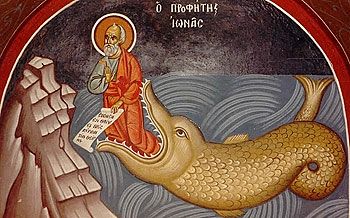
Jonah and God's Righteousness Among the Heathen


"Now, the righteousness of God has been manifested apart from the law, although the Law and the Prophets bear witness to it - the righteousness of God through faith in Jesus Christ for all who believe. For there is no distinction: for all have sinned and fall short of the glory of God, and are justified by His grace as a gift, through the redemption that is in Christ Jesus, whom God put forward as a propitiation by His blood, to be received by faith. This was to show God's righteousness, because, in His divine forbearance, He had passed over former sins." --Romans 3:21-25 

In this passage, I want to focus especially on the last clause: "In His forbearance, He had passed over former sins." By itself, it strikes us as strange, because it seems to suggest that God was unconcerned about sins that occurred before the coming of Jesus. In fact, some people claim that it means that the heathen, who had not known God's written law, unlike Israel, were not held accountable for what would have been sins, because those acts were done in ignorance. 

That view is an egregious act of eisegesis, inserting the assumptions of dispensationalism into a text which says no such thing. 

First, consider the wording of the clause itself. The dispensationalist claims that God overlooked actions which would have been sins, but weren't. Yet Paul says just the opposite. He doesn't say that God overlooked actions; he explicitly states that God overlooked sins. "For all have sinned and fall short of the glory of God" (verse 23). So, there must be a standard by which those heathen were judged, and Paul tells us what that standard was: "The righteousness of God has been manifested apart from the law, though the Law and Prophets bear witness to it" (verse 21). Paul makes a distinction between "law," marked here with a small "p," and the Law, marked by a capital "P." Thus, there has always been a moral code, reflecting the righteous nature of God, which, at a particular point in time, was written down through Moses. Therefore, the dispensationalist is wrong. The law did not begin with Moses; it was merely recorded by Moses. It is the same as the theory of relativity. Energy equals mass times the speed of light squared did not suddenly come into existence when Albert Einstein put it in writing! It had been true ever since the first day of creation. 

Second, do we see God's not holding heathens accountable for their sins? 

"'Arise, go to  Nineveh, that great city, and call out against it, for their evil has come before Me... Arise, go to Nineveh, that great city, and call out against it the message that I tell you.' So Jonah arose and went to Nineveh, according to the word of the Lord. Now Nineveh was an exceeding great city, three days' journey in breadth. Jonah began to go into the city, going a day's journey. And he called out, 'yet forty days, and Nineveh shall be overthrown!' And the people of Nineveh believed God. They called for a fast and put on sackcloth, from the greatest of them to the least of them" (Jonah 1:2, 3:2-5). God sent His prophet to these heathens to warn them of their coming judgment. Judgment according to what? The dispensationalist has no answer, because he holds to his presupposition that the law was only for Israel. We could also consider the case of Sodom and Gomorrah. While God relented of His wrath against Nineveh, He did not against the Sodomites (Genesis, chapters 18 and 19).

Thus, we must conclude logically that the doctrine of the dispensationalist was not what Paul intended. Rather, consider the context: he isn't giving us a contrast between sinfulness and sinlessness; he is contrasting the coming of Jesus, against the previous age without Him. While the Law and the Prophets directed Israel to the coming Redeemer, such as seen explicitly in Job 19:25, the heathen received no such succor. The faithful in Israel had an object for saving faith, but the heathen had none, except for a few individuals, such as Ruth. That is the sense in which God overlooked their sins: He refrained from revealing to them a basis for forgiveness and restoration. Thank God that He has now done so! 

Saturday, April 2, 2022

Kings Your Foster Fathers and Queens Your Nursing Mothers: Biblical Religion the Duty of the Christian Magistrate

"Kings shall be your foster fathers and their queens your nursing mothers" (Isaiah 49:23). 

In today's America, a supposed religious neutrality is enforced by law, especially by a zealously secular judicial system. I question whether that was ever the intention of the Founders when they adopted the First Amendment to the US Constitution. Below is an extended quote from John Bannerman, in his book, The Church of Christ, in which he argues for the doctrine of the established church, as he knew in Scotland. 

"I take it for granted, as a fact not to be disputed, that the state, in all its acts, is to be accounted a moral and responsible agent, as much as any individual that is a subject of it; and that, although not under law to man, the supreme power, or organ of the state, is under law to God. I take it for granted, further, that, in consequence of this responsibility to God, the state is bound, as the first and chief of its duties, to own His will, as embodied in the form of a supernatural revelation from Him, and, in its national capacity, to recognize the authority and the Word of God as its law. And now, with an inspired revelation from God in its hands, what is it that the state learns as to its own interests and duties? It learns, in the first place, the intimate and indissoluble connection between the interests of civil society and the interests of true religion; and that, to promote the wellbeing, or, rather, to insure the existence of the state, it is necessary to call in the aid of powers and influences which the state has not in itself. It finds that what is awanting [sic] in civil society for accomplishing the very end of its own existence, the Gospel alone can supply; and that, for the state to dismiss, as a matter foreign to it, the religious instruction and spiritual wellbeing of the people at large, is to forego the main instrumentality which God has put into its hands for securing the authority of law, for promoting the ends of civil government, [and] for protecting the rights and furthering the peace of society. All this is too plain to need illustration. Without some religion, no society on earth, it is admitted by all parties, could exist at all; and without the true religion, no society can exist happily. Law would cease to be enforced if it had to trust to punishment alone for its authority, without any higher motive to secure obedience to it; and justice between man and man could not be carried into effect if it had no hold upon the conscience and the moral sense of a nation. And can it be alleged that religion is a matter with which states, as such, have no right to intermeddle, when it, in reality, forms the main and only secure foundation on which the authority of state rests - the only sanction sufficient to enforce right and to deter from wrong in a community - the only force strong enough to ensure obedience and respect for law - the only bond that can bind together the discordant elements of human society, and give peace between man and man? To assert that it is no duty of the civil magistrate to care for the religion of the people is nothing less than to assert that he is at liberty to forego the chief or only certain stay of his own authority, and to disregard what is essential to his own existence or wellbeing. If religion be the great and indissoluble cement of human society, then the magistrate is bound, by a regard to his own interests, and for the sake of the grand objects for which a state exists at all, to make the care of religion one of the first duties he has to discharge towards his people." [emphasis in the original]


Saturday, December 4, 2021

King David the Theonomist


"I will look with favor on the faithful in the land, that they may dwell with me; he who walks in the way that is blameless shall minister to me. No one who practices deceit shall dwell in my house; no one who utters lies shall continue before my eyes. Morning by morning I will destroy all the wicked in the land, cutting off all the evildoers from the city of the Lord." 

- Psalm 101:6-8 

The passage above was written by King David. Notice that he rejects the wicked from both his own house, i. e., from among his family, and in the land, i. e., his political realm of Israel. 

While this was the common Christian view in history, including in the colonial and early independence periods of the United States. Yet, today, even professing Christians, those who claim to believe in God's Word, have accepted the view of the humanists that God has no say in the laws of the land. Under the influence of pietism and dispensationalism, Christians advocate any law except that of God. 

What has that gotten us? Abortion, gunfights in the streets and in our schools, burning down our own cities. How has that been a winning strategy? 

In contrast, David, the paradigm of the believing magistrate, took it as his responsibility to eliminate the wicked from the land over which God had given him charge. 

Wednesday, October 20, 2021

The Most-Specious Argument Against Theonomy


Everyone knows the Fifth Commandment by heart: "Honor your father and your mother, that your days may be long in the land that the Lord your God is giving you" (Exodus 20:12). The apostle Paul refers to it as "the first commandment with a promise" (Ephesians 6:2). It is the basis of all human government, arguing from the least to the greatest. That is, if we should honor mother and father, then, obviously, we owe even more honor to the king. 

What few people consider, however, is the importance that God lays on this social order which He instituted: "If a man has a stubborn and rebellious son who will not obey the voice of his father or the voice of his mother, and, though they discipline him, will not listen to them, then his father and his mother shall take hold of him and bring him out to the elders of his city at the gate of the place where he lives, and they shall say to the elders of his city, 'This our son is stubborn and rebellious; he will not obey our voice; he is a glutton and a drunkard.' Then all the men of the city shall stone him to death with stones. So you shall purge the evil from your midst, and all Israel shall hear, and fear" (Deuteronomy 21:18-21). 

We observe several things here. First, this is a son who is habitually rebellious, not one who is occasionally ill-behaved. Second, the parents have struggled with him, striving to bring him to order. If the parents are sinfully lenient, that is a different sin. Third, they go to the elders of their hometown for action. That is, men who are familiar with the family, and witnesses of both the efforts of the parents and the incorrigibility of the son. And fourth, most importantly, this son is not a child. He is living riotously, including the abuse of alcohol. At the very least, he is a teenager. He is to be removed from society because of his baleful actions and influence on others. Notice the last phrase, which indicates that one of the purposes of this law is to serve as an example to the rest of society. 

Yet, this is the one law which is immediately attacked by the antinomian whenever the proper role of God's law in society ("theonomy") is discussed. "So you want the government to stone children, huh?" Well, as I have already said, we aren't talking about children here. Nor do I want anyone to be stoned. Rather, they make that choice when they commit an act which is legal grounds for capital punishment. What is necessary is not the same as what is subjectively desired

Furthermore, look at what has happened to our society as a result of coddling wickedness in our young people! It is impossible to enumerate the crimes that would be prevented before they could happen if the incorrigible wicked were removed before they started their spree of violence. 

So, to answer the challenge of the antinomian: No, I don't want children stoned. I want a society in which children are brought up to respect their elders, society, and, most importantly, the God who rules over us all. 

Wednesday, November 25, 2020

God's Law or Man's Law?

Recently, I have been seeing an argument from antinomians that we are not under the Old Testament law, but rather under the Law of Christ. When I have asked them to show me where that law is found, if they try to give any answer at all, they make a vague reference to "the law of love" or to the first and second commandments (Matthew 22:37-40). When I ask them to define "love" apart from the law, they usually disappear. Same thing when I point to Jesus words about His two commandments: "On these two commandments depend all the Law and the Prophets" (Matthew 22:40). My point is simply that the Law of the Old Testament is the Law of Jesus. I am sad to say that those who hold the antinomian doctrine never give it up, simply because it is self-refuting. Rather, they always fall back on that antinomian trump card, "You are not under law but under grace" (Romans 6:14, ignoring context).

On the other hand, if my challenge to them is that men are then left free to decide right and wrong for themselves (Genesis 3:5), they deny that, too, trying to play both sides. Logically, it must be one or the other, as Gary North described in his book, "Tools of Dominion" (p. 315): "To argue that there ever was, ever is, or ever will be a time when men are not under God's specified judicial sanctions is to argue that they are under sanctions imposed by autonomous man, meaning the self-proclaimed autonomous State. In short, to argue this is inescapably to argue also that God has in history authorized either the tyranny of the unchained State or else the implicit subsidizing of criminal behavior through the State's unwillingness to impose God's specified sanctions. In either case, victims lose. This is what antinomians of all varieties refuse even to discuss, let alone answer biblically." 

I would suggest that our society has arri9ved exactly at the point described by North. Having rejected God's enscripturated Law, Western culture has turned to humanistic morality, maintained not by the inner power of the Holy Spirit, but rather enforced by increasing state violence. Enforced unsuccessfully. The result has been a split competition between a violent state and a violent anarchistic population. This is what a society looks like, when it has turned religion into psychotherapy and pietism.

Wednesday, October 14, 2020

Social Disorder, Statism, and God's Law


I write this at a time when America is going through widespread social tumult over police shootings of black men and women. George Floyd and Breonna Taylor are names we hear on the nightly news almost every day. On one hand, we have the protesters, some of whom are committing wanton acts of violence and destruction, and on the other, politicians arguing over who better supports the police. Rather, I am asking whether Scripture tells us anything relevant to this crisis.

Do we see any solutions to this situation in Scripture? Some argue for more evangelism, saying that the Gospel provides an effective means of uniting people. While that is true, I don't think it is the only solution, and it is not my topic here. 

Rather, I am asking whether Scripture addresses government in a way that impacts this situation. And I think it does.

First, what is the source of law in the Bible? Is it the state? No, it isn't. Nowhere in Scripture do we find a basis for government promulgations regarding crimes or punishments. This isn't an argument for anarchy, but rather for a severely restricted state. If not the state, then what is the source of law? It is God alone. "See, I [Moses] have taught you statutes and rules, as the Lord my God commanded me, that you should do them in the land that you are entering to take possession of it. Keep them and do them, for that will be your wisdom and your understanding in the sight of the peoples, who, when they hear all these statutes, will say, ‘Surely this great nation is a wise and understanding people.’ For what great nation is there that has a god so near to it as the Lord our God is to us, whenever we call upon Him? And what great nation is there, that has statutes and rules so righteous as all this law that I set before you today?" (Deuteronomy 4:5-8). Not the king's law, or the president's or Congress's, but God's law. 

Then who is to enforce the law? Nowhere in Scripture do we see a description of a police force or of inspectors or enforcers. Rather we see this: "On the evidence of two witnesses or of three witnesses the one who is to die shall be put to death; a person shall not be put to death on the evidence of one witness. The hand of the witnesses shall be first against him to put him to death, and afterward the hand of all the people. So you shall purge the evil from your midst" (Deuteronomy 17:6-7). The enforcement of the law is not assigned to a separate enforcement class, but is instead the responsibility of the people themselves. 

Our social conflict is the result of our worship of the state, of our looking to the state for salvation, of our looking to the state to be the source of social order. Since that is not God's intended role for the state, the result of those expectations is not social order but social chaos.

Saturday, August 15, 2020

How the Church Paved the Way for Humanism

There has long been a tradition of dividing the Ten Commandments into two tables, commandments one through four and then five through ten. I am OK with that division. The first four deal primarily with man's relationship with God, and the other six primarily with his relationship with his fellow man. They are often portrayed this way in images of the commandments. That might be a bit fanciful. We have no record of how they were divided between the two tablets. Or even if they were divided. Some people believe that each tablet displayed all ten.

That's fine so far. 

There is also a common view that the civil government is supposed to enforce the second table, the laws against thievery and murder, etc., but has no authority over the first four. 

My question is this: Why? 

Sometimes the answer is that the First Amendment to the Constitution forbids it. We have freedom of religion in this land, so we can't have laws against idolatry. Yet our country has a heritage of so-called "blue laws," laws that required businesses to be closed on Sunday in honor of the Sabbath. "Blue," in this case, derives from a historical usage, in which "blue" was used for something which was overly strict. It was a pejorative term, but passed into general usage. The courts have upheld Sunday-closing laws on secular grounds, such as the practicality of providing a day off for workers. 

However, the question must be, Why does the First Amendment - in reality, the Supreme Court's interpretation of the First Amendment - outweigh God's commandments? Should a cultural preference become the standard by which even Christians are to live, over the Word of God? 

When God tells us, "You shall have no other gods before Me" (Exodus 20:3), His desire is clear. So also when He says, "You shall not make for yourself a carved image, or any likeness of anything that is in heaven above, or that is in the earth beneath, or that is in the water under the earth. You shall not bow down to them or serve them, for I the Lord your God am a jealous God" (verses 4-5). So, on what grounds do we decide that His will in these two commandments is less important that it is when He says, "You shall not murder" (verse 13)? There is certainly no biblical justification for that judgment. 

When the Westminster Standards were originally written, the Larger Catechism, question and answer 109, included among the sins forbidden by the Second Commandment, "tolerating a false religion."  However, in 1788, when the first Presbytery of the Presbyterian Church met in the newly-independent United States, they removed that clause as offensive to religious liberty. Not as offensive to the Word of God. 

What this should tell us is that the secular humanism which has come to dominate these United States is not a new phenomenon, and did not suddenly puff into existence because prayer was removed from government schools in the 1960's. Rather, it was the culmination of that decision in 1788 to place political and cultural considerations above the enscripturated Word of God. The door was opened to the supposed independence of "secular life" from God. Now we have parts of our lives which are designated "religious," and parts which are designated "secular." And the humanists are perfectly happy with allowing Christians to enjoy that distinction, because it turns all of life outside the church doors over to them. And the church doors are only a temporary barrier, until the humanists have secured their territory against that day.

Saturday, August 8, 2020

The Impotence of the Church

These two quotes from Gary North ("Tools of Dominion," p. 48), written in 1990, explain why the church is impotent in the face of the crises of humanistic 2020 America.

"To retreat from this task of applied Christianity is to to turn over the running of the world to pagan humanists and their theological allies, Christian antinomians. It is to turn the medical world over to the God-hating abortionists who are opposed so vigorously by Dr. [James] Dobson. Yet this is precisely what every publicly-visible Christian leader has done throughout the Twentieth Century, and what almost all of them did after the late-Seventeenth Century. It is universally assumed by Christians that the case laws of Exodus are null and void, and should be" (emphasis in the original).

"The tools of dominion, God's law, sit unused, and generally-unread by those who call themselves Christians. They are the best weapons that Christians possess for moral self-defense, since the best defense is a good offense, yet they steadfastly refuse to use them. To use God's revealed law effectively would require them to become intimately familiar with its many subtleties and complex applications, and, even less appealing, to discipline themselves in terms of it. They prefer to let is sit unopened, either in their laps or on their shelves. Christians, therefore, continue to lose the war for civilization."