Wednesday, May 3, 2017

Sola Scriptura: The Best Defense Against Spiritual Bondage


One thing cults have in common is that they have some leader, whether alive or dead, whom they declare to be some paragon of truth. We have Ellen White, Mary Baker Eddy, Joseph Smith, an interminable list of popes, Victor Paul Wierwille, David Koresh. It is a long list, and adds more every day.

The Bible tells us how to resist even the most charismatic cultist: "Learn by us not to go beyond what is written, that none of you may be puffed up in favor of one against another" (I Corinthians 4:6). This is the Apostle Paul speaking, someone to whom the word of God was entrusted (I Thessalonians 2:13). If anyone could claim personal superiority, surely it was he. Yet, he tells the Christians of Corinth that mere men can be "puffed up." And the cure for that is not to go beyond what is written. That is, when any man claims spiritual knowledge outside of Scripture, then he is "puffed up," and is to be resisted. While he does not explicitly quote it, Paul is applying the principle taught in God's Law (Deuteronomy 18:20): "The prophet who presumes to speak a word in My name that I have not commanded him to speak, or who speaks in the name of other gods, that same prophet shall die."

This is what the Reformers did, starting in 1517. As they discovered and taught, more and more, that the declarations of the popes went beyond anything written in the Bible, people were liberated from hundreds of years of bondage to the erroneous teachings of men. Martin Luther said of the fathers of the Catholic Church, "Their holiness does not make them infallible, and it does not imply that one must rely and depend on all the dicta of the fathers or approve and believe all their teachings. Rather take the touchstone of God’s Word into your hands. Let this be your criterion for testing, trying and judging all that the fathers have preached, written and said, as well as all the precepts and human ordinances that have been promulgated. Otherwise one will be easily misled and deceived. And since this polishing stone was not applied to the pope in times past, he ran rampant and covered the church with errors."

It was in the Bible, not the teachings of the popes, that Luther learned that "the righteous shall live by faith" (Habakkuk 2:4, quoted in Romans 1:17, Galatians 3:11, and Hebrews 10:38). Suddenly, his conscience was freed. Having been a monk who spent hours in confession, and, yet, could find no relief for his conscience, he was transformed into a joyful Christian, who could now say, "If you try to deal with sin in your conscience, let it remain there, and continue to look at it in your heart, your sins will become too strong for you. They will seem to live forever. But when you think of your sins as being on Christ and boldly believe that He conquered them through His resurrection, then they are dead and gone. Sin can’t remain on Christ. His resurrection swallowed up sin."

False teachings have one consistent effect: they bring a man into bondage to a man or an organization. Sola Scriptura liberates a man through true knowledge. As Jesus said (John 17:17), "I am the way, and the truth, and the life. No one comes to the Father except through me." Scripture points a hopeless soul to Jesus. The teachings of men will point you to those men.

Saturday, April 29, 2017

The Second Commandment and Images

Moses gave us this word from God: "You shall not make idols for yourselves or erect an image or pillar, and you shall not set up a figured stone in your land to bow down to it, for I am the Lord your God" (Leviticus 26:1). Most people, even those who are ignorant of the Scriptures, recognize this as a rephrasing of the Second Commandment: "You shall not make for yourself a carved image, or any likeness of anything that is in heaven above, or that is in the earth beneath, or that is in the water under the earth" (Exodus 20:4).

The problem is that, as I have noted before, the Catholic Church has hidden the Second Commandment from its public displays. The self-serving nature of that exclusion is self-evident: the worst offenders of the Commandment pretend that it doesn't exist.

However, God does not allow His word to be mocked in this way (Galatians 6:7). While Rome seeks to blank out the commandment in one context, He has expressed it again elsewhere, that they may not pretend ignorance of His command. As the images in my earlier post show, Rome has erased the commandment from her displays of the Commandments. Yet, His word stands, and the honest reader of Scripture is confronted, and not just once, by His rejection of idols.

God says, "I am the LORD; that is My name; My glory I give to no other, nor My praise to carved idols" (Isaiah 42:8). When the Catholic Church calls Mary "co-redemptrix" or "mediatrix," or tells her members to pray to so-called saints, she may congratulate herself on her novelties, but God rejects them. And what He rejects, He judges: "Now Nadab and Abihu, the sons of Aaron, each took his censer and put fire in it and laid incense on it and offered unauthorized fire before the Lord, which He had not commanded them. And fire came out from before the Lord and consumed them, and they died before the Lord" (Leviticus 10:1-2). Notice that these two sons of Aaron did not do something forbidden by God. Rather, they did something which He had not authorized. The significance of that is that their judgment was so severe, though their action was less than the forbidden worship of the Catholic Church. If God killed Nadab and Abihu, what must the judgment against Rome be?

Wednesday, April 26, 2017

The Trinitarian Process of Sanctification


It is common to think of the process of sanctification (I'm not referring to the instantaneous forensic sanctification that happens at conversion) as the the work of the Holy Spirit in us. And it certainly is that. The problem is that Scripture does not credit it to the Holy Spirit alone. Rather, it is a cooperative effort of all three Persons of the Godhead working in the heart of a believer.

First, it is true that we are sanctified by the Holy Spirit. Scripture does, indeed, say so: "According to the foreknowledge of God the Father, in the sanctification of the Spirit, for obedience to Jesus Christ and for sprinkling with his blood" (I Peter 1:2). I find it interesting that, even asserting this role for the Holy Spirit, Peter does not allow us to neglect that our salvation is a Trinitarian affair.

Next, the Apostle Paul credits our sanctification to God the Son: "Christ loved the church and gave Himself up for her, that He might sanctify her, having cleansed her by the washing of water with the word" (Ephesians 5:25-26). See also Romans 15:16.

And Moses repeatedly shows the role of the Father in sanctifying His people: "Keep My statutes and do them; I am the LORD who sanctifies you" (Leviticus 20:8).

We have such an impoverished view of the spiritual life, being unaware of the level of divine involvement that, not only has saved us, but continues to work in us to bring us more and more into conformity with the nature of our God (Romans 8:29).

Saturday, April 22, 2017

"Total Depravity" Seen in the Life of David

We don't usually look for much theology in the history books of the Bible, especially in the Old Testament. They show God's dealings with His covenant people, whether for good or for ill. But, if our interest is to discuss a particular doctrine, we are more likely to go to the Gospel of John or the Epistles of Paul than we
David and Saul
are to First Samuel. And that is proper. However, that practice can cause us to overlook the gems hidden in the midst of wars and genealogies that we expect in them.

In First Samuel 24, we are in the midst of the conflict between the outgoing King Saul and the rising king-to-be David. David finds a sleeping Saul in a cave, and cuts of a corner of the royal robe. Later, he shows the sample to Saul to prove that he could have killed his oppressor, but refrained, out of respect for the Lord's Anointed (verse 10). David explains (I Samuel 24:12-13), "May the Lord judge between me and you, may the Lord avenge me against you, but my hand shall not be against you. As the proverb of the ancients says, ‘Out of the wicked comes wickedness.’ But my hand shall not be against you."

I especially want to focus on the one phrase, "Out of the wicked comes wickedness." That this proverb is true is shown by its later use by David's descendant, the Lord Jesus Christ: "What comes out of the mouth proceeds from the heart, and this defiles a person. For out of the heart come evil thoughts, murder, adultery, sexual immorality, theft, false witness, slander. These are what defile a person" (Matthew 15:18-20).

This is the doctrine of total depravity. Both David and Jesus are teaching the biblical truth that we sin, every one of us, because we are sinners. Our hearts are wicked (Jeremiah 17:9)! This is contrary to the common belief that committing sins makes us into sinners. All of Scripture teaches this, though our human hearts reject it. In fact, our natural reaction to the doctrine is subjective proof of its truth!

Wednesday, April 19, 2017

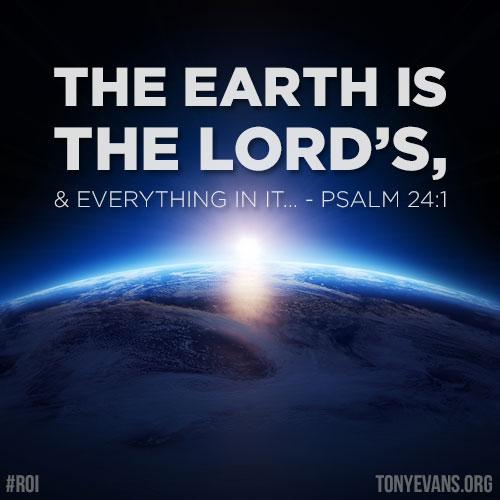
The World Belongs to Jesus, Not to Satan

There is a common mentality that holds that this world belongs to Satan. We are merely to rescue a soul here and there, but the rest of the world is literally going to Hell. Working for change is ridiculed as "polishing brass on a sinking ship."

But that is far from a biblical worldview.

To begin with, it has never been true. The false view is based on a misuse of II Corinthians 4:4: "In their case the god of this world has blinded the minds of the unbelievers, to keep them from seeing the light of the gospel of the glory of Christ, who is the image of God." While it is true that "god of this world" here refers to Satan, it is not true that he is a god, at all, or that "world" means "everything." Rather, this verse refers to the minds of the unbelieving world of men. Notice that his power is explicitly applied to the minds of unbelievers alone.

Furthermore, this world does not belong, and has never belonged, to Satan, or even to man, but rather to God. "The earth is the Lord’s and the fullness thereof, the world and those who dwell therein, for He has founded it upon the seas and established it upon the rivers" (Psalm 24:1). The earth and everything in it belong to God, because He created it. He has never ceded its rule to anyone else, including especially to Satan. He even tells us, "My glory I will not give to another" (Isaiah 42:8 and 48:11). There are people, such as Jehovah's Witnesses and some dispensationalists, who would have us turn the glory of God over to Satan, but He allows no such sacrilege.

We do know that Satan is a dangerous threat. The Apostle Peter warned us, "Your adversary the devil prowls around like a roaring lion, seeking someone to devour" (I Peter 5:8). That is clearly intended to indicate that he is powerful. However, it is a far cry from all-powerful.

While a believer cannot afford complacency, it is not a call to terror, as if we may be consumed by the power of the devil at any moment. Why? Because Jesus has defeated Satan. Jesus told us (John 16:33), "I have said these things to you, that in Me you may have peace. In the world you will have tribulation. But take heart; I have overcome the world." This is where these dispensationalists truly fall short. As bad as it is that they exaggerate the power of the enemy, it is a magnitude worse that they undervalue the redemptive work of Christ. Jesus hasn't merely saved a person here and a person there, while Satan wins everything else. Instead, Jesus won the victory over all the power of the devil: "Since therefore the children share in flesh and blood, He himself likewise partook of the same things, that through death He might destroy the one who has the power of death, that is, the devil" (Hebrews 2:14).

When anyone acts as if he thinks that Satan is hiding behind every bush, remember the words of Jesus: "Now is the judgment of this world; now will the ruler of this world be cast out" (John 12:31).

Monday, April 17, 2017

Like Juice for Breakfast, Idols Aren't Just for Pagans!

In his first epistle, the Apostle John makes an interesting remark: "And we know that the Son of God has come and has given us understanding, so that we may know Him who is true; and we are in Him who is true, in His Son Jesus Christ. He is the true God and eternal life. Little children, keep yourselves from idols" (I John 5:20-21). He asserts that spiritual enlightenment is found in Christ. OK, that's a good thing. Then he asserts the true deity of Christ. That's an excellent addition. then he adds, "Keep yourselves from idols."

That warning just seems out of left field!

If a person understands the first two things, that light and life come in the incarnate Son of God, is it not self-evident that he would then stay away from idols?

Of course, the man of God has that statement from the Father: "You shall not make for yourself a carved image, or any likeness of anything that is in heaven above, or that is in the earth beneath, or that is in the water under the earth. You shall not bow down to them or serve them, for I the Lord your God am a jealous God" (the Second Commandment, Exodus 20:4-5). And we know how well that worked out for Israel (Exodus 32). We know, therefore, that knowing the true God does not shut down the fallen heart, of which John Calvin said, "Man's nature, so to speak, is a perpetual factory of idols."

We must be saddened by the awareness that professing Christians do little better than did the ancient Israelite. Does not Rome produce an army of idols?

Images of Various Saints

This is what John addresses, perverting our faith in the true god, Jesus Christ, by turning our devotion to images, whether we call them saints, gods, or even Jesus. After all, when the Israelites were worshiping the Golden Calf, they called it Jehovah (Exodus 32:5). Therefore, regardless of the claims of Rome, the Second Commandment isn't just about worshiping pagan gods.

Saturday, April 15, 2017

What Is The "World" of John 3:16?

Almost any American can recite John 3:16: "For God so loved the world, that He gave His only Son, that whoever believes in Him should not perish but have eternal life." We see it flashed at all sorts of public events, even sports games. Just the citation, not the full text.

But who stops to consider what it means? What is included in the "world"? What God? What Son? What does it mean to "believe"? "Perish" how? What is "eternal life"? I don't mean to consider all of those questions. Rather, I mean to point out how it has been turned into a slogan, with no awareness of its content.

As can be seen by my headline, I want to examine what "world" it is that God loves.

First of all, what is it not? The fact that it goes on to talk about those who believe, we can see that it isn't talk about a world, such as Mars or Vulcan. Rather, it is talking about the world of men. It is like we might say, "The whole world watched the moon landing on TV." Anyone would understand that we are not talking about a world in the sense of a ball of rock twirling through space.

The Bible refers often to this same world and God's plans for it.

In Isaiah 65:17, God gives us this promise: "For behold, I create new heavens and a new earth, and the former things shall not be remembered or come into mind." God has a plan for this world of men, this world with cancer, war, famine, and angst. It is to be replaced. He tells us more of His plan in Isaiah 66:22: "For as the new heavens and the new earth that I make shall remain before Me, says the Lord, so shall your offspring and your name remain. From new moon to new moon, and from Sabbath to Sabbath, all flesh shall come to worship before Me, declares the Lord." This new world that He is creating shall be distinguished from the old one by its relationship with Him, from one person to the next, generation after generation.

The Apostle Paul explained this idea. In Romans 8:19-23, he explained, "The creation waits with eager longing for the revealing of the sons of God. For the creation was subjected to futility, not willingly, but because of him who subjected it, in hope that the creation itself will be set free from its bondage to corruption and obtain the freedom of the glory of the children of God. For we know that the whole creation has been groaning together in the pains of childbirth until now. And not only the creation, but we ourselves, who have the firstfruits of the Spirit, groan inwardly as we wait eagerly for adoption as sons." This world around us was never meant to contain the suffering and futility that we see everyday. Rather, they result from the curse brought about by the sin of Adam (see Genesis 3:17-19). However, as God brings His people into our proper relationship with Him, to that same extent the curse is rolled back, and all of creation is released and restored to its proper state in service to man under God. How is that relationship brought about? John refers to "everyone who believes," and Paul expands this (II Corinthians 5:19): "In Christ, God was reconciling the world to Himself, not counting their trespasses against them, and entrusting to us the message of reconciliation." That is, "believing in Him" means being reconciled to God through Jesus Christ. That is, not believing in the sense that we believe that the sun will rise tomorrow, but rather being restored to our relationship with our Creator, who has reconciled us to Himself through His only Son.

The Apostle Peter adds his own testimony to this restoration. In II Peter 3:13, he tells us, "According to his promise we are waiting for new heavens and a new earth in which righteousness dwells." This is how the new earth, the world of John 3:16, will look: "in which righteousness dwells"!

How will this be attained? The same Apostle John tells us (I John 2:2): "He is the propitiation for our sins, and not for ours only but also for the sins of the whole world." Adam sinned, bringing God's curse on our world. However, He loved the world He made, and chose to remedy the destruction which man had wrought. He sent His Son to die on the cross to satisfy His justice for all who believe in Him. Through that and the changes that occur as a result, He is restoring the world He created.

In Revelation 21:1, 4, John continues describing us what this new world will be like: "Then I saw a new heaven and a new earth, for the first heaven and the first earth had passed away. [And there] He will wipe away every tear from their eyes, and death shall be no more, neither shall there be mourning, nor crying, nor pain anymore, for the former things have passed away." Where Adam had created a world of futility and hardship, God re-creates a new world where we will cease to know hardship or sorrow. That is the world that God loves, and which He is, even now, creating through Jesus's work of reconciliation in and through His people, the church.