Saturday, June 17, 2017

Sovereignty of God From the Mouth of a Compromiser: Balaam

Near the beginning of the Conquest, Balak, the king of Moab, hired Balaam, an Israelite prophet of shady
character, to curse Israel, in the hope that their advance into Canaan would be undermined by occult forces. Balaam is a bizarre biblical character, because, though his faith was syncretistic, and he was content to sell his gift to anyone with some gold, yet God truly spoke to him, and gave him true messages.

The story is told by Moses in Numbers, chapters 22 through 24.

However, it is on Numbers 24:1 that I want to focus: "When Balaam saw that it pleased the Lord to bless Israel, he did not go, as at other times, to look for omens, but set his face toward the wilderness."

This is an amazing thing to see in the story of a wicked, greedy, spiritually-compromised. fallen, man of God. While he had been perfectly content to sell out his own nation, when Balaam saw that Jehovah, the God of Israel, would not cooperate, he stopped. Where he had been accustomed to using magical charms in an
effort to coerce God to his purposes, this time he forbore, accepted the judgment of God, and abandoned his heathen benefactors.

The reason I bring this up is the contrasting attitude I see too often today. the Prosperity Gospel peddlers have taught most American evangelicals that God is a heavenly Santa Claus (it is Christmas Eve as I type this), who must grant whatever materialistic demand we present to Him. Yet, this admitted half-heathen traitor to his own people has more sense: when God refuses to give him his wish, he puts aside his incantations and charms and walks away. If only the Prosperity heretics showed as much sense as they do their baptized heathenry!

In Balaam's own words (Num. 24:13): "If Balak should give me his house full of silver and gold, I would not be able to go beyond the word of the Lord, to do either good or bad of my own will. What the Lord speaks, that will I speak." No doubt that is the one thing that kept Jehovah speaking to him.

Wednesday, June 14, 2017

Precious Perseverance in the Psalms


Knowing my own heart, as well as what Scripture says about it (such as Jeremiah 17:9 and Romans 3:10-12), I know that my salvation has been all of Christ and none of myself. One aspect of that is my perseverance. As prone to treason as the Scripture says my heart is, how could I have any hope of staying saved for a mere hour, if it depended on my free will, my effort, or on anything at all from me? There could be no hope at all. That is why people in Pelagian "churches," such as Rome, the so-called Churches of Christ," and the United Pentecostal Church, add so many things to salvation, trying to find something that will give them an assurance of eternal life. Yet, they always return to their state of terror when their questions return: How many masses will make sure I get to heaven? How many times raising my hand? Being baptized the right way? What will give me security of conscience? How much gibbering will satisfy the wrath of God?

And the answer will always be, if you look to yourself for assurance, then you will never find any.

The author of Psalm 119 talks about where he found his assurance (Ps. 119:33-40):
"Teach me, O Lord, the way of Your statutes;
     and I will keep it to the end.
Give me understanding, that I may keep Your law
     and observe it with my whole heart.
Lead me in the path of Your commandments,
     for I delight in it.
Incline my heart to Your testimonies,
     and not to selfish gain!
Turn my eyes from looking at worthless things;
     and give me life in Your ways.
Confirm to Your servant Your promise,
     that You may be feared.
Turn away the reproach that I dread,
     for Your rules are good.
Behold, I long for Your precepts;
 

     in Your righteousness give me life!"

Notice the imperative verbs he uses: "teach me," "give me," "lead me," "incline me," "turn me," "confirm to me," "turn away." All of these verbs are requests that God will exercise His sovereign grace in the author's spiritual life. not once here does he make any claim to have power in himself to do these things. There is no appeal to free will. Rather, they all appeal for God to do these things in him (see also Isaiah 26:12). And that prayer is very appropriate, because it is a promise of God to do exactly that: "It is God who works in you, both to will and to work for His good pleasure" (Philippians 2:13).

One further point must be made here. Notice from this that the perseverance of the saints is no "once saved, always saved." No saint can find assurance in raising his hand or signing some response card. Rather, perseverance involves the working of the Holy Spirit in the heart of the truly converted. We do not persevere as a convert left as he was, but rather as the convert is changed to be more and more like Jesus. He will change the true believers in will and life, not in passivity.

Monday, June 12, 2017

Rational Epistemology: How Do We Know What Is True?

Let me say up front that logic is a good thing. I would say that God is logical, and logic is part of the image of God in men.

The problem is the person who claims that he can believe only what results from reason, i. e., the application of logic. Why is that a problem? Well, how does one verify that principle, that knowledge can only come from reason? If you use reason to demonstrate it (by which I do not mean that is possible), then you have already violated your principle by using the fallacy of circular reasoning. Reason must be verified before it can be applied. On the other hand, if you use something other than reason (not that I can imagine what that might be), then you have violated your own principle. Either way, you can only falsify the principle, not prove it.

Therefore, bald reason cannot be the foundation of knowledge. By its own principles, that conclusion is unavoidable.

On the other hand, let me return to the assertions with which I started, i. e., that logic is part of the nature of God, and thereby of men, because we are made in His image.

On that basis, I have a foundation for reason that is neither circular nor self-refuting. That is the difference between the Christian and the rationalist atheist. Not that one is rational while the other is not. But rather that the one has a foundation for his reason, while the other does not.

This is simply what is asserted by God in the Bible: "The fear of the LORD is the beginning of knowledge" (Proverbs 1:7). It is with this sure foundation that all reason is possible.


Saturday, June 10, 2017

The Connection Between Election and the Continuing Sabbath

"Since therefore it remains for some to enter it...,  there remains a Sabbath rest for the people of God, for whoever has entered God’s rest has also rested from his works as God did from His. Let
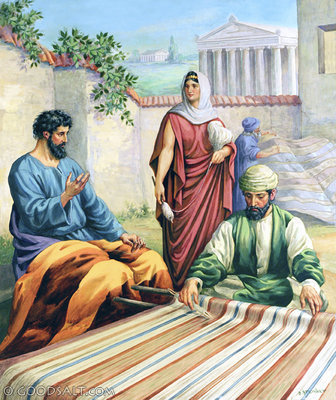
Paul at Corinth
us therefore strive to enter that rest, so that no one may fall by the same sort of disobedience
." 

- Hebrews 4:6-11

A common objection to the continuing ordinance of the Sabbath is that Jesus has fulfilled it, because Christians find our spiritual rest in Him alone. While I certainly agree with that premise, I think it is an unwarranted leap of logic to go from there to the abrogation of the Sabbath.

Note the words of the author of this epistle, quoted above: there "remain some to enter..." That is, there were - and still are - elect members of Christ who have not yet found their spiritual rest in Him. I have, as millions of Christians down through history have. However, there is an unknowable of number, ordained by God (Acts 13:48, 18:10), who have not yet heard the Gospel or responded to it. There still remains a rest for them, when they respond as they are ordained to do.

That is why the Sabbath cannot have been fulfilled, in an abrogating sense. The redeeming work of Christ has been finished, which is why the types pointing to it have been abrogated. However, that is not to what the Sabbath day points. Rather, its fulfillment is when the last believer finds his spiritual rest in that finished work of Christ. That is necessarily a progressive, historical process. And that necessarily means that its type, the Sabbath, cannot yet have ceased.

While it is beside my point here, I do not want to be taken to imply that this typological role of the Sabbath is its only purpose.

Wednesday, June 7, 2017

Jesus and the Continuing Ordinance of the Sabbath

Jesus made a curious statement as part of His Olivet discourse: "Pray that your flight may not be in winter or on a Sabbath" (Matthew 24:20). I consider this to be a reference to the chaos surrounding the Roman destruction of Jerusalem. However, my point below is even greater for those who insist that He is talking about some future tribulation.

The reason that this sentence strikes me is because of His reference to the Sabbath. So many Christians claim that He fulfilled the Sabbath, so that it has no continuing significance. They often, but improperly, cite Colossians 2:16 to support this view.

However, the words of Jesus here indicate that He, at least, had no expectation of the cessation of the Sabbath. He anticipated that Christians would still be honoring it, and the concomitant command to cease from labor, at least forty years after He spoke these words!

This sentence is a major difficulty for the dispensationalist. First, he has been taught, erroneously though it be, that the Sabbath was part of the Law, and we "are under grace, not under Law" (Romans 6:14). Therefore, his hermeneutical presuppositions make no allowance for the future Sabbath. Second, he has been taught that Matthew 24 is about a tribulation that will happen just before the return of Jesus, sometime in the future. Therefore, by his own theological axioms, the words of Jesus require a continuing recognition of the Sabbath for at least two thousand years since the words were spoken. This one sentence completely overturns the dispensational hermeneutic.


Monday, June 5, 2017

Perseverance and God's Warnings Against Apostasy

A house built on sand
God warns His people against apostasy in many places in Scripture, both in the Old And New Testaments. For example, in Jeremiah 2:19, He said to Israel, "Your evil will chastise you, and your apostasy will reprove you. Know and see that it is evil and bitter for you to forsake the LORD your God; the fear of Me is not in you, declares the Lord GOD of hosts." And in Hebrews 6:4-6, that writer tells us, "in the case of those who have once been enlightened... and then have fallen away, to restore them again to repentance."

Those are serious warnings. I think no one would deny it.

The problem comes when Arminians cite such verses as supposed proof that a true believer can fall away from the faith. I oppose that assertion as both unbiblical and destructive of any Christian assurance. It turns the Christian life into agony and terror: Am I saved today? What about tomorrow?

Biblically speaking, that assertion by the Arminians is exactly that, an assertion, and no more. It is opposed by so much more of Scripture. Consider the words of Jesus Himself: "My sheep hear My voice, and I know them, and they follow Me. I give them eternal life, and they will never perish, and no one will snatch them out of My hand. My Father, who has given them to Me, is greater than all, and no one is able to snatch them out of the Father’s hand. I and the Father are one" (John 10:27-30).

But what about the apostasy references above, and ones like them? Notice the difference between the subjects in the two groups of verses. In the apostasy verses, God addresses the failures of the professing believers. But in the words of Jesus from the Gospel of John, the eye is not on believers, but on the power and love of Jesus.

The difference is the object of faith, whether in my own good works or in Jesus, the only-begotten God. Consider another verse, one that is more explicit than the two I cited above: "When a righteous person turns away from his righteousness and does injustice and does the same abominations that the wicked person does, shall he live? None of the righteous deeds that he has done shall be remembered; for the treachery of which he is guilty and the sin he has committed, for them he shall die" (Ezekiel 18:24). Here the prophet defines the apostate, something that neither Jeremiah nor the writer of Hebrews did above. The apostate person is one who was confident in his own righteousness, and then falls from his own moral status (compare the rich young ruler, Matthew 19:16-22, and the Pharisee in the temple, Luke 18:11).

The Apostle John makes this distinction even clearer: "They went out from us, but they were not of us; for if they had been of us, they would have continued with us. But they went out, that it might become plain that they all are not of us. But you have been anointed by the Holy One, and you all have knowledge" (I John 2:19-20). He, too, refers to two discrete groups of people. "They" went out, i. e., committed apostasy, because they were never truly part of Christ's body. But "you" are held by the Holy One, i. e., Christ. 

Apostasy is not something that can happen from Christ, because it doesn't depend on the believer, but on Christ. Rather, it is something that can only happen to the hypocrite, the one who holds up his own righteousness, and depends on that, only to find it a foundation of sand (Matthew 7:26-27).

Saturday, June 3, 2017

Our Duty to God in the Fourth Commandment, Remembering the Sabbath


In Matthew 22:35-40, we read a well-known story: "A lawyer asked Him a question to test Him. 'Teacher, which is the great commandment in the Law?' And He said to him, 'You shall love the Lord your God with all your heart and with all your soul and with all your mind. This is the great and first commandment. And a second is like it: You shall love your neighbor as yourself. On these two commandments depend all the Law and the Prophets.'" In my own church, we often recite these verses for the reading of the Law. In His answer, Jesus describes our duties primarily toward God, the first four of the Ten Commandments, and then our duties primarily to our fellow men, the last six of the Ten Commandments.

I want to focus on Jesus's "great and first commandment" (cited from Deuteronomy 6:5): "You shall love the Lord your God with all your heart and with all your soul and with all your mind." That is, the Christian is to love God by not worshiping other Gods, or by using unauthorized images in His worship, or by taking His name in vain. But we are also to love the Lord our God by "remembering the Sabbath day to keep it holy" (Exodus 20:8). And, of course, it is understandable that Jesus would expect us to love the Lord with the Sabbath, because He Himself is that Lord of the Sabbath (Matthew 12:8)! 

Frequently in these discussions, someone will bring up some other words of Jesus on the Sabbath (Mark 2:27-28): "The Sabbath was made for man, not man for the Sabbath." And He certainly did say that. But what is the next verse? It is the same one (in Mark's parallel) that I cited just above: "So the Son of Man is Lord even of the Sabbath." Therefore, the Sabbath doesn't exist for man as a choice for him to honor or not. Rather, it is a day in which men are freed from the world to give Christ His due honor!

Therefore, I would say that the Scriptures uphold the doctrine of the Westminster Confession of Faith XXI:8: "This Sabbath is to be kept holy unto the Lord when men, after a due preparing of their hearts, and ordering of their common affairs beforehand, do not only observe an holy rest all the day from their own works, words, and thoughts about their worldly employments and recreations; but also are taken up the whole time in the public and private exercises of his worship, and in the duties of necessity and mercy."