Wednesday, February 15, 2017

"Baptism with Fire": What Is It?

In Matthew 3:11 (and the parallel in Luke 3:16), we see a quote from John the Baptist that has always seemed mysterious to me: "I baptize you with water for repentance, but He who is coming after me is mightier than I, whose sandals I am not worthy to carry. He will baptize you with the Holy Spirit and fire." John was making a clear distinction of status between himself and the One who was coming after him, i. e., Jesus. While John was performing an external rite with water, Jesus would do an internal work "with the Holy Spirit and fire."

Pentecostals take the reference as one thing, that "Holy Spirit" and "fire" are appositives, referring to their experiences of tongues, etc. Orthodox Protestants, on the other hand, consider the baptism with the Holy Spirit to be something that happens to every true believer when he is born again. I consider that understanding to be consistent with I Corinthians 12:13: "in one Spirit we were all baptized into one body—Jews or Greeks, slaves or free—and all were made to drink of one Spirit" (see also John 7:39).

That phrase, "baptized with the Holy Spirit," occurs several times in the New Testament. We find it in Mark 1:8, John 1:33, Acts 1:5, 11:16, and 18:25. In none of these verse is it paired with "fire," even in the parallel verses in Mark 1:8 and John 1:33.

I think we must take that to mean that "with the Holy Spirit" and "with fire" are not different words for the same thing, but rather references to contrasting things. "Baptism with the Holy Spirit," as Paul indicates, is something that happens to every believer. Then, to whom does the contrasting "baptism with fire" apply?

On whom else does Jesus attribute a pouring out of fire? He mentions Sodom and Gomorrah (Luke 17:29), and unrepentant unbelievers (Matthew 25:41). These verses indicate that "fire" is not used for an extra-spiritual experience of the saved, but rather for judgment on the wicked (compare Mark 9:42-49).

This gives, I think, by analogy of the faith, what John was saying of Jesus: "I baptize you with water for repentance, but He who is coming after me will baptize you [believers] with the Holy Spirit and [you unbelievers with] fire." Note that "you" is plural, so he is addressing the whole audience, not anyone in particular. That is why he would have used an inclusive comment. To have spoken as the Pentecostals interpret him would have him to assume that all of his audience was - or would be - believers, which is obviously not the case. Also, look at the verse in both Matthew and Luke, where Jesus makes it explicit: "The chaff He will burn with unquenchable fire."

Saturday, February 11, 2017

The Closure of the Unbelieving Mind

When I look at the world around me, everything I see is proof, not only of God's existence, but also of providence, His wise organization and care of both myself and the rest of mankind and the world. Yet, unbelievers demand proof of God's existence. It is comparable to a man in a lifeboat in the middle of the sea demanding proof of the existence of water. This is a clash of perspective, of course, but, more importantly a clash of natures. The believing mind has been taken into a relationship with God, and thus recognizes all things as centered upon Him. The unbelieving mind, however, desires to rule for itself, and thus must retain a blind spot over God in its world.

When the Christian apologist seeks to perform his ministry on the basis of commonality between himself and an unbeliever, then he runs into this unbridgeable gap and is necessarily stymied.

In his description of the Man of Sin (probably equivalent to John's Antichrist), Paul tells us (II Thessalonians 2:9-10), "The coming of the lawless one is by the activity of Satan with all power and false signs and wonders, and with all wicked deception for those who are perishing, because they refused to love the truth and so be saved." The Apostle tells us that "those who are perishing," i. e., unbelievers, will be vulnerable to the deceptions of Satan through this man, not because of ignorance, but because of a willful refusal to accept the truth. In other words, they close their minds to biblical truth, and are thus left susceptible to spiritual deception.

The same apostle makes a similar comment in I Corinthians 1:18: "The word of the cross is folly to those who are perishing, but to us who are being saved it is the power of God." And again in I Corinthians 2:14: "The natural person does not accept the things of the Spirit of God, for they are folly to him, and he is not able to understand them because they are spiritually discerned." In the unbelieving mind, there is an a priori judgment that the spiritual truths regarding God, sin, and redemption, are foolishness, not by a process of reasoning, but rather because of an inherent condition of his heart. His spiritual nature blocks his rational openness to those truths.

The Lord Jesus explained to His disciples the principle that results in the conditions described by Paul (John 14:16-17): "I will ask the Father, and He will give you another Helper, to be with you forever, even the Spirit of truth, whom the world cannot receive, because it neither sees Him nor knows Him." It is the Holy Spirit who creates the gulf between the believer and the unbeliever. A believer is not smarter or morally superior to the unbeliever. Rather, the presence of the Spirit in Him renders him able to understand. And His absence leaves the unbeliever clinging desperately to his refusal to understand. Thus, where Paul says that truth is "spiritually discerned," he isn't talking about a man's spirit, for both classes of men have spirits. he is talking about the action of the Spirit, the Third Person of the Trinity.

Wednesday, February 8, 2017

Free Will: The Right and Wrong Understandings of It

The fundamental error of the atheist is his imagination of autonomy, that his unbelief makes him free of the sovereignty and judgment of God. This is, in fact, Satan's promise to Adam and Eve in the garden (Genesis 3:5). What is sad, though, is the efforts of so many professing Christians to hold on to the same error. Of course, we immediately think of nominal or liberal Christians, who claim the name of Christ, but have zero spiritual commitment. However, I think even of those evangelicals of the Pelagian and Arminian end of the
faith. They still claim the same autonomy as the atheist, but they cover it up by calling it "free will," meaning that men decide their fates autonomously from the will of God.

To my mind, that is worse than the unbelief of the atheist. The atheist makes no pretense of honoring God's Word. The Arminian, however, pretends exactly that, while still holding an essentially-atheist view of the sovereignty of God.

The Arminian has to hold to the incompatible precepts of autonomous free will and the biblical description of God's rule: "A man’s steps are from the Lord; how then can man understand his way?" (Proverbs 20:24). 

The biblical worldview, that of the Calvinist, holds to free will, too, but in a far different way from the Arminian. Properly speaking, the will is free, in that it chooses according to its own intent, without coercion. However, the will is not free in the sense that it is able to choose any random thing. Rather, it chooses freely according to its nature. The will is fallen, sinful, and, therefore, freely chooses to act wickedly (Isaiah 64:6, Romans 3:10-12, 23). 

As the writer of Proverbs asserts, it is God who is sovereign, not the will of man. Therefore, man always acts, freely choosing to do so, according to his sinful purposes, but also according to the predetermination of God, "who works all things according to the counsel of His will" (Ephesians 1:11).

Saturday, February 4, 2017

Early Church Practice of the Sabbath

As I have said before, I have friends who are Seventh-Day Adventists. They claim that the Sabbath was forcibly changed from the seventh day to the first day of the week by Emperor Constantine, the council of Laodicea, and the Catholic Church, in the Fourth Century.

However, as is confessional for my own church, I hold that the change occurred in Acts, as a result of the resurrection of Christ on the first day of the week (as I have written before; use the "sabbath" tag below). This is testified in the Apostolic Fathers, such as the Epistle of Barnabas, which dates, at least, from the Second Century. It may have been written by Saint Barnabas, who figures prominently in Acts.

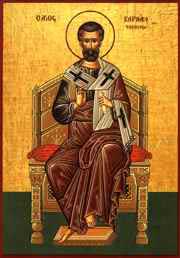
St. Barnabas
In 15:8-9, we read, "Further, He says to them, 'Your new moons and your Sabbaths I cannot endure.' Ye perceive how He speaks: Your present Sabbaths are not acceptable to me, but that which I have made, [namely this,] when, giving rest to all things, I shall make a beginning of the eighth day, that is, a beginning of another world. Wherefore, also, we keep the eighth day with joyfulness, the day also on which Jesus rose again from the dead. And when He had manifested Himself, He ascended into the heavens."

After citing Isaiah 1:13, the author tells us that the practice of the Christians, in honor both of Christ's resurrection and ascension, gathered on the eighth day, which would be the first day of the following week. He uses "eighth day" instead of "first day" because of the prophecies of such, e. g., Leviticus 22:27, 23:11, 23:36, and especially the Feast of Pentecost in Leviticus 23:15-16. Notice the repeated references to the eighth day in the context of atonement!

This epistle, while not Scripture, nevertheless indicates that it was the practice of the church to celebrate the first day of the week, not the seventh. And, thus, the claims of the Adventists are erroneous.

Wednesday, February 1, 2017

The Pentecostal Signs: Jesus Said That a Time Would Come When They Would Cease


 My answer to the question above is "no." I am a strict cessationist, as I have written before (see the "cessationism" tag below). I am convinced that the extraordinary spiritual gifts were intended only for the minstry of the Apostles, and, therefore, ceased with their passing from history.

As part of my reasoning for that, I refer you to Jesus's words in John 9:4: "We must work the works of Him who sent Me while it is day; night is coming, when no one can work." He said that just as He was preparing to heal a blind man, so we know that He referred, at least, to the gift of healing (I Corinthians 12:9, 28, 30). And, logically speaking, if that gift was to end, then the others of its class would, as well. This does not mean that God no longer heals, but rather that He no longer gives a gift of healing to particular individuals.

Someone may say that this argument doesn't prove cessationism conclusively, and I would grant that. However, I do not assert it as my only argument for cessationism. See here, for example, where I show, conclusively I think, that the extraordinary gifts were intended to serve as a verification of the authority of the Apostles, thus becoming unnecessary with their passing. I refer there to Mark 16:20, Acts 14:3, II Corinthians 12:12, and Hebrews 2:3-4. When you start adding all of these passages together, then I think you see an insurmountable case.

Saturday, January 28, 2017

The History of the Christian First-Day Sabbath

The Seventh-Day Adventists claim that Christians celebrated the same seventh-day Sabbath as the Jews, until forced to change by Emperor Constantine (why is always Constantine? the anti-trinitarians blame him, too). While I have addressed the biblical refutation of that claim before (such as here), this time I want to address the historical evidence.

One of the earliest Church Fathers was Ignatius of Antioch, the first bishop of that city, who was a disciple of the Apostle John, and testifies to the practices of the church in the immediate post-Apostolic period. In his Epistle to the Magnesians 9:1, he says, ""If, then, those who had lived according to ancient practices came to the newness of hope, no longer keeping the [Jewish]  Sabbath, but living in accordance with the Lord's Day, on which our life also rose through Him and His death (which some deny), the mystery through which we came to believe, and because of which we patiently endure, in order that we may be found to be disciples of Jesus Christ, our only teacher." He is describing the historical practice of what Paul advises in Colossians 2:16: "So don't let anyone condemn you for what you eat or drink, or for not celebrating certain holy days or new moon ceremonies or Sabbaths." Notice the list of things that Paul lists, all of which were elements of the Jewish ceremonial law, and, therefore, abrogated as completed in the cross work of Christ. That is, Paul is not dismissing the Sabbath, per se. Who would he be to dismiss one of the Ten Commandments? Rather, he is disputing against the Jewish ceremony of Sabbath.

Ignatius describes the carrying out of that exhortation, with the replacement of the seventh-day Jewish Sabbath, with the Christian Sabbath, the first day of the week, because it was the Lord's day, the day of His resurrection and the completion of our redemption! Thus, the Christian Sabbath became the practice of the Christian Church, as described by Acts 20:7 and I Corinthians 16:2, almost three hundred years before the time of Constantine.

Wednesday, January 25, 2017

The Baptism of Jesus as a Sign of His Priestly Office


I want to compare two events, one in the Old Testament, the other in the New Testament.

The first is the process of consecration of the Levitical priests. "You shall bring Aaron and his sons to the entrance of the tent of meeting and wash them with water" (Exodus 29:4). "Then you shall bring Aaron and his sons to the entrance of the tent of meeting and shall wash them with water" (Exodus 40:12). "All those who were listed of the Levites, whom Moses and Aaron and the chiefs of Israel listed, by their clans and their fathers’ houses, from thirty years old up to fifty years old, everyone who could come to do the service of ministry and the service of bearing burdens in the tent of meeting, those listed were 8,580" (Numbers 4:46-48, but compare also verses Num. 4:3, 23, and 29). The two things that I want to emphasize in these passages in that their ministries began at age thirty, and were marked by washings in water (see Hebrews 9:10).

The other is the account of the baptism of Jesus (Mark 1:9-11, compare John 1:31-34): "In those days Jesus came from Nazareth of Galilee and was baptized by John in the Jordan. And when He came up out of the water, immediately He saw the heavens being torn open and the Spirit descending on Him like a dove. And a voice came from heaven, 'You are My beloved Son; with You I am well pleased.'" We know that this happened when He was thirty years old from Luke 3:23: "Jesus, when He began his ministry, was about thirty years of age."

Thus we see how Jesus fulfilled the provisions for the Levitical priesthood, though He Himself was not a Levite (Hebrews 7:13). Rather, His priesthood is described as "in the order of Melchizedek" (Psalm 110:4, Hebrews 5:6, 5:10, 6:20, and especially 7:17). 

As Christians, we receive many benefits from His priestly office, something which the Westminster divines found essential to their system of doctrine. In answer 44, the Westminster Larger Catechism tells us, "Christ executes the office of a priest, in His once offering Himself a sacrifice without spot to God, to be a reconciliation for the sins of His people; and in making continual intercession for them." And in describing that intercession, answer 55 tells us, "Christ makes intercession, by His appearing in our nature continually before the Father in heaven, in the merit of His obedience and sacrifice on earth, declaring His will to have it applied to all believers; Answering all accusations against them, and procuring for them quiet of conscience, notwithstanding daily failings, access with boldness to the throne of grace, and acceptance of their persons and services." We rarely hear this doctrine preached today, but how comforting it should be to us, His people.