The author of this article is a former Catholic priest, now a true follower of Jesus Christ. He is in active ministry, seeking to liberate others from the cult of Romanism. I reprint here with his kind permission. For more information, please visit his website, http://www.bereanbeacon.org/. About a third of the way down, there is a graphic missing of Roman coins. I couldn't get it to load, so I apologize for that. The text is fully-understandable without the graphic.
Under the title of Holy Father, Pope Francis is due to visit the USA in September 2015. Thus, we ask the question, “Who truly is the Holy Father?” A Christian's relationship with the Holy Father is crucial. Thus, Jesus Christ prayed, “Holy Father, keep through thine own name those whom thou hast given me, that they may be one, as we are.” Only
those who have been placed in Christ Jesus by God's grace alone have
the right and privilege to call Holy God their Father. Nevertheless,
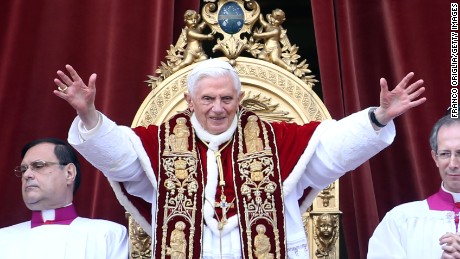
the Vatican both teaches a different gospel and, on its website, claims a successive chain of 266 “holy fathers,” or popes, from St. Peter to Pope Francis.
In Christendom, the great visible center of
religious life is the Pope and the Vatican. Papal Rome enjoys its
apparent worldly pre-eminence and exercises an authoritarian dominion
over the political and religious thinking of hundreds of millions.
However, the true Kingdom of God in the spiritual body of Christ
continues its triumphant growth under the direction of the Lord Jesus
Christ by His Spirit. Hidden from the view of the world and not
perceptible as an institutional force, the true Church remains the
ultimate fact of human history yet to be fully revealed at the Lord's
return. Of these two contemporary entities, the Vatican has, according
to the revealed will of God, unhappily proven itself to be the most
dominant, as the Pope plays a major part on the stage of world history
leading up to the return of the Lord Jesus Christ.
It is critical to appreciate the contemporary
context in which the Roman claim to historical-political priority and
Church preeminence is being reasserted on the world stage. The
aggressive regeneration of orthodox Islam in general and ISIS in
particular is focusing the Western world back to toward the
consideration of religion as a force with which to be reckoned
politically. With the Muslims knowing their religion's history back to Muhammad,
it makes sense that the Papacy would republish in 2015 its claim to a
religious history allegedly more ancient and potent than Islam.
Moreover, the balance of political power world wide
is shifting. Particularly in times of such shifts, the Papacy is ever
ready to present what appears to be an established stability in the
midst of growing disorder and uncertainty. With the 2015 posting of its
unbroken line of popes from Peter to the present Francis, comes the
Papacy's not so subtle reminder of its claim to have been established by
God. It is time to set the record straight.
The beginning of the Official List of Popes
On the Vatican website, the first four claimed popes are the following:
The first four claimed popes are Peter, Linus, Cletus, and Clement. These four are a foundational
tradition in the Roman Catholic system. Uncertainty about any one of
these undermines the entire tradition. More than uncertainty, serious
skepticism about Linus, Cletus, and Clement, however, is warranted, as shown by Richard P. McBrien, who was a well-known Catholic scholar of Notre Dame University. In his book, Lives of the Popes: the Pontiffs from St. Peter to John Paul II, McBrien stated the following,
“Although Catholic tradition, beginning in the late
second and early third centuries, regards St. Peter as the first Bishop
of Rome, and, therefore, as the first pope, there is no evidence that
Peter was involved in the initial establishment of the Christian
community in Rome (indeed,
what evidence there is would seem to point in the opposite direction)
or that he served as Rome's first bishop. Not until the pontificate of
St. Pius I in the middle of the second century
(ca. 142-ca. 155) did the Roman church have a monoepiscopal structure
of government (one bishop as pastoral leader of a diocese). Those whom
Catholic tradition lists as Peter's immediate successors (Linus,
Anacletus, Clement, et al.) did not function as the one bishop of Rome.
(The succession lists were passed down by St. Irenaeus of Lyons [d. ca.
200] and the historian St. Hegesippus [d. ca. 180], and were attested
by Eusebius of Caesarea [d. ca. 339], often called the `Father of Church
History.')
The Roman community seems instead to have had a
corporate or collegial form of pastoral leadership. Those counted among
the earliest popes, therefore, may very well have been simply the
individuals who presided over the local council of elders or
presbyter-bishops. Or they may have been the most prominent of the
pastoral leaders of the community. In any case, the popes of the first
four centuries—that is, until the watershed papacy of Leo I in the
middle of the fifth century—functioned with relatively limited authority
beyond Rome and its immediate environs.”
The statement by Richard P. McBrien utterly
undermines the basic premise of the Vatican. In fact, from the Apostle
Paul's letter to the Romans, it is apparent that the pastors i.e.
bishops of Rome faithfully treasured the Gospel of salvation. Under severe persecution from the Roman emperors these normal pastors and their congregations remained faithful.
The spread of the Christian faith during the first three centuries was rapid and extensive.
While under persecution, the pastors, i.e., the bishops of Rome, were
faithful and zealous in preaching the Gospel of grace. The persecution
of Christians ended in A.D. 313 when Emperor Constantine proclaimed the Edict of Milan.
The Bishop of Rome was first the Successor of Caesar
In A.D. 330, Emperor Constantine (the Caesar) moved
the seat of the Imperial Roman Empire from Rome to Constantinople. By
that time, he had decreed Christianity the religion of the Empire in hopes that by means of its acceptance a new unifying strength could be infused into his crumbling empire.
Thus, in
those early years of the fourth century, the bishops of Rome claimed to
be the successor of Caesar; i.e., the rightful heirs to the Caesars.
The city that had been the seat of power for the Imperial
Roman Empire became the city for the bishop of Rome to exercise his
authority. Gradually, other bishops and national monarchs accepted him as successor to Caesar with the same title that Caesar had, “Pontifex Maximus.”
On the far left is a coin of Caesar Augustus, 27 B.C. On the right, a coin of Pope Leo XIII. They both bear the abbreviation PONT MAX, standing for Pontifex Maximus; one of many examples of popes appropriating Caesar's title. Much later in the early fifth century,
was the bishop of Rome called the successor of Peter. Thus, it was
that Innocent I (401- A.D. 417.) held that the bishop of Rome as Peter's
successor was entitled to exercise Peter's power and prerogatives. Later again in the fifth century, it was more fully formulated
in the teaching of Bishop Leo I (440-461). The fact, however, stands
that Scripture is utterly silent about the Apostle Peter going to Rome.
His visits to Samaria, Lydda, Joppa, Caesarea and Antioch were carefully recorded. But there is simply no mention made of his going to Rome, which is essential to establish the Roman Catholic position.
Clearly the presupposition that Peter was in Rome as its first bishop
is just a tradition. Literally, it took hundreds of years before the
tradition that Peter was the first bishop in Rome was believed and that he had successors in his role of bishop of Rome.
The Historical Foundation of the Supremacy of the Bishop of Rome
Emperor Justinian I, more than anyone else, was the
one to establish the supremacy of the bishop of Rome in the sixth
century. He did it in a formal and legal manner, by bringing religious
matters under the control of civil law. LeRoy Edwin Froom summarized
what happened,
“Justinian I (527-565) [was the] greatest of all the rulers of the Eastern Roman Empire.[His]
great achievement was the regulation of ecclesiastical and theological
matters, crowned by the imperial Decretal Letter seating the bishop of
Rome in the churches as the `Head of all the holy churches,' thus laying
the legal foundation for papal ecclesiastical supremacy.”
Justinian's decree did not create the “Status of the Bishop of Rome” but rather set a legal foundation for the acquisition of civil ruling power by the bishops of Rome. Soon after Justinian's decree, the bishops of Rome began to reign like kings. Vitalian,
the Bishop of Rome from A.D. 657-672, was the first to actually be
addressed with the title “Pope,” when he was called in Latin, “Papa Vitalianus”; i.e., Pope Vitalian. It took time for the pope of Rome to spread the exercise of his state-given title over the other bishops of Europe. For example, even in northern Italy in A.D. 800, Claude, the bishop of Turin, did not recognize the bishop of Rome's authority. Quite apart from the work of Justinian to formalize the civil authority of the “bishop of Rome,” the Vatican and its hierarchy itself later perpetrated manifest historical frauds by outright forgery in documents such as the “Donation of Constantine.” This document purported to be a legal document
in which Emperor Constantine bestowed on Sylvester Bishop of Rome
(314-335) much of his property and invested him with great spiritual
power. The purpose of this fraud was to provide a foundational documentary authentication, albeit entirely false, declaring the ecclesiastical power of the popes during the Dark and Middle ages.
The Popes Grew Strong and Decadent via Civil Power
From the fourth century through the eighth century, much of the growth of papal power was acquired
in trade-offs with kings throughout what had been the old Imperial
Roman Empire. In the eighth century, when the pope needed defending
against the Saracens and the Lombards, the French kings provided
it and presented the pope with ruling title to the cities they had won.
As a reward, in A.D. 800, Pope Leo III notably crowned Charlemagne as
emperor. Thus began the Holy Roman Empire, and consequently began
turmoil over issues of the legal limits of jurisdiction
of the pope on one hand, and the emperor on the other. These issues
were traumatically worked out throughout the actual course of history.
In 1203, as head of the state religion, Pope Innocent III began to
demand, through his Courts of Inquisition, subjection to Roman Church's
doctrines and traditions and had them enforced by civil law.
Many on the Vatican's List of 266 “Holy Fathers” Were Unholy Wicked Men
Honorius reigned from 625 to 638. He was condemned as a heretic by the Sixth Ecumenical Council (680-681). He was also condemned as a heretic by Pope Leo II, as well as by subsequent Roman popes.
In 903, Pope Leo V reigned only for one month because Christopher, a
cardinal priest of San Damaso, had Leo put in prison and declared
himself pope. Then Christopher
was overthrown and put in prison by Sergius. Leo was murdered while in
prison, and Christopher was murdered while in prison on orders of
Sergius. Sergius reigned as Pope Sergius
III from 904 to 911. The immoral murderer Sergius III is number 120 of
the Vatican's list of “Holy Fathers.” Pope John XII reigned from 955
to 963. “Elected at age eighteen, he led one of the most immoral lives of any pope in history and died of a stroke, allegedly in the bed of a married woman.” The notorious Pope John XII is number 131 of the Vatican's list of “Holy Fathers.” The dominant Crescentii Family
played an important part in the history of making and unmaking of Roman
popes from the middle of the tenth through to the eleventh century. Thus, Count Theophylact of Tusculum, in what became the Tusculan political family, began making and unmaking of the Roman popes. In fact, for two centuries the status of being pope was an arena of confusion, as the Crescentii and Tusculan families of Italy disputed and fought over it like a possession.
The year 1073 was a turning point from the centuries of gross immorality. Rigorous discipline
now became the norm of the Papacy. Reaching above the lusts of the
flesh, the lusts of papal minds continued to clutch at total dominion,
both ecclesiastical and civil. Pope Gregory VII (also known as
Hildebrand) was ambitious beyond all who had preceded him. He was convinced
that the reign of the pope was in fact the reign of God on earth and
determined to subject materially all authority and power, both spiritual
and temporal, to the “chair of Peter.” It was Gregory VII who
envisioned what was to become the vast structure of the Papacy. His goal was to be the supreme ruler and judge of all leaders, both Church and State. The supremacy,
which he claimed by divine right, demanded sure dominion over both
emperors and kings. The material supremacy of such a notion
was not won in a day. However, it was Gregory VII's astute grasp of
the notion, and his crushing ambition, coupled with the enormous wealth
that the Roman Catholic Church by then possessed, which made its implementation possible.
These shrewd enactments began
to bear fruit even during Gregory VII's own rule (1073-1085). The
Popes that followed him developed the structures he had established.
They continued his projects and strove by deceit, by crusades, and by interdicts to place the world under papal, political control. For two centuries from the time of Gregory VII's reign, the papacy increased in power and glory, always
at the price of thousands of destroyed lives, many deposed kings, and
princes, along with numerous ruined cities and countless homesteads and
farms utterly wasted, all in the name of the religion of Rome. Popes Innocent III (1198-1216) and Boniface
VIII (1294-1303) put the final touches to papal triumph of spiritual
and temporal power. Pope Innocent III proclaimed a warring crusade
against the Albigenses
and offered to all who would engage in it the pardon of all sins to get
to heaven without passing through purgatory. It was a war perpetrated
with unimaginable cruelty. Whole villages and towns were indiscriminately butchered; thousands were burned at the stake, while others were subjected
to the most hideous torture. The history of these horrendous deeds of
cruelty and murder are established by numerous accounts. Pope Boniface
VIII was stubborn, ambitious, intelligent, vain, and unscrupulous. He believed deeply that the pope was literally the Vicar of Christ on Earth and that he held extraordinary powers. He is most famous for a statement in his papal bull Unum Sanctum, “We declare, say, define, and proclaim to every human creature that they by necessity for salvation are entirely subject to the Roman Pontiff.”
Seventy-five popes, one after another, from Pope Innocent III to Pope
Pius VII, approved of torture, murder, and burning at the stake, and the
confiscation of property in the horrific centuries of the Inquisition. Many of those tortured and slain were true Bible believers.
In Recent Times, Popes No Longer are obviously Depraved, yet are sinisterly so
While the Papacy no longer has the military might by
which to enforce its will, it has in no way renounced its sovereign
control over men's minds and bodies, as Catholic law shows. Of necessity, then, to reintroduce coercion of any consequence, there must first be enacted absolute law within the Catholic system. Second, it is necessary
to ensnare the civil authorities in such a way that they are again
subservient to Catholic purposes. Because the Papal Church is also
civil power, known as the Holy See, it has been able to advance its
status by diplomatic agreements called “concordats.” Prior to 1989, the Holy See signed international agreements primarily with European and Latin American countries. Vatican control
can be seen very clearly in those nations where concordats have long
been established, as for example, in Germany under the extant concordat worked out between Pius XII and Hitler. The Vatican's desire to maintain
civil relations with other nations is now greater than ever. From 1950
to 1999, 128 concordats were signed between Rome and various states.
In the course of nine years, 43 concordats
were signed between the Holy See and other nations. Even nations of
the Middle East, Asia, and Africa are entering juridical agreements with
Rome. Moreover, the Roman Catholic Church has much influence in national and international laws, particularly in the nations in which she has papal nuncios as ambassadors. At present, she maintains diplomatic relations with 179 countries at embassy level. The political civil power is subordinate to the spiritual control of the Roman Catholic Church and is each individual pope's necessary instrument used to fulfill his aspirations and objectives. Thus, while the wickedness of the popes is no longer overtly shown, it is seen sinisterly in its civil legal power.
Beholding the Father's love by the intimate title of “Father” gives the true believer the deep sense of being loved personally as a child of God. In total contrast, the official law of the Roman Catholic Church speaks of the necessity
of submitting one's highest faculties, that of mind and will, not to
God the heavenly Father, but to a so-called Holy Father in Rome. Thus,
the official law of the Roman Catholic Church states, “A
religious respect of intellect and will, even if not the assent of
faith, is to be paid to the teaching which the Supreme Pontiff or the
college of bishops enunciate on faith or morals...” The Lord Jesus Christ commands, “Thou shalt love the Lord thy God with all thy heart, and with all thy soul, and with all thy mind.” One cannot serve two sovereigns, for the Lord's command contradicts that of the Pontiff. A man cannot be impartial between two masters who are incompatible
and demanding total allegiance. The necessity of a choice arises. So
being a Catholic, you ought to decide who indeed your Lord is! Then, as we saw, the Lord Jesus gave the command, “call no man your father upon the earth: for one is your Father, which is in heaven.” Thus, the Father in heaven is worthy of worship, and a true believer will speak to God alone the words, “The Holy Father.” Nonetheless, the Church of Rome teaches that her pope is called “Holy Father.” Pray, therefore, that the Lord God may be gracious to lift the spiritual blindness that binds Catholic men and women to a system that substitutes
the pope for the Lord Jesus Christ! This is no time to presume on the
grace of God, but rather to pray urgently for it, until we see the
fruits of our prayers. The Apostles Peter and John tell us, “you were not redeemed with corruptible things, as silver and gold, from your vain conversation received by tradition from our fathers; but with the precious blood of Christ, as of a lamb without blemish and without spot.” “And he is the propitiation for our sins; and not for ours only, but also for the sins of the whole world.” The Bible clearly states that salvation was Christ's work and His alone: “when he had by himself purged our sins, sat down on the right hand of the Majesty on high.” The Lord's Glory, the Gospel, and His promises are at stake! “Wherefore
we receiving a kingdom which cannot be moved, let us have grace,
whereby we may serve God acceptably with reverence and godly fear. For
our God is a consuming fire.”
Permission is given by the author to copy this article if it is done in its entirety without any changes.
Permission is also given post this article in its entirety on Internet Websites.
The Catholic news agency `Zenit' normally calls the Pope the
“Holy Father.” In fact for most Catholics the term “Holy Father”
usually means the Pope.
John 17:11 The Lord Jesus uses the term “Holy Father” exclusively in speaking to His Father.
Vatican Website at: http://w2.vatican.va/content/vatican/en/holy-father.html 2/11/2015
Richard P. McBrien, Lives of the Popes: The Pontiffs from St. Peter to John Paul II (HarperSanFransisco, 2000) Ch. 1, p. 25
Roman emperors held the title of Pontifex Maximus signifying that they were the highest pontifex or priest in ancient Rome.
http://www.badnewsaboutchristianity.com/ad0_emperors.htm 1/26/2015
Thus it was that four centuries had passed before the claim to be Peter's successor was made.
Certainly the Holy Spirit would not have passed over an
event so significant and essential. In his letter to the Romans, the
Apostle Paul greets many in the Church at Rome but offers no salutation
to Peter. The same Apostle Paul, being at Rome in the reign of Emperor
Nero, never once mentions Peter in any of his letters written from Rome
to the churches and to Timothy, although he does remember very many
others who were with him in the city.
Le Roy Edwin Froom, The Historical Development of Prophetic Interpretation (Review and Herald Publishing Assn., 1950) Vol. I, pp. 507-508
http://www.answers.com/topic/Pope-vitalian
It was only after Bishop Claude's death, as the Gospel and the Bible were removed, that this area fell to the Roman bishop's authority.
A copy of the pretended original document is in Wylie's History of Protestantism Vol. I, Book First, Ch. 3, p.11
Philip Schaff, History of the Christian Church (Hendrickson, 1885) Vol. 4, pp. 250-253
William Webster, The Church of Rome at the Bar of History (Banner of Truth Trust, 1995) pp. 63-71. Peter DeRosa, Vicars of Christ: The Dark Side of the Papacy
(Crown Publishers, 1988) pp. 208-209. (De Rosa is a practicing
Catholic and a former Catholic priest.) See also Catholic theologian
Hans Kung, The Catholic Church: A Short History (Modern Library Paperback Ed., 2003) p. 60.
McBrien, pp. 435, 157-159; see also DeRosa, pp. 211-215
Henry Denzinger, The Sources of Catholic Dogma, Revised by Karl Rahner, S. J. (St. Louis, MO: B. Herder Book Co., 1957), #469.
Documented details regarding the
torture and burning at the stake of the Inquisition are on the video
called the “Inquisition” at: https://www.youtube.com/watch?v=Rx8PdvOELvY And read the article called “The Systematic Murder of Believers: The Untold History of the Inquisition” on http://www.bereanbeacon.org
A concordat is an international
contract, which legally binds the nation involved and the Vatican. A
concordat also establishes rights such as that of defining doctrine;
educating Roman Catholics in the tenants and practice of their faith, an
education which touches every area of their lives including their
understanding of economics (which is socialist); negotiating laws
regarding church property. Such legal issues are agreed on in civil law
between the “Holy See” (as she in her position as a sovereign state is
legally called) and the other nation.
The Catholic Code of Canon Law Canon 752
Schaff, Vol. 4, pp. 250-253
I Peter 1:18-19, I John 2:2