Thursday, August 29, 2013

Bishops in the Church (Part 1): the Bible versus Catholic Tradition

The Roman Catholic Church, the Eastern Orthodox churches, and the churches of the Anglican Communion, all practice the form of church government commonly called "episcopalian" or "prelacy." This is in contrast to the "presbyterian" and "congregationalist" systems. They claim that church history refers to government by bishops, and is found in the earliest church Fathers, including those of the immediate post-Apostolic period. And, as far as that goes, they are correct.

The reason that I say, "as far as that goes," is that it is a half-truth, leaving out a lot of relevant information, especially the simple fact that the word "bishop," a transliteration of the Greek word "episkopos," was used very differently from the way these churches use it.

There are two New Testament verses that refer to the "episkopoi" of particular congregations. Note that: "episkopoi" in the plural, not "episkopos" in the singular. In Philippians 1:1, Paul sends salutations to the Church at Philippi: "to all the saints in Christ Jesus, with the bishops and deacons" (KJV). The other is Acts 20:28 (cf  KJV margin). In both places, modern translations read "overseers," which is the literal translation of "episkopoi." The Acts passage, which begins at verse 17, is especially important, because it begins by referring to the "elders" of the Church at Ephesus, Greek "presbuteroi," and then changes to "episkopoi" for the same men.

The importance of these two verses is that they refer to multiple bishops in single congregations, utterly contrary to the single monarchical bishops of the episcopal churches.  In fact, in the immediate post-Apostolic period, the term came to refer, not to a regional monarchical official, but rather to the pastor of a city church. St. Jerome, that prominent church Father so often quoted by Catholic apologists, said, in his commentary on Titus, "A bishop is the same as a presbyter... [S]o let bishops know that they are greater than presbyters more by custom than in consequence of our Lord's appointment..." What he is referring to is Paul's instruction to Titus (in Titus 1:5) to appoint "elders," i.e., "presbuteroi," in every church. Note the plural, a plurality of elders, not a single monarchical figure. Then he continues in verse 7, "For an overseer (episkopos), as God's steward, must be above reproach." Paul uses both Greek terms to refer to the same men in the same office. That is why the New Jerusalem Bible, a Catholic translation, translates "episkopos" as "presiding elder," not "bishop."

Thus, in two ways, both the New Testament and the first church Fathers contradict the use that episcopalians put upon them. In contrast, they support the presbyterian church of government, which not only permits, but rather requires, multiple elders to govern each local church.

For Part 2, click here
 

Tuesday, July 30, 2013

Apostasy: A Critique of "Rome Sweet Home" by Scott Hahn


It is rare for me to be completely revolted when reading a book, especially a book on some aspect of theology, even theology that I disagree with. However, this book, the tale of the journey of a Presbyterian minister and his wife to conversion to Roman Catholicism, outraged me, with its appeals to sentiment, ignorance, and strawman arguments. Especially considering that it was written by a clergyman, someone that I would expect to write on a certain moral level. I definitely didn't find that level maintained in this book. In fact, two Bible verses come to mind to express my reaction. The first is Acts 20:30, "From among your own selves, will arise men speaking twisted things, to draw away the disciples after them." The other is I John 2:19, "They went out from us, but they were not of us; for if they had been of us, they would have continued with us." This book is a tale of bald-faced apostasy, with justifications that only the ignorant could swallow.

Let me begin with the most-deceptive elements. Scott Hahn begins by describing himself as a hardcore Calvinist in seminary. What he doesn't explain is why he chose to go to Gordon-Conwell Seminary, which is evangelical, but not Reformed. However, the answer becomes evident, even if unspoken. On page 31, Hahn informs us that he had come to "discover" that Saint Paul did not teach the doctrine of sola fide (justification by faith alone). Any Protestant reading that should be struck dumb, because we immediately think of such Pauline references as Romans 4:5, "To the one who does not work, but believes in Him who justifies the ungodly, his faith is counted as righteousness." Then Hahn adds his assertion that sola fide isn't taught anywhere in Scripture, claiming James 2:24 as his support. The reason I make such a point of this is to demonstrate that Hahn had abandoned Protestantism long before his official conversion.

We see the reason for this when Hahn mentions that he had become involved with Norman Shepherd, who was forced to leave Westminster Seminary for undermining the biblical view of justification. Hahn even mentions Shepherd's heresy trial, demonstrating that he was well-aware that those views were outside the pale of Reformed doctrine. Shepherd was the father of the Federal Vision movement, which has disrupted Reformed churches with an attempt to bring back this exact Catholic doctrine of justification. Hahn went to his first pulpit with these views, at a Federal Vision church, but does not say that he informed his presbytery of his views, a deceptive act. While there, he also began to teach at a tiny seminary, i.e., in spite of the "major seminary" claim of one article promoting him. Again, we see that this "Presbyterian" minister was never really Presbyterian.

In addition to his justification heresy, Hahn began the ministry with erroneous views on the sacraments. He complains, p. 49, about the Protestant doctrine of the Lord's Supper - or Eucharist, as he prefers to say - that it is a mere symbol. This is repeated on page 56. Unfortunately for him, that is not the Protestant view, at least among Lutherans, who hold to consubstantiation, or the Reformed, who hold to a spiritual, noncorporeal Real Presence. As the Westminster Confession of Faith XXIX:7 says, "Worthy receivers outwardly partaking of the visible elements in this sacrament, do then also, inwardly by faith, really and indeed, yet not carnally and corporally, but spiritually, receive and feed upon Christ crucified, and all benefits of His death; the body and blood of Christ being then, not corporally or carnally, in, with, or under the bread and wine; yet, as really, but spiritually, present to the faith of believers in that ordinance, as the elements themselves are to their outward senses." Which solution would be worse: that Hahn was ignorant of this doctrine? or that he was knowingly railing against a doctrinal strawman?

One of the endorsements on the back cover of the book says, "This book is inspiring and exciting for any reader desirous of rediscovering, from a scripture base, the reasons why the Catholic Church believes, teaches, and practices its doctrines." But this is exactly what the book doesn't do.We read statements such as, "I had fallen head over heels in love with the Lord in the Eucharist" (p. 88), and "I felt the Lord unleash his power through his mother" (p. 89). This is sentiment, not biblical exegesis. He also mentions direct revelations "from the Lord" on pages 114 and 115. Voices in the head are, again, not biblical exegesis.

This book, as well as other publications from Hahn, are promoted by (some, not all) the Catholic Church in an effort to convert Protestants. You can see them at his website, linked at the top, as well as here. This is what plays into the Acts 20:30 reference above; Hahn hasn't just committed apostasy himself, with his family, he wants to convince the rest of us evangelicals to follow him! God's warning to us is found in Deuteronomy 7:4, "[He] would turn away your sons from following Me, to serve other gods. Then the anger of the Lord would be kindled against you, and He would destroy you quickly." And God's warning to Hahn is found in Deuteronomy 13:5, "That prophet shall be put to death, because he has taught rebellion against the Lord your God."

A video by two ex-Catholic priests with a viewpoint opposed to Hahn's can be seen here

Monday, July 22, 2013

Does John 3:16 Imply a Universal Atonement?

For God so loved the world, that He gave His only Son, that whoever believes in Him should not perish but have eternal life."

The doctrine of particular atonement, also known as definite or limited atonement, is one of the five doctrines of salvation commonly called the five points of Calvinism.  It is probably the most controversial of the five, which is why you'll even find those who call themselves "four-point Calvinists," as if the five doctrines don't stand or fall together. Arminians are most shrill in attacking the Calvinist understanding of the atonement. In essence, the Calvinist says that God the Father gave a number of particular individuals to God the Son to be redeemed and to be regenerated by God the Spirit. This group is explicitly named, not just any unspecified number. Refer to John 10:29 and 17:2.

In contrast, the Arminian (and the semi-Pelagian of any type) holds that Jesus died for every person in the world, without distinction. In every discussion on the issue I can remember, the Arminian participant always threw out the verse above, arrogantly, as if it ended the debate. They act like a man who steps on an ant; he doesn't pause to see whether not the ant is dead.

I, however, suggest that John 3:16 tells us nothing about the extent of the atonement. Let us consider what it actually says: "God so loved the world." Even if the Bible didn't explicitly state this, would it not be obvious? The world is His creation. He devoted great wisdom to its form and orderly operation. Of course He loves it! But let us consider an analogy. If I tell you that 70% of Americans are white, what race is John Smith (just to pick a name hypothetically)? You would have to say that you don't know, because what is true of the aggregate implies absolutely nothing about the particular.

In the same way, to say that God loves His creation in aggregate, in no way conflicts with, for example, "Jacob I have loved, but Esau I have hated," (Malachi 1:2-3 and Romans 9:13). The particular takes precedence over the general.

There are plenty of more-technical reasons to demonstrate that John 3:16 doesn't mean what the Arminian claims it means. However, this simple logical argument seems to me the most-straightforward way to deal with it. So, whatever you might think of the doctrine of particular atonement, I deny that you have the option of simply throwing out this verse as if it trumps every other consideration. If you want to see other arguments, simply click on the tag below, and you will see what else I have written on the issue.

Monday, July 15, 2013

Keeping the Lord's Day Holy

"The sacred observance of one day in seven is God's appointed means for the cultivation of piety: when piety vanishes, orthodoxy necessarily follows it in due time."

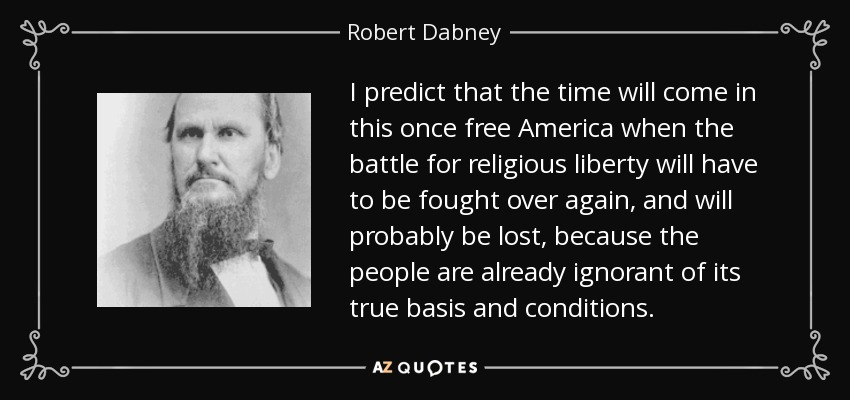
This quote is from the Lectures on Systematic Theology (the specific lecture is available in this pdf) of Robert Lewis Dabney, one of the two best-known theologians from the old Southern Presbyterian Church. In this passage, he was stating his opinion that a lack of Sabbath concern in European churches, including both Calvin and Luther personally, was the reason that the European mainland was, even in his time, a spiritual wasteland. I am sure that, if he lived in our day, he would suggest that the same disease is what has destroyed the Protestant churches, his own Presbyterian Church included, have faded into paganism, even in the English-speaking nations.

The view Dabney was defending can be found in the Westminster Larger Catechism, Question 116: "What is required in the fourth commandment? Answer: The fourth commandment requires of all men the sanctifying or keeping holy to God such set times as He has appointed in His Word, expressly one whole day in seven; which was the seventh from the beginning of the world to the resurrection of Christ, and the first day of the week ever since, and so to continue to the end of the world; which is the Christian sabbath, and in the New Testament called the Lord's day." (See also Questions 117-121). He held, and I also hold, that this view best summarizes the biblical teaching relevant to the Lord's Day, or Sabbath, for the Christian.

The opening biblical reference is Genesis 2:1-3: "Thus the heavens and the earth were finished, and all the host of them. And on the seventh day God finished His work that He had done, and He rested on the seventh day from all His work that He had done. So God blessed the seventh day and made it holy, because on it God rested from all His work that He had done in creation." That is, the Sabbath arises from the creative acts of God at the beginning of history. Remember that; it is a crucial aspect of what I am advocating.

Next, it comes up in the IVth Commandment, in both Exodus 20:8-11 and Deuteronomy 5:12-15.

The objections to continuing Sabbath observance, even in its Christian first-day form, are twofold. The first is a general objection that the ceremonial law has been fulfilled in Christ, and is therefore no longer binding on the Christian. That principle is certainly correct. However, it is irrelevant here, because, as I mentioned above, the Sabbath is a creation ordinance, instituted thousands of years - at least- before the time of Moses. In addition, we have the New Testament concurring in Hebrews 4:9, "There remains a Sabbath rest for the people of God." Thus, the Sabbath is found both before the ceremonial law was given and after it was abrogated in Christ. Therefore, it could not have been abolished with the ceremonies, such as the sacrifices and the Levitical priesthood.

The other objection is more specific. It is based on Colossians 2:16, "Therefore no one is to act as your judge in regard to food or drink or in respect to a festival or a new moon or a Sabbath day." But that interpretation is only possible if you ignore the next verse, "These are a shadow of the things to come, but the substance belongs to Christ." This brings us back to the exact point I made in the paragraph above. Paul is encouraging the Colossian believers not to be shaken by the criticisms of the Jews, or of Judaizers in the Church, who advocated the continuing devotion to the Jewish ceremonies, e.g., the festivals and seventh-day Sabbath attendance at synagogue or the Temple. In other words, he is not referring to the Sabbath principle here, but rather to the now-superseded Jewish Sabbath. Otherwise, Paul's companion Luke would have been remiss in recording that the Christians met on the first day of the week (Acts 20:7).  And Paul himself would have erred in encouraging the believers to take up an offering in their meetings on that day (I Corinthians 16:2). So, the general reading of Sabbath in Colossians 2:16 would make it contradict these two verses, and especially Hebrews 4:9 (quoted above). The narrow reading, i.e., that it is reference specifically to the Jewish Sabbath, must therefore be the correct interpretation.

Saturday, July 6, 2013

The Apocrypha and the Catholic Doctrine of Scripture

"If it is well-composed and to the point, that is just what I wanted. If it is worthless and mediocre, that is all I could manage."
- II Maccabees 15:38, New Jerusalem Bible

This verse is the penultimate verse of the apocryphal Second Book of Maccabees. Along with First Maccabees, this book is an accepted part of the Roman Catholic and Eastern Orthodox canons of the Old Testament. The Eastern Orthodox also accept Third and Fourth Maccabees. These books describe the historical period between the prophecies of Malachi and the Gospel of Matthew.

All of these books are found in the Septuagint, the pre-Christian Greek translation of the Jewish scriptures. However, all four are excluded from the so-called Palestinian canon, the basis of both the modern Jewish and Protestant canons. The Orthodox accept all four simply on the grounds that they consider the Septuagint to be the authoritative basis for their Old Testament. And, it must be acknowledged, the manuscripts that survive of the Septuagint are far older than the oldest Hebrew manuscripts. The Church of Rome, on the other hand, pleads the actions of certain church councils (not any of the universal Ecumenical Councils), especially of the Third Council of Carthage, a provincial council that met in 397, and ratified by the Sixth Council of Carthage in 419. However, Rome rejects the Synod of Laodicea, 365, which excluded the Books of Maccabees. In addition, they claim the authority of Augustine, who accepted the books, but reject the opinion of Jerome who excluded them from his canon, i.e., the Vulgate Bible.

My point in mentioning these councils and church Fathers is that the Church of Rome cherry-picks its authorities. Since the Council of Trent "infallibly" determined to include the books, the Roman Church is forced by its own claims to profess only those authorities that agree with that decree.

The problem for the Catholic (and Orthodox) view is that it is contradicted by the very text that they are claiming as canonical. Look at the quote at the top of this page. The writer of Second Maccabees is worried that his book will be found to be mediocre! Would he have that fear if he were inspired, as, for example, Paul was? Rome claims that he was merely mistaken, unaware of his inspiration, because, they claim, the Scriptures aren't infallible in matters of science or history, i.e., "objective" facts. A-hah! Here we have the crux of the issue: in order to maintain its own infallibility, Rome is perfectly willing to cast away the infallibility of God! This is the reason the Reformers pointed their fingers at the papacy with the cry of "Antichrist"!

In contrast, Jesus, speaking to His heavenly Father, trustingly confessed, "Your word is truth" (John 17:17). That is the authority that I accept. As the Psalmist says (Psalm 119:160), "The sum of Your word is truth." Since no pope has ever died for my sins or risen from the dead, I will choose the words of Jesus over the words of Rome. I am secure in the trust that those words will never change.

Friday, June 14, 2013

Tongues: Not a Blessing, but a Curse

Deuteronomy literally means "second law," because it contains the second enumeration of the Ten Commandments. It is primarily a book of the covenant, the terms of the treaty of relationship between Jehovah and His people. It includes blessings for covenant faithfulness, as well as curses for treason against the covenant. The verse I wish to highlight is in the latter portion.

Deuteronomy 28:49, "The Lord will bring a nation against you from far away, from the end of the earth, swooping down like the eagle, a nation whose language you do not understand."

There are a number of verses throughout the Old Testament that parallel this one. For example, Isaiah 28:11, "For by people of strange lips and with a foreign tongue, the Lord will speak to this people." Paul also quotes this verse to the same end in I Corinthians 14:21, and then adds in verse 22, "Thus, tongues are a sign, not for believers, but for unbelievers." That is, to unbelieving Jews. Yet, where do we see the promotion of "tongues"? In church worship services! The purpose of these verses, if I may paraphrase, is for God to tell Israel, "If you refuse to listen to Me, then I will continue to speak to you, but through languages that you do not understand." This was a judgment. It is as the parent who continues his warnings to an errant child, even as that child puts his fingers in his ears to keep from hearing. I refer to these verses as the defense of my belief that glossolalia, commonly referred to as "speaking in tongues," is not a blessing, and is not intended for today's Church. Hearing someone else speak in an unknown tongue is a final step in God's bringing discipline against a wayward believer or church. When a professing Christian hears other people speaking in tongues, that means that either he or his entire community has provoked the wrath of God and may soon anticipate some form of judgment. This is not a good thing!

Saturday, June 8, 2013

Covenantal Envy in Ruth 1:6-18

"Then Naomi arose with her daughters-in-law to return from the country of Moab, for she had heard in the fields of Moab that the LORD had visited his people and given them food. So she set out from the place where she was with her two daughters-in-law, and they went on the way to return to the land of Judah. But she said to her two daughters-in-law, 'Go, return each of you to her mother’s house. May the LORD deal kindly with you, as you have dealt with the dead and with me. The LORD grant that you may find rest, each of you in the house of her husband!' Then she kissed them, and they lifted up their voices and wept. And they said to her, 'No, we will return with you to your people.' But Naomi said, 'Turn back, my daughters; why will you go with me? Have I yet sons in my womb that they may become your husbands? Turn back, my daughters; go your way, for I am too old to have a husband. If I should say I have hope, even if I should have a husband this night and should bear sons, would you therefore wait till they were grown? Would you therefore refrain from marrying? No, my daughters, for it is exceedingly bitter to me for your sake that the hand of the LORD has gone out against me.' Then they lifted up their voices and wept again. And Orpah kissed her mother-in-law, but Ruth clung to her. And she said, 'See, your sister-in-law has gone back to her people and to her gods; return after your sister-in-law.' But Ruth said, 'Do not urge me to leave you or to return from following you. For where you go I will go, and where you lodge I will lodge. Your people shall be my people, and your God my God. Where you die I will die, and there will I be buried. May the LORD do so to me and more also if anything but death parts me from you.' And when Naomi saw that she was determined to go with her, she said no more."

 I am thinking about this passage as I prepare to substitute for the teacher of my Sunday School class tomorrow.

 It seems to me that the key verse for understanding the Book of Ruth is here, the latter part of the sixteenth verse of the first chapter: "Your people shall be my people, and your God my God." Note that I am not turning the book into an allegory, but rather seeking the purpose for including this historical event in the inspired text. Note the parallel phrasing here with the covenantal declarations of God: "I will be your God and you shall be My people," such as in Exodus 6:2-7, Leviticus 26:6-13, and Ezekiel 36:22-28. In those passages, it is Jehovah speaking in the first person of the covenant which He Himself is initiating, i.e., the Covenant of Grace. In contrast, Ruth is speaking only in the second person, referring to Naomi's people and Naomi's God. That is because she is speaking as one outside that covenantal relationship.

This is actually within the revealed purposes of God's covenant. In Deuteronomy 4:6, He says to Israel, "Keep them [i.e., the Law] and do them, for that will be your wisdom and your understanding in the sight of the peoples, who, when they hear all these statutes, will say, 'Surely this great nation is a wise and understanding people.'" Also Ezekiel 36:15-23, "And I will not let you hear anymore the reproach of the nations, and you shall no longer bear the disgrace of the peoples and no longer cause your nation to stumble, declares the Lord GOD. The word of the LORD came to me: 'Son of man, when the house of Israel lived in their own land, they defiled it by their ways and their deeds. Their ways before Me were like the uncleanness of a woman in her menstrual impurity. So I poured out My wrath upon them for the blood that they had shed in the land, for the idols with which they had defiled it. I scattered them among the nations, and they were dispersed through the countries. In accordance with their ways and their deeds I judged them. But when they came to the nations, wherever they came, they profaned My holy name, in that people said of them, 'These are the people of the LORD, and yet they had to go out of his land.' But I had concern for My holy name, which the house of Israel had profaned among the nations to which they came. 'Therefore say to the house of Israel, Thus says the Lord GOD: It is not for your sake, O house of Israel, that I am about to act, but for the sake of My holy name, which you have profaned among the nations to which you came. And I will vindicate the holiness of My great name, which has been profaned among the nations, and which you have profaned among them. And the nations will know that I am the LORD, declares the Lord GOD, when through you I vindicate my holiness before their eyes.'"

 Having ignited this envy among Israel's pagan neighbors, how did Jehovah then satisfy it? I think the clear clue is verse 2 of Ruth 1: "They were Ephrathites from Bethlehem in Judah." That little tidbit reminds us of I Chronicles 4:4, which says, in passing, "These were the sons of Hur, the firstborn of Ephrathah, the father of Bethlehem." Then Micah 5:2, "But you, O Bethlehem Ephrathah, who are too little to be among the clans of Judah, from you shall come forth for Me one who is to be ruler in Israel, whose coming forth is from of old, from ancient days." And its fulfillment in Matthew 2:6. This a shadowy connection to the coming of the Messiah, who was given to be a light to the Gentiles (Isaiah 42:6, Isaiah 49:6 [compare Luke 2:32], and Acts 13:47). And the writer of Ruth (probably the Prophet Samuel), brings this down to genealogy. From the marriage of Ruth and Boaz came Obed, the grandfather of David, and thus the lineal ancestor of Jesus the Messiah! Thus, this one literary work demonstrates the covenantal envy of Israel's pagan comptetitors, in the purposes of God, and His sovereign satisfaction of that envy centuries later. I love it when Scripture strands come together like this!