Saturday, August 14, 2021

Salvation Is Too Easy for Most Men

"The truth of justification by faith alone is contrary to depraved human nature, which always supposes and insists that the way to be righteous is by exerting oneself to attain this status, since righteousness makes one worthy of salvation and of every blessing. The truth of justification is truly amazing since faith is not a work that makes one worthy of righteousness, but merely a means, an instrument, by which God gives - by imputation - and the sinner passively receives righteousness as a gift. Indeed, the faith itself by which the sinner is justified is God's gift to the sinner." -Rev. David Engelsma, "Gospel truth of Justification," p. 191. 

In most things, we expect a person to choose the easiest way to attain his goals. To choose the hardest way is considered irrational. Yet we all exempt salvation from that plain rule. 

Recall the reactions of Adam and Eve immediately after their Fall into sin: "Then the eyes of both were opened, and they knew that they were naked. And they sewed fig leaves together and made themselves loincloths. And they heard the sound of the Lord God walking in the garden in the cool of the day, and the man and his wife hid themselves from the presence of the Lord God among the trees of the garden. But the Lord God called to the man and said to him, 'Where are you?' And he [i. e., Adam] said, 'I heard the sound of You in the garden, and I was afraid, because I was naked, and I hid myself.' He [i. e., the Lord] said, 'Who told you that you were naked? Have you eaten of the tree of which I commanded you not to eat?' The man said, 'The woman whom You gave to be with me, she gave me fruit of the tree, and I ate.' Then the Lord God said to the woman, 'What is this that you have done?' The woman said, 'The serpent deceived me, and I ate'" (Genesis 3:7-13). 

First, let us notice who is speaking. This is the Lord, the tetragrammaton, Yahweh. This is the covenantal name of the preincarnate Son. Where the Father could have come in proper wrath and justice, instead, the Son comes in the first instance of His mediatorial role. He is present with the now-sinful Adam and Eve, giving them an immediate opportunity to plead His mediatorial mercy and forgiveness. That would have been the easy solution. 

Instead, what did they do? Immediately they covered their nakedness with fig leaves. The consciousness of their nakedness is an indication of their loss of their pre-Fall innocence. So, they attempted to work out their own solution to their guilt: cover it up. Next, they hide themselves among the trees. They have hidden their sin from their own eyes with the leaves, and then they add hiding themselves from the eyes of God. After all, he cannot judge them if He doesn't know where they are, right? Or so they reasoned. Yet, when He finds them, as was inevitable, they resort to pointing fingers. It was the woman, Adam claims, and You gave her to me. So it is God's fault. Even in her place passed the blame to the serpent, that ancient Tempter, whom we know as Satan. For Adam and Eve, their defense boiled down to, No one here but us innocent little chickens! 

And to this day, the posterity of our first parents respond the same way. We always strive to avoid responsibility for our wickedness. It is someone else's fault, not mine. Or I will fix myself, and God can just go on about His business with those other wicked people. 

And while we scramble to make all of these efforts to hide or fix our sin, the only mediator between the just God and sinful men is Jesus Christ. How simple it is to turn to Him alone by faith alone. Then we need not make garments for ourselves, because He gives us His own white robe of righteousness: "I counsel you to buy from me gold refined by fire, so that you may be rich, and white garments so that you may clothe yourself and the shame of your nakedness may not be seen, and salve to anoint your eyes, so that you may see" (Revelation 3:18; compare Zechariah 3:3-4). We need not hide or fix our sin. Indeed, we cannot. But He can, and does. How easy salvation in Christ is!


Wednesday, August 11, 2021

King David and the Doctrine of Perseverance

 According to the superscription, David wrote this when he was taken prisoner by the Philistines: "You [God] have delivered my soul from death, yes, my feet from falling, that I may walk before God in the light of life" (Psalm 56:13). It may be this verse which inspired Jude, the half-brother of Jesus, to write centuries later, "Now to Him who is able to keep you from stumbling and to present you blameless before the presence of His glory with great joy, to the only God our Savior, through Jesus Christ our Lord, be glory, majesty, dominion, and authority, before all time and now and forever. Amen" (Jude 1:24-25). 

Both men exult not in some belief that they must sustain their own faith, as the Pelagian claims, but rather in the knowledge that it is God's power that will sustain them to the end. 

Jesus also talked about this: "My sheep hear My voice and I know them, and they follow Me. I give them eternal life, and they will never perish, and no one will snatch them out of My hand. My Father, who has given them to Me, is greater than all, and no one is able to snatch them out of the Father's hand" (John 10:27-29). 

David and Jude write from their experiences of the faithfulness of God. Jesus, however, writes as the God who is faithful. It is on that faithfulness that the perseverance of the true believer depends and is guaranteed. 

I have been told by both Catholics and Mormons that it is arrogant to be sure now of my eternal life. They both claim that no one can be sure until he arrives at his eternal destination. They consistently refer to Matthew 24:13: "The one who endures to the end will be saved." But neither one ever considers how the believer endures. As cited above, the Bible tells us that it is God's action that gives endurance, not the willpower of the believer. And God can never fail. Therefore, the believer has a sound foundation for his assurance, just as the Apostle John tells us: "I write these things to you [Christians] who believe in the name of the Son of God, that you may know that you have eternal life" (I John 5:13). The possession of eternal life is something that the true believer has now, not something for which he merely hopes.


Saturday, August 7, 2021

King David and the Biblical Doctrine of Total Depravity

When praying to God, King David included this plea: "Enter not into judgment with Your servant, for no one living is righteous before You" (Psalm 143:2). David, under the inspiration of the Holy Spirit, includes a lot of good theology in these two lines of poetry. First, he indicates that he understands that he

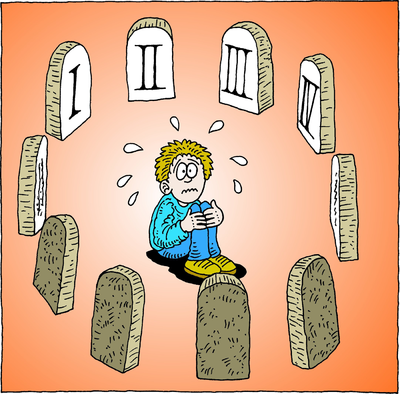
Fear of Judgment
deserves the wrath of God. However, as God's servant, i. e., a true believer, he has the right to plead, not God's justice, but rather God's mercy, in not imputing his sin to him. And the second line is, again, the acknowledgement that he deserves the wrath of God, with the additional acknowledgement that this is the natural condition of every human being (compare Ephesians 2:3). 

In theology, we would say that David is describing the doctrine of total depravity. This is the biblical teaching that every descendant of Adam (excepting Jesus alone) is a sinner from conception, with no natural ability to do spiritual good. 

David's profession is distressing to the human heart, because we all naturally want to believe in our worthiness and value. However, from God's perspective, which is that of perfect holiness, we all fall short of His standard (Romans 3:23). And, as David says, that shortfall earns us the judgment of God (Romans 6:23). There is no innocence, no age of accountability, no excuse because of ignorance. 

This is the knowledge that the unbeliever seeks to suppress (Romans 1:18). However, it is only as a person recognizes and acknowledges that he deserves the wrath of God that he can seek the only refuge from that wrath, under the blood of Jesus on the cross, applied to the believer by faith alone. 

Wednesday, August 4, 2021

Justification by Double Imputation, Through Faith Alone

Orthodox Protestants properly state that justification is by faith alone, without regard to works. That statement is true, and the only way of justification found in the Bible. But we are often week in defining what it is that is conveyed to the believer by means of - not on the basis of - his faith. What is conveyed to the believer is the negative obedience of Christ, i. e., His willing submission to the judgment of the Father for sin, and His positive obedience, i. e., His willing obedience to the law of God as the Second Adam.

The first cancels the sin debt that the elect carried for our sins, while the latter gives us a true righteousness in the eyes of God. 

"If faith in Christ is the only way to be righteous, to the exclusion of all the works of the sinner himself, then the sinner's righteousness with God consists exclusively of the works of Christ in his stead and on his behalf. In the saving work of God of justification the sinner's righteousness is solely the obedience of Christ - His lifelong, perfect obedience to all the commandments of the law in our stead and His obedience in our place to the demand of the law that we be cursed for our transgressions. 'By the obedience of one shall many be [constituted] righteous' (Romans 5:19)" Engelsma, Gospel Truth of Justification, p. 192.

For His negative obedience, we have many passages in the Bible, such as Isaiah 53:4-6: "Surely He has borne our griefs and carried our sorrows; yet we esteemed Him stricken, smitten by God, and afflicted. But He was pierced for our transgressions; He was crushed for our iniquities; upon Him was the chastisement that brought us peace, and with His wounds we are healed. All we like sheep have gone astray; we have turned—every one—to his own way; and the LORD has laid on Him the iniquity of us all." 

That passage is well-known, but how many can point to the imputation of his perfect obedience? " You will ordain peace for us, for You have indeed done for us all our works" (Isaiah 26:12). See also II Corinthians 5:21 and Hebrews 13:20-21. When we stand before Jesus, not to be judged, but to have His righteousness and mercy displayed before the universe, we will not be without works. Rather we shall bear His works! 

Saturday, July 31, 2021

God's Rest and His Blessed Sabbath for His People


I want to relate two passages of Scripture here. 

The first is Genesis 2:1-3: "Thus the heavens and the earth were finished, and all the host of them. And on the seventh day God finished His work that He had done, and He rested on the seventh day from all His work that He had done. So God blessed the seventh day and made it holy, because on it God rested from all His work that He had done in creation." This passage is well-known and straightforward. After six days of creative work, God rested on the seventh day. Not literally, of course, since God cannot tire. However, using an anthropomorphism, Moses describes God in terms that his readers could understand. Notice that God is not described as resting from everything, but specifically from the work of creation. The physical universe and its denizens were complete, as He had designed them to complement one another. 

However, one phrase is consistently overlooked: "and made it holy." That phrase necessarily relates to men, since God need do nothing in relationship to Himself to be holy. We will come back to that. 

The second passage is Hebrews 4:1-13: "Therefore, while the promise of entering His rest still stands, let us fear lest any of you should seem to have failed to reach it. For good news came to us just as to them, but the message they heard did not benefit them, because they were not united by faith with those who listened. For we who have believed enter that rest, as He has said, 'They shall not enter My rest,’ although His works were finished from the foundation of the world. For He has somewhere spoken of the seventh day in this way: 'And God rested on the seventh day from all His works.' And again in this passage He said, 'They shall not enter My rest.' Since therefore it remains for some to enter it, and those who formerly received the good news failed to enter because of disobedience, again He appoints a certain day, 'Today,' saying through David so long afterward, in the words already quoted, 'Today, if you hear His voice, do not harden your hearts.' For if Joshua had given them rest, God would not have spoken of another day later on. So then, there remains a Sabbath rest for the people of God, for whoever has entered God’s rest has also rested from his works as God did from His. Let us therefore strive to enter that rest, so that no one may fall by the same sort of disobedience. For the word of God is living and active, sharper than any two-edged sword, piercing to the division of soul and of spirit, of joints and of marrow, and discerning the thoughts and intentions of the heart. And no creature is hidden from His sight, but all are naked and exposed to the eyes of Him to whom we must give account." 

This passage is the theological explanation of what Jesus said during His earthly ministry: "The Sabbath was made for man, not man for the Sabbath" (Mark 2:27). 

There is a claim often made by anti-Sabbatarians that the Sabbath was part of the law of Moses, and was, therefore, abrogated along with the other ceremonies, such as the sacrifices and the food laws. When in response I have pointed to the reference from Genesis 2, these people have claimed that, since the word "Sabbath" isn't used in it, this passage refers only to an act of God, not to the continuing Sabbath. However, look at what I have already mentioned from Genesis 2:3, that God made the day holy. That can only refer to men's use of it, since God cannot do anything unholy. Also, notice in Hebrews 4 that the author there relates the rest awaiting believers in Heaven to God's rest, which, in turn, is withheld from unbelievers. It is even explicitly called a Sabbath rest in verse 9! How, then, can anyone claim that the Sabbath of the Fourth Commandment is different from God's rest in Genesis? 

To my mind, the logic of Hebrews 4 requires us to believe in the continuing validity of the Sabbath for Christians, not as a burden, but as a blessing intended for us by Jehovah, the Lord of the Sabbath, the preincarnate Jesus (Matthew 12:8).

Wednesday, July 28, 2021

Whom Does God Love? And Why?


A doctrine of humanism has seeped into the Christian Church: God loves everyone unconditionally. Thus, our culture has done away with the holiness and wrath of God. It is acceptable to say, "My god doesn't hate." That small "g" is not a typo; I did it on purpose, because that god is an idol, not the God of the bible. 

Even though it wasn't an issue in His time, Jesus said something which addresses this error: "The Father Himself loves you [i. e., the disciples], because you have loved Me and have believed that I came from God [the Father]" (John 16:27). So, His audience is His disciples, not people in general, and He gives a reason for the love of the Father to them, i. e., their love to Jesus and belief in His messianic work. 

Therefore, in one sentence, Jesus tells us that God does not love everyone; and that those whom He loves, it is on the condition of their relationship to, and, therefore, salvation by, Jesus His Son. The supposition that God loves everyone unconditionally is, thus, shown to be a doctrine foreign to biblical religion. 

Saturday, July 24, 2021

God, the Just Justifier

"The righteousness of God has been manifested apart from the law, although the Law and the Prophets bear witness to it— the righteousness of God through faith in Jesus Christ for all who believe. For there is no distinction: for all have sinned and fall short of the glory of God, and are justified by His grace as a gift, through the redemption that is in Christ Jesus, whom God put forward as a propitiation by His blood, to be received by faith. This was to show God’s righteousness, because in His divine forbearance He had passed over former sins. It was to show His righteousness at the present time, so that He might be just and the justifier of the one who has faith in Jesus."
- Romans 3:21-26 

In prehistory, when God decided to save a Church from their sins, God faced a dilemma (I am putting this in human terms). If sin is contrary to His nature, how could He save sinners without denying His own nature? How could God remain the holy deity which is He is, if He merely ignored the wickedness in men? As verse 26 puts it, how could God remain just while becoming the justifier of His people?

First, let us consider whether the wickedness of men is contrary to God's nature. The Prophet Habakkuk asks God this question: "You who are of purer eyes than to see evil and cannot look at wrong why do You idly look at traitors and remain silent when the wicked swallows up the man more righteous than he?" (Habakkuk 1:13). The prophet asks the exact question that we are considering. How can the righteous God, to whom evil is an alien and contrary condition, allow wicked men to continue? Such a God cannot receive the evil of men into His fellowship. Therefore, the problem of sin requires a solution. How can His justice be satisfied apart from the destruction of every sinner? 

Then another steps forward and volunteers. This one is Himself God; not a different God, but God the Son, both the one God and a distinct Person within the Godhead. He voluntarily offered Himself, sinless and holy, just as God the Father is, on behalf of those whom the Father would give Him to be His body the Church (John 6:37-39, 10:7-18, 17:1-19, Ephesians 5:25). As represented by the Mosaic priestly sacrifices, Jesus's priestly offering of Himself as the true sacrifice (Hebrews 9:14) achieved the Father's desire. His judgment of sin fell on His own Son, so that His justice was satisfied, and the justification thus purchased was imputed to His elect, so that He could become their justifier. 

"Apart from the obedience and death of Christ in the stead of elect sinners, God may not justify guilty sinners. Apart from the cross of Christ, God would show Himself unrighteous were He to justify the ungodly. the Christian gospel is not simply that God justifies the sinner who believes in Jesus Christ. The Christian gospel is that God justifies the sinner who believes in Jesus Christ, on the ground of Christ's substitutionary obedience, especially the obedience of His suffering and death" (Rev. David Engelsma, "Gospel Truth of Justification," p. 266; emphasis in the original).