Tuesday, June 29, 2010

Signs and Wonders and Heretics, Oh My!


"Beloved, do not believe every spirit, but test the spirits to see whether they are from God, for many false prophets have gone out into the world." - I John 4:1

The Apostle John here is applying a warning from the Law of Moses. In Deuteronomy 13:1-3, God through Moses gives a stern warning: "If a prophet or a dreamer of dreams arises among you and gives you a sign or wonder, and the sign or wonder that he tells you comes to pass, and if he says, 'Let us go after other gods,' which you have not known, 'and let us serve them,' you shall not listen to the words of that prophet or that dreamer of dreams. For the Lord your God is testing you, to know whether you love the Lord your God with all your heart and with all your soul." So, our God will sometimes allow a false teacher to prophesy or perform miracles, not as an endorsement, but rather as a test of the obedience of His people.

The same apostle himself prophesies of a marvelous wonder performed by the sea beast of the Revelation. In Rev. 13:1, he tells us, "One of its heads seemed to have a mortal wound, but its mortal wound was healed, and the whole earth marveled as they followed the beast." And again in 17:8, "The beast that you saw was, and is not, and is about to rise from the bottomless pit and go to destruction. And the dwellers on earth whose names have not been written in the book of life from the foundation of the world will marvel to see the beast, because it was and is not and is to come." John obviously doesn't believe that miracle-working is proof of divine sanction!

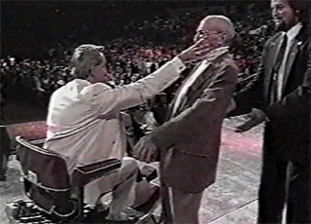
Yet, the astonishing thing is that, in spite of these warnings, every crackpot tent evangelist who can stage a few healings soon has crowds eating out of his (or often her) hands and sending their life savings by return mail. This though they are often Pelagians, Arians, or simply charlatans! Everyone knows that Jim Bakker went to prison for his activities, but others, notably Benny Hinn, are still on the road. Surely thousands are failing the test of faith spoken of in Deuteronomy.

Tuesday, June 15, 2010

Isaiah 64:6 and the Absurdity of Conditional Election

"We have all become like one who is unclean, and all our righteous deeds are like a polluted garment. We all fade like a leaf, and our iniquities, like the wind, take us away."

Some argue that the predestination spoken of by Paul, especially in Ephesians 1, is in response to foreseen faith and righteousness in the particular believer. This position is referred to as "conditional election." This is the opposite of the Reformed view of unconditional election.

However, as the Prophet Isaiah says above, no one (since the Fall of Adam, and excluding Jesus) has native righteousness. Our best deeds are as a polluted garment, a euphemism for a menstrual rag ("filthy rags", KJV). And Romans 3 gives a litany of Old Testament quotes, such as "no one seeks for God" (verse 11) and "no one does good, not even one" (verse 12), and "there is no fear of God before their eyes" (verse 18). So the case of the Arminian is that God's election of His people is dependent on the very qualities that Scripture says we don't have! The Arminian doctrine of election logically would mean that no one is elected, and therefore no one can be saved!

I would go even further: Paul says in Ephesians 2:8 that faith is the gift of God, and in Philippians 2:13 that He works in us to do His pleasure. And he states the same truth negatively in Titus 3:5, "He saved us, not because of works done by us in righteousness, but according to His own mercy." Now, if the faith and good works in a believer are the result of God's work within him, is it then not a tautology to say that they are the basis on which God elects His people? Given that sense, I would even find that doctrine acceptable. Clumsy, but tolerable. But it certainly isn't what the Arminian intended.

The problem here is that Arminians fail to understand Ephesians 2:1-2, "And you were dead in the trespasses and sins in which you once walked." Just as a dead body cannot act to restore its own life, the dead soul cannot regenerate itself. Arminians unconsciously insert "sick" for "dead", because a sick man can certainly act on his own behalf in restoring health. However, the Scriptures do not give them the wiggle-room that their human pride seeks. Before regeneration by the Holy Spirit, the soul is dead, and the faith and works that arise from it are dead and disgusting in God's eyes. It is only by His electing intervention in the heart of the believer that such a one can respond in faith and good works.

Thus we can see that the Arminian doctrine of conditional election depends on false premises, and is contrary to Biblical truth. There is security only in resisting our natural pride and resting in God's merciful election.

Saturday, June 12, 2010

Godly Wealth

"You shall remember the Lord your God, for it is He who gives you power to get wealth, that He may confirm His covenant that He swore to your fathers, as it is this day." - Deuteronomy 8:18

I have written before (here and here) about the corruption of godly desire for wealth by the prosperity gospel teachers, but I have been struck again by the simplicity of scripture on the matter.

Moses here plainly repeats God's own self-description as the one who enables His people to gain wealth. Does it involve hocus-pocus or writing a check to a fat-cat TV preacher? No!

I was struck again by the earthy (pun intended) wisdom of Proverbs tonight. Prov. 12:11 reads, "Whoever works his land will have plenty of bread, but he who follows worthless pursuits lacks sense." It is the diligent day-to-day labor that a person should do which God blesses in creating wealth. It isn't writing a check to the Mercedes-driving, hair-mousse-addicted TV preacher. Nor is it some get-rich-quick scheme suggested by an infomercial or chat-line psychic. It is simple diligent labor. What a radical concept!

The first half of the next verse is equally telling: "Whoever is wicked covets the spoil of evildoers..." I would suggest that this is an indictment of the one who ignores God's way to covet the lifestyle of the TV preacher. Just read the Proverbs. There are other verses that give good direction on a responsible wealth-building lifestyle. Try chapter 6, verses 6-11 as a start.

Thursday, June 10, 2010

Deuteronomy 9:4-6, Not for Our Righteousness


"Do not say in your heart, after the Lord your God has thrust them out before you, 'It is because of my righteousness that the Lord has brought me in to possess this land,' whereas it is because of the wickedness of these nations that the Lord is driving them out before you. Not because of your righteousness or the uprightness of your heart are you going in to possess their land, but because of the wickedness of these nations the Lord your God is driving them out from before you, and that He may confirm the word that the Lord swore to your fathers, to Abraham, Isaac, and to Jacob. Know, therefore, that the Lord your God is not giving you this good land to possess because of your righteousness, for you are a stubborn people."

On the verge of the conquest of the Promised Land, Jehovah yanks the reins of Israel. He knows that their wicked hearts would assume the credit for the promise, rather than to give the credit to His grace. In correcting that attitude, He lets them know that His blessings on them are not as wages to their righteousness, because they are instead a stubborn people, i.e., stubbornly wicked. This is the same declaration made at the other end of the Bible to the church at Laodicea, Revelation 3:17, "For you say, I am rich, I have prospered, and I need nothing, not realizing that you are wretched, pitiable, poor, blind, and naked." So, that spiritual pride can certainly not be described as a special quality of ethnic Israel.

Paul repeated that warning in Titus 3:5, "He saved us, not because of works done by us in righteousness, but according to His own mercy, by the washing of regeneration and renewal of the Holy Spirit."

In contrast, Jehovah calls Israel to obedience, lest they in turn be overthrown and banished from the land (see especially chapter 28, starting at verse 25). God at the beginning of Deuteronomy is scattering the rejected peoples to make way for Israel. But at the end, He threatens to scatter Israel to make way for another people. Deuteronomy 28:64 tells them, "And the Lord will scatter you among all peoples, from one end of the earth to the other..." And we see God carry out this threat twice, temporarily under the Assyrians and Babylonians, and then finally in the Roman conquest of 70 AD.

The same covenant promises and warnings are made to Christians. In Revelation 3:9, we see the initial replacement, this time of the unbelievers of ethnic Israel by the Christian Gentiles: "Behold, I will make those of the synagogue of Satan, who say they are Jews and are not, but lie - behold, I will make them come and bow down before your feet and they will learn that I have loved you." See also Romans 11:17-24. The covenant threats follow quickly in the Revelation, in the case of the church at Laodicea, which God threatens "to spit out of My mouth" (Rev. 3:16), followed by a very deuteronomish (is that a word?) warning in verse 19, "Those whom I love, I reprove and discipline, so be zealous and repent."

Christians today read the description of Israel in Deuteronomy 9, but consistently fail to recognize themselves in it. Too often, we say, "You go, God; let 'em have it!" without considering whether we are urging judgment on ourselves. If Israel received the promise contrary to their worth, in the grace of God alone, how can we be spiritually worthy? This is the error of attitude behind free-will theology, this concept of worthiness on our part. There is none. Instead, we are "wretched, pitiable, poor, blind, and naked."

Monday, May 24, 2010

The High Cost of the Cheapening of Human Life

"He who digs a pit will fall into it,
and a serpent will bite him who breaks through a wall."
- Ecclesiastes 10:8

I just read this insightful application of this verse by the late Rev. Rousas Rushdoony: "Since World War II, we have, to a great extent, set aside the death penalty for most cases of murder. We have cheapened life, and murders have increased to a very high number. By making life easier for murderers and criminals generally, we have made it less tenable for ourselves. We have fallen into a pit of our own making; we have broken the fence of God's law, and we have been smitten as transgressors."

By placing an inordinate value on the dregs of society, we have devalued the righteous and innocent.

Sunday, May 23, 2010

The Remaining Christian Sabbath

"So then, there remains a Sabbath rest for the people of God, for whoever has entered God's rest has also rested from his works as God did from His."
- Hebrews 4:9-10

The Sabbath was incorporated into the very first acts of God in His creation. After the six days of creation of Genesis 1, chapter 2 begins with the Sabbath. Verses 1-3 read, "Thus the heavens and the earth were finished, and all the host of them. And on the seventh day God finished His work that He had done, and He rested on the seventh day from all the work that He had done. So God blessed the seventh day and made it holy, because on it God rested from all His work that He had done in creation." So the Sabbath long preceded the ceremonial Law, and was not part of it, though recognized in it. However, in commemoration of that event, God instructed Moses to include it in the Law. Exodus 20:8-11: "Remember the Sabbath day, to keep it holy. Six days you shall labor, and do all your work, but the seventh day is a Sabbath to the Lord your God. On it you shall not do any work, you, or your son, or your daughter, your male servant, or your female servant, or your livestock, or the sojourner who is within your gates. For in six days the Lord made heaven and earth, the sea, and all that is in them, and rested the seventh day. Therefore the Lord blessed the Sabbath day and made it holy."

The theme is also picked up by the prophets. In Isaiah 58:13-14, the prophet tells us, "If you turn back your foot from the Sabbath, from doing your pleasure on My holy day, and call the Sabbath a delight and the holy day of the Lord honorable; if you honor it, not going your own ways, or seeking your own pleasure, or talking idly, then you shall take delight in the Lord, and I will make you ride on the heights of the earth; I will feed you with the heritage of Jacob your father, for the mouth of the Lord has spoken."

In the New Testament, Jesus acknowledges the Sabbath. For example, in Matthew 12:8, He declares Himself Lord of the Sabbath. Of course, as Jehovah in the flesh, He would have literally been the Lord of the Sabbath, even if He hadn't declared it explicitly. However, the fact that He did so is clear indication that He considered it part of the Old Testament typology that will be completed in Him, to be valued by Christians, for it hasn't been fulfilled, yet, as the writer of Hebrews, quoted above, reminds us.

Jesus's teaching on the Sabbath is clarified in Mark 2:27, which precedes the Marcan version of Mt 12:8, "The Sabbath was made for man, not man for the Sabbath." That is, He rejected the rules of the Pharisees which made the Sabbath a burden, restoring it to its original purpose, i.e., the rest from our labors that honors and celebrates the providence of God.

In Acts (such as Acts 13:14), we see the apostolic Christians attending synagogue on the Jewish Sabbath, then gathering as the church on the first day in celebration of the resurrection. There appears to be no explicit command for this transfer; apparently it happened spontaneously. For example, Acts 20:7 describes the believers gathering on the first day of the week to celebrate the Lord's Supper. Paul also mentions this practice in I Corinthians 16:2. In contrast, the same apostle dismisses the demands of the Judaizers that the Christians celebrate the other, ceremonial holidays, in Romans 15:4 and Galatians 4:10, or the Jewish Sabbath in Colossians 2:16. While the Christians may celebrate these days with their Jewish neighbors and kin, they are also free not to, as their individual consciences may dictate.

The writer of Hebrews reminds us in 4:9, that "there remains a Sabbath rest for the people of God..." Among its many blessings, the Sabbath reminds us that we can, even must, rest from our spiritual labors, because Jesus has fulfilled the requirements of the Law and satisfied the justice of God, which had been offended by the fall of Adam and all his posterity. However, the Sabbath continues to have an eschatological aspect, because we cannot yet rest from our spiritual warfare, against Satan and the remaining sin in our flesh. That work, too, will end in the resurrection, where we shall receive our new bodies, free of corruption, and Satan will be finally judged and removed from any influence in the world. That is the ultimate Sabbath that the weekly Sabbath points us to. That is why the Sabbath cannot cease to be a blessing as long as this life continues.

And finally, we find the Christian Sabbath mentioned in the last book of the Bible. The Apostle John mentions, in passing, Rev. 1:10, that he was in the Spirit on the Lord's Day, an alternate name for the Christian Sabbath. Thus, the emphasis on his personal spiritual exercise on the first day of the week, not the Jewish Sabbath, but rather the Christian.

Thus we see the biblical basis for the credal view of the Sabbath, from the first book of the Bible to the last. The Westminster Confession of Faith (XXI:7) says, "As it is the law of Nature, that, in general, a due portion of time be set apart for the worship of God; so, in His Word, by a positive, moral, and perpetual commandment, binding all men, in all ages, He hath particularly appointed one day in seven, for a Sabbath, to be kept holy unto Him: which, from the beginning of the world to the resurrection of Christ, was the last day of the week; and from the resurrection of Christ, was changed into the first day of the week, which in Scripture is called the Lord's Day, and is to be continued to the end of the world, as the Christian Sabbath."
Sunday, May 16, 2010

Whom Shall We Fear? God Alone!


"But you, O Israel, my servant,
     Jacob, whom I have chosen,
the offspring of Abraham, My friend;
     you whom I took from the ends of the earth,
and called from the farthest corners,
     saying to you, 'You are My servant,
I have chosen you and not cast you off';
     fear not, for I am with you;
be not dismayed, for I am your God;
     I will strengthen you, I will help you,
I will uphold you with My righteous right hand.

"Behold, all who are incensed against you
     shall be put to shame and confounded;
those who strive against you
     shall be as nothing and shall perish.
You shall seek those who contend with you,
     but you will not find them;
those who war against you shall be as nothing at all.
     For I, the Lord your God, hold your right hand;
it is I who say to you, 'Fear not,
     I am the one who helps you.'

"Fear not, you worm Jacob, you men of Israel!
     I am the one who helps you, declares the Lord;
your Redeemer is the Holy One of Israel."
- Isaiah 41:8-14

The Bible speaks much of the fear of the Lord: a reverence for Him that leads us to fear offending Him.

Deuteronomy 6:13: "It is the Lord your God you shall fear. Him shall you serve and by His name you shall swear."

Psalm 111:10: "The fear of the Lord is the beginning of wisdom; all those who practice it have a good understanding. His praise endures forever!" But the "beginning of wisdom" spoken of here isn't in the sense of "first", as one is the first of the numbers but otherwise the same. Rather it means "core, foundation, that which gives everything else meaning."

Proverbs 19:23: "The fear of the Lord leads to life, and whoever has it rests satisfied; he will not be visited by harm."

In our own time, where are we urged to give our fear? If a police officer says he has some questions for us, do we not all sweat? Or what about the IRS? Does the thought of an audit give us cuddly feelings? Of course not!

It has been estimated that the average American commits three felonies a day, without even realizing it. While we all understand that criminals properly have a fear of the civil law, our current political system is rather designed to cause the peaceable citizen to fear, even more than the criminal!

The Larger Catechism, Question 96, asks, "What particular use is there of the moral law to unregenerate men?" And answers, in part, "The moral law is of use to unregenerate men, to awaken their consciences to flee from the wrath to come, and to drive them to Christ." Ah, here in this concise summary of biblical teaching, we see the contrast. God's Law serves to strike the fear of Him in the heart of the unbeliever, such that he flees for mercy to Jesus Christ. To whom shall the citizen apply for mercy under secular law? That person, whether officer, judge, or bureaucrat, holds the power over the citizen, and revels in the awareness of that power.

Our time doesn't have temples devoted to emperor worship, the official religion of the ancient Romans. The Roman emperor didn't care whether the Christians loved and worshiped Jesus, as long as the emperor had the preeminence. It was the refusal to grant that preeminence that sent the Christians to the Coliseum! In the same way, the FBI won't object to our having Jesus in our hearts, in our homes, even in our churches, just as long as we don't let that devotion interfere with our devotion to the State Our Savior. This is the apostasy of our time.

And Jesus Himself warned us that such a choice would be forced upon us. In Matthew 10:28, He says, "Do not fear those who kill the body but cannot kill the soul. Rather fear him who can destroy both soul and body in hell." Our God is a jealous God, and will not allow us to give allegiance to the state now, no matter its abuse of us, and to continue to expect His favor in eternity. It is a stark choice: will I have the wrath of government in this life, or the wrath of God forever after?

While God may command our allegiance simply because He is God, yet He is also a gracious Father, and gives us blessed promises and encouragements to the right choice.

Deuteronomy 1:29-30: "Then I said to you, 'Do not be in dread or afraid of them. The Lord your God who goes before you will Himself fight for you, just as He did for you in Egypt before your eyes.'" Just as He overthrew the power of Pharaoh at the Red Sea, God goes before us in the defeat of our own self-deified state.

Joshua 1:9: "Have I not commanded you? Be strong and courageous. Do not be frightened, and do not be dismayed, for the Lord your God is with you wherever you go."

Psalm 27:1: "The Lord is my light and my salvation; whom shall I fear? The Lord is the stronghold of my life; of whom shall I be afraid?"

Isaiah 41:10: "Fear not, for I am with you; be not dismayed, for I am your God; I will strengthen you, I will help you, I will uphold you with My righteous right hand."

And Jesus speaking in John 16:33: "In the world you will have tribulation. But take heart; I have overcome the world."

So, what can we conclude? I want you to remember three things. First, that there are two conflicting claims on our spiritual fear. Shall it be God? Or shall it be the humanistic state, which pretends to deity? Second, this is a choice with eternal consequences: Shall we grant our fear to the state for our brief lives in exchange for the eternal wrath of God. And third, the true and living God has given us such comforting encouragements to strengthen us against the self-appointed god of this life.

May the Holy Spirit always recall these encouragements to our minds when we face these choices. Amen!