Saturday, April 23, 2011

Evangelicalism for the New Age?


I have written before of the abandonment of the Regulative Principle of Worship by Lake Forest Church, a local, very large congregation of the Evangelical Presbyterian Church. Now, in addition to creeping Popery, Lake Forest has added New Age spirituality to its eclectic mix.

For Easter, Lake Forest is promoting its "prayer labyrinth." Their website announces, "Come participate in an interactive visual and auditory journey of prayer in our Gathering Space meant to draw you deeper into a centered relationship with Christ." While such labyrinths have become commonplace among liberal churches, especially Episcopalian and Catholic, this is the first time I have heard of it in a professing evangelical church. Such labyrinths were absorbed by the state church from Roman paganism about the Fourth Century.

Lake Forest Pastor Mike Moses promotes the labyrinth on his personal blog. Note that he refers to not even one Scripture as a justification for the labyrinth. Rather, he tells us, "The inward journey – ‘letting go’ or shedding. The middle of the journey – centering. The outward journey – incarnation." That isn't biblical Christianity; that is New Age psychobabble!

Moses does refer to one (and only one) Scripture in his blog post, Romans 14, implying that the one who refuses to participate in the labyrinth is "the weaker brother." But I would refer Rev. Moses to I Corinthians 10: 14, "Therefore, my beloved, flee from idolatry." And verse 20, "what pagans sacrifice they offer to demons and not to God. I do not want you to be participants with demons." I suggest that, by adopting a pagan ceremony, Lake Forest Church is fellowshipping with demons.

Wednesday, April 6, 2011

The Bereans and Christian Apologetics


"Now when they had passed through Amphipolis and Apollonia, they came to Thessalonica, where there was a synagogue of the Jews. And Paul went in, as was his custom, and on three Sabbath days he reasoned with them from the Scriptures, explaining and proving that it was necessary for the Christ to suffer and to rise from the dead, and saying, 'This Jesus, Whom I proclaim to you, is the Christ.' And some of them were persuaded and joined Paul and Silas, as did a great many of the devout Greeks and not a few of the leading women."
- Acts 17:1-4

In our Wednesday evening service tonight at church, we started a video series by R. C. Sproul on apologetics. The elder who was leading started us with reading a couple of relevant Bible texts, including I Peter 3:15 and Acts 17, part of which I have quoted above.

That portion reminded me of the book pictured here, which I received recently from Amazon. Note that I haven't read it, yet, so I'm not necessarily endorsing it. I merely note its relevance to the matter at hand.

I also thought of Isaiah 55:11, "[S]o shall My word be that goes out from My mouth; it shall not return to Me empty, but it shall accomplish that which I purpose, and shall succeed in the thing for which I sent it."

I notice in the Mars Hill (or Areopagus, depending on version) story (Acts 17:16-34), Paul didn't preach on justifying what Scripture teaches. Rather, he taught the Scriptures as authoritative and sufficient in themselves. A former pastor of mine advised the congregation to point out what Scripture says on a matter, then to stop, and let the Holy Spirit work. Afterall, the Scriptures are His word, and He will sustain and apply them, as Isaiah promised. He doesn't require us to protect Him from opposition. When Paul followed that advice, though he was an apostle with the authority that office carries, Jews and Greeks were converted!

Sunday, April 3, 2011

Baptism and the Visible/Invisible Church Dichotomy


This morning at church (The Associate Reformed Presbyterian Church of Huntersville) we had both an infant baptism and communion. I heard it called "Sacrament Sunday" several times. While communion was occurring as regularly scheduled, it is unusual to have both sacraments together. The subject of "why baptize infants" came up in Sunday School, and was also the subject of the sermon. I have addressed the biblical basis for the baptism of the infant children of believers before (see here, here, and here; and regarding the mode of baptism, here, here, here, and here), so I won't repeat that here. Rather, I want to address why paedobaptists, i.e., those who baptize the infant children of believers, see this, while credobaptists, i.e., those who advocate believers' baptism only, don't. Note that my reasoning here is a Reformed position, and is not intended to explain the views of Lutherans, Anglicans, Catholics, or Eastern Orthodox.

I think that the problem is that credobaptists seek to apply the characteristics of the invisible church to the visible church.

The Westminster Larger Catechism, Question 62, defines the "visible church" as "a society made up of all such as in all ages and places of the world do profess the true religion, and of their children." That is, an organization on earth, such that one can point to it, and say, "there it is." Scripture uses this sense in such places as Romans 16:3-5, in reference to the church that met in the house of Priscilla and Aquila.

In contrast, Question 64 defines the invisible church as "the whole number of the elect, that have been, are, or shall be gathered into one under Christ the head." Scripture uses this sense in such places as Ephesians 1:22-23, "the church, which is his body..."

The visible church is as man sees it, while the invisible church is as God sees it. The latter is necessarily pure, because God knows our hearts. The first cannot be pure, because men have no infallible means of perceiving the hearts of other men (and imperfectly even their own). The credobaptist expects the visible church to be equivalent to the invisible church, even though this is beyond the ken of mortal men. That is what blinds him to the status of the children of believers (see I Corinthians 7, especially verse 14). By maintaining this dichotomy, the paedobaptist experiences no dissidence in the baptism of someone who is not, and, in fact, may never be, a believer.

Saturday, April 2, 2011

Election and Reprobation in the Words of Jesus


"Then the disciples came and said to Him, 'Why do You speak to them in parables?' And He answered them, 'To you it has been given to know the secrets of the kingdom of heaven, but to them it has not been given. For to the one who has, more will be given, and he will have an abundance, but from the one who has not, even what he has will be taken away. This is why I speak to them in parables, because seeing they do not see, and hearing they do not hear, nor do they understand. Indeed, in their case the prophecy of Isaiah is fulfilled that says: “You will indeed hear but never understand, and you will indeed see but never perceive. For this people’s heart has grown dull, and with their ears they can barely hear, and their eyes they have closed, lest they should see with their eyes and hear with their ears and understand with their heart and turn, and I would heal them." But blessed are your eyes, for they see, and your ears, for they hear. For truly, I say to you, many prophets and righteous people longed to see what you see, and did not see it, and to hear what you hear, and did not hear it.'"
- Matthew 13:10-17
 

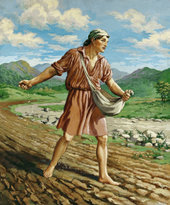
This exchange between the Lord and His disciples occurred immediately after His giving of the Parable of the Sower (Matthew 13:1-9). They wanted to know why He told truths in parables, rather than explaining them in plain words, i.e., in "layman's terms" as we might say today. His answer is astounding, verse 11: "to them it has not been given." The Arminian cannot explain His words, but they flow naturally from the Calvinist perspective: Jesus is teaching the doctrine of election, in that He has chosen them to understand. And He is teaching reprobation, in that He intentionally withholds comprehension from others.

This confronts the errors of some that hold that the doctrines of grace are somehow a distortion of the Gospel taught only by Paul (as if that would invalidate them anyway). And it also undermines the equivocations of those "red-letter" Christians who believe that the words of Jesus alone are authoritative. And there is no wiggle-room for the Arminians who seek to deprive election of any meaning by making it contingent on some foreseen quality in the elect. Jesus claims this choice as His own sovereign act of will.

I personally wouldn't have it any other way. I am content to depend on these other words of His, from John 15:5, "
I am the vine; you are the branches. Whoever abides in Me and I in him, he it is that bears much fruit, for apart from Me you can do nothing."

Monday, March 21, 2011

Ephesians 5:25 and Limited Atonement at Its Simplest

"Husbands, love your wives, as Christ loved the church and gave Himself up for her."

If one asks the question, "For whom did Christ die?", no more-straightforward answer than this one can be given. For her, i.e., the Church! Can it be more explicit? Here is limited or particular atonement in one sentence! One must really struggle to avoid that consequence of this verse. While it would be correct to say that it is not the thrust of Paul's intent to explain that doctrine here, it is necessary to recognize that it is his assumption of it that provides the basis of his instruction to the Christian husband.

Saturday, March 12, 2011

Strange Fire: The Abandonment of Sola Scriptura by American Evangelicals


I have written before about the abandonment of the opposition to Rome by modern Protestantism. Today, I want to write about the abandonment of Protestantism itself.

The Reformers established five principles which divided them from Rome, traditionally designated by their Latin forms: sola fide, sola gratia, sola Christus, sola scriptura, and soli gloria Deo. You can go here for my explanation of them.

Here in my hometown, a large church, called Lake Forest Church, promoted its Ash Wednesday service in the local newspaper (no longer available online). Lake Forest is a congregation of the Evangelical Presbyterian Chrurch, but check their website, and see how hard you have to look to find that connection. It never appears in their promotional announcements and advertising. According to the article, Lake Forest Pastor Mike Moses extolled the event on the basis that his congregation is "a modern church that delights in ancient practices."

And there lies my objection: instead of the Reformation principle of sola scriptura, scripture alone, Moses uses the Roman Catholic standard, i.e., tradition. As the Westminster Confession (XXI:1) says, "the acceptable way of worshiping the true God is instituted by Himself, and so limited by His own revealed will, that He may not be worshiped according to the imaginations and devices of men, or the suggestions of Satan, under any visible representation or any other way not prescribed in the holy Scripture." The Larger Catechism, answer 109, reads in part, "The sins forbidden in the second commandment are all devising, counseling, commanding, using, and anywise approving, any religious worship not instituted by God Himself." As a Presbyterian Church, the EPC, and Lake Forest Church as an affiliate thereof, are constitutionally committed to the WCF as its primary subordinate standard of doctrine (however, the EPC has extensively amended the WCF, and may actually have removed this passage; I simply don't know).

The WCF position, commonly referred to as "the regulative principle of worship," is based primarily on Deuteronomy 12:32, "Everything that I command you, you shall be careful to do. You shall not add to it or take from it." But it can be seen historically in the story of Aaron's sons, Nadab and Abihu, whom God executed for offering "strange fire," or "unauthorized fire" as worded by the ESV, on the altar of the tabernacle. See Leviticus 10:1, Leviticus 16:1, Numbers 3:4, and Numbers 26:61, for references to the story. Further explanation can be found in this article from Archibald Alexander Hodge, the son of Charles Hodge.

What separates Protestants from Catholics is that Protestants ask, "What do the Scriptures say?" while the Catholic apologetic appeals to the historicity of a practice. My question to Rev. Mike Moses is this: Human sacrifice is far more ancient than Ash Wednesday: according to your theology, does that make it equally- or even more valid? Sola scriptura gives one answer, but your apologetic seems to lead to another.

Sunday, February 27, 2011

According to the Koran, All Muslims Should Become Christians!

"We sent after them in their footsteps Jesus, son of Mary, verifying that which was before him of the Torah; and We gave him the Gospel containing guidance and light, and verifying that which was before it of the Torah, and a guidance and an admonition for the dutiful. And let the People of the Gospel judge by that which Allah has revealed in it. And whoever judges not by what Allah has revealed, those are the transgressors."
- The Koran, Sura 5, verses 46-47

We find something here in the Islamic Scriptures that I find very interesting. They teach that the Gospel, i.e., what Christians call the New Testament, was given to Jesus to provide guidance to His followers. And the final sentence clearly states that anyone who refuses to judge spiritual truth by the New Testament is a transgressor. There is no indication here of what has become a tradition among Muslims, that the Gospel has been corrupted.

They hold that Jesus was a great prophet. To my mind, that should indicate that what He said of Himself must therefore be taken as truth from God.

John 8:58, "Jesus said to them, 'Truly, truly, I say to you, before Abraham was, I am.'" Here, Jesus claims for Himself the divine name of God, I Am, found in Exodus 3:14, i.e., the very Torah of Moses that the Koran claims was confirmed by Jesus in the Gospel.

John 10:30, "I and the Father are one." Jesus identifies Himself with God the Father, not in Person, but in nature, using again the words of Moses, from Deuteronomy 6:4.

John 14:7, "If you had known Me, you would have known My Father also. From now on you do know Him and have seen Him.” And 14:9, "Whoever has seen Me has seen the Father." Jesus claims that to know Him is to know the Father.

John 16:15, "All that the Father has is Mine." Here is a clear claim to divine omnipresence and omniscience, for they are logically necessary to identify all that is the Father's.

John 17:11, "Holy Father, keep them in Your name, which You have given me, that they may be one, even as We are one." In this portion of what is called His High Priestly Prayer, Jesus again claims a clear identification of Himself with His Heavenly Father.

John 20:28-29, "Thomas answered Him, 'My Lord and my God!' Jesus said to him, 'Have you believed because you have seen Me? Blessed are those who have not seen and yet have believed.'" Here, in a post-resurrection meeting, the Apostle Thomas proclaims His recognition of Jesus as Lord and God! If it weren't so, shouldn't Prophet Jesus have protested against Thomas's declaration as idolatry? That is exactly the accusation that Muslims make against Christians. Apparently, Jesus is guilty of the same sin! But then the Muslim is trapped by his own logic, because a man cannot be a great prophet if he allows idolatry!

My point here is that the very beliefs of Islam, if followed consistently, must force the Muslim to become a Christian. And I will offer the Muslim one even more-compelling reason, again in Jesus's own words, John 14:6, "
Jesus said to him, 'I am the way, and the truth, and the life. No one comes to the Father except through Me.'" Jesus declares that there is no way for access to God in heaven without His mediation. But He also gives this promise, John 6:37, "All that the Father gives Me will come to Me, and whoever comes to Me I will never cast out." We have His promise to receive all who come to Him, that we may know without doubt that we have received eternal life. Is that an assurance that Islam can give you?