Showing posts with label ruth. Show all posts

Monday, October 30, 2017

The Mission of the Church: Our Marching Orders

     In our original creation, God gave our first parents certain responsibilities in the new world. As the bearer of the imago dei, Adam was given the tasks of exercising dominion in the world, reproducing, and organizing the fruitfulness of the world (Genesis 1:26-30). In these ways, Adam was to be God’s viceroy, exercising a role analogous to that of God, but subordinate to Him. However, Adam rebelled against God, and marred the image, such that his descendants bore, not the image of God, but rather the image of Adam (5:3). As a result, Adam was cursed with death, and all his labors were cursed with futility, and His wife was cursed in all her familial relations (3:16-19). Yet, the viceroyal calling of Adam was not revoked, as we see in its renewal to Noah after the Flood: “Then God blessed Noah and his sons, and said to them, ‘Be fruitful and multiply and fill the earth. Every beast of the earth and every bird of the sky and all that moves on the earth and all the fish of the sea will fear you and be terrified of you. Every moving thing that lives will be food for you. I give you everything, just as I gave you the green plant” (Genesis 9:1-3).
    We continue to see hints of this dominion covenant as the covenantal history continues. For example, we see God’s promise to Abraham that all the nations will be blessed through him (e. g., Gen. 12:2-3). Part of this plan is seen in the mediatorial role that God gives His people toward the rest of the world, such as Abraham’s intercession in 18:22-33, and Jacob’s altar work in 35:1-15. The godly seed are called to rulership, such as in 27:29, 41:38-49, and 49:10: “The scepter shall not depart from judah, nor a lawgiver from between his feet, until Shiloh comes; and to him will be the obedience of the people.”
    Under the Old Covenant, this calling reached its pinnacle in the royal priesthood: “You will be to Me a kingdom of priests and a holy nation” (Exodus 16:6). Yet, this calling was not limited to israel or to the Mosaic economy, as the Apostle Peter made clear: “You are a chosen race, a royal priesthood, a holy nation, a people for God’s own possession, so that you may declare the goodness of Him who has called you out of darkness into His marvelous light” (I Peter 2:9). Peter expands the calling explaining it as a responsibility to represent Him who bought us to the unbelieving rest of the world. He says that, as priests, we are to offer up spiritual sacrifices (verse 5). What are those sacrifices? Our bodies (Romans 12:1), our material possessions (Philippians 4:18), our praises (Hebrews 13:15), and our prayers (James 5:16). Thus, everything in our day to day lives is subservient to our calling as priests. Our bodies are to be given for the work of God. Our possessions are to be given for the work of God. Our praises are to be given in our work (as Piper says, “Missions is not the ultimate goal of the church. Worship is. Missions exists because worship doesn’t. Worship is ultimate, not missions, because God is ultimate, not man. When this age is over and the countless millions of the redeemed fall on their faces before the throne of God, missions will be no more. It is a temporary necessity. But worship abides forever,” p. 35). And our prayers are to be offered for each other and for the recipients of our message.
    As God’s nation of priests, Israel was explicitly instructed to portray Him to the nations. There was both a passive sense of this mission, such as in Deuteronomy 4:6: “Therefore, keep and do them [i. e., the Law], for this is your wisdom and your understanding in the sight of the nations which shall hear all these statutes, and say, ‘Surely this great nation is a wise and understanding people.’” Among other things, the Law was intended by God (preceptually speaking, not in the sense of a failed decree) to make His people a shining example to the pagan nations around them. This theme, too, was repeated in the New Testament: “You are the light of the world. A city that is set on a hill cannot be hidden. Neither do men light a candle and put it under a basket, but on a candlestick, and it gives light to all who are in the house. Let your light so shine before men that they may see your good works and glorify your Father who is in heaven” (Matthew 5:14-16).
    It is this shining example that leads to the fulfillment of the promises of the Father to the Son: “All the ends of the world will remember and turn to the LORD, and all the nations will worship before You” (PSalm 22:27). Notice especially here the fulfillment of Piper’s thesis of missions leading to worship. Also, “Thus says the LORD of hosts, in those days ten men from every language of the nations will take hold of the garment of a Jew, saying, ‘Let us go with you, for we have heard that God is with you’” (Zechariah 8:23). Thus, we see that a missionary concern didn’t start with the New Testament.
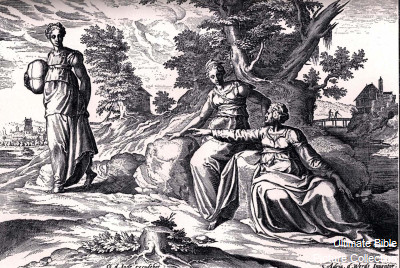
    The missionary calling of Israel was not merely passive, however. God’s calling to them was a call to action: “Let all the nations be gathered together, and let the people be assembled… [For] you are My witnesses, says the LORD, and my servant whom i have chosen, that you may know and believe Me, that I am He… I, even I, am the LORD, and besides Me there is no Savior… therefore, you are My witnesses, that I am God” (Isaiah 43:9-12). God reveals Himself to israel, with the explicit intent that that nation would then be His witnesses, His missionaries, to the rest of the world. While Israel fell far short of her calling, her failure wasn’t absolute. We have the story of Ruth, in which a Moabitess comes to believe in the true God (1:!6), in spite of the restriction in Deuteronomy 23:3, and becomes an ancestress both of King David and of Jesus Christ.
    Another principle in the Old Testament is the creation of the new heavens and new earth: “I create a new new heavens and a new earth; the former things shall not be remembered or come to mind. But be glad and rejoice forever in that which I create, for I create Jerusalem for rejoicing and her people for joy. I will rejoice in jerusalem and be glad in my people; and the voice of weeping shall no longer be heard in her, nor the voice of crying” (Isaiah 6517-19). In this new heavens and new earth, “All flesh shall come to worship before Me, says the LORD” (66:23). Peter adds that, “according to his promise, we are waiting for new heavens and a new earth, in which righteousness dwells” (II Peter 3:13). Contrary to the claims of the premillennialists, this cannot be a reference to the eternal state, because there will still be death and a need to eat (Is. 65:20). Rather, this is a description of the New Jerusalem, the church in its prosperity (ibid., verses 18-19, Heb. 12:220, where righteousness shall dominate (II Peter 3:13), though some sinners remain (Is. 65:20). This is a description of the result of the mission of God, a prosperous church in a world, not where the curse has been completely eliminated, but in which the Gospel has created a world in which the nations are largely converted and living lives commensurate to their spiritual state: “There shall no longer be an infant who lives only a few days, nor an old man who has not filled out his days. For the child shall die a hundred years old, but the sinner being a hundred years old shall be accursed” (ibid.).
    It is against this Old Testament background that we see the significance of the missionary heart of Jesus: “Jesus went throughout all the cities and villages, teaching in their synagogues, preaching the gospel of the kingdom… But when he saw the crowds, he was moved with compassion for them, because they fainted and were scattered, like sheep without a shepherd. Then He said to His disciples, ‘the harvest truly is plentiful, but the laborers are few. Therefore, pray to the Lord of the harvest, that He will send out laborers into His harvest” (Matthew 9:35-38). This reveals three things about the divine mission: first, it is based on the compassion of Jesus; second, it is the responsibility that he gives to His disciples; and third,  a missionary goes out only by the calling and sending of God (compare Isaiah 6:9). This is an astonishing passage, because we know that the purpose of Christ was to redeem the elect (john 3:16, Ephesians 5:25, etc.). However, this passage shows us that, separate from the issue of election, He was not blind to the rest of humanity, but was, rather, filled with sorrow by their sin, spiritual blindness, disease, futility, and even their stubbornness. Consider His statement in Matthew 23:37: “O Jerusalem, Jerusalem, you who kill the prophets and stone those who are sent to you, how often I would have gathered your children as a hen gathers her chicks under her wings, but you would not!” These same people that he condemned to judgment for the murder of the prophets (see the previous verse and the Parable of the tenants, Matthew 21:33-44), brought Him to tears of sorrow over their hardheartedness.
    Out of this compassion, Jesus passed His missionary heart on to His disciples in the Great Commission. So important is this to God that the Holy Spirit inspired it over and over, as the Apostles wrote the New Testament. Of course, the best-known version is that of Matthew 28:18-20: “Jesus came and spoke to them, saying, ‘All authority has been given to Me in heaven and earth. Go, therefore, and make disciples of all nations, baptizing them in the name of the Father and of the Son and of the Holy Spirit, teaching them to observe all things I have commanded you. And remember, I am with you always, even to the end of the age.’” These three sentences teach us two main things about the call of Jesus to evangelize. First, our mission is not a power in ourselves, but is, rather, dependent on His mediatorial kingship. The mission of the Christian is to serve as the frontline combatant in Christ’s conquest of the nations (Revelation 11:15). He has already gained all of the authority necessary to apply His claims to the nations: “I have installed My king on Zion, My holy hill. Ask of Me, and I will give You the nations for Your inheritance, and the ends of the earth for Your possession” (Psalm 2:6, 8). The Father promised Him the nations, and the Great Commission is His claim to that which was promised. So important is this authority to our mission that He mentions it twice, as the basis of our mission, and as the unfailing encouragement to continue the battle, even in the face of apparent failures. Second, the Great Commission indicates what a mission is, the things that our divine and royal general has given us to do. Not just to proclaim the Gospel, and not just to win a convert here and another there, but, through His effectual authority, to disciple the nations, which means to convert them, to baptize them, and to train them in obedience to God’s word. This is not evangelism as extraction from the world, but as overcoming the world!
    In Mark 16:15, we have the words of Jesus explicitly to the Eleven: “Go into all the world, and preach the Gospel to every creature. He who believes and is baptized will be saved. But he who does not believe will be condemned.” This version of the Great Commission appears to be aimed specifically at the Apostles, not disciples in general, both because of the introduction to it (verse 14), and also because of the miraculous consequences. The extraordinary signs were for the verification of the ministry of the Apostles ( Mark 16:20, Acts 14:3, II Corinthians 12:12, Hebrews 2:3-4). However, it does indicate to all Christians the importance of profligate proclamation of the Gospel.
    Finally, in His last earthly sermon, Jesus announced to the gathered, but frightened, Church, “You
shall receive power when the Holy Spirit comes upon you. And you shall be My witnesses in Jerusalem, and in Judea and Samaria, and to the ends of the earth” (Acts 1:8). We see some of the same themes from Matthew, but made more explicit. There, the Lord had promised the power of His authority in the mission of the Church. Here He tells them that that authority would work by the presence of the Holy Spirit. There, He had sent them to all nations. Here He assigns them a concentric geographical series to achieve that assignment: Start in jerusalem, your current environs, then expand to the immediate surrounding area of Judea and Samaria, and then on to the rest of the nations of the world. We quickly see the fulfillment of this battle plan, as the persecution that broke out after the stoning of Stephen first drove disciples into Samaria (Acts 8:5), then to Gentiles in general (ibid., 10:45), and then to more-distant regions (ibid., 11:19). Paul took it to the final stage in deliberately seeking out unreached regions for his mission: “I have strived to preach the Gospel, [but] not where Christ was named, so that I should not build on another man’s foundation” (Romans 15:20).

Saturday, April 1, 2017

God's Common Goodness Is No Common Grace


In Matthew 5:45, Jesus tells us, "[God] makes His sun rise on the evil and on the good, and sends rain on the just and on the unjust." This is a precious truth, that God is the source of all good things, and that He shares His gifts with all men. God is good to all because God is all good!

However, a problem arises when some people claim that God's common goodness is properly common grace. That is an idea that I cannot accept.

Consider the further words on Jesus in Mark 7:24-30: "He arose and went away to the region of Tyre and Sidon. And He entered a house and did not want anyone to know, yet He could not be hidden. But immediately a woman whose little daughter had an unclean spirit heard of Him and came and fell down at His feet. Now the woman was a Gentile, a Syrophoenician by birth. And she begged Him to cast the demon out of her daughter. And He said to her, 'Let the children be fed first, for it is not right to take the children’s bread and throw it to the dogs.' But she answered Him, 'Yes, Lord; yet even the dogs under the table eat the children’s crumbs.' And He said to her, 'For this statement you may go your way; the demon has left your daughter.' And she went home and found the child lying in bed and the demon gone."

Jesus was referring to His own comment in Matthew 15:24: "I was sent only to the lost sheep of the house of Israel." During His earthly ministry, His focus was only on ethnic Israel. Of course, that expanded to the entire world after His ascension, but that was later. When this foreign woman came to Him, He was still in the transitional state between the Old Covenant focus on Israel and the New Covenant inclusion of all nations. Yet, the woman said, even when the chosen children are enjoying the feast, there are scraps which fall to the dogs. The Book of Ruth would be an expanded image of what she means.

The application here is the parallel between the children and the dogs in this vivid story and the children of God and the rest of the world in Matthew 5:45. The wicked, when they are enjoying the good gifts of God, are not enjoying God's favor to them, but are rather receiving the overflow from His blessings on His own people, His children, the church. Why isn't this grace? Because it is not to their advantage. Grace is God's favor, the application of Christ's merits, but that isn't what the reprobate are receiving (Romans 1:21):"For although they knew God, they did not honor him as God or give thanks to him, but they became futile in their thinking, and their foolish hearts were darkened." Is this blessing for them? Not at all. Rather, as Paul goes on to say, this arrogant and presumptuous use of God's gifts brings these unbelievers to grief (Romans 1:28-29): "And since they did not see fit to acknowledge God, God gave them up to a debased mind to do what ought not to be done. They were filled with all manner of unrighteousness, evil, covetousness, malice."

Saturday, August 31, 2013

Ruth 2:1-16, the Overflowing Covenant

[Because of the length of this passage, I'm not going to quote the whole thing, but rather refer to particular verses in it.]

Do you ever read portions of Scripture which just move your heart? Portions that give you a particular sense of gratitude to God and peace in His covenant? For me, Ruth, chapters 1 and 2, were such a portion. While I definitely believe that Ruth is historical, not allegorical, I also see in it strong and gratifying types of Jesus Christ, the ultimate biological expression of the events of the book.

In the first verse, we are introduced to Boaz, a kinsman of Ruth's late husband. In Hebrew, his name means "in him is strength," one of the clues that he is to be taken as a type for Jesus, his lineal descendant. The typology is reinforced by the placing of the events of the book, except the sojourn in Moab, in Bethlehem. The second verse describes Ruth supporting herself and her mother-in-law, Naomi, through gleaning, a biblical form of support for the indigent, established in Leviticus 19:9-10.  See also Deuteronomy 24:19. How beautiful it is to see this type of Christ providing his overflowing benefits to this alien from the covenant!

In verse 12, we have Boaz saying of Ruth, that she had "taken refuge under the wings" of Jehovah, an obvious indication of her true conversion. This was something that hadn't been clear earlier. In Ruth 1:16, Ruth had said that Naomi's God would be her God, but it wasn't clear that this was conversion, rather than mere loyalty to her mother-in-law. We see it confirmed, now, that Ruth had truly received the God of Israel by faith. This is a vibrant example of what is described in James 2:5, "Has not God chosen those who are poor in the world to be rich in faith and heirs of the kingdom?"

In verses 15 and 16, we see Boaz instructing his workers to give Ruth her gleanings, not from the post-harvest field alone, but even from that portion of the harvest which had been gathered for the storehouses. God does indeed bless His people with fruitfulness. He promises this in Deuteronomy 16:15, "The Lord your God will bless you in all your produce and in all the work of your hands." But His blessing isn't just a blessing of sufficiency, but rather a blessing which overflows even to the unbelievers around us! We see this described in Matthew 15:26-28, especially verse 26, "Even the dogs eat the crumbs that fall from their masters' table."

In chapter 1, I described Ruth's envy of Israel's covenantal relationship with Jehovah. Now, here in chapter 2, we see here experiencing second-hand those same covenantal blessings. Why? Because was now herself in covenant with the faithful, covenant-keeping God! This is a type of us! We who were once strangers of the covenant (Ephesians 2:12), have now received the benefits of the covenant, through the Jews (Romans 11:11-12)! This is because Boaz's descendant, Jesus Christ (Matthew 1:5), of whom Boaz was a type, received blessings from His Father to pass to us, His covenant people (John 15:15 and 17:18)! We have gleaned grace, sanctification, and glorification yet to come, typified here by Ruth, from the overflowing blessings of this same covenant-keeping God! To me, that is a source of great joy and comfort!

Saturday, June 8, 2013

Covenantal Envy in Ruth 1:6-18

"Then Naomi arose with her daughters-in-law to return from the country of Moab, for she had heard in the fields of Moab that the LORD had visited his people and given them food. So she set out from the place where she was with her two daughters-in-law, and they went on the way to return to the land of Judah. But she said to her two daughters-in-law, 'Go, return each of you to her mother’s house. May the LORD deal kindly with you, as you have dealt with the dead and with me. The LORD grant that you may find rest, each of you in the house of her husband!' Then she kissed them, and they lifted up their voices and wept. And they said to her, 'No, we will return with you to your people.' But Naomi said, 'Turn back, my daughters; why will you go with me? Have I yet sons in my womb that they may become your husbands? Turn back, my daughters; go your way, for I am too old to have a husband. If I should say I have hope, even if I should have a husband this night and should bear sons, would you therefore wait till they were grown? Would you therefore refrain from marrying? No, my daughters, for it is exceedingly bitter to me for your sake that the hand of the LORD has gone out against me.' Then they lifted up their voices and wept again. And Orpah kissed her mother-in-law, but Ruth clung to her. And she said, 'See, your sister-in-law has gone back to her people and to her gods; return after your sister-in-law.' But Ruth said, 'Do not urge me to leave you or to return from following you. For where you go I will go, and where you lodge I will lodge. Your people shall be my people, and your God my God. Where you die I will die, and there will I be buried. May the LORD do so to me and more also if anything but death parts me from you.' And when Naomi saw that she was determined to go with her, she said no more."

 I am thinking about this passage as I prepare to substitute for the teacher of my Sunday School class tomorrow.

 It seems to me that the key verse for understanding the Book of Ruth is here, the latter part of the sixteenth verse of the first chapter: "Your people shall be my people, and your God my God." Note that I am not turning the book into an allegory, but rather seeking the purpose for including this historical event in the inspired text. Note the parallel phrasing here with the covenantal declarations of God: "I will be your God and you shall be My people," such as in Exodus 6:2-7, Leviticus 26:6-13, and Ezekiel 36:22-28. In those passages, it is Jehovah speaking in the first person of the covenant which He Himself is initiating, i.e., the Covenant of Grace. In contrast, Ruth is speaking only in the second person, referring to Naomi's people and Naomi's God. That is because she is speaking as one outside that covenantal relationship.

This is actually within the revealed purposes of God's covenant. In Deuteronomy 4:6, He says to Israel, "Keep them [i.e., the Law] and do them, for that will be your wisdom and your understanding in the sight of the peoples, who, when they hear all these statutes, will say, 'Surely this great nation is a wise and understanding people.'" Also Ezekiel 36:15-23, "And I will not let you hear anymore the reproach of the nations, and you shall no longer bear the disgrace of the peoples and no longer cause your nation to stumble, declares the Lord GOD. The word of the LORD came to me: 'Son of man, when the house of Israel lived in their own land, they defiled it by their ways and their deeds. Their ways before Me were like the uncleanness of a woman in her menstrual impurity. So I poured out My wrath upon them for the blood that they had shed in the land, for the idols with which they had defiled it. I scattered them among the nations, and they were dispersed through the countries. In accordance with their ways and their deeds I judged them. But when they came to the nations, wherever they came, they profaned My holy name, in that people said of them, 'These are the people of the LORD, and yet they had to go out of his land.' But I had concern for My holy name, which the house of Israel had profaned among the nations to which they came. 'Therefore say to the house of Israel, Thus says the Lord GOD: It is not for your sake, O house of Israel, that I am about to act, but for the sake of My holy name, which you have profaned among the nations to which you came. And I will vindicate the holiness of My great name, which has been profaned among the nations, and which you have profaned among them. And the nations will know that I am the LORD, declares the Lord GOD, when through you I vindicate my holiness before their eyes.'"

 Having ignited this envy among Israel's pagan neighbors, how did Jehovah then satisfy it? I think the clear clue is verse 2 of Ruth 1: "They were Ephrathites from Bethlehem in Judah." That little tidbit reminds us of I Chronicles 4:4, which says, in passing, "These were the sons of Hur, the firstborn of Ephrathah, the father of Bethlehem." Then Micah 5:2, "But you, O Bethlehem Ephrathah, who are too little to be among the clans of Judah, from you shall come forth for Me one who is to be ruler in Israel, whose coming forth is from of old, from ancient days." And its fulfillment in Matthew 2:6. This a shadowy connection to the coming of the Messiah, who was given to be a light to the Gentiles (Isaiah 42:6, Isaiah 49:6 [compare Luke 2:32], and Acts 13:47). And the writer of Ruth (probably the Prophet Samuel), brings this down to genealogy. From the marriage of Ruth and Boaz came Obed, the grandfather of David, and thus the lineal ancestor of Jesus the Messiah! Thus, this one literary work demonstrates the covenantal envy of Israel's pagan comptetitors, in the purposes of God, and His sovereign satisfaction of that envy centuries later. I love it when Scripture strands come together like this!

Saturday, December 31, 2011

Erastianism: The Trojan Horse of the Marriage Debate

"Then Boaz said to the elders and all the people, 'You are witnesses this day that I have bought from the hand of Naomi all that belonged to Elimelech and all that belonged to Chilion and to Mahlon. Also Ruth the Moabite, the widow of Mahlon, I have bought to be my wife, to perpetuate the name of the dead in his inheritance, that the name of the dead may not be cut off from among his brothers and from the gate of his native place. You are witnesses this day.' Then all the people who were at the gate and the elders said, 'We are witnesses.'"
- Ruth 4:9-11

The Zwinglian Theologian Thomas Erastus is known for the philosophy named for him, Erastianism, which is a theory of church government that holds that the church should be subservient to the state in a Christian nation. This was in opposition to the Catholic doctrine that the state should be subservient to the church. And both rejected the Augustinian "two-swords" doctrine, according to which the church and the state are mutually independent.

The predominant view of American evangelicals toward state recognition of same-sex marriages is that such recognition should be forbidden. In fact, I bring the matter up because my own state is holding a March referendum on adding such a prohibition to our state constitution. I am opposed to that amendment for two reasons, neither of which, I am sure, is coming into the mind of my reader right now.

First of all, I am appalled by the bait-and-switch tactics used by the proponents of this amendment. The debate has focused on whether same-sex couples should marry. That isn't the issue being voted on! The question is whether the state should recognize such marriages, which is a logically-distinct question. By distracting the debate with the false question, the lovers of the state have an opening for their agenda, which leads to my second and main objection.

There are neutral principles in law that apply to everyone, banning fraud and force. In marriage, that is the legitimate basis for banning, for example, the marriage of children. Those principles are neutral because they are general, applying to all classes of people. However, this amendment forbids a minister, as such, from performing his duty in a situation opposed by the state. That is not general; it is specifically a restriction that applies to the minister in his spiritual role.

That is why I raise the warning against Erastianism. Certainly I understand that the minister should be accountable, primarily to God and secondarily to his church. However, to make him accountable to the state is the essence of Erastianism, and I must oppose it as such.

Take a look at the text I use at the top of this post. It is a famous portion of the story of Ruth, in which Boaz takes her as his wife. Notice what he does: he informs the elders of his marriage contract with Ruth. He appoints the town elders as witnesses. At no point does he ask their permission to marry Ruth. In fact, nowhere in scripture is the government given any role in marriage, except - as noted above- to prevent force or fraud. And that is exactly where we have gone off track. The church has surrendered the family to the state. Therefore, I oppose this amendment as more of the same, and plead for American Christians to throw off the shackles of Erastianism, and return to the biblical pattern for the church and family.

I will close with this passage form the 18th-Century Scottish Minister William Wilson, one of the founders of the Associate Presbytery: "The Lord Jesus Christ alone, as Mediator, is Head, Lord, and Lawgiver unto His Church, and to Him alone it belongs to give laws, ordinances, and statutes unto the office-bearers of His house, in their several [respective] spiritual and ecclesiastical functions and administrations... and unto the Lord Jesus alone it appertains to give instructions unto His ministers, to regulate them in the exercise of their ministry..."