Saturday, July 31, 2010

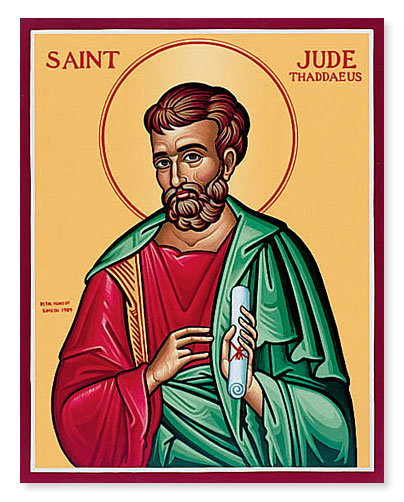
Jude, That Obscure Little Epistle, and the Doctrines of Grace

"Now unto Him that is able to keep you that ye fall not, and to present you faultless before the presence of His glory with joy, that is, to God only wise, our Savior, be glory and majesty and dominion and power, both now and forever, amen."
- Jude 1:24-25, Geneva Bible

I use the Geneva Bible here instead of my usual ESV for two reasons. One is that it simply has a loftier rhythm to it, to my ear, though there is no material difference between the two translations of these verses. And the other is because of the archaic use of pronouns that shows the use of the plural here. Jude isn't addressing a particular person, but rather the church as a whole.

Of the so-called Five Points of Calvinism, the most maligned is probably Limited Atonement, while the most accepted is the Perseverance of the Saints or, as many Baptists phrase it, "once saved, always saved." Given the pride of fallen men, that should hardly be surprising.

One doesn't hear much about the Epistle of Jude. Not only is it painfully brief overall, but it also addresses a string of eschatological concerns, so it just doesn't get talked about as much as, for example, Paul's epistles. But here it explicitly touches on a doctrine that can be misused as a justification for spiritual complacency, but should, rather, serve as a great comfort to the struggling believer.

Notice how it combines major themes from other books of the Bible. Where Jude reminds us that God is able to keep us, we are reminded of the words on Jesus in John 10:28, "I give them eternal life, and they will never perish, and no one will snatch them out of My hand." And "to present us blameless before Him" recalls the words of Paul in Ephesians 1:4, "He chose us in him before the foundation of the world, that we should be holy and blameless before Him." Thus, contrary to the view of most Baptists, our perseverance is grounded in His predestination of us. Then Jude justifies this perseverance as, not for our sakes, even as profitable as it is, but rather because of the glory it brings to God.

This is where I believe that the Calvinist rises above the Arminian: while the Arminian is concerned to preserve his own pride and supposed native righteousness, the Calvinist is concerned only with the glory of God and establishing His righteousness.

Tuesday, July 27, 2010

Kindly Teasing Baptists!

"I want you to know, brothers, that our fathers were all under the cloud, and all passed through the sea, and all were baptized into Moses in the cloud and the sea..."
- I Corinthians 10:1-2

Referring to this passage, Neil MacMichael, a Scottish Presbyterian minister of the mid-1800's, came up with this light-hearted jab at his Baptist brethren:

"1. The Israelites were baptized, both adults and infants, for the Apostle declares it.

2. They were not immersed, a fact which Moses and other inspired writers testify.

3. The Egyptians who pursued them were immersed.

4. The Israelites had baptism without immersion, and the Egyptians immersion without baptism.

5. The baptism of the Israelites was salvation, and the immersion of the Egyptians drowning."

Friday, July 2, 2010

Augustus Toplady on Creedalism


"Follow the pattern of the sound words that you have heard from me, in the faith and love that are in Christ Jesus. By the Holy Spirit who dwells within us, guard the good deposit entrusted to you."
- II Timothy 1:13-14

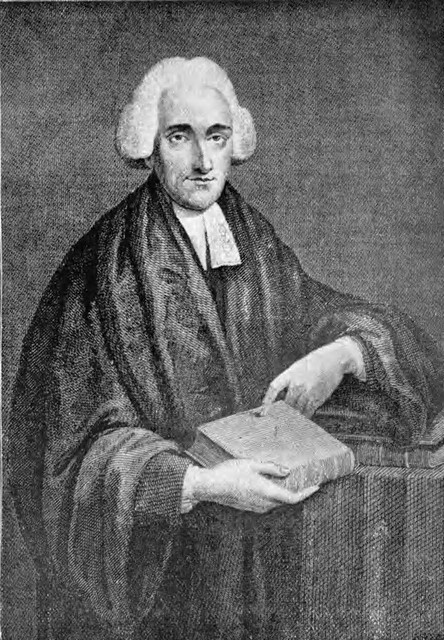
Augustus Toplady, a solidly-Calvinist 18th Century Anglican churchman and author of the classic hymn "Rock of Ages," chose this text to defend the use of creeds in Protestant churches. For him, that referred to the Thirty-Nine Articles, but would apply equally to Reformed or Lutheran formularies, as well.

In a sermon preached on Christmas Day, 1770, Toplady interprets the Greek translated above as "sound words" to mean "the copy, pattern, or outline of sound doctrines." It must be recalled that Paul is addressing his protege here before the completion of the New Testament canon. Therefore, it appears that Paul must have provided some form of doctrinal statement, informal perhaps, against which Timothy could test his own teaching.

Toplady explains, "[W]ithout some given model, or determinate plan of doctrine, deduced from the sacred Scriptures, it will be impossible, either for ministers or people, to form just and connected ideas of divine things. Unless the pearls, which are scattered at large in the gospel-field, be marshalled into some kind of order, and reduced in a regular chain, we can never preach, as the apostle directs, according to the analogy of faith, i.e., in exact agreement with that nice connection and mutual relation, which the several doctrines have in common with each other, so as to make of the whole one consistent, uniform, unclashing system..." That is, without a systematic presentation of doctrine, not only can the various preachers not check that their teachings are consistent both with each other and with their predecessors, even just one preacher cannot check his consistency in one point with himself at another. In addition, each preacher would be stuck reinventing the wheel. For example, without a formulation of the doctrine of the Trinity, he must explain it anew himself, from scratch. That is an open invitation, not just to theological novelty and innovation, but even to heresy! Come to think of it, that is a pretty good description of the American ecclesiastical scene!

Thursday, July 1, 2010

Some Thoughts on Limited Atonement

A field of tulips
My personal view on the matter of the atonement is that of Bible-believing Reformed orthodoxy, that the Father eternally decreed a particular race of people, the Son eternally undertook their redemption in the fullness of time, and the Holy Spirit eternally undertook their regeneration and sanctification in this life.

First, let me point out that the phrase "limited atonement" is a misnomer. It came into popular usage because the "L" fits the TULIP acronym. "Definite atonement" or "particular atonement" better reflect the actual meaning of the phrase. It is the understanding of the Reformed or Calvinists that the atonement in the blood of Christ was intended for the elect, not humanity in general. If anything, it is the Arminian who holds to a limited atonement: while the Calvinist insists that Jesus fully and effectually atoned for the sin of the elect, the Arminian holds that He actually only potentially atoned for the sins of all without distonction.

I am not going to address the biblical support for the Calvinist view of the atonement. That has been handled elsewhere better than I can do. I intend merely to address some logical issues that arise in my own mind.

For example, if Jesus atoned for the sins of all men, then that necessarily implies that there are some who are or will be in Hell for whom Jesus died (I'm passing over those who hold to universal salvation, which avoids this issue, but doesn't enter the biblical discussion). In addition to being a repugnant thought, it would also necessarily imply that the blood of Christ is insufficient for salvation. If that is so, then no one can have any hope of eternal life!

Also, consider the implications for the Person of Christ.

If the Second Person of the Trinity has died for some that the Father has not decreed His purpose to save, and that the Holy Spirit has not undertaken to regenerate, then we set up a war within the Trinity, an obvious impossibility! That would introduce a logical slippery slope to Arianism, depriving Christ of His essential divinity! This is why the Pelagians of the hardest core, the United Pentecostal Church on one hand and the Jehovah's Witnesses on the other, deny the doctrine of the Trinity. While their error is greater, one must at least acknowledge their logical consistency!

Logically speaking, I think that one who holds to a universal atonement must acknowledge that he makes either the atonement insufficient or the Person of Christ impotent, or both. No doubt someone reading this will say he believes no such thing(s), but rather that it depends on us. That response in itself concedes my point, as it cannot answer directly this accusation, but rather turns to man, which is my very objection! My salvation is in Christ alone, not myself, nor in any mere man!

I hold, as an accurate summary of what Scripture teaches, what the Westminster Confession of Faith III:6 says: "As God hath appointed the elect unto glory, so hath He, by the eternal and most free purpose of His will, foreordained all the means thereunto. Wherefore they who are elected being fallen in Adam are redeemed by Christ, are effectually called unto faith in Christ by His Spirit working in due season; are justified, adopted, sanctified, and kept by his power through faith unto salvation. Neither are any other redeemed by Christ, effectually called, justified, adopted, sanctified, and saved, but the elect only."

Wednesday, June 30, 2010

Genesis 2:15-17, Thinking about Grace Before the Fall

"The Lord God took the man and put him in the garden of Eden to work it and keep it. And the Lord commanded the man, saying, 'You may surely eat of every tree of the garden, but of the tree of the knowledge of good and evil you shall not eat, for in the day that you eat of it you shall surely die.'"

This is fleshed out by the Apostle Paul, primarily in the fifth chapter of Romans, and is traditionally referred to as the Covenant of Works, because God promises eternal life to Adam on the basis of obedience. As the footnote in the Geneva Bible puts it, the purpose was "that man might know there was a sovereign Lord, to whom he owed obedience." Before the Fall, Adam had the opportunity, along with the ability, to earn eternal life by his works. The tree was forbidden to him as the test of his works, with the warning that disobedience would bring death upon him. Fine so far. With that understanding, I had never gone on to think what role grace played under this Covenant.

I am reading a book on the federal theology (an alternative name for covenant theology) of Thomas Boston of Ettrick, one of the original Scottish Seceders, a group of particular interest to me.

Boston was concerned to show that grace was fundamental to the covenant of works. First, he pointed out that God, as Creator, would be purely in His right to expect obedience from Adam as creature, with no obligation to offer a reward. To promise eternal life as a reward for obedience was an act of condescension, purely of free grace. I was astounded! That had never occurred to me. Further, he points to the forbidden tree. Boston describes this as an act of grace because it gave Adam a visible warning of the risk and consequences of sin. More subtle perhaps, but a good and edifying interpretation.

In this post, I am not advocating for this particular interpretation. I found it intriguing, so I am presenting it for its thought-provoking character. I am sure that I will be mulling it for a while.

Tuesday, June 29, 2010

Signs and Wonders and Heretics, Oh My!


"Beloved, do not believe every spirit, but test the spirits to see whether they are from God, for many false prophets have gone out into the world." - I John 4:1

The Apostle John here is applying a warning from the Law of Moses. In Deuteronomy 13:1-3, God through Moses gives a stern warning: "If a prophet or a dreamer of dreams arises among you and gives you a sign or wonder, and the sign or wonder that he tells you comes to pass, and if he says, 'Let us go after other gods,' which you have not known, 'and let us serve them,' you shall not listen to the words of that prophet or that dreamer of dreams. For the Lord your God is testing you, to know whether you love the Lord your God with all your heart and with all your soul." So, our God will sometimes allow a false teacher to prophesy or perform miracles, not as an endorsement, but rather as a test of the obedience of His people.

The same apostle himself prophesies of a marvelous wonder performed by the sea beast of the Revelation. In Rev. 13:1, he tells us, "One of its heads seemed to have a mortal wound, but its mortal wound was healed, and the whole earth marveled as they followed the beast." And again in 17:8, "The beast that you saw was, and is not, and is about to rise from the bottomless pit and go to destruction. And the dwellers on earth whose names have not been written in the book of life from the foundation of the world will marvel to see the beast, because it was and is not and is to come." John obviously doesn't believe that miracle-working is proof of divine sanction!

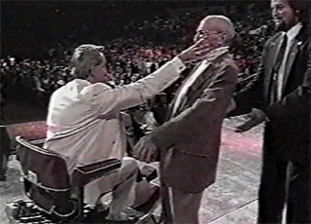
Yet, the astonishing thing is that, in spite of these warnings, every crackpot tent evangelist who can stage a few healings soon has crowds eating out of his (or often her) hands and sending their life savings by return mail. This though they are often Pelagians, Arians, or simply charlatans! Everyone knows that Jim Bakker went to prison for his activities, but others, notably Benny Hinn, are still on the road. Surely thousands are failing the test of faith spoken of in Deuteronomy.

Tuesday, June 15, 2010

Isaiah 64:6 and the Absurdity of Conditional Election

"We have all become like one who is unclean, and all our righteous deeds are like a polluted garment. We all fade like a leaf, and our iniquities, like the wind, take us away."

Some argue that the predestination spoken of by Paul, especially in Ephesians 1, is in response to foreseen faith and righteousness in the particular believer. This position is referred to as "conditional election." This is the opposite of the Reformed view of unconditional election.

However, as the Prophet Isaiah says above, no one (since the Fall of Adam, and excluding Jesus) has native righteousness. Our best deeds are as a polluted garment, a euphemism for a menstrual rag ("filthy rags", KJV). And Romans 3 gives a litany of Old Testament quotes, such as "no one seeks for God" (verse 11) and "no one does good, not even one" (verse 12), and "there is no fear of God before their eyes" (verse 18). So the case of the Arminian is that God's election of His people is dependent on the very qualities that Scripture says we don't have! The Arminian doctrine of election logically would mean that no one is elected, and therefore no one can be saved!

I would go even further: Paul says in Ephesians 2:8 that faith is the gift of God, and in Philippians 2:13 that He works in us to do His pleasure. And he states the same truth negatively in Titus 3:5, "He saved us, not because of works done by us in righteousness, but according to His own mercy." Now, if the faith and good works in a believer are the result of God's work within him, is it then not a tautology to say that they are the basis on which God elects His people? Given that sense, I would even find that doctrine acceptable. Clumsy, but tolerable. But it certainly isn't what the Arminian intended.

The problem here is that Arminians fail to understand Ephesians 2:1-2, "And you were dead in the trespasses and sins in which you once walked." Just as a dead body cannot act to restore its own life, the dead soul cannot regenerate itself. Arminians unconsciously insert "sick" for "dead", because a sick man can certainly act on his own behalf in restoring health. However, the Scriptures do not give them the wiggle-room that their human pride seeks. Before regeneration by the Holy Spirit, the soul is dead, and the faith and works that arise from it are dead and disgusting in God's eyes. It is only by His electing intervention in the heart of the believer that such a one can respond in faith and good works.

Thus we can see that the Arminian doctrine of conditional election depends on false premises, and is contrary to Biblical truth. There is security only in resisting our natural pride and resting in God's merciful election.