Showing posts with label covenant of works. Show all posts

Wednesday, September 8, 2021

Our Covenant Heads: The First Adam and the Last Adam

"Because He is the covenantal head of elect believers, He [Jesus] may be and is their righteousness with God by faith alone in Him. Because He is the covenantal head of elect believers, the obedience of these believers need not be, may not be, and is not their righteousness with God. For their obedience to be their righteousness with God would be to dispossess, displace, disregard, and disgrace the head of the covenant, who is Jesus the Christ. It is the precise purpose of Galatians 3 to establish that the precious but contested truth of justification by faith alone in Jesus Christ has its ground in the covenantal headship of Jesus Christ."

- David Engelsma, "Gospel Truth of Justification," p. 303

The Apostle Paul describes a parallel and contrast between Adam and Jesus in Romans 5:12-21. 

First, he tells us of Adam in verse 12: "Sin came into the world through one man, and death through sin, and so death spread to all men because all sinned..." Theologians refer to this as the Covenant of Works, which God made with Adam, and, through him, with all his posterity. All of Adam's descendants, excepting Jesus alone, were represented by Adam. If Adam had fulfilled that covenant by perfect obedience during his period of probation, then not only he, but that posterity also, would have been confirmed in eternal life. The condition to be met in that covenant was perfect obedience. For how long? We aren't told. However, for some length of time. But Adam failed, taking himself and his posterity into death, both spiritual and physical. 

Then Paul tells us of a separate covenant between the Father and the Son, for which the application to us has been called the Covenant of Grace. "But the free gift is not like the trespass. For if many died through one man's [i. e., Adam's] trespass, much more have the grace of God and the free gift by the grace of that one man Jesus Christ abounded for [a different] many. And the free gift is not like the result of that one man's sin. For the judgment following one trespass brought condemnation, but the free gift following man trespasses brought justification. For if, because of one man's trespass, death reigned through that one man, much more will those who receive the abundance of grace and the free gift of righteousness reign in life through the one man Jesus Christ. Therefore, as one trespass led to condemnation for all men, so one act of righteousness leads to justification and life for all men. For as by the one man's disobedience the many were made sinners, so by the one man's obedience the many will be made righteous" (Romans 5:15-18).

Thus, Paul points to two covenants, one headed by Adam, the other by Jesus, whom he calls "the last Adam" in I Corinthians 15:45, and contrasts their effects. One renders men sinners while the other renders men righteous, not inherently, but rather by the imputation of the nature of the heads of the respective covenants. 

Modern Americans have a problem with covenant theology, because we do not live in a covenantal society. We believe that each person determines his own fortunes in life. Yet we same Americans are happy to talk about Jesus as our savior. We will gladly accept the imputation to us of His righteousness. However, we rarely accept the other side of the same coin, the imputation of Adam's fall. The two concepts follow the same covenantal logic, but they fall on our ears very differently. Yet, to accept the one necessarily implies the other, as I wrote here


Saturday, February 27, 2021

Covenant Theology and the Imputation of Sin and Righteousness.

Paul gives us this description of the Gospel and man's need of it: "Just as sin came into the world through one man, and death through sin, and so death spread to all men because all sinned— for sin indeed was in the world before the law was given, but sin is not counted where there is no law. Yet death reigned from Adam to Moses, even over those whose sinning was not like the transgression of Adam, who was a type of the One who was to come. But the free gift is not like the trespass. For if many died through one man’s trespass, much more have the grace of God and the free gift by the grace of that one Man Jesus Christ abounded for many. And the free gift is not like the result of that one man’s sin. For the judgment following one trespass brought condemnation, but the free gift following many trespasses brought justification. For if, because of one man’s trespass, death reigned through that one man, much more will those who receive the abundance of grace and the free gift of righteousness reign in life through the one Man Jesus Christ. Therefore, as one trespass led to condemnation for all men, so one act of righteousness leads to justification and life for all men. For as by the one man’s disobedience the many were made sinners, so by the one Man’s obedience the many will be made righteous" (Romans 5:12-19). 

This is covenant theology in one paragraph. Paul tells us that, in the sin of Adam, all of his posterity became sinners. That means every man, woman, and child, except Jesus, from conception to the end of his or her life, is a sinner. Theologians call this the Covenant of Works, because life and death, both physical and spiritual, were based on the perfect obedience of Adam. If he had remained faithful, his faithfulness would have been imputed to his posterity. However, since he fell, his sin was imputed to his posterity instead. 

Americans hate this biblical teaching, because it violates our cultural belief in the sovereignty of the individual. And I don't mean just atheists. Even professing Christians will hold to some form of individualistic religion, in which every person is responsible only for his own sin and for his own salvation. 

But let us continue with Paul in Romans. 

Paul also tells us that Jesus has a posterity, a posterity which, in Him, receives salvation because of His perfect sinlessness and substitutionary atoning act on the cross. Theologians call this the Covenant of Grace, exactly because it is graciously applied by imputation to all those who receive it by faith alone, which faith itself is a gracious gift of God. 

Strangely, this part of Paul's message is quite popular. Somehow, those individualists who object to sin by imputation don't see their personal sovereignty as violated by the imputation of righteousness

We can see the cultural role of this covenant headship in the history of Israel. In Second Samuel 24, the Bible gives us the story of David's census of the people of Israel, without God's command. In verse 1, we are told that it was because God planned judgment against Israel. However, in I Chronicles 21:1, we are told that Satan stirred up the idea in David's heart. Obviously, it was the purpose of God, which He worked through the means of Satan. 

The key verse, though, is II Samuel 24:16: "So the Lord sent a pestilence on Israel from the morning until the appointed time. And there died of the people from Dan to Beersheba 70,000 men." It was David who sinned, as he himself admits in verse 10, yet it was those 70,000 men who suffered the consequences. How can that be just? Well, if it is the individual who is primary, then it wasn't just. But that isn't the case. As king, David was the covenant head of the people of Israel, just as Adam and Jesus of their respective peoples. Therefore, when David sinned as king, the sin and its judgment fell on all who were in covenant with God through David. 

This covenant mentality is very different from our modern American culture. We cannot judge it according to our cultural values. Rather, we must understand and accept it on the basis of God's values. To reject the imputation of sin logically requires the equal rejection of the imputation of righteousness.

Saturday, May 25, 2019

The Futility in Life for the Unbeliever

"Should a wise man answer with windy knowledge,
     and fill his belly with the east wind?
Should he argue in unprofitable talk,
     or in words with which he can do no good?

The wicked man writhes in pain all his days,
     through all the years that are laid up for the ruthless.
Dreadful sounds are in his ears;
     in prosperity the destroyer will come upon him.
He does not believe that he will return out of darkness,
     and he is marked for the sword.
He wanders abroad for bread, saying, ‘Where is it?’
     He knows that a day of darkness is ready at his hand;
distress and anguish terrify him;
     they prevail against him, like a king ready for battle.
Because he has stretched out his hand against God
     and defies the Almighty...

Let him not trust in emptiness, deceiving himself, 
     for emptiness will be his payment."
- Job 15:2-3, 20-25, 31

After the fall of Adam, God announced a curse against him: "Cursed is the ground because of you; in pain you shall eat of it all the days of your life; thorns and thistles it shall bring forth for you; and you shall eat the plants of the field. By the sweat of your face you shall eat bread..." (Genesis 3:17-19). Here the curse is pronounced in a life of toil made difficult and unproductive. The passage above fleshes out that curse. In both, Adam, both for himself and for his posterity, is given a life of futility in place of the blessedness that he knew, and would have continued to know, in the Garden of Eden. 


However, Job adds as element to the curse. 

We know from elsewhere that the regenerate will experience life in a world in which that curse is gradually rolled back. We see this in both agricultural and lifestyle blessings described in various portions of the prophecies of Isaiah. For example, see Isaiah 35:1-2: "The wilderness and the dry land shall be glad; the desert shall rejoice and blossom like the crocus; it shall blossom abundantly and rejoice with joy and singing."

That isn't what the passage in job describes. Rather,  it is about the continuous, lifelong futility experienced by the unbeliever. Pursuing a life in rebellion against God brings against the unbeliever the opposition of the world created by that God. Even the dirt beneath his feet conspires against him. 

Does this mean that every unbeliever suffers through life or that every believer prospers? No, it doesn't. It's a generalization. But not by much. 

Wednesday, July 26, 2017

Adam Made It Rough: The Sin Nature

The hardest inheritance that all men have received from our first ancestor, Adam, is the promise of eternal life on the basis of perfect obedience to the covenant of works. As we know from subsequent events, Adam broke the covenant, forfeiting salvation by it, and bringing death, both spiritual and physical, on all his posterity (Romans 5:12-19). Yet our hearts have retained that consciousness of the original covenant, and find every opportunity to convince us that a little hard work will restore us to eternal life. This results in the Pelagianism that is inherent in all pagan religions, all forms of secularism, and much of popular Christianity. Apart from orthodox, biblical Christianity, all religions, including secular religions, hold that men are good, or, at least, good enough to claw our way to whatever vision of salvation we hold.

It is biblical Christianity alone that teaches consistently that the covenant of works is broken and hopeless. By its very nature, failure is permanent, leaving no opportunity for second chances: "The soul who sins shall die" (Ezekiel 18:20). And this isn't sin on a curve, i. e., the one who sins more than someone else. Rather, broken means broken, all or nothing: "Whoever keeps the whole law but fails in one point has become guilty of all of it. For he who said, 'Do not commit adultery,' also said, 'Do not murder.' If you do not commit adultery but do murder, you have become a transgressor of the law" (James 2:10-11).

Yet, we just naturally keep trying to get back on that train, though it long ago left the station. We all want to get the credit for saving ourselves. It is the same deceptive independence that Satan offered Adam and Eve in the garden: "God knows that when you eat of it [the Tree of the Knowledge of Good and Evil] your eyes will be opened, and you will be like God, knowing good and evil" (Genesis 3:5). "Don't let God rule you," Satan said. "Rule yourselves." And he continues to whisper that same deception in the ear of every human being since then, even Jesus (Matthew 4:8-9). Jesus alone never gave in to that temptation.

That same Jesus tells us the truth about what is left of the covenant of works: "When you have done all that you were commanded, say, ‘We are unworthy servants; we have only done what was our duty'" (Luke 17:10). He is not impressed with what impresses us. While we trumpet each prideful act, He says that ever our best is merely the minimum standard, not anything that gets merit in His eyes.

That's why every philosophy based on human autonomy is a pathway to judgment. It starts with a false premise. God's beginning premise is Himself, with the holiness that is essential to His nature (Habakkuk 1:13). Men always start with themselves, which means with the antiholiness that Adam has passed to all of us. When we agree with Him, then salvation is available in Jesus Christ. All other options are really just one option, judgment. Hear Jesus's words: "Enter by the narrow gate. For the gate is wide and the way is easy that leads to destruction, and those who enter by it are many. For the gate is narrow and the way is hard that leads to life, and those who find it are few" (Matthew 7:13-14).

Saturday, November 7, 2015

The Mosaic Covenant: Grace, Not Works

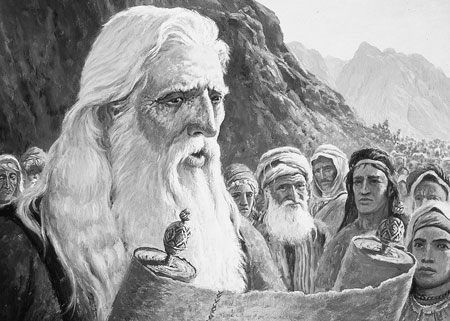
Moses, Reading the Law
There is a common misunderstanding, usually connected to a dispensational view of scripture, that holds that the Mosaic covenant is a religion of works salvation. In fairness, I admit that Paul refers to justification "by the works of the Law," but that reference is to the Pharisaic misuse of the Law (Rom. 9:32), not its proper purpose. Rather, the Law was to serve as a temporary guardian (KJV, "schoolmaster"), until the coming of Christ (Gal. 3:19, 24). The Law - and I am talking here of the ceremonial Law, not the moral - marked that which or who was clean, from that which or who was unclean. It created a hedge around the covenant people that separated them, sanctified them, as distinct from the rest of humanity. Why? That they would be reserved as a conduit through which the Messiah would come, the Savior of the world (John 3:16 and Acts 4:12).

Why did it matter among what nation the Redeemer would be born? That goes back to the original promise of the Gospel, Genesis 3:15: "I will put enmity between you and the woman, and between your offspring and her offspring; He shall bruise your head, and you shall bruise His heel." This promise was given immediately after the Fall, and especially touched Eve, the first human to give in to the temptations of Satan. It was a balm to her conscience to know that her descendant would also be the means of undoing what she and Adam had done. That is why the lineage of Christ is so carefully recorded. Of course, all mankind is the seed of Eve in a general sense, but His lineage is laid out explicitly, legally (i. e., covenantally) in Matthew 1, and genetically in Luke 3. A record is given of exactly in what way He represented her lineage. In our culture, that isn't considered important, but in theirs it was.

What makes me especially to marvel is that this story is carried all the way to the other end of the Bible. In Revelation 12:1-6, the Apostle John describes a woman who gives birth to a son, and a red dragon who persecutes both her and that son. I believe that the woman represents both Eve personally and the covenant people of Israel federally, and the son is, of course, Jesus Christ (see also Rom. 16:20). John explicitly tells us that the dragon is the serpent from the garden (Rev. 12:9). This is the end of the need for the restriction of the lineage, which is why God does away with the ceremonial law, and opens the Church to the Gentiles, those who had formerly been legally unclean (both aspects are described in the account of Peter's dream in Acts 10:10-29; see also Eph. 2:11-16).

This is why I insist that the Mosaic covenant is not a covenant of works, but is rather a temporary administrative stage of the covenant of grace. It was a necessary preparation for the coming of the full salvation that we have in Jesus Christ. It is not, and never was, an opportunity for the Jews - or anyone else - to earn their way to eternal life through good works. This is clear even in its establishment. The account of the giving of the Ten Commandments is found in Exodus 20:1-17. However, verse 2, the Preamble, says, "I am the Lord your God, who brought you out of the land of Egypt, out of the house of slavery." Before giving the shalls and shall-nots, God reminds the people of the redemption that He has already provided them, as the foundation on which the Law was to be built. Justification came before the Law (Rom. 4:10, 14; Gal. 3:17).

Contrary to the teachings of classical dispensationalism, there was never a time  - i. e., after the Fall of Adam - in which any man could be saved by works. In Adam, we all became sinners (Rom. 5:12). We start life as sinners (Psalm 51:5, 58:3). This is the key: sin does not make us sinners; we sin because we are already sinners. It is comparable to a runner in a race who runs facing the wrong way; no matter how fast he runs, he is incapable of winning the race. If that weren't the case, then Jesus would never have needed to come, to suffer, and to die on the cross. As Paul says (Gal. 3:21-22), "if a law had been given that could give life, then righteousness would indeed be by the law. But the Scripture imprisoned everything under sin, so that the promise by faith in Jesus Christ might be given to those who believe."

Sunday, October 4, 2015

Do We Understand How Sinful Sin Really Is? The Puritans Did!

The Puritan Thomas Watson, in his Body of Divinity, lists ten ways in which sin is truly sinful:

     1) Incredulity: Our first parents did not believe that what God had spoken was truth (Gen. 2:16-17, 3:4). They believed not that they should die, because they could not be persuaded that such fair fruit had death at the door. Thus, by unbelief they made God a liar. In fact, what was worse was that they believed the devil rather than God.

     2) Unthankfulness: God had enriched Adam with a variety of mercies, stamped His own image on him, made him lord of the world, and given him the fruit of all the trees for food, with just one excepted. Thus, to take from that one tree was high ingratitude.

     3) Discontent: Adam differed little from the angels (Ps. 8:5), had native innocence, and enjoyed the glory of Paradise as his realm. Yet, he had to have more, because his heart could not be satisfied with all that he had.

     4) Pride: he loved the offer of Satan to become like God (Gen. 3:5)!

     5) Disobedience: God had given him his existence and all his subsistence, so it was right to expect his obedience.

     6) Curiosity: Adam sought to meddle with what was not his, though it was to cost him everything.

     7) Wantonness: With the choice of all other trees, Adam had all of his needs filled, but demanded the satisfaction of his lusts as well. Watson is expressing the same truth as in James 1:14-15: "Each person is tempted when he is lured and enticed by his own desire. Then desire when it has conceived gives birth to sin, and sin when it is fully grown brings forth death."

     8) Sacrilege: God had reserved this one tree of the garden for Himself, yet Adam deigned to rob Him of what was His alone.

     9) Murder: as the federal head of all his posterity in the covenant of works, Adam represented us in his actions, and chose to bring the curse of death on all of humanity (Rom. 5:12).

     10) Presumption: Adam presumed, contrary to God's warning, that he would not die, regardless of his actions. "Surely," he decided, "God must relent if I choose to do as I wish."

And later in the same book, Watson makes this observation: "The sight of Christ's bleeding body should incense us against sin. Let us not parley with it; let that not be our joy, which made Christ a man of sorrow." This is, again, a precept from James 2:10: "Whoever keeps the whole law but fails in one point has become accountable for all of it." Whatever sin any person holds onto, thinking it just isn't really so bad, he must think differently if he understands that any sin makes the sinner guilty of breaking the whole law (James 2:11). This especially overthrows the Catholic distinction between "mortal" and "venial" sins. According to James (a book that they otherwise enjoy quoting), and, as repeated by Watson, every sin is mortal (Ezekiel 18:4, Rom. 6:23).

Friday, December 31, 2010

Job 9:28-32, Our Condition Outside of Christ in the Covenant of Works

"I become afraid of all my suffering,
    for I know you will not hold me innocent.
I shall be condemned;
    why then do I labor in vain?
If I wash myself with snow
    and cleanse my hands with lye,
yet you will plunge me into a pit,
    and my own clothes will abhor me.
For he is not a man, as I am, that I might answer him,

    that we should come to trial together."

Job here gives utterance to a concept also found in Isaiah 64:6, comparing our nature to rotten and filthy clothes that must be put off. He goes further, describing the efforts of the unregenerate man to cleanse himself, seeking the purity of snow (contrast Isaiah 1:18), and the cleanliness of harsh lye soap (against Psalm 51:7). This is man under the covenant of works, striving by works to achieve the eternal life first offered to Adam for his perfect obedience (Genesis 1:28-30, 2:17). In Adam's transgression we all became sinners (Romans 5:12), and under judgment for breaking God's commandments (James 2:10 and Galatians 3:10). And Job warns us that the shifty arguments that we offer in defense do not sway our divine Judge (verse 32). That covenant is broken and there is only judgment, not hope, therein.

So, where can we be made clean? Only by being washed in the shed blood of Jesus Christ (Revelation 1:5).


Monday, October 18, 2010

For the Hypocrite, Even Easy Religion Is Just Too Hard!


"[They] say to the seers, 'Do not see,' and to the prophets, 'Do not prophesy to us what is right; speak to us smooth things, prophesy illusions...'"
- Isaiah 30:10

The hypocritical believer continues his attachment to the Covenant of Works, believing that his own righteousness will carry him to heaven. Yet, such persons clamor for a lowering of God's standards. Picture the pole-vaulter in the Olympics, assuring everyone that he can overleap the bar at its competitive height, yet still begging to have it lowered.

I think this is part of what Paul talks about in Romans 2:15. From the rankest unbeliever to the purest hypocritical professor, a man's conscience knows that he has not lived without sin. But the fallen man seeks that righteousness which was forfeited by Adam in the Garden. Finding that he cannot live that righteousness, he seeks to have the standard lowered to his own level. And he rebels against that true believer who testifies against his unrighteousness, whether by word or just by contrasting lifestyle. We have all heard the codewords: "puritanical," "intolerant." He is inventive in exalting himself over the believer, because the truths that he hears from the believer prick his conscience and trip up his self-righteousness.

The Covenant of Grace holds forth God's way of salvation by free grace alone: "Come, everyone who thirsts, come to the waters; and he who has no money, come, buy and eat! Come, buy wine and milk without money and without price." (Isaiah 55:1) How hard it is for fallen man to receive what is free, because he has deceived himself into believing that he has wealth. It is as Jesus said to the Church at Laodicea in Revelation 3:17, "You say, 'I am rich. I have everything I want. I don't need a thing!' And you don't realize that you are wretched and miserable and poor and blind and naked."

Wednesday, June 30, 2010

Genesis 2:15-17, Thinking about Grace Before the Fall

"The Lord God took the man and put him in the garden of Eden to work it and keep it. And the Lord commanded the man, saying, 'You may surely eat of every tree of the garden, but of the tree of the knowledge of good and evil you shall not eat, for in the day that you eat of it you shall surely die.'"

This is fleshed out by the Apostle Paul, primarily in the fifth chapter of Romans, and is traditionally referred to as the Covenant of Works, because God promises eternal life to Adam on the basis of obedience. As the footnote in the Geneva Bible puts it, the purpose was "that man might know there was a sovereign Lord, to whom he owed obedience." Before the Fall, Adam had the opportunity, along with the ability, to earn eternal life by his works. The tree was forbidden to him as the test of his works, with the warning that disobedience would bring death upon him. Fine so far. With that understanding, I had never gone on to think what role grace played under this Covenant.

I am reading a book on the federal theology (an alternative name for covenant theology) of Thomas Boston of Ettrick, one of the original Scottish Seceders, a group of particular interest to me.

Boston was concerned to show that grace was fundamental to the covenant of works. First, he pointed out that God, as Creator, would be purely in His right to expect obedience from Adam as creature, with no obligation to offer a reward. To promise eternal life as a reward for obedience was an act of condescension, purely of free grace. I was astounded! That had never occurred to me. Further, he points to the forbidden tree. Boston describes this as an act of grace because it gave Adam a visible warning of the risk and consequences of sin. More subtle perhaps, but a good and edifying interpretation.

In this post, I am not advocating for this particular interpretation. I found it intriguing, so I am presenting it for its thought-provoking character. I am sure that I will be mulling it for a while.

Tuesday, September 8, 2009

The Universalism of the Covenant of Works versus the Particularity of the Covenant of Grace

This is another passage from Peter Bulkeley's "The Gospel Covenant." I find great spiritual sweetness in it. Odd spellings and grammar are in the original, as are the italics.

"The covenant of works was made with all men, all men being in Adams loins, and he standing as a publique person in the roome of all his children, when God made that covenant with him: but the covenant of grace is not made with all men, but onely with the faithfull, with those that are given unto Christ by the Father, John 17. And therefore by the covenant of works, God is a God to one as well as to another; God is not a God of one people more than another, by the covenant of workes, for it was made equally with us all in Adam, it being made with him for all his posterity. And therefore seeing wee are all equally the sons of Adam, this Covenant makes no difference betwixt man and man, but all are shut up under it, all bound to fulfill it; and if they breake it (as wee all doe), then liable are we to the sentence of death. But in the Covenant of grace, God is the God of one people, and not of another. Hence is that in Gen. 17:21. God saith that he will establish his Covenant with Isaac, and not with Ishmael: So it was made with Jacob and not with Esau, with Abel and not with Cain, with David and not with Saul; not with Judas, but with Peter; with the Jewes first, and not with the Gentiles; and after, with the Gentiles, and not with the Jewes. By this Covenant one people becomes a more peculiar people then another. As first of Peter, 2 chap. The Covenant of grace is not universal, it is not made with all, as the Covenant of workes was."

Monday, August 31, 2009

Sovereign Election: Thank God for His Gracious Discrimination!

Another excerpt from The Gospel Covenant, by New England Puritan Divine Peter Bulkeley. All arcane spellings, grammar, and emphasis are from the original. Words in brackets are my insertions for the sake of clarity. "&c" in the original has been edited to "etc.", in the modern fashion.

"In the Covenant of workes, God deales alike with all, that are alike in themselves; Looke how he deales with one, so will he do with another, if they walke in the same way; The same worke shall have the same reward, whether in good or in evill. They that are alike in sin, shall be alike in punishment. Justice, which is Gods rule in the covenant of workes, maketh no difference between persons that are equall in themselves. It hath its balance in its hand to give to everyone according to their works; It is no respecter of persons. Therefore God speaking of Baasha, I Kings 16:2-3, saith, that because he walked in the wayes of Jeroboam the son of Nebat, who made Israel to sin, therefore God would make his house like the house of Jeroboam. They both make Israel to sin, and therefore they are both alike in punishment; so also he speaks of Jerusalem, Ezek. 23:31, that because she walked in the way of her Sister, that therefore he would give her cup into her hand. Hence saith the Apostle, Rom. 2:6 to 17, That every soul that continues in well-doing, shall have glory and honour, but unto the disobedient shall be tribulation and wrath, whether Jewes or Gentiles, etc. Where actions are alike, God will deal alike with all such as are under the covenant of workes: What is just towards one is just towards another, when actions and workes are alike; Now God will deale justly with all: he that commands us to give every man his due, Rom. 13:7, will not himself withhold due from any; here therefore God will alike deale alike with all. Let one fulfill the Law, and he shal live thereby; Let another fulfill it, and he also shall have the same life. Let one breake it, and he shall dye, and as many break it, shall lye under the same condemnation. But now it is otherwise in the covenant of grace; grace deales diversly with men that are equall in themselves; where there was no difference before, grace makes a difference, as Rom. 3:23-34. All have sinned, etc., there is no difference in ourselves, we are all shut up in condemnation by sin;but are all justified? No; but onely those that are of the faith of Jesus. Hence saith the Apostle, Rom. 9:10-13, that when Jacob and Esau were both in the same condition, neither of them having done either good or evill, yet grace put a difference betwixt them, and preferred one before the other; They were alike in themselves, yet they had not the like grace vouchsafed to them from God. Justice is due, but grace is free; Justice must doe right, but but grace may communicate itself, to whom, where, and in what measure it will. Hence is that in Rom. 9:15, I will have mercy on whom I have mercy, etc., He doth not say, I will deal justly with whom I will, he cannot deale unjustly with any; But concerning grace he saith, I will have mercy on whom I will have mercy. Therefore to manifest the goodnesse of his grace, the Lord sometimes preferreth those that seem least worthy, he sets the younger before the older, Jacob before Esau, Ephraim before Manasseh, and the Gentiles which were aliens from God, before the Jewes which counted themselves to be the onely people. Consider those two speeches in Mat. 20. The one ver. 14. Take that which is thine own, and go thy way: the other, ver. 15. I will do with mine own as I will. Here is our own, and God's own; our own is that which we look for according to our agreement which we have made with God, for the worke done. As those hyred into the Vineyard, they agreed with the Master of the Vineyard for so much; and that which they so agreed for, for their worke, that was their owne, due by justice; But that which was not by agreement, nor for worke, but comes by grace, that is Gods owne, with which he may do even as he will: our own is that which is due from Gods justice: Gods own is the gift of his free grace. To every one God will say, take thine owne. And where there is no difference in worke, justice will make no difference in wages. And if any begin to complaine that others are better dealt with then they, the Lord answers to such, I will do with mine owne as I will; Grace is mine own, and I owe it to none, I will shew it where I will; It is grace which makes the difference, herein may God deale diversly, giving more to one, lesse to another, as pleaseth him. And hereto agrees that in ver. 16. He that is first shall be last, and the last first. He that should be last in a way of Justice, shall become first in a way of grace; Those that Justice would set last and lowest, Grace will advance and set highest."

Monday, August 24, 2009

The Incompatibility of the Covenants: Grace versus Works

"For all who rely on works of the law are under a curse; for it is written, 'Cursed be everyone who does not abide by all things written in the Book of the Law, and do them.' Now it is evident that no one is justified before God by the law, for 'The righteous shall live by faith.'"
 - Galatians 3:10-11

In verse 10 Paul refers to what is traditionally entitled the Covenant of Works. The Westminster Confession of Faith (VII:2) explains this: "The first covenant made with man was a covenant of works, wherein life was promised to Adam, and in him to his posterity, upon condition of perfect and personal obedience." Adam was promised eternal life after perfectly fulfilling all the commands of his Creator, in nature, intent, and action. In his created state, Adam was capable of this state of holiness, would have been confirmed in that state, and his posterity would have inherited that native holiness.

However, as every child in Sunday school has learned, Adam broke the covenant, disobeying God in eating from the forbidden tree. He provoked the wrath of God, and forever forfeited the eternal life promised in that covenant, for himself and his posterity.

However, while justice would surely have allowed God to take no further concern with His rebellious children, in His love and grace He chose to establish a second covenant, the Covenant of Grace. As the Confession continues (VII:3), "Man by his fall having made himself incapable of life by that covenant [i.e., of works], the Lord was pleased to make a second, commonly called the Covenant of Grace; wherein He freely offereth unto sinners life and salvation by Jesus Christ, requiring of them faith in Him that they may be saved, and promising to give unto all those that are ordained unto life, His Holy Spirit, to make them willing, and able to believe." Or in Paul's words (Rom. 1:17, Gal. 3:11, from Habakkuk 2:4), "The righteous shall live by faith."

If you look to your works to justify you before God, then you are relying on a Covenant that will now save no man, because its standard is perfection, in nature, intent, and action. For us, the fallen descendants of Adam, there is only one hope, and that is faith in the works and person of our Redeemer, Jesus Christ.