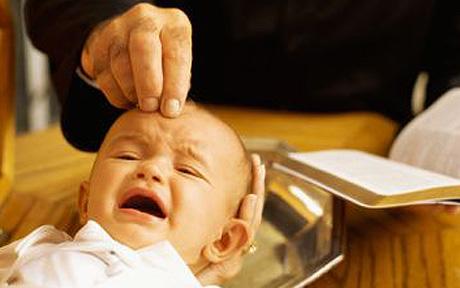
Showing posts with label baptists. Show all posts

Wednesday, May 3, 2023

Book of Numbers and Sprinkling as the Mode of Baptism

Most Christians would say that Numbers is a book that they avoid reading. And I admit that the censuses of Israel, from which the book gets its name in English, are tedious, and I usually skip over them. However, to skip the entire book is to miss some hidden gems within it. 

What struck me recently is the rite of purification, described in chapter 19: "Now the Lord spoke to Moses and to Aaron, saying, 'This is the statute of the law that the Lord has commanded: Tell the people of Israel to being you a red heifer without defect, in which there is no blemish, and on which a yoke has never come. And you shall give it to Eleazar the priest, and it shall be taken outside the camp and slaughtered before him. And Eleazar the priest shall take some of its blood with his finger and sprinkle some of its blood toward the front of the tent of meeting seven times. And the heifer shall be burned in his sight. Its skin, its flesh, and its blood, with its dung, shall be burned. And the priest shall take cedarwood and hyssop and scarlet yarn and throw them into the fire burning the heifer... And a man who is clean shall gather up the ashes of the heifer and deposit them outside the camp in a clean place. And they shall be kept for the water for impurity for the congregation of the people of Israel; it is a sin offering'" (Numbers 19:1-6, 9, emphasis added). 

So we have a ceremony described by God, in which a heifer, that is, a cow that has not yet been bred or worked, is to be sacrificed. Its blood is to be sprinkled before the tabernacle, the symbol of God's presence among His people. It was then to be burned and its ashes gathered and saved for "the water of impurity." 

"'This is the law when someone dies in a tent: everyone who comes into the tent and everyone who is in the tent shall be unclean seven days... For the unclean they shall take some ashes of the burnt sin offering, and fresh water shall be added in a vessel. Then a clean person shall take hyssop and dip it in the water and sprinkle it on the tent and on all the furnishings and on whoever touched the bone or the slain or the dead or the grave. And the clean person shall sprinkle it on the unclean on the third day and on the seventh day. Thus, on the seventh day he shall cleanse him, and he shall wash his clothes and bathe himself in water, and at evening he shall be clean'" (Numbers 19:14, 17-19). Reference to sprinkling can also be found in verse 21. Thus, the rest of the ceremony is that the ashes from the heifer would be mixed with water and sprinkled on the unclean person, and he would be cleansed. 

Finally, in Isaiah 52:15, part of the Suffering Servant passage, we read the words of the prophet to Israel of the coming Messiah who would cleanse His people from their sins. How? "He shall sprinkle many nations." The blood of Jesus is to sprinkled by faith on unclean sinners just as the ashes of the heifer were sprinkled on the unclean under the law of Moses. That is no coincidence! The one is a type of the other. 

To my Baptist brethren, I would also point out that the recipient of cleansing wasn't dipped in the water of impurity. On the contrary, it was the finger of the priest, who would then sprinkle both the blood of the sacrifice and the water of cleansing. This strongly refutes the claim of Baptists that baptism is properly done only by immersion. Rather, the type in Numbers indicates that the proper mode of baptism is by sprinkling (by which I do not mean that baptisms by other modes are, therefore, invalid). 

This Scripture points to what the Westminster Assembly would say on the subject of baptism some three millennia later: "Dipping of the person into the water is not necessary; but baptism is rightly administered by pouring or sprinkling water upon the person" (Westminster Confession of Faith XXVIII:3).
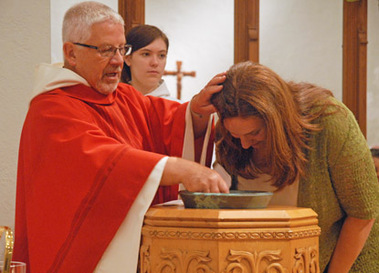


Saturday, March 5, 2022

Infant Baptism, the Covenant, and the Reformed View


"Upon You have I leaned from before my birth; You are He who took me from my mother's womb. My praise is continually of You"(Psalm 71:6). 

When discussing the baptism of infants with Baptists, they often tell me that a little baby can't know anything about God. We should, they claim, wait until a person grows to an age of accountability or moral awareness. It is phrased in different ways. 

Yet, look at the words above from Scripture. Is that not to be our authority? We are not to look to pop psychology or secular educational assumptions. 

Unlike other psalms, Psalm 71 includes no superscription with its authorship. I think it sounds like David. Whether or not it is, is obviously the words of a covenant child, i. e., one born to a believing home. He professes even a preborn experience of the promise of God: "All your children shall be taught of the Lord, and great shall be the peace of your children" (Isaiah 54:13). Note that He doesn't say all children; rather, He says your children. Why the distinction? Because God claims the children of believers as His own (Ezekiel 16:20). Not that He promises that they are or will ever be regenerate, but that He distinguishes them covenantally from the children of pagans. We see it in His discrimination between the sons of Abraham, Isaac and Ishmael. While Ishmael is the heir of the promise, He also blesses Ishmael because of his covenantal status (Genesis 17:18-21). Both sons are members of the visible church, while only Isaac is a member of the invisible church, a proviso that Baptists consistently fail to consider. 

That is why the Reformed baptize the children of our members. God has claimed them as His own, a great privilege! Therefore, they have a right to His covenant sign, baptism. I am not attempting here to explain the Catholic or Lutheran views of baptism; that is for them to do. But the Reformed do not assume the regeneration of our infants, contrary to the oft-repeated strawman argument of Baptists. We just give them the status that God has declared of them. 

Saturday, July 4, 2020

Romans 6:4 Says Nothing About the Mode of Baptism

"We were buried, therefore, with Him by baptism into death, in order that, just as Christ was raised from the dead by the glory of the Father, we too might walk in newness of life."
- Romans 6:4

This verse is one of those trump cards that some people plunk down in any debate, thinking that they outweigh any evidence to the contrary. In this case, it is plunked down by Baptists when discussing the mode of baptism. They claim that it means that the mode must look like the burial of Jesus. So they baptize by lowering a person backward, like a corpse lowering into a grave,and then raising him up, like a corpse rising in resurrection. But do you notice that the verse says nothing about "looking like"? Not one syllable. Rather, this is a case of begging the question, presupposing a conclusion, and then reading it into the premise.

However, Romans 6:4 is not about the mode of baptism. Rather, it uses "baptism" to indicate the covenantal connection between the elect and the death of Christ, ending the previous relationship to sin "by baptism into death" (no comma). When it was finished for Him, it was finished for us, too, because of the covenantal connection. In other words, Paul here is making the same point that he did in the following chapter: "You also have died to the law through the body of Christ, so that you may belong to another, to Him who has been raised from the dead, in order that we may bear fruit for God. For while we were living in the flesh, our sinful passions, aroused by the law, were at work in our members to bear fruit for death. But now we are released from the law, having died to that which held us captive, so that we serve in the new way of the Spirit and not in the old way of the written code" (Romans 7:4-6).

Since the believer is now in Christ, he is "dead to sin and alive to God in Christ Jesus" (Romans 6:11). To turn verse 4 into a reference to the mode of baptism is to ignore Paul's point about our new relationship to sin and righteousness. As always, context, context, context.

Wednesday, May 20, 2020

Old Testament Usage Proves that "Baptizo" Cannot Necessarily Mean "Immerse"

One of the claims made by certain groups, such as Baptists and Seventh-Day Adventists, regarding baptism is that immersion is the required mode. I am sure that you have seen the pictures of a person lowered back first - always back first - into a baptismal pool. Or just a swimming pool, pond, seaside, in a bath tub - I've seen them all. One of the reasons they give is that "baptizo," the Greek verb from which we get the word "baptism," supposedly means "to immerse."

It is that assertion that I wish to address here.

As I have said before, I agree with the Westminster Confession regarding the mode of baptism: "Dipping of the person into the water is not necessary; but baptism is rightly administered by pouring or sprinkling water upon the person" (XXVIII:3). I do not claim, nor does the Confession state, that baptism by immersion invalidates the rite. In fact, I was personally baptized by immersion, and it was in a swimming pool! However, as I have grown in my knowledge of Scripture, I have come to conclude that sprinkling is the intended mode of baptism.

The problem with the claim about the word "baptizo" is that it is inconsistent with the usage of that word. In the New Testament, does anyone claim that the pharisees immersed their dining couches (Mark 7:4)? The word translated "wash" there is "baptizo" in the Greek. The problem is even greater in the Greek version of the Old Testament, the Septuagint. In that version, "baptizo" or "bapto" appear five times. Of those, two are used in situations in which sprinkling, not immersion, are logically or explicitly required.

The first is in Daniel 4:33 (verse 30 in the LXX), the description of Nebuchadnezzar's curse of madness. We are told that he was "bathed in the dew of Heaven." "Bathed" there is a translation of "ebapso," a tense of "bapto." Could any sensible person suggest that he was immersed in the dew?

The other is Ecclesiasticus 34:25 (not Ecclesiastes; also called Sirach): "He that washeth himself after the touching of a dead body, if he touch it again, what availeth his washing?" The first use of "washing" is a translation of "baptizomenos," a tense of "baptizo." Some might object that this verse is from the Apocrypha, which is true. However, I cite it only as an example of usage. Compare it to the Mosaic laws regarding purification washings (e. g., Numbers 19:9; and Judith 12:7, in a fountain), and we see that the ceremonies described by Sirach were done by sprinkling, not by immersion.

The conclusion is unavoidable that the claim that "baptizo" refers only to "immersion" is not biblically sustainable. To insistence on it is to put a denominational prejudice ahead of the words in the text.

Wednesday, July 11, 2018

Infant Baptism and a Thousand Generations of God's Faithfulness

Opponents of infant baptism will often make arguments such as, "God has no grandchildren." Which is both true and irrelevant to the discussion. Would it be sufficient answer is I were to say, "And God has no orphans either"? I am assuming  that it would not be, though it is equally to the point.

In Deuteronomy 30:6, God said, "The LORD your God will circumcise your heart and the heart of your offspring, so that you will love the LORD your God with all your heart and with all your soul, that you may live." Is that a promise that all of the descendants of a believer will be regenerate? Of course not! The cases of Ishmael and Esau demonstrate the contrary. However, it does indicate a generality, that God, while He converts men one by one, yet intends for the family to be the basis of His mission in this fallen world.

This is what I meant by my remark above about orphans. The exclusive emphasis that credobaptists (i. e., those who hold to the baptism of professing believers only) places on individual decisions denies God's plan for dealing with people in their generations, not as random individuals (see also, for example, Deuteronomy 7:9). Certainly conversions happen one by one, but they continue especially in the family line.

In the New Testament, Paul makes the same point, when he tells us that the children of believing parents are holy (I Corinthians 7:14). God explicitly claims them for His own (Ezekiel 16:20). He promises blessings to them that He never offers to the children of unbelievers: "All your children shall be taught by the LORD, and great shall be the peace of your children" (Isaiah 54:13). Yet, the credobaptist wants us to believe that the children of believers are no less little pagans than are the children of unbelievers!

What I find amusing about that attitude is that many credobaptists demonstrate that their hearts know better than do their heads when they hold "infant dedications." They use a completely manmade ceremony to show exactly that they do not view their children as little pagans! They merely keep the ceremony dry to avoid the implication that they are really practicing infant baptism.

Monday, October 2, 2017

The Baptism of Households as God's Plan to Build His Church

One conclusion that I have had from the debate over believers' baptism versus infant baptism is that it is not a matter of the scriptural evidence about baptism. Rather, it is a disagreement over God's aim in salvation. Is it the individual? I think the credobaptist would say yes. However, the paedobaptist would say no.

In the account of the Philippian jailer (Acts 16:16-40), we see this question addressed. When the doors of his jail are thrown open, the jailer, thinking that he would be executed for negligence, asks Paul and Silas, "Sirs, what must I do to be saved?" (verse 30). His concern is about his own eternal welfare. But the answer of Paul and Silas is a little different: "Believe in the Lord Jesus, and you will be saved, you and your household" (verse 31). They address his question, "You will be saved," but go further, "and your household."

We also see this in the conversion of Lydia, in the same chapter, verses11-15. When she is converted, who gets baptized? "She was baptized, and her household as well" (verse 15). We see again the inclusion, not just of the one professing faith, but of his or her entire family! My pastor calls this "oikobaptism," from the Greek word for house or household.

These accounts show us that God's target for faith isn't just the individual, but families. And that is the dividing line between credobaptists, who tend to have an atomistic view of conversion, that the individual is all that matters, and the paedobaptist, or oikobaptist, who attends to the family.

Baptists will often refer to themselves as "New Testament Christians." And it is that semi-blindness that produces their error. While I have shown above that the atomisitic view is contrary to New Testament teaching, it is essential to note that the New Testament teaching is merely a carry-over from the Old Testament: "The LORD your God will circumcise your heart and the heart of your offspring, so that you will love the LORD your God with all your heart and with all your soul, that you may live" (Deuteronomy 30:6). God has never had an atomistic view of His plans for the regeneration of the world. And it is the failure to recognize that that leads to the Baptist error of rejecting the continuity between circumcision and baptism, including its application to the children of believers.

When God converts a man or woman, He gives promises that go beyond that individual: "All your children shall be taught by the LORD, and great shall be the peace of your children" (Isaiah 53:13). The conversion of the individual is God's plan for then growing His church, because His plan doesn't stop even with the conversion of the family: "Go therefore and make disciples of all nations, baptizing them in the name of the Father and of the Son and of the Holy Spirit, teaching them to observe all that I have commanded you. And behold, I am with you always, to the end of the age" (Matthew 28:19-20, compare Genesis 1:28). God's missionary plan is to convert individuals first, then our families, and then our nations, and that terraced system is connected by baptism. Therefore, when Baptists deny baptism to the children of believers, they are inserting their manmade doctrine into the longterm strategy of God!

God's Plan, One Step Leads to the Next

Monday, September 18, 2017

The Ethiopian Eunuch and the Mode of Baptism

On the Desert Road to Gaza
When it comes to the mode of baptism, all Baptists, most (maybe all) Pentecostals, and other groups, claim that it must be by immersion. They often even claim that the Greek word "baptizo" (from which the English word "baptize" is derived) itself means "to immerse." As I have argued before, such as here, that is not the case. I will here offer another proof that "baptizo," in fact cannot mean "to immerse" (at least, in some passages).

Most Christians know the story of Philip and the Ethiopian eunuch (Acts 8:26-39). To summarize, God sends an angel to tell Philip to go to a place along the road from Jerusalem to Gaza. There, he sees an Ethiopian riding in a chariot, presumably with a driver, reading the scroll of the Suffering Servant (Isaiah 52:13-53:12). He asks Philip to explain the passage. Philip does so, and the Holy Spirit blesses His word in the conversion of the Ethiopian. Ethiopian Christians claim this event as the origin of Christianity in Ethiopia.

Baptists often point to verses 38 and 39: "And he commanded the chariot to stop, and they both went down into the water, Philip and the eunuch, and he baptized him. And when they came up out of the water, the Spirit of the Lord carried Philip away, and the eunuch saw him no more, and went on his way rejoicing." Since the two men went "down into" the water, and then "came out of" the water, the Baptists claim, then Philip must have immersed the eunuch in the water. In fact, pictures based on this story consistently show this supposed scenario.

However, there is a huge problem with this picture. the problem is found in verse 26: "This [area] is desert." Does the picture above show a desert? Obviously not! How likely is it that a desert road will happen to pass a river or pool deep enough to immerse a grown man? Extremely unlikely!

I conclude that this passage cannot be used as Baptists have commonly used it. in fact, I would take it to require the opposite of the claim of the immersionists. It necessarily requires that the baptism here described must have been by either pouring or sprinkling, not by immersion. 

This last image gives a more-likely scenario for the baptism.


Wednesday, August 16, 2017

John's Baptism, Not Christian Baptism

Baptists will often cite the baptism of Jesus by John the Baptist (Matthew 3:13-17, Mark 1:9-11, Luke 3:21-22) as evidence of immersion as the only acceptable mode of baptism. they claim that "He came up
out of the water" (Matthew 3:16) requires Him to have been under the water. While it can be understood otherwise, that isn't my purpose here. Rather, I deny that the account has any relevance to the debate, because John's baptism was an Old Testament ritual, not Christian baptism.

Turn to another passage about John's baptism, Acts 19:1-7. I won't quote the whole thing here. It is the account of Paul's ministry to a group of people who had been baptized only by John's baptism (whether that refers to John personally, or baptism by his disciples is unclear). The Apostle asks the people whether they had received the Holy Spirit, to which they replied that they had never even heard of the Holy Spirit. Then (verses 4-5), Paul told them, "'John baptized with the baptism of repentance, telling the people to believe in the one who was to come after him, that is, Jesus.' On hearing this, they were baptized in the name of the Lord Jesus." That is, they had not received the Holy Spirit. This does not indicate, in spite of what Pentecostals would claim, that there is a difference between believing and receiving the Spirit. That is false (I Corinthians 12:13). Rather, they hadn't received the Spirit because they had not been fully instructed about Jesus. When Paul had done so, they believed, received the Holy Spirit, and were then baptized again.

There is no record that Paul objected in any way to John's baptism. However, his actions indicate that he did not consider it to be the baptism commanded by Christ (Matthew 28:19). Therefore, it is invalid as a basis for our doctrine of Christian baptism.

Friday, July 24, 2015

Infant Baptism: Explaining the Obvious, Romans 4:11

"[Abraham] received the sign of circumcision as a seal of the righteousness that he had by faith while he was still uncircumcised. The purpose was to make him the father of all who believe without being circumcised, so that righteousness would be counted to them as well."

As I have demonstrated on this website, I am a paedobaptist. I know someone is asking, "Is that anything like a  Southern Baptist?" But no, it's not. Rather, a paedobaptist (from the Greek words for "child" and "baptizer") is a person who believes in the baptism of the minor children of believers. This is in contrast to a credobaptist (from the Latin word for "belief" and "baptism," so "believer's baptism"). Paedobaptists include Catholics, Eastern Orthodox, Lutherans, Methodists, and Presbyterians, though for various different, even opposed, reasons. Credobaptists include Baptists (obviously!), most Pentecostals, Mormons, and Jehovah's Witnesses, again for various reasons.

I am, to be more specific, a Reformed Paedobaptist, so I do not necessarily endorse the explanations of others, especially Catholics and Eastern Orthodox. The resemblance between our rite and theirs is strictly coincidental.

The passage above refers back to the events of Genesis 17. I bring the specific verse above into the conversation because it explicitly states that circumcision is a seal, i. e., a sacramental sign, of righteousness by faith. Yet, Abraham was explicitly commanded to circumcise the infant and juvenile male members of his household (Gen. 17:12-13).

This aims directly at credobaptist objections to the baptism of infants. As water baptism is the sign and seal of righteousness by faith (I Peter 3:18-21), they say, it cannot be applied to infants, since they are incapable of believing.

That argument runs smack into the argument of Paul in this verse. Circumcision, he says, is this same sort of seal, yet it is to be applied to the infants of believers, who, as the Baptists insist, are themselves still incapable of belief (we will set aside the case of John  the Baptist for this discussion, Luke 1:41). Therefore, there are no biblical grounds for withholding baptism from those same infants, under the New Covenant. Let me re-emphasize: if circumcision, as a seal of faith, was not to be withheld from the infants of believers, then neither is baptism to be withheld from them as such.

While he doesn't make the point in this passage, Paul's theology here is the same as that which he explains in I Corinthians 7:14: "the unbelieving husband is made holy because of his wife, and the unbelieving wife is made holy because of her husband. Otherwise your children would be unclean, but as it is, they are holy." The children of one or both believing parents are holy, not individually, because of the righteousness of faith, but rather federally, under the umbrella - so to speak - of their parent's or parents' faith. Thus, they were to be circumcised under the Old Covenant, and are to baptized under the New Covenant.

I think that this is a very clear refutation of the views of my credobaptist brethren. At the very least, they should have the charity to stop accusing Presbyterians of baptizing our children merely as a holdover tradition from Roman Catholicism.

Friday, October 28, 2011

News: Baptists Turn Away Church for Being "Too Calvinistic"


News out of Owensboro, KY, reports that the Daviess-McLean Baptist Association has refused membership (by a lopsided vote of 104-9) to the Pleasant Valley Community Church. The story can be read on the Associated Baptist Press website. And the church's website can be seen here.

I especially want to bring to your attention the statement of the Association's credentials committee: "Our concern in the initial stages of our investigation revolved around the fact that Pleasant Valley Community Church’s confessional statement is one that (is) Calvinistic in nature. It affirms the doctrine of election and
grace." This is a stunning expression of ignorance, considering the Calvinistic roots of the Baptist churches. The London Confession of Faith (1689), a Baptist adaptation of the Westminster Confession, says in Article 3, "God has decreed in Himself from all eternity, by the most wise and holy counsel of His own will, freely and unchangeably, all things which shall ever come to pass," which is quoted almost word-for-word in the objected portion of PVCC's statement of faith (60 pages?!?). The Confession continues, "By the decree of God, for the manifestation of His glory, some men and angels are predestinated or foreordained to eternal life through Jesus Christ, to the praise of His glorious grace. Others are left to act in their sin to their just condemnation, to the praise of His glorious justice."

Thus we can see that Calvinism is well-entrenched in Baptist roots. Doesn't this mean that the Association is aberrant, not Pleasant Valley? Consider this article on the tradition of Calvinism among Southern Baptists. And I chose the picture at the top for one very good reason: Charles Haddon Spurgeon, perhaps the greatest preacher in the English language, was both a Baptist and an unapologetic Calvinist!

Tuesday, July 27, 2010

Kindly Teasing Baptists!

"I want you to know, brothers, that our fathers were all under the cloud, and all passed through the sea, and all were baptized into Moses in the cloud and the sea..."
- I Corinthians 10:1-2

Referring to this passage, Neil MacMichael, a Scottish Presbyterian minister of the mid-1800's, came up with this light-hearted jab at his Baptist brethren:

"1. The Israelites were baptized, both adults and infants, for the Apostle declares it.

2. They were not immersed, a fact which Moses and other inspired writers testify.

3. The Egyptians who pursued them were immersed.

4. The Israelites had baptism without immersion, and the Egyptians immersion without baptism.

5. The baptism of the Israelites was salvation, and the immersion of the Egyptians drowning."

Thursday, April 29, 2010

Baptism as a Sign of the Covenant in the Westminster Confession


"Baptism is a sacrament of the New Testament, ordained by Jesus Christ, not only for the solemn admission of the party baptized into the visible church, but also of his ingrafting into Christ, of regeneration, of remission of sins, and of his giving up unto God through Jesus Christ, to walk in newness of life."
- Westminster Confession of Faith XXVIII:1

Paedobaptists, especially Presbyterians, fall midway between two other views of the sacraments among Evangelicals. On one end are those who claim that baptism isn't required for salvation - which is certainly true - and is, therefore, unimportant - which is not true. On the other are the credobaptists who hold that baptism can be a sign only of the conversion which has already happened. Along with all traditional Presbyterians, I believe that both of those views are wrong.

Against the first, the first paragraph of the confession finishes with this sentence: "Which sacrament is, by Christs's own appointment, to be continued until the end of the world." The ground for this claim is Matthew 28:19-20, "Go therefore and make disciples of all nations, baptizing them in the name of the Father and of the Son and of the Holy Spirit, teaching them to observe all that I have commanded you. And behold, I am with you always, to the end of the age." If that passage doesn't require baptizing until the Second Coming, then neither can it require making disciples, nor can it promise the empowering presence of Christ among His people until that time.

On the other hand, credobaptists claim that baptism can only be a sign of something that has already occurred in the believer. Yet, I am sure that they do not follow that logic in the rest of life. Do the Golden Arches of McDonalds only have significance to someone who has already eaten? Of course not! They are an encouragement to the hungry, "Here is satisfaction for your need!" In the same way, the baptism of the child of believing parents is a sign throughout his life that cleansing of the heart is found in the washing of the blood of Christ. I have dealt with the question of infant baptism elsewhere (such as here), so I won't address it here.

Baptist critics of the baptism of infants before their conversion are wrong, on both logical and biblical grounds. I don't want Presbyterians to fall back on defending tradition, a Papist error, but rather to stand their ground for being right!

Sunday, March 21, 2010

The Mode of Baptism, According to Scripture, Part 4, the Last

Finally, Hodge reviews the examples of baptism in the New Testament. He concludes that none require immersion, and in several, immersion is highly unlikely.

Before considering particular examples, Hodge gives two general reasons weighing against immersion: 1) because the Apostles and most of their early converts were Jews, accustomed to purification rites performed by sprinkling or pouring (as discussed in Part 2); and 2) because of the large numbers baptized at one time, under the arid conditions predominant in Palestine.

Three thousand were baptized in one day in Acts 2:5-6, in a Jerusalem dependent on wells and culverts for water. The Ethiopian eunuch of Acts 8:26-39 was baptized by the roadside at a random stop in the countryside in the desert. While there could be a seasonal brook beside the road, there wouldn't likely be a pool! And most clearly of all was the baptism of Paul by Ananias in Acts 9:18 and 22:16. Not only was he baptized at bedside, hardly likely to be a pool, but Ananias explicitly tells him to stand to be baptized, which Paul then does.

I write this, not to tell any Baptist that he has been baptized wrongly, but rather to free the conscience of the one who is concerned about his own baptism. God isn't waiting with a writ to shove in your face about the mode of your baptism! Also, I write for the Presbyterian or Anglican who is accused of being somehow biblically-deficient or tradition-bound. The Bible doesn't sustain that accusation, so your conscience should be free.

To get to part 1, the beginning of this essay, click here.

Thursday, March 18, 2010

The Mode of Baptism, According to the Scriptures, Part 3

Where Hodge most vigorously opposes the immersionists, I think, is in the symbology of baptism. Where Baptists customarily describe baptism as an analogy of the death and resurrection of Christ - best represented, they say, by immersion- Hodge prefers a parallel with the baptism of the Holy Spirit.

Hodge directs us to Matthew 3:11, where John the Baptizer says, "I baptize you with water for repentance...", while in contrast, Jesus "will baptize you with the Holy Spirit and with fire." See also the parallel passages in Mark 1:8, Luke 3:16, and John 1:26, 33, and their recounting in Acts 1:5 and 11:16. Notice the baptismal imagery that Paul applies to the Holy Spirit in Titus 3:5-6, "the washing of regeneration and renewal of the Holy Spirit, whom He poured out on us richly through Jesus Christ our Savior."

Hodge continues, "Baptism of the Holy Ghost, of which water baptism is the emblem, is never set forth in Scripture as an 'immersion,' but always as a 'pouring' and 'sprinkling.'" In the Old Testament, we find this usage in Isaiah 44:3, 52:15, Ezekiel 36:25-27, And especially Joel 2:28-29, "And it shall come to pass afterward that I will pour out My Spirit on all flesh... [I]n those days I will pour out My Spirit..." And in the New Testament, we can see it in Acts 2:1-4, 32-33; 10:44-48; and 11:15-16.

As mentioned in Part 2, the Old Testament rites of purification were done by sprinkling. Confer Ex. 24:5-8, Lev. 8:30, 14:7, 14:51, Numbers 8:6-7, and Heb. 9:12-22.

From these references, I would conclude that the best mode of baptism would be by sprinkling. However, I repeat that I (and Hodge) do not consider the mode of baptism to be a critical matter. In fact, I myself was immersed as a teenager.

 To go to part 4, the conclusion, click here.