Showing posts with label amos. Show all posts

Friday, June 7, 2024

The Universal Sovereignty of God

"God reigns over the nations; God sits on His holy throne. The princes of the people have gathered together; the people of the God of Abraham. For the shields of the earth belong to God; He is greatly to be exalted" (Psalm 47:8-9). 

There is a common belief among evangelicals that only the church is accountable to God. In fact, dispensationalists would go even further and claim that only Israel is accountable to God, as a nation. But those assumptions are based on human presuppositions, not on any assertion of Scripture. 

Notice the verses above, in which the Psalmist tells us that God reigns, not over Israel, but explicitly over the "nations," which can also be translated as "Gentiles." When God created Adam, He created the founder of the human race, not of the people of Israel in particular. That is the establishment of His universal rule over all of mankind, of whatever nation we may be. 

The mistake that the dispensationalists make is that they overlook the role that Israel fulfilled as the reestablishment of a people in faithful covenant with God. Adam and Eve and their immediate descendants in the line of Seth were in such a faithful covenant. Yet they died out, such that God called Abraham, a pagan, into His covenant of grace, to restore the line of faith among men. Abraham, too, was not a Jew; they were to be his descendants. 

That is why Paul could refer to the Gentiles called by God's name, because this was not a new concept, contrary to the assertions of dispensationalists, but a return to God's original purpose, as described, not just in the psalm above, but also in Amos 9:11-12: "After this, I [God] will return and will rebuild the tabernacle of David, which has fallen down; I will rebuild its ruins, and I will set it up; so that the rest of mankind may seek the Lord, even all the Gentiles who are called by My name, says the Lord who does all these things" (in the Septuagint version, as quoted in Acts 15:16-17). 

After the Fall, the focus of God's revelation narrowed step by step to just one man, Abraham. From him, that revelation began to widen again step by step to its original scope, until it once again includes all elect men, whether Jewish or Gentile. Dispensationalists err when they try to distinguish between the Jews as the people of God and the Gentiles as a mere parenthesis in His plans of redemption. 



Wednesday, April 6, 2022

The Conversion of Israel As Proof of the Saint's Perseverance

"I will establish his [i. e., David's] offspring forever, and his throne as the days of the heavens. If his children forsake My law, and do not walk according to My rules, if they violate My statutes, and do not keep  My commandments, then I will punish their transgressions with the rod and their iniquity with stripes, but I will not remove from him My steadfast love or be false to My faithfulness. I will not violate My covenant or alter the word that went forth from My lips" (Psalm 89:29-34). 

These are the words of God in His covenantal promises to King David. Paul echoes them in II Timothy 2:13: "If we are faithless, He remains faithful - because He cannot deny Himself." In both passages, God's faithfulness to His people is never founded on our faithfulness to Him. Rather, even when we are unfaithful, He remains faithful, because to do otherwise would be to deny Himself. To violate His covenant promises would be a betrayal of His own nature, and is, therefore, unthinkable

We know the history of Israel, though it was still future to the time of the writing of the Psalm. She was, indeed, unfaithful, and God did, indeed, bring down on her fearsome judgments, especially the destruction of Jerusalem and the temple by the Babylonians, and the carrying away by them of the bulk of the population into captivity. This was a judgment only succeeded by the later judgment under the Romans in 70 AD, when Jerusalem was again looted and the temple destroyed, and an estimated 1.1 million Jews were massacred. From that judgment, the Jews have not yet recovered. Rather, Israel lies under a judicial hardening for her rejection and murder of her Messiah. 

Yet even that judgment points to Psalm 89. 

"It is true [that] the body of that nation, for their unbelief, is now broken off; there is a suspension of the outward part of the covenant. Not that God intends an utter rejection of them. For such as have part in the special election are always saved, Romans 11:7, and the time will come when all Israel shall be saved. For, as touching the election, they are beloved still, though yet unborn. For their sakes it was that 'those days of tribulation were shortened,' Matthew 24:22, which answers to Isaiah 65:8, 'Destroy it not, there is a blessing in it.' The Lord will not so much regard what they have done or deserved as what His covenant is concerning Abraham's seed, which, minding of His covenant, is from the unchangeableness of His purpose. And, therefore, though broken off at present, 'they shall be grafted in again,' verse 24, though driven into all lands, scattered into corners, mingled with the heathen, and become so like them as not to be known asunder. Yet, being His chosen, and within His covenant, He will bring them out of their holes and gather them one by one, Isaiah 27:12. He will do it so accurately, exactly, punctually, that none shall be wanting, 'though sifted among all nations, not one grain shall fall to the earth,' Amos 9:9. The reservation mentioned in Romans 11 was God's omnipotent safeguarding of His elect, when the rest of the nation fell to idolatry. They had gone all, as well as some, had not election held them back. It is, therefore, said to be according to the election of grace. Election was the pattern, and reservation the copy of it" ( Puritan Elisha Coles, "A Practical Discourse of God's Sovereignty"). 

Coles cites the faithfulness of God to His promises to Abraham as the grounds for the sustaining of a faithful remnant among the Jews, and for their eventual national repentance and salvation. And that same faithfulness is why the Christian can be assured that God will enable him to persevere in this life unto eternal life in the age to come. 


Saturday, March 12, 2016

The Pre-Incarnate Mediatorship of Christ in Amos 7

The seventh chapter of Amos opens with three warning visions.

The first is Amos 7:1-3: "This is what the Lord God showed me: behold, he was forming locusts when the latter growth was just beginning to sprout, and behold, it was the latter growth after the king’s mowings. When they had finished eating the grass of the land, I said, 'O Lord God, please forgive! How can Jacob stand? He is so small!' The Lord relented concerning this: 'It shall not be,' said the Lord."

The second is Amos 7:4-6: "This is what the Lord God showed me: behold, the Lord God was calling for a judgment by fire, and it devoured the great deep and was eating up the land. Then I said, 'O Lord God, please cease! How can Jacob stand? He is so small!' The Lord relented concerning this: 'This also shall not be,' said the Lord God." 

And the third in Amos 7:7-9: "This is what he showed me: behold, the Lord was standing beside a wall built with a plumb line, with a plumb line in his hand. And the LORD said to me, 'Amos, what do you see?' And I said, 'A plumb line.' Then the Lord said, 'Behold, I am setting a plumb line in the midst of my people Israel; I will never again pass by them; the high places of Isaac shall be made desolate, and the sanctuaries of Israel shall be laid waste, and I will rise against the house of Jeroboam with the sword."

In all three visions, God warns of an impending judgment on the northern kingdom, a judgment which was eventually fulfilled in the conquest and deportation by Assyria in 722BC. The difference is that the first two judgments are turned away through the intercession of Amos himself. 

However, the third vision is very different. First, notice the varying use of "lord." In the first and third occurrences we see "Lord." That is, the Hebrew word adon. In contrast, the middle usage is "LORD," for the Tetragrammaton, Jehovah. This contrast indicates a conversation between the First and Second Persons
of the Trinity. Compare Psalm 110:1 and its use in Luke 20:42 and Acts 2:34. 

We see Amos's twice taking a mediatorial role, and turning aside God's judgment on the northern portion of Israel. However, in the third judgment, Christ, the ultimate Mediator, refuses to intervene on behalf of Israel and this third, most-devastating, judgment was poured out in the destruction of these ten tribes. We see it again in Amos 9:7, where God tells the northern kingdom that she has no more privileges in His eyes than do the most-obscure (in their knowledge of the world) foreigners. How horrible must God's wrath be, if His own appointed Mediator refuses to plead for a sinner!

Friday, April 24, 2015

"The Lord's Day"? Or "the Day of the Lord"?

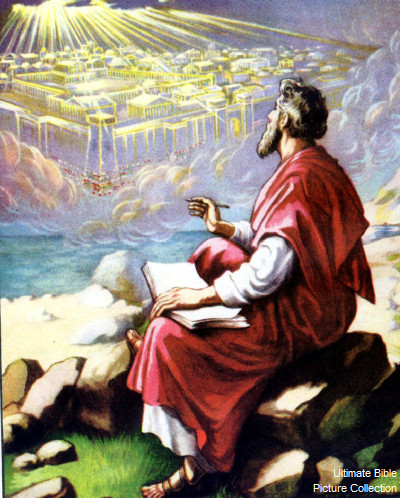
In Revelation 1:10, the Apostle John wrote that he "was in the Spirit on the Lord's Day" as he wrote this final book of the Bible. In general, Christians have taken this to refer to the Christian Sabbath, the first day of the week. However, that tradition is challenged by seventh-day sabbatarians, such as Seventh-Day Adventists, who claim instead that he was in the Spirit on "the day of the Lord."

However, in favor of the traditional wording is that John uses a different word in the genitive here from what is used in the New Testament for "day of the Lord." In the passage at hand, the Greek reads "te kuriake hemera." In contrast, where the New Testament writers referred to "the day of the Lord," such as in I Thessalonians 5:2, the writers use "he hemera kuriou." "Kuriakos" is used only here and in I Corinthians 11:20 (to refer to "the Lord's Supper"). "Kurios," in contrast, is used 720 times, both for Christ and for higher authorities, in general, which is why it is sometimes translated "master." Thus, the difference is that "kurios" is the more-generic term, while "kuriakos" is used only for Christ, which is why it came into Germanic languages as the word for "church" ("kirk" in Scottish dialect, "kirche" in German), instead of the Greek and Latin "ekklesia" ("eglise" in French, "iglesia" in Spanish, "chiesa" in Italian).
Apostle John

The point is this: the day in Rev. 1:10 is not the Day of the Lord, such as appears not just in I Thessalonians, but also in the Old Testament prophets (e. g., Amos 5:18, Zephaniah 1:14, and Joel 1:15). Rather, it is specifically the day of Christ! That is because the first day was the day of His resurrection (John 20:1ff), and when He revealed Himself glorified to His disciples (John 20:19), and when He sent the Holy Spirit (Acts 2:1; Pentecost was fifty days after Passover, i. e., seven seventh-days plus one, the first day of the week), and the day that the apostolic church gathered for worship (Acts 20:7 and I Corinthians 16:2). Thus, for John to have been involved in spiritual exercises on that day is only to be expected. To say that he was doing so on "the day of the Lord" makes no sense, at all.

Accordingly, I affirm the statement of the Westminster Confession of Faith (XXI:7): "As it is of the law of nature, that, in general, a due proportion of time be set apart for the worship of God; so, in His Word, by a positive, moral, and perpetual commandment, binding all men in all ages, He hath particularly appointed one day in seven for a Sabbath, to be kept holy unto Him: which, from the beginning of the world to the resurrection of Christ, was the last day of the week; and, from the resurrection of Christ, was changed into the first day of the week, which in Scripture is called the Lord's Day, and is to be continued to the end of the world as the Christian Sabbath." I find the biblical case for the first-day Sabbath, ever since the resurrection of Christ, to succeed over that for a continuing seventh-day Sabbath. I consider the latter to be an effort at judaizing the Christian faith, and, therefore, to be opposed.

Friday, January 27, 2012

Election Means The REAL God Ain't You!

As I have noted before, I don't believe that the religion of modern America is Christianity, but rather Deism, i. e., the belief that there is a God, but He doesn't take an active role in the world. Americans love our religiosity, as long as it doesn't interfere with our own sovereignty over our lives! Just enough religion to be comfortable, but not enough actually to affect how we live.

The problem is this: the God of the Bible doesn't allow Himself to be boxed in that way. He has a discomfiting habit of insisting that He is God and we aren't.

Consider Psalm 115:3, "Our God is in the heavens; he does all that He pleases." Short but straightforward. As is Psalm 103:19, "The LORD has established his throne in heaven, and his kingdom rules over all." And again in Psalm 135:6, "The LORD does whatever pleases Him, in the heavens and on the earth, in the seas and all their depths." The sovereignty of God was a favorite theme of the psalmists.

The Prophet Isaiah chimes in on the theme. Isaiah 14:24 and 27, "The Lord of hosts has sworn: 'As I have planned, so shall it be, and as I have purposed, so shall it stand... For the Lord of hosts has purposed, and who will annul it? His hand is stretched out, and who will turn it back?'" For, as the prophet also says in Isaiah 42:8, "I am the LORD; that is my name; My glory I give to no other, nor my praise to carved idols."

And the Prophet Amos gives us God's words in Amos 3:6, "Is a trumpet blown in a city, and the people are not afraid? Does disaster come to a city, unless the LORD has done it?" He declares that God is even sovereign in bringing disaster. Job reinforces this point in Job 2:10. "'Shall we receive good from God, and shall we not receive evil?' In all this Job did not sin with his lips." The inspired text even reinforces his point by telling us that Job's comment wasn't sinful!

American evangelicalism is sinfully man-centered, especially that portion known as the "Prosperity Gospel." In contrast, the Bible is radically God-centered. I suspect that this is the reason that the bulk of American evangelicalism is losing membership and growing increasingly impotent. God has given the professing Christians what they wanted: their own spiritual sovereignty. And it has destroyed our nation's spiritual heritage.

Friday, December 10, 2010

Amos 3:2, Election and God's Disciplining Love


"You only have I known of all the families of the earth; therefore I will punish you for all your iniquities."

Addressing His own chosen people, God declares that His discipline arises from His special love for us. The same principle appears across the Scriptures, in both testaments. For example, Moses writes in Deuteronomy 8:5, "Know then in your heart that, as a man disciplines his son, so the LORD your God disciplines you." That is quoted almost word-for-word by the author of Hebrews 12:7. Proverbs 3:12 in the Old Testament, and again, John in Revelation 3:19 in the New.

Paul gives the explanation for this discipline in I Corinthians 11:32, "When we are judged by the Lord, we are disciplined so that we may not be condemned along with the world." The discipline of the Lord is directed toward the effectual goal of separating those who are His from those who are not (Matthew 25:33).

When His discipline seems so hard, and it certainly can be, remember one other exhortation from Proverbs 3:11, "My son, do not despise the LORD’s discipline or be weary of His reproof." His discipline arises not from tyranny, but from the love of His fatherhood.

Thursday, October 21, 2010

Amos 3:6, Is It the Responsibility of a Sovereign God to Make Us Happy?


"Does disaster come to a city, unless the LORD has done it?"

Portions like this one are why ignorance of the Old Testament is almost a sign of superiority amongst American Evangelicals. Consider that popular song: "At the cross, at the cross, where I first saw the light, and the burden of my heart rolled away, it was there by faith I received my sight, and now I am happy all the day!" Charismatics, especially the Prosperity Gospel peddlars, are well-known for claiming that illnesses are "lies from Satan!" But is it biblical to expect to be "happy all the day" or free from illness, simply because one knows Jesus?

Consider another verse, Isaiah 45:7, "I form light and create darkness, I make well-being and create calamity, I am the Lord, who does all these things." Speaking of Himself, God certainly makes no claims of being the bringer of only sweetness and light.

Or what of the testimony of Job? In 2:10, he says, "But he said to her, 'You speak as one of the foolish women would speak. Shall we receive good from God, and shall we not receive evil?' In all this Job did not sin with his lips." And the text even makes explicit that it was no sin for him to say this!

God does indeed bring suffering into the lives of even the strongest Christians. the reasons are many. It may be to expose hidden sin or overblown pride (consider Paul's thorn in the flesh, II Corinthians 12:7-10). Suffering also helps us to loosen our grasp on material things in this life and to focus on the life to come. But the issue is his sovereignty: He does, because He can. It is our place to receive His purposes in our lives. To put it simply: we must learn more and more that He is God and we are not!

The reason American evangelicals avoid passages such as these is that evangelism and worship in most churches have changed God from our sovereign king to Santa Claus, lifestyle guru, or the candyman. Do you remember the Candyman in "Chitty-Chitty-Bang-Bang"? He was a wicked man who enslaved children with promises of sweets from a pretty wagon. However, when the children responded to his charms, the candy wagon was suddenly revealed as a cage, as the children were carted away to enslavement. I think that provides an excellent analogy for Satan in the deceptions of American popular evangelicalism!

Tuesday, August 17, 2010

The Hermeneutics of Sentiment: Criminal Justice According to God

If anyone kills a person, the murderer shall be put to death on the evidence of witnesses. But no person shall be put to death on the testimony of one witness. Moreover, you shall accept no ransom for the life of a murderer, who is guilty of death, but he shall be put to death. And you shall accept no ransom for him who has fled to his city of refuge, that he may return to dwell in the land before the death of the high priest. You shall not pollute the land in which you live, for blood pollutes the land, and no atonement can be made for the land for the blood that is shed in it, except by the blood of the one who shed it. You shall not defile the land in which you live, in the midst of which I dwell, for I the Lord dwell in the midst of the people of Israel.
- Numbers 35:30-34

There are a number of professing Christian groups that work against capital punishment in the United States. The most prominent is the Catholic Church. However, it is most-closely associated with churches of the pietist and Anabaptist tradition, such as Mennonite statements here and here.

I suggest that there are two hermeneutical errors involved. The first is placing sentiment ahead of obedience in approaching Scripture. The second is a disparaging of the Old Testament. The first is a matter of obstinacy, not reasoning. However, the second is based on faulty reasoning. After all, when Jesus quoted Scripture, what did He quote? The Old Testament, of course, such as Deuteronomy during His temptation (see Matthew 4:1-11). When Paul commends Timothy for his knowledge of the Scriptures, at the knees of his mother and grandmother (II Timothy 3:15), for the knowledge they give of salvation in Jesus Christ, the New Testament hadn't even been written yet. This is especially telling in verses 16-17, the classical statement of Scriptural inspiration and infallibility. When Anabaptists disparage the Old Testament, they go against the examples of both the apostles and of Christ Himself!

Even their sentiment speaks against the Catholic and Anabaptist attitudes. They place victim and perpetrator on a level, something that Scripture testifies against. Isaiah 5:20 anathematizes the one who equates good and evil. Jesus in Matthew 12:35 tells us that actions come from the nature of the heart, whether good or evil. Good people and evil people are not the same! (This is a different issue from fallenness, by which all men are sinners.) And Amos 5:15 and Romans 12:9 give a testimony in both testaments to the requirement of justice in order to true love! Sentiment is hatred; justice is love!

In Numbers, we see God's standard of justice. The unlawful taking of life creates an imbalance of injustice that exposes both land and people to the judgment of God. To restore the balance, the blood of the guilty must be shed. This is required by the very presence of a holy God among His people. The importance of this principle is so great that even the inability to convict a murderer does not dispense with the requirement. Deuteronomy 21:1-9 establishes a procedure for dealing with an unsolved murder. According to Moses here, a virgin heifer is to be killed, and the blood poured out in symbolic judgment on the actual human murderer. That is, the shedding of guilty blood is so important to God's justice, that He even commands the symbolic shedding of blood when actual guilty blood cannot be determined.

The standard isn't man's love, but God's holiness!