Showing posts with label hypocrisy. Show all posts

Wednesday, April 22, 2020

Mormonism and the Issue of Race

As some may know, there was a time that the Church of Jesus Christ of Latter-Day Saints, commonly known as the Mormons, officially excluded black men from their priesthood. This was based on a belief that dark skin was the so-called "mark of Cain" (see Genesis 4:15). They were not alone in this belief. It was used as the justification for the American system of chattel slavery (see also the curse of Ham, Genesis 9:25). The Mormons repudiated their doctrine in the 1970's. Both the imposition and the repeal of the doctrine were by supposed revelations given to their leadership.

When someone brings up this past racism with Mormons, they will be quick to point to the ending of the doctrine. And correctly.

However, while that particular racial doctrine has been repudiated, it was not the only racist teaching in Mormonism. Their Scriptures include several more cases.

For example, in I Nephi 13:15, we read, "And I beheld the Spirit of the Lord, that it was upon the Gentiles, and they did prosper and obtain the land for their inheritance; and I beheld that they were white, and exceeding fair and beautiful, like unto my people before they were slain." So, the good guys are white!

Next, we can read in II Nephi 5:21, "And he [i. e., the Lord, previous verse] had caused the cursing to come upon them, yea, even a sore cursing, because of their iniquity. For behold, they had hardened their hearts against him, that they had become like unto a flint; wherefore, as they were white, and exceeding fair and delightsome, that they might not be enticing unto my people, the Lord God did cause a skin of blackness to come upon them." In this verse, we see two things. First, God curses a group of apostates by changing them from white to black. And second, we are explicitly told that this was become UNenticing. So, black skin is bad, and black skin is ugly!

Third, we can look at Jacob 3:5, 8: "Behold, the Lamanites your brethren, whom ye hate because of their filthiness and the cursing which hath come upon their skins, are more righteous than you; for they have not forgotten the commandment of the Lord, which was given unto our fathers - that they should have save it were one wife, and concubines they should have none, and there should not be whoredoms committed among them... O my brethren, I fear that ye shall not repent of your sins that their skin will be whiter than yours, when ye shall be brought with them before the throne of God." So, whiter is better! And to be black is to be hated.

Fourth, we will turn to Alma 3:6-9: "The skins of the Lamanites were dark, according to the mark which was set upon their fathers, which was a curse upon them because of their transgression and their rebellion against their brethren... And their brethren sought to destroy them, therefore they were cursed; and the Lord God set a mark upon them, yea, upon Laman and Lemuel, and also the sons of Ishmael, and Ishmaelitish women. And this was done that their seed might be distinguished from the seed of their brethren, that thereby the Lord God might preserve his people that they might not mix and believe in incorrect traditions which would prove their destruction. And it came to pass that whosoever did mingle his seed with that of the Lamanites did bring the same curse upon his seed." So blackness is a mark from God to prevent racial mixture between good white people and bad black people, because black people are a bad influence.

And finally, turn to III Nephi 2:14-16: "It came to pass that those Lamanites who had united with the Nephites were numbered among the Nephites; and their curse was taken from them, and their skin became white like unto the Nephites; and their young men and their daughters became exceedingly fair, and they were numbered among the Nephites, and were called Nephites..." So, if a bad black person was converted, he didn't become a good black person. Rather, according to the story, he or she ceased to be black and became white and fair. That claim should disgust any fair-minded person.


These quotes come from Mormon Scripture. That means that no individual Mormon can dodge responsibility for it with their standard response: "That isn't official doctrine." When the LDS organization claims that it no longer holds to the racist views of the past, those claims are whitewashing, no pun intended, not reality. Their own Scriptures testify against them.

Saturday, December 7, 2019

Apostasy and Its Leaders

We live in a time where the culture has returned to a pre-Christian stage, in which every man does what is right in his own eyes (Judges 21:25). Things which were considered too shameful for polite company within the lifetimes of man of us living today are now common fare in entertainment or taught to our children in government schools.

While it is true that the American government has been on a crusade to scrub the Christian presence from public society, I don't blame government. And while it is true that there are influencers in government and the media who hate the Gospel and seek to silence it, I don't blame them. Unbelievers must be expected to hate the Gospel (Romans 1:18). That's what makes them unbelievers.

However, when I see the church complacent in its own suppression, then I find cause for blame.

We have public religious figures - I don't call them Christians - such as Joel Osteen, who refuse to talk about sin because they don't want to offend anyone. That is who deserves the blame.

In 586 BC, Judah, the Southern Kingdom, was conquered by Babylon and carried away into exile. Why? Because they had abandoned the faith on which their kingdom was established, and turned to pagan deities and practice.

What did their religious leaders say about that apostasy? Did they denounce the sin of the people, and fight against that apostasy?

"Your prophets have seen for you false and deceptive visions; they have not exposed your iniquity to restore your fortunes, but have seen for you oracles that are false and misleading" (Lamentations 2:14). No, no denunciations; no warnings of judgment. Rather, the religious leaders joined in that apostasy, soothing the apostates with assurance that God was happy with their perverted worship and lives. Does that sound like today's religious world? I think so.

But what does God say? Is he bound by the soothing words of apostate preachers? "If I say to the wicked, ‘You shall surely die,’ and you give him no warning, nor speak to warn the wicked from his wicked way, in order to save his life, that wicked person shall die for his iniquity, but his blood I will require at your hand" (Ezekiel 3:18). Not in the smallest bit. Rather, He promises that judgment of sin will come, but it will begin with false teachers who failed to preach a warning about the consequences of sin.

Wednesday, November 20, 2019

American Evangelical Tolerance: The Game Plan That Failed

In America, the popular version of evangelical Christianity has followed our new national orthodoxy: "Thou shalt not offend." God loves everyone unconditionally. Even the Pope has joined in, claiming that atheists might be saved without knowing it. To talk about God's holiness, wrath, or judgment is to be considered too fanatical for polite company.

However, that American religion is not at all like the biblical faith from which it came.

Here is what the Bible says about the justice of God: "That day [of judgment] is the day of the Lord GOD of hosts, a day of vengeance, to avenge Himself on His foes. The sword shall devour and be sated and drink its fill of their blood" (Jeremiah 46:10. Where is that tolerant, all-loving deity of today's Christian? Certainly not in this verse.

Here is another one: "The LORD has a sword; it is sated with blood; it is gorged with fat, with the blood of lambs and goats, with the fat of the kidneys of rams. For the LORD has a sacrifice in Bozrah, a great slaughter in the land of Edom" (Isaiah 34:6).

These verses are just examples, not alone in expressing the violence of the judgment of God. Moreover, they reveal a God who is utterly unlike the creampuff advocated by the average American professing evangelical. Why is that?

It is because of the content of the "love" advocated by that brand of evangelical. He thinks of God's love as requiring approval of whatever he wants to do. Only a meanie describes anything as wicked or as deserving of judgment.

The problem is that the love described by such people is love for them, and for what they want. They do not allow the other side of love, God's love for Himself. God is not allowed to love Himself or His holiness or His word. In other words, such people advocate a one-directional tolerance, a tolerance that benefits them. They feel no obligation to tolerate God or what He values. And, sadly for them, God does not feel bound to honor their definition of tolerance. "Woe to those who call evil good and good evil, who put darkness for light and light for darkness, who put bitter for sweet and sweet for bitter! Woe to those who are wise in their own eyes, and shrewd in their own sight!" (Isaiah 5:20-21). 

You see, when these evangelicals created their religion of unconditional love and tolerance, they just assumed that God would go along with the gameplan. If they had consulted Him, though, they would have discovered that God doesn't play by their plan.

Saturday, October 6, 2018

American Pharisees: Lost Without a Physician


"There are those who are clean in their own eyes but are not washed of their filth. There are those—how lofty are their eyes, how high their eyelids lift!" (Proverbs 30:12-13). 

Among Americans, Satan's primary attack against biblical Christianity is not atheism, alternative religions, or evolutionism, as bad as those things are. Rather, he attacks the faith through complacency.

Luke describes the conversion of Levi (another name for the Apostle Matthew): "Levi made Him a great feast in his house, and there was a large company of tax collectors and others reclining at table with them. And the Pharisees and their scribes grumbled at his disciples, saying, 'Why do you eat and drink with tax collectors and sinners?' And Jesus answered them, 'Those who are well have no need of a physician, but those who are sick. I have not come to call the righteous but sinners to repentance'" (Luke 5:29-32). At the house of Matthew, Jesus sat at dinner with tax-collectors, a class hated by the Jews, and other sinners. The Pharisees saw this, and rebuked Him for His bad taste in companions. After all, were the Pharisees not the cream of Jewish society? 

But the rebuke of Jesus must have caught those Pharisees completely flat-footed: "I have not come to call the [supposedly] righteous but sinners to repentance." In their moral satisfaction, the Pharisees had no desire for what Jesus had come to give, redemption in His blood. However, the tax-collectors and sinners in Matthew's house knew their spiritual condition, and were looking to Jesus to forgive their sins and restore them to righteousness: "Help us, O God of our salvation, for the glory of Your name; deliver us, and atone for our sins, for Your name’s sake!" (Psalm 79:9).

And this explains the spiritual anemia of America's professing Christians. Too many of us are satisfied with our moral superiority. Rare is the man who can say from his heart, "God, be merciful to me, a sinner!" (Luke 18:13). Yet Jesus tells us that is exactly the point to which we must come to find Him.

Saturday, July 28, 2018

Mormonism's Origins and Hypocrisy

Cults and sects often accuse orthodox Christians of deriving our doctrines, such as the trinity, from Greek philosophy. They never actually mention a particular Greek philosopher who taught the doctrine. Nor do they ever disprove the biblical justification for the doctrine. It's just an assertion that they constantly repeat, without actually checking the facts.

Mormons are one of the groups in particular that do this.

The reason I mention them specifically is that one of their own websites mentions -brags to be more explicit- that one of their cardinal doctrines, the preexistence of souls, comes from Plato: "Several philosophers from Plato through Leibniz and Kant to twentieth-century Cambridge intellectuals, dozens of poets from antiquity to Robert Frost, and numerous religious thinkers throughout the Jewish and Christian traditions, propounded a pre-earthly realm peopled by the souls of men and women yet unborn. Pre-existence has been invoked to explain 'the better angels of our nature,' including the human yearning for transcendence and the sublime; it suggests a reason for the frequent sensation of alienation and the indelible sadness of human existence" (https://ldsmag.com/article-1-408).

Do you see the hypocrisy?

This has been my consistent experience with Mormons. They make unsubstantiated accusations against Christians, while blanking out even the professed sources of their own religion.


Wednesday, July 26, 2017

Adam Made It Rough: The Sin Nature

The hardest inheritance that all men have received from our first ancestor, Adam, is the promise of eternal life on the basis of perfect obedience to the covenant of works. As we know from subsequent events, Adam broke the covenant, forfeiting salvation by it, and bringing death, both spiritual and physical, on all his posterity (Romans 5:12-19). Yet our hearts have retained that consciousness of the original covenant, and find every opportunity to convince us that a little hard work will restore us to eternal life. This results in the Pelagianism that is inherent in all pagan religions, all forms of secularism, and much of popular Christianity. Apart from orthodox, biblical Christianity, all religions, including secular religions, hold that men are good, or, at least, good enough to claw our way to whatever vision of salvation we hold.

It is biblical Christianity alone that teaches consistently that the covenant of works is broken and hopeless. By its very nature, failure is permanent, leaving no opportunity for second chances: "The soul who sins shall die" (Ezekiel 18:20). And this isn't sin on a curve, i. e., the one who sins more than someone else. Rather, broken means broken, all or nothing: "Whoever keeps the whole law but fails in one point has become guilty of all of it. For he who said, 'Do not commit adultery,' also said, 'Do not murder.' If you do not commit adultery but do murder, you have become a transgressor of the law" (James 2:10-11).

Yet, we just naturally keep trying to get back on that train, though it long ago left the station. We all want to get the credit for saving ourselves. It is the same deceptive independence that Satan offered Adam and Eve in the garden: "God knows that when you eat of it [the Tree of the Knowledge of Good and Evil] your eyes will be opened, and you will be like God, knowing good and evil" (Genesis 3:5). "Don't let God rule you," Satan said. "Rule yourselves." And he continues to whisper that same deception in the ear of every human being since then, even Jesus (Matthew 4:8-9). Jesus alone never gave in to that temptation.

That same Jesus tells us the truth about what is left of the covenant of works: "When you have done all that you were commanded, say, ‘We are unworthy servants; we have only done what was our duty'" (Luke 17:10). He is not impressed with what impresses us. While we trumpet each prideful act, He says that ever our best is merely the minimum standard, not anything that gets merit in His eyes.

That's why every philosophy based on human autonomy is a pathway to judgment. It starts with a false premise. God's beginning premise is Himself, with the holiness that is essential to His nature (Habakkuk 1:13). Men always start with themselves, which means with the antiholiness that Adam has passed to all of us. When we agree with Him, then salvation is available in Jesus Christ. All other options are really just one option, judgment. Hear Jesus's words: "Enter by the narrow gate. For the gate is wide and the way is easy that leads to destruction, and those who enter by it are many. For the gate is narrow and the way is hard that leads to life, and those who find it are few" (Matthew 7:13-14).

Saturday, July 22, 2017

The Spirituality of the Hypocrite Will Not Save Him

Asaph the Psalmist records a frightening warning to the hypocrite (Psalm 50:16-17):
"To the wicked God says: 
'What right have you to recite my statutes
     or take My covenant on your lips?
For you hate discipline,
 

     and you cast My words behind you.'"

Let me start with defining a "hypocrite." In the spiritual sense, a hypocrite is a person who claims a spiritual commitment, while living inconsistently with that profession. He is also called a "false professor." We see it used, for example in the words of Jesus (Matthew 23:27): "Woe to you, scribes and Pharisees, hypocrites! For you are like whitewashed tombs, which outwardly appear beautiful, but within are full of dead people’s bones and all uncleanness." He compares them to whitewashed tombs, well-decorated on the outside, but putrid on the inside.

That is the type of person who gets God's warning through Asaph's Psalm. He refers to those who act very spiritual, quoting the Scriptures or mouthing claims to God's covenantal blessings. Yet, he tells them, they actually hate the restrictions in God's word, and live as if they have never heard them.

Is this not a description of most of today's professing Christendom? We even have special words for such people: "Sunday Christians," or "carnal Christians." However, in view of God's statement here, is it proper to refer to such people as "Christians"?

God certainly doesn't think so! He continues with this warning (Ps. 50:21-22):
"These things you have done, and I have been silent;
     you thought that I was one like yourself.
But now I rebuke you and lay the charge before you.
 
     Mark this, then, you who forget God,
     lest I tear you apart, and there be none to deliver!"

For the hypocrite, He says that there is no deliverer. That means that adding the mere word "Christian" after "carnal" brings no salvation, any more than lipstick on a pig makes it a fashion queen.

The good news is that the Psalm has one more verse, one that gives final hope: "The one who offers thanksgiving as his sacrifice glorifies Me; to one who orders his way rightly I will show the salvation of God!" For the person who has merely mouthed the words of God, when those words become joined with a changed heart, then God's wrath will also be converted, into forgiveness. "Remember that you were at that time separated from Christ, alienated from the commonwealth of Israel and strangers to the covenants of promise, having no hope and without God in the world. But now in Christ Jesus you who once were far off have been brought near by the blood of Christ" (Ephesians 2:12-13).

Saturday, July 15, 2017

Yes, It Is Black or White: Belief and Unbelief

 In today's society, it has become unpopular to state things in absolutes: truth or falsehood, right or wrong. It seems as if nearly everyone wants the world in shades of gray. Any person who declares certainty about anything is labeled intolerant. However, have you noticed that defining intolerance as evil is the one absolute that is still acceptable? "I can't tolerate intolerance" may be nonsensical, but it is the popular theme of our age.

The funny thing is that the overwhelming majority of those same people profess to be Christians, about 90% of Americans. How does their intolerant tolerance line up with His attitude? Did Jesus not say, "I am the way, and the truth, and the life. No one comes to the Father except through Me" (John 14:6)? Of course, He did say exactly that, and it is far from a tolerant statement.

He said some other intolerant things, too. We see Him, saying (John 3:18), "Whoever believes in Him is not condemned, but whoever does not believe is condemned already, because he has not believed in the name of the only Son of God." He also says of unbelievers (John 8:43-44), "Why do you not understand what I say? It is because you cannot bear to hear my word. You are of your father the devil, and your will is to do your father’s desires." Apart from commitment to Him, a person is under judgment. That is, now, not just in the hereafter. Why does a person not believe? Because he is acting consistently with his nature as the seed of Satan (Genesis 3:15). These are black and white categories. Either/or. Jesus is an absolutist!

Another categorical statement that Jesus made is, "Whoever is not with Me is against Me" (Matthew 12:30). That is a shocking statement, even to supposed Christians! I know that it is hip to be neutral. To be for or against anything is fanaticism. Except for certitude. One must absolutely be against that. Don't forget, "I can't tolerate intolerance." However, Jesus doesn't make any effort to be hip, or tolerant, or flexible. Nor does He allow His followers to be any such thing. Rather, if you aren't for Him, then He considers you to be against Him.

"Tolerance" has become the catchword for everyone who wants to be an "individual," just like everyone else. However, the biblical Christian is the real counter-cultural radical. The culture says, "Don't conform!" But it only means "don't conform to Christ." Conformity to culture is the modern standard of nonconformity, and it cannot be an option for the Christian.

The Bible commands us to a form of nonconformity (Romans 12:2): "Do not be conformed to this world, but be transformed by the renewal of your mind, that by testing you may discern what is the will of God, what is good and acceptable and perfect." When God says, "Don't conform," He means to the very worldview that is demanding our conformity. At the same time, He also commands a certain conformity (Romans 8:29): "Those whom He foreknew He also predestined to be conformed to the image of His Son, in order that He might be the firstborn among many brothers." Therefore, in a very black and white contrast, to conform as the world demands is rejected by God. The conformity that the world condemns is the exact conformity that God commands. There is no gray, no neutral territory, no safe zone. It's a matter of faithfulness, and to deny it is an act of idolatry.

Saturday, March 4, 2017

Astrology: Is Our Fate Written in the Stars?

In chastising his congregants for consulting astrologers, John Calvin referred to Isaiah 44:25: "[The Lord] frustrates the signs of liars and makes fools of diviners, who turns wise men back and makes their knowledge foolish." The prophet here tells the Israelites that consulting astrologers is dangerous, because God deliberately deceives the deceivers, as punishment for the deceived. 

The Prophet Jeremiah also addressed the question of astrologers (Jeremiah 10:2): "Do not act like the other nations, who try to read their future in the stars. Do not be afraid of their predictions, even though other nations are terrified by them."

In their advertisements and signs, astrologers, palm-readers, and "spiritual advisors" often include a cross, claiming that their foundation is Christian. It is OK to consult them, we are to believe, because they aren't like Pagan fortune tellers. But God says otherwise.

The person who goes to a fortune teller, whether of the Pagan or the professedly-Christian variety, is looking for a secret source of information, apart from the revelation that God has given us. That in itself is a pagan act, regardless of what Christian terminology anyone uses to clothe it.

Isaiah also addresses that mentality directly (Isaiah 8:19-20): "When they say to you, 'Inquire of the mediums and the necromancers who chirp and mutter,' should not a people inquire of their God? Should they inquire of the dead on behalf of the living? To the teaching and to the testimony! If they will not speak according to this word, it is because they have no dawn." "The teaching and the testimony" are biblical words for the Scriptures (see Psalm 119). Thus, God opposes the use of fortune tellers, and directs His people to find their infallible revelation in His word alone. If a person is seeking spiritual knowledge outside Scripture, then he is committing two sins: one is to demonstrate a pagan mentality that seeks truth outside that given by God; and the second is to accuse God of inadequacy. What He gives you, you decide, is not good enough. Do you not recognize that as the same temptation with which Satan destroyed the bliss of our first parents (Genesis 3:1-5)?

No matter what you call yourself, if you consult astrology, or any other type of fortune teller, then you are a Pagan, not a Christian. 


Saturday, February 20, 2016

Divorce, Same-Sex Marriage, and Adultery

In Matthew 5:31-32, Jesus taught a crowd, including His disciples, "It was also said, 'Whoever divorces his wife, let him give her a certificate of divorce.' But I say to you that everyone who divorces his wife, except on the ground of sexual immorality, makes her commit adultery, and whoever marries a divorced woman commits adultery." A person may ask why it only refers to the wife's adultery after a divorce. It is because, under the Law, only a husband could initiate a divorce. The counter-balance was the right of the now-exwife to keep her bride price. In our society, the principles would apply equally to husband and wife.

Was Jesus here objecting to the Law? After all, the principle to which He objects comes from Deuteronomy 24:1. And the answer is, of course, no. As God incarnate, He could certainly not repudiate something that He had legislated. Rather, He was objecting to the perversion of the Law, by which men dismissed their wives for the pettiest of offenses: "The Talmud specifically says that a man can divorce a woman because she spoiled his dinner or simply because he finds another woman more attractive, and the woman's consent to the divorce is not required." The Old Testament clearly condemned such a lackadaisical attitude toward marriage (Malachi 2:13-16): "You cover the Lord’s altar with tears, with weeping and groaning because He no longer regards the offering or accepts it with favor from your hand. But you say, 'Why does He not?' Because the Lord was witness between you and the wife of your youth, to whom you have been faithless, though she is your companion and your wife by covenant. Did He not make them one, with a portion of the Spirit in their union? And what was the one God seeking? Godly offspring. So guard yourselves in your spirit, and let none of you be faithless to the wife of your youth. For the man who does not love his wife but divorces her, says the Lord, the God of Israel, covers his garment with violence, says the Lord of hosts."

I have thought of this often during the debates over same-sex marriage, including when it was opposed with "The Defense of Marriage Act." How many of the members of Congress  were divorced who voted for DOMA? And what about Bill Clinton, the philanderer-in-chief who signed DOMA? The best hip boots in the world wouldn't be good enough to wade through that tide of hypocrisy. Kim Davis, the Kentucky county clerk who made world news for opposing same-sex marriages, has been married four times! Which of those marriages was she defending?

As a society, we have become completely unmoved by divorce. Any excuse will do, even such drivel as "I just wasn't happy anymore." Do we skip over God's protest in Malachi? Close our eyes to it? Do we imagine that He sets His opinion aside when it doesn't match the most-recent opinion polls? And do we think that crying about same-sex marriages will cover the hypocrisy of our own dismissal of God's standards for marriage?

Saturday, January 9, 2016

The Connection Between Love and Truth in the Second Epistle of John

Have you ever noticed the consistent response that a person gets if he tries to point out the theological errors of someone else, especially a TV preacher? He is "judgmental," "unloving." The vocabulary is
very consistent.

Often, the only effort at a biblical criticism is to exclaim, "Judge not, lest ye be judged!" And that is, indeed, biblical, from Matthew 7:1. However, it is not completely biblical. What does the next verse say? "With the judgment you pronounce you will be judged, and with the measure you use it will be measured to you." By what standard will you be judged? By the standard of the Word of God, of course. Thus, Matthew is making the same point that John does in John 7:24: "Do not judge by appearances, but judge with right judgment." That is, judge according to the word of God, not according to one's personal preferences. In both cases, the authors are quoting Jesus. Thus, in context, Jesus in Matthew is not making an absolute statement against exercising judgment. Otherwise we would have Him contradicting Himself.

Later in life, John explained these words of Jesus in his second epistle. He uses the buzzword of the nonjudgmental crowd (that is, nonjudgmental among themselves; they have plenty of judgment for anyone who dares to disagree with them), "love," four times in just the first six verses (out of the mere thirteen in the whole epistle). And I am sure that the love crowd would love to stop at that point. However, John gives a definition of love, one that they will not like (verse six):  "this is love, that we walk according to his commandments." "Love," in John's usage, has content

Another word that John uses a lot in this epistle, five times, is "truth." Not just "a truth," but "the truth," truth that "we know," is "in us," and "abides with us forever." John expresses his joy that the recipients of this epistle are "walking in the truth, just as we were commanded by the Father" (verse 4). In contrast, he warns against "deceivers" (verse 7), who do "not abide in the teaching of Christ" (verse 9), and who we are "not receive him into your house or give him any greeting" (verse 10).


Thus, contrary to the judgment of the love crowd, we are not commanded to love everybody (that is, equally and openly), but rather those who are faithful to the truth, i. e., biblical truth. This is the same attitude that David expresses in Psalm 139:21-22: "Do I not hate those who hate you, O Lord? And do I not loathe those who rise up against you? I hate them with complete hatred; I count them my enemies." The "man after God's own heart" (I Samuel 13:14, Acts 13:22) hated those who hate the truth. And we are, too, regardless of the shrieks of rage from the unloving love hypocrites.

Saturday, December 5, 2015

Syncretism: God's Conflict with "Christians" Who Support Abortion

"The Lord said to me: 'Son of man, will you judge Oholah and Oholibah? Declare to them their abominations. For they have committed adultery, and blood is on their hands. With their idols they have committed adultery, and they have even offered up to them for food the children whom they had borne to Me. Moreover, this they have done to Me: they have defiled My sanctuary on the same day and profaned My Sabbaths. For when they had slaughtered their children in sacrifice to their idols, on the same day they came into My sanctuary to profane it.'"
- Ezekiel 23:36-39

In this chapter of Ezekiel, the prophet is using the names Oholah for Israel, the northern kingdom, and Oholibah for Judah, the southern kingdom. The story is an allegory of two sisters. The first becomes an adulterous prostitute, and is duly punished. This refers to the destruction and deportation of the northern kingdom by the Assyrians as punishment for turning to pagan gods and practices, including the sacrifice of their own children. Judah witnessed these events. Yet, instead of serving as a deterrence to her, these experiences only provided the template for her own apostasy and consequent destruction by the Babylonians.

However, notice the things that enrage God the most. He chastises the paganism of the sisters, yet He also mentions that, when they had finished their pagan abominations, they then entered His temple to perform His mandated rituals. This is what enraged Him: the hypocrisy of their paganism on the one hand combined with a pretended exercise of biblical religion on the other. This combination of worldviews is called syncretism. Jehovah, the God of the Bible, is a jealous God (Ex. 34:14, Deut. 6:15). That is, He does not share what belongs to Him (Isaiah 42:8, 48:11). Yet, knowing this, Israel and Judah thought that He would be satisfied with half of their devotion, imagining that they were then free to spread the other half of their devotions to any demon that struck their fancy. Thus, the label of whoredom.

This theme also appears in Psalm 106:36-40:
"They served their idols,
     which became a snare to them.
They sacrificed their sons
     and their daughters to the demons;
they poured out innocent blood,
     the blood of their sons and daughters,
whom they sacrificed to the idols of Canaan,
     and the land was polluted with blood.
Thus they became unclean by their acts,
     and played the whore in their deeds.
Then the anger of the Lord was kindled against His people,
     and He abhorred His heritage."

I have previously described the connection between abortion and the ancient cult of Molech. I have also talked about the support that liberal clergy have devoted to this human sacrifice (here, here, and here). They promote the sacrifice of children, including His covenant children ("the children whom they had borne to Me" above). Then they perform their ecclesiastical functions the next Sunday. They are committing the very same whoredoms of Israel and Judah all these centuries after. God's words have fallen on deaf ears again.


Saturday, October 31, 2015

Hypocrisy and True Spiritual Peace

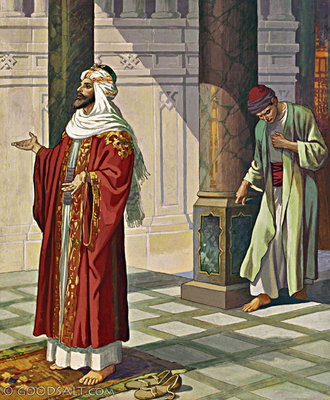
In Luke 18:9-14, Jesus told a deep parable, that of the Pharisee and the Tax Collector. In it, we see strikingly different attitudes in their approaches to God, representative of those of people everywhere. The Pharisee prays (verses 11-12), "God, I thank you that I am not like other men, extortioners, unjust,
The Pharisee and the Tax Collector
adulterers, or even like this tax collector.
I fast twice a week; I give tithes of all that I get." Then He turns to the tax collector, who prays (verse 13), "God, be merciful to me, a sinner!" Then the Lord ends the parable with His own inspired synopsis (verse 14): "I tell you, this man went down to his house justified, rather than the other. For everyone who exalts himself will be humbled, but the one who humbles himself will be exalted."

Notice how much longer the prayer of the Pharisee is (see Matthew 6:1-4). He uses thirty-three words in this English version, all of them extolling his virtues. In contrast, the tax collector uses just seven words, begging for God's mercy on his sins. What a contrast! Thirty-three words to stand condemned, but only seven to be justified!

The Pharisee in the story exemplifies something that the Puritan Thomas Watson said: "The wicked may have something which looks like peace, but is not. They may be fearless and stupid, but there is a great difference between a stupified conscience and a pacified conscience. 'When a strong man armed keepeth his palace, his goods are in peace.' Luke 11:21. This is the devil's peace. He rocks men in the cradle of security. He cries, 'Peace, peace,' when men are on the precipice of hell. The seeming peace that a sinner has is not from the knowledge of his happiness but from the ignorance of his danger."

This same false, self-deceived spiritual peace is spoken of by the Prophet Jeremiah (Jer.  3:3-5): "The showers have been withheld, and the spring rain has not come; yet you have the forehead of a whore; you refuse to be ashamed. Have you not just now called to Me, 'My father, you are the friend of my youth— will He be angry forever, will He be indignant to the end?' Behold, you have spoken, but you have done all the evil that you could." In a time of apostasy, the Jews spoke loving words to God, yet devoted themselves to their wicked deeds and idolatries, as if God could be deceived. Yet, He wasn't. And the Prophet Isaiah is even more blunt (Is. 57:21): "'There is no peace,' says my God, 'for the wicked.'"

Watson explains what is necessary for true peace between the sinner and his God: "The graft must first be inoculated into the tree before it can receive sap or nourishment from it; so we must first be
A tree prepared for grafting in a new branch.
ingrafted into Christ before we can receive peace from Him." It is only as the believer is connected to Christ by faith that he can experience true peace of conscience. Isaiah also teaches this (Is. 32:17): "The effect of righteousness will be peace, and the result of righteousness, quietness and trust forever." See also Isaiah 9:6-7 and John 16:33. In contrast, the one who depends on his own worthiness is described in Deuteronomy 29:19-20: "The one who, when he hears the words of this sworn covenant, blesses himself in his heart, saying, 'I shall be safe, though I walk in the stubbornness of my heart,' the Lord will not be willing to forgive him, but rather the anger of the Lord and His jealousy will smoke against that man, and the curses written in this book will settle upon him, and the Lord will blot out his name from under heaven." That is the fate of the Pharisee in the parable with which I began.

What is righteousness? It is a standard of action and motivation purely consistent with the commands and nature of God. Who meets that standard? No one but Jesus, "for all have sinned and fall short of the glory of God" (Romans 3:23). That's why it is His righteousness, not our own, that we need, when we seek to approach God: "[They] who pursued a law that would lead to righteousness did not succeed in reaching that law. Why? Because they did not pursue it by faith, but as if it were based on works" (Romans 9:31-32). What righteousness? "The righteousness of God through faith in Jesus Christ for all who believe" (Romans 3:22).

Anyone who follows the example of the Pharisee, satisfied with his own goodness to qualify him for eternal life, condemns himself. The one who, like the tax collector, recognizes his own unrighteousness, but looks to that of Christ alone, is justified, and receives both peace with God and peace of conscience.

Friday, April 3, 2015

The Deceptions of Mormonism

One of the issues that divides Mormonism from Christianity is over the question of the Trinity. Christians hold that there is, and has always been, one God, who exists eternally in three Persons, Father, Son, and Holy Ghost. In contrast, Mormonism teaches tritheism, i. e., that the Persons are distinct gods. Not only that, but Mormonism holds that these three are gods only on earth; there are an unknowable number of gods on other worlds, and good Mormons will become gods themselves, with their own planets. The god of this world was once a man on another planet.

The problem is that  Mormon missionaries, those clean-cut young men in ties riding their bicycles, don't tell people that information. They tell people to read the Book of Mormon, and then pray about whether or not it is the word of god (lower-case intentional). But what does the Book of Mormon say?

Mosiah 7:27: "He [the prophet] said unto them that Christ was the God, the Father of all things, and said that he should take upon him the image of man...; and that God should come down among the children of men, and take upon him flesh and blood, and go forth upon the face of the earth."

Mosiah 16:15: "Teach them that redemption cometh through Christ the Lord, who is the very Eternal Father."

Alma 11:38-39: "Is the Son of God the very Eternal Father?... Yea, he is the very Eternal Father of heaven and of earth..."

III Nephi 11:36: "Thus will the Father bear record of me [i. e., Christ], and the Holy Ghost will bear record... of the Father and me; for the Father, and I, and the Holy Ghost are one."

And of their doctrine that God was once a man on another planet, serving another god, one can read in Mormon 9:9-10: "Do we not read that God is the same yesterday, today, and forever, and in him there is no variableness, neither shadow of changing? But behold, I will show unto you a God of miracles, even the God of Abraham, and the God of Isaac, and the God of Jacob; and it is that same God who created the heavens and the earth, and all things that in them are."

Now, to be upfront, I will unequivocally confess that I consider the Book of Mormon to be a load of nonsense. It is no more the word of god, any god, than is any other work of fiction, such as those created for the role-playing game Dungeons and Dragons. Rather, my point in posting these quotations is to demonstrate why I consider the Church of Jesus Christ of Latter-Day Saints, i. e., the Mormons, to be, not a Christian church, but to be a soul-destroying, anti-Christian, pagan cult. Their missionaries distribute literature that would give the mistaken impression that they hold the doctrines of historic Christianity. It is only as a convert gets drawn in ever more deeply that he is exposed to their more-bizarre teachings. You can see a description this from an ex-insider in Beyond Mormonism: An Elder's Story, by James Spencer, a former stake missionary, who was later converted to Christianity.

I anticipate getting comments to the effect of, "It is unfair to criticize your Christian brothers this way." I see this in the reviews of every anti-Mormon book on Amazon. I will not post such comments. Mormons are not my Christian brothers. In addition, such complaints drip with hypocrisy. Mormon missionaries tell their prospects, "We call it the Apostasy. The true church did fall away and mankind plunged into the Dark Ages. It wasn't until 1820 that God found someone worthy enough to restore the Church through - the Prophet Joseph Smith." That supposed prophet said of other churches: "I must join none of them, for they were all wrong, and the personage who addressed me said that all their creeds were an abomination in His sight: that those professors were all corrupt." And Brigham Young agreed: "He did send His angel to this same obscure person, Joseph Smith jun., who afterwards became a Prophet, Seer, and Revelator, and informed him that he should not join any of the religious sects of the day, for they were all wrong." Thus, while weeping crocodile tears over their own martyrdom, Mormons are, at the same time, describing all other professing Christians as apostate, an abomination, and corrupt.


Saturday, November 9, 2013

I Kings 22:20, God Deceives the Wicked

Arminians snarl whenever the Calvinist doctrine of reprobation comes up. Reprobation is God's intentional hardening of the hearts of those that He has passed over in election, leaving them to the judgment that their wickedness earns them. Arminians claim that this makes God the author of sin, in violation of James 1:13.

And it must be confessed that James does indeed say there that "God tempts no one."

Yet, in I Kings 22:20, the inspired text has Jehovah seeking a spirit to "entice" (some versions, "deceive") Ahab, the wicked king of Israel. See also Jeremiah 20:7 and Ezekiel 14:9, where the same Hebrew word is used for God's deceiving of false prophets.

I think that the distinction between these two contrasting concepts is that James is addressing Christians, while the Old Testament references are to unbelievers. That is, God does not place stumblingblocks in the paths of believers, His elect and beloved people, but does trip up hypocritical professors, using their own wickedness to bring consequences into their present lives as a foretaste of their judgment to come.

This is reprobation! This is God provoking the sin nature in those whom He has rejected! And it not to bring about their repentance, but rather to confirm them in their spiritual rebellion.

This should be a thunderous warning to unbelievers. If you are reading this, but have never submitted to the lordship of Christ, you have great reason for fear. Judgment isn't waiting for you to die and pass into eternity. Rather, it is happening now, in this life, and is a costly burden to bear. The last chapter of I Kings goes on to describe the death of Ahab, lost without any remaining hope of redemption. I beg you not to follow his path!

Tuesday, July 30, 2013

Apostasy: A Critique of "Rome Sweet Home" by Scott Hahn


It is rare for me to be completely revolted when reading a book, especially a book on some aspect of theology, even theology that I disagree with. However, this book, the tale of the journey of a Presbyterian minister and his wife to conversion to Roman Catholicism, outraged me, with its appeals to sentiment, ignorance, and strawman arguments. Especially considering that it was written by a clergyman, someone that I would expect to write on a certain moral level. I definitely didn't find that level maintained in this book. In fact, two Bible verses come to mind to express my reaction. The first is Acts 20:30, "From among your own selves, will arise men speaking twisted things, to draw away the disciples after them." The other is I John 2:19, "They went out from us, but they were not of us; for if they had been of us, they would have continued with us." This book is a tale of bald-faced apostasy, with justifications that only the ignorant could swallow.

Let me begin with the most-deceptive elements. Scott Hahn begins by describing himself as a hardcore Calvinist in seminary. What he doesn't explain is why he chose to go to Gordon-Conwell Seminary, which is evangelical, but not Reformed. However, the answer becomes evident, even if unspoken. On page 31, Hahn informs us that he had come to "discover" that Saint Paul did not teach the doctrine of sola fide (justification by faith alone). Any Protestant reading that should be struck dumb, because we immediately think of such Pauline references as Romans 4:5, "To the one who does not work, but believes in Him who justifies the ungodly, his faith is counted as righteousness." Then Hahn adds his assertion that sola fide isn't taught anywhere in Scripture, claiming James 2:24 as his support. The reason I make such a point of this is to demonstrate that Hahn had abandoned Protestantism long before his official conversion.

We see the reason for this when Hahn mentions that he had become involved with Norman Shepherd, who was forced to leave Westminster Seminary for undermining the biblical view of justification. Hahn even mentions Shepherd's heresy trial, demonstrating that he was well-aware that those views were outside the pale of Reformed doctrine. Shepherd was the father of the Federal Vision movement, which has disrupted Reformed churches with an attempt to bring back this exact Catholic doctrine of justification. Hahn went to his first pulpit with these views, at a Federal Vision church, but does not say that he informed his presbytery of his views, a deceptive act. While there, he also began to teach at a tiny seminary, i.e., in spite of the "major seminary" claim of one article promoting him. Again, we see that this "Presbyterian" minister was never really Presbyterian.

In addition to his justification heresy, Hahn began the ministry with erroneous views on the sacraments. He complains, p. 49, about the Protestant doctrine of the Lord's Supper - or Eucharist, as he prefers to say - that it is a mere symbol. This is repeated on page 56. Unfortunately for him, that is not the Protestant view, at least among Lutherans, who hold to consubstantiation, or the Reformed, who hold to a spiritual, noncorporeal Real Presence. As the Westminster Confession of Faith XXIX:7 says, "Worthy receivers outwardly partaking of the visible elements in this sacrament, do then also, inwardly by faith, really and indeed, yet not carnally and corporally, but spiritually, receive and feed upon Christ crucified, and all benefits of His death; the body and blood of Christ being then, not corporally or carnally, in, with, or under the bread and wine; yet, as really, but spiritually, present to the faith of believers in that ordinance, as the elements themselves are to their outward senses." Which solution would be worse: that Hahn was ignorant of this doctrine? or that he was knowingly railing against a doctrinal strawman?

One of the endorsements on the back cover of the book says, "This book is inspiring and exciting for any reader desirous of rediscovering, from a scripture base, the reasons why the Catholic Church believes, teaches, and practices its doctrines." But this is exactly what the book doesn't do.We read statements such as, "I had fallen head over heels in love with the Lord in the Eucharist" (p. 88), and "I felt the Lord unleash his power through his mother" (p. 89). This is sentiment, not biblical exegesis. He also mentions direct revelations "from the Lord" on pages 114 and 115. Voices in the head are, again, not biblical exegesis.

This book, as well as other publications from Hahn, are promoted by (some, not all) the Catholic Church in an effort to convert Protestants. You can see them at his website, linked at the top, as well as here. This is what plays into the Acts 20:30 reference above; Hahn hasn't just committed apostasy himself, with his family, he wants to convince the rest of us evangelicals to follow him! God's warning to us is found in Deuteronomy 7:4, "[He] would turn away your sons from following Me, to serve other gods. Then the anger of the Lord would be kindled against you, and He would destroy you quickly." And God's warning to Hahn is found in Deuteronomy 13:5, "That prophet shall be put to death, because he has taught rebellion against the Lord your God."

A video by two ex-Catholic priests with a viewpoint opposed to Hahn's can be seen here

Thursday, November 24, 2011

McCheyne on II Corinthians 5:14: The Heart of the Hypocrite


"For the love of Christ controls us, because we have concluded this: that one has died for all, therefore all have died."

Robert Murray McCheyne was a minister of the Church of Scotland in the early XIXth Century.

"We have so choked up the avenues of self-examination - there are so many turnings and windings before we can arrive at the true motives of our actions - that our dread and hatred of God, which first moved man to sin, and which are still the grand impelling forces whereby Satan goads on the children of disobedience - these are wholly concealed from our view, and you cannot persuade a natural man that they are really there."

Monday, October 31, 2011

Psalm 51:10-12, a Dividing Line between Hypocritical and True Believers


"Create in me a clean heart, O God,
     and renew a right spirit within me.
Cast me not away from Your presence,
     and take not Your Holy Spirit from me.
Restore to me the joy of your salvation,
     and uphold me with a willing spirit."

In an earlier post, I defined a hypocritical believer as a professing, but false, Christian who has hidden from himself the reality of his spiritual lostness. I believe that the text before us reinforces that contrast.

In it, we see David after II Samuel 11. In that story, he had been looking out over the city of Jerusalem from his palace. He saw Bathsheba bathing on her roof. Stirred by lust, he had arranged for the murder of her husband, Uriah the Hittite, so that he could gain her for himself. After the Prophet Nathan rebuked David (II Samuel 12), David was overcome by sorrow over what he had done. Psalm 51 is the prayer he wrote, confessing his sin, and seeking a restoration of his damaged relationship with Jehovah, his God.

Consider also Psalm 38, another psalm by David. In verse 3, he describes the physical trauma caused by sin. In verse 6, "all the day I go about mourning." And verse 8, "I groan because of the tumult of my heart."

In both of these psalms, we see a man traumatized, sorrowful and cast down, because he is aware of his sin. That doesn't happen in a hypocrite. The hypocritical believer is self-satisfied with his spirituality, and would be quite insulted if anyone were to suggest that he isn't as holy as he imagines himself to be. He wears blinders, so he won't see the reality within him (though, of course, those blinders don't prevent him from seeing faults in others).

Further, even if a hypocrite were to recognize that maybe he isn't so spiritual after all, another aspect of his condition is that he won't consider his shortfall something to be concerned about, something that needs to be dealt with. And he certainly isn't going to respond positively if someone were to confront him about his complacency! Since he has no real relationship with God in Christ, he isn't conscious of lacking that relationship.

Prophets like Nathan make a true believer change. But they merely reinforce the blindness of the hypocrite. With just one exception: if the sovereign Lord sees fit to grant the hypocrite repentance (Acts 5:31 and II Timothy 2:25).

Monday, October 10, 2011

Isaiah 53:2, the Danger of Images

"For He grew up before Him like a young plant, and like a root out of dry ground; He had no form or majesty that we should look at Him, and no beauty that we should desire Him."

The picture here shows an iconostasis, which is the display of images in an Orthodox Church. Unlike the Church of Rome, the Orthodox hold that the Second Commandment forbids carved images, but not
painted. Thus, no statues. However, I would contend that their distinction has no biblical foundation. As the Commandment (Exodus 20:4) says, "You shall not make for yourself a carved image, or any likeness of anything that is in heaven above, or that is in the earth beneath, or that is in the water under the earth" [emphasis mine]. Notice that it clearly states "carved" or "any likeness."

But, other than the sin of disobedience (I John 3:4), where is the harm? That is the most-frequent question asked by today's latitudinarian Christian. That great Puritan preacher John Owen, suggests a good answer: "[M]en who are complete strangers to seeing the person and glory of Christ by faith have turned to images, pictures, and music to help them in their worship." Owen's position was that we walk by faith in this life, in preparation for the life of sight that we will enjoy in the eternal state (I Corinthians 13:12, I John 3:2, II Corinthians 4:18, 5:7, Hebrews 11:1). Therefore, images enter the religion of the individual or church which does not know Christ by faith. It is a sort of short-circuit, and fools that person into believing that he is in a spiritual condition that he does not truly have. That is why I used the Isaiah text at the top: it precisely makes the point that the experience we need to have with Jesus, the Suffering Servant, is not found in looking upon His likeness.

That is the danger: that images would create a spiritual complacency in a person which blinds him to his real need for the Gospel. To use an analogy, it is like filling the stomach with sand, creating a false sense of fullness, while the person is actually starving to death.

Tuesday, June 21, 2011

Deism as the American National Religion

"As you received Christ Jesus the Lord, so walk in Him, rooted and built up in Him and established in the faith, just as you were taught, abounding in thanksgiving. See to it that no one takes you captive by philosophy and empty deceit, according to human tradition, according to the elemental spirits of the world, and not according to Christ. For in Him the whole fullness of deity dwells bodily, and you have been filled in Him, who is the head of all rule and authority."
Colossians 2:6-10

About 90% of Americans are professing Christians. In fact, Islamists often refer to that fact, along with American materialism and immorality, as supposed evidence of what Christians are really like. I suggest that not only are they wrong, but that the profession of Christianity is based on self-deception.

In any discussion, that is, of the sort that we call "water-cooler" conversations, whatever the topic, how common is it to refer to the biblical standards for judging the matter? In fact, there is even a presumption that most subjects, e.g., economics, politics, education, employment, family, have no distinct Christian evaluation or solution. They are considered spiritually neutral. But that view itself is contrary to Scripture.

Look at I Corinthians 1:18-25. Look especially at the second half of verse 20, "Has not God made foolish the wisdom of the world?" Where is the wisdom of God found? Jesus Himself tells us (John 17:17): "Sanctify them in the truth; Your word is truth." The foundation of truth is the Word of God, not some supposed common ground we share with unbelievers.

In fact, "neutrality" is exactly the presumption of unbelief. The average American believes that there is a god (note lower-case "g"), while simultaneously believing that he/she/it is irrelevant to life. This is properly labeled "Deism," not Christianity. In other words, while most Americans label themselves Christian, they are in error. The true national religion of America is Deism!

Paul gives the contrasting position in Colossians 2, quoted above. He gives the contrast between naturalist precepts and biblical faith, which is founded on the deity of Christ. He uses that principle himself in his sermon on Mars Hill (Acts 17). Look especially at Acts 17:28: "In Him we live and move and have our being." Our lives exist in God's world, under His laws, according to His plans, whether we are willing or not. There is no neutrality here; rather, there is only truth contrasted with error. In fact, biblically-speaking, unbelief isn't neutral. In Romans 1:18-21, Paul warns us that unbelievers "by their unrighteousness suppress the truth," and are "futile in their thinking." To seek common ground with them is to seek futility, the very opposite of rationality!