Friday, June 14, 2013

Tongues: Not a Blessing, but a Curse

Deuteronomy literally means "second law," because it contains the second enumeration of the Ten Commandments. It is primarily a book of the covenant, the terms of the treaty of relationship between Jehovah and His people. It includes blessings for covenant faithfulness, as well as curses for treason against the covenant. The verse I wish to highlight is in the latter portion.

Deuteronomy 28:49, "The Lord will bring a nation against you from far away, from the end of the earth, swooping down like the eagle, a nation whose language you do not understand."

There are a number of verses throughout the Old Testament that parallel this one. For example, Isaiah 28:11, "For by people of strange lips and with a foreign tongue, the Lord will speak to this people." Paul also quotes this verse to the same end in I Corinthians 14:21, and then adds in verse 22, "Thus, tongues are a sign, not for believers, but for unbelievers." That is, to unbelieving Jews. Yet, where do we see the promotion of "tongues"? In church worship services! The purpose of these verses, if I may paraphrase, is for God to tell Israel, "If you refuse to listen to Me, then I will continue to speak to you, but through languages that you do not understand." This was a judgment. It is as the parent who continues his warnings to an errant child, even as that child puts his fingers in his ears to keep from hearing. I refer to these verses as the defense of my belief that glossolalia, commonly referred to as "speaking in tongues," is not a blessing, and is not intended for today's Church. Hearing someone else speak in an unknown tongue is a final step in God's bringing discipline against a wayward believer or church. When a professing Christian hears other people speaking in tongues, that means that either he or his entire community has provoked the wrath of God and may soon anticipate some form of judgment. This is not a good thing!

Saturday, June 8, 2013

Covenantal Envy in Ruth 1:6-18

"Then Naomi arose with her daughters-in-law to return from the country of Moab, for she had heard in the fields of Moab that the LORD had visited his people and given them food. So she set out from the place where she was with her two daughters-in-law, and they went on the way to return to the land of Judah. But she said to her two daughters-in-law, 'Go, return each of you to her mother’s house. May the LORD deal kindly with you, as you have dealt with the dead and with me. The LORD grant that you may find rest, each of you in the house of her husband!' Then she kissed them, and they lifted up their voices and wept. And they said to her, 'No, we will return with you to your people.' But Naomi said, 'Turn back, my daughters; why will you go with me? Have I yet sons in my womb that they may become your husbands? Turn back, my daughters; go your way, for I am too old to have a husband. If I should say I have hope, even if I should have a husband this night and should bear sons, would you therefore wait till they were grown? Would you therefore refrain from marrying? No, my daughters, for it is exceedingly bitter to me for your sake that the hand of the LORD has gone out against me.' Then they lifted up their voices and wept again. And Orpah kissed her mother-in-law, but Ruth clung to her. And she said, 'See, your sister-in-law has gone back to her people and to her gods; return after your sister-in-law.' But Ruth said, 'Do not urge me to leave you or to return from following you. For where you go I will go, and where you lodge I will lodge. Your people shall be my people, and your God my God. Where you die I will die, and there will I be buried. May the LORD do so to me and more also if anything but death parts me from you.' And when Naomi saw that she was determined to go with her, she said no more."

 I am thinking about this passage as I prepare to substitute for the teacher of my Sunday School class tomorrow.

 It seems to me that the key verse for understanding the Book of Ruth is here, the latter part of the sixteenth verse of the first chapter: "Your people shall be my people, and your God my God." Note that I am not turning the book into an allegory, but rather seeking the purpose for including this historical event in the inspired text. Note the parallel phrasing here with the covenantal declarations of God: "I will be your God and you shall be My people," such as in Exodus 6:2-7, Leviticus 26:6-13, and Ezekiel 36:22-28. In those passages, it is Jehovah speaking in the first person of the covenant which He Himself is initiating, i.e., the Covenant of Grace. In contrast, Ruth is speaking only in the second person, referring to Naomi's people and Naomi's God. That is because she is speaking as one outside that covenantal relationship.

This is actually within the revealed purposes of God's covenant. In Deuteronomy 4:6, He says to Israel, "Keep them [i.e., the Law] and do them, for that will be your wisdom and your understanding in the sight of the peoples, who, when they hear all these statutes, will say, 'Surely this great nation is a wise and understanding people.'" Also Ezekiel 36:15-23, "And I will not let you hear anymore the reproach of the nations, and you shall no longer bear the disgrace of the peoples and no longer cause your nation to stumble, declares the Lord GOD. The word of the LORD came to me: 'Son of man, when the house of Israel lived in their own land, they defiled it by their ways and their deeds. Their ways before Me were like the uncleanness of a woman in her menstrual impurity. So I poured out My wrath upon them for the blood that they had shed in the land, for the idols with which they had defiled it. I scattered them among the nations, and they were dispersed through the countries. In accordance with their ways and their deeds I judged them. But when they came to the nations, wherever they came, they profaned My holy name, in that people said of them, 'These are the people of the LORD, and yet they had to go out of his land.' But I had concern for My holy name, which the house of Israel had profaned among the nations to which they came. 'Therefore say to the house of Israel, Thus says the Lord GOD: It is not for your sake, O house of Israel, that I am about to act, but for the sake of My holy name, which you have profaned among the nations to which you came. And I will vindicate the holiness of My great name, which has been profaned among the nations, and which you have profaned among them. And the nations will know that I am the LORD, declares the Lord GOD, when through you I vindicate my holiness before their eyes.'"

 Having ignited this envy among Israel's pagan neighbors, how did Jehovah then satisfy it? I think the clear clue is verse 2 of Ruth 1: "They were Ephrathites from Bethlehem in Judah." That little tidbit reminds us of I Chronicles 4:4, which says, in passing, "These were the sons of Hur, the firstborn of Ephrathah, the father of Bethlehem." Then Micah 5:2, "But you, O Bethlehem Ephrathah, who are too little to be among the clans of Judah, from you shall come forth for Me one who is to be ruler in Israel, whose coming forth is from of old, from ancient days." And its fulfillment in Matthew 2:6. This a shadowy connection to the coming of the Messiah, who was given to be a light to the Gentiles (Isaiah 42:6, Isaiah 49:6 [compare Luke 2:32], and Acts 13:47). And the writer of Ruth (probably the Prophet Samuel), brings this down to genealogy. From the marriage of Ruth and Boaz came Obed, the grandfather of David, and thus the lineal ancestor of Jesus the Messiah! Thus, this one literary work demonstrates the covenantal envy of Israel's pagan comptetitors, in the purposes of God, and His sovereign satisfaction of that envy centuries later. I love it when Scripture strands come together like this!

Tuesday, April 16, 2013

Worship Worthy of the Holiness of God

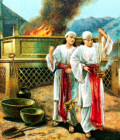
"Now Nadab and Abihu, the sons of Aaron, each took his censer and put fire in it and laid incense on it and offered unauthorized fire before the Lord, which he had not commanded them. And fire came out from before the Lord and consumed them, and they died before the Lord. Then Moses said to Aaron, 'This is what the Lord has said, "Among those who are near Me I will be sanctified, and before all the people I will be glorified."' And Aaron held his peace."
- Leviticus 10:1-3

 We have this brief narrative, in which Moses tells of us two of the sons of Aaron, the newly-appointed high priest," offering "unauthorized fire" (KJV, "strange fire") on the altar of the Lord. This may mean that, where they had been commanded to keep a continuous fire on the altar, they instead began their work with a newly-kindled flame. Or, as in Keil and Delitzsch, this may refer to an unscheduled time or in an improper place. The text here doesn't explain the reference, presumably because it was written by Moses at the time, or soon after, so the details would have been publicly known.

The Lord's response is surprising. He doesn't ask simply, "Why didn't you do things the way I told you?" Rather, He rebukes it as an affront to His holiness.

We see a similar rebuke, also to the priests, in Malachi 1:6, "'A son honors his father, and a servant his master. If then I am a father, where is My honor? And if I am a master, where is My fear?' says the LORD of hosts to you, O priests, who despise My name. But you say, ‘How have we despised Your name?’" There, the priests feign ignorance of their sins: "How have we despised Your name?" they ask.

Manmade worship, labeled theologically as "will-worship," is an affront to God's holiness because it places His worship at the whim of fallen, sinful man. It brings His worship down to our level, rather than up to His. It treats His worship like actual manmade worship of pagan deities. It is no longer worship but abuse. John Calvin (II.8.17), describes it as, "the licentious daring which would subject the incomprehensible God to our senses..." This principle is known in Reformed theology as "the regulative principle of worship" (hereafter "RPW"). It is often phrased as, "Whatever is not commanded is forbidden."

This contrasts with the Lutheran concept, which holds that, "Whatever is not forbidden is permitted." These Protestant views I consider to be consistent with Paul's admonition in I Corinthians 1:40, that "all things should be done decently and in order." And, of course, it contrasts with Catholicism, which holds that the Pope is the Vicar of Christ, and can therefore create whatever he wants in God's name. 

The RPW is prominent in Reformed confessional tradition. In the Second Helvetic Confession, the confessional standard of the Swiss and Hungarian Reformed churches, Chapter V, we read, "[W]e teach that God is to be adored and worshiped as He Himself has taught us to worship, namely, 'in spirit and in truth' (John 4:23 f.), not with any superstition, but with sincerity, according to His Word; lest at anytime He should say to us: 'Who has required these things from your hands?' (Isa. 1:12; Jer. 6:20). For Paul also says: 'God is not served by human hands, as though he needed anything,' etc. (Acts 17:25)." And in the Westminster Confession, the confessional standard of Reformed churches in the Scottish tradition, usually titled "Presbyterian," XXI:1, we read, "[T]he acceptable way of worshiping the true God is instituted by Himself, and so limited by His own revealed will, that He may not be worshiped according to the imaginations and devices of men, or the suggestions of Satan, under any visible representation or any other way not prescribed in the holy Scripture."

 This narrative in Leviticus is a case-law application of the Second Commandment. The fact that God puts His worship in such a prominent place in His Law indicates how important it is in His estimation, regardless of how lackadaisically we treat it. That is why I personally could never, in good conscience, be a member of any but a Reformed church. That is not to say that I think that only the Reformed are Christians. In fact, if my family attended an orthodox Lutheran church, where now they attend none, I would bless God, and not quibble. But in my own actions, my conscience is more thoroughly trained, and I would not make that choice for myself.

Tuesday, March 26, 2013

Why I Do Not Hold to "Signs and Wonders" Christianity

"How shall we escape if we neglect such a great salvation? It was declared at first by the Lord, and it was attested to us by those who heard, while God also bore witness by signs and wonders and various miracles and by gifts of the Holy Spirit distributed according to His will."
- Hebrews 2:3-4

This passage seems to me to undermine the entire premise of Pentecostal churches and the Charismatic movement. Signs, wonders, miracles, and [some] gifts of the Holy Spirit were given, not to create a superior class of Christians, but rather to confirm the Gospel message. That last part is why I am more accepting of such things in pioneering missionary works, especially in predominantly-Muslim areas. However, that proviso certainly does not apply to the United States!

Paul is usually quoted in favor of the continuing Pentecostal gifts. After all, he claimed to speak in tongues more than the rest of the church (I Corinthians 14:18). But why? Afterall, Paul himself said (verses 2-4) that tongues benefit the speaker alone, not the church. So why does he advocate them?

In a later passage (II Corinthians 12:12), Paul says, "The signs of a true apostle were performed among you with utmost patience, with signs and wonders and mighty works." These miraculous gifts were marks of his true apostleship, in contrast to the false apostles of verse 11. This same point is made in Acts 14:3, "So they remained for a long time, speaking boldly for the Lord, who bore witness to the word of His grace, granting signs and wonders to be done by their [i.e., Paul and Barnabas, who is called an apostle here] hands." Again, the miraculous gifts are God's signs of the authenticity of the apostolic message. This is also why Jesus Himself rebuked those who seek signs (Matthew 12:39); they aren't for you!

That brings us back to the Hebrews passage above: The signs and wonders were the marks of the apostolic message, not of spiritual superiority. Thus, those churches which advocate them in the modern church are actually undermining the biblical message, applying what ended with the apostles to modern Christians, and further creating guilt and despondency in those church members who don't experience them. I am being generous in saying experiencing "them," since I actually believe that their modern expressions are counterfeits. I will note that a few Pentecostal groups actually acknowledge this difficulty, but then get around it by claiming that their clergy are modern apostles. This especially marks the New Apostolic Church, but is also found in many independent congregations. This is also why the Roman Catholic Church is so welcoming to charismatics: the Catholic hierarchy claims a continuing apostolic authority!

Sunday, March 10, 2013

Sola Scriptura: Biblical Authority versus Catholic Tradition

"...[T]he [Catholic] Church, to whom the transmission and interpretation of Revelation is entrusted, does not derive her certainty about all revealed truths from the Holy Scriptures alone. Both Scripture and Tradition must be accepted and honored with equal sentiments of devotion and reverence."

The statement above is from the Catechism of the Catholic Church (1997), the official doctrinal organ of the Roman Catholic Church in the United States. I quote it here as proof from their own words that Scripture, contained in the Old and New Testaments of the Bible, is not their ultimate source of authority. They confess that they hold their extra-biblical tradition to be of equal authority. I consider this to be a gross equivocation; I believe that they give their tradition superior authority.

With the Reformers, I hold that such an equation is impossible. That is, I would suggest that the Scriptures forbid any comparable authority outside of themselves. Therefore, to claim that tradition is equal to scripture is actually a roundabout repudiation of the authority of scripture. Jesus addressed this issue Himself in two portions of the New Testament.

First, in Matthew 6:24, He said, "No one can serve two masters, for either he will hate the one and love the other, or he will be devoted to the one and despise the other." He was explicitly addressing the rule of money, but His principle applies to any dual system of authority.

And second, He criticized the Pharisees for this very act of equivocation, in Mark 7:6-8, "And He said to them, 'Well did Isaiah prophesy of you hypocrites, as it is written, "This people honors Me with their lips, but their heart is far from Me; in vain do they worship Me, teaching as doctrines the commandments of men." You leave the commandment of God and hold to the tradition of men.'" In almost parallel phrasing, our Lord condemns the very act that the Catholic Church officially endorses!

The scriptures testify to their own sufficiency. II Timothy 3:16-17 tells us, "All Scripture is breathed out by God and profitable for teaching, for reproof, for correction, and for training in righteousness, that the man of God may be competent, equipped for every good work." Not "for some good work," thus needing additional revelation, but "for every good work."

That is why the Westminster Confession of Faith I:10 reads, "The Supreme Judge, by which all controversies of religion are to be determined, and all decrees of councils, opinions of ancient writers, doctrines of men, and private spirits, are to be examined, and in whose sentence we are to rest, can be no other but the Holy Spirit speaking in the Scripture." Someone might object that the Confession is a tradition. And that is certainly true. The principle of sola scriptura doesn't mean the repudiation of all tradition. That would be impossible. Rather, it means that ultimate authority resides in scripture alone; the confession, and all other traditions, are subordinate to the authority of scripture.

Sunday, October 28, 2012

Muslim Insecurity Leads to Self-Destructive Riots

We have all seen the news stories: maddened crowds burning, chanting, screaming, even killing. Why? Because they were offended by a privately-made film which ridicules their prophet. That is the reality in Muslim-dominated countries. Where the peaceful debate over ideas is commonplace, and taken for granted, in countries with a Christian tradition (notice that I am not saying that they are Christian), in Muslim countries the free exchange of ideas certainly does not take place. Rather, in those countries, disagreement with majority views is suppressed with violence, both by government and by private individuals or groups. These riots have hit Arab countries, Pakistan, Muslim immigrant communities in Europe, and around the world. Where Muslims have free access to the media, and may publish their views, even critical of governments or other religions, reciprocal freedoms certainly are not found in Muslim-majority countries. Those who refuse to accept Islam face persecution, arson, rape, even murder. To my mind, there could be no more-eloquent proof that the faith of Muslims is indefensible, because their religion originated in the mind of a madman, not God.

Sunday, October 21, 2012

John Knox on Temptation

"Then Jesus was led up by the Spirit into the wilderness to be tempted by the devil." This verse begins the description of the Temptation of Christ, found in Matthew 4:1-11.

 In a sermon on this passage, the Scottish Reformer John Knox left us some comforting remarks on the question of temptation of ourselves. Knox taught that God sends temptations "to open and make manifest the secret motions of men's hearts, the puissance and power of God's Word, and the great lenity [leniency] and gentleness of God towards the infirmities , the horrible sins, and rebellions of those whom he hath received into His regiment and care." Thus, he held that temptations have three purposes in the intentions of God.

 First, they reveal, on one hand, the true character of the believer, bringing up his strengths, weaknesses, self-deceptions, unrecognized motivations, and ignorance. Second, they confirm the accuracy, power, and effectiveness of scripture. And third, they reveal the mercy and leniency of God toward our failures. I find great sweetness in those thoughts.

Some would object with James 1:13, "Let no one say when he is tempted, 'I am being tempted by God,' for God cannot be tempted with evil, and he himself tempts no one." Knox addresses this verse. He held that James wasn't speaking in an absolute sense, i.e., that God never sends any temptation to any person at any time. Rather, he understood James to mean that God doesn't send temptation with the evil intentions that Satan does. I think Knox's interpretation is supported by the account of the temptation of Job, such as Job 1:11 and 2:5. In those verses, we see Satan intending to undermine Job's faith. In contrast, in allowing Satan's efforts, God expects, rightly, as we later see, to be glorified.