Showing posts with label resurrection. Show all posts

Wednesday, April 14, 2021

How Long Was There Darkness After the Crucifixion? The Bible Versus the Book of Mormon

In the "Book of Mormon Student Manual," chapter 40, "The three days of darkness symbolized the death of Jesus Christ, who is 'the light and life of the world' 3 Nephi 11:11. Mormon emphasized that the three days of darkness was 'a sign' given of the Savior’s death. After describing the damage caused by the 'great storm' that lasted for three hours, Mormon documented the complete darkness as one of the signs that was now fulfilled. The darkness was so intense that 'there could not be any light at all.' During this time of darkness, the body of Jesus Christ, the Light of the World, lay in the tomb. On the day of His Resurrection, after Christ had overcome death, light came again to the people in America, signifying Christ’s victory over death and darkness." 

This refers to the LDS claim that there was three days of darkness after the crucifixion of Jesus, as, they claim, was prophesied by their prophets. "And the God of our fathers, who were led out of Egypt, out of bondage, and also were preserved in the wilderness by him, yea, the God of Abraham, and of Isaac, and the God of Jacob, yieldeth himself, according to the words of the angel, as a man, into the hands of wicked men, to be lifted up, according to the words of Zenock, and to be crucified, according to the words of Neum, and to be buried in a sepulchre, according to the words of Zenos, which he spake concerning the three days of darkness, which should be a sign given of his death  unto those who should inhabit the isles of the sea, more especially given unto those who are of the house of Israel" (I Nephi 19:10). And, "But behold, as I said unto you concerning another sign, a sign of his death, behold, in that day that he shall suffer death the sun shall be darkened and refuse to give his light unto you; and also the moon and the stars; and there shall be no light upon the face of this land, even from the time that he shall suffer death, for the space of three days, to the time that he shall rise again from the dead. And he said unto me that while the thunder and the lightning lasted, and the tempest, that these things should be, and that darkness should cover the face of the whole earth for the space of three days" (Helaman14:20, 27). 

This is in contrast to the biblical account: "It was now about the sixth hour, and there was darkness over the whole land until the ninth hour, while the sun’s light failed" (Luke 23:44-45; see also Matthew 27:43). So, not three days, but three hours!

 Why the difference? Since I consider the Bible alone to be the Word of God, I necessarily believe that the error is in the Book of Mormon, not the Bible. My suspicion is that Joseph Smith, author of the Book of Mormon, confused the account of the crucifixion with the expectation of the resurrection on the third day. If one were hurried, it would be easy to gloss "days" for "hours." Acting under the inspiration of the Holy Spirit, the writers of the Gospels had no such risk. The supposed "prophecies" were then invented to cover Smith's error.


Wednesday, May 15, 2019

The Physical Resurrection: One Event or Two?

The predominant eschatology among American evangelicals is premillennialism (which has different forms, but that isn't the issue here). One particular way in which premillennialism differs from other schools is in making literal the description of two resurrections (Revelation 20:5-6). According to the premillennial interpretation, the godly dead will be resurrected, then a period of a thousand years will elapse, at the end of which the wicked dead will be raised. Then the premillennialist denies the literal interpretation of other passages that point to a single resurrection.

As I describe here, comparing scripture to scripture gives us good grounds for taking the First Resurrection in a non-literal sense, to refer to regeneration of believers.

So, what of the references to a single, general resurrection?

We can start with Job 14:11-12: "As waters fail from a lake and a river wastes away and dries up, so a man lies down and rises not again; till the heavens are no more he will not awake or be roused out of his sleep." Without distinguishing between the types of people, he places resurrection at the end of this physical creation, not a thousand years before the end.

And what of the words of Jesus in John 6:40: "This is the will of My Father, that everyone who looks on the Son and believes in Him should have eternal life, and I will raise him up on the last day." Not only does Jesus place the resurrection at the end of history, not a thousand years before the end, but He explicitly tells us that this is the resurrection of the godly, whom the premillennialist claims will have been resurrected for a thousand years by that time.

The premillennialist view in general, and specifically regarding the resurrection, depends on a literal interpretation of a highly-figurative passage, and then forces that interpretation on other, clearer, not-at-all figurative passages in order to maintain its peculiar doctrine. That is just bad hermeneutics, which depends on the clearer passage to interpret the more obscure.

Saturday, August 13, 2016

How Many Resurrections Will There Be?

As the reader probably knows, premillennialism teaches that there will be two literal resurrections, that of believers at the beginning of the millennium, that of the wicked at the end of the millennium. They base this on a literal interpretation of Resurrection 20:4-5: "I saw the souls of those who had been beheaded for the testimony of Jesus and for the word of God, and those who had not worshiped the beast or its image and had not received its mark on their foreheads or their hands. They came to life and reigned with Christ for a thousand years. The rest of the dead did not come to life until the thousand years were ended. This is the first resurrection." Note two things: first, this is the only chapter in all of Scripture which describes this millennium; and second, this would mean that resurrected saints will be sharing the earth with aging, dying, and sinning unbelievers. I find that a detestable thought!

The problem with that is that it turns the principles of hermeneutics (i. e., the interpretation of Scripture) on their head. One fundamental hermeneutical principle is that clearer, simpler passages of Scripture are to be used to explain the more-difficult passages, traditionally called "the analogy of faith." Yet, this one chapter, full of symbolism, in a book also full of symbolism, is imposed on other passages which were perfectly clear before that imposition. In fact, as I will now proceed to show, that literal interpretation is contrary to the explicit statements of other portions of Scripture.

Look first at John 5:28-29 (see also Ephesians 2:5-6): "An hour is coming when all who are in the tombs will hear His [i. e., the Son of God, v. 25] voice and come out, those who have done good to the resurrection of life, and those who have done evil to the resurrection of judgment." Will the resurrections be separated by a thousand years? Or any period of time, for that matter? No, the Lord explicitly states that the two resurrections will occur in the same hour. Jesus is paraphrasing the prophecy of Daniel 12:2: "Many of those who sleep in the dust of the earth shall awake, some to everlasting life, and some to shame and everlasting contempt." The essence of the two passages is the same, but Jesus adds the explicit time reference in John.

Also in that Gospel, consider John 6:39: "This is the will of Him who sent Me, that I should lose nothing of all that He has given Me, but raise it up on the last day." When will He raise us up? On one day, then a thousand years will transpire? No, but on the last day! In the biblical course of events, must that not be at the end of history? The end of the millennium, if you will?

Oops, did that disturb you? If Revelation describes a resurrection at the beginning of the millennium, and another one at the end, but other passages, by the same Apostle, describe only one resurrection, then what about the "first resurrection"? I believe that is a reference to conversion, which is often described in resurrectional terminology in the New Testament. Look, for example, at John 5:24, just before the verses above: "Whoever hears My word and believes Him who sent me has eternal life. He does not come into judgment, but has passed from death to life." This is the key: the millennium is the time of the reign of Christ between our respective conversions and the general resurrection at the end of history. Without denying that He reigns over all things, Jesus especially reigns in the hearts of His people. The millennium is now, and each new Christian enters it upon his conversion, his spiritual resurrection.

Sunday, May 23, 2010

The Remaining Christian Sabbath

"So then, there remains a Sabbath rest for the people of God, for whoever has entered God's rest has also rested from his works as God did from His."
- Hebrews 4:9-10

The Sabbath was incorporated into the very first acts of God in His creation. After the six days of creation of Genesis 1, chapter 2 begins with the Sabbath. Verses 1-3 read, "Thus the heavens and the earth were finished, and all the host of them. And on the seventh day God finished His work that He had done, and He rested on the seventh day from all the work that He had done. So God blessed the seventh day and made it holy, because on it God rested from all His work that He had done in creation." So the Sabbath long preceded the ceremonial Law, and was not part of it, though recognized in it. However, in commemoration of that event, God instructed Moses to include it in the Law. Exodus 20:8-11: "Remember the Sabbath day, to keep it holy. Six days you shall labor, and do all your work, but the seventh day is a Sabbath to the Lord your God. On it you shall not do any work, you, or your son, or your daughter, your male servant, or your female servant, or your livestock, or the sojourner who is within your gates. For in six days the Lord made heaven and earth, the sea, and all that is in them, and rested the seventh day. Therefore the Lord blessed the Sabbath day and made it holy."

The theme is also picked up by the prophets. In Isaiah 58:13-14, the prophet tells us, "If you turn back your foot from the Sabbath, from doing your pleasure on My holy day, and call the Sabbath a delight and the holy day of the Lord honorable; if you honor it, not going your own ways, or seeking your own pleasure, or talking idly, then you shall take delight in the Lord, and I will make you ride on the heights of the earth; I will feed you with the heritage of Jacob your father, for the mouth of the Lord has spoken."

In the New Testament, Jesus acknowledges the Sabbath. For example, in Matthew 12:8, He declares Himself Lord of the Sabbath. Of course, as Jehovah in the flesh, He would have literally been the Lord of the Sabbath, even if He hadn't declared it explicitly. However, the fact that He did so is clear indication that He considered it part of the Old Testament typology that will be completed in Him, to be valued by Christians, for it hasn't been fulfilled, yet, as the writer of Hebrews, quoted above, reminds us.

Jesus's teaching on the Sabbath is clarified in Mark 2:27, which precedes the Marcan version of Mt 12:8, "The Sabbath was made for man, not man for the Sabbath." That is, He rejected the rules of the Pharisees which made the Sabbath a burden, restoring it to its original purpose, i.e., the rest from our labors that honors and celebrates the providence of God.

In Acts (such as Acts 13:14), we see the apostolic Christians attending synagogue on the Jewish Sabbath, then gathering as the church on the first day in celebration of the resurrection. There appears to be no explicit command for this transfer; apparently it happened spontaneously. For example, Acts 20:7 describes the believers gathering on the first day of the week to celebrate the Lord's Supper. Paul also mentions this practice in I Corinthians 16:2. In contrast, the same apostle dismisses the demands of the Judaizers that the Christians celebrate the other, ceremonial holidays, in Romans 15:4 and Galatians 4:10, or the Jewish Sabbath in Colossians 2:16. While the Christians may celebrate these days with their Jewish neighbors and kin, they are also free not to, as their individual consciences may dictate.

The writer of Hebrews reminds us in 4:9, that "there remains a Sabbath rest for the people of God..." Among its many blessings, the Sabbath reminds us that we can, even must, rest from our spiritual labors, because Jesus has fulfilled the requirements of the Law and satisfied the justice of God, which had been offended by the fall of Adam and all his posterity. However, the Sabbath continues to have an eschatological aspect, because we cannot yet rest from our spiritual warfare, against Satan and the remaining sin in our flesh. That work, too, will end in the resurrection, where we shall receive our new bodies, free of corruption, and Satan will be finally judged and removed from any influence in the world. That is the ultimate Sabbath that the weekly Sabbath points us to. That is why the Sabbath cannot cease to be a blessing as long as this life continues.

And finally, we find the Christian Sabbath mentioned in the last book of the Bible. The Apostle John mentions, in passing, Rev. 1:10, that he was in the Spirit on the Lord's Day, an alternate name for the Christian Sabbath. Thus, the emphasis on his personal spiritual exercise on the first day of the week, not the Jewish Sabbath, but rather the Christian.

Thus we see the biblical basis for the credal view of the Sabbath, from the first book of the Bible to the last. The Westminster Confession of Faith (XXI:7) says, "As it is the law of Nature, that, in general, a due portion of time be set apart for the worship of God; so, in His Word, by a positive, moral, and perpetual commandment, binding all men, in all ages, He hath particularly appointed one day in seven, for a Sabbath, to be kept holy unto Him: which, from the beginning of the world to the resurrection of Christ, was the last day of the week; and from the resurrection of Christ, was changed into the first day of the week, which in Scripture is called the Lord's Day, and is to be continued to the end of the world, as the Christian Sabbath."

Saturday, December 5, 2009

John 6:35-51, the Sovereign Redeemer

"Jesus said to them, 'I am the bread of life; whoever comes to Me shall not hunger, and whoever believes in Me shall never thirst. But I said to you that you have seen Me and yet do not believe. All that the Father gives Me will come to me, and whoever comes to Me I will never cast out. For I have come down from heaven, not to do my own will but the will of him who sent me. And this is the will of Him who sent Me, that I should lose nothing of all that He has given Me, but raise it up on the last day. For this is the will of My Father, that everyone who looks on the Son and believes in Him should have eternal life, and I will raise him up on the last day.'

"So the Jews mumbled about Him, because He said, 'I am the bread that came down from heaven.' They said, 'Is not this Jesus, the son of Joseph, Whose father and mother we know? How does He now say, "I have come down from heaven"?' Jesus answered them, 'Do not grumble among yourselves. No one can come to Me unless the Father who sent Me draws him. And I will raise him up on the last day. It is written in the Prophets, "And they will all be taught by God." Everyone who has heard and learned from the Father comes to Me - not that anyone has seen the Father except He Who is from God; he has seen the Father. Truly, truly, I say to you, whoever believes has eternal life. I am the bread of life. Your fathers ate the manna in the wilderness, and they died. This is the bread that comes down from heaven, so that one may eat of it and not die. I am the living bread that came down from heaven. If anyone eats of this bread, he will live forever. And the bread that I give for the life of the world is My flesh."

The doctrine of election is often taught from the words of the Apostle Paul, such as in Ephesians 1. That makes sense, of course, since Paul is the one who presents it in the most systematic fashion. But here we have the words of Jesus our Savior Himself.

First, He tells us that the decree of the Father is efficacious, verse 37, such that not one of the elect can possibly fail to be saved. Calvinists refer to this as "irresistible grace." The same principle is seen again in verse 39. Notice also that it is particular: the Father gives Him a definite number of specific individuals, not an ambiguous mass. This same idea is seen in Acts 13:48, where Luke tells us, "As many as were appointed to eternal life believed."

And second, we see that Jesus also teaches election from the negative perspective, i.e., that no one outside the Father's decree can stumble into salvation by accident or by native ability. Our Lord says in verse 44, "No one can come to Me unless the Father who sent Me draws him." Also later, in verse 65, "No one can come to Me unless it is granted him by the Father." Our author also teaches this principle in the Revelation 13:8, where he describes the deception of any "whose name has not been written before the foundation of the world in the book of life of the Lamb that was slain." Calvinists refer to this as the doctrine of "reprobation." Paul also teaches this doctrine, such as in Romans 9:21-23, where he refers to the reprobate as "vessels of wrath prepared for destruction."

And third, He is confronted by the opposition of the religious people, verse 41, just as we now see the emotional objection to election by so many professing Christians.

The Puritan commentator Matthew Henry writes of this passage: "The Father, having sent Christ, will succeed Him [i.e., give Him success], for He would not send Him on a fruitless errand. Christ having undertaken to bring souls to glory, God promised Him, in order thereunto, to bring them to Him, and so to give Him possession of those to whom He had given Him a right. God, having by promise given the kingdom of Israel to David, did at length draw the hearts of the people to him; so, having sent Christ to save souls, He sends souls to Him to be saved by Him."

Think of the consequences if God hadn't rendered His decree of election. As men are dead in trespasses and sins (Eph. 2:1), no one would come to Christ of his own volition. Would not a Savior with no one saved be a despised Son? God forbid that He should leave His Son a wasted Savior! And what a basis of assurance for our faith. Knowing that God the Father saved us out of the mass of fallen mankind, what have we to fear for our spiritual welfare? Nothing at all, for He promises never to cast us out or to allow us to be lost.

The Father said to the Son (Isaiah 49:6), "It is too light a thing that You should be My servant to raise up the tribes of Jacob and to bring back the preserved of Israel; I will make You as a light for the nations, that My salvation may reach to the end of the earth." Oh, that God for that!

Saturday, November 28, 2009

Revelation 20:4-6, The First Resurrection


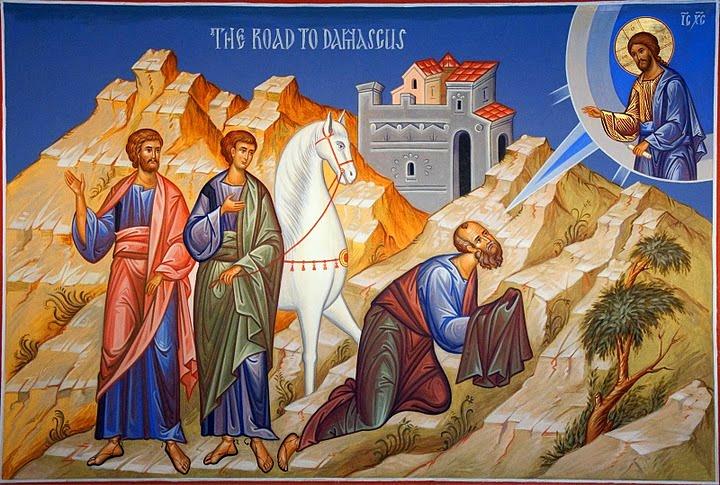
The Conversion of Paul
"Then I saw thrones, and seated on them were those to whom authority to judge was committed. Also I saw the souls of those who had been beheaded for the testimony of Jesus and for the word of God, and who had not worshiped the beast or its image and had not received its mark on their foreheads or their hands. They came to life and reigned with Christ for a thousand years. The rest of the dead did not come to life until the thousand years were ended. This is the first resurrection. Blessed and holy is the one who shares in the first resurrection! Over such the second death has no power, but they will be priests of God and of Christ, and they will reign with him for a thousand years."

Premillennialists hold that these verses refer to a resurrection of the righteous at the beginning of a future millennial reign of Christ. There are a number of problems with that interpretation.

Notice first of all what is resurrected: not the bodies of the righteous, but rather their souls. In other words, John is using "resurrection" in a metaphorical, not a literal, sense. He has used this metaphor before. Our author uses "resurrection" in the spiritual sense in his Gospel. In chapter 5, verses 24-25, he quotes the Lord Himself, "Truly, truly, I say to you, whoever hears My word and believes Him who sent Me has eternal life. He does not come into judgment, but has passed from death to life. Truly, truly, I say to you, and hour is coming, and is now here, when the dead will hear the voice of the Son of God, and those who hear will live." Then, as in the Apocalypse, Jesus proceeds from this spiritual resurrection to the physical.

In the Old Testament, the Prophet Ezekiel uses the metaphor of resurrection to describe God's regeneration of His elect. Chapter 37:11-14 tell us, "Then He said to me, 'Son of man, these bones are the whole house of Israel. Behold, they say, "Our bones are dried up, and our hope is lost; we are clean cut off." Therefore prophesy, and say to them, Thus says the Lord God: "Behold, I will open your graves and raise you from your graves, O My people. And I will bring you into the land of Israel. And you shall know that I am the Lord, when I open your graves, and raise you from your graves, O My people. And I will put My Spirit within you, and you shall live, and I will place you in your own land. Then you shall know that I am the Lord; I have spoken, and I will do it, declares the Lord."'"

And elsewhere in the New Testament, Paul uses the resurrection metaphor in the epistles to both the Ephesians and the Colossians. In Eph. 2:5-6, Paul says, "when we were dead in our trespasses, [God] made us alive together with Christ - by grace you have been saved- and raised us up with Him and seated us with Him in the heavenly places in Christ Jesus." And Col. 3:1, "If then you have been raised with Christ, seek the things that are above, where Christ is, seated at the right hand of God."

Thus, logically, to interpret the first resurrection as a literal, physical resurrection is forbidden by the text itself, and instead requires a spiritual interpretation, consistent with its use elsewhere in both testaments, especially in the writing of our present author.

What interpretation then presents itself? That the first resurrection is the spiritual passing from death to life by the regeneration of the Holy Spirit, the only way that sinful men become "blessed and holy" (Revelation 20:6). The second resurrection is then the literal physical rising usually connected with the term. Thus the millennium is the period in between, when Christ in His Gospel, through the Holy Spirit, is converting His elect, and ruling in and through them. Thus, this passage forbids the premillennial interpretation usually forced upon it, and logically directs the reader to either the amillennial or postmillennial positions (the difference between these two isn't answered by this text). The first death would then be the physical, while the second death would be the condemnation of the reprobate. That is why the one who has been converted, i.e., been through the first resurrection, is not subject to the second death. As Jesus says in the text from John (5:24), "He does not come into judgment, but has passed from death to life."