Showing posts with label preterism. Show all posts

Saturday, September 9, 2023

Lamentations and the Identity of the Whore of the Revelation

In his Revelation, the Apostle John gave us this description: "One of the seven angels who had the seven bowls came and said to me, 'Come, I will show you the judgment of the great prostitute who is seated on many waters, with whom the kings of the earth have committed sexual immorality, and with the wine of whose sexual immorality the dwellers on earth have become drunk.' And he carried me away in the Spirit into a wilderness, and I saw a woman sitting on a scarlet beast that was full of blasphemous names, and it had seven heads and ten horns. The woman was arrayed in purple and scarlet, and adorned with gold and jewels and pearls, holding in her hand a golden cup full of abominations and the impurities of her sexual immorality. And on her forehead was written a name of mystery: 'Babylon the great, mother of prostitutes and of earth's abominations.' And I saw the woman, drunk with the blood of the saints, the blood of the martyrs of Jesus. When I saw her, I marveled greatly" (Revelation 17:1-6). 

This woman is identified in various ways, according to the interpretive system of the interpreter. Futurists may take the reference to Babylon literally, and claim that it refers to a future restoration of the city of Babylon. Others take it as a coded reference to Rome, and claim that there will be a future restoration of the Roman Empire. And yet others believe it refers to Rome, but in her ecclesiastical manifestation, rather than political. Even the Westminster Confession, to which I hold, identifies the Papacy as the Anti-Christ, and head of the great Whore. 

In contrast, those who hold that the Revelation refers to events in John's time, either in part, as I do, or in its whole. We hold that Babylon is used as a code word, not for Rome, but for unbelieving Jerusalem. And in this post, I wish to point the reader to an Old Testament parallel which supports that interpretation. 

Let us look at a series on verses in the Book of lamentations, which was written by the Prophet Jeremiah to mourn the destruction of Jerusalem by the Babylonians

"How lonely sits the city that was full of people! How like a widow has she become, she who was great among the nations! She who was a princess among the provinces has become a slave!...Jerusalem sinned grievously; therefore, she became filthy; all who honored her despise her, for they have seen her nakedness; she herself groans and turns her face away. Her uncleanness was in her skirts; she took no thought of her future; therefore, her fall is terrible; she has no comforter. 'O Lord, behold my affliction , for the enemy has triumphed!'... Zion stretches out her hands, but there is none to comfort her; the Lord has commanded against Jacob that his neighbors should be his foes; Jerusalem has become a filthy thing among them...'I called to my lovers, but they deceived me; my priests and elders perished in the city, while they sought food to revive their strength'... All who pass along the way clap their hands at you; they hiss and wag their heads at the daughter of Jerusalem: 'Is this the city that was called the perfection of beauty, the joy of all the earth?'" (Lamentations 1:1, 8-9, 17, 19; 2:15). 

Read the rest of the passages to get proper context. However, what I have quoted here is plainly parallel. The Holy Spirit inspired John to see the destruction of Jerusalem by the Babylonians as a preview of the soon-coming destruction by the Romans in 70AD. He even mentioned Babylon in the passage to reinforce the parallel! 


Wednesday, March 30, 2022

When Are the "Last Days"?

Among those of a certain eschatological bent, the 'last days" of the New testament have been identified repeatedly with events current at that time. Most recently, the covid crisis and the war in Ukraine are cited as evidence that we are now in the last days, and that the rapture will occur any day. 

The problem is that none of those declarations ever give/gave proper consideration to how the phrase is used in the New Testament. "The last days" is treated as if it is disconnected from the rest of Scripture, with no meaning to those who used it, or as if it could be meaningful to its audience, even if it would occur two-thousand years (so far) in their future. 

Consider Hebrews 2:1-2: "Long ago, at many times and in many ways, God spoke to our fathers by the prophets, but, in these last days, He has spoken to us by His Son, whom He appointed the heir of all things, through whom also He created the world." To the author of the epistle, the last days were "these last days," not "those last days," as assumed by the dispensationalist. He considered the phrase to describe the time in which he wrote, not some far future time. He reinforces this intent by relating the last days to the coming of Jesus, i. e., His first coming, not the second

The Apostle Peter said something similar in I Peter 1:19-20: "But with the precious blood of Christ, like that of a lamb without blemish or spot. He was foreknown before the foundation of the world but was made manifest in the last times for your sake." Peter is referring to two events that were past tense at the time he wrote, the plan for the Son from before the foundation of the world and His manifestation. When did that happen? At his incarnation, which is why Peter uses the past tense of the verb. To him, the last times were past (or continuing), not two-thousand years in the future. 

The Apostle John, the only writer to mention an antichrist, mentions antichrists in I John 2:18: "Children, it is the las hour, and, as you have heard that antichrist is coming, so now many antichrists have come. Therefore, we know that it is the last hour." This one verse gives us two key pieces of information. First is that he refers to a belief among Christians of a coming antichrist. He corrects them in two ways, one that the word is plural, not singular, and the second that some of the antichrists had already come. Therefore, he concluded, the time in which he wrote was the last hour. His statements preclude a future Antichrist or last day, yet dispensationalists pass right over it. 

In Hebrews 9:26, that writer again describes the end of the ages: "For then He would have had to suffer repeatedly since the foundation of the world. But, as it is, He has appeared once for all at the end of the ages to put away sin by the sacrifice of Himself." Again, He identifies the last days not just with the coming of Jesus, as in the verse at the top, but specifically with His working of redemption. Again, that necessarily happened two-thousand years ago, past tense even when Hebrews was written, not in his or our future. To the same effect is Peter in I Peter 1:20: "He was foreknown before the foundation of the world, but was made manifest in the last times for your sake." 

Together, these references are infallible evidence that a future "last day" is unbiblical, the invention of men, not just apart from scriptural support, but in contradiction to the biblical testimony. 


Saturday, November 16, 2019

Who Was the Whore of Babylon?

A strange description occurs near the end of the Bible: "'Come, I will show you the judgment of the great prostitute who is seated on many waters, with whom the kings of the earth have committed sexual immorality, and with the wine of whose sexual immorality the dwellers on earth have become drunk.' And he carried me away in the Spirit into a wilderness, and I saw a woman sitting on a scarlet beast that was full of blasphemous names, and it had seven heads and ten horns. The woman was arrayed in purple and scarlet, and adorned with gold and jewels and pearls, holding in her hand a golden cup full of abominations and the impurities of her sexual immorality. And on her forehead was written a name of mystery: 'Babylon the great, mother of prostitutes and of earth’s abominations.' And I saw the woman, drunk with the blood of the saints, the blood of the martyrs of Jesus'" (Revelation 17:1-6).

The account continues to verse 18, which tells us, "And the woman that you saw is the great city that has dominion over the kings of the earth." The woman is traditionally called the Whore of Babylon, from the King James Version of this passage. Her identity has been variously interpreted. The majority view is that she is a symbol of Rome. I, however, join with the minority in identifying her with apostate Israel, represented by Jerusalem, i. e., those Jews who rejected her Messiah and joined in crucifying Him 

I am going to speak to that here.

One of the challenges I have gotten from dispensationalists regarding this passage is that, supposedly, Jerusalem didn't rule the nations; rather, Rome did. However, the usage of Scripture does, actually, make Jerusalem the ruler of the nations: "How lonely sits the city that was full of people! How like a widow has she become, she who was great among the nations! She who was a princess among the provinces has become a slave. She weeps bitterly in the night, with tears on her cheeks; among all her lovers she has none to comfort her; all her friends have dealt treacherously with her; they have become her enemies" (Lamentations 1:1-2). Does this passage not echo John's words? It is a description of the destruction of Jerusalem by the Babylonians in 587 BC.

In fact, I think that this is a prominent flaw of dispensational interpretation: it consistently ignores Old testament usages in dealing with New Testament prophecy. the Bible is a whole, with the later revelations building on the earlier. While dispensationalists talk about "rightly dividing the word of truth," their practice is better described as "wrongly dividing" it. Their hermeneutic is built on presuppositions outside of Scripture.

Saturday, March 23, 2019

The Revelation versus Manmade Eschatology

I have noticed that, in popular, "Left Behind"-style eschatology, there is always an immediate rush past the first chapter of the Revelation to offer hair-raising interpretations of the symbols in the rest of the book. I don't want that to be taken to mean that I don't understand that rush. Studying the first chapter would shut down the exciting interpretations that make some men, such as Hal Lindsey, a lot of money.

Notice first verse 3: "Blessed is the one who reads aloud the words of this prophecy, and blessed are those who hear and who keep what is written in it, for the time is near" (emphasis added). The events in the book, or, at least, the majority of them, are explicitly stated to be in the near future when John was writing these words. Not two-thousand years and counting afterward!

In particular I want to direct your attention to verse 9: "I, John, your brother and partner in the tribulation and the kingdom and the patient endurance that are in Jesus, was on the island called Patmos on account of the word of God and the testimony of Jesus." The two important words here are "tribulation" and "kingdom." Dispensationalists love to make up new theories about a future tribulation, mostly involving the modern State of Israel. And the Kingdom, i. e., of God, they put off until some future millennium that supposedly occurs after the return of Christ. Yet, John tells us that he was sharing in both at the time he was writing (which I believe to be about 68 AD, shortly after the beginning of the Roman campaign against Israel and Jerusalem).

Any sober reading of the Revelation must, therefore, conclude that most of the feverish teaching that is so popular today is merely manmade (un)science fiction, not biblical exegesis.


Wednesday, January 16, 2019

"The Man of Sin" in Preterist Perspective

"Now concerning the coming of our Lord Jesus Christ and our being gathered together to Him, we ask you, brothers, not to be quickly shaken in mind or alarmed, either by a spirit or a spoken word, or a letter seeming to be from us, to the effect that the day of the Lord has come. Let no one deceive you in any way. For that day will not come, unless the rebellion comes first, and the man of lawlessness is revealed, the son of destruction, who opposes and exalts himself against every so-called god or object of worship, so that he takes his seat in the temple of God, proclaiming himself to be God."
- II Thessalonians 2:1-4

Let me say up front that this is a difficult passage to interpret. I immediately grant that sincere brethren will disagree with the interpretation that I will give it here. And I am OK with that. I merely present some thoughts as possible, in the hope that it will provoke thought, not conflict.

The passage above is popular among dispensationalists, who equate "the man of lawlessness" (or "man of sin," KJV) with the so-called anti-Christ. I think that equation is unjustified, even apart from my denial of a personal anti-Christ. They do so simply on the presuppositions of their hermeneutic, not because of solid exegesis.

Let's go point by point. "The coming of the Lord Jesus Christ." This is not the second coming. Rather, it is the next historical element in the salvation of God's people, His coming in judgment against their enemies, the apostate Jews, by means of the Romans and the destruction of Jerusalem, the temple, and the sacrificial system in 70AD. "Our being gathered to Him," not in any supposed "Rapture," but in death or at His Second Advent. Paul is addressing an error here, in which some people were claiming that the resurrection and return of Jesus had already occurred, and the people to whom Paul wrote were left behind (pun intended). In other words, they had their own version of the full-preterist heresy, and Paul felt compelled to refute it. "For that will not come," Paul assures them (and us), "unless the rebellion comes first." What rebellion? While this is often explained as a general apostasy among professing Christians, there is no biblical support for such a thing. Can Jesus fail to keep His people (see Jude 1:24-25)? Rather, this is a rebellion, an apostasy, of the general population of Jews, which began with their rejection and murder of Jesus, and continued in their persecution, and even murder, of the Christians among them. God would judge them for that apostasy, removing their legal protections in the Empire, and bringing down the wrath of Rome upon their heads.

Therefore, it was Judaism that would be removed, allowing the revelation of the man of lawlessness. Under Roman law, the Jews had had certain legal privileges, privileges that extended to Christians, as long as they were considered a sect within Judaism. However, with the reversal of those privileges, the Christians no longer had that protective covering, and were thus exposed to the persecuting power of the Roman emperors, who were, successively, the Man of Lawlessness.


Saturday, December 23, 2017

The People of God: Apostate Israel or Sodom?

A large segment of American Evangelicalism, especially of the dispensationalist stripe, insists on calling the nation of Israel "the people of God," and, therefore, pushing American government policy to an inordinate support for the government of the State of Israel.

However, I deny that the Jews are any such thing, or that there is a special blessing or curse on America, depending on our political attitude toward the modern nation of Israel.

Why? Well, I have mentioned some reasons before, such as here and here. I want to address an additional reason now.

In Matthew 10, Jesus sends the Apostles out on an early mission to the cities of the Jews. He explicitly forbids them to preach to the Gentiles or Samaritans. And of any city that rejects their message, he says (Matthew 10:15), "Truly, I say to you, it will be more bearable on the day of judgment for the land of Sodom and Gomorrah than for that town." He extends that warning more explicitly in Matthew 11:20-24: "Then He began to denounce the cities where most of His mighty works had been done, because they did not repent. 'Woe to you, Chorazin! Woe to you, Bethsaida! For if the mighty
Fire Falls on Sodom
works done in you had been done in Tyre and Sidon, they would have repented long ago in sackcloth and ashes.
But I tell you, it will be more bearable on the day of judgment for Tyre and Sidon than for you. And you, Capernaum, will you be exalted to heaven? You will be brought down to Hades. For if the mighty works done in you had been done in Sodom, it would have remained until this day.
But I tell you that it will be more tolerable on the day of judgment for the land of Sodom than for you.'"


This is an astounding warning! We know what happened to Sodom (Genesis 18 and 19): It was destroyed with fire and brimstone when ten righteous men couldn't be found in her. Yet, Jesus says, Sodom was more righteous than were these Jewish cities that rejected Him and His message.

The question that this should raise in anyone's mind is, Did Jesus, therefore, prefer Sodom over these unbelieving Jews? And I think the answer is self-evident! The implication of that can only be that ethnicity has no standing in the purposes of God (Matthew 3:9, Galatians 3:7, and especially Acts 10:34-35). What implication does that have for the question I asked in the headline above? I will leave it to my reader to decide.

Saturday, August 13, 2016

How Many Resurrections Will There Be?

As the reader probably knows, premillennialism teaches that there will be two literal resurrections, that of believers at the beginning of the millennium, that of the wicked at the end of the millennium. They base this on a literal interpretation of Resurrection 20:4-5: "I saw the souls of those who had been beheaded for the testimony of Jesus and for the word of God, and those who had not worshiped the beast or its image and had not received its mark on their foreheads or their hands. They came to life and reigned with Christ for a thousand years. The rest of the dead did not come to life until the thousand years were ended. This is the first resurrection." Note two things: first, this is the only chapter in all of Scripture which describes this millennium; and second, this would mean that resurrected saints will be sharing the earth with aging, dying, and sinning unbelievers. I find that a detestable thought!

The problem with that is that it turns the principles of hermeneutics (i. e., the interpretation of Scripture) on their head. One fundamental hermeneutical principle is that clearer, simpler passages of Scripture are to be used to explain the more-difficult passages, traditionally called "the analogy of faith." Yet, this one chapter, full of symbolism, in a book also full of symbolism, is imposed on other passages which were perfectly clear before that imposition. In fact, as I will now proceed to show, that literal interpretation is contrary to the explicit statements of other portions of Scripture.

Look first at John 5:28-29 (see also Ephesians 2:5-6): "An hour is coming when all who are in the tombs will hear His [i. e., the Son of God, v. 25] voice and come out, those who have done good to the resurrection of life, and those who have done evil to the resurrection of judgment." Will the resurrections be separated by a thousand years? Or any period of time, for that matter? No, the Lord explicitly states that the two resurrections will occur in the same hour. Jesus is paraphrasing the prophecy of Daniel 12:2: "Many of those who sleep in the dust of the earth shall awake, some to everlasting life, and some to shame and everlasting contempt." The essence of the two passages is the same, but Jesus adds the explicit time reference in John.

Also in that Gospel, consider John 6:39: "This is the will of Him who sent Me, that I should lose nothing of all that He has given Me, but raise it up on the last day." When will He raise us up? On one day, then a thousand years will transpire? No, but on the last day! In the biblical course of events, must that not be at the end of history? The end of the millennium, if you will?

Oops, did that disturb you? If Revelation describes a resurrection at the beginning of the millennium, and another one at the end, but other passages, by the same Apostle, describe only one resurrection, then what about the "first resurrection"? I believe that is a reference to conversion, which is often described in resurrectional terminology in the New Testament. Look, for example, at John 5:24, just before the verses above: "Whoever hears My word and believes Him who sent me has eternal life. He does not come into judgment, but has passed from death to life." This is the key: the millennium is the time of the reign of Christ between our respective conversions and the general resurrection at the end of history. Without denying that He reigns over all things, Jesus especially reigns in the hearts of His people. The millennium is now, and each new Christian enters it upon his conversion, his spiritual resurrection.

Monday, April 6, 2015

The Two Witnesses of the Revelation

I would never claim that the Revelation is an easy book to understand. Some portions are, while others definitely are not. I generally look to the rule of parsimony in interpreting it, i. e., that the simplest interpretation is to be preferred, unless there is evidence to the contrary. By simplest, I do not mean most literal. In fact, I find that those who hold to a generally-literal approach are the ones who go to the greatest hermeneutical acrobatics to force it to fit their chronologies. I usually find that the partial-preterist approach requires the fewest twists and bends to understand the text.

Chapter 11 describes two witnesses from God. Verse 3 tells us, "I will grant authority to my two witnesses, and they will prophesy for 1,260 days, clothed in sackcloth." Many colorful interpretations have been given regarding the identity of these witnesses. I don't think such efforts are necessary. The Revelation is a revelation of whom? The first verse of the book tells us: "The revelation of Jesus Christ." And where has He referred to two witnesses to Himself? He says (John 5:39), "You search the Scriptures because you think that in them you have eternal life; and it is they that bear witness about Me." And, more specifically (Luke 24:27), "Beginning with Moses and all the Prophets, He interpreted to them in all the Scriptures the things concerning Himself." And of Him, Philip testifies (John 1:45), "We have found Him of Whom Moses in the Law and also the prophets wrote, Jesus of Nazareth, the son of Joseph."

Recall, also, the accounts of the Transfiguration (Matthew 17: 1-13, Mark 9:2-13, and Luke 9:28-36). While the Apostle John, author of the Revelation, doesn't include the Transfiguration in his Gospel, the Synoptic accounts report that he was present (Matt. 17:1, Mark 9:2, Luke 9:28). And what did he witness? Moses, the writer of the Law, and Elijah, the foremost of the prophets, giving their witness to the Messiahship of Jesus.

So, I would suggest that the reader doesn't have to search the newest book from the prophecy-mongers or today's newspaper to take a guess as to the identity of the witnesses. They are the same witnesses that have been pointing to Him since the first verses of the New Testament.

Consider also the evidence in Revelation 11 itself. Verse 6 tells us, "They have the power to shut the sky, that no rain may fall during the days of their prophesying, and they have power over the waters to turn them into blood and to strike the earth with every kind of plague, as often as they desire." Where have we seen someone associated with the withholding of rain? In I Kings 17:1, Elijah tells Ahab, king of Israel, "As the Lord, the God of Israel, lives, before Whom I stand, there shall be neither dew nor rain these years, except by my word." And who is associated with plagues, such as turning waters to blood? Exodus, starting in chapter 7, describes Moses as the intermediary of God's plagues on Egypt. The plague of blood, specifically, is found in Exodus 7:17-18.  This isn't rocket science. John is using images from the Old Testament which would have been very familiar to his readers. I am saddened that they aren't as familiar to today's popular "bible teachers."

Revelation 11 continues with its account. In verse 7, they are killed, which verse 8 tells us happens in Jerusalem. Then verse 10 tells us, "those who dwell on the earth will rejoice over them and make merry and exchange presents, because these two prophets had been a torment to those who dwell on the earth." The word translated here as "earth," can also be translated as "land," which I prefer. The people of the land, that is, of the land of Israel, celebrate the silencing of the testimony of the law and the prophets, because they wanted an excuse to reject their Messiah. The Deacon Stephen describes this in his evangelistic sermon in Acts 7. Notice especially verses 52 and 53: "Which of the prophets did your fathers not persecute? And they killed those who announced beforehand the coming of the Righteous One, Whom you have now betrayed and murdered, you who received the law as delivered by angels and did not keep it." By killing the prophets and resisting the Law of Moses, the reprobate among the nation of Israel believed that they avoided the consequences for their unbelief, which is what they celebrate in Revelation 11:10.

Was their scheme successful? Revelation 11:11-13: "But after the three and a half days a breath of life from God entered them [i. e., the witnesses], and they stood up on their feet, and great fear fell on those who saw them. Then they heard a loud voice from heaven saying to them, 'Come up here!' And they went up to heaven in a cloud, and their enemies watched them. And at that hour there was a great earthquake, and a tenth of the city fell. Seven thousand people were killed in the earthquake, and the rest were terrified and gave glory to the God of heaven." These verses aren't as clear as the earlier portion. The reference to being received into heaven in a cloud suggests that this portion describes the ascension of Christ (compare Luke 24:51, and Acts 1:9-11), with the signs in the place of the thing signified. Whether there was an earthquake at that time, or possibly that this is a figurative reference, I cannot say.

Thursday, May 19, 2011

The Proper Dating of the Revelation of John

While I have long held to the necessarily-early dating of the writing of the Revelation, I am indebted for the reasoning below to Rev. Kenneth Gentry's book "Postmillennialism Made Easy."

The general view among evangelicals is that the Apostle John wrote the Revelation in the early 90's AD, during the persecution under Emperor Diocletian. Liberal theologians time it much later, and deny the apostolic authorship. However, I don't take that view into consideration. Gentry, and many in the preterist and postmillenialist crowd, time it about 25 years earlier, during the reign of Emperor Nero. I find their reasoning, based on the internal evidence, to be compelling.

First, John writes with a view of a standing Temple. Revelation 11:1-2 reads, "Then I was given a measuring rod like a staff, and I was told, 'Rise and measure the temple of God and the altar and those who worship there, but do not measure the court outside the temple; leave that out, for it is given over to the nations, and they will trample the holy city for forty-two months.'" Since the Romans destroyed the Temple in 70AD, as Jesus Himself prophesied in Matthew 24:2, then the Revelation must have been written before that date. Notice especially the parallel wording used by John here and the words of Jesus in Luke 21:24.

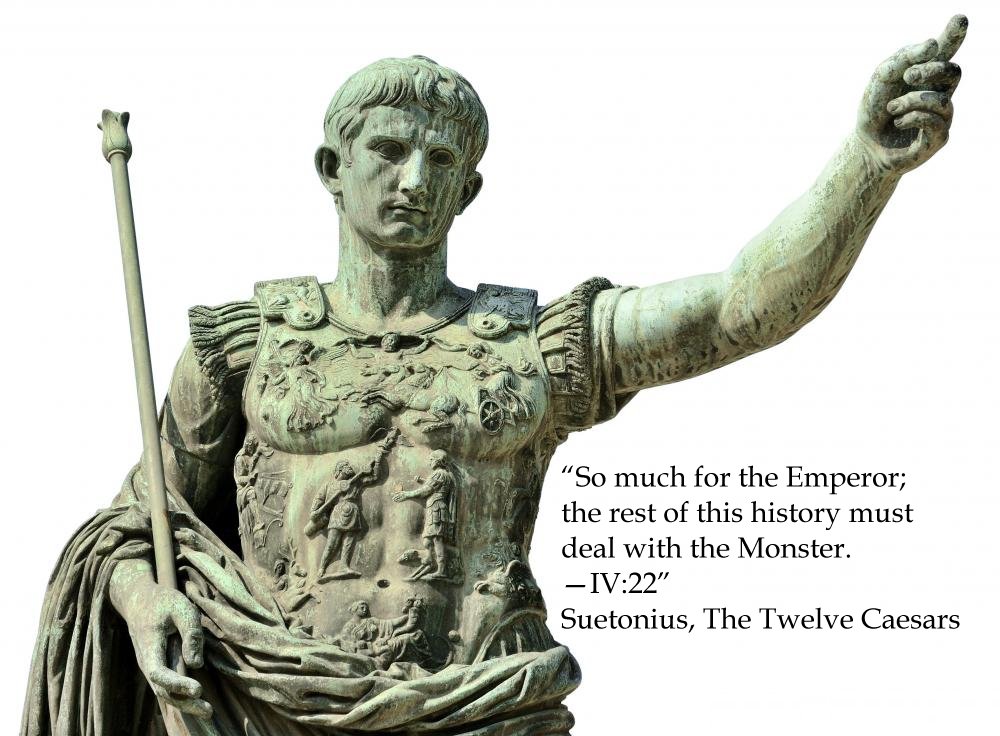
Now go down to Revelation 17:1-6, the vision of a seven-headed beast. Verse 9 then interprets the vision: the seven heads represent seven mountains, surely a reference to the renowned seven hills of Rome. Then verse 10 adds that the heads also represent seven kings. The presumption is strong that these would then be kings of Rome. John specifies that there were five past kings in the chain, one reigning currently, with his successor doomed to reign only briefly. The first seven emperors of Rome were Julius Caesar (49-44BC), Augustus (31BC-14AD, see Luke 2:1), Tiberius (14-37AD, see Luke 3:1), Gaius (37-41AD), Claudius (41-54AD, see Acts 11:28 and Acts 18:2), Nero (54-68AD. see Acts 28:19), and Galba (June, 68-January, 69AD). So, sixth Emperor Nero's death in 68 (followed by the six-month reign of Galba), requires that the Revelation have been written no later that his death on June 6, 68AD, an historically-objective circumstance not subject to anyone's theological presuppositions.

Where this leads me is to the expectation that John was describing the upcoming destruction of Jerusalem, the Temple, and the sacrificial system, in the Revelation. Not exhaustively, since I am conscious obviously that the resurrection and Second Coming are yet to be fulfilled. However, this is logically the predominant focus of the book. Not the European Union or Social Security numbers or the myriad of other passing fantasies that arise daily in the "prophetic" crowd, most-recently from Harold Camping.

Saturday, May 14, 2011

Does Matthew 24 Teach a Future Tribulation?


"Jesus left the temple and was going away, when His disciples came to point out to Him the buildings of the temple. But He answered them, 'You see all these, do you not? Truly, I say to you, there will not be left here one stone upon another that will not be thrown down.' As He sat on the Mount of Olives, the disciples came to him privately, saying, 'Tell us, when will these things be, and what will be the sign of your coming and of the close of the age?' And Jesus answered them, 'See that no one leads you astray. For many will come in My name, saying, "I am the Christ," and they will lead many astray. And you will hear of wars and rumors of wars. See that you are not alarmed, for this must take place, but the end is not yet. For nation will rise against nation, and kingdom against kingdom, and there will be famines and earthquakes in various places. All these are but the beginning of the birth pains.'"
- Matthew 24:1-8

Bits and pieces of this passage have been brought into modern parlance, primarily through the work of popular apocalyptic preachers, such as Hal Lindsay. Every time some foreign conflict is mentioned on the news, someone starts spouting about "wars and rumors of wars," and every earthquake is touted as proof of the coming rapture. However, there is very little critical thinking in these usages. Are they actually justified by the text?

My answer is no, they are not justified. Not only do I deny that Matthew 24 teaches a future tribulation, but I even insist that it is about events that happened long ago, indeed, soon after Jesus spoke these words. I suggest that the apocalyptic interpretation is not only not required by the text, but is actually forbidden by it. I can hear all the voices out there, bellowing, "What, are you CRAZY?!?!?!"

First, go a little further down the passage to verse 16, "
then let those who are in Judea flee to the mountains." Who is Jesus addressing with these warnings? Not people all over the world, but rather specifically in Judea! That is, He isn't warning of wars in general, but specifically in Judea (the area around modern Jerusalem). Nor is He warning of earthquakes in general, but rather specifically in that same area. This is reinforced by the parallel passage in Luke 21:20, "But when you see Jerusalem surrounded by armies, then know that its desolation has come near." There, Luke paraphrases "abomination of desolation" as "Jerusalem surrounded by armies," a situation that doesn't occur in the many conflicts in our modern era. Thus, the geographical references within the passage forbid its use as is popular in our time.

Second, the time references given by the Lord forbid a futuristic interpretation. Note His very words in verse 34, "Truly, I say to you, this generation will not pass away until all these things take place." He explicitly states that the events He is describing will occur within the general lifetimes of His audience. Some dispensationalists have tried to get around this verse by referring it to some future generation, in spite of His use of "this generation." However, their interpretations are excluded not only by the "this," though that would be sufficient, but also by other usages in its context. Just before, in Matthew 23:36, Jesus, speaking to the scribes and Pharisees, tells them, "Truly, I say to you, all these things will come upon this generation." He is referring to their judgment. Remember that our chapter and verse divisions are relatively modern, dating from the 1500's; they were not part of the inspired text. Matthew 23 and 24 are a continuous narrative, with no break in time between the "generation" of 23:36 and the "generation" of 24:34. Jesus is telling the hypocritical leaders of the Jewish nation that the hardness of their hearts will soon bring His retribution. When? In the destruction of Jerusalem by the Romans in 70AD, including the demolition of the temple (24:2, "not one stone left upon another") and the ending of the priestly and sacrificial system. Jesus came again, not in the salvific Second Coming that we yet look forward to, but in awful judgment on those who rejected and murdered Him. Matthew 24, describes a horrible tribulation, it is true, but for them, not for today's Christians.

Thursday, January 13, 2011

Revelation 8:8, An Interesting Parallel!

"The second angel blew his trumpet, and something like a great mountain, burning with fire, was thrown into the sea, and a third of the sea became blood."

I am sure that we have all read this verse a hundred times. I am also sure that we have heard the pop ministers spout their apocalyptic interpretations of what this verse refers to, the pop eschatology which has become so popular among professing evangelicals. However, I am struck, not by wild-eyed interpretations, but rather by the parallels this verse has to other portions of scripture.

I have written before on Matthew 21:21, especially the latter portion, "even if you say to this mountain, ‘Be taken up and thrown into the sea,’ it will happen." This is virtually an exact quote of the Revelation passage! And, as I point out there, He doesn't refer to some generic mountain, but rather to this specific mountain. i.e., the Temple Mount. if those words mean the Temple Mount there, is it not logical to expect the exact same words to apply to the Temple Mount here?

Consider also the words of the Prophet Jeremiah. In Jeremiah 51:25, he wrote, "Behold, I am against you, O destroying mountain, declares the Lord, which destroys the whole earth; I will stretch out My hand against you, and roll you down from the crags, and make you a burnt mountain." Here he is prophesying the doom of Babylon. In Revelation, spiritual Babylon is a major theme. One plausible interpretation is that spiritual Babylon is apostate Israel, again lending credence to the interpretation of this passage as referring to the destruction of the Temple by the Romans in 70AD.

While I am not a consistent preterist, i.e., I still expect the resurrection and the Second Advent, I do generally interpret the prophetic portions of the New Testament as pointing to the destruction of Jerusalem in 70AD. I think that this verse from Revelation, compared to its parallels in both testaments, is strong support for that perspective.

Wednesday, November 11, 2009

Revelation 11 and 70AD: The Judge Rules in Favor of the Plaintiffs

"The nations raged, but Your wrath came, and the time for the dead to be judged, and for rewarding Your servants, the prophets and saints, and those who fear Your name, both small and great, and for destroying the destroyers of the earth."
- Revelation 11:18

For years, I have had trouble understanding why this verse is located where it is. Why would John describe the great judgment halfway through his book, only to bring it up again near the end, in chapter 20? However, through an enlightening remark in a commentary, I have gotten it. The judgment here isn't of the dead, but rather a judgment for the righteous dead, in answer to their prayers in 6:9-10, "When He opened the fifth seal, I saw under the altar the souls of those who had been slain for the word of God and for the witness they had borne. They cried out with a loud voice, 'O Sovereign Lord, holy and true, how long before You will judge and avenge our blood on those who dwell on the earth?'" In other words, 11:18 is comparable to a civil lawsuit in our times, while 20:11ff is a criminal judgment.

We see parallels in some of the Davidic Psalms, such as 35:17, "How long, O Lord, will You look on? Rescue me from their destruction, my precious life from the lions." Compare verses 22-26. And again in 94:2, "Rise up, O judge of the earth, repay to the proud what they deserve!" Likewise the Prophet Habakkuk, such as 1:13b, "Why do You idly look at traitors and are silent when the wicked swallows up the man more righteous than he?"

I think this judgment in Revelation also comes in answer to Jesus's own words in Matthew 21:21, "Truly, I say to you, if you have faith and do not doubt, you will not only do what has been done to this fig tree, but even if you say to this mountain, 'Be taken up and thrown into the sea,' it will happen." While this verse is often misread, as if He said "a mountain," or even spiritualized to represent obstacles in life, notice that He actually specifies "this mountain." This is spoken as He returns to Jerusalem the morning after He cleansed the temple (v. 18). In other words, I think that He was instructing His disciples to pray for the overthrow of Jerusalem and the temple order, as actually occurred in 70AD. Revelation 6 describes the martyred saints making this prayer, and 11:18 describes their sovereign Redeemer vindicating their pleas with a judgment against their persecutors, represented in their emblem, the Temple Mount. This understanding of that verse brings much clarity in my mind, as to the intentions of God, speaking through the Apostle John, in the first half of Revelation.

While I have followed my own thinking in coming to these conclusions, I am not alone in them. The Preterist Archive has a page dedicated to this interpretation. And Kenneth Gentry gives a wide-ranging bibliography of publications on his website.