Monday, November 13, 2017

Grace and Faith Do not Justify Antinomianism!

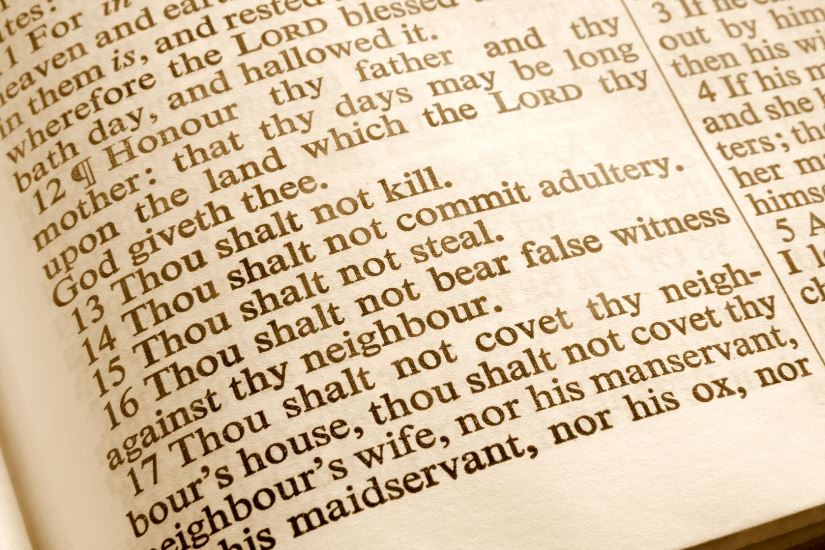
One thing at which Dispensationalism has succeeded is in making modern evangelicalism utterly hostile to God's Law. A phrase everyone seems to have memorized is, "We are under grace, not under law," a corruption of Romans 6:14. I bet you can't remember what the rest of the verse says!

However, one thing I have frequently noticed is that this shibboleth gets drawn out only when something in the Pentateuch disproves something an evangelical says. But, whenever the subject of homosexuality, for example, comes up, that same evangelical will pop out with Leviticus 18:22. And quoted correctly, unlike Romans 6:14!

There are so many problems with this doctrine, called antinomianism. Just logically speaking, it is offensive! The Law is the expression of God's moral nature. His precept for us is to reflect His holiness: "Consecrate yourselves, therefore, and be holy, for I am the Lord your God. Keep My statutes and do them; I am the Lord who sanctifies you" (Leviticus 20:7-8, quoted in I Peter 1:16). If a person rejects the Law out of hand, is he not rejecting the holiness of God? And with what is he replacing it? Whose holiness will he now imitate?

Also, biblically speaking, the assertion that Romans 6:14 eliminates the Law from the life of the Christian is contrary to what Paul himself tells us elsewhere in the same epistle: "Do we then overthrow the law by this faith? By no means! On the contrary, we uphold the law" (Romans 3:31). How can the same man in the same epistle endorse the Law in one verse and repudiate it in another? What does the assertion that he does so say about the view of Scripture of such persons? Or of the God who inspired the Scripture?

Let's look at another comment by Paul regarding the Law: "The law is not laid down for the just but for the lawless and disobedient, for the ungodly and sinners, for the unholy and profane, for those who strike their fathers and mothers, for murderers, the sexually immoral, men who practice homosexuality, enslavers, liars, perjurers, and whatever else is contrary to sound doctrine, in accordance with the gospel of the glory of the blessed God with which I have been entrusted" (I Timothy 1:9-11). Ah, here is the solution! The Law is not for those who are now living consistently with our new nature in Christ. It is for those who require an outside limit on their wickedness. Notice that he even includes false doctrine. That's something very few people will consider, a proper role of the state in the suppression of heresy.

Lets look once more at Romans 6:14, but the whole verse, properly quoted: "Sin will have no dominion over you, since you are not under law but under grace." Now we can see that Paul's contrast isn't between law and grace, but between grace and bondage to sin. This is exactly what he says in I Timothy, that the Spirit-controlled man has his sin nature shackled on the inside. But the natural man has no such control, and, therefore, requires an external control, the Law of God.

Saturday, November 11, 2017

Either Jesus Is God, or God Has Been Deceived!

In two different places, the Prophet Isaiah tells us that God does not share His glory: "I am the LORD; that is my name; my glory I give to no other" (Isaiah 42:8); "My glory I will not give to another" (Isaiah 48:11). Both statements are clear, bold, and unequivocal.

However, we then have this statement from Jesus (John 17:5): "Now, Father, glorify Me in Your own presence with the glory that I had with You before the world existed."

In the Old Testament, "God" (Hebrew, "Elohim") without qualification, as here in Isaiah, usually refers to the Trinity collectively. However, if a person denies that, or denies that it is the case here, then he has even greater difficulty in these passages, because they then become the words of God the Father. We have God's claiming that He does not share His glory. Then we have Jesus's claiming that He has shared, and will share, the glory of God the Father.

That can be nothing less that a claim that He is Himself that God who spoke through Isaiah!


Wednesday, November 8, 2017

Society Has a Choice: Wickedness or Righteousness

"When a land transgresses, it has many rulers,
     but with a man of understanding and knowledge,
     its stability will long continue.

When the righteous triumph, there is great glory,
     but when the wicked rise, people hide themselves.

When the wicked rise, people hide themselves,     
     but when they perish, the righteous increase."
- Proverbs 28:2, 12, 28 

The Book of Proverbs is the most practical book in the Bible, addressing every area of life, both for the man on the street and for the man in the highest socio-economic strata of society. Here the writer, apparently Solomon, addresses the latter, the leaders of society.

His first comment, verse 2, describes much of what we see in modern America. He says that a society where wickedness becomes commonplace will be plagued with a multiplication of government officials. As our society has moved away from its biblical traditions, have we not seen an expanding swarm of bureaucrats, promulgating more and more laws? Is there not a mindset that says that social order will be restored if we just come up with the right regulations? Of course there is! It is a humanistic mindset which claims that morality is a matter of law, not grace, and even that is the autonomous laws of men, not the sovereign laws of God. It is the plague of tyranny!

The second comment, verse 12, also describes a humanistic society in moral breakdown. As biblical morality has broken down, have we not become a society of fear? We often hear of a golden age when no one had to lock his doors at night, or where no parents had to explain "stranger danger" to our children. People lament the loss of neighborliness, because too many people fear walking the streets of their own neighborhoods, due to gangs. When was the last time a woman felt safe walking down her own street? 

The third comment, verse 28, also describes the fear of peaceful people, sealed in their own homes for fear of the chaos outside. Yet, unlike the other two verses, this one describes a solution: "When they [the wicked] perish, the righteous increase." Note that God, speaking through Solomon, does not advocate a new social program or a new government agency as the solution, but rather says that righteousness will increase as the wicked perish! The wicked do not need self-esteem or social support. Rather, society needs for them to be removed. We have absorbed a humanistic mindset that says that wickedness is a disorder, for which the rest of society is responsible. It isn't! Wickedness is a choice, and violence is its consequence. Humanism, therefore, puts the welfare of the wicked ahead of the welfare of the peaceable members of society. Therefore, until that mindset is changed, we can only anticipate that wickedness will continue to dominate American society.

Monday, November 6, 2017

Godly Men Love God's Sabbath

When talking about the importance of the Sabbath, I have noticed that most Christians will make a dismissive remark about its being ceremonial law. That statement is false, since the Sabbath long preceded the time of Moses (Genesis 2:2-3). Even more, though, it ignores the role the Sabbath played in the rest of the Old Testament. The godly people of Israel valued the Sabbath. In fact, that quality is used in the Old Testament as a distinguishing mark between pious and nominal Israelites.

Before the Babylonian exile, God, speaking through the Prophet Jeremiah, warned the people of Israel, "If you do not listen to me, to keep the Sabbath day holy, and not to bear a burden and enter by the gates of Jerusalem on the Sabbath day, then I will kindle a fire in its gates, and it shall devour the palaces of Jerusalem and shall not be quenched" (Jeremiah 17:27, but look at the whole passage from 21 to 27). Yet, we know that Judah ignored the warning, and it was fulfilled in the sacking of Jerusalem by the Babylonians in 586BC.

After the exile, the governor of Israel - appointed by the king of Persia, but God's man - Nehemiah, remembered these words, and tried to start the restoration of Judah on better footing. First, he recognized the pattern of Sabbath desecration: "In those days I saw in Judah people treading winepresses on the Sabbath, and bringing in heaps of grain and loading them on donkeys, and also wine, grapes, figs, and all kinds of loads, which they brought into Jerusalem on the Sabbath day. And I warned them on the day when they sold food. Tyrians also, who lived in the city, brought in fish and all kinds of goods and sold them on the Sabbath to the people of Judah, in Jerusalem itself! Then I confronted the nobles of Judah and said to them, 'What is this evil thing that you are doing, profaning the Sabbath day? Did not your fathers act in this way, and did not our God bring all this disaster on us and on this city? Now you are bringing more wrath on Israel by profaning the Sabbath'" (Nehemiah 13:15-18). Both the Jews themselves and the foreigners resident among them were trampling God's day, just as their ancestors had in the time of Jeremiah. They had learned no lessons from their seventy years of exile.

So, he commanded reforms: "As soon as it began to grow dark at the gates of Jerusalem before the Sabbath, I commanded that the doors should be shut and gave orders that they should not be opened until after the Sabbath. And I stationed some of my servants at the gates, that no load might be brought in on the Sabbath day. Then the merchants and sellers of all kinds of wares lodged outside Jerusalem once or twice. But I warned them and said to them, 'Why do you lodge outside the wall? If you do so again, I will lay hands on you.' From that time on they did not come on the Sabbath. Then I commanded the Levites that they should purify themselves and come and guard the gates, to keep the Sabbath day holy. Remember this also in my favor, O my God, and spare me according to the greatness of your steadfast love" (Nehemiah 13:19-22). This passage shows both the binding nature of the Sabbath for the people of God and the responsibility of the civil magistrate to fence the day from abomination.

This is the basis for the Westminster Larger Catechism (question 117): "The sabbath or Lord's day is to be sanctified by an holy resting all the day, not only from such works as are at all times sinful, but even from such worldly employments and recreations as are on other days lawful; and making it our delight to spend the whole time (except so much of it as is to betaken up in works of necessity and mercy) in the public and private exercises of God's worship: and, to that end, we are to prepare our hearts, and with such foresight, diligence, and moderation, to dispose and seasonably dispatch our worldly business, that we may be the more free and fit for the duties of that day." Though the day has been changed from the seventh to the first, the Sabbath principle is just as binding as it was to Jeremiah and Nehemiah.


Saturday, November 4, 2017

The Prosperity Gospel: A Baptized Get-Rich-Quick Scheme


The Proverbs say a lot about how a man is to support himself and his family and advance in the material aspects of his life. However, I am often left wondering if Christians have read that book. Maybe it has languished as part of the dispensationalist dismissal of the Old Testament (except the portions that they can use for their wild-eyed eschatological theories).

I am especially troubled by the Prosperity Gospel movement, not just here in America, but, increasingly, spreading in the mission field, especially Nigeria and the Philippines. These ministers, mostly of a Pentecostal origin, who claim that the Christian life consists in the accumulation of shiny objects, such as fancy cars, big houses, expensive suits, or big hairdos. The favor of God, they claim, is evidenced by flashy stuff, especially for their ministers, such as Creflo Dollar's private jet.

This is not God's way. While He calls Himself the one who teaches us to acquire wealth (Deuteronomy 8:18), He also says, "Do not toil to acquire wealth; be discerning enough to desist" (Proverbs 23:4).

Where is the balance here? Wealth is clearly not sinful, since He promotes it. However, in the getting of wealth, there is much more that He has to say.

Proverbs 28:6: "Better is a poor man who walks in his integrity, than a rich man who is crooked in his ways." Let's start with priorities. Wealth is not worth the selling of our souls, as Dollar has. If faced with the choice, then the man of God sticks to his integrity. It cannot be for sale.

Proverbs 28:19: "Whoever works his land will have plenty of bread, but he who follows worthless pursuits will have plenty of poverty."  Godly wealth comes from legitimate, honest work. The example here is agriculture. This isn't a way to get rich quick. Rather, it is the day-in, day-out work of honest labor. Dishonest, instant gains will just as instantly disappear, leaving a man with "plenty of poverty." 

The next verse, Proverbs 28:20, is even stronger: "A faithful man will abound with blessings, but whoever hastens to be rich will not go unpunished." The drive to get rich quick will have the opposite effect, as God will give that man the consequence of poverty. Notice the contrast between faithfulness and the drive for easy wealth. They cannot coexist (Matthew 6:24). 

And lastly, Proverbs 28:22: "A stingy man hastens after wealth, and does not know that poverty will come upon him." This verse addresses the opposite extreme, the stingy or miserly man. This is not about thrift, something which is otherwise commended in Scripture. Rather, this is about the man who turns a blind eye to the needs of his neighbor, though he has the means to help him (Proverbs 14:21, 21:10).

I keep thinking of these principles, as I watch people shelling out money for lottery tickets. Where does that money come from? We know that poor people are more likely to buy lottery tickets. They are spending their mortgages, or their kids' college funds, or even money that would have gone to putting food on their tables. God will not honor such foolishness.

Wednesday, November 1, 2017

Circular Reasoning in Christian Thought


A true Christian will always base his spiritual views on the Scriptures. This is both proper and necessary. If I believe in God, then I must believe what He says. That seems obvious to me.

However, the atheist responds with an accusation of circular reasoning. That is, the Christian's knowledge about God is based on the Bible, and His trust in the Bible is based on his knowledge of God. And, as far as it goes, the accusation is true.

However, there is an unstated premise in the atheist's attack. That unstated premise is that the atheist does not use circular reasoning. Is that premise true? In order for a conclusion to be true, then its premises must be true and organized according to the objective rules of logic.

Here is the atheist's argument, in the form of a syllogism:
     Truth is based on logic.
     Logic does not produce a belief in the bible.
     Therefore, the logical person does not accept the Bible as a standard of truth.

Do you see the problem in this argument? Actually, there are two problems, one stated and the other not.The stated problem is that the conclusion is a restatement of the first premise. That is called "begging the question," a logical fallacy. The second problem is that this argument is a logical argument. That is, logic is used to prove that logic is superior to the Bible. Or to be explicit, using logic to prove logic is itself a circular argument. In fact, it is impossible to avoid a circular argument to prove an ultimate standard of truth.

Therefore, the accusation of the atheist applies to himself as much as it does to the Christian.

However, I deny that circularity is a fatal accusation against biblical Christianity. Why? Because it is also the flaw of the argument against Christianity. Think of it this way: If God is real, and the Bible is true, then what it says is ultimate truth. By its very nature, that which is ultimate has no higher standard against which it can be judged. Therefore, it can only be judged according to its own presuppositions. Then, the evidence against Christian theism can only be, not that we didn't start with evidence, but rather that it leads to irrational results, such as contradiction, or something which is demonstrably false. That means that the burden of proof is not on the Christian, who is acting according to reason with proper justification, but rather on the atheist to demonstrate the falsity of the Bible.

Monday, October 30, 2017

The Mission of the Church: Our Marching Orders

     In our original creation, God gave our first parents certain responsibilities in the new world. As the bearer of the imago dei, Adam was given the tasks of exercising dominion in the world, reproducing, and organizing the fruitfulness of the world (Genesis 1:26-30). In these ways, Adam was to be God’s viceroy, exercising a role analogous to that of God, but subordinate to Him. However, Adam rebelled against God, and marred the image, such that his descendants bore, not the image of God, but rather the image of Adam (5:3). As a result, Adam was cursed with death, and all his labors were cursed with futility, and His wife was cursed in all her familial relations (3:16-19). Yet, the viceroyal calling of Adam was not revoked, as we see in its renewal to Noah after the Flood: “Then God blessed Noah and his sons, and said to them, ‘Be fruitful and multiply and fill the earth. Every beast of the earth and every bird of the sky and all that moves on the earth and all the fish of the sea will fear you and be terrified of you. Every moving thing that lives will be food for you. I give you everything, just as I gave you the green plant” (Genesis 9:1-3).
    We continue to see hints of this dominion covenant as the covenantal history continues. For example, we see God’s promise to Abraham that all the nations will be blessed through him (e. g., Gen. 12:2-3). Part of this plan is seen in the mediatorial role that God gives His people toward the rest of the world, such as Abraham’s intercession in 18:22-33, and Jacob’s altar work in 35:1-15. The godly seed are called to rulership, such as in 27:29, 41:38-49, and 49:10: “The scepter shall not depart from judah, nor a lawgiver from between his feet, until Shiloh comes; and to him will be the obedience of the people.”
    Under the Old Covenant, this calling reached its pinnacle in the royal priesthood: “You will be to Me a kingdom of priests and a holy nation” (Exodus 16:6). Yet, this calling was not limited to israel or to the Mosaic economy, as the Apostle Peter made clear: “You are a chosen race, a royal priesthood, a holy nation, a people for God’s own possession, so that you may declare the goodness of Him who has called you out of darkness into His marvelous light” (I Peter 2:9). Peter expands the calling explaining it as a responsibility to represent Him who bought us to the unbelieving rest of the world. He says that, as priests, we are to offer up spiritual sacrifices (verse 5). What are those sacrifices? Our bodies (Romans 12:1), our material possessions (Philippians 4:18), our praises (Hebrews 13:15), and our prayers (James 5:16). Thus, everything in our day to day lives is subservient to our calling as priests. Our bodies are to be given for the work of God. Our possessions are to be given for the work of God. Our praises are to be given in our work (as Piper says, “Missions is not the ultimate goal of the church. Worship is. Missions exists because worship doesn’t. Worship is ultimate, not missions, because God is ultimate, not man. When this age is over and the countless millions of the redeemed fall on their faces before the throne of God, missions will be no more. It is a temporary necessity. But worship abides forever,” p. 35). And our prayers are to be offered for each other and for the recipients of our message.
    As God’s nation of priests, Israel was explicitly instructed to portray Him to the nations. There was both a passive sense of this mission, such as in Deuteronomy 4:6: “Therefore, keep and do them [i. e., the Law], for this is your wisdom and your understanding in the sight of the nations which shall hear all these statutes, and say, ‘Surely this great nation is a wise and understanding people.’” Among other things, the Law was intended by God (preceptually speaking, not in the sense of a failed decree) to make His people a shining example to the pagan nations around them. This theme, too, was repeated in the New Testament: “You are the light of the world. A city that is set on a hill cannot be hidden. Neither do men light a candle and put it under a basket, but on a candlestick, and it gives light to all who are in the house. Let your light so shine before men that they may see your good works and glorify your Father who is in heaven” (Matthew 5:14-16).
    It is this shining example that leads to the fulfillment of the promises of the Father to the Son: “All the ends of the world will remember and turn to the LORD, and all the nations will worship before You” (PSalm 22:27). Notice especially here the fulfillment of Piper’s thesis of missions leading to worship. Also, “Thus says the LORD of hosts, in those days ten men from every language of the nations will take hold of the garment of a Jew, saying, ‘Let us go with you, for we have heard that God is with you’” (Zechariah 8:23). Thus, we see that a missionary concern didn’t start with the New Testament.
    The missionary calling of Israel was not merely passive, however. God’s calling to them was a call to action: “Let all the nations be gathered together, and let the people be assembled… [For] you are My witnesses, says the LORD, and my servant whom i have chosen, that you may know and believe Me, that I am He… I, even I, am the LORD, and besides Me there is no Savior… therefore, you are My witnesses, that I am God” (Isaiah 43:9-12). God reveals Himself to israel, with the explicit intent that that nation would then be His witnesses, His missionaries, to the rest of the world. While Israel fell far short of her calling, her failure wasn’t absolute. We have the story of Ruth, in which a Moabitess comes to believe in the true God (1:!6), in spite of the restriction in Deuteronomy 23:3, and becomes an ancestress both of King David and of Jesus Christ.
    Another principle in the Old Testament is the creation of the new heavens and new earth: “I create a new new heavens and a new earth; the former things shall not be remembered or come to mind. But be glad and rejoice forever in that which I create, for I create Jerusalem for rejoicing and her people for joy. I will rejoice in jerusalem and be glad in my people; and the voice of weeping shall no longer be heard in her, nor the voice of crying” (Isaiah 6517-19). In this new heavens and new earth, “All flesh shall come to worship before Me, says the LORD” (66:23). Peter adds that, “according to his promise, we are waiting for new heavens and a new earth, in which righteousness dwells” (II Peter 3:13). Contrary to the claims of the premillennialists, this cannot be a reference to the eternal state, because there will still be death and a need to eat (Is. 65:20). Rather, this is a description of the New Jerusalem, the church in its prosperity (ibid., verses 18-19, Heb. 12:220, where righteousness shall dominate (II Peter 3:13), though some sinners remain (Is. 65:20). This is a description of the result of the mission of God, a prosperous church in a world, not where the curse has been completely eliminated, but in which the Gospel has created a world in which the nations are largely converted and living lives commensurate to their spiritual state: “There shall no longer be an infant who lives only a few days, nor an old man who has not filled out his days. For the child shall die a hundred years old, but the sinner being a hundred years old shall be accursed” (ibid.).
    It is against this Old Testament background that we see the significance of the missionary heart of Jesus: “Jesus went throughout all the cities and villages, teaching in their synagogues, preaching the gospel of the kingdom… But when he saw the crowds, he was moved with compassion for them, because they fainted and were scattered, like sheep without a shepherd. Then He said to His disciples, ‘the harvest truly is plentiful, but the laborers are few. Therefore, pray to the Lord of the harvest, that He will send out laborers into His harvest” (Matthew 9:35-38). This reveals three things about the divine mission: first, it is based on the compassion of Jesus; second, it is the responsibility that he gives to His disciples; and third,  a missionary goes out only by the calling and sending of God (compare Isaiah 6:9). This is an astonishing passage, because we know that the purpose of Christ was to redeem the elect (john 3:16, Ephesians 5:25, etc.). However, this passage shows us that, separate from the issue of election, He was not blind to the rest of humanity, but was, rather, filled with sorrow by their sin, spiritual blindness, disease, futility, and even their stubbornness. Consider His statement in Matthew 23:37: “O Jerusalem, Jerusalem, you who kill the prophets and stone those who are sent to you, how often I would have gathered your children as a hen gathers her chicks under her wings, but you would not!” These same people that he condemned to judgment for the murder of the prophets (see the previous verse and the Parable of the tenants, Matthew 21:33-44), brought Him to tears of sorrow over their hardheartedness.
    Out of this compassion, Jesus passed His missionary heart on to His disciples in the Great Commission. So important is this to God that the Holy Spirit inspired it over and over, as the Apostles wrote the New Testament. Of course, the best-known version is that of Matthew 28:18-20: “Jesus came and spoke to them, saying, ‘All authority has been given to Me in heaven and earth. Go, therefore, and make disciples of all nations, baptizing them in the name of the Father and of the Son and of the Holy Spirit, teaching them to observe all things I have commanded you. And remember, I am with you always, even to the end of the age.’” These three sentences teach us two main things about the call of Jesus to evangelize. First, our mission is not a power in ourselves, but is, rather, dependent on His mediatorial kingship. The mission of the Christian is to serve as the frontline combatant in Christ’s conquest of the nations (Revelation 11:15). He has already gained all of the authority necessary to apply His claims to the nations: “I have installed My king on Zion, My holy hill. Ask of Me, and I will give You the nations for Your inheritance, and the ends of the earth for Your possession” (Psalm 2:6, 8). The Father promised Him the nations, and the Great Commission is His claim to that which was promised. So important is this authority to our mission that He mentions it twice, as the basis of our mission, and as the unfailing encouragement to continue the battle, even in the face of apparent failures. Second, the Great Commission indicates what a mission is, the things that our divine and royal general has given us to do. Not just to proclaim the Gospel, and not just to win a convert here and another there, but, through His effectual authority, to disciple the nations, which means to convert them, to baptize them, and to train them in obedience to God’s word. This is not evangelism as extraction from the world, but as overcoming the world!
    In Mark 16:15, we have the words of Jesus explicitly to the Eleven: “Go into all the world, and preach the Gospel to every creature. He who believes and is baptized will be saved. But he who does not believe will be condemned.” This version of the Great Commission appears to be aimed specifically at the Apostles, not disciples in general, both because of the introduction to it (verse 14), and also because of the miraculous consequences. The extraordinary signs were for the verification of the ministry of the Apostles ( Mark 16:20, Acts 14:3, II Corinthians 12:12, Hebrews 2:3-4). However, it does indicate to all Christians the importance of profligate proclamation of the Gospel.
    Finally, in His last earthly sermon, Jesus announced to the gathered, but frightened, Church, “You
shall receive power when the Holy Spirit comes upon you. And you shall be My witnesses in Jerusalem, and in Judea and Samaria, and to the ends of the earth” (Acts 1:8). We see some of the same themes from Matthew, but made more explicit. There, the Lord had promised the power of His authority in the mission of the Church. Here He tells them that that authority would work by the presence of the Holy Spirit. There, He had sent them to all nations. Here He assigns them a concentric geographical series to achieve that assignment: Start in jerusalem, your current environs, then expand to the immediate surrounding area of Judea and Samaria, and then on to the rest of the nations of the world. We quickly see the fulfillment of this battle plan, as the persecution that broke out after the stoning of Stephen first drove disciples into Samaria (Acts 8:5), then to Gentiles in general (ibid., 10:45), and then to more-distant regions (ibid., 11:19). Paul took it to the final stage in deliberately seeking out unreached regions for his mission: “I have strived to preach the Gospel, [but] not where Christ was named, so that I should not build on another man’s foundation” (Romans 15:20).