Sunday, October 4, 2015

Do We Understand How Sinful Sin Really Is? The Puritans Did!

The Puritan Thomas Watson, in his Body of Divinity, lists ten ways in which sin is truly sinful:

     1) Incredulity: Our first parents did not believe that what God had spoken was truth (Gen. 2:16-17, 3:4). They believed not that they should die, because they could not be persuaded that such fair fruit had death at the door. Thus, by unbelief they made God a liar. In fact, what was worse was that they believed the devil rather than God.

     2) Unthankfulness: God had enriched Adam with a variety of mercies, stamped His own image on him, made him lord of the world, and given him the fruit of all the trees for food, with just one excepted. Thus, to take from that one tree was high ingratitude.

     3) Discontent: Adam differed little from the angels (Ps. 8:5), had native innocence, and enjoyed the glory of Paradise as his realm. Yet, he had to have more, because his heart could not be satisfied with all that he had.

     4) Pride: he loved the offer of Satan to become like God (Gen. 3:5)!

     5) Disobedience: God had given him his existence and all his subsistence, so it was right to expect his obedience.

     6) Curiosity: Adam sought to meddle with what was not his, though it was to cost him everything.

     7) Wantonness: With the choice of all other trees, Adam had all of his needs filled, but demanded the satisfaction of his lusts as well. Watson is expressing the same truth as in James 1:14-15: "Each person is tempted when he is lured and enticed by his own desire. Then desire when it has conceived gives birth to sin, and sin when it is fully grown brings forth death."

     8) Sacrilege: God had reserved this one tree of the garden for Himself, yet Adam deigned to rob Him of what was His alone.

     9) Murder: as the federal head of all his posterity in the covenant of works, Adam represented us in his actions, and chose to bring the curse of death on all of humanity (Rom. 5:12).

     10) Presumption: Adam presumed, contrary to God's warning, that he would not die, regardless of his actions. "Surely," he decided, "God must relent if I choose to do as I wish."

And later in the same book, Watson makes this observation: "The sight of Christ's bleeding body should incense us against sin. Let us not parley with it; let that not be our joy, which made Christ a man of sorrow." This is, again, a precept from James 2:10: "Whoever keeps the whole law but fails in one point has become accountable for all of it." Whatever sin any person holds onto, thinking it just isn't really so bad, he must think differently if he understands that any sin makes the sinner guilty of breaking the whole law (James 2:11). This especially overthrows the Catholic distinction between "mortal" and "venial" sins. According to James (a book that they otherwise enjoy quoting), and, as repeated by Watson, every sin is mortal (Ezekiel 18:4, Rom. 6:23).

Thursday, October 1, 2015

Perseverance by Grace in the Ministry of Paul

We have all read of Paul's imprisonments. The first, house arrest in Rome for two years, is described at the end of Acts. The second ended with his martyrdom. It is during the first that he wrote what are commonly called his "prison epistles," Ephesians, Philippians, Colossians, and Philemon.

Even before his second imprisonment, Paul was conscious of a time of martyrdom approaching (II Timothy 4:6-8): "For I am already being poured out as a drink offering, and the time of my departure has come. I have fought the good fight, I have finished the race, I have kept the faith. Henceforth there is laid up for me the crown of righteousness, which the Lord, the righteous judge, will award to me on that Day." Paul's attitude here is so contrary to the predominant theology of our day, which I label "neo-Pelagianism." According to that theology, there is no security for the believer; he can fall into unbelief at any time, if he ever stops having enough faith. My response is that such a belief turns the Christian life into the same terror against which Martin Luther revolted on October 31, 1517. And it certainly isn't an accurate portrayal of Paul's attitude in this passage.

According to the Arminian, Paul could fall from his faith before his death, and thus lose his salvation. Yet, Paul expresses his secure hope in a successfully-run race, for which he would soon receive the crown of righteousness in glory. Where is his insecurity? He shows none.

Further, a few verses later, Paul tells Reverend Timothy (II Tim. 4:18), "The Lord will rescue me from every evil deed and bring me safely into His heavenly kingdom." Not "my strength," not "my faith," not "my holiness." In fact, not "my" anything! Rather, he looks to Jesus to carry him through, just as he described in Philippians 1:6: "I am sure of this, that He who began a good work in you will bring it to completion at the day of Jesus Christ." That is why I dislike even the phrase "once saved, always saved," because it gives the misimpression that it is the strength of the individual that brings him safely through this life. Rather, I use the historical phrase "perseverance of the saints," because it is God Who carries the believer by means of faith and sanctification until the day of his glorification (Romans 8:30). That is why Paul is secure as he sees death approaching, because he knows he can trust his divine redeemer, Jesus Christ (Deut. 33:27, Psalm 145:20, II Tim. 1:12 NASB, John 10:28).

Since the earliest days of my Christian life, thirty-three years ago, I have never understood why people hate this doctrine. Why do they prefer the terror of believing that they may be saved today, just to lose it tomorrow? Even if it were true - and I thank God that it isn't - such a doctrine would be too horrific for me to hold. What does such a doctrine say about the efficacy of Christ's blood and the ministry of the Holy Spirit?

Friday, September 25, 2015

The Doctrine of the Immaculate Conception: Was Mary Really Sinless?

The Catholic Church holds as dogma the doctrine of the Immaculate Conception. Many Christians mistakenly believe that this refers to the sinlessness and virgin birth of Jesus. However, it is actually about the supposed sinless conception and life of Mary. Catholics claim that her sinlessness was
necessary to make her worthy of giving birth to the Lord. The doctrine is claimed to be from "tradition," but was only decreed as official by Pope Pius IX on December 8, 1854.

Christians should have a huge problem with this doctrine. For one thing, the Bible says that "all have sinned and fall short of the glory of God" (Romans 3:23). Jesus alone is exempted through His conception by the Holy Spirit (Hebrews 4:15, II Corinthians 5:21). If Mary escaped a sinful nature, then the Bible's teachings about our need of salvation all tumble like a house of cards.

However, in addition to this general objection, there are also specific biblical references which preclude the Catholic view.

We know, from Luke 2:24, that Mary made the sacrifice of atonement for a new mother (Leviticus 12:2). Specifically, she sacrificed two pigeons, the sacrifice for someone who was too poor to offer a lamb (Lev. 12:8). Mary was unclean, and thus had to atone, neither of which can be consistent with sinlessness.

The problem with the Catholic doctrine isn't simply that it is wrong, but rather because it undermines the office of Christ as Mediator between God and fallen Man. It has also led the Catholic Church actually to change Scripture. In Genesis 3:15, in what is called the Protevangelium, Catholic bibles have replaced "He will bruise your [i. e., the serpent's] head and you will bruise His heel," [emphasis added] with "she will bruise your head, and you will bruise her heel." These versions follow the Vulgate in changing the masculine singular of the Hebrew to the feminine singular in Latin. This has been used to justify giving a mediatorial and redemptive role to Mary alongside that of Christ, in explicit violation of I Timothy 2:5: "there is one God, and there is one mediator between God and men, the man Christ Jesus."

This is how this works: by giving Mary a role of redemptrix and mediatrix next to that of Christ, and then pointing out that Protestants reject any such role, the Church of Rome lays claim to providing a supposedly-superior form of spiritual security. However, since that claim is based on both false and falsified evidence, it is a deception, one that will lead many sincere people on the wide road into Hell (Matthew 7:13). That is why I persist in calling the Roman Catholic Church a cult, and in urging people to abandon her for the sake of their souls (Revelation 18:4).

Wednesday, September 23, 2015

In Honor of the Pope's Visit to the United States

Back in 1987, then-Pope John-Paul II visited the United States, including a stop in neighboring South Carolina. At the time, a co-worker, a professing atheist, said to me, "You must be excited." "Why?" I asked her. "Because of the Pope's visit," she replied. "But I'm not Catholic," I explained, to her blank face. She didn't understand the distinction between Catholics and Protestants. I am saddened to say that my experiences, even with Protestants over the years, has convinced me that few of us understand, either.

Beginning with the nailing of his 95 Theses on the Wittenburg Church door by Martin Luther on October 31, 1517 (so the 500th anniversary is approaching), Protestants have systematized our conflict with Rome in the so-called Five Solas:

Sola Scriptura: that our only infallible standard for spiritual truth is the Holy Bible, in the Old and New Testaments, and what by necessary logical consequence might be based on them.

Soli Deo Gloria: that our salvation and sanctification are for the glory of God alone, not based on any works for which a man might claim credit.

Solus Christus: that our salvation is based on the finished work of Christ alone, in His life, crucifixion, resurrection, and eternal intercession.

Sola Gratia: by grace alone, that is, by God's voluntary condescension, not because of any obligation that we have placed upon Him.

Sola Fide: that it is by faith alone, as the instrumental means, that the works of Christ are imputed to us for our justification.

These Five Solas (Latin for "alone") are the essential points of conflict between the churches of the Reformation and the Church of Rome. She has never changed her denial of these five truths, so our repudiation of her legitimacy must be maintained, for the rest of human history, if need be. Any ecumenical relationship, while she continues in her apostasy from the Gospel, can only carry Protestants into judgment with her. As Jesus Himself says (Revelation 18:4): "Come out of her, My people, lest you take part in her sins, lest you share in her plagues."

Thursday, September 17, 2015

The Calling of the Jews, as Described in Jeremiah

In Question 191, the Westminster Larger Catechism asks, "What do we pray for in the second petition [of the Lord's Prayer]?" The answer says, in part, "In the second petition (which is, Thy kingdom come), acknowledging ourselves and all mankind to be by nature under the dominion of sin and Satan, we pray, that the kingdom of sin and Satan may be destroyed, the gospel propagated throughout the world, the Jews called, the fulness of the Gentiles brought in..." And the Directory for the Publick Worship of God, under the heading of "prayer," directs that prayer be made, among other things, "for the conversion of the Jews, the fulness of the Gentiles..." That is almost a direct quote from the Apostle Paul in Romans 11:25-26: "a partial hardening has come upon Israel, until the fullness of the Gentiles has come in. And in this way all Israel will be saved..." It is these promises on which the catechism answer is based.

Did this concept originate with Paul? Is this a Christian imposition, and to be considered offensive by Jews? I answer no to both questions.

In Jeremiah 31:3-4, we find, "I have loved you with an everlasting love; therefore I have continued My faithfulness to you. Again I will build you, and you shall be built, O virgin Israel!" This promise appears after long passages protesting the apostasy of Israel, which God would judge with the seventy-year exile in Babylon (e. g., Jer. 25:18). The prophet continues in verse 6, "For there shall be a day when watchmen will call in the hill country of Ephraim: 'Arise, and let us go up to Zion, to the Lord our God.'" Verse 9, "With weeping they shall come, and with pleas for mercy I will lead them back..., for I am a father to Israel, and Ephraim is my firstborn." And 13-14, "I will turn their mourning into joy; I will comfort them, and give them gladness for sorrow. I will feast the soul of the priests with abundance, and My people shall be satisfied with My goodness, declares the Lord.”

"Don't these verses refer to the return of Israel after the Exile?" someone may ask. Modern Jews limit it to that application. On the other hand, dispensationalists apply it to the modern State of Israel. The problem for either interpretation is further down the passage.

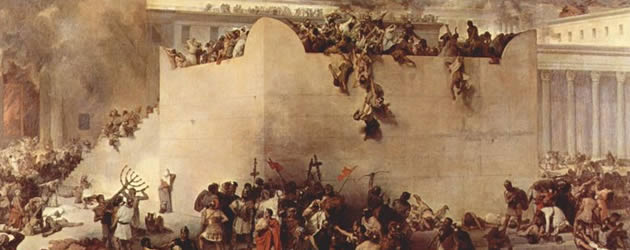
In verses 18-20, the prophet tells us, "I have heard Ephraim grieving, 'You have disciplined me, and I was disciplined, like an untrained calf; bring me back that I may be restored, for You are the Lord my God. For after I had turned away, I relented, I was ashamed, and I was confounded, because I bore the disgrace of my youth.' Is Ephraim My dear son? Is he My darling child? For as often as I speak against him, I do remember him still. Therefore My heart yearns for him; I will surely have mercy on him, declares the Lord." This is a description of the repentance of Israel, and return to faithfulness to her God, which certainly has not happened. Ancient Israel continued in apostasy, even rejecting and killing her Messiah, so that God destroyed their nation, city, and temple, in 70AD. And today's State of Israel is overwhelmingly secular. Under her laws, a Jew can be religious, agnostic, atheist, or even Buddhist or New Age. What he cannot be is a follower of Jesus the Messiah.

And in verses 33-34 (part of the same New Covenant passage quoted in Hebrews 8:8-12), God Himself says, "This is the covenant that I will make with the house of Israel after those days, declares the Lord: I will put My law within them, and I will write it on their hearts. And I will be their God, and they shall be My people. And no longer shall each one teach his neighbor and each his brother, saying, 'Know the Lord,' for they shall all know Me, from the least of them to the greatest, declares the Lord. For I will forgive their iniquity, and I will remember their sin no more."  This is what Paul talks about, when Israel repents of her apostasy and turns, as a nation, to her Messiah, Jesus Christ. The key is found in Jer. 30:9: "They shall serve the LORD their God and David their king, whom I will raise up for them." The restoration prophesied by Jeremiah isn't geographical or political, but rather a restoration through Jesus, the Davidic king (compare Isaiah 9:6-7 and Jer. 33:14-26). That has, demonstrably, not happened yet.

That same event is described by the Prophet Zechariah (Zech. 12:10): "And I will pour out on the house of David and the inhabitants of Jerusalem a spirit of grace and pleas for mercy, so that, when they look on Me, on Him Whom they have pierced, they shall mourn for Him, as one mourns for an only child, and weep bitterly over Him, as one weeps over a firstborn." Their God, Jehovah, promises to send His Holy Spirit to change their hearts, so that they will finally recognize Who Jesus is, and what they did to Him 2,000 years ago. And He shall receive them (Rom. 11:26-27, Isa. 59:20-21): "The Deliverer will come from Zion, He will banish ungodliness from Jacob; and this will be My covenant with them when I take away their sins." Thus, both Old and New Testaments prophecy of a time when the Jews, en masse, will repent of their hardheartedness, and turn to their God and Savior Jesus Christ.

Sunday, September 13, 2015

Another Clergyman Comes Out for Molech: Abortion

I wrote recently about some Episcopal Church clergy who were campaigning for the right to kill babies and rip their bodies apart. Now word has come out about United Church of Christ Minister Tom Davis, who has written a book, Sacred Work: Planned Parenthood and Its Clergy Alliances, in which he
claims that pro-abortion clergy teach "a form of humane theology." Yes, readers, Davis claims that a humane view of God requires a clergyman to advocate for the mass murder of unborn children.

Together with Davis, Presbyterian Church (USA) Minister Andrew Kukla explained on his blog that he loves everything about the organization. He said, "I love Planned Parenthood. I love the people that are Planned Parenthood. I love their ministry [sic]. I love that they live resurrection in a way I only talk about it." Hmmm... the "ministry" and "love" of Planned Parenthood, by which "they live resurrection." Are these men supporting abortion to speed these children on their ways to resurrection? Such doublespeak explains why the memberships of both denominations are imploding before our eyes.

In contrast, as I have also noted recently, true Presbyterians are publicizing the death industry behind the doors of Planned Parenthood.

Davis and Kukla, regardless of their claims or of their media images, are no clergy of Christ. In fact, I cannot accept them even as mere Christians. What they advocate is completely unlike biblical religion, but is actually a revival of the human sacrifices of Molech worship. Condemnations of these practices can be seen in Leviticus 20:3 and 20:5. Yet, the Israelites adopted that same practice, which was part of the apostasy for which God punished them in the Exile (see, for example, Jeremiah 32:34-35).

David, Kukla, and the Episcopal priests, and all who march with them for human sacrifice, in spite of their spiritual-sounding claims, are marching to bring God's judgment on America. As I have also written, God holds us accountable for shedding innocent blood. How many could the Israelites have sacrificed? Hundreds, maybe thousands, yet God destroyed their nation. What will he do for the tens of millions of innocent babies that we have killed, just since 1973?

Are these so-called clergymen accountable for their activities? Of course! In fact they bring upon themselves an even heavier judgment. God tells them, "Not many of you should become teachers, my brothers, for you know that we who teach will be judged with greater strictness" (James 3:1). Not that I believe that these men and women will be frightened merely by the words of God.

However, they will not be alone in their judgment. Does anyone really believe that the congregations that pay the salaries of these clergypersons can wash their hands of the actions of their clergy? God says to you (Jeremiah 23:16-17), "Do not listen to the words of the prophets who prophesy to you, filling you with vain hopes. They speak visions of their own minds, not from the mouth of the Lord. They say continually to those who despise the word of the Lord, 'It shall be well with you'; and to everyone who stubbornly follows his own heart, they say, 'No disaster shall come upon you.'"

I think of something else that God is saying to you: "Come out of her, my people, lest you take part in her sins, lest you share in her plagues" (Revelation 18:4). Your money and membership are being used to support these pagan men and their vile activities. No matter how much you might cluck your tongue at them - and I am being generous to assume even that much - your passive support enables them to continue. And, as Jesus said in the Revelation, you will share in their plagues.

Sunday, September 6, 2015

God's Judgment on Manmade Religion


The Prophet Jeremiah gave his prophecies in the time immediately before and immediately after the sacking of Jerusalem by the Babylonians, followed by the subsequent exile of the Jews to Babylon. His sermons before those events were proclamations of God's judgment against Judah, for which these events were His judgment.

Notice the pattern in the quotations below:

Jeremiah 3:17: "They shall no more stubbornly follow their own evil heart."

Jeremiah 7:24: "They did not obey or incline their ear, but walked in their own counsels and the stubbornness of their evil hearts, and went backward and not forward."

Jeremiah 11:8: "They did not obey or incline their ear, but everyone walked in the stubbornness of his evil heart."

Jeremiah 13:10: "This evil people, who refuse to hear My words, who stubbornly follow their own heart and have gone after other gods to serve them and worship them."

Jeremiah 23:17: "They say continually to those who despise the word of the LORD, 'It shall be well with you'; and to everyone who stubbornly follows his own heart, they say, 'No disaster shall come upon you.'"

Do you see what each of these verses says? God doesn't chastise Judah for a lack of religiosity. Rather, He chastises them for religious practices according to the inclinations of their own hearts. Judah even proclaimed her innocence (Jer. 2:35), and pretended not to understand why He was angry with them. God acknowledges that they have continued in their religious activities, but not according to His purposes (Jer. 7:9-11): "Will you steal, murder, commit adultery, swear falsely, make offerings to Baal, and go after other gods that you have not known, and then come and stand before Me in this house, which is called by My name, and say, ‘We are delivered!’—only to go on doing all these abominations? Has this house, which is called by My name, become a den of robbers in your eyes? Behold, I Myself have seen it, declares the Lord." Look also at Jer. 7:21-26.

God makes a final effort to call His covenant people to repentance (verses 5-7):  "If you truly amend your ways and your deeds, if you truly execute justice one with another, if you do not oppress the sojourner, the fatherless, or the widow, or shed innocent blood in this place, and if you do not go after other gods to your own harm, then I will let you dwell in this place, in the land that I gave of old to your fathers forever." Yet, in the face of His mercy, Judah refuses. Jer. 8:6: "They have not spoken rightly; no man relents of his evil, saying, 'What have I done?' Everyone turns to his own course."

What was the real religious devotion of Judah? (Jer. 9:13-14): "They have forsaken My law that I set before them, and have not obeyed My voice or walked in accord with it, but have stubbornly followed their own hearts..." It is that same error described above: will-worship. They preferred the spiritual exercises that they had invented (or borrowed from their pagan neighbors) over those commanded by God in His word.

This is a description of two times in our own Western history: it was part of the complaints of the Reformers against the Church of Rome that she had polluted Christian worship with pagan images and pageantry not authorized by Scripture, and again in the "seeker-friendly" neopaganism which is spreading in our own time.  Rome has added additional "sacraments" and dogmas, not to mention the superstious praying to angels and saints. She is the exemplar of "following their own hearts." And why is that so bad? Jeremiah answers that question, too (Jer. 17:9): "The heart is deceitful above all things, and desperately sick." While Rome pretends to an authority to legislate faith and morals beyond the mandates of Scripture, God says that the reservoir from which she draws is deceitful (which is not to exempt Protestant innovators of the same criticism).

Judah's apostasy here is in violation to the First and Second Commandments of God (Exodus 20:3-4). While Rome attempts to obscure the Second by subsuming it into the First, by doing so she merely demonstrates that her error is no accident, but is willful and deliberate. In my own tradition, it is called the Regulative Principle of Worship, and is explicitly enjoined in the Westminster Larger Catechism, Question 109: "The sins forbidden in the second commandment are, all devising, counseling, commanding, using, and anywise approving, any religious worship not instituted by God Himself." That is our rejection of the worship in the Church of Rome.


This truth led to an essential warning in the Westminster Confession of Faith (XX:2): "God alone is Lord of the conscience, and hath left it free from the doctrines and commandments of men which are in any thing contrary to His Word, or beside it in matters of faith on worship. So that to believe such doctrines, or to obey such commandments out of conscience, is to betray true liberty of conscience; and the requiring an implicit faith, and an absolute and blind obedience, is to destroy liberty of conscience, and reason also."