Showing posts with label evolution. Show all posts

Wednesday, September 23, 2020

The Creation as Proof of the Being and Goodness of God


"For thus says the LORD, who created the heavens (He is God!), who formed the earth and made it (He established it; He did not create it empty, He formed it to be inhabited!): 'I am the LORD, and there is no other'" (Isaiah 45:18).

I think the verse above is one of the most beautiful in Scripture. But more than its beauty is its fullness. In just two sentences, it defines and applies all of natural theology, i. e., what we can know about God from the Creation. 

The Prophet here repeats some of what we already know from Genesis 1. Like Moses, Isaiah begins with God. However, he tells us more than Moses did. He specifies that it is Yahweh who is doing the creating. We know from other places that Yahweh is the name of the preincarnate Christ. Thus, the Prophet is telling us what Paul would later repeat: "By Him [i. e., Christ] all things were created, in heaven and on earth, visible and invisible, whether thrones or dominions or rulers or authorities—all things were created through Him and for Him" (Colossians 1:16).

Then Isaiah announces - twice! - that the events he is describing show that He is God! And we know from the rest of Scripture that He is God the Son. He made the whole physical universe, thus excluding even the possibility of other gods. And He created purposefully! God's interest has never been in dirt and grass. The goal toward which His work of creation was aimed was always Adam, and in him, the rest of the human race. Where Moses built up step by step to the crowning creation of man, Isaiah makes straight to the point: The creation came into existence not for its own sake, but as the ideal home for mankind. To state that truth is to pronounce doxology, as we see from Isaiah! 

There is also a significant philosophical declaration in Isaiah: the creation was purposeful, with mankind as the goal, bringing into creation the image of God. In contrast, the humanistic philosophy of evolution claims that all occurred by chance, including the coming of man, so that a man has no more significance than a flea, or a weed, or a rock. 

That distinction has consequences. For example, because of our understanding of man as the image bearer, it has been Christians historically who have built schools and hospitals. Education and medical care make no sense if men are merely a random and temporary conglomeration of chemicals.

There is also an apologetical element in Isiah's statement. The atheist thinks that he is clever when he demands proof for the existence and goodness of the biblical God. The Christian knows that all that the atheist claims for evolution actually points to God. and the Scriptures tell us that the atheist knows this, too, but has suppressed that knowledge (Romans 1:18-21).

Wednesday, October 30, 2019

The Irrational and Self-Refuting Worldview of the Secularist

That our modern world, with life in its multitudinous forms is the result of chance has become dogma in the United States, taught in public schools and accepted as the educated belief in the media. To deny the secularist orthodoxy is to place yourself in the inbred gap-toothed hillbilly camp for most people.

Okay, so it is orthodoxy, but is it true? Are their rational reasons for denying it? Is there a possibility for the self-respecting Christian to hold to a different worldview?

Yes, too all of those questions.

Science and education require a consistent, rational, predictable universe, exactly the opposite of chance. Yet the secularist blocks that incompatibility from his mind, lest the foundations of his worldview be shaken.

The creation is intelligible exactly because it was created by a personal, rational God. Chance could not produce an understandable universe. It is just as we know that the straight furrows of a farm require an organized mind to have made them. Unbelievers avoid this basic logic because it implies an absolute God to whom they are accountable. They want a self-existing universe because then there could be no morality or accountability. Yet reason requires a rational universe. Therefore, they depend on the biblical worldview to provide a context for reason and morality, but then deny that same worldview to maintain their myth of autonomy. 

In other words, if the secularist worldview is true, then it must be false, because it cannot sustain itself. The secularist worldview can only be sustained if the biblical, Christian worldview is true. However, again, if the Christian worldview is true, then the secularist worldview is false. No matter how you examine it, the secularist worldview is unsustainable, and, therefore, irrational. 


Wednesday, April 18, 2018

Another Logical Flaw in Evolutionism

According to evolutionists, life began as a primordial ooze, in which life self-ignited, and then progressed through one mutation after another, like ascending the steps of a ladder, finally producing the pinnacle of earth's biology, Homo sapiens. Such a philosophy precludes the need for God, its proponents claim, meaning that it is pure science, not religion.

I find lots of logical problems with that. The least of which is this question: How is the a priori exclusion of God any less religious than the inclusion of Him? But that isn't the question I am seeking to address here.

Rather, I want to address this evolutionist philosophy on the basis of progress through mutations. That implies that no single step can have any features that are absent in its predecessors. Rather, each step can only be an adjustment.

Yet, do we look at those animals most similar to us, the apes, and see something that is different only in degree? I don't think so. On the contrary, we see differences of kind! We have the power to reason, an esthetic sense, imagination, and even science itself. We have a culture, which is as inherent in us as are any of our physical qualities. Can we conceive of any human being, short of one who is mentally incapacitated, who does not imagine stories or demonstrate a spirit of inquiry? No, such a person would cease to be human. We wouldn't think of him as an 80% human, but only as a beast. Such qualities are absolutes, not subject to degrees.

Those qualities of humanity cannot be explained by evolution, because they do not proceed from our supposed predecessors. They are, however, explained by the creation account of Genesis. Humans differ in kind from animals because we alone were created in the image of God (Genesis 1:27). We alone were created to display the attributes of God (in a finite, analogical sense).

The dogma of evolution cannot explain all of the factors of the case, while biblical creationism can. So, by simple logic, evolutionary dogma must be rejected.

Saturday, October 21, 2017

Science Without God Results in an Irrational Universe


Science assumes that things can be understood because they operate according to rules, resulting in predictable and testable outcomes. However, a philosophy of science that excludes God introduces an assumption that some things, at least, and fundamental things, in particular, happen by chance, and are, therefore, neither predictable nor testable.

This results in an atheism (or a theism which assumes that God is not relevant, i. e., deism) that depends for its rational basis on holding two mutually-exclusive presuppositions simultaneously. That is, to use the terminology of logic, it holds "A" and "not-A" together, in violation of the Law of Non-Contradiction. This basic law of logic says simply that a premise and its contrary cannot both be true at the same time.

In contrast, positing God as the origin, not chance, provides the basis of rationality on which science depends. It is the biblical God who testifies that it is "in Him [that] we live and move and have our being" (Acts 17:28). It is His a priori rationality that gives order and comprehensibility to all other things: "He is before all things, and in Him all things hold together" (Colossians 1:17).

In other words, the logic of science requires, not the exclusion of the concept of God, but rather the assumption of the biblical God. When scientists perform their research or their experiments, they are assuming the very rationality of God, while repudiating it in their conscious statements. In fact, that is the only way that science can function, by acting on principles that it denies, while advocating principles which undermine its very existence.

Friday, October 21, 2016

Moses and the Pride of Men

We all know Moses, especially as he relates to Israel's exodus from slavery in Egypt. He was also the human conduit for God's giving of the Old Testament rituals to the nation of Israel in the Pentateuch, the first five books of the Bible. However, we lose track of the one other portion of Scripture that he wrote, the ninetieth Psalm.

In Psalm 90:12 that wise man was inspired to write, "Teach us to number our days that we may get a heart of wisdom." Such a simple concept: Oh, Lord, cause to understand how fleeting this mortal life is, so that we can attend to the most important thing, knowing You. For, according to Proverbs 9:10, "The fear of the LORD is the beginning of wisdom, and the knowledge of the Holy One is insight." That man, who lived to be one-hundred-twenty years old (Deuteronomy 34:7), thought that his life had been so short that he had to hurry and learn about God, while he could.

What strikes me about this is the contrast to our modern attitude. Today, our expected life span is a little shy of eighty years, a third less than Moses experienced. And in those years, we contemplate things such as the distance to the nearest stars, a distance which even light requires years to traverse. Yet, it isn't enough time for so many to contemplate that eternity is approaching, and it is their relationship with Jesus Christ, or lack thereof, which will determine what kind of eternity they will have.

Some people give us the knowledge of amazing things - of supernovas, of tyrannosaurs, of particles of matter so small that they pass through us continuously without any awareness on our part. Yet, there is no distance so far, or predator so fierce, or neutrino so small, that it can stir in so many hearts an awareness of the God who made them all, and before whom, someday, we will stand to be judged.

Truly, Lord, make us conscious of the fleeting nature of life, and the length of eternity that follows, that we may make our hearts right with You.

Wednesday, December 11, 2013

Psalm 119:99-100, the Explanation for Why Evolutionary "Scientists" Don't Have a Clue

"I have more understanding than all my teachers, for Your testimonies are my meditation. I understand more than the aged, for I keep Your precepts."

With these words, the anonymous author of Psalm 119 reveals what is at the heart of the continuous controversy over the question of ultimate origins.

As are all men, unbelieving scientists (and their representatives in education and the popular media) are fallen; they are sinners. Thus, their moral natures are corrupted. However, they continue to be men, so they have the ability to reason. It isn't their ability to reason which is misaligned, but rather their worldview, which is built on erroneous premises.

As a rational human being, a scientist, a bureaucrat, or an educator, has the ability to study and describe the relationships among living things, such as between a plant and its pollinator, or between a carnivore and its prey. Where they fail is their inability to acknowledge the relationship of each creature or species to its Creator. Only a believer can recognize that.

The Apostle Paul describes this contrast in I Corinthians 2:14, "The natural person does not accept the things of the Spirit of God, for they are folly to him, and he is not able to understand them, because they are spiritually discerned."

This is the problem with court decisions which have banned the discussion of biblical creation, on the basis of "religious neutrality." Secularism isn't "spiritually-neutral." It is a contrary spiritual worldview, a view which has been given legal preference over orthodox Christianity.

Sunday, December 8, 2013

The Answer of Genesis to the Question of Stellar Distances, Light, and a Young-Earth Creation

In the conflict between the belief in a young-earth creation and evolutionism (whether atheistic or theistic), the evolutionist side often refers to the distance to some light sources as proof of an old earth, even billions of years old. Their argument is that, since it takes millions, or even billions, of years for light to reach the earth from some intergalactic sources, then the universe must be at least that old.

Some creationists have claimed that non-Euclidean geometry removes the necessity that light must take that long to get here. And that may be true. I simply don't have the mathematical knowledge to express an opinion on the matter. Fortunately for me, such knowledge isn't necessary, because biblical creationism doesn't require that system.

Rather, I believe that the book of Genesis already includes sufficient information to provide the answer.

In Genesis 1: 2-5, the Bible tells us that God created light on the first day of the creation week. That is, He created light as a thing in itself, not simply as the derivative effect of distant light sources. Those light sources appear independently as His handiwork on the fourth day. Why is that important? Because it indicates that light was already in transit between the newly-created light source in the distance and its being seen here on earth. In other words, those light sources were not created as the initiators of the light we see, but rather as the sources of continuous resupply of that light. Thus, for example, Adam saw light from the direction of Alpha Centauri for 4.3 years before he saw the first light actually produced by Alpha Centauri. In the same way, we will be seeing light from the direction of Andromeda for an eon before we see the first light produced by that neighboring galaxy.

So, I suggest that simple logic indicates that the vast stellar distance pose no issue for the belief in the biblical, young-earth creation. The revelation from God of His actions remains sufficient, unchallenged, and unadulterated.

Thursday, June 30, 2011

Isaiah 55:6-9 vs The Worship of the God of Chance


Seek the Lord while He may be found;
     call upon Him while He is near;
let the wicked forsake his way,
     and the unrighteous man his thoughts;
let him return to the Lord, that He may have compassion on him,
     and to our God, for He will abundantly pardon.
For My thoughts are not your thoughts,
     neither are your ways My ways, declares the Lord.
For as the heavens are higher than the earth,
     so are My ways higher than your ways
and My thoughts than your thoughts."

If you ask an unbeliever, "What is two plus two?", he will respond, "Four." Is it ever anything other than four? Of course not, he will say. So ask now, "Where does the sun rise?" "In the east," he will tell you. Does it always rise in the east? Never the west, or appear in the center of the sky? "How silly!" he will probably say.

Yet, he will play the lottery, expecting that luck will eventually pay off for him. Or ask the origins of the world around him, and he will unthinkingly respond,"Chance." And he will say it without any consciousness of the logical tension between that belief and his earlier statements.

My point is this: the world operates according to laws, predictable laws. That is because it was created by a God of laws. The very predictability of the universe is a consistent evidence of the hand of God. However, the unbeliever covers his eyes at that evidence, even as he admits the particular examples that he himself acknowledges.

This is what Paul talks about in Romans 1:18-22, especially 18b, "by their unrighteousness [they] suppress the truth." To acknowledge the God Who made them would force the unbeliever to acknowledge that he is in rebellion against Him, and deserving of His judgment. That he can never permit! And it is this that the Christian confronts in apologetics and evangelism.

Sunday, October 10, 2010

Speedy Gonzales Ain't Got Nuthin' on This Universe!


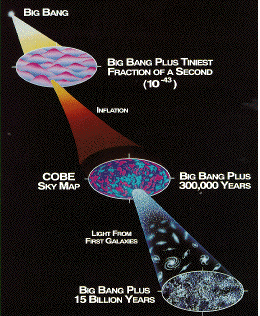
According to astronomers, the Big Bang happened 15 billion years ago. However, the matter of the universe stretches 156 billion light years across. In order for the matter at the edge to have reached its current position, i.e., a radius of 78 billion light years, it would have had to travel at five times the speed of light. According to the accepted physical laws, as explained by Einstein, it is impossible for anything to exceed the speed of light. So, how did that happen?

Thursday, September 30, 2010

Romans 2:14, the Law Written in Our Hearts


"For when Gentiles, who do not have the law, by nature do what the law requires, they are a law to themselves, even though they do not have the law."

To my mind, one of the strongest evidences that Man is a special creation of God is morality. We do not talk about morality in animals, because it requires a choice and a value system, which only humans have. Paul talks about that inherent morality in the verse above. Even those who have never seen or heard the Law of God have an inner voice that speaks to them on certain fundamental moral standards.


The first objection that comes to mind is those individuals who commit the most horrific acts, seemingly with no twinge of conscience. Ted Bundy, Jeffrey Dahmer, and John Wayne Gacy come to mind (pictured here, proceeding from bottom to top). What of the pillaging of the Vikings or the predations of cannibals? And in our own time, there seems to be a rising number of amoral individuals who prey on their neighbors like wolves among sheep. Do these not indicate that morality is only learned from the threats of outside punishment?


I thought about that question. It certainly seems to be a strong rebuttal. However, a thought occurred to me: even the most hardened gang member, child molester, or schoolyard bully, while he may have no twinge of conscience for abusing his victim, certainly would claim to be wronged if those actions were perpetrated against him. That indicates that he does have a moral conscience; he merely exempts himself from it. He certainly understands what is moral for everyone else.

Wednesday, September 29, 2010

A Logical Deadend for Evolutionism


A fundamental assumption of secular science is uniformitarianism, i.e., the expectation that the way things work at one point in time will be the same at another point. However, I notice that scientists only apply it when it serves their purposes, and ignore it when it works against them.

The main example that comes to mind is the supposed spontaneous beginning of life. If a random collection of chemicals can spontaneously become capable of self-replication, why can those same chemicals not do so repeatedly? That is, if life arose spontaneously at one place and one point in time, why did it never again do so at another place at another time? Shouldn't it be a continuous process, with new cells popping up every epoch?

If human sapience is the result of evolutionary pressures, have those pressures now ceased? Logically, that must be so, if sapience never developed again. And why just in a particular line of primates? Do those evolutionary pressures not apply to felines or canines or reptiles? In fact, that last creates a real problem for evolution, to my mind. If birds are the remnants of the class of dinosaurs known as raptors, as is the dominant theory, then their advanced forms have been around millions of years longer than have the higher mammals. Why did sapience never develop an ornithoid version?

Here is the issue: the secularist must find a naturalist alternative to Deity. Since that is impossible, he blanks out the holes in his logic and proclaims victory. It reminds me of the little boy playing pirate who vigorously insists that his stick is actually a sabre!