Monday, February 26, 2024

Sin, Human Autonomy, and Practical Atheism

In his famous book, The Existence and Attributes of God, Puritan Stephen Charnock tells us, "By the nonregarding [sic, for "disregarding"]of God, men rush into evil. Pharaoh oppressed Israel because he knew not the Lord. If he did not deny the being of a deity, yet he had such an unworthy notion of God as was inconsistent with the nature of a deity: he, a poor creature, thought himself a match for the Creator." He refers to the passage in Exodus known especially for the account of the ten plagues, as Moses tried to free the Israelites from slavery in Egypt. In that passage, we see comments from Pharaoh like, "Who is the Lord that I should obey His voice and let Israel go?" (Genesis 5:2).

Charnock called this attitude "practical atheism." He notes that Pharaoh never denied the existence of gods, or even of the God. Rather, Pharaoh denied the sovereignty of God, asserting, instead, his personal autonomy from the will and commands of God. That is why Charnock calls Pharaoh's mentality "atheism," because it was a denial, in effect, of the deity, of the Godness, of God. 

This exemplifies, Charnock continues, the attitude behind all the sins of men, whether or not stated explicitly as it was by Pharaoh. It is, in fact, the false promise made by Satan in the Garden, that Adam and Eve would become like gods, deciding for themselves what is good and what is evil (Genesis 3:5). It is as if he told them, "Forget about God and decide for yourselves." And, like Pharaoh long after them, they accepted the promise of Satan. 


Wednesday, October 4, 2023

The Commandments of God in Stone and the Hearts of Men


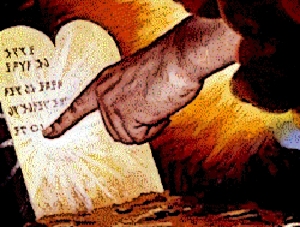
Most people are not aware that God gave Moses the Ten Commandment not once but twice. The first time is described in Exodus 24:12: "The Lord said to Moses, 'Come up to Me on the mountain and wait there, that I may give you the tablets of stone, with the law and the commandment, which I have written for their instruction.'" And again in 31:18: "And He gave to Moses, when He had finished speaking with him on Mount Sinai, the two tablets of the testimony, tablets of stone, written with the finger of God." These tablets were the ones shattered by Moses in anger at the idolatry of the Israelites in their worship of the golden calf (chapter 32).

After shattering the original tablets, Moses was then tasked with replacing them with a new pair of tablets, which he himself fashioned. "The Lord said to Moses, 'Cut for yourself two tablets of stone like the first, and I will write on the tablets the words that were on the first tablets, which you broke'" (Exodus 34:1). As when Adam fell into sin, when Moses broke the commandments, literally, he was cursed with an increase in labor, having to carve and carry the stone tablets himself. 

This historical event came to my mind during a recent Sunday school lesson at my church. Part of that lesson dealt with the law of God written on human hearts. We see this in two places in the New Testament. First, Paul mentions it in Romans 2:15: "[Gentiles] show that the work of the law is written on their hearts, while their conscience also bears witness, and their conflicting thoughts accuse or even excuse them." Then the writer of Hebrews mentions it again as part of the new covenant, which he, in turn, borrowed from the Prophet Jeremiah: "This is the covenant that I will make with them after those days, declares the Lord: I will put My laws on their hearts, and write them on their minds" (Hebrews 10:16, from Jeremiah 31:33). 

Notice the parallels between these two pairs of events. In each, God gave His holy commandments, but they were broken by men. And then God gave them again

By this pairing of breaking and restoration, we see two magnificent things. First is that God does not lower His standards merely because men cannot meet them. To do so would be to betray His own holiness. And second is His mercy. While the breaking of the law naturally incurs the death penalty (Romans 6:23), God's work is restorative, not punitive, for His elect. He restores His law (Isaiah 42:21). And He restores His elect through the imputation by faith of the perfect obedience of His only-begotten Son, Jesus Christ (John 1:17, II Corinthians 5:21, Romans 3:21-22). 

Saturday, September 9, 2023

Lamentations and the Identity of the Whore of the Revelation

In his Revelation, the Apostle John gave us this description: "One of the seven angels who had the seven bowls came and said to me, 'Come, I will show you the judgment of the great prostitute who is seated on many waters, with whom the kings of the earth have committed sexual immorality, and with the wine of whose sexual immorality the dwellers on earth have become drunk.' And he carried me away in the Spirit into a wilderness, and I saw a woman sitting on a scarlet beast that was full of blasphemous names, and it had seven heads and ten horns. The woman was arrayed in purple and scarlet, and adorned with gold and jewels and pearls, holding in her hand a golden cup full of abominations and the impurities of her sexual immorality. And on her forehead was written a name of mystery: 'Babylon the great, mother of prostitutes and of earth's abominations.' And I saw the woman, drunk with the blood of the saints, the blood of the martyrs of Jesus. When I saw her, I marveled greatly" (Revelation 17:1-6). 

This woman is identified in various ways, according to the interpretive system of the interpreter. Futurists may take the reference to Babylon literally, and claim that it refers to a future restoration of the city of Babylon. Others take it as a coded reference to Rome, and claim that there will be a future restoration of the Roman Empire. And yet others believe it refers to Rome, but in her ecclesiastical manifestation, rather than political. Even the Westminster Confession, to which I hold, identifies the Papacy as the Anti-Christ, and head of the great Whore. 

In contrast, those who hold that the Revelation refers to events in John's time, either in part, as I do, or in its whole. We hold that Babylon is used as a code word, not for Rome, but for unbelieving Jerusalem. And in this post, I wish to point the reader to an Old Testament parallel which supports that interpretation. 

Let us look at a series on verses in the Book of lamentations, which was written by the Prophet Jeremiah to mourn the destruction of Jerusalem by the Babylonians

"How lonely sits the city that was full of people! How like a widow has she become, she who was great among the nations! She who was a princess among the provinces has become a slave!...Jerusalem sinned grievously; therefore, she became filthy; all who honored her despise her, for they have seen her nakedness; she herself groans and turns her face away. Her uncleanness was in her skirts; she took no thought of her future; therefore, her fall is terrible; she has no comforter. 'O Lord, behold my affliction , for the enemy has triumphed!'... Zion stretches out her hands, but there is none to comfort her; the Lord has commanded against Jacob that his neighbors should be his foes; Jerusalem has become a filthy thing among them...'I called to my lovers, but they deceived me; my priests and elders perished in the city, while they sought food to revive their strength'... All who pass along the way clap their hands at you; they hiss and wag their heads at the daughter of Jerusalem: 'Is this the city that was called the perfection of beauty, the joy of all the earth?'" (Lamentations 1:1, 8-9, 17, 19; 2:15). 

Read the rest of the passages to get proper context. However, what I have quoted here is plainly parallel. The Holy Spirit inspired John to see the destruction of Jerusalem by the Babylonians as a preview of the soon-coming destruction by the Romans in 70AD. He even mentioned Babylon in the passage to reinforce the parallel! 


Wednesday, August 9, 2023

Wicked America in Scripture

"Your prophets have seen for you false and deceptive visions; they have not exposed your iniquity to restore your fortunes, but have seen for you oracles that are false and misleading." - Lamentations 2:14 

As I read this verse again recently, I was struck by how well it describes today's America. Ours is a country in which an overwhelming majority of the people describe ourselves as Christians. Yet immorality is rampant, and our government is progressing further and further into fascism. How can these things coexist with that Christian profession? 

When Europeans first colonized our continent, they brought with them a vigorous and all-encompassing faith. the settlers on the Mayflower signed a compact, an early form of constitution, committing themselves and their new colony to the glory of God. Later, the Puritans of the New England colonies built their laws on the Scriptures, conscientiously establishing a society which practiced the justice of God. 

Yet, now, we their descendants look on a country which celebrates "pride" in the very things which were crimes in those days. And their church-centered communities have evolved into a society in which naming the name of Christ is considered to be a sign of fanaticism. 

The answer is seen above, spoken to Israel an estimated twenty-six centuries ago. Due to liberalism, dispensationalism, and pietism, our clergy have turned silent about the sins of our culture. Instead, they preach nice things, uncontroversial things, inoffensive things. There is little talk of sin, except to criticize those who still speak biblically. The sin is no longer the wicked acts of men, but rather the wicked act of pointing out the wickedness. 

Ancient Israel was punished for her apostasy by the destruction and exile perpetrated by the Babylonians. What is the judgment waiting for America? 


Saturday, May 27, 2023

The Scriptures as the Basis of Our Apologetic

 Psalm 119 is the longest chapter in the Bible, with 176 verses. Of those verses, only three don't contain a word referring to the scriptures, such as law, commandments, or testimonies. The Psalm is 176 references to the benefits of God's Word in the life of the believer. I will focus on the section labeled "Waw," verses 41-48. 

"Let Your steadfast love come to me, O Lord, Your salvation according to Your promise; then shall I have an answer for him who taunts me, for I trust in your Word. And take not the word of truth utterly out of my mouth, for my hope is in Your rules. I will keep Your law continually, forever and ever, and I shall walk in a wide place, for I have sought your precepts. I will also speak of Your testimonies before kings and shall not be put to shame, for I find my delight in Your commandments, which I love. I will lift up my hands toward Your commandments, which I love, and I will mediate on Your statutes" (Psalm 119:41-48).  

The Psalmist here uses the same encouragement that Jesus gave to His disciples: "Behold, I am sending you out as sheep in the midst of wolves, so be wise as serpents and innocent as doves. Beware of men, for they will deliver you over to courts and flog you in the synagogues, and you will be dragged before governors and kings for My sake, to bear witness before them and the Gentiles. When they deliver you over, do not be anxious how you are to speak or what you are to say, for what you are to say will be given to you in that hour. For it not you who speak, but the Spirit of your Father speaking through you" (Matthew 10:16-20). 

In both passages, it is the source of our answers that should give us confidence, because it is the very Word of God, inspired  by the Holy Spirit. The rest of Psalm 119 relays the means to this end, the constant study of, and obedience to, the Word of God. 

What is often forgotten in our apologetical confrontations is that there is no promise in Scripture that God will give success to our clever response. Rather, He promises His power to attend His word: "So shall My word be, that goes out from My mouth; it shall not return to Me empty, but it shall accomplish that which I purpose, and shall succeed in the thing for which I sent it" (Isaiah 55:11). 


Wednesday, May 24, 2023

Is Rape a Justification for Abortion?

Rape is a horrible crime. Not only does it violate the physical wholeness of the victim, but it is also an assault on her mental wholeness. It often causes an unjustified sense of shame, and it always deprives her of a sense of security, especially around men. Some people claim that those consequences justify making rape an exception to the immorality of rape. Doesn't that baby cause the mother continuing emotional damage from the attack? 

And a moral person can agree with that statement. A baby resulting from rape is a constant physical reminder of the worst experience most people can imagine. However, the question of whether that justifies aborting the baby is a step beyond sympathy. 

"Fathers shall not be put to death because of their children, nor shall children be put to death because of their fathers. Each one shall be put to death for his own sin" (Deuteronomy 24:16). 

This verse is an expression of God's justice, one with which most people would otherwise agree. Contrary to the custom in the ancient world, no person is responsible for the criminal act of his kin. In the example before us, that applies to the child of a rapist. No one claims that there is any moral culpability in the child from the circumstances of his conception. It is the father alone who should receive the legal penalty for the crime of rape. 

Therefore, from the perspective of God, rape is no justification for the additional act of violence against an innocent preborn child. This would apply as well to babies conceived by incest. 


Saturday, May 6, 2023

God's Judgment on Abortion

"They [i. e., Israel] served their idols, which became a snare to them. They sacrificed their sons and daughters to the demons; they poured out innocent blood, the blood of their sons and daughters, whom they sacrificed to the idols of Canaan, and the land was polluted with blood" (Psalm 106:36-38).

I have been reading of  "progressive Christians" who claim that the Bible says nothing about abortion. Yet here we have God's wrath spoken against the sacrifice of the children of Israel to pagan deities. If that is not the essence of abortion, I don't know how we could put it more clearly. 

Are Americans not aborting our sons and daughters as sacrifices to something - the universe, maybe - as an act of worship in exchange for prosperity? Our jobs will be better, we will have more money, we will avoid embarrassment, however we justify it. It is that paganism which is judged by God, because it is the shedding of blood - innocent blood - as an exchange for personal prosperity, the ultimate act of self-involvement!